

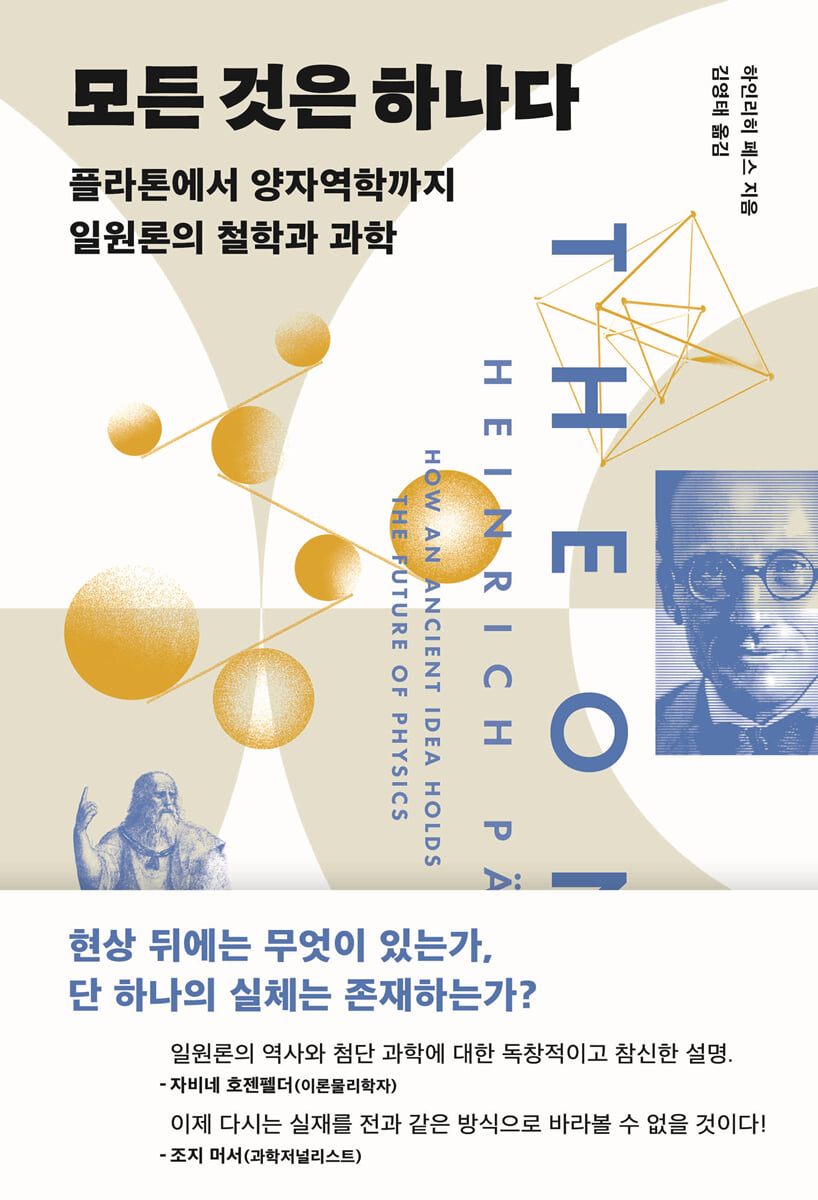
Everything is one
 |
Description
Book Introduction
Does everything arise from one reality?
Answering the oldest questions surrounding the universe and existence!
Is there a single reality underlying everything in the universe, from pebbles and cats to stars and galaxies? A growing number of physicists are agreeing with this interpretation of quantum mechanics.
"All Is One," written by a German particle physicist, points out that the cutting-edge scientific theory of quantum mechanics and the conclusions of monistic philosophy, which is as old as human history, are consistent.
This book examines the birth of quantum mechanics, the debate surrounding the reality of the quantum world, and the characteristics of the fundamental reality called the "entangled quantum universe." It also revisits the history of monism, which was rejected as mystical and persecuted as heresy, yet stubbornly survived and inspired the modern scientific revolution.
From Pythagoras and Plato to Bruno and Spinoza, from Copernicus to Newton and Einstein, what contribution has monism made to the advancement of philosophy and science, and why has it remained taboo for so long? How does cutting-edge quantum mechanics, which asserts a single, entangled quantum reality, connect with monism, and what new breakthroughs can it offer to modern physics, mired in reductionism and obsession with ever-smaller particles? "All Is One" takes readers on a grand journey of thought, exploring the nature of the universe and reality that has captivated humanity for millennia, traversing philosophy, science, and the history of thought.
Answering the oldest questions surrounding the universe and existence!
Is there a single reality underlying everything in the universe, from pebbles and cats to stars and galaxies? A growing number of physicists are agreeing with this interpretation of quantum mechanics.
"All Is One," written by a German particle physicist, points out that the cutting-edge scientific theory of quantum mechanics and the conclusions of monistic philosophy, which is as old as human history, are consistent.
This book examines the birth of quantum mechanics, the debate surrounding the reality of the quantum world, and the characteristics of the fundamental reality called the "entangled quantum universe." It also revisits the history of monism, which was rejected as mystical and persecuted as heresy, yet stubbornly survived and inspired the modern scientific revolution.
From Pythagoras and Plato to Bruno and Spinoza, from Copernicus to Newton and Einstein, what contribution has monism made to the advancement of philosophy and science, and why has it remained taboo for so long? How does cutting-edge quantum mechanics, which asserts a single, entangled quantum reality, connect with monism, and what new breakthroughs can it offer to modern physics, mired in reductionism and obsession with ever-smaller particles? "All Is One" takes readers on a grand journey of thought, exploring the nature of the universe and reality that has captivated humanity for millennia, traversing philosophy, science, and the history of thought.
- You can preview some of the book's contents.
Preview
index
Introduction: Looking at the Stars
Hidden One
Everything is one
One for all
The fight for one
From science to beauty in one
One of salvation
One that transcends space and time
One with consciousness
Conclusion: The Unknown One
Acknowledgements
Translator's Note
Read more
Glossary of Terms
main
List of references
Search
Hidden One
Everything is one
One for all
The fight for one
From science to beauty in one
One of salvation
One that transcends space and time
One with consciousness
Conclusion: The Unknown One
Acknowledgements
Translator's Note
Read more
Glossary of Terms
main
List of references
Search
Into the book
Particle physicists are trying to find a fundamental description of the universe, a description in which no information is wasted.
But if you take quantum mechanics seriously, what it means at the most fundamental level is that nature cannot be composed of components.
The most basic description of the universe must begin with the universe itself.
--- p.13
Is reality a collection of scenes stored on a projector's lightbulb and a roll of film, or is it the story we see on the screen? Even today, physicists and philosophers are divided on two camps.
The two camps are engaged in a heated debate over precisely this question.
The orthodox "Copenhagen" interpretation of quantum mechanics, supported by Niels Bohr, Werner Heisenberg, and the overwhelming majority of physicists, argues that movie plots constitute reality.
Erwin Schrödinger (at least for a period of time), Wheeler's disciple Hugh Everett, and the German physicist H.
Only a few outcasts, including Dieter Zeh, remained in the 'projector camp' for decades.
However, the views of these renegades are becoming increasingly popular.
--- p.27~29
Entanglement is more than just another bizarre quantum phenomenon.
Entanglement is the underlying principle behind both why quantum mechanics merges the world into one and why we experience this fundamental unity as many separate objects.
At the same time, entanglement is also why we seem to live in classical reality.
Entanglement is—literally—the glue that binds the world together and the creator of the world.
--- p.62
A fundamental single quantum universe not only alleviates the problem of Everett's interpretation being known as "excessive metaphysical baggage" (as Wheeler complained), but it also completely negates this criticism, since such a fundamental reality is not only a single universe, but also a single entity that constitutes matter, space, time, and potentially all possible events and situations.
Not only does there exist only one world, but this one world is everything! While little known, this conclusion of his theory may be Everett's most important legacy.
As Wojciech Zurek asserts, “It was Everett who allowed us to think of the universe as entirely quantum mechanical.” --- p.113
For thousands of years, the official church has tried to ban monistic conceptions of nature and relegate monism to the exclusively religious and extra-secular realm.
From the anonymous philosopher Dionysius, who became a church father, to Eriugena, whose books were banned, and Meister Eckhart, who was convicted of demonic possession, to Cusa, who rose to the highest office in the papacy, and finally to Bruno, who was burned at the stake, the church struggled to appropriate monism in the concept of God on the one hand, and to violently persecute any conflation of God or monism with the natural world on the other.
--- p.195~196
Although not all concepts inspired by the monistic harmony of the universe have proven correct—Kepler's celestial music and Newton's speculations about alchemy are prime examples—Kepler and Newton would not have made their groundbreaking discoveries had they not strived for a harmonious and unified explanation of nature.
Indeed, history has shown that whenever monism flourished, art and science also flourished.
In retrospect, this is not surprising.
Creativity often boils down to discovering previously unknown connections and similarities between things that were previously considered separate domains.
A way of thinking that accepts nature as a single entity is particularly prone to discovering and exploiting such correlations.
--- p.250~251
“Which comes first, the whole or the parts? … Which ultimately comes first: the one ultimate whole or its many ultimate parts?” … The fundamental layer of reality is built not on its components but on the universe itself—not as the sum of its components, but as an entangled quantum state.
… “A monist holds that the whole is superior to the parts, and thus sees the universe as fundamental, with a metaphysical explanation descending from the One.” … At the most fundamental level of description, there is only one object: the quantum universe.
--- p.267
Modern physics does not begin with space and time to explain things in the existing background.
Instead, space and time themselves are considered products of a more fundamental projection reality.
…also, entanglement plays a fundamental role in most scenarios proposing emergent spacetime.
…this ultimately means that there are no longer any individual objects in the universe, but that everything is connected to everything else.
“Adopting entanglement as a world that creates relationships comes at the cost of giving up the possibility of separation.
But those who are ready to take this step will probably have to find in the entanglement the fundamental relationships that make up this world (and perhaps all other possible relationships).” So when space and time disappear, a unified one appears.
--- p.325
Unfortunately, if there is anything more difficult to understand than the origins of space, time, and matter, it is the nature of consciousness.
…according to him [Giulio Tononi], consciousness may arise as a byproduct of a specific type of information processing that is sufficiently complex and highly interconnected, and … Max Tegmark also shares this philosophy.
“I think consciousness is a physical phenomenon that feels non-physical, because consciousness is like a wave or a calculation.” In other words, “I think consciousness is the way information feels when it is processed in a complex way.” --- p.347
I began writing this book because I realized that if “everything is one,” then it no longer made sense to think of the universe as made up of particles.
Rather, the opposite is true.
That is, any collection of particles is merely a particular view of the all-encompassing one.
This viewpoint is tantamount to turning the inquiry into the fundamentals of physics upside down.
If we take the book's arguments to their logical conclusion, physics can only move forward if it builds on quantum cosmology rather than particles or strings.
But if you take quantum mechanics seriously, what it means at the most fundamental level is that nature cannot be composed of components.
The most basic description of the universe must begin with the universe itself.
--- p.13
Is reality a collection of scenes stored on a projector's lightbulb and a roll of film, or is it the story we see on the screen? Even today, physicists and philosophers are divided on two camps.
The two camps are engaged in a heated debate over precisely this question.
The orthodox "Copenhagen" interpretation of quantum mechanics, supported by Niels Bohr, Werner Heisenberg, and the overwhelming majority of physicists, argues that movie plots constitute reality.
Erwin Schrödinger (at least for a period of time), Wheeler's disciple Hugh Everett, and the German physicist H.
Only a few outcasts, including Dieter Zeh, remained in the 'projector camp' for decades.
However, the views of these renegades are becoming increasingly popular.
--- p.27~29
Entanglement is more than just another bizarre quantum phenomenon.
Entanglement is the underlying principle behind both why quantum mechanics merges the world into one and why we experience this fundamental unity as many separate objects.
At the same time, entanglement is also why we seem to live in classical reality.
Entanglement is—literally—the glue that binds the world together and the creator of the world.
--- p.62
A fundamental single quantum universe not only alleviates the problem of Everett's interpretation being known as "excessive metaphysical baggage" (as Wheeler complained), but it also completely negates this criticism, since such a fundamental reality is not only a single universe, but also a single entity that constitutes matter, space, time, and potentially all possible events and situations.
Not only does there exist only one world, but this one world is everything! While little known, this conclusion of his theory may be Everett's most important legacy.
As Wojciech Zurek asserts, “It was Everett who allowed us to think of the universe as entirely quantum mechanical.” --- p.113
For thousands of years, the official church has tried to ban monistic conceptions of nature and relegate monism to the exclusively religious and extra-secular realm.
From the anonymous philosopher Dionysius, who became a church father, to Eriugena, whose books were banned, and Meister Eckhart, who was convicted of demonic possession, to Cusa, who rose to the highest office in the papacy, and finally to Bruno, who was burned at the stake, the church struggled to appropriate monism in the concept of God on the one hand, and to violently persecute any conflation of God or monism with the natural world on the other.
--- p.195~196
Although not all concepts inspired by the monistic harmony of the universe have proven correct—Kepler's celestial music and Newton's speculations about alchemy are prime examples—Kepler and Newton would not have made their groundbreaking discoveries had they not strived for a harmonious and unified explanation of nature.
Indeed, history has shown that whenever monism flourished, art and science also flourished.
In retrospect, this is not surprising.
Creativity often boils down to discovering previously unknown connections and similarities between things that were previously considered separate domains.
A way of thinking that accepts nature as a single entity is particularly prone to discovering and exploiting such correlations.
--- p.250~251
“Which comes first, the whole or the parts? … Which ultimately comes first: the one ultimate whole or its many ultimate parts?” … The fundamental layer of reality is built not on its components but on the universe itself—not as the sum of its components, but as an entangled quantum state.
… “A monist holds that the whole is superior to the parts, and thus sees the universe as fundamental, with a metaphysical explanation descending from the One.” … At the most fundamental level of description, there is only one object: the quantum universe.
--- p.267
Modern physics does not begin with space and time to explain things in the existing background.
Instead, space and time themselves are considered products of a more fundamental projection reality.
…also, entanglement plays a fundamental role in most scenarios proposing emergent spacetime.
…this ultimately means that there are no longer any individual objects in the universe, but that everything is connected to everything else.
“Adopting entanglement as a world that creates relationships comes at the cost of giving up the possibility of separation.
But those who are ready to take this step will probably have to find in the entanglement the fundamental relationships that make up this world (and perhaps all other possible relationships).” So when space and time disappear, a unified one appears.
--- p.325
Unfortunately, if there is anything more difficult to understand than the origins of space, time, and matter, it is the nature of consciousness.
…according to him [Giulio Tononi], consciousness may arise as a byproduct of a specific type of information processing that is sufficiently complex and highly interconnected, and … Max Tegmark also shares this philosophy.
“I think consciousness is a physical phenomenon that feels non-physical, because consciousness is like a wave or a calculation.” In other words, “I think consciousness is the way information feels when it is processed in a complex way.” --- p.347
I began writing this book because I realized that if “everything is one,” then it no longer made sense to think of the universe as made up of particles.
Rather, the opposite is true.
That is, any collection of particles is merely a particular view of the all-encompassing one.
This viewpoint is tantamount to turning the inquiry into the fundamentals of physics upside down.
If we take the book's arguments to their logical conclusion, physics can only move forward if it builds on quantum cosmology rather than particles or strings.
--- p.372
Publisher's Review
The intersection of modern quantum mechanics and ancient monism
The ancient Greek philosopher Heraclitus summarized monism with the words, “In all, one, and in one, all.”
Monism is one of the oldest ideas in human history, having emerged over 3,000 years ago. It is the idea that there is only one all-encompassing entity underlying everything we experience.
This concept, which sounds absurd at first, was long ignored, but a new interpretation of modern quantum mechanics has changed the situation.
Heinrich Pess, a German particle physicist, uses a film analogy to explain the two conflicting interpretations of quantum mechanics.
When a film is projected onto a screen via a projector, where does "reality" reside? Is it the image visible on the screen, or the film roll inside the projector? The Copenhagen interpretation, led by Bohr and Heisenberg, acknowledged only the observable reality on the screen, denying the hidden reality behind the phenomenon.
However, a small number of physicists (Schrödinger, Everett, H.
Dieter Zee and others pushed the idea that the projector and the film roll were real, and that at the most fundamental level there was only one thing in the universe: the universe itself.
Bohr denied the reality of the quantum world, trapped in the framework of positivism that focuses only on what can be observed, but Everett expanded the concept of reality to include everything represented by the equations of quantum mechanics.
There is increasing evidence that quantum mechanics applies not only to the microscopic world of particles but also to the macroscopic world.
If we accept the two core principles of quantum mechanics, entanglement and decoherence, proven through numerous macroscopic quantum experiments, as characteristics of reality, we can see that everything is ultimately one and that everything comes from the one.
'Entanglement' connects everything into one (“from all things one”), and 'breaking' causes everything to branch out from one (“from one all”).
There is a hidden unity behind all phenomena in nature, and the mechanism that allows everything to be integrated into one is called 'entanglement'.
“Entanglement provides the glue that allows quantum mechanics to construct the philosophy of monism, the radical notion that there is only one thing that constitutes everything that exists.” And it is decoherence that explains why we experience many things, even though the world is ultimately one.
The world we experience arises through the decoherence of quantum mechanical waves, and “decoherence explains how a fully quantum universe appears to a local observer.”
Everett's theory is often referred to as the 'many-worlds interpretation', but this is a misunderstanding that was spread by his teacher Wheeler and early advocate DeWitt, who were concerned about Bohr, who dominated the academic world at the time.
As Everett's original paper title suggests, in Everett's theory there is not many worlds, but only one quantum world with a universal wave function.
According to him, physical reality is the wave function of the entire universe itself.
According to Dieter Sze, who established the theory of decoherence, “the only thing that really exists is the quantum state of the entire universe.” “The fundamental thing is the projection reality, which constitutes an entangled ‘quantum universe,’ an all-encompassing single entity.
“Everything else, including matter and particles, is an illusion.”
MIT cosmologist Max Tegmark summarizes this confrontation with the analogy of birds and frogs.
The frog symbolizes the inner observer who lives in this world.
From the frog's perspective, the observer perceives only a very small part of the whole of reality.
They can see their own universe, but due to the process of shattering, they cannot see their parallel copies.
From the frog's perspective, only one Everett branch (i.e., the classical universe we experience) is real.
On the other hand, the bird symbolizes the physicist who looks at the world from the outside.
From the bird's perspective, there is only one wavefunction.
This abstract quantum world, described by an evolving wave function, contains numerous quantum phenomena that cannot be explained by classical mechanics, as well as countless classical parallel worlds that constantly split and merge, but in reality, only one entangled quantum universe exists.
(The quantum world that this book focuses on is not the isolated microcosm that we have experienced so far, but the entire quantum universe that encompasses everything.
Our world of experience is created through breaking from this foundational 'one'.)
Tegmark's contrast of frog perspective versus bird perspective is another version of the author's on-screen reality versus projector reality (or film roll reality), and goes back to Plato's Allegory of the Cave.
Plato contrasted the shadows on the cave wall with the true reality, the Ideas, and while the Copenhagen interpretation is closer to the perspective of the cave prisoner (or the audience in the cinema), Everett and Dieter Zee, among others, support monism, the idea that at the most fundamental level, everything is one.
Is it just a coincidence that the new realist interpretation of quantum mechanics is in line with the conclusions of monism that have persisted since ancient times?
The influence of monistic philosophy on science
The reason why Copenhagen physicists, despite successfully developing quantum mechanics, dismissed the quantum realm as 'unreal' was because it was an all-encompassing unity, a concept that had historically been associated with religion and often equated with God.
To understand how deeply ingrained monism and its rejection are in Western culture, the author traces the history of "Monism? A 3,000-year-old philosophical legacy: celebrated in antiquity, persecuted in the Middle Ages, revived in the Renaissance, and altered in Romanticism."
Pantheistic monism, the belief that God and the world are inseparable, is found in all ancient religions and ideologies, and reached its peak in Plato's philosophy, which spoke of "a single, monistic, unchanging, and eternal reality as fundamental truth."
However, after the Christian church established the concept of God by appropriating Plato's monism, it began to persecute him, claiming that monism, which identifies God with nature, secularizes God (and that if God is everywhere, then there is no need for an exclusive mediator called a priest to contact God).
“Many scientists have also internalized the message the church wants to convey: that monism and nature, or monism and science, do not belong together, and that the hypothesis that ‘everything is one’ is simply not sound science.”
One of the main concerns of this book is to refute these claims and restore monism to science.”
The author examines in detail the ideas of five medieval philosophers who continued the tradition of monism in Europe, where the traditions of ancient Greece had disappeared: Dionysius the Areopagite, Johannes Scotus Eriugena, Meister Eckhart, Nicolaus of Cusa, and Giordano Bruno. He analyzes the revival of monism from Ficino and da Vinci in the Renaissance to Spinoza, Goethe, and Schelling in the modern era, and especially the influence of monism on the modern scientific revolution.
Copernicus, inspired by the works of Plato, became convinced that the Sun, not the Earth, was the center of the planetary system, while Galileo revived the Pythagorean belief that the "book of nature" of the universe was written in the language of mathematics and that the Earth was no different from other celestial bodies.
Kepler studied the regularities of planetary orbits and the "music of the heavens" from the works of Cusanus and Bruno, while Newton, who referenced Plato and Pythagoras throughout his research notes, believed that "gravity is the direct result of the action of a divine force," and that "this all-embracing divine force permeates all things."
The author comments on how monism could directly influence the modern scientific revolution.
“As an inspiration for finding unity and beauty in nature, monism became a catalyst and powerful detonator for scientific creativity.” “It was the monistic tradition inherent in the philosophy of Plato and the Pythagoreans that drove the modern scientific revolution.” “Indeed, history shows that whenever monism flourished, art and science also flourished.
In retrospect, this is not surprising.
Creativity often boils down to discovering previously unknown connections and similarities between things that were previously considered separate domains.
A way of thinking that accepts nature as a single entity is particularly prone to discovering and exploiting such correlations.” So can monism also help modern physics?
The Crisis of Modern Physics and the Breakthrough of Monism
The author, a particle physicist, believes that physics is currently on the wrong track.
The reductionism of today's particle physics, which holds that large things are made up of smaller things (quarks, neutrinos, Higgs particles, etc.), has run into difficulties.
The Standard Model does not properly explain dark matter and dark energy.
Why is the mass of the Higgs boson so small? Why is the amount of dark energy in the universe so small? As we zoom in to ever-smaller distances and higher energies, we lose sight of the whole picture.
In other words, by fragmenting the world, we have lost the link that holds the universe together.
We desperately need new physics beyond the Standard Model.
The crisis in particle physics and cosmology today may be resolved by considering it from a perspective that focuses on the whole rather than the parts.
“If you take quantum mechanics seriously, what it means at the most fundamental level is that nature cannot be composed of components.
"The most fundamental description of the universe must begin with the universe itself." In other words, the most fundamental thing in the universe, the foundation of physics, is nothing other than the universe itself! If the fundamental explanation of the universe is the universe itself, perceived as "one," then this means that science must be based on quantum cosmology.
Today, more and more scientists are rethinking the fundamentals of physics—matter, space, time, and consciousness—from a monistic perspective.
According to them, matter, space and time, and consciousness are not “fundamental properties of the universe, but rather properties of our perspective on the universe.”
“In quantum gravity, the world is fundamentally timeless and does not contain any classical components.
The quantum universe is static.
Nothing happens.
There is existence but no creation.
“The flow and movement of time are illusions.” “Time is undoubtedly a fundamental experience for us, but it is no longer understood as a fundamental property of the universe.
Instead, time is a feature of the eye of the beholder, that is, of our perspective on the universe.” Space, like time and matter, is not fundamental but emerges through disruption.
“Space is a device originally introduced to explain the position and movement of particles.
“So space is literally just a space that stores information.” “Spacetime is… just a geometric picture of how matter is entangled within the quantum system.” “Modern physics does not begin with space and time in order to continue to explain things in the existing background.
Instead, space and time themselves are considered products of a more fundamental projection reality.
“It is the One, the quantum universe, that gives rise to space, time, and matter.”
Scientists differ on what 'one' is.
It could be information (“In the beginning, there were bits”? Seth Lloyd), mathematics (“Reality is mathematics”? Tegmark), or the wave function (“In the beginning, there was the wave function”--Dieter Zeh).
But one thing is clear.
“It no longer makes sense to think of the universe as made up of particles.
It is just a particular point of view on reality.
Physics can only move forward if it builds on quantum cosmology instead of particles or strings.
“Particle physics will remain an important pillar of fundamental physics, but it must be complemented by strengthened research on quantum information and its quantum foundations, as well as cosmology.” And monism provides a new perspective for approaching fundamental questions in particle physics and cosmology, and is the most promising candidate among the principles that define the foundations of current physics, the authors say.
A thrilling mix of fascinating and provocative history, philosophy, and cutting-edge theory.
This dizzying journey into the monistic multiverse excites and captivates us.
-- The Wall Street Journal
Thorough historical research and cutting-edge physics resonate with the author's macroscopic perspective.
Most, or perhaps all, of what we perceive as reality may be a product of our limited perspective.
-- Scientific American
The ancient Greek philosopher Heraclitus summarized monism with the words, “In all, one, and in one, all.”
Monism is one of the oldest ideas in human history, having emerged over 3,000 years ago. It is the idea that there is only one all-encompassing entity underlying everything we experience.
This concept, which sounds absurd at first, was long ignored, but a new interpretation of modern quantum mechanics has changed the situation.
Heinrich Pess, a German particle physicist, uses a film analogy to explain the two conflicting interpretations of quantum mechanics.
When a film is projected onto a screen via a projector, where does "reality" reside? Is it the image visible on the screen, or the film roll inside the projector? The Copenhagen interpretation, led by Bohr and Heisenberg, acknowledged only the observable reality on the screen, denying the hidden reality behind the phenomenon.
However, a small number of physicists (Schrödinger, Everett, H.
Dieter Zee and others pushed the idea that the projector and the film roll were real, and that at the most fundamental level there was only one thing in the universe: the universe itself.
Bohr denied the reality of the quantum world, trapped in the framework of positivism that focuses only on what can be observed, but Everett expanded the concept of reality to include everything represented by the equations of quantum mechanics.
There is increasing evidence that quantum mechanics applies not only to the microscopic world of particles but also to the macroscopic world.
If we accept the two core principles of quantum mechanics, entanglement and decoherence, proven through numerous macroscopic quantum experiments, as characteristics of reality, we can see that everything is ultimately one and that everything comes from the one.
'Entanglement' connects everything into one (“from all things one”), and 'breaking' causes everything to branch out from one (“from one all”).
There is a hidden unity behind all phenomena in nature, and the mechanism that allows everything to be integrated into one is called 'entanglement'.
“Entanglement provides the glue that allows quantum mechanics to construct the philosophy of monism, the radical notion that there is only one thing that constitutes everything that exists.” And it is decoherence that explains why we experience many things, even though the world is ultimately one.
The world we experience arises through the decoherence of quantum mechanical waves, and “decoherence explains how a fully quantum universe appears to a local observer.”
Everett's theory is often referred to as the 'many-worlds interpretation', but this is a misunderstanding that was spread by his teacher Wheeler and early advocate DeWitt, who were concerned about Bohr, who dominated the academic world at the time.
As Everett's original paper title suggests, in Everett's theory there is not many worlds, but only one quantum world with a universal wave function.
According to him, physical reality is the wave function of the entire universe itself.
According to Dieter Sze, who established the theory of decoherence, “the only thing that really exists is the quantum state of the entire universe.” “The fundamental thing is the projection reality, which constitutes an entangled ‘quantum universe,’ an all-encompassing single entity.
“Everything else, including matter and particles, is an illusion.”
MIT cosmologist Max Tegmark summarizes this confrontation with the analogy of birds and frogs.
The frog symbolizes the inner observer who lives in this world.
From the frog's perspective, the observer perceives only a very small part of the whole of reality.
They can see their own universe, but due to the process of shattering, they cannot see their parallel copies.
From the frog's perspective, only one Everett branch (i.e., the classical universe we experience) is real.
On the other hand, the bird symbolizes the physicist who looks at the world from the outside.
From the bird's perspective, there is only one wavefunction.
This abstract quantum world, described by an evolving wave function, contains numerous quantum phenomena that cannot be explained by classical mechanics, as well as countless classical parallel worlds that constantly split and merge, but in reality, only one entangled quantum universe exists.
(The quantum world that this book focuses on is not the isolated microcosm that we have experienced so far, but the entire quantum universe that encompasses everything.
Our world of experience is created through breaking from this foundational 'one'.)
Tegmark's contrast of frog perspective versus bird perspective is another version of the author's on-screen reality versus projector reality (or film roll reality), and goes back to Plato's Allegory of the Cave.
Plato contrasted the shadows on the cave wall with the true reality, the Ideas, and while the Copenhagen interpretation is closer to the perspective of the cave prisoner (or the audience in the cinema), Everett and Dieter Zee, among others, support monism, the idea that at the most fundamental level, everything is one.
Is it just a coincidence that the new realist interpretation of quantum mechanics is in line with the conclusions of monism that have persisted since ancient times?
The influence of monistic philosophy on science
The reason why Copenhagen physicists, despite successfully developing quantum mechanics, dismissed the quantum realm as 'unreal' was because it was an all-encompassing unity, a concept that had historically been associated with religion and often equated with God.
To understand how deeply ingrained monism and its rejection are in Western culture, the author traces the history of "Monism? A 3,000-year-old philosophical legacy: celebrated in antiquity, persecuted in the Middle Ages, revived in the Renaissance, and altered in Romanticism."
Pantheistic monism, the belief that God and the world are inseparable, is found in all ancient religions and ideologies, and reached its peak in Plato's philosophy, which spoke of "a single, monistic, unchanging, and eternal reality as fundamental truth."
However, after the Christian church established the concept of God by appropriating Plato's monism, it began to persecute him, claiming that monism, which identifies God with nature, secularizes God (and that if God is everywhere, then there is no need for an exclusive mediator called a priest to contact God).
“Many scientists have also internalized the message the church wants to convey: that monism and nature, or monism and science, do not belong together, and that the hypothesis that ‘everything is one’ is simply not sound science.”
One of the main concerns of this book is to refute these claims and restore monism to science.”
The author examines in detail the ideas of five medieval philosophers who continued the tradition of monism in Europe, where the traditions of ancient Greece had disappeared: Dionysius the Areopagite, Johannes Scotus Eriugena, Meister Eckhart, Nicolaus of Cusa, and Giordano Bruno. He analyzes the revival of monism from Ficino and da Vinci in the Renaissance to Spinoza, Goethe, and Schelling in the modern era, and especially the influence of monism on the modern scientific revolution.
Copernicus, inspired by the works of Plato, became convinced that the Sun, not the Earth, was the center of the planetary system, while Galileo revived the Pythagorean belief that the "book of nature" of the universe was written in the language of mathematics and that the Earth was no different from other celestial bodies.
Kepler studied the regularities of planetary orbits and the "music of the heavens" from the works of Cusanus and Bruno, while Newton, who referenced Plato and Pythagoras throughout his research notes, believed that "gravity is the direct result of the action of a divine force," and that "this all-embracing divine force permeates all things."
The author comments on how monism could directly influence the modern scientific revolution.
“As an inspiration for finding unity and beauty in nature, monism became a catalyst and powerful detonator for scientific creativity.” “It was the monistic tradition inherent in the philosophy of Plato and the Pythagoreans that drove the modern scientific revolution.” “Indeed, history shows that whenever monism flourished, art and science also flourished.
In retrospect, this is not surprising.
Creativity often boils down to discovering previously unknown connections and similarities between things that were previously considered separate domains.
A way of thinking that accepts nature as a single entity is particularly prone to discovering and exploiting such correlations.” So can monism also help modern physics?
The Crisis of Modern Physics and the Breakthrough of Monism
The author, a particle physicist, believes that physics is currently on the wrong track.
The reductionism of today's particle physics, which holds that large things are made up of smaller things (quarks, neutrinos, Higgs particles, etc.), has run into difficulties.
The Standard Model does not properly explain dark matter and dark energy.
Why is the mass of the Higgs boson so small? Why is the amount of dark energy in the universe so small? As we zoom in to ever-smaller distances and higher energies, we lose sight of the whole picture.
In other words, by fragmenting the world, we have lost the link that holds the universe together.
We desperately need new physics beyond the Standard Model.
The crisis in particle physics and cosmology today may be resolved by considering it from a perspective that focuses on the whole rather than the parts.
“If you take quantum mechanics seriously, what it means at the most fundamental level is that nature cannot be composed of components.
"The most fundamental description of the universe must begin with the universe itself." In other words, the most fundamental thing in the universe, the foundation of physics, is nothing other than the universe itself! If the fundamental explanation of the universe is the universe itself, perceived as "one," then this means that science must be based on quantum cosmology.
Today, more and more scientists are rethinking the fundamentals of physics—matter, space, time, and consciousness—from a monistic perspective.
According to them, matter, space and time, and consciousness are not “fundamental properties of the universe, but rather properties of our perspective on the universe.”
“In quantum gravity, the world is fundamentally timeless and does not contain any classical components.
The quantum universe is static.
Nothing happens.
There is existence but no creation.
“The flow and movement of time are illusions.” “Time is undoubtedly a fundamental experience for us, but it is no longer understood as a fundamental property of the universe.
Instead, time is a feature of the eye of the beholder, that is, of our perspective on the universe.” Space, like time and matter, is not fundamental but emerges through disruption.
“Space is a device originally introduced to explain the position and movement of particles.
“So space is literally just a space that stores information.” “Spacetime is… just a geometric picture of how matter is entangled within the quantum system.” “Modern physics does not begin with space and time in order to continue to explain things in the existing background.
Instead, space and time themselves are considered products of a more fundamental projection reality.
“It is the One, the quantum universe, that gives rise to space, time, and matter.”
Scientists differ on what 'one' is.
It could be information (“In the beginning, there were bits”? Seth Lloyd), mathematics (“Reality is mathematics”? Tegmark), or the wave function (“In the beginning, there was the wave function”--Dieter Zeh).
But one thing is clear.
“It no longer makes sense to think of the universe as made up of particles.
It is just a particular point of view on reality.
Physics can only move forward if it builds on quantum cosmology instead of particles or strings.
“Particle physics will remain an important pillar of fundamental physics, but it must be complemented by strengthened research on quantum information and its quantum foundations, as well as cosmology.” And monism provides a new perspective for approaching fundamental questions in particle physics and cosmology, and is the most promising candidate among the principles that define the foundations of current physics, the authors say.
A thrilling mix of fascinating and provocative history, philosophy, and cutting-edge theory.
This dizzying journey into the monistic multiverse excites and captivates us.
-- The Wall Street Journal
Thorough historical research and cutting-edge physics resonate with the author's macroscopic perspective.
Most, or perhaps all, of what we perceive as reality may be a product of our limited perspective.
-- Scientific American
GOODS SPECIFICS
- Date of issue: August 29, 2025
- Page count, weight, size: 452 pages | 750g | 150*220*26mm
- ISBN13: 9791166893704
- ISBN10: 1166893707
You may also like
카테고리
korean


korean

![GQ KOREA Mark (Monthly): December [2025]](http://librairie.coreenne.fr/cdn/shop/files/8ef265dbbfbf186523ed75ba7319009d.jpg?v=1765340328&width=3840)


