

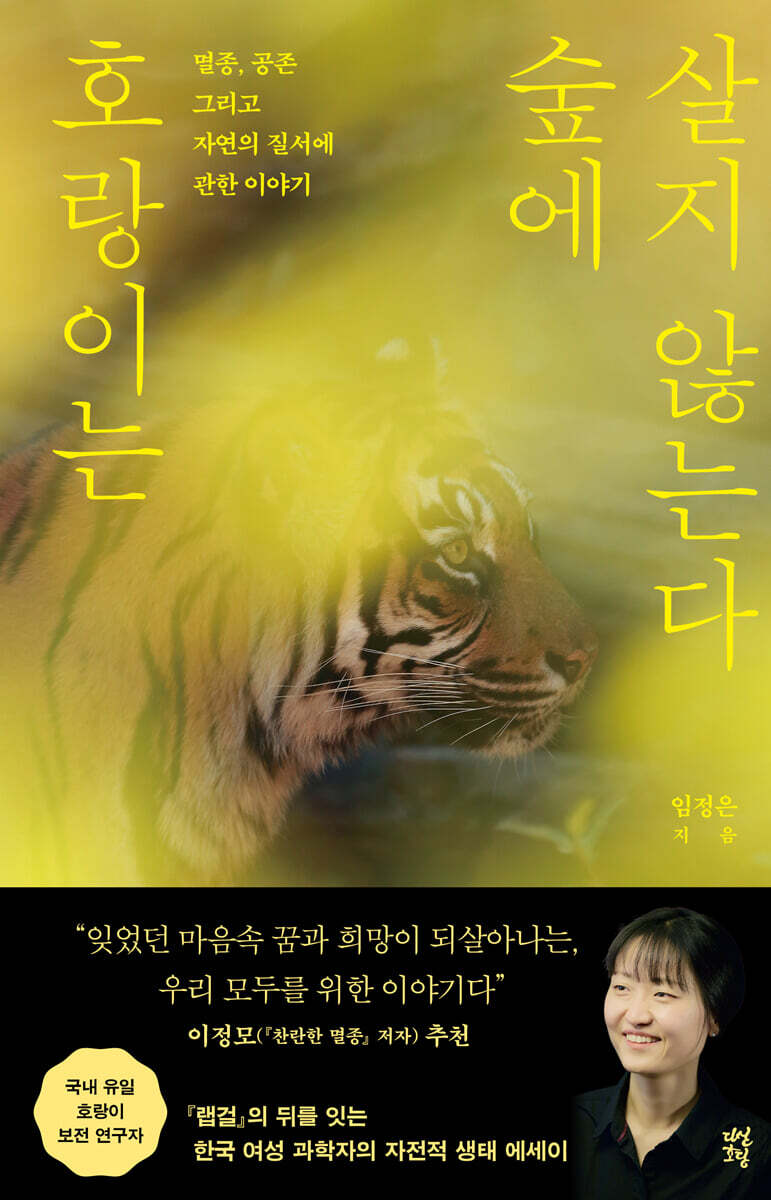
Tigers don't live in the forest.
 |
Description
Book Introduction
An autobiographical ecological essay by a Korean female scientist, following in the footsteps of "Lab Girl."
“The dreams and hopes in my heart that I had forgotten are coming back to life,
“It’s a story for all of us.”
Until a century ago, this land was so teeming with tigers that it could be called the "Land of the Tiger."
But now, they can no longer be found in any forest or mountain.
A college student who fell in love with a leopard at first sight at a zoo he happened to visit thought that someone must take responsibility for the sad reality of the Korean Peninsula.
In this way, he pioneered a path as a conservation biologist, which was unprecedented in Korea.
This book is the first essay by Lim Jeong-eun, a conservation biologist who has become Korea's only tiger researcher. It contains the story of her intense journey to find ways for humans and animals to coexist while traveling to sites around the world to confront biodiversity and climate crises.
The essence of conservation biology, the author argues, is 'fighting against the complexity and uncertainty of reality.'
While some are pessimistic that the ecological crisis is already beyond human control, the author argues that there is still work to be done.
This book is a story of growth for a woman who has faced cynicism and doubt, and a story of a scientist's struggle to explore the natural order that sustains us through invisible connections.
So, as former Director of the National Science Museum in Gwacheon, Lee Jeong-mo, said in his recommendation, “This book is not simply a record of the conservation of tigers and leopards, nor is it a story solely about endangered species.” The author’s story, crafted through enduring lonely times, will offer bright hope to those who seem to have lost their way in life, and warm comfort and clear courage to those frustrated in the face of a global crisis.
“The dreams and hopes in my heart that I had forgotten are coming back to life,
“It’s a story for all of us.”
Until a century ago, this land was so teeming with tigers that it could be called the "Land of the Tiger."
But now, they can no longer be found in any forest or mountain.
A college student who fell in love with a leopard at first sight at a zoo he happened to visit thought that someone must take responsibility for the sad reality of the Korean Peninsula.
In this way, he pioneered a path as a conservation biologist, which was unprecedented in Korea.
This book is the first essay by Lim Jeong-eun, a conservation biologist who has become Korea's only tiger researcher. It contains the story of her intense journey to find ways for humans and animals to coexist while traveling to sites around the world to confront biodiversity and climate crises.
The essence of conservation biology, the author argues, is 'fighting against the complexity and uncertainty of reality.'
While some are pessimistic that the ecological crisis is already beyond human control, the author argues that there is still work to be done.
This book is a story of growth for a woman who has faced cynicism and doubt, and a story of a scientist's struggle to explore the natural order that sustains us through invisible connections.
So, as former Director of the National Science Museum in Gwacheon, Lee Jeong-mo, said in his recommendation, “This book is not simply a record of the conservation of tigers and leopards, nor is it a story solely about endangered species.” The author’s story, crafted through enduring lonely times, will offer bright hope to those who seem to have lost their way in life, and warm comfort and clear courage to those frustrated in the face of a global crisis.
- You can preview some of the book's contents.
Preview
index
Prologue: Deciding to Walk the Path Without Footprints
Chapter 1: Urban Conservation Biologists
―Following the traces of a vanished being
There was an animal there
Decide to walk with the tiger
Conservation biologist Lim Jeong-eun, not the second Jane Goodall
What does the number 282 mean?
A mind that will not go extinct
Chapter 2: The Echoes Left Behind by the Tiger
-How do we connect with them?
The disappearance of Korean tigers
Tiger Chasers
Another forgotten crime
Humane Reasons Why Gorani and Lynx Shouldn't Be Extinct
Animals have no borders
Chapter 3: Conservation Biologists in the Forest
―Bringing together different hearts
| Project 1 | Indonesia
Displaced Rhinos and Outlaws
| Project 2 | Belize
The long-time owner of the sea
Unpaid workers on the fourth floor of the Chrysler Building
| Project 3 | China
People who hate the tiger that kills our cow
An American spy hiding in Hunchun?
A proposal accepted after twenty-one attempts
| Project 4 | Laos
Tracking tiger tracks in Laos
Between reality and the ideal of conservation
The courage to stop once
| Project 5 | Korea and Russia
First encounter with the DMZ
Finally reunited with the leopard
First love with a herbivore
Greetings to the 'Red' cat
Chapter 4: A Long Walk Together
―On the courage to move forward while wavering
My little stepping stone
How can we live together?
Things Everyone Can Do for the Earth
The steep slope of conservation biology
A life that loves recklessness
Chapter 1: Urban Conservation Biologists
―Following the traces of a vanished being
There was an animal there
Decide to walk with the tiger
Conservation biologist Lim Jeong-eun, not the second Jane Goodall
What does the number 282 mean?
A mind that will not go extinct
Chapter 2: The Echoes Left Behind by the Tiger
-How do we connect with them?
The disappearance of Korean tigers
Tiger Chasers
Another forgotten crime
Humane Reasons Why Gorani and Lynx Shouldn't Be Extinct
Animals have no borders
Chapter 3: Conservation Biologists in the Forest
―Bringing together different hearts
| Project 1 | Indonesia
Displaced Rhinos and Outlaws
| Project 2 | Belize
The long-time owner of the sea
Unpaid workers on the fourth floor of the Chrysler Building
| Project 3 | China
People who hate the tiger that kills our cow
An American spy hiding in Hunchun?
A proposal accepted after twenty-one attempts
| Project 4 | Laos
Tracking tiger tracks in Laos
Between reality and the ideal of conservation
The courage to stop once
| Project 5 | Korea and Russia
First encounter with the DMZ
Finally reunited with the leopard
First love with a herbivore
Greetings to the 'Red' cat
Chapter 4: A Long Walk Together
―On the courage to move forward while wavering
My little stepping stone
How can we live together?
Things Everyone Can Do for the Earth
The steep slope of conservation biology
A life that loves recklessness
Detailed image

Into the book
In this wildfire, the damage to animals has received unusually significant media attention.
During the hasty evacuation, guardians were forced to leave without releasing the animals' leashes, resulting in the tragic deaths of some animals, including those who were burned or starved to death.
But the scars left by wildfires aren't limited to just visible damage.
This is because the entire ecosystem, including soil, water quality, microorganisms, insects, and plants, is affected by forest fires.
It is our scientists' job to investigate how much damage each species has suffered and how much habitat has been lost.
--- p.21 "There Was an Animal There"
"What are those noble eyes and elegant gestures? How can they be so cool?"
At the age of twenty-one, these were the words I blurted out without realizing it during my brief but intense first encounter with an Amur leopard that changed the course of my life.
(…) The sad story of the leopard, which once inhabited the entire Korean Peninsula, becoming the world's most critically endangered big cat, barely surviving in the border areas of North Korea, China, and Russia, captivated me like the wild animal stories from "Animal Kingdom" I used to watch as a child.
--- p.26~27 "Decided to Walk with a Criminal"
Coexistence with humans is just as important as conservation and restoration of endangered species.
Although this part is not particularly well known, coexistence is the next step in restoration and another key challenge.
Even if restoration is successful, populations increase, and genetic diversity is stably secured, this means that problems remain to be solved.
--- p.43 "What the Number 282 Means"
Tiger hunting appears to have continued in North Korea until the 1970s.
Their most recent record of a tiger is a footprint found on Mount Baekdu in 1998.
As information about the reality of North Korea is difficult to obtain, all kinds of speculations surround the tiger.
However, in 2019, Sergei Aramilev, director of Russia's Amur Tiger Center, revealed that there were estimated to be around 20 tigers remaining in North Korea, raising hopes that tigers may not have completely disappeared from the Korean Peninsula.
--- p.65 "The Vanished Korean Tiger"
When marine ecosystems are devastated, people who work in the fishing and tourism industries in coral reef areas are affected, and the decline in marine resources leads to food shortages.
Moreover, coral reefs act as 'natural breakwaters' that absorb and disperse wave energy, so their disappearance threatens the living environment of nearby residents.
When tropical storms such as typhoons occur, coastal erosion becomes more severe, causing damage such as roads and farmland being submerged or washed away by seawater.
The collapse of the ecosystem caused by the destruction of biodiversity will inevitably have an impact on humans.
--- p.85 "Humane Reasons Why Gorani and Lynx Should Not Disappear"
Residents were grazing cattle within the tiger reserve.
At that time, the price of a cow was so expensive that it amounted to one-third of their annual income.
(…) However, they were angry at the tigers, letting the cows loose in the area where the tigers were, citing the ridiculous reason that they could not bring the cows near their houses because they would damage the crops.
This was the way of life that had sustained them for a long time.
(…) Things that were so unfamiliar and incomprehensible to me were common sense to them.
We had to start by clearing up those common sense and misunderstandings.
--- p.156~157 "People Who Hate the Tiger That Killed Our Cow"
Faced with such a desperate reality, conservation biologists often joke, with a hint of self-deprecation, that “we are fighting a losing battle.”
But no matter how much I feel like I'm going to lose in a fight, I don't want to give up easily.
I hear that the economic sense of the villagers has improved a lot compared to before.
Maybe now is the time to try a new method.
Some of us will once again take on new challenges.
--- p.216 "Between Reality and the Ideal of Preservation"
Despite being the subject of countless doubts and skepticism, the reason I continue on this path is because the process of fulfilling my mission as a scientist is itself satisfying.
Above all, there is an active life that only field scientists can enjoy.
The experiences I gain from working in the field are accumulated as my knowledge and capabilities.
Changeable factors such as climate, race, culture, and institutions make this discipline dynamic and constantly pose new questions to researchers.
The process of pursuing that question is the greatest joy to me.
During the hasty evacuation, guardians were forced to leave without releasing the animals' leashes, resulting in the tragic deaths of some animals, including those who were burned or starved to death.
But the scars left by wildfires aren't limited to just visible damage.
This is because the entire ecosystem, including soil, water quality, microorganisms, insects, and plants, is affected by forest fires.
It is our scientists' job to investigate how much damage each species has suffered and how much habitat has been lost.
--- p.21 "There Was an Animal There"
"What are those noble eyes and elegant gestures? How can they be so cool?"
At the age of twenty-one, these were the words I blurted out without realizing it during my brief but intense first encounter with an Amur leopard that changed the course of my life.
(…) The sad story of the leopard, which once inhabited the entire Korean Peninsula, becoming the world's most critically endangered big cat, barely surviving in the border areas of North Korea, China, and Russia, captivated me like the wild animal stories from "Animal Kingdom" I used to watch as a child.
--- p.26~27 "Decided to Walk with a Criminal"
Coexistence with humans is just as important as conservation and restoration of endangered species.
Although this part is not particularly well known, coexistence is the next step in restoration and another key challenge.
Even if restoration is successful, populations increase, and genetic diversity is stably secured, this means that problems remain to be solved.
--- p.43 "What the Number 282 Means"
Tiger hunting appears to have continued in North Korea until the 1970s.
Their most recent record of a tiger is a footprint found on Mount Baekdu in 1998.
As information about the reality of North Korea is difficult to obtain, all kinds of speculations surround the tiger.
However, in 2019, Sergei Aramilev, director of Russia's Amur Tiger Center, revealed that there were estimated to be around 20 tigers remaining in North Korea, raising hopes that tigers may not have completely disappeared from the Korean Peninsula.
--- p.65 "The Vanished Korean Tiger"
When marine ecosystems are devastated, people who work in the fishing and tourism industries in coral reef areas are affected, and the decline in marine resources leads to food shortages.
Moreover, coral reefs act as 'natural breakwaters' that absorb and disperse wave energy, so their disappearance threatens the living environment of nearby residents.
When tropical storms such as typhoons occur, coastal erosion becomes more severe, causing damage such as roads and farmland being submerged or washed away by seawater.
The collapse of the ecosystem caused by the destruction of biodiversity will inevitably have an impact on humans.
--- p.85 "Humane Reasons Why Gorani and Lynx Should Not Disappear"
Residents were grazing cattle within the tiger reserve.
At that time, the price of a cow was so expensive that it amounted to one-third of their annual income.
(…) However, they were angry at the tigers, letting the cows loose in the area where the tigers were, citing the ridiculous reason that they could not bring the cows near their houses because they would damage the crops.
This was the way of life that had sustained them for a long time.
(…) Things that were so unfamiliar and incomprehensible to me were common sense to them.
We had to start by clearing up those common sense and misunderstandings.
--- p.156~157 "People Who Hate the Tiger That Killed Our Cow"
Faced with such a desperate reality, conservation biologists often joke, with a hint of self-deprecation, that “we are fighting a losing battle.”
But no matter how much I feel like I'm going to lose in a fight, I don't want to give up easily.
I hear that the economic sense of the villagers has improved a lot compared to before.
Maybe now is the time to try a new method.
Some of us will once again take on new challenges.
--- p.216 "Between Reality and the Ideal of Preservation"
Despite being the subject of countless doubts and skepticism, the reason I continue on this path is because the process of fulfilling my mission as a scientist is itself satisfying.
Above all, there is an active life that only field scientists can enjoy.
The experiences I gain from working in the field are accumulated as my knowledge and capabilities.
Changeable factors such as climate, race, culture, and institutions make this discipline dynamic and constantly pose new questions to researchers.
The process of pursuing that question is the greatest joy to me.
--- p.306 "The Steep Road of Conservation Biology"
Publisher's Review
★★★ Highly recommended by Lee Jeong-mo (author of “Splendid Extinction”)!
★★★Korea's only tiger conservation researcher
★★★ Author featured on EBS's "Hobby is Science"
“The task of reviving the lost tiger
“Could it be that we can save ourselves?”
A bioengineering student who loved 'tigers',
Jump into the science of coexistence to protect vanishing lives.
We are now in the age of the sixth mass extinction.
Humans' distorted perception, ignorance, and greed have had a huge impact on the disappearance of 73 percent of the world's animals over the past 50 years.
And its influence is returning to humans in the name of the 'biodiversity crisis'.
However, 'conservation biology', the discipline that protects and manages the disappearing species, habitats, and ecosystems of the Earth, is still a wasteland in Korea.
About 20 years ago, a college student who didn't know how to do anything just flipped through Nature and fearlessly went to study abroad in England, following a British professor who had written a paper on 'ecological conservation.'
It was the beginning of Lim Jeong-eun's journey to become a 'conservation biologist'.
This book contains scientific knowledge about tigers, "Koreans' most beloved mammal," and the biodiversity and climate crises that threaten all of humanity, but it doesn't simply list information.
The story continues through the author's adventurous experiences as she grew from a girl who cried over animal stories in "Seton's Animal Chronicles" to the only tiger researcher in Korea.
He was a foreigner in his early twenties, from a country that didn't have tigers, a woman in science who "don't remember women's achievements."
Above all, there was no one nearby who left footprints for him to follow.
I had to find and grasp all the means and methods from start to finish.
It was for one goal: to ‘protect the disappearing beings.’
So this book is a story about the closest science to us, life, and about one man's reckless and bold dreams and challenges.
“Life is something that can only continue if you hold hands.
Science taught me”
Displaced wild animals and people who have become illegal,
A kind scientist among them
The author initially wanted to become an ecologist studying animal ecology like Jane Goodall, but as she continued her studies, she came to realize the importance of resolving conflicts between humans and wild animals.
No matter how plausible the solution or how painstakingly constructed the protected area was, it could not solve the problem if people did not accept it.
This is the issue of 'coexistence' that goes beyond 'conservation' and is the focus of conservation biology.
So the author traveled around the world in search of areas where wild animals and humans are in conflict.
I've hunted rhinos in Indonesia, marine life in Belize, and tigers in China and Laos.
On one side were people who had to make a living, and on the other side were plants and animals that were pushed out by those people.
Forcing sacrifices on one side was not sustainable.
His role was to create a loop of compromise, coordination, and dialogue between them.
As if to mock his passion, failure always followed his efforts.
Although it is the job of a scientist to repeat failures, he could never get used to failure because his own failure meant the permanent disappearance of a species from the Earth.
The only way was to learn how to be brave again, even if I failed.
Wandering through remote areas and jungles with no food, water, or toilets, they were repeatedly turned away by the locals who were hostile to animals.
He also made sarcastic remarks such as, "Are you fighting your own kind to save one more tiger?" and "Can you even call that science?"
To those who ask why he goes to such lengths for the tigers, he replies that this work is by no means solely for the tigers.
Protecting tigers is protecting the vegetation of the mountains and fields, protecting herbivores and birds, and ultimately protecting ourselves as part of nature.
So, every time the author failed in a challenge, and every time he realized that failure was inevitable, he quietly picked himself up with the belief that 'someone is doing what needs to be done for the Earth.'
“If you know, you will love.
“If you love, you can live together.”
A story about choosing slow hope over easy despair.
Here and now, what we can do for them
Today, the economic value of biodiversity and the services it provides reaches $140 trillion annually.
Even if we don't realize it, we already depend heavily on biodiversity to survive.
Yet, public interest in biodiversity remains low.
Government and corporate attention is also focused on climate change.
This book addresses the specific issues of the biodiversity crisis and shows the current state of the Earth's ecosystem today.
And instead of easy despair, it speaks of slow-moving hope.
It shows the progress of the efforts of conservation biologists over the past 50 years.
The resulting changes are already beginning to take place around the world.
Listening to this cheerful scientist's story, readers gain an understanding of the unfamiliar world of endangered species.
And we naturally come to realize that the land we use is home not only to people but also to wild animals.
While science and technology are necessary for the restoration of endangered species, coexistence requires the support of human will and generosity.
In particular, the author argues that coexistence with wild animals requires genuine interest that goes beyond simple curiosity.
The 'sincere concern' he speaks of is not something grandiose.
It is about recognizing that the ecological crisis is a problem for our entire community and respecting wildlife as inherent members of the ecosystem.
The author has quietly practiced this belief and love in his life and in his work called science.
This is why his journey is not just one person's life story, but the story of us all.
His story will reconnect us with animals that once seemed unfamiliar, and remind us of the values of consideration, solidarity, circulation, and coexistence.
★★★Korea's only tiger conservation researcher
★★★ Author featured on EBS's "Hobby is Science"
“The task of reviving the lost tiger
“Could it be that we can save ourselves?”
A bioengineering student who loved 'tigers',
Jump into the science of coexistence to protect vanishing lives.
We are now in the age of the sixth mass extinction.
Humans' distorted perception, ignorance, and greed have had a huge impact on the disappearance of 73 percent of the world's animals over the past 50 years.
And its influence is returning to humans in the name of the 'biodiversity crisis'.
However, 'conservation biology', the discipline that protects and manages the disappearing species, habitats, and ecosystems of the Earth, is still a wasteland in Korea.
About 20 years ago, a college student who didn't know how to do anything just flipped through Nature and fearlessly went to study abroad in England, following a British professor who had written a paper on 'ecological conservation.'
It was the beginning of Lim Jeong-eun's journey to become a 'conservation biologist'.
This book contains scientific knowledge about tigers, "Koreans' most beloved mammal," and the biodiversity and climate crises that threaten all of humanity, but it doesn't simply list information.
The story continues through the author's adventurous experiences as she grew from a girl who cried over animal stories in "Seton's Animal Chronicles" to the only tiger researcher in Korea.
He was a foreigner in his early twenties, from a country that didn't have tigers, a woman in science who "don't remember women's achievements."
Above all, there was no one nearby who left footprints for him to follow.
I had to find and grasp all the means and methods from start to finish.
It was for one goal: to ‘protect the disappearing beings.’
So this book is a story about the closest science to us, life, and about one man's reckless and bold dreams and challenges.
“Life is something that can only continue if you hold hands.
Science taught me”
Displaced wild animals and people who have become illegal,
A kind scientist among them
The author initially wanted to become an ecologist studying animal ecology like Jane Goodall, but as she continued her studies, she came to realize the importance of resolving conflicts between humans and wild animals.
No matter how plausible the solution or how painstakingly constructed the protected area was, it could not solve the problem if people did not accept it.
This is the issue of 'coexistence' that goes beyond 'conservation' and is the focus of conservation biology.
So the author traveled around the world in search of areas where wild animals and humans are in conflict.
I've hunted rhinos in Indonesia, marine life in Belize, and tigers in China and Laos.
On one side were people who had to make a living, and on the other side were plants and animals that were pushed out by those people.
Forcing sacrifices on one side was not sustainable.
His role was to create a loop of compromise, coordination, and dialogue between them.
As if to mock his passion, failure always followed his efforts.
Although it is the job of a scientist to repeat failures, he could never get used to failure because his own failure meant the permanent disappearance of a species from the Earth.
The only way was to learn how to be brave again, even if I failed.
Wandering through remote areas and jungles with no food, water, or toilets, they were repeatedly turned away by the locals who were hostile to animals.
He also made sarcastic remarks such as, "Are you fighting your own kind to save one more tiger?" and "Can you even call that science?"
To those who ask why he goes to such lengths for the tigers, he replies that this work is by no means solely for the tigers.
Protecting tigers is protecting the vegetation of the mountains and fields, protecting herbivores and birds, and ultimately protecting ourselves as part of nature.
So, every time the author failed in a challenge, and every time he realized that failure was inevitable, he quietly picked himself up with the belief that 'someone is doing what needs to be done for the Earth.'
“If you know, you will love.
“If you love, you can live together.”
A story about choosing slow hope over easy despair.
Here and now, what we can do for them
Today, the economic value of biodiversity and the services it provides reaches $140 trillion annually.
Even if we don't realize it, we already depend heavily on biodiversity to survive.
Yet, public interest in biodiversity remains low.
Government and corporate attention is also focused on climate change.
This book addresses the specific issues of the biodiversity crisis and shows the current state of the Earth's ecosystem today.
And instead of easy despair, it speaks of slow-moving hope.
It shows the progress of the efforts of conservation biologists over the past 50 years.
The resulting changes are already beginning to take place around the world.
Listening to this cheerful scientist's story, readers gain an understanding of the unfamiliar world of endangered species.
And we naturally come to realize that the land we use is home not only to people but also to wild animals.
While science and technology are necessary for the restoration of endangered species, coexistence requires the support of human will and generosity.
In particular, the author argues that coexistence with wild animals requires genuine interest that goes beyond simple curiosity.
The 'sincere concern' he speaks of is not something grandiose.
It is about recognizing that the ecological crisis is a problem for our entire community and respecting wildlife as inherent members of the ecosystem.
The author has quietly practiced this belief and love in his life and in his work called science.
This is why his journey is not just one person's life story, but the story of us all.
His story will reconnect us with animals that once seemed unfamiliar, and remind us of the values of consideration, solidarity, circulation, and coexistence.
GOODS SPECIFICS
- Date of issue: August 13, 2025
- Page count, weight, size: 320 pages | 412g | 135*210*20mm
- ISBN13: 9791130670010
- ISBN10: 1130670015
You may also like
카테고리
korean


korean

![GQ KOREA Mark (Monthly): December [2025]](http://librairie.coreenne.fr/cdn/shop/files/8ef265dbbfbf186523ed75ba7319009d.jpg?v=1765340328&width=3840)


