

Electric Fairy
 |
Description
Book Introduction
- A word from MD
-
A fascinating chronicle of electric civilizationAlthough it is a science book, it is not just about science.
We explore the process of how we came to enjoy today's convenient electric civilization, meeting various people and events, from the Greek philosopher Thales to Goethe, Kant, and the French Revolution.
A book that encompasses extraordinary giants, lesser-known scientists, and the collaborations of humanity.
August 26, 2025. Natural Science PD Son Min-gyu
From pumpkins and magnets to semiconductors and quantum mechanics,
Putting the puzzle together of modern civilization built on electricity
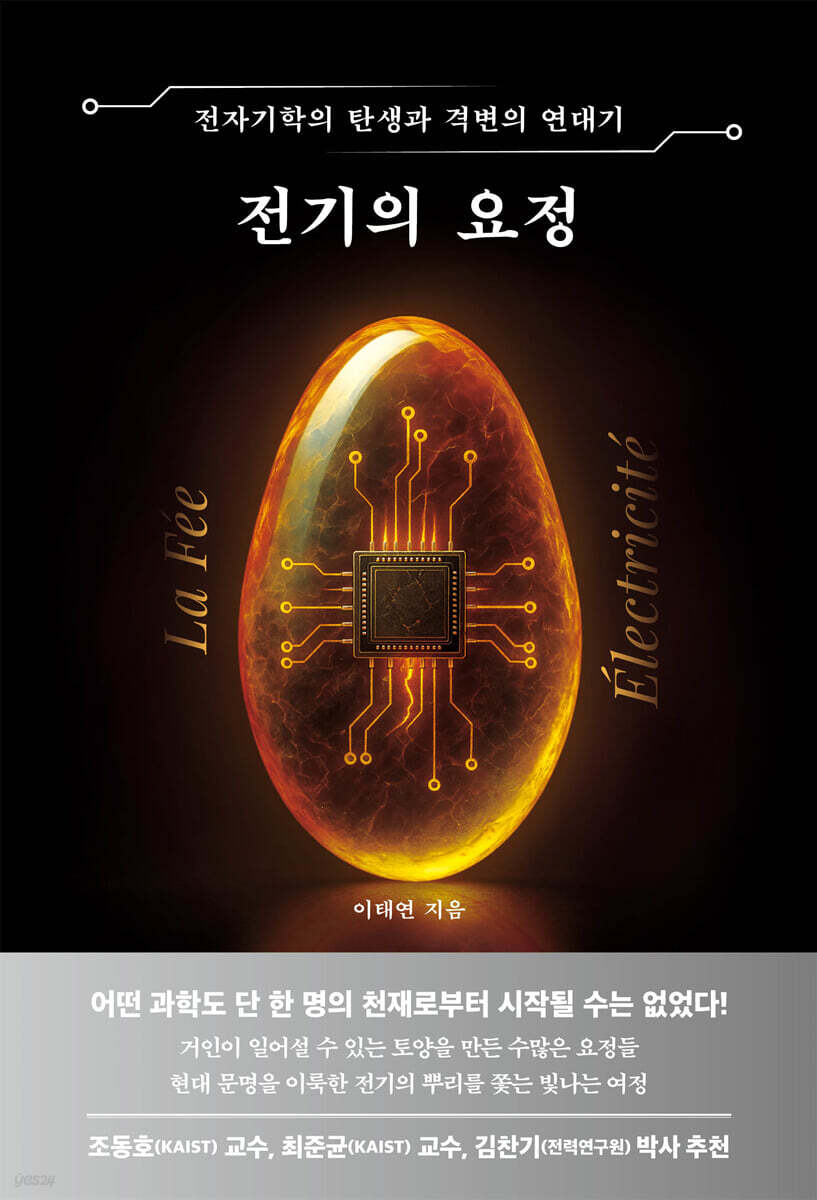
“French painter Raoul Dufy (1877-1953) painted ‘a painting’ at the request of the Paris Electricity Company.
This work, which is 60 meters long and 10 meters high, is 『La Fe?e Electricite』, which was exhibited at the 1937 World's Fair.”
This book began with the author's impression of Raoul Dufy's "The Electric Genie," a painting that holds greater meaning for electromagnetism majors than for art majors.
What the author offers readers in this book goes beyond a simple listing of the history of electromagnetic science and is a journey that explores the deep structure of electromagnetism that created modern human civilization.
"The Electric Fairy" traces the origins of the concept of electricity and how it has transformed human life and science and technology, focusing on the characters, the "Electric Fairies."
Beginning with Thales' amber, through Maxwell's electromagnetic equations, Tesla and Edison's war of currents, and the dawn of quantum mechanics, it organically weaves together the history of electricity, magnetism, and electromagnetic force over time, integrating all branches of technological evolution into a single, overarching thread.
The most striking feature of 『The Electric Fairy』 is its perspective on the vast forest of electrodynamics.
By showing the struggles of figures like Ampere, Faraday, and Maxwell, whom we only briefly learn about in textbooks, and the scientists they stood on in different eras, it simultaneously conveys the continuity of science and human stories.
Above all, it allows us to view the process by which electromagnetism has expanded into various fields such as communications, semiconductors, displays, and control as a single flow, thereby helping us to regain the 'context' beyond understanding technology.
Through this book, the author helps readers, even those who are not specialists, to understand the vast forest of electricity and electromagnetism.
Rather than complex formulas or technical terms, it focuses on stories and connections, people's choices and failures, and turning points of the times, drawing readers into the heart of the history of science.
Just as the joy of putting together a puzzle of previously disparate pieces comes to life, "The Electric Fairy" will serve as a guide to reconnecting our understanding of science.
Putting the puzzle together of modern civilization built on electricity
“French painter Raoul Dufy (1877-1953) painted ‘a painting’ at the request of the Paris Electricity Company.
This work, which is 60 meters long and 10 meters high, is 『La Fe?e Electricite』, which was exhibited at the 1937 World's Fair.”
This book began with the author's impression of Raoul Dufy's "The Electric Genie," a painting that holds greater meaning for electromagnetism majors than for art majors.
What the author offers readers in this book goes beyond a simple listing of the history of electromagnetic science and is a journey that explores the deep structure of electromagnetism that created modern human civilization.
"The Electric Fairy" traces the origins of the concept of electricity and how it has transformed human life and science and technology, focusing on the characters, the "Electric Fairies."
Beginning with Thales' amber, through Maxwell's electromagnetic equations, Tesla and Edison's war of currents, and the dawn of quantum mechanics, it organically weaves together the history of electricity, magnetism, and electromagnetic force over time, integrating all branches of technological evolution into a single, overarching thread.
The most striking feature of 『The Electric Fairy』 is its perspective on the vast forest of electrodynamics.
By showing the struggles of figures like Ampere, Faraday, and Maxwell, whom we only briefly learn about in textbooks, and the scientists they stood on in different eras, it simultaneously conveys the continuity of science and human stories.
Above all, it allows us to view the process by which electromagnetism has expanded into various fields such as communications, semiconductors, displays, and control as a single flow, thereby helping us to regain the 'context' beyond understanding technology.
Through this book, the author helps readers, even those who are not specialists, to understand the vast forest of electricity and electromagnetism.
Rather than complex formulas or technical terms, it focuses on stories and connections, people's choices and failures, and turning points of the times, drawing readers into the heart of the history of science.
Just as the joy of putting together a puzzle of previously disparate pieces comes to life, "The Electric Fairy" will serve as a guide to reconnecting our understanding of science.
- You can preview some of the book's contents.
Preview
index
Recommendation
prolog
Part 1: The Dawn of the European Electrical Revolution
01 People who studied pumpkins and magnets
Thales's amber / Ancient Greek natural philosophers / Roman records / Arab science and the magnets of the Crusaders / Roger Bacon and Scholastic philosophy / William Gilbert's "On the Magnet" / The use of the term "electromagnetism"
02 Scientific Revolutions and the Embryos of Electromagnetism: From Copernicus to Newton
Heliocentrism, the establishment of the sun-centered universe / Struggles against Aristotle's worldview / The wind that blew in the Netherlands / Descartes, a scientist known as a philosopher / Newton, a great scientist who stood on the shoulders of giants / Contemporary giants / The inverse square debate and the revolution of the Principia / The calculus debate between Newton and Leibniz / The dawn of electromagnetism
03 17th-18th century, people who dealt with electricity
Otto von Guericke invents the Magdeburg hemisphere / British electrical engineer pioneers gas discharge / Stephen Gray discovers electrical conductivity / Dufay reproduces Gray's experiment / Leyden jar: the birth of an invention that stores electricity / Lightning-attracting men
04 The Electrical Revolution of the Age of Enlightenment
Epinus's electricity and the parallel-plate capacitor / Coulomb's torsion balance and the electric force / Adam and Eve who ushered in the French Age of Enlightenment / The Bernoulli family and Euler / Fluid resistance and d'Alembert's paradox / The beginning of the battery and the electrical revolution
Part 2: From Force to Field: The Birth of Electromagnetism
05 Scientists of the Romantic Age
Kant's Idealism and the Copernican Shift / How to View Nature / Romanticism Was Actually Resistance / Beyond the Visible Spectrum / Oersted's Discovery: The Interaction of Electricity and Magnetism / Ampere's Magnetism and Biot-Savart's Law / The Footprints of the Royal Institution / Humphry Davy, Who Led the Show of Science / The Great Leap Forward, Faraday's Legacy
06 Revolution and the Fairies of France
The Background of the French Revolution / Lavoisier, the Noble and Vain Scientist / Lagrangian: The Principle of the World's Operations / Laplace, the Algebraist, and the Meaning of His Equations / Two Masters from the École Polytechnique
07 Conservation of Energy and Its Origins
The Industrial Revolution and the Lunar Society / Researchers of the Law of Conservation of Energy / Lenz's Law / Studies of Work, Energy, and Heat / Reflections on the Law of Conservation of Energy
08 The Unglamorous Appearance of Maxwell's Equations
German Action at a Distance / Ohm's Law and Its Simultaneous Discoverers / The Midwives of Electromagnetism / The Emergence of Maxwell's Equations / On Light
Part 3: Maxwell's Legacy and Limitations, and the Prelude to Uncertainty
09 Cavendish Laboratory and Maxwellists
Cavendish in Cambridge's historic center / Journey to the Heaviside Layer / Hertz's discovery of electromagnetic waves / Research on the wave nature of light that heralded a turning point in the era
10 The Age of Inventors
Steinmetz, an American electrical engineer with a deficiency / British and American inventors / The beginning of submarine cables / The transatlantic cable, a giant underwater snake that transmits information / Pioneers of early electric motors / Tesla, the wizard of electricity, makes his debut / Other contemporary inventors who invented the induction motor / Three-phase motor, uniform rotational force / History of electric cars / The war of currents / Sound waves, radio waves, and the telephone / Marconi and Tesla's wireless communication / Wireless power transmission
11 About the new line
Research on vacuum tubes and discharges / The beginning of semiconductors was the light bulb / Thomson's experiments and the discovery of electrons / Unknown light, X-rays / New light, radiation
12 Einstein, always a latecomer
The moment the absolute coordinate system collapses / Who is the main character of the principle of relativity?
13 The quantum world where light splits and begins
People who studied the emission and absorption of radiant energy / The birth of quantum mechanics / The photon hypothesis / The history of quantum mechanics and modern civilization
Epilogue_ A Korean who came close to winning the Nobel Prize
main
prolog
Part 1: The Dawn of the European Electrical Revolution
01 People who studied pumpkins and magnets
Thales's amber / Ancient Greek natural philosophers / Roman records / Arab science and the magnets of the Crusaders / Roger Bacon and Scholastic philosophy / William Gilbert's "On the Magnet" / The use of the term "electromagnetism"
02 Scientific Revolutions and the Embryos of Electromagnetism: From Copernicus to Newton
Heliocentrism, the establishment of the sun-centered universe / Struggles against Aristotle's worldview / The wind that blew in the Netherlands / Descartes, a scientist known as a philosopher / Newton, a great scientist who stood on the shoulders of giants / Contemporary giants / The inverse square debate and the revolution of the Principia / The calculus debate between Newton and Leibniz / The dawn of electromagnetism
03 17th-18th century, people who dealt with electricity
Otto von Guericke invents the Magdeburg hemisphere / British electrical engineer pioneers gas discharge / Stephen Gray discovers electrical conductivity / Dufay reproduces Gray's experiment / Leyden jar: the birth of an invention that stores electricity / Lightning-attracting men
04 The Electrical Revolution of the Age of Enlightenment
Epinus's electricity and the parallel-plate capacitor / Coulomb's torsion balance and the electric force / Adam and Eve who ushered in the French Age of Enlightenment / The Bernoulli family and Euler / Fluid resistance and d'Alembert's paradox / The beginning of the battery and the electrical revolution
Part 2: From Force to Field: The Birth of Electromagnetism
05 Scientists of the Romantic Age
Kant's Idealism and the Copernican Shift / How to View Nature / Romanticism Was Actually Resistance / Beyond the Visible Spectrum / Oersted's Discovery: The Interaction of Electricity and Magnetism / Ampere's Magnetism and Biot-Savart's Law / The Footprints of the Royal Institution / Humphry Davy, Who Led the Show of Science / The Great Leap Forward, Faraday's Legacy
06 Revolution and the Fairies of France
The Background of the French Revolution / Lavoisier, the Noble and Vain Scientist / Lagrangian: The Principle of the World's Operations / Laplace, the Algebraist, and the Meaning of His Equations / Two Masters from the École Polytechnique
07 Conservation of Energy and Its Origins
The Industrial Revolution and the Lunar Society / Researchers of the Law of Conservation of Energy / Lenz's Law / Studies of Work, Energy, and Heat / Reflections on the Law of Conservation of Energy
08 The Unglamorous Appearance of Maxwell's Equations
German Action at a Distance / Ohm's Law and Its Simultaneous Discoverers / The Midwives of Electromagnetism / The Emergence of Maxwell's Equations / On Light
Part 3: Maxwell's Legacy and Limitations, and the Prelude to Uncertainty
09 Cavendish Laboratory and Maxwellists
Cavendish in Cambridge's historic center / Journey to the Heaviside Layer / Hertz's discovery of electromagnetic waves / Research on the wave nature of light that heralded a turning point in the era
10 The Age of Inventors
Steinmetz, an American electrical engineer with a deficiency / British and American inventors / The beginning of submarine cables / The transatlantic cable, a giant underwater snake that transmits information / Pioneers of early electric motors / Tesla, the wizard of electricity, makes his debut / Other contemporary inventors who invented the induction motor / Three-phase motor, uniform rotational force / History of electric cars / The war of currents / Sound waves, radio waves, and the telephone / Marconi and Tesla's wireless communication / Wireless power transmission
11 About the new line
Research on vacuum tubes and discharges / The beginning of semiconductors was the light bulb / Thomson's experiments and the discovery of electrons / Unknown light, X-rays / New light, radiation
12 Einstein, always a latecomer
The moment the absolute coordinate system collapses / Who is the main character of the principle of relativity?
13 The quantum world where light splits and begins
People who studied the emission and absorption of radiant energy / The birth of quantum mechanics / The photon hypothesis / The history of quantum mechanics and modern civilization
Epilogue_ A Korean who came close to winning the Nobel Prize
main
Publisher's Review
Where did electricity begin? Tracing the roots of electric civilization.
The history of invisible power, again as a human story
Electricity that we use on a daily basis.
A light that turns on at the push of a switch, a circuit that transmits and receives Internet signals, the current flowing through the smartphone in your hand... Where does all this electricity come from? "The Electric Fairy" answers that question through human stories.
From the fingertips of Thales rubbing amber, through Tesla and Edison who started the War of Currents, to modern physics stepping into the world of quantum mechanics—this narrative unfolds over time to show how the seed of the concept of electricity sprouted, bore fruit, and created today's electromagnetic civilization.
This book does not approach electricity simply as a physical phenomenon or formula.
From the seemingly trivial observation that most people overlook, such as "pumpkins attract light objects around them," to the experimental curiosity of "Why do magnets have two poles?" and the famous question of "Is light a particle or a wave?", it follows all the questions humans have ever posed and completes the puzzle of electricity.
In addition, we examine the lives of the scientists who made these questions possible, as well as the era and society they belonged to, and the chain of knowledge.
Technology accumulates, but the human exploration that made it possible does not cease.
"The Electric Fairy" looks at electricity and electromagnetism as an accumulation of human collaboration.
It reflects on how the soil was created not only by the great men who left their names, but also by the unknown scholars who became their roots—the “electrical fairies”—and shows us a world beyond the history of science we are familiar with.
For science majors, this book will offer the thrill of connecting the scattered pieces, while for non-science majors, it will offer the drama of a grand narrative.
Behind every brilliant theory are nameless fairies.
Restoring the Hidden Helpers Who Formed the Foundation of Civilization
When a non-major thinks of a certain discipline, the names of the giants who support that discipline often come to mind.
In electromagnetism, great figures like Maxwell and Tesla fall right into that category.
However, Raoul Dufy did not only highlight these great figures in his paintings.
To create the vast forest of electromagnetism, the existence of not only giants but also a total of 108 'electric fairies' was essential.
Likewise, 『The Electric Fairy』 is filled with stories of countless people who are not easily found in science textbooks, but who served as the background for great theories and inventions.
"The Electric Fairy" brings back to our eyes those who, while studying electricity and light, paradoxically, were not exposed to light.
There were countless nameless figures who sowed the seeds, leveled the ground, and pruned the branches to cultivate the forest of electromagnetism.
For example, the existence of Peregrinus, who first experimentally proved the dipole nature of magnets, and Ibn al-Haytham, who attempted to establish the principles of optics, unfortunately remain outside the awareness of non-specialists.
This book focuses on those 'soil makers'.
Science is a continuous and cumulative collaboration of humankind.
Rather than simply highlighting those with well-known names, it also examines the discoveries and struggles of those who were buried in the flow of time, thereby unraveling the "story of people" rather than the "history of science."
In this way, readers discover the drama of human emotions and choices within the subject of science and technology, which can easily be perceived as a cold image.
Electromagnetism was not simply the combination of electricity and magnetism, but a vast current where people and times, philosophies and challenges, chance and necessity intersected.
"The Electric Fairy" is a kind of "return to the stage" that brings back to the stage supporting characters who had been erased from the narrative, and it is a book that returns science to the reader as a human story.
The history of science is the history of humanity, and The Electric Fairy restores it to a brilliant narrative.
Why did Thales rub amber?
A single ray of static electricity changes an era
Around 600 BC, the Greek philosopher Thales rubbed amber with animal skin and observed a strange phenomenon.
It happened that light and small objects got stuck to the pumpkin.
We call this event the 'discovery of static electricity'.
However, 『The Electric Fairy』 restores this trivial scene as the first scientific question of mankind.
From the question 'Why?', the epic of modern electromagnetism begins.
This book vividly portrays the cosmology and mythological interpretations of ancient philosophers, as well as the first attempts to move beyond them into experimentation.
From the time when magnets were thought to be stones imbued with souls, to the discovery of Peregrinus, who experimentally distinguished the two poles of a magnet—electromagnetism as we know it today was by no means established overnight.
The concept of 'electricity' has been gradually refined at the intersection of thousands of years of superstition, philosophy, religion, experimentation, and social desire.
Even the anti-static film on the smart devices we hold in our hands is imprinted with the trajectory of questions spanning thousands of years since Thales.
"The Electric Fairy" shows how curiosity became knowledge and then civilization.
It is not the result of something born in a huge laboratory, but something that started at the fingertips of people.
The message that 'science is ultimately an act of asking questions' resonates not in the reader's head but in his or her heart.
Science's Curve: A History of Failure
The progress of science has not been a straight line, but a trajectory of repetition and regression.
"The Electric Fairy" does not depict the history of science as a linear progression.
Rather, it is depicted as a process of drawing a curve through repeated confusion, debate, and trial and error.
This book shows that the scientific revolution was not a single, sudden change, but a series of conflicts and readjustments that shook and re-established the existing order.
Neither Newton's law of universal gravitation nor Maxwell's equations were absolute truths, but rather 'one answer to previous questions', which immediately gave rise to new questions.
The process has always been nonlinear.
Aristotle's physics, which had dominated the pre-modern scientific community for 2,000 years, collapsed not in a single experiment but in the midst of numerous controversies and social contexts.
The world of electricity was no different.
During the same era, many people made similar discoveries, but were either forgotten or lost in debate.
This book meticulously reconstructs that process, reminding us that science is a complex history intertwined with error, controversy, social conditions, and human choices.
Why Study Electricity Again Today
Quantum computers, AI, electric cars… The key to the future lies in the past.
Although we enjoy the benefits of electricity every day, we often don't know what it is or where it comes from.
Electricity is as familiar as air, yet at the same time it is the most unfamiliar thing.
"The Electric Fairy" asks why we need to revisit the history of electricity in this day and age.
Electricity is not just a matter of energy, but a history of civilization that encapsulates how human intelligence, philosophy, technology, and sensibility have evolved.
This book is not simply a 'general electrical textbook'.
Rather, it starts from the realization that we must look back to the 'foundations' in an era where the foundations of science and technology are shaking and a new paradigm is required.
Quantum mechanics, semiconductors, artificial intelligence, electric cars… none of this can be explained without understanding electricity.
However, its foundation is not simply theory, but is based on a synthesis of the flow of the times, human insight, experimentation, and philosophy.
To move forward into the future, we must return to the thinking of the past.
"The Electric Fairy" allows us to start 'asking science again' from that starting point.
This is why I recommend this book not only to those who dream of becoming scientists and engineers, but also to anyone who is curious about the principles of the world.
The history of invisible power, again as a human story
Electricity that we use on a daily basis.
A light that turns on at the push of a switch, a circuit that transmits and receives Internet signals, the current flowing through the smartphone in your hand... Where does all this electricity come from? "The Electric Fairy" answers that question through human stories.
From the fingertips of Thales rubbing amber, through Tesla and Edison who started the War of Currents, to modern physics stepping into the world of quantum mechanics—this narrative unfolds over time to show how the seed of the concept of electricity sprouted, bore fruit, and created today's electromagnetic civilization.
This book does not approach electricity simply as a physical phenomenon or formula.
From the seemingly trivial observation that most people overlook, such as "pumpkins attract light objects around them," to the experimental curiosity of "Why do magnets have two poles?" and the famous question of "Is light a particle or a wave?", it follows all the questions humans have ever posed and completes the puzzle of electricity.
In addition, we examine the lives of the scientists who made these questions possible, as well as the era and society they belonged to, and the chain of knowledge.
Technology accumulates, but the human exploration that made it possible does not cease.
"The Electric Fairy" looks at electricity and electromagnetism as an accumulation of human collaboration.
It reflects on how the soil was created not only by the great men who left their names, but also by the unknown scholars who became their roots—the “electrical fairies”—and shows us a world beyond the history of science we are familiar with.
For science majors, this book will offer the thrill of connecting the scattered pieces, while for non-science majors, it will offer the drama of a grand narrative.
Behind every brilliant theory are nameless fairies.
Restoring the Hidden Helpers Who Formed the Foundation of Civilization
When a non-major thinks of a certain discipline, the names of the giants who support that discipline often come to mind.
In electromagnetism, great figures like Maxwell and Tesla fall right into that category.
However, Raoul Dufy did not only highlight these great figures in his paintings.
To create the vast forest of electromagnetism, the existence of not only giants but also a total of 108 'electric fairies' was essential.
Likewise, 『The Electric Fairy』 is filled with stories of countless people who are not easily found in science textbooks, but who served as the background for great theories and inventions.
"The Electric Fairy" brings back to our eyes those who, while studying electricity and light, paradoxically, were not exposed to light.
There were countless nameless figures who sowed the seeds, leveled the ground, and pruned the branches to cultivate the forest of electromagnetism.
For example, the existence of Peregrinus, who first experimentally proved the dipole nature of magnets, and Ibn al-Haytham, who attempted to establish the principles of optics, unfortunately remain outside the awareness of non-specialists.
This book focuses on those 'soil makers'.
Science is a continuous and cumulative collaboration of humankind.
Rather than simply highlighting those with well-known names, it also examines the discoveries and struggles of those who were buried in the flow of time, thereby unraveling the "story of people" rather than the "history of science."
In this way, readers discover the drama of human emotions and choices within the subject of science and technology, which can easily be perceived as a cold image.
Electromagnetism was not simply the combination of electricity and magnetism, but a vast current where people and times, philosophies and challenges, chance and necessity intersected.
"The Electric Fairy" is a kind of "return to the stage" that brings back to the stage supporting characters who had been erased from the narrative, and it is a book that returns science to the reader as a human story.
The history of science is the history of humanity, and The Electric Fairy restores it to a brilliant narrative.
Why did Thales rub amber?
A single ray of static electricity changes an era
Around 600 BC, the Greek philosopher Thales rubbed amber with animal skin and observed a strange phenomenon.
It happened that light and small objects got stuck to the pumpkin.
We call this event the 'discovery of static electricity'.
However, 『The Electric Fairy』 restores this trivial scene as the first scientific question of mankind.
From the question 'Why?', the epic of modern electromagnetism begins.
This book vividly portrays the cosmology and mythological interpretations of ancient philosophers, as well as the first attempts to move beyond them into experimentation.
From the time when magnets were thought to be stones imbued with souls, to the discovery of Peregrinus, who experimentally distinguished the two poles of a magnet—electromagnetism as we know it today was by no means established overnight.
The concept of 'electricity' has been gradually refined at the intersection of thousands of years of superstition, philosophy, religion, experimentation, and social desire.
Even the anti-static film on the smart devices we hold in our hands is imprinted with the trajectory of questions spanning thousands of years since Thales.
"The Electric Fairy" shows how curiosity became knowledge and then civilization.
It is not the result of something born in a huge laboratory, but something that started at the fingertips of people.
The message that 'science is ultimately an act of asking questions' resonates not in the reader's head but in his or her heart.
Science's Curve: A History of Failure
The progress of science has not been a straight line, but a trajectory of repetition and regression.
"The Electric Fairy" does not depict the history of science as a linear progression.
Rather, it is depicted as a process of drawing a curve through repeated confusion, debate, and trial and error.
This book shows that the scientific revolution was not a single, sudden change, but a series of conflicts and readjustments that shook and re-established the existing order.
Neither Newton's law of universal gravitation nor Maxwell's equations were absolute truths, but rather 'one answer to previous questions', which immediately gave rise to new questions.
The process has always been nonlinear.
Aristotle's physics, which had dominated the pre-modern scientific community for 2,000 years, collapsed not in a single experiment but in the midst of numerous controversies and social contexts.
The world of electricity was no different.
During the same era, many people made similar discoveries, but were either forgotten or lost in debate.
This book meticulously reconstructs that process, reminding us that science is a complex history intertwined with error, controversy, social conditions, and human choices.
Why Study Electricity Again Today
Quantum computers, AI, electric cars… The key to the future lies in the past.
Although we enjoy the benefits of electricity every day, we often don't know what it is or where it comes from.
Electricity is as familiar as air, yet at the same time it is the most unfamiliar thing.
"The Electric Fairy" asks why we need to revisit the history of electricity in this day and age.
Electricity is not just a matter of energy, but a history of civilization that encapsulates how human intelligence, philosophy, technology, and sensibility have evolved.
This book is not simply a 'general electrical textbook'.
Rather, it starts from the realization that we must look back to the 'foundations' in an era where the foundations of science and technology are shaking and a new paradigm is required.
Quantum mechanics, semiconductors, artificial intelligence, electric cars… none of this can be explained without understanding electricity.
However, its foundation is not simply theory, but is based on a synthesis of the flow of the times, human insight, experimentation, and philosophy.
To move forward into the future, we must return to the thinking of the past.
"The Electric Fairy" allows us to start 'asking science again' from that starting point.
This is why I recommend this book not only to those who dream of becoming scientists and engineers, but also to anyone who is curious about the principles of the world.
GOODS SPECIFICS
- Date of issue: August 5, 2025
- Page count, weight, size: 372 pages | 574g | 152*223*22mm
- ISBN13: 9788962626681
You may also like
카테고리
korean


korean

![GQ KOREA Mark (Monthly): December [2025]](http://librairie.coreenne.fr/cdn/shop/files/8ef265dbbfbf186523ed75ba7319009d.jpg?v=1765340328&width=3840)


