

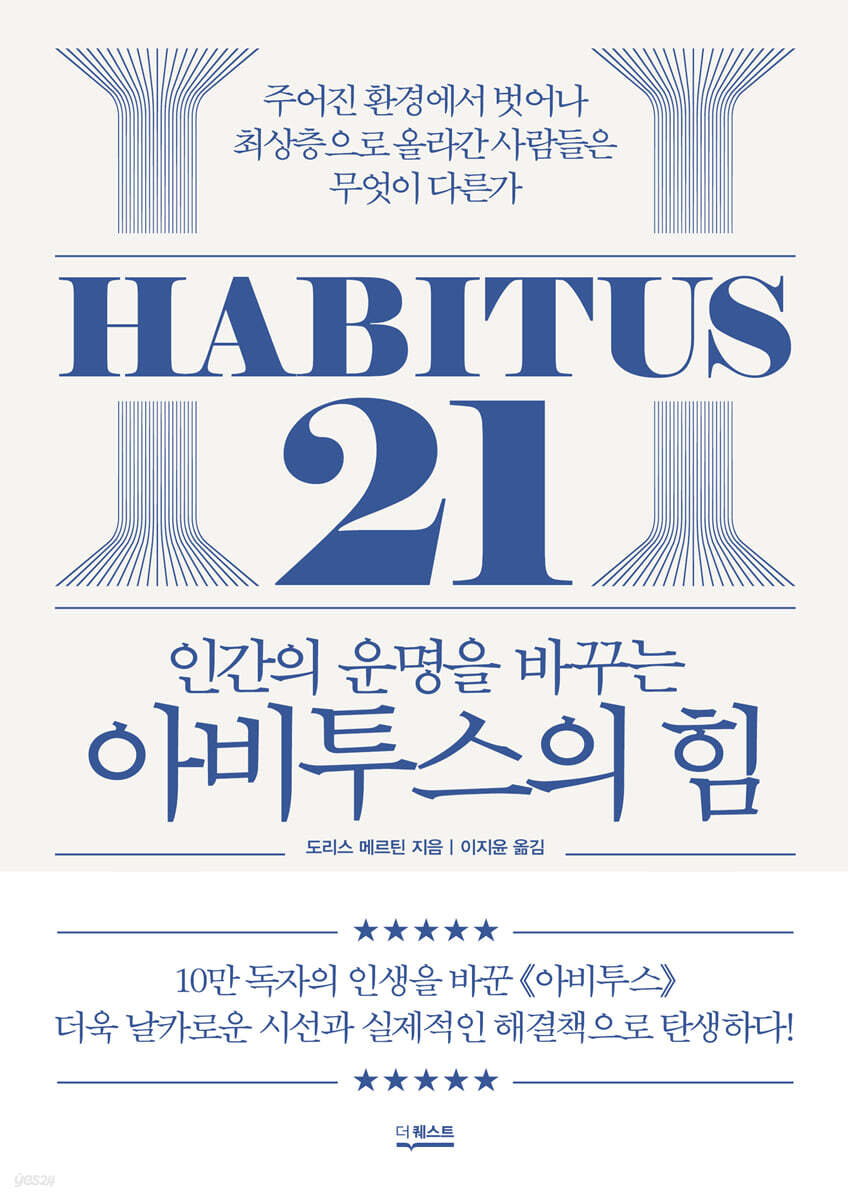
The power of Abitus
 |
Description
Book Introduction
“You can't climb the ladder of success with your hands in your pockets.” What if you want to overcome the harsh truths of life and yet still overcome an uncertain future?! ***The rebirth of "Abitus" amid a flood of inquiries from 100,000 readers. ***“A book that deciphers the code of the upper class” Highly praised by German economic journals and business magazines! ***A special preface from the author for Korean readers! ㅤ Dr. Ugur Zahin of BioNTech, the developer of the COVID-19 vaccine, Michelle Obama, and German President Frank-Walter Steinmeier are all top figures in their respective fields, but they did not inherit privilege or a silver spoon in their mouths. Rather, they were born into very poor circumstances, but they worked hard to become role models in their respective positions, and ultimately jumped over the ladder of success. What makes people who change their own destiny different? The author, who delved into the truths of life that many people know but rarely speak of through 『Abitus』, reveals the secrets that enable ordinary people to leap forward from their positions. The new book, "The Power of Habitus," addresses the question of which level of "habitus," the sociocultural form learned while living in the world and often called second nature, we should acquire. That is, it suggests how to acquire 'advanced habitus'. When people live in groups, it is natural for classes to be divided, and within that class, there are clearly upper and lower classes. In a capitalist society, it is said that 'wealth' will occupy a significant portion of that class, but in reality, this is not the case. Many things that can be acquired through effort, such as the so-called human qualities, such as confidence, consideration for others, and culture, determine your status. This book honestly conveys how, in an age when the ladder of success is said to be broken, one can still climb to the upper class with dignity. |
- You can preview some of the book's contents.
Preview
index
Preface to the Korean Edition: For Those Who Want to Go Further and Higher
Introduction: The Inconvenient Truths of Life We Must Face
The First Strength: The Courage to Face Reality
-Take on life's obstacles head-on-
Second Strength: The Perseverance to Seek Opportunities
-Absorb diverse cultural capital-
Third Strength: The Confidence to Believe You Can Execute
-Abandon the myths of success and complaints about reality-
The Fourth Force: Basic Education to Support the Ladder of Success
-Build the best foundation through education-
The Fifth Strength: The Power to Turn Weaknesses into Strengths
-Turn deficiency into blessing-
The Sixth Power: Insight to See Beyond Usefulness
-Think beyond the numbers-
The Seventh Power: Appearance that Demonstrates Culture
-Your speech and gait tell a lot-
The Eighth Force: The Dual Habitus of Social Roles
Finding a Balance Between the Original Family and the Leaping Class
The Ninth Force: Moderately Dense Networks
-Leap forward using solidarity as a springboard-
The Tenth Force: The Measuring Scale for Success
-Pursue your own highest value-
Eleventh Strength: A Strong Mindset, Even in the Face of Others' Evaluation
Build psychological assets like willpower and resilience.
The Twelfth Strength: The Prudence to Control Your Emotions
-Approach your goal slowly-
The Thirteenth Force: Style with Class
-Develop refined taste-
The Fourteenth Strength: Self-Awareness and Overcoming Deficiency
Overcome Mask Syndrome
The Fifteenth Power: Liberating the Mind Across Classes
-Break through the limitations of stereotypes-
The Sixteenth Power: The Wisdom to Know Wealth and Its Value
-Money is a tool that must be kept in good hands-
The Seventeenth Strength: Leadership that Moves Away from Fear
-Stand up front and receive the service-
The Eighteenth Power: The Insider Code of the Upper Class
-Think rich, look poor-
The Nineteenth Strength: Freedom from Comparison
-Above all, don't push the person next to you-
The Twentieth Force: Beliefs That Indicate Status
-Do good and be honored with nobility-
The Twenty-First Power: A Broader View of the World
-Break down the barriers in your mind-
annotation
Introduction: The Inconvenient Truths of Life We Must Face
The First Strength: The Courage to Face Reality
-Take on life's obstacles head-on-
Second Strength: The Perseverance to Seek Opportunities
-Absorb diverse cultural capital-
Third Strength: The Confidence to Believe You Can Execute
-Abandon the myths of success and complaints about reality-
The Fourth Force: Basic Education to Support the Ladder of Success
-Build the best foundation through education-
The Fifth Strength: The Power to Turn Weaknesses into Strengths
-Turn deficiency into blessing-
The Sixth Power: Insight to See Beyond Usefulness
-Think beyond the numbers-
The Seventh Power: Appearance that Demonstrates Culture
-Your speech and gait tell a lot-
The Eighth Force: The Dual Habitus of Social Roles
Finding a Balance Between the Original Family and the Leaping Class
The Ninth Force: Moderately Dense Networks
-Leap forward using solidarity as a springboard-
The Tenth Force: The Measuring Scale for Success
-Pursue your own highest value-
Eleventh Strength: A Strong Mindset, Even in the Face of Others' Evaluation
Build psychological assets like willpower and resilience.
The Twelfth Strength: The Prudence to Control Your Emotions
-Approach your goal slowly-
The Thirteenth Force: Style with Class
-Develop refined taste-
The Fourteenth Strength: Self-Awareness and Overcoming Deficiency
Overcome Mask Syndrome
The Fifteenth Power: Liberating the Mind Across Classes
-Break through the limitations of stereotypes-
The Sixteenth Power: The Wisdom to Know Wealth and Its Value
-Money is a tool that must be kept in good hands-
The Seventeenth Strength: Leadership that Moves Away from Fear
-Stand up front and receive the service-
The Eighteenth Power: The Insider Code of the Upper Class
-Think rich, look poor-
The Nineteenth Strength: Freedom from Comparison
-Above all, don't push the person next to you-
The Twentieth Force: Beliefs That Indicate Status
-Do good and be honored with nobility-
The Twenty-First Power: A Broader View of the World
-Break down the barriers in your mind-
annotation
Detailed image

Into the book
Habitus (the tastes and habits that distinguish me from others, and my second nature determined by the sociocultural environment) is created without me even knowing it.
We are each born into different families and grow up experiencing different living environments and lifestyles.
While there are families where parents often take their children on overseas trips, there are also families where children rarely leave their neighborhood.
There are homes where the whole family cooks together and eats the food, and there are homes where everyone heats up frozen food on their own.
The important thing here is that the children absorb all these differences.
Children learn what values are important and what attitudes are right through their surroundings.
They unconsciously adopt the way of thinking and behaving that someone has shown them.
Children of parents with high social status tend to inherit more robust thinking, behavior, and self-image that help them realize their potential.
Of course, even those who weren't born with such good fortune have ample opportunities to improve their lives.
However, it is rare for the inner pressure or potential tension that suddenly appears at a very inappropriate moment to be completely relieved.
--- From "The First Strength: The Courage to Face Reality"
Aljoscha Neubauer, professor of differential psychology at the University of Graz, found that:
“Intelligence develops during the first 15 years of life, and the level of intelligence can vary greatly depending on the quality and quantity of education received in kindergarten and school.
Therefore, education policy must provide the best opportunities for everyone, regardless of their background.”
The time between the ages of ten and fifteen is so precious that we should make the most of it.
Of course, you can also receive higher education for two or three years at vocational schools to obtain a specialized higher degree or general higher degree.
However, humanities students of the same age, in grades 8 and 9, spend more than three times as much time broadening their horizons of cultural experience beyond their major knowledge.
This is why vocational and humanities courses cannot be considered the same high school curriculum.
A ten-year-old student who goes to a liberal arts school is intellectually more stimulated and exposed to a wider range of upper-class culture than his peers who go to comprehensive or vocational schools.
Around the age of ten is a time when you can expect ideal results from special opportunities.
Because Abitus is “not yet fully hardened and can be easily transformed,” its potential for development is limitless.
--- From "The Fourth Force: Basic Education to Support the Ladder of Success"
American psychologist Emmi Werner and her team have proven this through long-term studies.
They followed about 200 children born in 1955 on the Hawaiian island of Kauai for 40 years, and although all of them initially grew up in poor environments, about a third of them emerged with remarkable talents.
From a very young age, they have responded admirably to the circumstances and difficulties they have been given, and although they have suffered some wounds along the way, they have not been frustrated.
He always found a way to save himself, adjusted his goals flexibly, and found hope in situations where people who were blessed with a lot of luck and grew up spoiled easily would easily despair, showing a positive attitude.
Their mental strength, which gradually grew stronger as they overcame life's challenges, was an ability that could not be learned through a sudden attack.
--- From "The Fifth Power: The Power of Thinking to Turn Weaknesses into Strengths"
Working at the school during the holidays allowed me to connect with new people, learn about event management, and get a behind-the-scenes look.
And by the end of the vacation, I was hired as a full-time teaching assistant.
I didn't know then that part-time jobs and internships during college weren't random choices, but rather a matter of class. But I know now.
While students who are the first in their families to attend college prioritize earning a living, children of highly educated parents prioritize building connections and experiences that will help them in the future.
Such decisions determine the direction of the future.
While serving plates at a restaurant during the holidays will add money to your account, an unpaid administrative internship at a city theater will add a line to your resume.
--- From "The Sixth Power: Insight that Sees Beyond Usefulness"
The middle class has a reverence for money, but the rich don't.
Their mindset toward money is drier than you might think.
Money is nothing more or less than a tool that makes the world go round.
Therefore, it is natural for those who have enough money to maximize profits.
They do not consider material and humanitarian values as conflicting.
The saying, 'The rich save even a hundred won', cannot encompass such an attitude.
That's why we need to learn from the rich how to strategically accumulate wealth and invest it in a satisfying way.
--- From "The Sixteenth Power: The Wisdom to Know Wealth and Its Value"
Taylor Phillips, a scholar who has studied the psychology of the privileged class, says that such self-concepts are fundamental to human psychology.
That is precisely why, even among the upper classes, only a very small minority behave like Russia's new oligarchs.
Even more often than not, the opposite is true.
According to Phillips's social psychology research, it is true that people who start out with an advantage over others tend to maintain their positions because of it.
But when you look at their actions and attitudes, you might think that their success is due to their talent, dignity, and responsible and moderate lifestyle.
The belief in performance-based pay is reflected in the basic morals of the upper class, and they hold responsibility, freedom, practice, and confidence as their principles.
Of course, these values become the norm across all social classes.
However, it is the upper class that most revere these values.
They often mention these values in their daily lives.
So it won't hurt you at all to place these values at the top of your value scale.
We are each born into different families and grow up experiencing different living environments and lifestyles.
While there are families where parents often take their children on overseas trips, there are also families where children rarely leave their neighborhood.
There are homes where the whole family cooks together and eats the food, and there are homes where everyone heats up frozen food on their own.
The important thing here is that the children absorb all these differences.
Children learn what values are important and what attitudes are right through their surroundings.
They unconsciously adopt the way of thinking and behaving that someone has shown them.
Children of parents with high social status tend to inherit more robust thinking, behavior, and self-image that help them realize their potential.
Of course, even those who weren't born with such good fortune have ample opportunities to improve their lives.
However, it is rare for the inner pressure or potential tension that suddenly appears at a very inappropriate moment to be completely relieved.
--- From "The First Strength: The Courage to Face Reality"
Aljoscha Neubauer, professor of differential psychology at the University of Graz, found that:
“Intelligence develops during the first 15 years of life, and the level of intelligence can vary greatly depending on the quality and quantity of education received in kindergarten and school.
Therefore, education policy must provide the best opportunities for everyone, regardless of their background.”
The time between the ages of ten and fifteen is so precious that we should make the most of it.
Of course, you can also receive higher education for two or three years at vocational schools to obtain a specialized higher degree or general higher degree.
However, humanities students of the same age, in grades 8 and 9, spend more than three times as much time broadening their horizons of cultural experience beyond their major knowledge.
This is why vocational and humanities courses cannot be considered the same high school curriculum.
A ten-year-old student who goes to a liberal arts school is intellectually more stimulated and exposed to a wider range of upper-class culture than his peers who go to comprehensive or vocational schools.
Around the age of ten is a time when you can expect ideal results from special opportunities.
Because Abitus is “not yet fully hardened and can be easily transformed,” its potential for development is limitless.
--- From "The Fourth Force: Basic Education to Support the Ladder of Success"
American psychologist Emmi Werner and her team have proven this through long-term studies.
They followed about 200 children born in 1955 on the Hawaiian island of Kauai for 40 years, and although all of them initially grew up in poor environments, about a third of them emerged with remarkable talents.
From a very young age, they have responded admirably to the circumstances and difficulties they have been given, and although they have suffered some wounds along the way, they have not been frustrated.
He always found a way to save himself, adjusted his goals flexibly, and found hope in situations where people who were blessed with a lot of luck and grew up spoiled easily would easily despair, showing a positive attitude.
Their mental strength, which gradually grew stronger as they overcame life's challenges, was an ability that could not be learned through a sudden attack.
--- From "The Fifth Power: The Power of Thinking to Turn Weaknesses into Strengths"
Working at the school during the holidays allowed me to connect with new people, learn about event management, and get a behind-the-scenes look.
And by the end of the vacation, I was hired as a full-time teaching assistant.
I didn't know then that part-time jobs and internships during college weren't random choices, but rather a matter of class. But I know now.
While students who are the first in their families to attend college prioritize earning a living, children of highly educated parents prioritize building connections and experiences that will help them in the future.
Such decisions determine the direction of the future.
While serving plates at a restaurant during the holidays will add money to your account, an unpaid administrative internship at a city theater will add a line to your resume.
--- From "The Sixth Power: Insight that Sees Beyond Usefulness"
The middle class has a reverence for money, but the rich don't.
Their mindset toward money is drier than you might think.
Money is nothing more or less than a tool that makes the world go round.
Therefore, it is natural for those who have enough money to maximize profits.
They do not consider material and humanitarian values as conflicting.
The saying, 'The rich save even a hundred won', cannot encompass such an attitude.
That's why we need to learn from the rich how to strategically accumulate wealth and invest it in a satisfying way.
--- From "The Sixteenth Power: The Wisdom to Know Wealth and Its Value"
Taylor Phillips, a scholar who has studied the psychology of the privileged class, says that such self-concepts are fundamental to human psychology.
That is precisely why, even among the upper classes, only a very small minority behave like Russia's new oligarchs.
Even more often than not, the opposite is true.
According to Phillips's social psychology research, it is true that people who start out with an advantage over others tend to maintain their positions because of it.
But when you look at their actions and attitudes, you might think that their success is due to their talent, dignity, and responsible and moderate lifestyle.
The belief in performance-based pay is reflected in the basic morals of the upper class, and they hold responsibility, freedom, practice, and confidence as their principles.
Of course, these values become the norm across all social classes.
However, it is the upper class that most revere these values.
They often mention these values in their daily lives.
So it won't hurt you at all to place these values at the top of your value scale.
--- From "The Twentieth Power: Beliefs That Indicate Status"
Publisher's Review
Don't be discouraged by the 'lottery' of birth
Revealing the secrets of those who saved themselves!
In developed countries like the United States, Germany, and Northern Europe, the work environment and quality of life have clearly improved compared to the past, and technology is also developing in ways that make everyday life more convenient.
This is similar to Korea, which has joined the ranks of advanced countries.
The four-day workweek is on the rise, per capita GDP and global awareness are rising, and the middle class is steadily growing.
But they all speak with one voice.
'Life has gotten better, but moving up has become more difficult than before,' he said.
In reality, it is much harder to go from 5th to 2nd place than to go from 50th to 30th.
Because most people work hard, you have to work harder to achieve remarkable results.
So, people in this era, tired of comparison, rely more on luck, like winning the lottery, that comes with an 'innate environment' and something like that from birth.
It is believed that birth has more influence than anything else.
But our social status is not 'etched in stone' and is not unchangeable.
The author of "The Power of Habitus" analyzed the secrets of those who, despite their harsh circumstances, ultimately found a path to success and leaped up the social ladder. How did they achieve this leap? They possessed a unique habitus that set them apart from others.
Habitus is a concept proposed by French philosopher Bourdieu. It is a second nature and habit determined by the sociocultural environment, and can be changed at any time through effort.
With 100,000 readers' inquiries flooding in, the author picks up his pen again.
The second story of 『Abitus』 written down!
The author's previous work, "Abitus," sold over 100,000 copies in Korea alone and was loved by many readers, including opinion leaders, receiving favorable reviews such as "the truth of life" and "a great realization that changed my life."
Readers wanted to go beyond understanding habitus and transform it into an upper-class habitus.
Along the way, the author received numerous inquiries asking, "How do ordinary people reconstruct habitus? Could you explain in more detail?" He took up the pen to quench this thirst and, at the same time, to inspire courage in their lives.
His intention is also clearly revealed in the special preface sent to Korean readers.
A person's leap forward should not depend on the lottery of birth.
Everyone has the right to think bigger and want more than the circumstances into which they were born or the nature they possessed.
This book will help you leap forward on your own strength rather than relying on luck or fate.
The ways to expand your opportunities and choices are to achieve financial independence, envision the future, teach your children about habitus, and aim higher.
We know that Korea is a country with a high possibility of doing so.
_From the 'Korean edition preface'
The author emphasizes that habitus is something that is acquired postnatally and can be embodied through education.
And it talks about how a person can change through various efforts.
Overcome your inner obstacles and find your path to success!
You have the power to change your destiny.
The author, a scholar and consultant who has been researching ways to transform businesses and individuals' lives for over 20 years, presents a concrete code for success in "The Power of Habitus," based on social research rather than fanciful methods.
The author emphasizes that the first thing that is needed is to cast off the existing habitus and the belief in status fatalism that hinder one's inner leap.
The most important thing to acquire good habitus is ‘education’.
Education includes not only intellectual things like books, but also the environment and the mind.
People who have developed a dignified habitus, such as self-esteem, confidence, and correct language habits, can more easily rise to the upper class.
Also, people who have a clear role model they want to emulate can easily find the path to higher places because they know clearly where to go.
By following the author's 21 guidelines, readers will be able to categorize what they currently have and what they don't have, supplement what they lack, and move forward.
Although this book covers liberal arts topics, it is closer to a practical guide that sharply analyzes the realities of reality.
No matter what kind of world we live in, classes will always exist.
Within it, there will always be people called lower class and people called upper class.
Are you going to stay where you are now?
That's good too.
Do you want to go up?
That's good too.
If you want to rise above, if you want to live a life higher than your parents, and if you want your children to live a better life than you, read this book now.
I will show you how to climb the ladder of success.
Revealing the secrets of those who saved themselves!
In developed countries like the United States, Germany, and Northern Europe, the work environment and quality of life have clearly improved compared to the past, and technology is also developing in ways that make everyday life more convenient.
This is similar to Korea, which has joined the ranks of advanced countries.
The four-day workweek is on the rise, per capita GDP and global awareness are rising, and the middle class is steadily growing.
But they all speak with one voice.
'Life has gotten better, but moving up has become more difficult than before,' he said.
In reality, it is much harder to go from 5th to 2nd place than to go from 50th to 30th.
Because most people work hard, you have to work harder to achieve remarkable results.
So, people in this era, tired of comparison, rely more on luck, like winning the lottery, that comes with an 'innate environment' and something like that from birth.
It is believed that birth has more influence than anything else.
But our social status is not 'etched in stone' and is not unchangeable.
The author of "The Power of Habitus" analyzed the secrets of those who, despite their harsh circumstances, ultimately found a path to success and leaped up the social ladder. How did they achieve this leap? They possessed a unique habitus that set them apart from others.
Habitus is a concept proposed by French philosopher Bourdieu. It is a second nature and habit determined by the sociocultural environment, and can be changed at any time through effort.
With 100,000 readers' inquiries flooding in, the author picks up his pen again.
The second story of 『Abitus』 written down!
The author's previous work, "Abitus," sold over 100,000 copies in Korea alone and was loved by many readers, including opinion leaders, receiving favorable reviews such as "the truth of life" and "a great realization that changed my life."
Readers wanted to go beyond understanding habitus and transform it into an upper-class habitus.
Along the way, the author received numerous inquiries asking, "How do ordinary people reconstruct habitus? Could you explain in more detail?" He took up the pen to quench this thirst and, at the same time, to inspire courage in their lives.
His intention is also clearly revealed in the special preface sent to Korean readers.
A person's leap forward should not depend on the lottery of birth.
Everyone has the right to think bigger and want more than the circumstances into which they were born or the nature they possessed.
This book will help you leap forward on your own strength rather than relying on luck or fate.
The ways to expand your opportunities and choices are to achieve financial independence, envision the future, teach your children about habitus, and aim higher.
We know that Korea is a country with a high possibility of doing so.
_From the 'Korean edition preface'
The author emphasizes that habitus is something that is acquired postnatally and can be embodied through education.
And it talks about how a person can change through various efforts.
Overcome your inner obstacles and find your path to success!
You have the power to change your destiny.
The author, a scholar and consultant who has been researching ways to transform businesses and individuals' lives for over 20 years, presents a concrete code for success in "The Power of Habitus," based on social research rather than fanciful methods.
The author emphasizes that the first thing that is needed is to cast off the existing habitus and the belief in status fatalism that hinder one's inner leap.
The most important thing to acquire good habitus is ‘education’.
Education includes not only intellectual things like books, but also the environment and the mind.
People who have developed a dignified habitus, such as self-esteem, confidence, and correct language habits, can more easily rise to the upper class.
Also, people who have a clear role model they want to emulate can easily find the path to higher places because they know clearly where to go.
By following the author's 21 guidelines, readers will be able to categorize what they currently have and what they don't have, supplement what they lack, and move forward.
Although this book covers liberal arts topics, it is closer to a practical guide that sharply analyzes the realities of reality.
No matter what kind of world we live in, classes will always exist.
Within it, there will always be people called lower class and people called upper class.
Are you going to stay where you are now?
That's good too.
Do you want to go up?
That's good too.
If you want to rise above, if you want to live a life higher than your parents, and if you want your children to live a better life than you, read this book now.
I will show you how to climb the ladder of success.
GOODS SPECIFICS
- Date of issue: October 25, 2024
- Page count, weight, size: 380 pages | 542g | 152*215*24mm
- ISBN13: 9791140711277
- ISBN10: 114071127X
You may also like
카테고리
korean


korean

![ELLE 엘르 스페셜 에디션 A형 : 12월 [2025]](http://librairie.coreenne.fr/cdn/shop/files/b8e27a3de6c9538896439686c6b0e8fb.jpg?v=1766436872&width=3840)


