

There's a spy in the art gallery
 |
Description
Book Introduction
- A word from MD
-
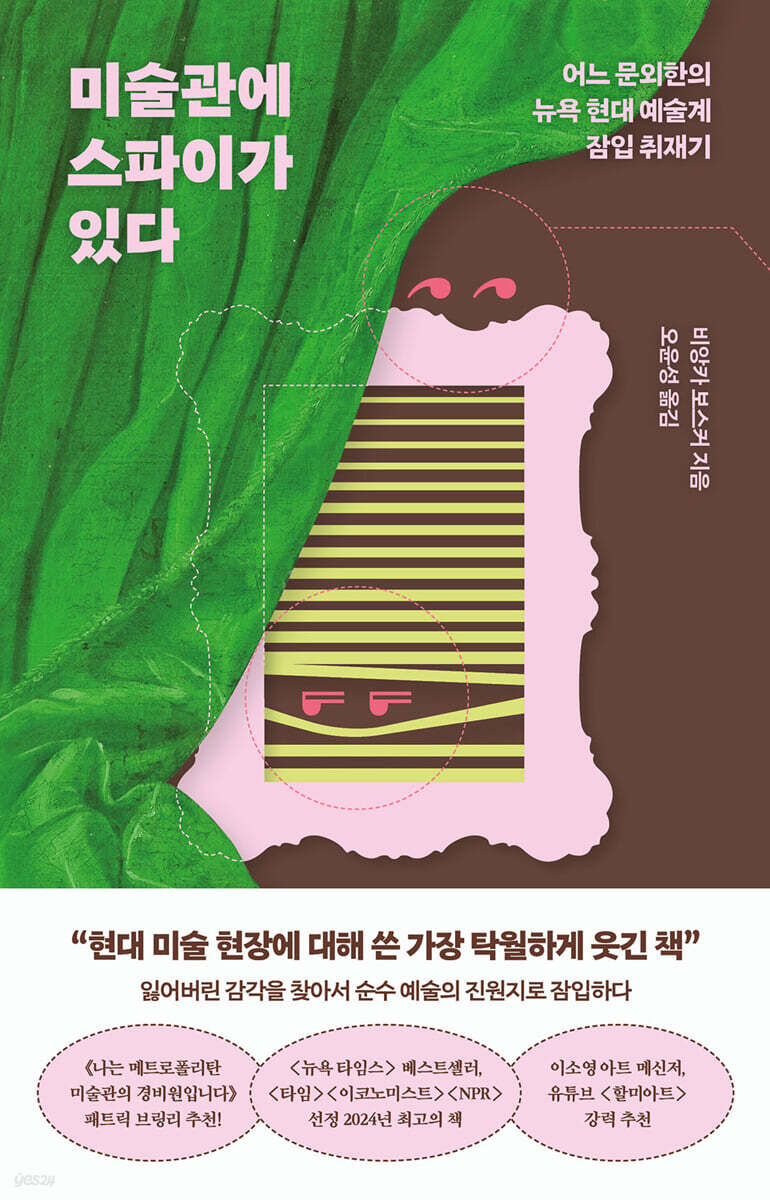
An undercover report that dives into the heart of art."What did you draw? Is this art?" A journalist goes undercover in the heart of New York's modern art scene to answer questions about modern art.
From gallery staff to museum security guards, this captivating exploration explores the fundamental questions of "What is good art? What is beauty?", offering readers a fresh and original perspective.
September 9, 2025. Art PD Ahn Hyun-jae
To you who have ever sat in a corner of an art gallery and thought, ‘Is this art too?’
An outsider's undercover investigation into the mysterious and confusing New York art world.
★★★I'm a Security Guard at the Metropolitan Museum of Art by Patrick Bringley, Lee So-young Art Messenger, YouTube [Grandma Art] Recommended★★★
★★★A New York Times bestseller, and a Best Book of 2024 by Time, The Economist, and NPR★★★
A foreigner's exploration of the New York contemporary art ecosystem, for those who have at least once wondered, "What on earth is this painting?" in a corner of an art gallery or exhibition hall.
The author, who was living a comfortable life as a journalist, suddenly wondered, "Why is art these days neglecting the public?" and, despite everyone's opposition, threw himself into this secretive and closed industry called "pure art."
A full-color reportage documenting the chaotic art world where “everyone is crazy!” and “this is so beautiful!” strangely coexist.
Starting out as a low-level employee at a small Brooklyn gallery, he worked his way up to selling paintings at the Miami Art Fair, then worked as an exhibition curator and studio assistant for emerging artists, and finally, as a security guard at the Guggenheim Museum, where he spent a long time staring at the silent works of art.
The author's multi-year journey continues, never swayed by the cynicism and contempt of industry elites and experts, VIPs and the super-rich, and "insiders" who claim to possess "high-brow taste."
The author's exciting journey into the world of "people who hyperventilate when they see their favorite color" leads to fundamental questions such as "What does it mean to see art?" and "What is good art, what is beauty?"
This book is a highly enjoyable introduction to modern art (more precisely, contemporary art), a subject that has often seemed difficult to understand, and will offer a fresh and original perspective to those who already love art.
An outsider's undercover investigation into the mysterious and confusing New York art world.
★★★I'm a Security Guard at the Metropolitan Museum of Art by Patrick Bringley, Lee So-young Art Messenger, YouTube [Grandma Art] Recommended★★★
★★★A New York Times bestseller, and a Best Book of 2024 by Time, The Economist, and NPR★★★
A foreigner's exploration of the New York contemporary art ecosystem, for those who have at least once wondered, "What on earth is this painting?" in a corner of an art gallery or exhibition hall.
The author, who was living a comfortable life as a journalist, suddenly wondered, "Why is art these days neglecting the public?" and, despite everyone's opposition, threw himself into this secretive and closed industry called "pure art."
A full-color reportage documenting the chaotic art world where “everyone is crazy!” and “this is so beautiful!” strangely coexist.
Starting out as a low-level employee at a small Brooklyn gallery, he worked his way up to selling paintings at the Miami Art Fair, then worked as an exhibition curator and studio assistant for emerging artists, and finally, as a security guard at the Guggenheim Museum, where he spent a long time staring at the silent works of art.
The author's multi-year journey continues, never swayed by the cynicism and contempt of industry elites and experts, VIPs and the super-rich, and "insiders" who claim to possess "high-brow taste."
The author's exciting journey into the world of "people who hyperventilate when they see their favorite color" leads to fundamental questions such as "What does it mean to see art?" and "What is good art, what is beauty?"
This book is a highly enjoyable introduction to modern art (more precisely, contemporary art), a subject that has often seemed difficult to understand, and will offer a fresh and original perspective to those who already love art.
- You can preview some of the book's contents.
Preview
index
Recommendation
Preface to the Korean edition
Introduction: Heads of Art
Part 1.
Jump into the art world
Chapter 1.
An uninvited outsider to the New York art world
Chapter 2.
The first task of a gallery worker is to apply nine layers of paint.
Chapter 3.
An art ecosystem that wields luxury goods and gossip
Chapter 4.
No one can succeed without someone else's name.
Chapter 5.
The monster called 'context' that is more important than the work itself
Chapter 6.
Towards an art fair where the smell of money vibrates
Part 2.
Dance, dance, dance at the Miami Art Fair
Chapter 7.
The painting market, where I jumped in with a bet of $39,000
Chapter 8.
Gods of the Art World, VIP and My First Painting Sales Machine
Chapter 9.
Is this art? An artist's butt with his face crushed.
Chapter 10.
There is no such thing as 'best' in art and work.
Part 3.
Artist in Brooklyn Studio
Chapter 11.
“I want to be the writer’s assistant.”
Chapter 12.
The Hungry Artist and the Starving Brush
Chapter 13.
From holding a paint can to holding a paint brush
Chapter 14.
People who went crazy looking for just one color
Chapter 15.
A Prayer for Survival as a Professional Artist
Chapter 16.
Why is this ugly and that beautiful?
Chapter 17.
Looking at the illusion of reality through the eyes of art
Part 4.
What the Guggenheim Museum Security Guard Sees
Chapter 18.
A new security guard appears in the mecca of art.
Chapter 19.
The true meaning of owning a work of art
Chapter 20.
Now stop, notice, and admire.
Opening Up: A New Beginning After a Stop
Acknowledgements
References
Preface to the Korean edition
Introduction: Heads of Art
Part 1.
Jump into the art world
Chapter 1.
An uninvited outsider to the New York art world
Chapter 2.
The first task of a gallery worker is to apply nine layers of paint.
Chapter 3.
An art ecosystem that wields luxury goods and gossip
Chapter 4.
No one can succeed without someone else's name.
Chapter 5.
The monster called 'context' that is more important than the work itself
Chapter 6.
Towards an art fair where the smell of money vibrates
Part 2.
Dance, dance, dance at the Miami Art Fair
Chapter 7.
The painting market, where I jumped in with a bet of $39,000
Chapter 8.
Gods of the Art World, VIP and My First Painting Sales Machine
Chapter 9.
Is this art? An artist's butt with his face crushed.
Chapter 10.
There is no such thing as 'best' in art and work.
Part 3.
Artist in Brooklyn Studio
Chapter 11.
“I want to be the writer’s assistant.”
Chapter 12.
The Hungry Artist and the Starving Brush
Chapter 13.
From holding a paint can to holding a paint brush
Chapter 14.
People who went crazy looking for just one color
Chapter 15.
A Prayer for Survival as a Professional Artist
Chapter 16.
Why is this ugly and that beautiful?
Chapter 17.
Looking at the illusion of reality through the eyes of art
Part 4.
What the Guggenheim Museum Security Guard Sees
Chapter 18.
A new security guard appears in the mecca of art.
Chapter 19.
The true meaning of owning a work of art
Chapter 20.
Now stop, notice, and admire.
Opening Up: A New Beginning After a Stop
Acknowledgements
References
Detailed image

Into the book
To be honest, everyone was against my idea.
This scared me, as it was not only impossible but also had some dangerous aspects.
It wasn't like anyone had openly threatened my safety or anything.
But I said, I wonder if my reputation, my happiness, my life as a journalist are really okay.
I wasn't trying to expose any national intelligence agency.
The place I was trying to infiltrate was the art world, a world that seemed to be in a state of collective delusion.
I wanted to know why art was important, whether it was even a serious issue, whether the quiet time spent gazing at a rock-shaped smear of paint on a taut cloth—commonly called a "painting"—could really transform human existence.
I was dying to know right away.
--- p.11
Here are some things I've accomplished over the years:
I was thrown out of the normal life I had been living and witnessed how messy 'pure' art could become.
We've caught up with the brush-crazy nerds, the color freaks, the "eyes," the brains, and the artist's enthusiasts to find out what keeps them up at night.
I bled on canvas, skin flayed on sculptures, and had a nearly naked stranger sit on my face in the name of art.
I worked as a security guard at an art museum, guarding piles of dust, and I understood why the scientific community called art a "biologically indispensable tool."
People crazy about art consider paintings as part of their bodies and find beauty in places we never thought of.
I got drunk because of them, I got courage, I got embarrassed, I got quiet, and I ended up becoming friends with them.
In this process, I discovered a new form of human existence.
A life where seeing with your eyes is an adventure.
--- p.27
A gallery that sells a lot of art is not necessarily a 'good' gallery.
In Jack's group, the highest compliment given to the gallery was the word "pure."
Pure galleries treat money like diarrhea.
'It's a harsh reality, but it's terrible.
It's like saying, 'Even if you have diarrhea, don't show it.'
Purists build their reputation and then gradually convert it into money, a process that may seem random at first glance, but is actually a highly calculated one.
Gagosian (300 employees, 280 artists, 19 gallery spaces, estimated annual revenue of $1 billion) is hardly a gallery, let alone a pure one.
One writer derided Gagosian as a "bank."
To be a purist, you have to exhibit works that are on the fringes, like a pile of Dan Bo's home appliances.
'Colorful paintings' were another word for 'easy money', and there were even people who spit out words and despised such works.
--- p.70~71
Here's the bad news.
First, being a woman doesn't help.
One collector Jack knew wouldn't buy any work by female artists because he thought they were "all going to be mothers soon."
Second, the big picture is risky.
Jack revealed an open secret in the industry.
“The elevators in Manhattan apartment complexes are the size of the palm of your hand.
Works that don't fit in there won't sell.
I wonder how you can decorate a living room with such a small painting, but anyway, that's it." Third, be wary of people in the art world.
“All the weird dynamics between humans are magnified when they enter the art world,” Jack said, pouring everyone a glass of red wine.
“There are a lot of people who are on the verge of alcoholism and a lot of people who are mentally unsound, and those two groups meet and drink all night long.
It's a disturbing combination."
--- p.97
How difficult it must have been for Jack to be with me. He lifted his shirt to reveal the rash that covered his abdomen so fiercely.
It was shingles.
He said, pointing to his stomach.
“It’s all your fault.”
After a few weeks, things started to get funny.
no.
It's wrong to say it's funny.
I guess it would be right to say that I felt sad.
From the moment I first started hanging out with people in the New York art world, I was struck by their delusions of grandeur.
They constantly checked their backs, were concerned about other people's opinions, and went off the record even when they were talking about something ordinary and normal.
But after spending a few months at 315, I too became fearful.
I was afraid that I would get the context wrong, wear the wrong clothes, or like the wrong piece of art.
I couldn't even form my own opinion until I asked someone who knew better.
--- p.140~141
Writer Gina Malek, whom I met at her home studio in the Bronx, offered similar advice.
“Just go to the piece and think about five things it shows you.” The five things here are not the overall theme or core of the piece.
This piece explores masculinity in the post-internet era, but it doesn't have to be some grand insight.
Just five things that caught your eye or that you felt a distinct emotion.
“That red is very cold, or very warm… that shape completely dominates the canvas… I like the way the vibrant paint fades there,” he said, touching on all the formal elements.
“It’s all important and has purpose,” I thought of Julie wrestling with the blue of the sky.
“Painting was a matter of endless choices.”
--- p.167
Hulbert, a visual neuroscientist, discussed color constancy by placing two paintings of Rouen Cathedral by Claude Monet side by side that day.
Monet painted Rouen Cathedral over thirty times, painting it at different times of day to study how the color of the stone on the building's surface—let's call it a dull beige—changes with the light.
He painted the cathedral at dawn, dusk, and noon.
I painted on clear days and cloudy days.
In the dawn painting, the cathedral's stone is a deep blue.
In the sunset painting, the color is vivid poppy.
According to Hulbert, this expression of color cannot be explained by artistry alone.
This means that some people, including artists, have the ability to transcend the brain's color constancy mechanisms.
Rebecca said:
“Monet saw all these different shades and brightnesses with his own eyes.
“Other people will probably only see the surface of the cathedral.”
--- p.328
Archaeological research shows that early humans went to great lengths to obtain the colors they wanted.
300,000 years ago, Paleolithic Africans traveled hundreds of kilometers across valleys teeming with deadly threats like snakes, lions, leopards, and hyenas to obtain the purple pigment pyroptic, even though pigments like yellow ochre and black manganese were readily available locally.
Why did you do that? Because the color was pretty.
Humans have committed poisoning, grave robbery, and murder because of their desire for color.
Ancient Romans used to have prisoners mine cinnabar (mercuric sulfide) to get the fiery red color of freshly slaughtered meat, a substance so toxic that digging it up was practically a death sentence.
--- p.334
The human brain has evolved as an engine that compresses reality into tiny droplets.
We had to conserve our mental energy to detect predators that were poised to emerge from the bushes and devour us.
But what happened when we evolved beyond being prey? I think our brains needed to transform from garbage compactors into microscopes.
It was in that very process that art would have emerged.
Art is a means of counteracting our instincts to cut off the trunk and branches from reality, and thereby allowing us to perceive more, understand more, and empathize more.
In short, art is a way to experience more.
If our lives are the sum total of our individual experiences, art, by not compressing those experiences, literally allows us to live a larger life in the same amount of time.
Art is both a practice of savoring life and a practice of creating a life worth savoring.
--- p.374~375
For example, when Van Gogh painted his famous [Sunflowers], he used yellow paint made from lead chromate, which was the latest pigment at the time, but it was only much later discovered that this pigment was easily discolored.
So the petals, which were initially bright yellow, turned brown like a real flower.
In the 1960s, Frank Stella created geometric abstract paintings featuring striking fluorescent stripes.
The bright orange he used, the yellow like tape marking the off-limits area, is already fading.
According to one conservator, if left unrestored, the work would turn into a "milky ruin."
It's a shame.
But it's also a wonderful thing.
This is why we must trust our own eyes.
Works of art change.
It gets damaged, rots, and falls apart.
In a way, the writing on the wall is an outdated explanation that cannot reflect such changes.
So, you now know that the best way to appreciate a work of art is to encounter it right now, at this very moment, in this very light, on this very day, at this very hour, on this very tour.
This scared me, as it was not only impossible but also had some dangerous aspects.
It wasn't like anyone had openly threatened my safety or anything.
But I said, I wonder if my reputation, my happiness, my life as a journalist are really okay.
I wasn't trying to expose any national intelligence agency.
The place I was trying to infiltrate was the art world, a world that seemed to be in a state of collective delusion.
I wanted to know why art was important, whether it was even a serious issue, whether the quiet time spent gazing at a rock-shaped smear of paint on a taut cloth—commonly called a "painting"—could really transform human existence.
I was dying to know right away.
--- p.11
Here are some things I've accomplished over the years:
I was thrown out of the normal life I had been living and witnessed how messy 'pure' art could become.
We've caught up with the brush-crazy nerds, the color freaks, the "eyes," the brains, and the artist's enthusiasts to find out what keeps them up at night.
I bled on canvas, skin flayed on sculptures, and had a nearly naked stranger sit on my face in the name of art.
I worked as a security guard at an art museum, guarding piles of dust, and I understood why the scientific community called art a "biologically indispensable tool."
People crazy about art consider paintings as part of their bodies and find beauty in places we never thought of.
I got drunk because of them, I got courage, I got embarrassed, I got quiet, and I ended up becoming friends with them.
In this process, I discovered a new form of human existence.
A life where seeing with your eyes is an adventure.
--- p.27
A gallery that sells a lot of art is not necessarily a 'good' gallery.
In Jack's group, the highest compliment given to the gallery was the word "pure."
Pure galleries treat money like diarrhea.
'It's a harsh reality, but it's terrible.
It's like saying, 'Even if you have diarrhea, don't show it.'
Purists build their reputation and then gradually convert it into money, a process that may seem random at first glance, but is actually a highly calculated one.
Gagosian (300 employees, 280 artists, 19 gallery spaces, estimated annual revenue of $1 billion) is hardly a gallery, let alone a pure one.
One writer derided Gagosian as a "bank."
To be a purist, you have to exhibit works that are on the fringes, like a pile of Dan Bo's home appliances.
'Colorful paintings' were another word for 'easy money', and there were even people who spit out words and despised such works.
--- p.70~71
Here's the bad news.
First, being a woman doesn't help.
One collector Jack knew wouldn't buy any work by female artists because he thought they were "all going to be mothers soon."
Second, the big picture is risky.
Jack revealed an open secret in the industry.
“The elevators in Manhattan apartment complexes are the size of the palm of your hand.
Works that don't fit in there won't sell.
I wonder how you can decorate a living room with such a small painting, but anyway, that's it." Third, be wary of people in the art world.
“All the weird dynamics between humans are magnified when they enter the art world,” Jack said, pouring everyone a glass of red wine.
“There are a lot of people who are on the verge of alcoholism and a lot of people who are mentally unsound, and those two groups meet and drink all night long.
It's a disturbing combination."
--- p.97
How difficult it must have been for Jack to be with me. He lifted his shirt to reveal the rash that covered his abdomen so fiercely.
It was shingles.
He said, pointing to his stomach.
“It’s all your fault.”
After a few weeks, things started to get funny.
no.
It's wrong to say it's funny.
I guess it would be right to say that I felt sad.
From the moment I first started hanging out with people in the New York art world, I was struck by their delusions of grandeur.
They constantly checked their backs, were concerned about other people's opinions, and went off the record even when they were talking about something ordinary and normal.
But after spending a few months at 315, I too became fearful.
I was afraid that I would get the context wrong, wear the wrong clothes, or like the wrong piece of art.
I couldn't even form my own opinion until I asked someone who knew better.
--- p.140~141
Writer Gina Malek, whom I met at her home studio in the Bronx, offered similar advice.
“Just go to the piece and think about five things it shows you.” The five things here are not the overall theme or core of the piece.
This piece explores masculinity in the post-internet era, but it doesn't have to be some grand insight.
Just five things that caught your eye or that you felt a distinct emotion.
“That red is very cold, or very warm… that shape completely dominates the canvas… I like the way the vibrant paint fades there,” he said, touching on all the formal elements.
“It’s all important and has purpose,” I thought of Julie wrestling with the blue of the sky.
“Painting was a matter of endless choices.”
--- p.167
Hulbert, a visual neuroscientist, discussed color constancy by placing two paintings of Rouen Cathedral by Claude Monet side by side that day.
Monet painted Rouen Cathedral over thirty times, painting it at different times of day to study how the color of the stone on the building's surface—let's call it a dull beige—changes with the light.
He painted the cathedral at dawn, dusk, and noon.
I painted on clear days and cloudy days.
In the dawn painting, the cathedral's stone is a deep blue.
In the sunset painting, the color is vivid poppy.
According to Hulbert, this expression of color cannot be explained by artistry alone.
This means that some people, including artists, have the ability to transcend the brain's color constancy mechanisms.
Rebecca said:
“Monet saw all these different shades and brightnesses with his own eyes.
“Other people will probably only see the surface of the cathedral.”
--- p.328
Archaeological research shows that early humans went to great lengths to obtain the colors they wanted.
300,000 years ago, Paleolithic Africans traveled hundreds of kilometers across valleys teeming with deadly threats like snakes, lions, leopards, and hyenas to obtain the purple pigment pyroptic, even though pigments like yellow ochre and black manganese were readily available locally.
Why did you do that? Because the color was pretty.
Humans have committed poisoning, grave robbery, and murder because of their desire for color.
Ancient Romans used to have prisoners mine cinnabar (mercuric sulfide) to get the fiery red color of freshly slaughtered meat, a substance so toxic that digging it up was practically a death sentence.
--- p.334
The human brain has evolved as an engine that compresses reality into tiny droplets.
We had to conserve our mental energy to detect predators that were poised to emerge from the bushes and devour us.
But what happened when we evolved beyond being prey? I think our brains needed to transform from garbage compactors into microscopes.
It was in that very process that art would have emerged.
Art is a means of counteracting our instincts to cut off the trunk and branches from reality, and thereby allowing us to perceive more, understand more, and empathize more.
In short, art is a way to experience more.
If our lives are the sum total of our individual experiences, art, by not compressing those experiences, literally allows us to live a larger life in the same amount of time.
Art is both a practice of savoring life and a practice of creating a life worth savoring.
--- p.374~375
For example, when Van Gogh painted his famous [Sunflowers], he used yellow paint made from lead chromate, which was the latest pigment at the time, but it was only much later discovered that this pigment was easily discolored.
So the petals, which were initially bright yellow, turned brown like a real flower.
In the 1960s, Frank Stella created geometric abstract paintings featuring striking fluorescent stripes.
The bright orange he used, the yellow like tape marking the off-limits area, is already fading.
According to one conservator, if left unrestored, the work would turn into a "milky ruin."
It's a shame.
But it's also a wonderful thing.
This is why we must trust our own eyes.
Works of art change.
It gets damaged, rots, and falls apart.
In a way, the writing on the wall is an outdated explanation that cannot reflect such changes.
So, you now know that the best way to appreciate a work of art is to encounter it right now, at this very moment, in this very light, on this very day, at this very hour, on this very tour.
--- p.434
Publisher's Review
“This book will change the way you ‘see’ art forever!”
Collectors, critics, spectators, and artists… Memoirs of passionate madmen
[New York Times] Bianca Bosker, author of the bestselling book Cork Dork, which delved into the dark underbelly of America's premier wine industry, returns with her new book, Get the Picture.
The author, who is actively working as a cultural journalist, guides readers into the secret and mad world of the 'New York art world', the 'contemporary art world', and various artists, which have been shrouded in mystery from the general public.
One day, the author recalls a forgotten watercolor painting by his grandmother from his childhood, and is seized by a pure artistic desire to awaken his dulled senses and regain new emotions.
This desire goes beyond simple curiosity and develops into a crazed desire to understand modern art, which is difficult to grasp even at a glance.
She finally decides to step into this impregnable 'pure art world' on her own two feet (although industry insiders unanimously tell her to "get out").
This book is a vivid exploration of the new world of "high art," a beautiful and noble, yet at the same time ambiguous, complex, and often bizarre and even comical one.
It is also a memoir of the author (or the general public, a passerby, or a single viewer) who has worked tirelessly for years to open the eyes of the viewer to modern art that makes them wonder, "Is this art too?"
Furthermore, it is also a self-reflective essay that persistently searches for beauty hidden deep within and one's own aesthetics.
“Why is this ugly and that beautiful?”
A small, revolutionary exploration journal for those who think "art is difficult."
The author begins writing this unique undercover account while barely managing to secure a low-level job at a small gallery in Brooklyn.
He stretches his canvas until his fingers are blistered, paints every wall in the gallery over and over again, and struggles to sell his paintings at any cost during the art fair in Miami Beach.
He's not afraid to join A-list parties filled with billionaire collectors, or to put his face against the buttocks of a nearly naked performance artist to understand abstraction.
And finally, I become a security guard at the Guggenheim Museum, known as the mecca of art, and I get to gaze at a single work of art in a quiet vacuum.
Through all these days, despite the petty contempt and cold judgments from so-called industry insiders, she bravely moves forward to find answers to her questions.
Instead of relying on old definitions of art or aesthetic theories, "There's a Spy in the Art Gallery" transparently describes the art world as a mess of money, power, class, desire, vanity, and gossip.
But that point doesn't make the book cynical.
Rather, it clearly shows the vitality of art through the lives of artists who fiercely create and survive even in isolated leagues, and the audience who burst into tears before their eyes at the work.
And finally, the author discovers his own way of life, which extends beyond the mechanistic workings of the art world.
She, who had never really understood a single painting, began to develop a 'real sense' of looking at art as she spent hours moving frames, hanging lights, priming canvases, and helping emerging artists with their work.
“A guide for everyone, from modern art lovers to skeptics.” _Patrick Bringley
“Art is not for the few, but for all who see it.” _Lee So-young, Art Messenger
“I’ve never seen a more raw (in a positive sense) art world story.” _YouTube “Grandma Art”
This book seems to be telling its readers:
“Art exists only in the way you ‘see’ it.
“If you find your own perspective, you can experience life again.” This message comes from the author’s belief that art is not just for a few experts or a select few geniuses, but that we can all connect with art as subjects of the senses.
"There's a Spies in the Art Museum" will be a delightful introduction for those who have found modern art difficult, and for those who already love art, it will be a book that presents a new lens of perspective.
To regain my lost senses and rediscover my true self.
It is time for us to relearn how to 'see' colors, objects, works of art, art, and life.
Collectors, critics, spectators, and artists… Memoirs of passionate madmen
[New York Times] Bianca Bosker, author of the bestselling book Cork Dork, which delved into the dark underbelly of America's premier wine industry, returns with her new book, Get the Picture.
The author, who is actively working as a cultural journalist, guides readers into the secret and mad world of the 'New York art world', the 'contemporary art world', and various artists, which have been shrouded in mystery from the general public.
One day, the author recalls a forgotten watercolor painting by his grandmother from his childhood, and is seized by a pure artistic desire to awaken his dulled senses and regain new emotions.
This desire goes beyond simple curiosity and develops into a crazed desire to understand modern art, which is difficult to grasp even at a glance.
She finally decides to step into this impregnable 'pure art world' on her own two feet (although industry insiders unanimously tell her to "get out").
This book is a vivid exploration of the new world of "high art," a beautiful and noble, yet at the same time ambiguous, complex, and often bizarre and even comical one.
It is also a memoir of the author (or the general public, a passerby, or a single viewer) who has worked tirelessly for years to open the eyes of the viewer to modern art that makes them wonder, "Is this art too?"
Furthermore, it is also a self-reflective essay that persistently searches for beauty hidden deep within and one's own aesthetics.
“Why is this ugly and that beautiful?”
A small, revolutionary exploration journal for those who think "art is difficult."
The author begins writing this unique undercover account while barely managing to secure a low-level job at a small gallery in Brooklyn.
He stretches his canvas until his fingers are blistered, paints every wall in the gallery over and over again, and struggles to sell his paintings at any cost during the art fair in Miami Beach.
He's not afraid to join A-list parties filled with billionaire collectors, or to put his face against the buttocks of a nearly naked performance artist to understand abstraction.
And finally, I become a security guard at the Guggenheim Museum, known as the mecca of art, and I get to gaze at a single work of art in a quiet vacuum.
Through all these days, despite the petty contempt and cold judgments from so-called industry insiders, she bravely moves forward to find answers to her questions.
Instead of relying on old definitions of art or aesthetic theories, "There's a Spy in the Art Gallery" transparently describes the art world as a mess of money, power, class, desire, vanity, and gossip.
But that point doesn't make the book cynical.
Rather, it clearly shows the vitality of art through the lives of artists who fiercely create and survive even in isolated leagues, and the audience who burst into tears before their eyes at the work.
And finally, the author discovers his own way of life, which extends beyond the mechanistic workings of the art world.
She, who had never really understood a single painting, began to develop a 'real sense' of looking at art as she spent hours moving frames, hanging lights, priming canvases, and helping emerging artists with their work.
“A guide for everyone, from modern art lovers to skeptics.” _Patrick Bringley
“Art is not for the few, but for all who see it.” _Lee So-young, Art Messenger
“I’ve never seen a more raw (in a positive sense) art world story.” _YouTube “Grandma Art”
This book seems to be telling its readers:
“Art exists only in the way you ‘see’ it.
“If you find your own perspective, you can experience life again.” This message comes from the author’s belief that art is not just for a few experts or a select few geniuses, but that we can all connect with art as subjects of the senses.
"There's a Spies in the Art Museum" will be a delightful introduction for those who have found modern art difficult, and for those who already love art, it will be a book that presents a new lens of perspective.
To regain my lost senses and rediscover my true self.
It is time for us to relearn how to 'see' colors, objects, works of art, art, and life.
GOODS SPECIFICS
- Date of issue: August 27, 2025
- Page count, weight, size: 480 pages | 684g | 135*210*30mm
- ISBN13: 9788925573298
- ISBN 10: 8925573296
You may also like
카테고리
korean


korean

![GQ KOREA Mark (Monthly): December [2025]](http://librairie.coreenne.fr/cdn/shop/files/8ef265dbbfbf186523ed75ba7319009d.jpg?v=1765340328&width=3840)


