

An art museum embracing the universe
 |
Description
Book Introduction
Artists' gaze towards the sky,
The story of the universe and humanity contained within it
Humans have been looking up at the sky since long ago.
He counted the stars and adjusted his life by following the movements of the sun and moon.
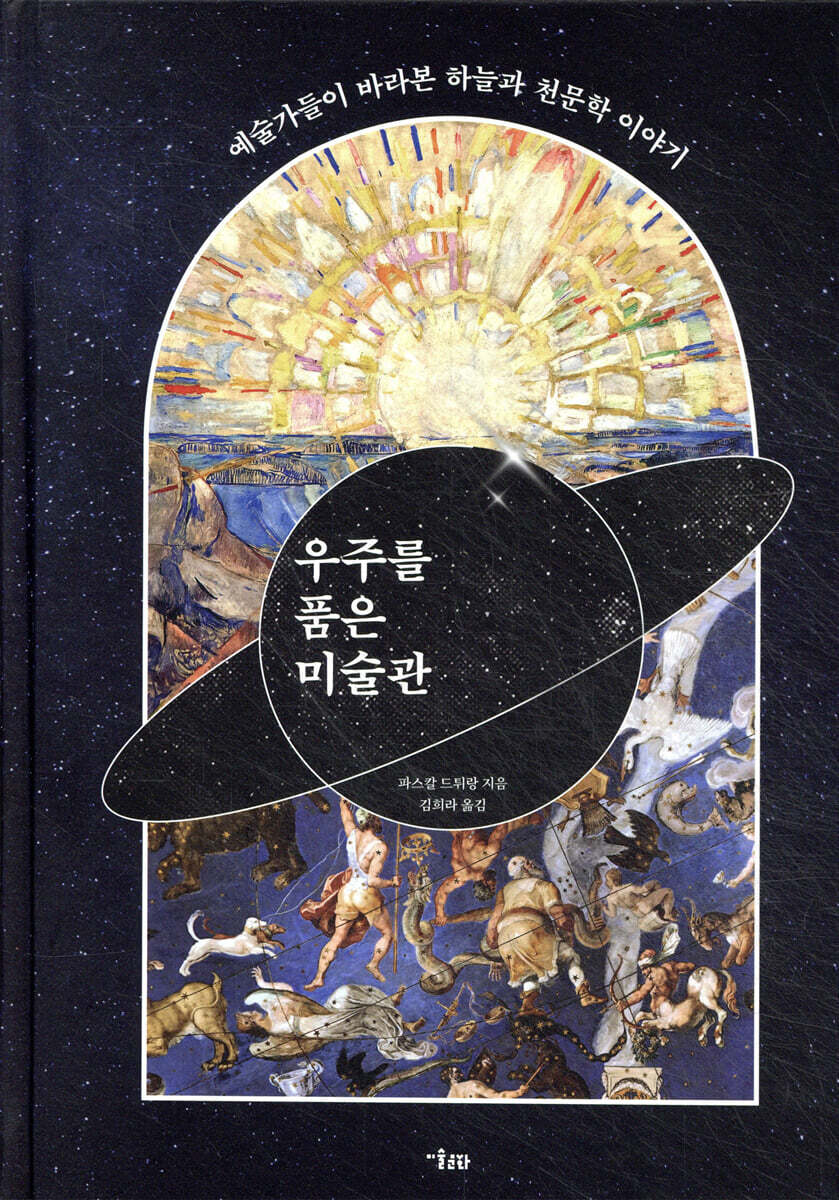
But what does the sky we encounter in art galleries look like? How have artists depicted the universe? "Art Gallery Embracing the Universe" is an astronomy and art humanities book that delves into the history of humanity's interpretation of the sky through works of art.
From ancient times to the present, we will follow the eras to see how the sun, moon, planets, and astronomical phenomena have been reborn in paintings through mythology, philosophy, science, and imagination.
If you follow the night sky that astronomers, philosophers, and painters have looked at together, you will soon realize something.
Looking at the sky means looking at myself.
The story of the universe and humanity contained within it
Humans have been looking up at the sky since long ago.
He counted the stars and adjusted his life by following the movements of the sun and moon.
But what does the sky we encounter in art galleries look like? How have artists depicted the universe? "Art Gallery Embracing the Universe" is an astronomy and art humanities book that delves into the history of humanity's interpretation of the sky through works of art.
From ancient times to the present, we will follow the eras to see how the sun, moon, planets, and astronomical phenomena have been reborn in paintings through mythology, philosophy, science, and imagination.
If you follow the night sky that astronomers, philosophers, and painters have looked at together, you will soon realize something.
Looking at the sky means looking at myself.
- You can preview some of the book's contents.
Preview
index
Prologue: Exploring the Infinity Beyond Your Eyes
-Coronelli's celestial sphere
- Ancient sky images
Part 1.
sun
The rise and fall of supreme power
Ancient Sun God Festival
- The sun in American Indian culture
The Magnificent Sun - Middle Ages and Renaissance
- The Duke of Berry's very luxurious prayer calendar
- The Solar System from Antiquity to the Renaissance
The Sun King's Reign
- Tiepolo's The Sun
The sublimity of romanticism
- Sunset of Romanticism
Age of Light
- The sun's orbit in the northern hemisphere
- The Sun of Surrealist Art
Part 2.
moon
A remarkable riddle
About the origin
- Japanese mythology and customs
- Moon Myths and Legends of the World
Protecting Mother, Queen of Heaven
- Map of the Moon in Art
Eyes of Melancholy
- The Moon in 19th Century Poetry
Travel and Dreams
- To the moon!
- moon
Part 3.
planet
Myths and Magic
- Nebra Sky Disc
- Solar system
Saturn is afraid
- Saturn
Brilliant Venus
- Venus
Giant Jupiter
- Jupiter
Mars, Mercury, and the rest of the planets
- Mars
- Mercury
- Uranus
- Neptune
- Astronomical symbols
constellation
- Constellation map
Part 4.
astronomical phenomena
Chaotic sky
Shining comets and meteors
- The life cycle of a star
The language of eclipses
- The food shown in the Passion of Jesus
The dazzlingly beautiful aurora
- Formation of the aurora
Epilogue: Towards the Stars - Ad Astra
- Starry Night of the 19th Century
Acknowledgements
List of plates
index
Copyright credit
-Coronelli's celestial sphere
- Ancient sky images
Part 1.
sun
The rise and fall of supreme power
Ancient Sun God Festival
- The sun in American Indian culture
The Magnificent Sun - Middle Ages and Renaissance
- The Duke of Berry's very luxurious prayer calendar
- The Solar System from Antiquity to the Renaissance
The Sun King's Reign
- Tiepolo's The Sun
The sublimity of romanticism
- Sunset of Romanticism
Age of Light
- The sun's orbit in the northern hemisphere
- The Sun of Surrealist Art
Part 2.
moon
A remarkable riddle
About the origin
- Japanese mythology and customs
- Moon Myths and Legends of the World
Protecting Mother, Queen of Heaven
- Map of the Moon in Art
Eyes of Melancholy
- The Moon in 19th Century Poetry
Travel and Dreams
- To the moon!
- moon
Part 3.
planet
Myths and Magic
- Nebra Sky Disc
- Solar system
Saturn is afraid
- Saturn
Brilliant Venus
- Venus
Giant Jupiter
- Jupiter
Mars, Mercury, and the rest of the planets
- Mars
- Mercury
- Uranus
- Neptune
- Astronomical symbols
constellation
- Constellation map
Part 4.
astronomical phenomena
Chaotic sky
Shining comets and meteors
- The life cycle of a star
The language of eclipses
- The food shown in the Passion of Jesus
The dazzlingly beautiful aurora
- Formation of the aurora
Epilogue: Towards the Stars - Ad Astra
- Starry Night of the 19th Century
Acknowledgements
List of plates
index
Copyright credit
Detailed image

Into the book
What will be at the end of the created world?
One day, someone is seized by an irresistible desire to see it.
Our human beings, our pilgrims, who seek to realize this wish, go to the ends of the earth.
Perhaps it was curiosity and anxiety that led him there.
--- p.9
The sun, the supreme star, creator of all things, a mingling of light and life, is the undisputed protagonist on the stage of the universe.
The sun's grandeur and brilliance, as well as its excess and violence, speak of its divine status from the beginning.
--- p.29
In surrealist art, the sun becomes a messenger announcing the arrival of an unprecedented world.
Apollinaire innovated the language of the sun by boldly describing it as a “decapitated sun” in his poetry collection Alcohol (1913).
The sun of surrealism shakes our convictions, as if it were ruthlessly breaking down images that have been accepted for too long.
The sun of this period overturns stereotypes and prepares surprises, allowing the viewer to have not only a new perspective but also a newly created world.
--- p.106
The goddess of the moon, the elusive goddess of the night, gentle yet dark, luminous yet associated with the underworld, is a contrasting figure and a vivid contradiction.
She is chaste but yields to desire, lovely but turns those who look at her to stone.
The list of conflicting things she embodies could be endless.
What is life? For her, life lies in the death in which she exists.
--- p.115
Still, dream.
A comforting dream.
A dream that brings relief rather than worry, as felt in Slutters' "Moonlight 4."
(...) What does it matter if the universe remains an eternal mystery, if humanity's place in the infinite is unknown, if life and death are incomprehensible concepts? The gentleness that permeates the moon and its caresses tells us one thing.
There will be a time for pursuit and worry, but there will also be a time for silence and sleep.
--- p.155
Venus fills the night with white light.
Venus was created to dazzle, and the goddess's body was made for love.
As a planet, Venus shines so brightly that it casts a shadow over its surroundings.
As a goddess, Venus stimulates the instincts to the point of overwhelming other women.
Clearly, she is a woman of heaven, a woman we seek, pray for, and love.
In the Triumph of Venus by the master of the Taranto conquest, the goddess stands nude in the center of a halo above a dodecagonal frame.
--- p.192
In the Chariot of Jupiter between Justice and Faith by Coappel, one of the decorative paintings of the Palace of Versailles, Jupiter naturally occupies the highest position and the grandeur of the king is revealed.
He carries a thunderbolt in his hand, wears a fluttering tunic, and has muscular muscles and the beard of old age.
Two eagles are not too many to pull his heavenly chariot.
--- p.204
The Vietnamese believed that the food phenomenon was caused by a giant frog-shaped demon called Raj swallowing the sun and moon.
In India, it was also believed that frogs eat the sun.
Raj pretended to be a god to steal immortality, but the sun god and moon god discovered him and reported him to the Hindu god Vishnu.
Vishnu punished Raja by cutting off his head before he could consume the sun.
--- p.272
With increasingly precise space telescopes allowing us to peer back to the Big Bang and beyond, has the universe lost its allure? The answer offered by three women—Hyeja Bang, Helen Frankenthaler, and Vija Celmins—is clear.
For them, stargazing is not only one of humanity's oldest activities, but it is also one that still makes the modern world nervous.
All three works are on the edge of abstraction because stars are at the edge of the visible realm.
If what they want to express is something that transcends not only the visual but also the imagination, then stars can be said to be at the extreme of art.
Infinity can never be captured in a picture, and the universe, if not infinite, is at least unfathomably vast and beyond the reach of even the most sophisticated telescopes.
Faced with a deep chasm filled with fragments of light in the very center of where human existence emerged, we simply lose our minds.
You will be confused.
It will be confusing but ecstatic.
One day, someone is seized by an irresistible desire to see it.
Our human beings, our pilgrims, who seek to realize this wish, go to the ends of the earth.
Perhaps it was curiosity and anxiety that led him there.
--- p.9
The sun, the supreme star, creator of all things, a mingling of light and life, is the undisputed protagonist on the stage of the universe.
The sun's grandeur and brilliance, as well as its excess and violence, speak of its divine status from the beginning.
--- p.29
In surrealist art, the sun becomes a messenger announcing the arrival of an unprecedented world.
Apollinaire innovated the language of the sun by boldly describing it as a “decapitated sun” in his poetry collection Alcohol (1913).
The sun of surrealism shakes our convictions, as if it were ruthlessly breaking down images that have been accepted for too long.
The sun of this period overturns stereotypes and prepares surprises, allowing the viewer to have not only a new perspective but also a newly created world.
--- p.106
The goddess of the moon, the elusive goddess of the night, gentle yet dark, luminous yet associated with the underworld, is a contrasting figure and a vivid contradiction.
She is chaste but yields to desire, lovely but turns those who look at her to stone.
The list of conflicting things she embodies could be endless.
What is life? For her, life lies in the death in which she exists.
--- p.115
Still, dream.
A comforting dream.
A dream that brings relief rather than worry, as felt in Slutters' "Moonlight 4."
(...) What does it matter if the universe remains an eternal mystery, if humanity's place in the infinite is unknown, if life and death are incomprehensible concepts? The gentleness that permeates the moon and its caresses tells us one thing.
There will be a time for pursuit and worry, but there will also be a time for silence and sleep.
--- p.155
Venus fills the night with white light.
Venus was created to dazzle, and the goddess's body was made for love.
As a planet, Venus shines so brightly that it casts a shadow over its surroundings.
As a goddess, Venus stimulates the instincts to the point of overwhelming other women.
Clearly, she is a woman of heaven, a woman we seek, pray for, and love.
In the Triumph of Venus by the master of the Taranto conquest, the goddess stands nude in the center of a halo above a dodecagonal frame.
--- p.192
In the Chariot of Jupiter between Justice and Faith by Coappel, one of the decorative paintings of the Palace of Versailles, Jupiter naturally occupies the highest position and the grandeur of the king is revealed.
He carries a thunderbolt in his hand, wears a fluttering tunic, and has muscular muscles and the beard of old age.
Two eagles are not too many to pull his heavenly chariot.
--- p.204
The Vietnamese believed that the food phenomenon was caused by a giant frog-shaped demon called Raj swallowing the sun and moon.
In India, it was also believed that frogs eat the sun.
Raj pretended to be a god to steal immortality, but the sun god and moon god discovered him and reported him to the Hindu god Vishnu.
Vishnu punished Raja by cutting off his head before he could consume the sun.
--- p.272
With increasingly precise space telescopes allowing us to peer back to the Big Bang and beyond, has the universe lost its allure? The answer offered by three women—Hyeja Bang, Helen Frankenthaler, and Vija Celmins—is clear.
For them, stargazing is not only one of humanity's oldest activities, but it is also one that still makes the modern world nervous.
All three works are on the edge of abstraction because stars are at the edge of the visible realm.
If what they want to express is something that transcends not only the visual but also the imagination, then stars can be said to be at the extreme of art.
Infinity can never be captured in a picture, and the universe, if not infinite, is at least unfathomably vast and beyond the reach of even the most sophisticated telescopes.
Faced with a deep chasm filled with fragments of light in the very center of where human existence emerged, we simply lose our minds.
You will be confused.
It will be confusing but ecstatic.
--- p.302
Publisher's Review
The universe loved by art,
Adventure into its vast wonders
The sky has long been a screen reflecting our dreams and a repository of secrets.
The vast sky, where starlight and darkness intersect, has become a source of fear and wonder, imagination and exploration, and artists have captured that gaze in their works.
In this way, the universe has been a constant source of imagination and creation for humanity throughout the ages.
"The Art Museum Embracing the Universe" is a fusion of humanities and arts that weaves together art, astronomy, and mythological stories to explore how humans have interpreted the universe.
The book is divided into four parts, with Parts 1 and 2 exploring humanity's maps and symbols of the sky, centered around the sun and moon.
It unravels how the sun and moon were deified in ancient civilizations, and how the movements of constellations and celestial bodies were linked to mythological narratives.
It also shows how the image of the sky, transcending time and space, has been transformed in art, from the ornate prayer book illustrations of the Middle Ages and the astronomical illustrations of the Renaissance to the majestic sunsets and melancholic moonlit landscapes of Romantic painters.
Parts 3 and 4 deal with the planets and constellations that were thought to illuminate human destiny.
It explores the mythological origins and astrological significance of planets such as Venus, Saturn, and Jupiter, and how they have influenced human psychology and views of fate.
We further examine how the shapes of constellations have been translated into art, and how scientific discoveries have transformed artistic perspectives and symbols.
In this process, readers will gain a new appreciation for the profound relationship that art has had with the universe, as if deciphering the astronomical codes hidden throughout the artwork.
Ultimately, this book is an intellectual journey that shows how the boundaries of space and art intersect and reflect each other, through works of art that embody human aspirations and imagination toward the heavens.
From ancient paintings to modern art,
A selection of works that cross the East and West
Art Museum of the Shining Sky
This book contains over 260 works, ranging from ancient clay tablets to medieval miniatures, modern paintings, and contemporary abstract art.
Each chapter's illustrations are comprised of representative works that best illustrate the subject, allowing a fresh perspective on the entire history of art through the single theme of the universe.
This book is not simply a list of drawings of the universe.
From the kuduru of ancient Mesopotamia, the zodiac of the Middle Ages, the celestial globes of modern times, and even the abstract paintings of contemporary artists, it provides a three-dimensional view of how people of each era have tried to understand and explain the sky.
It also offers a broad perspective that crosses art, science, and philosophy, covering easily understandable astronomical knowledge along with the symbolism, mythology, religious interpretations, and psychological projections contained within it.
From the time when constellations and aurora were considered the language of the gods, there have been cultures that projected emotions and fate onto Venus and Saturn.
Before we know it, we realize that astronomy, captured in art, is the history of humanity's self-understanding.
This book contains the mythical imagination of mankind who worshipped the stars, the moment when astronomy was transformed into science, and the flow of art that returned to mystery in modern times.
As we follow the questions posed by philosophers, scientists, and artists who gazed at the sky and pondered, readers will find themselves revisiting the meaning of looking at the stars.
To all the pieces of stars living today,
Gifting an Art Gallery
“Don’t forget.
“You are made of star matter, and no one can take that away from you.”
―2021.
8. 4. NASA Instagram
Most of the elements that make up the human body were born in the hearts of stars, traveled through space, and arrived on Earth.
We are all made of star fragments.
This book is an art gallery that gives us, the pieces of that star, a piece of art.
From the mysteries that ancient people attributed to the stars and planets as they gazed at the sky, to the astronomical symbols left behind by the Middle Ages and the Renaissance, to the new language that modern artists use to interpret the universe, this volume compiles records of how humanity understood itself and imagined the world through the stars into an art archive.
As you turn the pages of this book, you will experience awe at the universe turning into questions about yourself.
This museum is the story of the vast universe, and the story of all of us who exist as fragments of stars.
Adventure into its vast wonders
The sky has long been a screen reflecting our dreams and a repository of secrets.
The vast sky, where starlight and darkness intersect, has become a source of fear and wonder, imagination and exploration, and artists have captured that gaze in their works.
In this way, the universe has been a constant source of imagination and creation for humanity throughout the ages.
"The Art Museum Embracing the Universe" is a fusion of humanities and arts that weaves together art, astronomy, and mythological stories to explore how humans have interpreted the universe.
The book is divided into four parts, with Parts 1 and 2 exploring humanity's maps and symbols of the sky, centered around the sun and moon.
It unravels how the sun and moon were deified in ancient civilizations, and how the movements of constellations and celestial bodies were linked to mythological narratives.
It also shows how the image of the sky, transcending time and space, has been transformed in art, from the ornate prayer book illustrations of the Middle Ages and the astronomical illustrations of the Renaissance to the majestic sunsets and melancholic moonlit landscapes of Romantic painters.
Parts 3 and 4 deal with the planets and constellations that were thought to illuminate human destiny.
It explores the mythological origins and astrological significance of planets such as Venus, Saturn, and Jupiter, and how they have influenced human psychology and views of fate.
We further examine how the shapes of constellations have been translated into art, and how scientific discoveries have transformed artistic perspectives and symbols.
In this process, readers will gain a new appreciation for the profound relationship that art has had with the universe, as if deciphering the astronomical codes hidden throughout the artwork.
Ultimately, this book is an intellectual journey that shows how the boundaries of space and art intersect and reflect each other, through works of art that embody human aspirations and imagination toward the heavens.
From ancient paintings to modern art,
A selection of works that cross the East and West
Art Museum of the Shining Sky
This book contains over 260 works, ranging from ancient clay tablets to medieval miniatures, modern paintings, and contemporary abstract art.
Each chapter's illustrations are comprised of representative works that best illustrate the subject, allowing a fresh perspective on the entire history of art through the single theme of the universe.
This book is not simply a list of drawings of the universe.
From the kuduru of ancient Mesopotamia, the zodiac of the Middle Ages, the celestial globes of modern times, and even the abstract paintings of contemporary artists, it provides a three-dimensional view of how people of each era have tried to understand and explain the sky.
It also offers a broad perspective that crosses art, science, and philosophy, covering easily understandable astronomical knowledge along with the symbolism, mythology, religious interpretations, and psychological projections contained within it.
From the time when constellations and aurora were considered the language of the gods, there have been cultures that projected emotions and fate onto Venus and Saturn.
Before we know it, we realize that astronomy, captured in art, is the history of humanity's self-understanding.
This book contains the mythical imagination of mankind who worshipped the stars, the moment when astronomy was transformed into science, and the flow of art that returned to mystery in modern times.
As we follow the questions posed by philosophers, scientists, and artists who gazed at the sky and pondered, readers will find themselves revisiting the meaning of looking at the stars.
To all the pieces of stars living today,
Gifting an Art Gallery
“Don’t forget.
“You are made of star matter, and no one can take that away from you.”
―2021.
8. 4. NASA Instagram
Most of the elements that make up the human body were born in the hearts of stars, traveled through space, and arrived on Earth.
We are all made of star fragments.
This book is an art gallery that gives us, the pieces of that star, a piece of art.
From the mysteries that ancient people attributed to the stars and planets as they gazed at the sky, to the astronomical symbols left behind by the Middle Ages and the Renaissance, to the new language that modern artists use to interpret the universe, this volume compiles records of how humanity understood itself and imagined the world through the stars into an art archive.
As you turn the pages of this book, you will experience awe at the universe turning into questions about yourself.
This museum is the story of the vast universe, and the story of all of us who exist as fragments of stars.
GOODS SPECIFICS
- Date of issue: August 15, 2025
- Format: Hardcover book binding method guide
- Page count, weight, size: 328 pages | 894g | 173*245*24mm
- ISBN13: 9791192768397
- ISBN10: 1192768396
You may also like
카테고리
korean


korean

![GQ KOREA Mark (Monthly): December [2025]](http://librairie.coreenne.fr/cdn/shop/files/8ef265dbbfbf186523ed75ba7319009d.jpg?v=1765340328&width=3840)


