

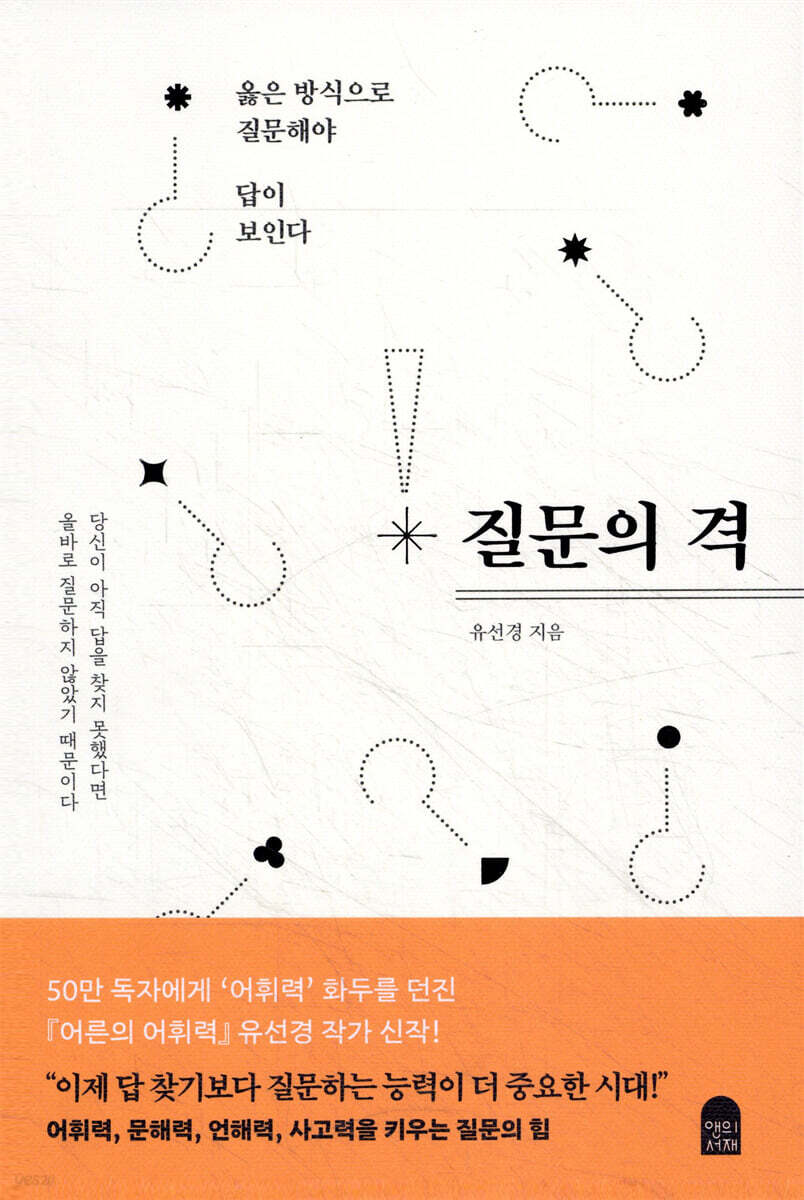
The level of the question
 |
Description
Book Introduction
- A word from MD
-
There is no tomorrow in a life without questions.A new work by author Yoo Seon-gyeong, author of “Adult Vocabulary.”
The theme of this book is questions.
The reason we need to ask the right questions is not only for our relationships, but also for ourselves.
Questions promise a better tomorrow.
A secret book that will help you improve your literacy, vocabulary, and thinking skills so you can ask the right questions.
May 27, 2025. Humanities PD Son Min-gyu
The topic of 'vocabulary' was thrown to 500,000 readers.
『Adult Vocabulary』, 『One Page a Day, My Vocabulary Note』, a new work by author Yoo Seon-gyeong!
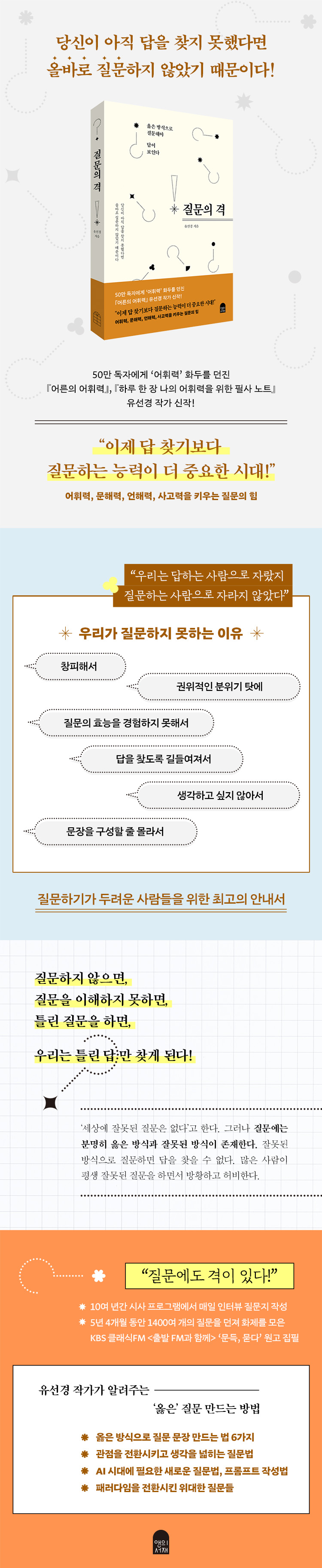
“Now is the time when the ability to ask questions is more important than finding answers!”
The power of questions to develop vocabulary, literacy, language skills, and thinking skills.
★ 6 Ways to Form Question Sentences the Right Way
★ Questioning techniques that change perspectives and broaden thinking
★ New questioning methods and prompt writing methods needed in the AI era
★ Great questions that shifted the paradigm
If you haven't found the answer yet, it's because you're not asking the right question!
“Don’t look for answers, look for questions.”
“Asking questions the right way can open up new perspectives, which can broaden your thinking, change your perspective, and spark creative thinking.
It is the beginning of a self-directed life.
As you ask yourself questions and find answers, you become an independent human being.
“The vitality that arises when you ask yourself questions and look at the world is something that does not exist when you passively accept the answers given by others.” _ From “Author’s Note”
Author Yoo Seon-gyeong, who provided new humanistic insights to 500,000 readers by raising the topics of 'vocabulary' and 'writing', now talks about 'questions'.
We were raised to be answerers, not questioners.
If you get the answer right, you will be praised and promoted.
But now, they say, we've entered a world where questions matter. With the advent of the AI era, the importance of questions is only growing.
But unfortunately, until now, no one has taught us how to 'ask questions'.
The author says that adding 'why' to a sentence or adding a question mark at the end of a sentence does not necessarily make it a question.
Although it is said that 'there are no wrong questions in the world', it is emphasized that there are clearly right and wrong ways to ask questions.
Many people wander and waste their lives asking the wrong questions.
If you haven't found the answer yet, it's because you haven't asked the right question.
"Questioning" explores the various social contexts that lead us to be unable to ask questions, and reveals five benefits that can be gained through questions, thereby reaffirming the importance of questions.
During her 30-plus years as a broadcast writer, including 10 years in charge of current affairs and social programs, writer Yoo Seon-gyeong wrote questionnaires for at least one interview every day.
Through this, I learned how to create questions that clarify intention and purpose and emphasize key vocabulary.
Also, for 5 years and 4 months, I wrote articles directly posing and answering approximately 1,400 questions in the corner “Suddenly Ask” on KBS Classic FM’s “Let’s Go with FM.”
He has shown examples of how simple curiosity or inquisitiveness can expand into questions that broaden one's knowledge from a new perspective, drawing enthusiastic responses from listeners.
You could call him a so-called 'questioning expert'.
Asking yourself the 'right' questions leads to a self-directed life.
The 'right' questions asked to the world change paradigms.
A question is also the power to summarize the content and use it in concise sentences.
Therefore, improving vocabulary, literacy, language comprehension, and thinking skills are a bonus.
In 『Questioning Style』, author Yoo Seon-gyeong shares her own questioning know-how and offers specific suggestions on 'how to create question sentences in the right way.'
In addition, we introduce various questioning methods, such as questioning methods that change perspectives and broaden thinking, and new questioning methods that are essential in the AI era.
『Adult Vocabulary』, 『One Page a Day, My Vocabulary Note』, a new work by author Yoo Seon-gyeong!
“Now is the time when the ability to ask questions is more important than finding answers!”
The power of questions to develop vocabulary, literacy, language skills, and thinking skills.
★ 6 Ways to Form Question Sentences the Right Way
★ Questioning techniques that change perspectives and broaden thinking
★ New questioning methods and prompt writing methods needed in the AI era
★ Great questions that shifted the paradigm
If you haven't found the answer yet, it's because you're not asking the right question!
“Don’t look for answers, look for questions.”
“Asking questions the right way can open up new perspectives, which can broaden your thinking, change your perspective, and spark creative thinking.
It is the beginning of a self-directed life.
As you ask yourself questions and find answers, you become an independent human being.
“The vitality that arises when you ask yourself questions and look at the world is something that does not exist when you passively accept the answers given by others.” _ From “Author’s Note”
Author Yoo Seon-gyeong, who provided new humanistic insights to 500,000 readers by raising the topics of 'vocabulary' and 'writing', now talks about 'questions'.
We were raised to be answerers, not questioners.
If you get the answer right, you will be praised and promoted.
But now, they say, we've entered a world where questions matter. With the advent of the AI era, the importance of questions is only growing.
But unfortunately, until now, no one has taught us how to 'ask questions'.
The author says that adding 'why' to a sentence or adding a question mark at the end of a sentence does not necessarily make it a question.
Although it is said that 'there are no wrong questions in the world', it is emphasized that there are clearly right and wrong ways to ask questions.
Many people wander and waste their lives asking the wrong questions.
If you haven't found the answer yet, it's because you haven't asked the right question.
"Questioning" explores the various social contexts that lead us to be unable to ask questions, and reveals five benefits that can be gained through questions, thereby reaffirming the importance of questions.
During her 30-plus years as a broadcast writer, including 10 years in charge of current affairs and social programs, writer Yoo Seon-gyeong wrote questionnaires for at least one interview every day.
Through this, I learned how to create questions that clarify intention and purpose and emphasize key vocabulary.
Also, for 5 years and 4 months, I wrote articles directly posing and answering approximately 1,400 questions in the corner “Suddenly Ask” on KBS Classic FM’s “Let’s Go with FM.”
He has shown examples of how simple curiosity or inquisitiveness can expand into questions that broaden one's knowledge from a new perspective, drawing enthusiastic responses from listeners.
You could call him a so-called 'questioning expert'.
Asking yourself the 'right' questions leads to a self-directed life.
The 'right' questions asked to the world change paradigms.
A question is also the power to summarize the content and use it in concise sentences.
Therefore, improving vocabulary, literacy, language comprehension, and thinking skills are a bonus.
In 『Questioning Style』, author Yoo Seon-gyeong shares her own questioning know-how and offers specific suggestions on 'how to create question sentences in the right way.'
In addition, we introduce various questioning methods, such as questioning methods that change perspectives and broaden thinking, and new questioning methods that are essential in the AI era.
- You can preview some of the book's contents.
Preview
index
Author's Note
Chapter 1.
Why We Need to Ask Questions 'The Right Way'
If you want to live differently, you have to ask different questions.
This difference determines the level of the question.
If you don't know that you don't know, you can't ask questions. | Socrates and Questions
Why You Can't Ask Questions | Why Can't We Ask Questions?
A Man Without Thought Never Asks Questions | How Could Adolf Eichmann Murder 437,000 People?
5 Benefits of Asking Questions
Chapter 2.
How to ask questions the right way
Ask questions that tap into a child's curiosity and wonder.
Asking Questions Using Interrogative Words | Questions and Questions | Neutralizing Questions | The Importance of the Interrogative Word "What" | Questioning in a Quantum World
Ask questions with context
Establish core vocabulary
Be clear about the intent and purpose of your question.
Narrow your categories and ask specific questions.
Questioning to Expand Your Mind | Descartes' Questioning Method | Peter Drucker's Questioning Method
In the AI Era, Questions Matter More Than Answers | How to Ask Questions in the AI Era | Discovering the Identity of Artificial Intelligence Through Questions
Chapter 3.
How to Ask Questions That Will Change Your Life and the World
Don't ask for the answer, ask 'how' to get the answer.
Recognize that as circumstances change, so do answers | Changing perspectives on the moon: How do creative ideas arise?
Ask "How" instead of "Why"
Great questions that shifted the paradigm
Chapter 1.
Why We Need to Ask Questions 'The Right Way'
If you want to live differently, you have to ask different questions.
This difference determines the level of the question.
If you don't know that you don't know, you can't ask questions. | Socrates and Questions
Why You Can't Ask Questions | Why Can't We Ask Questions?
A Man Without Thought Never Asks Questions | How Could Adolf Eichmann Murder 437,000 People?
5 Benefits of Asking Questions
Chapter 2.
How to ask questions the right way
Ask questions that tap into a child's curiosity and wonder.
Asking Questions Using Interrogative Words | Questions and Questions | Neutralizing Questions | The Importance of the Interrogative Word "What" | Questioning in a Quantum World
Ask questions with context
Establish core vocabulary
Be clear about the intent and purpose of your question.
Narrow your categories and ask specific questions.
Questioning to Expand Your Mind | Descartes' Questioning Method | Peter Drucker's Questioning Method
In the AI Era, Questions Matter More Than Answers | How to Ask Questions in the AI Era | Discovering the Identity of Artificial Intelligence Through Questions
Chapter 3.
How to Ask Questions That Will Change Your Life and the World
Don't ask for the answer, ask 'how' to get the answer.
Recognize that as circumstances change, so do answers | Changing perspectives on the moon: How do creative ideas arise?
Ask "How" instead of "Why"
Great questions that shifted the paradigm
Detailed image
Into the book
It never occurred to me before that the question could be wrong.
I thought any question was good.
It's not a problem if you don't do it, so what's the problem if you do it?
But you only get answers as many times as you ask.
Until now, we have only considered questions as questions because we do not know the answer to them.
This can be said to be the level of staying on an island on the Korean Peninsula of the Earth in the galaxy in the universe called Question.
Questions are asked not only to find out what we don't know, but also to get better answers and prevent accidents and mistakes.
--- From the author's note
The right questions make people want to talk.
It opens the mind of the person asking the question and cultivates an attitude that allows them to listen to what the other person has to say.
This difference determines the level of the question.
So, can't we change the questions (or non-questions) that contained complaints, grievances, and accusations above into the right ones and turn them into conversations?
You can get out of the position of trying to evaluate or control the other person's thoughts based on your own thoughts and change the question to a 'neutral' one.
--- p.23~24
The level of questioning depends on 'knowledge'.
Questions reveal not how much you don't know, but how much you know.
If you don't have any questions, it may not be because you know, but because you don't know, or because you don't want to know.
Where does ‘knowledge’ begin?
It is the point where you realize that you don't know.
Knowledge begins the moment you realize how much you lack, what you know wrong, and how you know it wrong.
The tool here that deflects, diverts, expands, and delves is the question.
--- p.29
I repeat, a thoughtless person never asks questions.
In other words, if you strive to speak and think correctly, that in itself is a heroic act of resisting evil.
He will ask himself questions at every moment to speak correctly, to think correctly, to think correctly from the other person's perspective, to see from a different perspective.
--- p.61
If you can find, understand, interpret, and communicate information through language—that is, if you have verbal literacy—you can ask appropriate questions.
Otherwise, it's easy to ask irrelevant questions that are out of context and out of focus.
Of course, there are cases where a question that others would consider odd can open up new avenues in a field, but this is an exception here because it may be proven in the distant future.
Find key words in what the other person says and ask questions based on your choice of words within the context.
Establishing key vocabulary before asking a question will help clarify the purpose and intent of the question and what you want to know through it.
--- p.117
Most questions start like that.
It's still just a question.
If you stop at that point, you won't be able to find the answer.
We need to go one step further and make it a question.
From broad to narrow categories, from vague to concrete, from unreal to real, from shadow to substance.
To do that, you have to ask yourself countless questions.
This is the ability to think.
So the process of finding the right question is also a thinking process.
--- p.130~131
Even if the subject is the same, if the situation changes, the question must be changed.
The old answers no longer work.
If you change the question, the answer will change.
Do you feel like the answers you were once sure of no longer hold true?
The question needs to be changed.
If you insist on asking the same question, you will end up with a series of wrong answers.
In doing so, I may fall into conflict or frustration, thinking that I am right but the world and people are wrong.
Let's change the question.
Changing the question can lead to a shift in thinking and a new perspective, like finally finding the right pair of glasses for your vision.
--- p.173
When I hear stories like this, I think that the truth that science, researched and developed by humans, is continuously proving is that 'this world is not centered around humans and the Earth.'
This is the expansion of perspective.
Those who have experienced a broadening of perspective while looking at the same thing create new paths by asking different questions with different frameworks, while those who have not experienced this remain stuck in the old ways by repeating the same questions with old frameworks.
I thought any question was good.
It's not a problem if you don't do it, so what's the problem if you do it?
But you only get answers as many times as you ask.
Until now, we have only considered questions as questions because we do not know the answer to them.
This can be said to be the level of staying on an island on the Korean Peninsula of the Earth in the galaxy in the universe called Question.
Questions are asked not only to find out what we don't know, but also to get better answers and prevent accidents and mistakes.
--- From the author's note
The right questions make people want to talk.
It opens the mind of the person asking the question and cultivates an attitude that allows them to listen to what the other person has to say.
This difference determines the level of the question.
So, can't we change the questions (or non-questions) that contained complaints, grievances, and accusations above into the right ones and turn them into conversations?
You can get out of the position of trying to evaluate or control the other person's thoughts based on your own thoughts and change the question to a 'neutral' one.
--- p.23~24
The level of questioning depends on 'knowledge'.
Questions reveal not how much you don't know, but how much you know.
If you don't have any questions, it may not be because you know, but because you don't know, or because you don't want to know.
Where does ‘knowledge’ begin?
It is the point where you realize that you don't know.
Knowledge begins the moment you realize how much you lack, what you know wrong, and how you know it wrong.
The tool here that deflects, diverts, expands, and delves is the question.
--- p.29
I repeat, a thoughtless person never asks questions.
In other words, if you strive to speak and think correctly, that in itself is a heroic act of resisting evil.
He will ask himself questions at every moment to speak correctly, to think correctly, to think correctly from the other person's perspective, to see from a different perspective.
--- p.61
If you can find, understand, interpret, and communicate information through language—that is, if you have verbal literacy—you can ask appropriate questions.
Otherwise, it's easy to ask irrelevant questions that are out of context and out of focus.
Of course, there are cases where a question that others would consider odd can open up new avenues in a field, but this is an exception here because it may be proven in the distant future.
Find key words in what the other person says and ask questions based on your choice of words within the context.
Establishing key vocabulary before asking a question will help clarify the purpose and intent of the question and what you want to know through it.
--- p.117
Most questions start like that.
It's still just a question.
If you stop at that point, you won't be able to find the answer.
We need to go one step further and make it a question.
From broad to narrow categories, from vague to concrete, from unreal to real, from shadow to substance.
To do that, you have to ask yourself countless questions.
This is the ability to think.
So the process of finding the right question is also a thinking process.
--- p.130~131
Even if the subject is the same, if the situation changes, the question must be changed.
The old answers no longer work.
If you change the question, the answer will change.
Do you feel like the answers you were once sure of no longer hold true?
The question needs to be changed.
If you insist on asking the same question, you will end up with a series of wrong answers.
In doing so, I may fall into conflict or frustration, thinking that I am right but the world and people are wrong.
Let's change the question.
Changing the question can lead to a shift in thinking and a new perspective, like finally finding the right pair of glasses for your vision.
--- p.173
When I hear stories like this, I think that the truth that science, researched and developed by humans, is continuously proving is that 'this world is not centered around humans and the Earth.'
This is the expansion of perspective.
Those who have experienced a broadening of perspective while looking at the same thing create new paths by asking different questions with different frameworks, while those who have not experienced this remain stuck in the old ways by repeating the same questions with old frameworks.
--- p.183
Publisher's Review
“Even questions have ranks!”
In the AI era, how to ask the "right" questions that will change you and the world.
“Every invention that has transformed human life is both a culmination of technology and a culmination of questions.
Civilization always takes its first step toward innovation with a 'question' and the 'communication' that question sparks.
Then and now, some people ask questions and some people don't.
Some people understand the question and some people don't.
Some people ask the right questions and some ask the wrong questions.
If you don't ask the obvious question, if you don't understand the question, if you ask the wrong question, you'll get the wrong answer.
Also, if you want to get a different answer, you have to ask a different question.”
_ In the text
In the AI era, where questions are more important than answers, we can no longer avoid asking questions.
You also need to be able to ask appropriate and correct questions.
What changes your life is not the answers, but the attitude toward finding the answers.
Don't mistake a question for a 'question' or an 'interrogative'.
Even questions have their own level of difficulty! A good question shouldn't simply seek to determine "what the answer is," but should also encompass the intention of "how (or by what means) to obtain the answer."
And the right questions make people want to talk.
For Koreans, who have prioritized the "answer" for the past half century and have tailored all methods to obtaining it as quickly and efficiently as possible, asking the "right" question is even more important.
Without questions, there are no thoughts, and without thoughts, there are no new ideas.
In other words, the process of finding questions is also a thinking process.
But asking such an important question is a typical act that goes against nature.
Because you have to think and summarize with concentration.
It's comfortable if you don't think, and it's comfortable if you don't ask questions.
This may result in more problems.
If you develop the habit of asking the right questions, listening to the right answers, and interpreting the content properly, you will develop discernment, which will help you avoid problems and find solutions when they do arise.
So instead of trying to find answers, let's look for questions.
In "Questioning Style," author Yoo Seon-gyeong will guide you in forming questions the right way.
Especially in the age of artificial intelligence, we are given two tasks.
The questions are, ‘What and how should we ask (to solve the problem)?’ and ‘Can we determine whether the answers provided by AI are correct?’
Even if the purpose is the same, different results can be produced depending on how the prompt is written.
It requires the ability to choose the right vocabulary, structure the question within a specific context, and ask questions.
At the same time, we must be able to understand the context of the AI's responses, evaluate them, make judgments, and then modify and supplement them.
In other words, asking questions in the 'right' way is very important both for writing prompts effectively and for evaluating whether the answers are correct.
All the hints are in 'How to Ask the Right Questions' by author Yoo Seon-gyeong.
For those who have been afraid to ask questions for various reasons, such as being embarrassed by the level of their questions, being in an authoritarian atmosphere, being trained to only look for answers, having difficulty constructing sentences, or having never experienced the effectiveness of questions, 『Questioning Level』 will be the best guide.
In the AI era, how to ask the "right" questions that will change you and the world.
“Every invention that has transformed human life is both a culmination of technology and a culmination of questions.
Civilization always takes its first step toward innovation with a 'question' and the 'communication' that question sparks.
Then and now, some people ask questions and some people don't.
Some people understand the question and some people don't.
Some people ask the right questions and some ask the wrong questions.
If you don't ask the obvious question, if you don't understand the question, if you ask the wrong question, you'll get the wrong answer.
Also, if you want to get a different answer, you have to ask a different question.”
_ In the text
In the AI era, where questions are more important than answers, we can no longer avoid asking questions.
You also need to be able to ask appropriate and correct questions.
What changes your life is not the answers, but the attitude toward finding the answers.
Don't mistake a question for a 'question' or an 'interrogative'.
Even questions have their own level of difficulty! A good question shouldn't simply seek to determine "what the answer is," but should also encompass the intention of "how (or by what means) to obtain the answer."
And the right questions make people want to talk.
For Koreans, who have prioritized the "answer" for the past half century and have tailored all methods to obtaining it as quickly and efficiently as possible, asking the "right" question is even more important.
Without questions, there are no thoughts, and without thoughts, there are no new ideas.
In other words, the process of finding questions is also a thinking process.
But asking such an important question is a typical act that goes against nature.
Because you have to think and summarize with concentration.
It's comfortable if you don't think, and it's comfortable if you don't ask questions.
This may result in more problems.
If you develop the habit of asking the right questions, listening to the right answers, and interpreting the content properly, you will develop discernment, which will help you avoid problems and find solutions when they do arise.
So instead of trying to find answers, let's look for questions.
In "Questioning Style," author Yoo Seon-gyeong will guide you in forming questions the right way.
Especially in the age of artificial intelligence, we are given two tasks.
The questions are, ‘What and how should we ask (to solve the problem)?’ and ‘Can we determine whether the answers provided by AI are correct?’
Even if the purpose is the same, different results can be produced depending on how the prompt is written.
It requires the ability to choose the right vocabulary, structure the question within a specific context, and ask questions.
At the same time, we must be able to understand the context of the AI's responses, evaluate them, make judgments, and then modify and supplement them.
In other words, asking questions in the 'right' way is very important both for writing prompts effectively and for evaluating whether the answers are correct.
All the hints are in 'How to Ask the Right Questions' by author Yoo Seon-gyeong.
For those who have been afraid to ask questions for various reasons, such as being embarrassed by the level of their questions, being in an authoritarian atmosphere, being trained to only look for answers, having difficulty constructing sentences, or having never experienced the effectiveness of questions, 『Questioning Level』 will be the best guide.
GOODS SPECIFICS
- Date of issue: May 25, 2025
- Page count, weight, size: 232 pages | 322g | 140*210*20mm
- ISBN13: 9791194877004
- ISBN10: 1194877001
You may also like
카테고리
korean


korean

![ELLE 엘르 스페셜 에디션 A형 : 12월 [2025]](http://librairie.coreenne.fr/cdn/shop/files/b8e27a3de6c9538896439686c6b0e8fb.jpg?v=1766436872&width=3840)


