

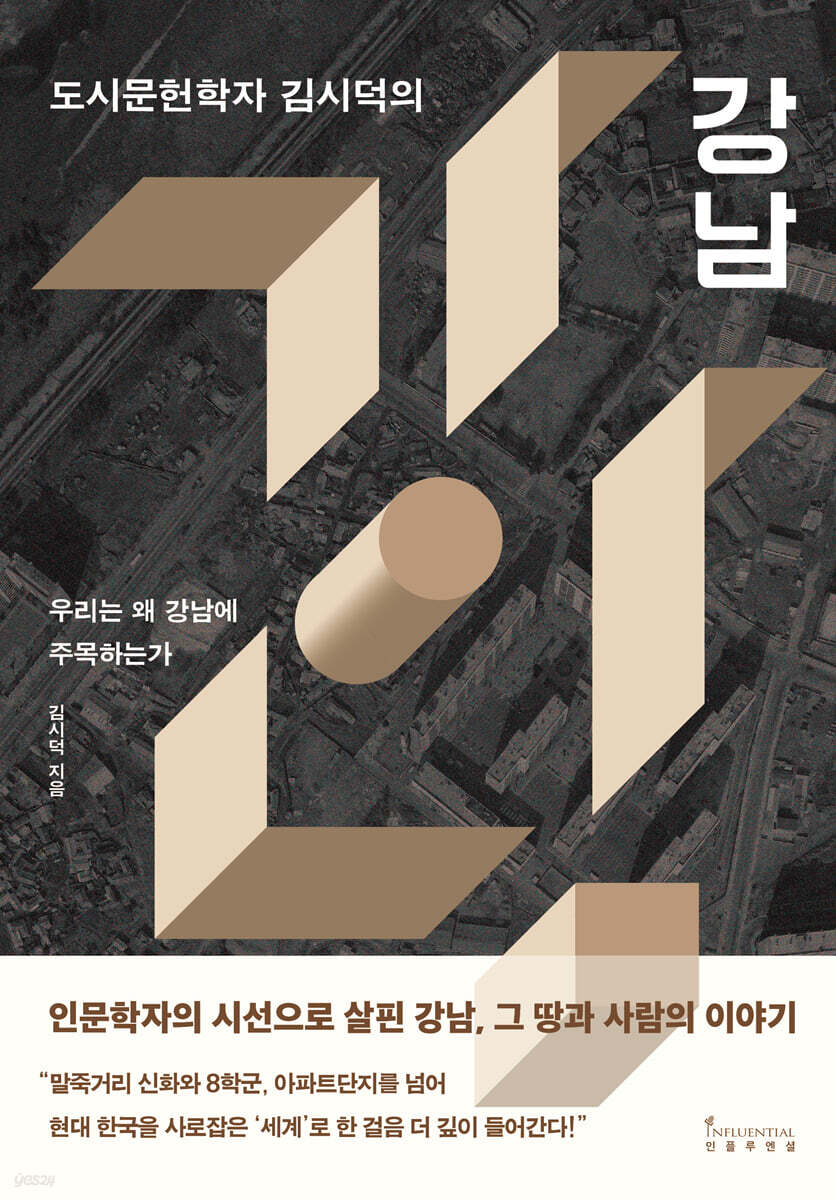
Gangnam by urban bibliographer Kim Si-deok
 |
Description
Book Introduction
- A word from MD
-
Gangnam, the heart of modern and contemporary KoreaMany people want to live in Gangnam.
It is a great place to live and is expected to remain a prime residential location for the foreseeable future.
There is some jealousy, envy, and conspiracy theories directed at Gangnam.
Let's put aside our vague longings and prejudices for a moment and read this book.
This is the most three-dimensional and fascinating book about Gangnam.
May 9, 2025. Humanities PD Son Min-gyu
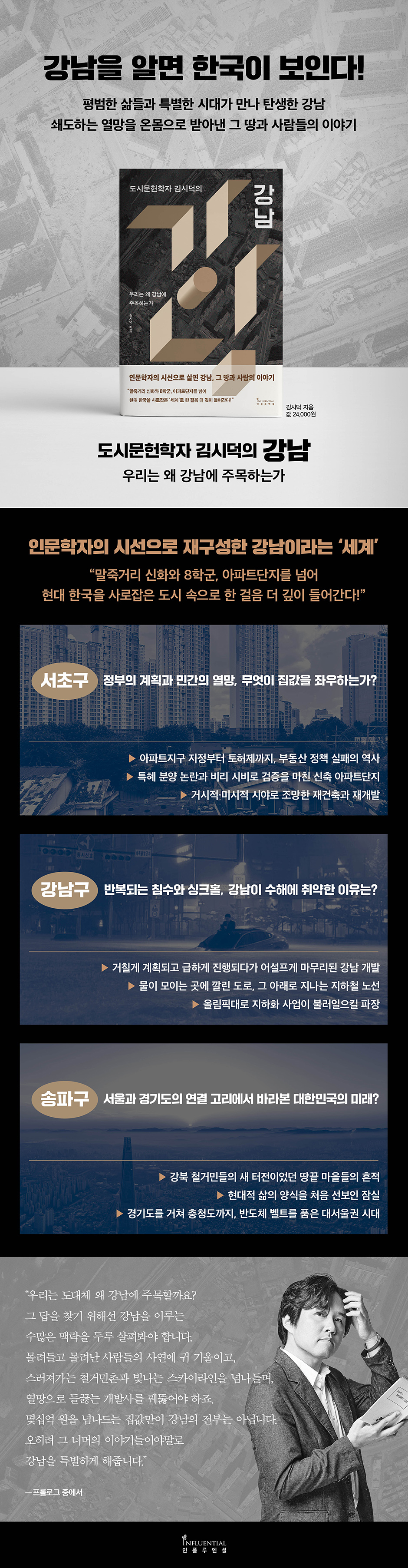
If you know Gangnam, you can see Korea!
The "world" of Gangnam reconstructed through the eyes of a humanist.
The story of the land and its people, who embraced the rush of passion with their whole bodies.
★ The real Gangnam seen and observed by Kim Si-deok, a 'living humanist', for over 40 years!
★ From development history to market outlook, the ultimate guide for those curious about Gangnam!
If you were to choose a place that is constantly a hot topic in Korea today, it would definitely be 'Gangnam'.
Recently, while Seoul City has once again written an undefeated legend in the process of reversing the 'Toheoje', it has also received attention mixed with concern as it has been pointed out as an area with a high concentration of 'sinkholes'.
Sensitive social issues such as the '7-year-old civil service exam ban' and the 'shantytown demolition' are also set in Gangnam.
In short, Gangnam is a space with diverse contexts that cannot be described solely by ‘house prices.’
Gangnam is a pulsating place, a place where countless people, their individual aspirations, complex developments, and urban planning that will determine Korea's future are intertwined and pulsating.
Can't we get a bird's eye view of this special space?
《Gangnam by Urban Literature Scholar Kim Si-deok》 follows the footsteps of a humanist and delves deeper into the world of Gangnam.
The author reconstructs the true image of Gangnam by drawing on his own experience living in various districts of Gangnam, exploring the area on foot, and finding interesting stories from newly discovered documents.
From those displaced to those with billions of won in assets, who truly are the people of Gangnam? How did Gangnam, plagued by overdevelopment, achieve economic success? What impact has the "Gangnam lifestyle" had on modern Koreans? Where is the "Gangnam you want to live in" and where is the "Gangnam you want to buy in"? How will Gangnam shape Korea in the future? This book seeks answers to these questions, spanning both humanistic and economic perspectives, revealing a full picture of Gangnam, often obscured by vague envy and misunderstanding.
The process of exploring the past, present, and future of Korea's representative spaces through the unique perspective of a humanist is both interesting and informative.
One is particularly struck by its 'dynamism', as the author emphasizes.
Gangnam was a planned space from the beginning, but it was also a space that deviated from the plan by that much.
As a result, while facing problems that are unbecoming of a high-tech city, such as water shortages, it also developed the capabilities of an 'expanding one-pole city'.
Let us carefully consider the insights this book conveys.
Your understanding of Gangnam will broaden significantly.
The "world" of Gangnam reconstructed through the eyes of a humanist.
The story of the land and its people, who embraced the rush of passion with their whole bodies.
★ The real Gangnam seen and observed by Kim Si-deok, a 'living humanist', for over 40 years!
★ From development history to market outlook, the ultimate guide for those curious about Gangnam!
If you were to choose a place that is constantly a hot topic in Korea today, it would definitely be 'Gangnam'.
Recently, while Seoul City has once again written an undefeated legend in the process of reversing the 'Toheoje', it has also received attention mixed with concern as it has been pointed out as an area with a high concentration of 'sinkholes'.
Sensitive social issues such as the '7-year-old civil service exam ban' and the 'shantytown demolition' are also set in Gangnam.
In short, Gangnam is a space with diverse contexts that cannot be described solely by ‘house prices.’
Gangnam is a pulsating place, a place where countless people, their individual aspirations, complex developments, and urban planning that will determine Korea's future are intertwined and pulsating.
Can't we get a bird's eye view of this special space?
《Gangnam by Urban Literature Scholar Kim Si-deok》 follows the footsteps of a humanist and delves deeper into the world of Gangnam.
The author reconstructs the true image of Gangnam by drawing on his own experience living in various districts of Gangnam, exploring the area on foot, and finding interesting stories from newly discovered documents.
From those displaced to those with billions of won in assets, who truly are the people of Gangnam? How did Gangnam, plagued by overdevelopment, achieve economic success? What impact has the "Gangnam lifestyle" had on modern Koreans? Where is the "Gangnam you want to live in" and where is the "Gangnam you want to buy in"? How will Gangnam shape Korea in the future? This book seeks answers to these questions, spanning both humanistic and economic perspectives, revealing a full picture of Gangnam, often obscured by vague envy and misunderstanding.
The process of exploring the past, present, and future of Korea's representative spaces through the unique perspective of a humanist is both interesting and informative.
One is particularly struck by its 'dynamism', as the author emphasizes.
Gangnam was a planned space from the beginning, but it was also a space that deviated from the plan by that much.
As a result, while facing problems that are unbecoming of a high-tech city, such as water shortages, it also developed the capabilities of an 'expanding one-pole city'.
Let us carefully consider the insights this book conveys.
Your understanding of Gangnam will broaden significantly.
- You can preview some of the book's contents.
Preview
index
preface
Prologue│Why We Focus on Gangnam
Part 1: Gangnam Before Gangnam: Forgotten Memories Restored with Urban Fossils
Chapter 1: Where Have All the Farmers Gone?: Gangnam Scenery from Its Rural Days
Old place names that remain in the school names│Apgujeong Hyundai Apartments built on rice paddies along the Han River│People from Gangnam who used to come and go by ferry│Gangnam Express Bus Terminal that used to be a radish field│Pioneers of flower cultivation and their descendants│The forefront of pig farming│Urban fossils that preserve traces of ‘rural Gangnam’│Gangnam suffered from floods 100 years ago as well│In search of the origins of Hanshin Pocha│People who used to climb up and down the hills
Part 2: The Birth of Gangnam: The Myth of Invincibility Born from a Failed Plan
Chapter 2: Breaking Ground: Yeongdong District Embracing the Aspirations of a Great Transition
The development axis that is at odds with the turbulent modern history│Why was a bunker installed in the 'Hangang View Apartment'?│There is no 'environment' in the green belt│The fate of the city determined by civil engineering technology│Which comes first, the road or the city?│"Only the conglomerates in Gangbuk are having fun"│The ripple effect that neither the president nor the mayor of Seoul anticipated│Why are government agencies moving south?│The never-ending discussion on the relocation of Seoul City Hall│Speculators disguised as the poor│What if Samsung Tower had been built instead of Tower Palace?│Traces of the development of Yeongdong District
Chapter 3: Changing the Flow of the Han River: Jamsil District, a New Land Connecting Cities
Jamsil, an island, Seokchon Lake, a river│The first 'Hangang View Apartment' and a wasteland│Warriors toward North Korea and the hosting of the Olympics│Songpa-gu, the link between Gangbuk and the Gwangju complex│The eventful life of the boatman 'Suk's father'│The disappeared dolmens and the demolished Baekje fortresses│Flooded, broken, and crumbling│How did corruption and scandal become a blessing?
Part 3: Three Dimensions of Modern Gangnam: The Interplay of Apartments, Industry, and Transportation
Chapter 4: From Matchbox to Object of Envy: The Trajectory of the Apartment
The collective memory of "a view of rice paddies next to an apartment"│The "Seoul countryside" once filled with housing complexes│"Bus routes are stagnant"│The origin of apartment complexes is not Gangnam│Luxury apartments built with loans│Why can't the government control housing prices│The whole story of the apartment district system│The future of reconstruction
Chapter 5: Standing on the Street, You Can See the Economy: Transportation and Industry That Sustain Gangnam
From gold to tungsten, the mines of 'rural Gangnam'│The defunct industrial railway plan│The defunct textile complex plan│Why a luxury goods store is being built in the terminal│New transportation networks and new industries
Part 4: The Future of Gangnam: The Emergence of a One-Polar City, No Second Gangnam
Chapter 6: A Macro View: The Era of Expanding Gangnam and the Greater Seoul Area
A "Gangnam-style lifestyle" embracing complex functions│Where does "Expanded Gangnam" begin?│A climb to Lotte World Tower reveals the "Greater Seoul Area Era."│The acceleration of the Gangnam-centric phenomenon.
Chapter 7: A Microscopic Look: Variables in Reconstruction and Redevelopment
What matters: housing type, location, or topographical characteristics? │ Could the Gyeongbu Expressway be built underground? │ Who opposes reconstruction and why? │ When will GTX-A Samsung Station open? │ Which areas should we pay attention to?
main
References
Photo source
Search
Prologue│Why We Focus on Gangnam
Part 1: Gangnam Before Gangnam: Forgotten Memories Restored with Urban Fossils
Chapter 1: Where Have All the Farmers Gone?: Gangnam Scenery from Its Rural Days
Old place names that remain in the school names│Apgujeong Hyundai Apartments built on rice paddies along the Han River│People from Gangnam who used to come and go by ferry│Gangnam Express Bus Terminal that used to be a radish field│Pioneers of flower cultivation and their descendants│The forefront of pig farming│Urban fossils that preserve traces of ‘rural Gangnam’│Gangnam suffered from floods 100 years ago as well│In search of the origins of Hanshin Pocha│People who used to climb up and down the hills
Part 2: The Birth of Gangnam: The Myth of Invincibility Born from a Failed Plan
Chapter 2: Breaking Ground: Yeongdong District Embracing the Aspirations of a Great Transition
The development axis that is at odds with the turbulent modern history│Why was a bunker installed in the 'Hangang View Apartment'?│There is no 'environment' in the green belt│The fate of the city determined by civil engineering technology│Which comes first, the road or the city?│"Only the conglomerates in Gangbuk are having fun"│The ripple effect that neither the president nor the mayor of Seoul anticipated│Why are government agencies moving south?│The never-ending discussion on the relocation of Seoul City Hall│Speculators disguised as the poor│What if Samsung Tower had been built instead of Tower Palace?│Traces of the development of Yeongdong District
Chapter 3: Changing the Flow of the Han River: Jamsil District, a New Land Connecting Cities
Jamsil, an island, Seokchon Lake, a river│The first 'Hangang View Apartment' and a wasteland│Warriors toward North Korea and the hosting of the Olympics│Songpa-gu, the link between Gangbuk and the Gwangju complex│The eventful life of the boatman 'Suk's father'│The disappeared dolmens and the demolished Baekje fortresses│Flooded, broken, and crumbling│How did corruption and scandal become a blessing?
Part 3: Three Dimensions of Modern Gangnam: The Interplay of Apartments, Industry, and Transportation
Chapter 4: From Matchbox to Object of Envy: The Trajectory of the Apartment
The collective memory of "a view of rice paddies next to an apartment"│The "Seoul countryside" once filled with housing complexes│"Bus routes are stagnant"│The origin of apartment complexes is not Gangnam│Luxury apartments built with loans│Why can't the government control housing prices│The whole story of the apartment district system│The future of reconstruction
Chapter 5: Standing on the Street, You Can See the Economy: Transportation and Industry That Sustain Gangnam
From gold to tungsten, the mines of 'rural Gangnam'│The defunct industrial railway plan│The defunct textile complex plan│Why a luxury goods store is being built in the terminal│New transportation networks and new industries
Part 4: The Future of Gangnam: The Emergence of a One-Polar City, No Second Gangnam
Chapter 6: A Macro View: The Era of Expanding Gangnam and the Greater Seoul Area
A "Gangnam-style lifestyle" embracing complex functions│Where does "Expanded Gangnam" begin?│A climb to Lotte World Tower reveals the "Greater Seoul Area Era."│The acceleration of the Gangnam-centric phenomenon.
Chapter 7: A Microscopic Look: Variables in Reconstruction and Redevelopment
What matters: housing type, location, or topographical characteristics? │ Could the Gyeongbu Expressway be built underground? │ Who opposes reconstruction and why? │ When will GTX-A Samsung Station open? │ Which areas should we pay attention to?
main
References
Photo source
Search
Detailed image
Into the book
To conclude, Gangnam is a very dynamic space.
This is where people are attracted, and these attracted people have created Gangnam.
In fact, it was the government and the Seoul Metropolitan Government that fired the starting gun for Gangnam's development, but people continued to flock to Gangnam, exceeding their expectations and even after their interest waned.
In the process, some people were pushed out, while others succeeded in settling down.
The same thing is happening again now.
--- From the "Prologue"
The Third Han River Bridge has another, lesser-known background.
At that time, ferry boats connecting the north and south of the Han River frequently capsized, resulting in dozens of deaths.
(…) In particular, the accident on September 7, 1962 was the direct cause for the construction of the Third Han River Bridge.
(…) Photos of the faces of the deceased, including Mr. Kim Bok-geun, who lived a life of poverty and met a tragic end, were published in newspapers at the time.
The difficult lives and faces of some residents of Gangnam's three districts, never mentioned in the myth of Maljukgeori, were accidentally recorded through a tragic accident.
--- From "Chapter 1: Where Did All Those Farmers Go?"
The villages of Gangnam, a rural area, have also given birth to unexpected cultural phenomena.
In Jamwon-dong, Seocho-gu, there remains an old village called ‘Naru Village.’
(…) It was here that Baek Jong-won, CEO of The Born Korea, created the famous restaurant chain ‘Hanshin Pocha’.
(…) Starting in the late 1970s, a construction company called Hanshin Construction began building large-scale apartment complexes in Banpo-dong and Jamwon-dong, Seocho-gu, around Naru Village.
In the 1980s, food stalls began to gather along apartment complexes.
People who were tired of staying up all night at the entertainment establishments in Sinsa-dong, Gangnam-gu, would often visit this street food stall village, and naturally, they started calling it "Hanshin Pocha" after the name of the nearby apartment complex.
--- From "Chapter 1: Where Did All Those Farmers Go?"
The 35-story height limit for residential buildings, which was enforced during the term of Seoul Mayor Park Won-soon, was lifted during the second term of Seoul Mayor Oh Se-hoon, and the floor heights of reconstructed apartment complexes in Yeouido and Gangnam are gradually increasing.
Accordingly, it was recently reported that the Ministry of National Defense had requested five reconstruction associations to install anti-aircraft positions.
(…) Apgujeong-dong in Gangnam-gu is the area that protrudes the farthest north among the three districts of Gangnam, so there is a high possibility that an anti-aircraft position will be installed there.
(…) How can we correctly understand the past, present, and future of Gangnam without understanding that the myth of Maljukgeori was based on a psychology of insecurity?
--- From "Chapter 2: Digging the First Shovel"
In addition to the controversy over real estate speculation by the ruling class, there were also reports that dozens of professional speculators, who drove around in Grandeurs or owned nearly 20,000 pyeong of land in the countryside, had entered the flower village by falsely claiming to be so-called "fake poor."
In fact, whenever a slum is developed, speculators disguised as poor people always cause trouble, and one of the first areas to do so was Kkotmaeul.
--- From "Chapter 2: Digging the First Shovel"
The topographical problem of the Gangnam area, which makes it vulnerable to heavy rain, still persists, and people's complacent perception of this still persists.
(…) If the underground space of Yeongdong-daero, where the bus stop will be built along the GTX-A·C lines, is flooded like Gangnam Station on Line 2 or Isu Station on Lines 4 and 7 on August 8, 2022, the damage will be much greater.
(…) Despite this situation, a pledge was made to bury Olympic-daero underground in the 22nd general election in 2024.
However, if Olympic-daero is arbitrarily buried underground, the area south of the Han River in Seoul will suffer enormous damage when heavy rains pour down.
--- From "Chapter 3: Changing the Flow of the Han River"
Contrary to popular belief, a significant portion of Gangnam's three districts are not apartment complexes, but rather single-family homes, villas, and small buildings.
(…) I think one of the reasons why apartment complexes in Gangnam’s three districts are expensive is because there are not enough apartment complexes here.
Middle- and upper-class Koreans want to live in the three districts of Gangnam, and preferably in newly built apartment complexes, but prices are rising because the supply of such housing is insufficient.
--- From "From Chapter 4 Matchbox to Object of Envy"
When designating apartment districts in the Gangnam area in 1975, the government also set the goal of “making the excessively expensive land prices in the Gangnam development area more realistic.”
However, the apartment complexes built in that way have become some of the most expensive apartment complexes in Korea today.
So, the apartment district system ultimately failed to achieve its goal.
--- From "From Chapter 4 Matchbox to Object of Envy"
Nowadays, it is taken for granted that department stores and subways are connected, but it is said that department stores initially refused to do so.
It was because I thought, “What purchasing power would people who walk around with dirt feet have?”
However, Lotte Group, which had previously recognized the potential of subways in Japan, actively pursued the combination of transportation and distribution from the early stages of subway construction in Korea, and this approach has become the standard today.
--- From "Chapter 5: The Economy is Visible When You Stand on the Road"
With the construction of Lotte World, a residential culture that could be called the 'Gangnam lifestyle' was born in Jamsil.
The Gangnam lifestyle consists of three main elements: apartment complexes built in developed areas, natural or artificial waterfront spaces, and complex shopping malls.
The first space where these three elements were combined was the Jamsil district in Songpa-gu, one of the three districts of Gangnam.
(…) After that, the Gangnam lifestyle was applied as a standard model when building new cities across the country.
--- From "Chapter 6 Macro-View"
People often raise their voices by saying things like 'Seobanpo·Dongjamsil' or 'Ma·Yong·Seong', but you shouldn't judge a city solely by its apartment prices.
The city should be evaluated on how well it performs its mixed functions, including residential functions.
The expanded Gangnam is a combination of two factors: the hardware of affinity with the three districts of Gangnam and the software of the semiconductor industry.
--- From "Chapter 6 Macro-View"
As time passed, the decline of the Yeongdeungpo area, one of the three major centers of Seoul, commonly referred to as the "three nuclear areas," became a reality, and the Sadamun area in Gangbuk became short of residential areas suitable for middle- and upper-class citizens.
Therefore, it is reasonable to assume that middle- and upper-class citizens across the country did not flock to the three core areas of Seoul, but rather to the single-pole area of Gangnam.
With this, Gangnam's three districts have become established as the unshakable central region of Korea.
--- From "Chapter 6 Macro-View"
The original plan for the construction of a transportation network often changes significantly, and even though the plan is established, completion is often delayed.
(…) So, I hope you will be conservative and listen carefully to the claims made by the government, local governments, and companies implementing civil engineering projects regarding the transportation network.
(…) It’s not like the construction of the Wirye-Sinsa Line hasn’t even started yet, but I’ve met more than a few people who bought houses believing that GTX-A would be fully opened in 2025 and that they would be able to use Samsung Station, only to be disappointed.
--- From "Chapter 7: A Microscopic View"
Meanwhile, it is also worth noting how the greenbelt and natural green space, the last remaining developable areas in Gangnam's three districts, will be utilized.
The Green Belt was originally established for security purposes.
As a result, this system, which grossly infringes on property rights, has been able to continue for decades.
(…) Naturally, as reconstruction and redevelopment in downtown Gangnam become increasingly difficult, attention will turn to the last remaining areas available for development.
(…) Whether it’s reconstruction, redevelopment, or land development, respecting the fundamental principle of capitalism that property rights must not be violated is the way to guarantee the future of Gangnam, which has grown through private power rather than government power.
This is where people are attracted, and these attracted people have created Gangnam.
In fact, it was the government and the Seoul Metropolitan Government that fired the starting gun for Gangnam's development, but people continued to flock to Gangnam, exceeding their expectations and even after their interest waned.
In the process, some people were pushed out, while others succeeded in settling down.
The same thing is happening again now.
--- From the "Prologue"
The Third Han River Bridge has another, lesser-known background.
At that time, ferry boats connecting the north and south of the Han River frequently capsized, resulting in dozens of deaths.
(…) In particular, the accident on September 7, 1962 was the direct cause for the construction of the Third Han River Bridge.
(…) Photos of the faces of the deceased, including Mr. Kim Bok-geun, who lived a life of poverty and met a tragic end, were published in newspapers at the time.
The difficult lives and faces of some residents of Gangnam's three districts, never mentioned in the myth of Maljukgeori, were accidentally recorded through a tragic accident.
--- From "Chapter 1: Where Did All Those Farmers Go?"
The villages of Gangnam, a rural area, have also given birth to unexpected cultural phenomena.
In Jamwon-dong, Seocho-gu, there remains an old village called ‘Naru Village.’
(…) It was here that Baek Jong-won, CEO of The Born Korea, created the famous restaurant chain ‘Hanshin Pocha’.
(…) Starting in the late 1970s, a construction company called Hanshin Construction began building large-scale apartment complexes in Banpo-dong and Jamwon-dong, Seocho-gu, around Naru Village.
In the 1980s, food stalls began to gather along apartment complexes.
People who were tired of staying up all night at the entertainment establishments in Sinsa-dong, Gangnam-gu, would often visit this street food stall village, and naturally, they started calling it "Hanshin Pocha" after the name of the nearby apartment complex.
--- From "Chapter 1: Where Did All Those Farmers Go?"
The 35-story height limit for residential buildings, which was enforced during the term of Seoul Mayor Park Won-soon, was lifted during the second term of Seoul Mayor Oh Se-hoon, and the floor heights of reconstructed apartment complexes in Yeouido and Gangnam are gradually increasing.
Accordingly, it was recently reported that the Ministry of National Defense had requested five reconstruction associations to install anti-aircraft positions.
(…) Apgujeong-dong in Gangnam-gu is the area that protrudes the farthest north among the three districts of Gangnam, so there is a high possibility that an anti-aircraft position will be installed there.
(…) How can we correctly understand the past, present, and future of Gangnam without understanding that the myth of Maljukgeori was based on a psychology of insecurity?
--- From "Chapter 2: Digging the First Shovel"
In addition to the controversy over real estate speculation by the ruling class, there were also reports that dozens of professional speculators, who drove around in Grandeurs or owned nearly 20,000 pyeong of land in the countryside, had entered the flower village by falsely claiming to be so-called "fake poor."
In fact, whenever a slum is developed, speculators disguised as poor people always cause trouble, and one of the first areas to do so was Kkotmaeul.
--- From "Chapter 2: Digging the First Shovel"
The topographical problem of the Gangnam area, which makes it vulnerable to heavy rain, still persists, and people's complacent perception of this still persists.
(…) If the underground space of Yeongdong-daero, where the bus stop will be built along the GTX-A·C lines, is flooded like Gangnam Station on Line 2 or Isu Station on Lines 4 and 7 on August 8, 2022, the damage will be much greater.
(…) Despite this situation, a pledge was made to bury Olympic-daero underground in the 22nd general election in 2024.
However, if Olympic-daero is arbitrarily buried underground, the area south of the Han River in Seoul will suffer enormous damage when heavy rains pour down.
--- From "Chapter 3: Changing the Flow of the Han River"
Contrary to popular belief, a significant portion of Gangnam's three districts are not apartment complexes, but rather single-family homes, villas, and small buildings.
(…) I think one of the reasons why apartment complexes in Gangnam’s three districts are expensive is because there are not enough apartment complexes here.
Middle- and upper-class Koreans want to live in the three districts of Gangnam, and preferably in newly built apartment complexes, but prices are rising because the supply of such housing is insufficient.
--- From "From Chapter 4 Matchbox to Object of Envy"
When designating apartment districts in the Gangnam area in 1975, the government also set the goal of “making the excessively expensive land prices in the Gangnam development area more realistic.”
However, the apartment complexes built in that way have become some of the most expensive apartment complexes in Korea today.
So, the apartment district system ultimately failed to achieve its goal.
--- From "From Chapter 4 Matchbox to Object of Envy"
Nowadays, it is taken for granted that department stores and subways are connected, but it is said that department stores initially refused to do so.
It was because I thought, “What purchasing power would people who walk around with dirt feet have?”
However, Lotte Group, which had previously recognized the potential of subways in Japan, actively pursued the combination of transportation and distribution from the early stages of subway construction in Korea, and this approach has become the standard today.
--- From "Chapter 5: The Economy is Visible When You Stand on the Road"
With the construction of Lotte World, a residential culture that could be called the 'Gangnam lifestyle' was born in Jamsil.
The Gangnam lifestyle consists of three main elements: apartment complexes built in developed areas, natural or artificial waterfront spaces, and complex shopping malls.
The first space where these three elements were combined was the Jamsil district in Songpa-gu, one of the three districts of Gangnam.
(…) After that, the Gangnam lifestyle was applied as a standard model when building new cities across the country.
--- From "Chapter 6 Macro-View"
People often raise their voices by saying things like 'Seobanpo·Dongjamsil' or 'Ma·Yong·Seong', but you shouldn't judge a city solely by its apartment prices.
The city should be evaluated on how well it performs its mixed functions, including residential functions.
The expanded Gangnam is a combination of two factors: the hardware of affinity with the three districts of Gangnam and the software of the semiconductor industry.
--- From "Chapter 6 Macro-View"
As time passed, the decline of the Yeongdeungpo area, one of the three major centers of Seoul, commonly referred to as the "three nuclear areas," became a reality, and the Sadamun area in Gangbuk became short of residential areas suitable for middle- and upper-class citizens.
Therefore, it is reasonable to assume that middle- and upper-class citizens across the country did not flock to the three core areas of Seoul, but rather to the single-pole area of Gangnam.
With this, Gangnam's three districts have become established as the unshakable central region of Korea.
--- From "Chapter 6 Macro-View"
The original plan for the construction of a transportation network often changes significantly, and even though the plan is established, completion is often delayed.
(…) So, I hope you will be conservative and listen carefully to the claims made by the government, local governments, and companies implementing civil engineering projects regarding the transportation network.
(…) It’s not like the construction of the Wirye-Sinsa Line hasn’t even started yet, but I’ve met more than a few people who bought houses believing that GTX-A would be fully opened in 2025 and that they would be able to use Samsung Station, only to be disappointed.
--- From "Chapter 7: A Microscopic View"
Meanwhile, it is also worth noting how the greenbelt and natural green space, the last remaining developable areas in Gangnam's three districts, will be utilized.
The Green Belt was originally established for security purposes.
As a result, this system, which grossly infringes on property rights, has been able to continue for decades.
(…) Naturally, as reconstruction and redevelopment in downtown Gangnam become increasingly difficult, attention will turn to the last remaining areas available for development.
(…) Whether it’s reconstruction, redevelopment, or land development, respecting the fundamental principle of capitalism that property rights must not be violated is the way to guarantee the future of Gangnam, which has grown through private power rather than government power.
--- From "Chapter 7: A Microscopic View"
Publisher's Review
"Gangnam's yesterday is a mirror that reflects Gangnam's tomorrow."
A Chronicle of 60 Years of Gangnam Development Reconstructed Through the Perspective of a Humanist
Gangnam is the most dynamic area in Korea.
This should not be understood to simply mean that many people live there.
In fact, Gangnam's population is estimated at 1.5 million as of 2024, accounting for only about 3 percent of the total Korean population.
Yet, Gangnam's presence is unrivaled.
For example, in terms of gross regional domestic product (GRDP), Gangnam-gu alone reaches 70 percent of the level of Busan or Incheon.
Gangnam is also the place with the most restaurants listed in the Michelin Guide.
In this way, Gangnam is standing out in various fields, from economy to culture.
Looking at Gangnam's achievements, the myth of its invincibility becomes self-evident.
It feels like a perfect space developed with full support from the government.
However, 《Gangnam by Urban Literature Scholar Kim Si-deok》 tells a completely different story.
In other words, Gangnam was in fact a “failed plan,” and its success today was due to “ripple effects that neither the president nor the mayor of Seoul anticipated.”
A good example is the 'Han River View Apartment', which is breaking new records every day.
The author focuses on its history rather than its location, synthesizing various government reports and testimonies from leading urban planners to explain that the site was planned as a kind of "bulwark."
However, as the government, conscious of the threat from North Korea, turned its attention to the area south of Seoul, the aspirations of the civilians took root in the void and have continued to this day.
In other words, as government interest weakens, private sector interest grows stronger. Gangnam development is full of this paradox, and for that reason, it is dynamic.
In this way, the book meticulously traces the numerous contexts hidden behind the splendid skyline, unfolding at a glance the path Gangnam has taken and the path it will take.
In that sense, this book will be the ultimate guide for anyone who wants to know about Gangnam for any reason, whether it's real estate investment, children's education, or a comfortable lifestyle.
“How a failed plan gave birth to an irreplaceable core city.”
The myth of invincibility that blossomed from the aspirations of the people
The author examines Gangnam's past, present, and future and emphasizes "administrative continuity."
This means that once a national policy is established, it continues to be implemented. Many of the large-scale development projects currently underway in Gangnam date back to the 1970s.
In other words, Gangnam's yesterday is a mirror that reflects Gangnam's tomorrow.
This is why the book begins its story in “rural Gangnam,” going back 60 years.
In Part 1, Gangnam Before Gangnam, we will depict the Gangnam landscape during its rural days and examine the traces that still remain.
In 1963, part of Gyeonggi-do was incorporated into Seoul, creating Gangnam. While Seocho-gu and Gangnam-gu were reorganized into large administrative districts, Songpa-gu was made up of part of Gangbuk and several smaller regions of Gyeonggi-do.
Because of this, even today, 60 years later, Songpa-gu has a different atmosphere and development direction from the other two districts in Gangnam.
Meanwhile, Gangnam, which had just been incorporated into Seoul, was close to a wasteland with endless low-lying areas.
But it wasn't an empty land.
Many farmers devoted themselves to vegetable and flower gardening and pig farming, which later became the prototype of the 'Seocho-dong Flower Village'.
In this rural Gangnam, flood damage was inevitable.
In fact, most villages at the time were located on hillsides that were relatively safe from flood damage, and the same was true for the single-family homes built during the early stages of Gangnam's development.
However, later, large apartment complexes, large industrial facilities, roads, and subway lines were built on the wide plains, which ended up causing flood damage.
For example, in 2022, the Gangnam area was severely flooded, resulting in casualties, and recently, it was reported that the Gangnam 4-gu district (Gangnam 3-gu + Gangdong-gu) in Seoul had the most empty space underground.
This is because the ground is particularly soft due to the development of the area by reclaiming wetlands.
In this passage, the author emphasizes that rural Gangnam should not be dismissed as a thing of the past.
Because life in Gangnam today can change depending on how we understand and utilize the traces of that time.
In Part 2, “The Birth of Gangnam,” we trace the development process of Gangnam and the origins of the myth of invincibility.
Gangnam was developed largely by dividing it into Yeongdong District (Seocho-gu and Gangnam-gu) and Jamsil District (Songpa-gu).
The development of the Yeongdong district, which began in 1968, was comparable to the process of building a massive military facility.
At the time, the government attempted to disperse the population of Gangbuk in preparation for the second Korean War, and as an extension of this, developed the Yeongdong district.
In fact, the Han River view apartments in Seocho-gu and Gangnam-gu, built during the development period, have bunkers and gun emplacements installed.
Even the vast greenbelt south of Yeongdong District was designated by President Park Chung-hee “by drawing lines on the map” to place military facilities.
But in the 1970s, the situation changed drastically.
As the US military withdrew from the Vietnam War and rumors of a withdrawal of US troops from South Korea began to circulate, the government became more sensitive to threats from North Korea.
As a result, the 'Temporary Administrative Capital Blank Plan' was created to move the capital to the current Sejong City.
Naturally, the development of Yeongdong District was put on hold, and it was at this time that the baton was taken up by the private sector.
From farmers who called themselves Gangnam natives to conglomerates and displaced people who moved from Gangbuk, countless people devoted themselves to the development of Gangnam, each pursuing their own aspirations.
In the process, as the price of houses in Gangnam became more expensive, especially in newly built apartments, the government tried to solve the problem by supplying more large-scale apartment complexes.
However, wherever the government intervened, an “apartment boom” occurred and housing prices soared.
This is the origin of the myth of invincibility, which runs parallel to the history of government failure.
This is still a lesson to be learned when investing in real estate today.
The development of Jamsil District, which began in 1971, was centered around attaching Jamsil Island, which was part of the Gangbuk living area at the time, to Gangnam.
After the 1981 Olympics and Asian Games were confirmed to be held, the Songpa-gu area underwent extensive renovations to welcome people from around the world.
Meanwhile, the development of Jamsil District was focused on geographic affinity with Gyeonggi Province as much as on security factors.
In other words, it served as a link connecting Seoul and Gyeonggi-do.
This is why Songpa-gu today shares human resources, goods, and capital with the semiconductor belt that stretches from Gyeonggi-do to Chungcheong-do.
In this way, Gangnam's past is not disconnected from its present.
Rather, he talks constantly.
By tracing the traces of life etched throughout Gangnam and connecting its past and present, the book helps us gain a deeper understanding of this captivating space.
“Not everyone lives in Gangnam, but everyone is influenced by Gangnam!”
Expanding Gangnam, a welcome addition to the era of the Greater Seoul Area
The book, which traces the history of Gangnam's development in Parts 1 and 2, takes a comprehensive look at its current state and looks ahead to the future in Parts 3 and 4.
〈Part 3: Three Dimensions of Modern Gangnam〉 examines Gangnam’s core elements: ‘apartments,’ ‘industry,’ and ‘transportation.’
In the case of apartments, reconstruction is definitely the hot topic, and most of the Gangnam apartments built in the 1970s have been rebuilt, leaving only Apgujeong Hyundai Apartment, Jamsil Jugong 5 Complex, and Eunma Apartment.
The problem is the Gangnam apartments built in the 1980s, and the author advises that the reconstruction of these apartments needs to be approached cautiously.
With construction costs and share fees skyrocketing, it is realistically difficult to redevelop apartments that are about ten years younger than those built in the 1970s.
In contrast, Gangnam's industry and transportation are still dynamic.
Gangnam boldly abandoned plans for a semi-industrial zone, textile complex, and industrial railway, which were once considered, and focused on attracting large corporations and cutting-edge IT companies.
In fact, Gangnam is where the largest number of headquarters of the top 50 corporations are located.
Meanwhile, in Gangnam, the combination of transportation (terminal) and distribution (department store) was attempted for the first time, creating a new flow of wealth.
The 'Yeongdong-daero Underground Space Complex Development Project' and the 'Jamsil Sports and MICE Complex Development Project', both of which are currently in full swing, also have transportation network development at their core.
Just as the Yeongdong area was developed around the Gyeongbu Expressway in the past, the development of the transportation network is also leading the future of Gangnam today.
〈Part 4: The Future of Gangnam〉 predicts the path Gangnam will take in the future at both a micro and macro level.
First, the author examines the current state of reconstruction and redevelopment in Gangnam at a “micro level,” examining even the “topography.”
Gangnam is prone to flooding, so even during reconstruction, there is constant noise surrounding drainage facilities.
This is because some residents perceive drainage facilities as disgusting.
In addition, the discussion of 'going underground on Olympic-daero', which is repeated every election season, could lead to a major disaster as it would eliminate the deep-water reservoir for heavy rain.
In conclusion, contrary to everyone's expectations, reconstruction and redevelopment are not easy problems even in Gangnam.
However, the reason the author is optimistic about Gangnam's future is because, on a macro level, Gangnam's urban functions are gradually being upgraded.
First of all, the ‘Gangnam lifestyle’ is expanding as a “factor that defines the lives of modern Koreans.”
The Gangnam lifestyle, consisting of 'apartments + shopping mall complex + waterfront space', first appeared in Jamsil, and today it is used as the basic framework for urban planning regardless of region.
The phenomenon of Gangnam's economic and administrative influence expanding along the semiconductor belt is also intensifying.
This phenomenon, which the author calls “extended Gangnam,” is a welcome sign of the “Greater Seoul era.”
'Greater Seoul' is not about Seoul 'expanding' through administrative district reorganization, but rather about it being 'connected' to several major hubs and transportation networks.
Ultimately, people, goods, and capital will move and share quickly, forming a single region.
With this, Gangnam is moving towards becoming an 'expanding one-pole city'.
This is why the author asserts that “there is no second Gangnam.”
We live in an era of ‘Koreanization of Gangnam, Gangnamization of Korea.’
Not everyone lives in Gangnam, but everyone is influenced by Gangnam.
That's exactly why you need to know Gangnam.
Because it allows us to see the future of Korea beyond the rise and fall of a specific city.
If you've always been curious about Gangnam, open this book and explore every nook and cranny through the eyes of a humanist.
You will encounter the real face of Gangnam that cannot be explained by housing prices alone.
A Chronicle of 60 Years of Gangnam Development Reconstructed Through the Perspective of a Humanist
Gangnam is the most dynamic area in Korea.
This should not be understood to simply mean that many people live there.
In fact, Gangnam's population is estimated at 1.5 million as of 2024, accounting for only about 3 percent of the total Korean population.
Yet, Gangnam's presence is unrivaled.
For example, in terms of gross regional domestic product (GRDP), Gangnam-gu alone reaches 70 percent of the level of Busan or Incheon.
Gangnam is also the place with the most restaurants listed in the Michelin Guide.
In this way, Gangnam is standing out in various fields, from economy to culture.
Looking at Gangnam's achievements, the myth of its invincibility becomes self-evident.
It feels like a perfect space developed with full support from the government.
However, 《Gangnam by Urban Literature Scholar Kim Si-deok》 tells a completely different story.
In other words, Gangnam was in fact a “failed plan,” and its success today was due to “ripple effects that neither the president nor the mayor of Seoul anticipated.”
A good example is the 'Han River View Apartment', which is breaking new records every day.
The author focuses on its history rather than its location, synthesizing various government reports and testimonies from leading urban planners to explain that the site was planned as a kind of "bulwark."
However, as the government, conscious of the threat from North Korea, turned its attention to the area south of Seoul, the aspirations of the civilians took root in the void and have continued to this day.
In other words, as government interest weakens, private sector interest grows stronger. Gangnam development is full of this paradox, and for that reason, it is dynamic.
In this way, the book meticulously traces the numerous contexts hidden behind the splendid skyline, unfolding at a glance the path Gangnam has taken and the path it will take.
In that sense, this book will be the ultimate guide for anyone who wants to know about Gangnam for any reason, whether it's real estate investment, children's education, or a comfortable lifestyle.
“How a failed plan gave birth to an irreplaceable core city.”
The myth of invincibility that blossomed from the aspirations of the people
The author examines Gangnam's past, present, and future and emphasizes "administrative continuity."
This means that once a national policy is established, it continues to be implemented. Many of the large-scale development projects currently underway in Gangnam date back to the 1970s.
In other words, Gangnam's yesterday is a mirror that reflects Gangnam's tomorrow.
This is why the book begins its story in “rural Gangnam,” going back 60 years.
In Part 1, Gangnam Before Gangnam, we will depict the Gangnam landscape during its rural days and examine the traces that still remain.
In 1963, part of Gyeonggi-do was incorporated into Seoul, creating Gangnam. While Seocho-gu and Gangnam-gu were reorganized into large administrative districts, Songpa-gu was made up of part of Gangbuk and several smaller regions of Gyeonggi-do.
Because of this, even today, 60 years later, Songpa-gu has a different atmosphere and development direction from the other two districts in Gangnam.
Meanwhile, Gangnam, which had just been incorporated into Seoul, was close to a wasteland with endless low-lying areas.
But it wasn't an empty land.
Many farmers devoted themselves to vegetable and flower gardening and pig farming, which later became the prototype of the 'Seocho-dong Flower Village'.
In this rural Gangnam, flood damage was inevitable.
In fact, most villages at the time were located on hillsides that were relatively safe from flood damage, and the same was true for the single-family homes built during the early stages of Gangnam's development.
However, later, large apartment complexes, large industrial facilities, roads, and subway lines were built on the wide plains, which ended up causing flood damage.
For example, in 2022, the Gangnam area was severely flooded, resulting in casualties, and recently, it was reported that the Gangnam 4-gu district (Gangnam 3-gu + Gangdong-gu) in Seoul had the most empty space underground.
This is because the ground is particularly soft due to the development of the area by reclaiming wetlands.
In this passage, the author emphasizes that rural Gangnam should not be dismissed as a thing of the past.
Because life in Gangnam today can change depending on how we understand and utilize the traces of that time.
In Part 2, “The Birth of Gangnam,” we trace the development process of Gangnam and the origins of the myth of invincibility.
Gangnam was developed largely by dividing it into Yeongdong District (Seocho-gu and Gangnam-gu) and Jamsil District (Songpa-gu).
The development of the Yeongdong district, which began in 1968, was comparable to the process of building a massive military facility.
At the time, the government attempted to disperse the population of Gangbuk in preparation for the second Korean War, and as an extension of this, developed the Yeongdong district.
In fact, the Han River view apartments in Seocho-gu and Gangnam-gu, built during the development period, have bunkers and gun emplacements installed.
Even the vast greenbelt south of Yeongdong District was designated by President Park Chung-hee “by drawing lines on the map” to place military facilities.
But in the 1970s, the situation changed drastically.
As the US military withdrew from the Vietnam War and rumors of a withdrawal of US troops from South Korea began to circulate, the government became more sensitive to threats from North Korea.
As a result, the 'Temporary Administrative Capital Blank Plan' was created to move the capital to the current Sejong City.
Naturally, the development of Yeongdong District was put on hold, and it was at this time that the baton was taken up by the private sector.
From farmers who called themselves Gangnam natives to conglomerates and displaced people who moved from Gangbuk, countless people devoted themselves to the development of Gangnam, each pursuing their own aspirations.
In the process, as the price of houses in Gangnam became more expensive, especially in newly built apartments, the government tried to solve the problem by supplying more large-scale apartment complexes.
However, wherever the government intervened, an “apartment boom” occurred and housing prices soared.
This is the origin of the myth of invincibility, which runs parallel to the history of government failure.
This is still a lesson to be learned when investing in real estate today.
The development of Jamsil District, which began in 1971, was centered around attaching Jamsil Island, which was part of the Gangbuk living area at the time, to Gangnam.
After the 1981 Olympics and Asian Games were confirmed to be held, the Songpa-gu area underwent extensive renovations to welcome people from around the world.
Meanwhile, the development of Jamsil District was focused on geographic affinity with Gyeonggi Province as much as on security factors.
In other words, it served as a link connecting Seoul and Gyeonggi-do.
This is why Songpa-gu today shares human resources, goods, and capital with the semiconductor belt that stretches from Gyeonggi-do to Chungcheong-do.
In this way, Gangnam's past is not disconnected from its present.
Rather, he talks constantly.
By tracing the traces of life etched throughout Gangnam and connecting its past and present, the book helps us gain a deeper understanding of this captivating space.
“Not everyone lives in Gangnam, but everyone is influenced by Gangnam!”
Expanding Gangnam, a welcome addition to the era of the Greater Seoul Area
The book, which traces the history of Gangnam's development in Parts 1 and 2, takes a comprehensive look at its current state and looks ahead to the future in Parts 3 and 4.
〈Part 3: Three Dimensions of Modern Gangnam〉 examines Gangnam’s core elements: ‘apartments,’ ‘industry,’ and ‘transportation.’
In the case of apartments, reconstruction is definitely the hot topic, and most of the Gangnam apartments built in the 1970s have been rebuilt, leaving only Apgujeong Hyundai Apartment, Jamsil Jugong 5 Complex, and Eunma Apartment.
The problem is the Gangnam apartments built in the 1980s, and the author advises that the reconstruction of these apartments needs to be approached cautiously.
With construction costs and share fees skyrocketing, it is realistically difficult to redevelop apartments that are about ten years younger than those built in the 1970s.
In contrast, Gangnam's industry and transportation are still dynamic.
Gangnam boldly abandoned plans for a semi-industrial zone, textile complex, and industrial railway, which were once considered, and focused on attracting large corporations and cutting-edge IT companies.
In fact, Gangnam is where the largest number of headquarters of the top 50 corporations are located.
Meanwhile, in Gangnam, the combination of transportation (terminal) and distribution (department store) was attempted for the first time, creating a new flow of wealth.
The 'Yeongdong-daero Underground Space Complex Development Project' and the 'Jamsil Sports and MICE Complex Development Project', both of which are currently in full swing, also have transportation network development at their core.
Just as the Yeongdong area was developed around the Gyeongbu Expressway in the past, the development of the transportation network is also leading the future of Gangnam today.
〈Part 4: The Future of Gangnam〉 predicts the path Gangnam will take in the future at both a micro and macro level.
First, the author examines the current state of reconstruction and redevelopment in Gangnam at a “micro level,” examining even the “topography.”
Gangnam is prone to flooding, so even during reconstruction, there is constant noise surrounding drainage facilities.
This is because some residents perceive drainage facilities as disgusting.
In addition, the discussion of 'going underground on Olympic-daero', which is repeated every election season, could lead to a major disaster as it would eliminate the deep-water reservoir for heavy rain.
In conclusion, contrary to everyone's expectations, reconstruction and redevelopment are not easy problems even in Gangnam.
However, the reason the author is optimistic about Gangnam's future is because, on a macro level, Gangnam's urban functions are gradually being upgraded.
First of all, the ‘Gangnam lifestyle’ is expanding as a “factor that defines the lives of modern Koreans.”
The Gangnam lifestyle, consisting of 'apartments + shopping mall complex + waterfront space', first appeared in Jamsil, and today it is used as the basic framework for urban planning regardless of region.
The phenomenon of Gangnam's economic and administrative influence expanding along the semiconductor belt is also intensifying.
This phenomenon, which the author calls “extended Gangnam,” is a welcome sign of the “Greater Seoul era.”
'Greater Seoul' is not about Seoul 'expanding' through administrative district reorganization, but rather about it being 'connected' to several major hubs and transportation networks.
Ultimately, people, goods, and capital will move and share quickly, forming a single region.
With this, Gangnam is moving towards becoming an 'expanding one-pole city'.
This is why the author asserts that “there is no second Gangnam.”
We live in an era of ‘Koreanization of Gangnam, Gangnamization of Korea.’
Not everyone lives in Gangnam, but everyone is influenced by Gangnam.
That's exactly why you need to know Gangnam.
Because it allows us to see the future of Korea beyond the rise and fall of a specific city.
If you've always been curious about Gangnam, open this book and explore every nook and cranny through the eyes of a humanist.
You will encounter the real face of Gangnam that cannot be explained by housing prices alone.
GOODS SPECIFICS
- Date of issue: April 22, 2025
- Page count, weight, size: 464 pages | 758g | 150*215*30mm
- ISBN13: 9791168342842
- ISBN10: 1168342848
You may also like
카테고리
korean


korean

![ELLE 엘르 스페셜 에디션 A형 : 12월 [2025]](http://librairie.coreenne.fr/cdn/shop/files/b8e27a3de6c9538896439686c6b0e8fb.jpg?v=1766436872&width=3840)


