

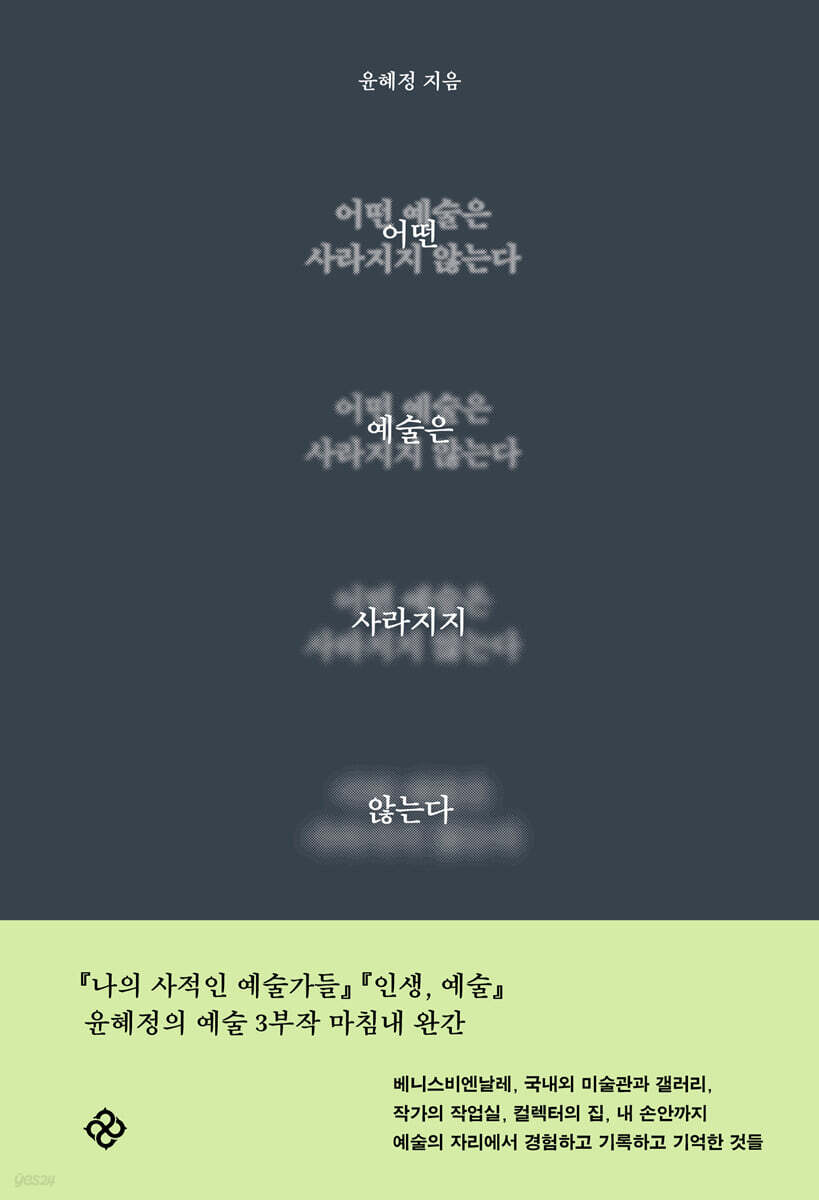
Some art never disappears
 |
Description
Book Introduction
My Private Artists and Life, Art
Yoon Hye-jeong's "Art Trilogy" Finally Completed
From biennales to world-class art galleries, artists' studios, collectors' homes, and even the palm of your hand.
Things I experienced, recorded, and remembered in the field of art
Author Hye-Jeong Yoon (Director of Kukje Gallery), who has been at the forefront of the cultural arts, has published a collection of her artistic experiences, 『Some Art Never Disappears』, which condenses them into a spatial and temporal structure, based on the artistic experiences she has accumulated since the 1990s. This collection has been published by Eulyoo Publishing Co.
This book is the final installment of Yoon Hye-jeong's 'Art Trilogy', following 'My Private Artists' (2020), a collection of interviews with masters of modern art, and 'Life, Art' (2022), a collection of essays that explores art through five keywords: emotion, relationship, work, women, and daily life, and focusing on the 'place' and 'temporality' of art.
That is, it collects and excavates artistic moments, experiences, knowledge, and thoughts that change depending on the landscape in which the work is placed, from the vast and distant art space of the "world city" to the very close and small "hand."
This book presents fifteen stories that have been preserved for a long time, among those the author has seen, heard, and felt over the past 20 years in the field of art.
From the diverse landscapes of the Venice Biennale to the various guards guarding prestigious art museums around the world, the author's own photographs, along with over 130 color plates, enrich the viewing experience.
Yoon Hye-jeong's "Art Trilogy" Finally Completed
From biennales to world-class art galleries, artists' studios, collectors' homes, and even the palm of your hand.
Things I experienced, recorded, and remembered in the field of art
Author Hye-Jeong Yoon (Director of Kukje Gallery), who has been at the forefront of the cultural arts, has published a collection of her artistic experiences, 『Some Art Never Disappears』, which condenses them into a spatial and temporal structure, based on the artistic experiences she has accumulated since the 1990s. This collection has been published by Eulyoo Publishing Co.
This book is the final installment of Yoon Hye-jeong's 'Art Trilogy', following 'My Private Artists' (2020), a collection of interviews with masters of modern art, and 'Life, Art' (2022), a collection of essays that explores art through five keywords: emotion, relationship, work, women, and daily life, and focusing on the 'place' and 'temporality' of art.
That is, it collects and excavates artistic moments, experiences, knowledge, and thoughts that change depending on the landscape in which the work is placed, from the vast and distant art space of the "world city" to the very close and small "hand."
This book presents fifteen stories that have been preserved for a long time, among those the author has seen, heard, and felt over the past 20 years in the field of art.
From the diverse landscapes of the Venice Biennale to the various guards guarding prestigious art museums around the world, the author's own photographs, along with over 130 color plates, enrich the viewing experience.
- You can preview some of the book's contents.
Preview
index
Prologue In the Place of Art
1.
About movement
Linus van de Velde + Kwon Hayoun + Bill Viola = Seoul Art Sonje Center + National Museum of Modern and Contemporary Art + Kukje Gallery
2.
Crossing the threshold
Giardini Park + Arsenale + Certosa Island = Venice Biennale
3.
Rediscovering relationships
Lee Ufan = At the Lee Ufan Museum in Arles
4.
Own, share, and love
Clifford Einstein in LA + Jorge Perez in Miami + Sten Bachmann in Copenhagen = Collector's House
5.
In the abyss of light and sound
Steve McQueen = At Dia Beacon in New York
6.
Life Exhibition
Gerhard Richter + Tetzing Hsieh = at the New National Gallery in Berlin
7.
To live with dignity
Jenny Holzer = New York Studio + Solomon R.
At the Guggenheim Museum
8.
The encounter between day and night
Yang Hye-gyu + Apichatpong Weerasethakul = at Naoshima Matabe
9.
The fiction of reality
Pierre Huyghe = Leeum, Samsung Museum of Art, Seoul + Punta della Dogana, Venice + Sculpture Project Münster
10.
One and only in the world
Kim Seung-deok + Frank Gautreau = at the Dijon Consortium Museum
11.
There is true beauty in chaos.
Daniel Boyd = Martin Gropius Bau, Berlin
12.
Living Art
Kim Yun-shin = In the Paju studio
13.
Two hours of wandering and freedom
Yoon Hye-jeong = Seoul Hyundai Card Music Library + CGV Myeongdong Station Cine Library + Uijeongbu Art Library
14.
To be consumed by abstraction
Anish Kapoor = At the Kukje Gallery in Seoul
15.
It won't disappear
Yoon Hye-jeong + Patrick Bringley = From the book 'I am a security guard at the Metropolitan Museum of Art'
main
Source of the illustration
Search
1.
About movement
Linus van de Velde + Kwon Hayoun + Bill Viola = Seoul Art Sonje Center + National Museum of Modern and Contemporary Art + Kukje Gallery
2.
Crossing the threshold
Giardini Park + Arsenale + Certosa Island = Venice Biennale
3.
Rediscovering relationships
Lee Ufan = At the Lee Ufan Museum in Arles
4.
Own, share, and love
Clifford Einstein in LA + Jorge Perez in Miami + Sten Bachmann in Copenhagen = Collector's House
5.
In the abyss of light and sound
Steve McQueen = At Dia Beacon in New York
6.
Life Exhibition
Gerhard Richter + Tetzing Hsieh = at the New National Gallery in Berlin
7.
To live with dignity
Jenny Holzer = New York Studio + Solomon R.
At the Guggenheim Museum
8.
The encounter between day and night
Yang Hye-gyu + Apichatpong Weerasethakul = at Naoshima Matabe
9.
The fiction of reality
Pierre Huyghe = Leeum, Samsung Museum of Art, Seoul + Punta della Dogana, Venice + Sculpture Project Münster
10.
One and only in the world
Kim Seung-deok + Frank Gautreau = at the Dijon Consortium Museum
11.
There is true beauty in chaos.
Daniel Boyd = Martin Gropius Bau, Berlin
12.
Living Art
Kim Yun-shin = In the Paju studio
13.
Two hours of wandering and freedom
Yoon Hye-jeong = Seoul Hyundai Card Music Library + CGV Myeongdong Station Cine Library + Uijeongbu Art Library
14.
To be consumed by abstraction
Anish Kapoor = At the Kukje Gallery in Seoul
15.
It won't disappear
Yoon Hye-jeong + Patrick Bringley = From the book 'I am a security guard at the Metropolitan Museum of Art'
main
Source of the illustration
Search
Detailed image

Into the book
Art, experience, record, memory.
While publishing two books, I wrote down several keywords that had accumulated or been engraved in my notebook several times.
These polite, ordinary words wriggled in place, moved, danced, and swayed.
The country shook people, woke them up, sometimes put them to sleep, and then woke them up again.
I haven't discovered anything new under the sun.
I was reunited with the countless moments of joy, surprise, despair, and emotion that I had spent time in.
As I dug through my phone's photo album, old notes, and old manuscripts, I realized that nothing ever truly disappears as long as someone remembers it with care.
Whether it's an exhibition that's temporary in nature, a place where artwork is displayed, a story about art that's just chasing after empty clouds, or something the world has forgotten about, it's us who keep it alive: us who experience, contemplate, remember, and record it.
---From the "Prologue"
The artist has worked as a video artist all his life with the belief that everything in the world is moving.
However, through this work, the concept of movement is expanded to the inner self of humans.
“It is not the mountain that moves, but your heart.” And then Viola turns her gaze and asks us:
Is there truly an unchanging truth in this world, in the world surrounding me? If so, what is it?
How can we define and accept the concept of immutability?
With the exhibition ending, Viola's work, which has now faded into memory, still comes to mind from time to time.
Is it the mountain I remember dancing gently along the rippling waves, or is it the mountain that tried to maintain its composure but failed time and time again?
Moving Stillness: Mount Rainier 1979 is a work that allows me to intuitively feel the waves and turmoil within my mind, a vast, deep, and yet poorly understood world.
---「1.
From “On Movement”
I began to think that the sense of compulsion I felt every time I visited the Venice Biennale might have stemmed from the countless hurdles I felt I had to overcome.
The difficulty of art, the glamour of big capital, the authenticity of modern art, doubts about it, and doubts about myself blindly struggling in the gaps between them…
All of this was a threshold.
The inflated expectations that the world we dream of and desire will unfold after we pass through this have turned the threshold to a free and abundant middle ground into a high wall.
Of course, it would be naive to expect that just because I've been waiting and crossing the threshold of despair all day, I'll become indifferent to the clash between reality and ideals, completely free from FOMO, or completely forget about museum fatigue.
I just want to remember the thrill and liberation of the moment when I realized that I might not exist at the end of the world, on this island that I never aspired to be the ultimate destination.
---「2.
From "Crossing the Threshold"
Lee Ufan does not use the expressions ‘creation’ or ‘creation’ in his work.
For him, art is not about creating something new that never existed before, but about rediscovering or reconstructing something that originally existed.
It is for the same reason that Lee Ufan constantly tries to erase his own existence in his work.
He is wary of the attitude of artists who objectify strong self-consciousness, clear ideologies, or specific concepts in their works.
I confess that I don't like works that overwhelm people with their presence, nor works that push logic.
Modern people are enthusiastic about and yearn for art as an object, but even if his works are selling for more and more money every day, Lee Ufan believes that art itself is a profound realm that can never be captured as an object.
If Lee Ufan's sculptures and paintings seem ascetic, it is because of the simple form and strict restraint, but also because, paradoxically, it is because of the artist's stubborn belief in minimizing the ego.
---「3.
From “Rediscovering Relationships”
When listening to collectors' stories, there are moments when you realize that this isn't just limited to artwork.
The desire to collect tells us a lot more than just our tastes or our financial situation.
The life they lived, their perspective, their direction, and their philosophy are reflected in the work they saw, felt, and ultimately decided to keep.
Stories about how art has contributed to a better life often spiral into vivid examples of how art contributes to our world, and that's where the inspiration comes from.
So I think a true collector is closer to an idealist than a quick-thinking realist.
People who fiercely develop affection and affection for those who fascinate them, actively realize it, and delight in expressing their feelings like children.
Their happiness doesn't come from simply owning something, but from being able to share it in some way.
In most cases, ownership and sharing are difficult to reconcile, but for art-for-alls, it is possible.
-「4.
From “Own, Share, Love”
Invisible waves create color, and inaudible sound waves create sound.
We tend to blindly believe what we see and hear, but perhaps it is the unseen and unheard that make up the world.
In that defenseless state, with only light and music, all I could do was focus on myself and the present moment.
It takes courage to take off your armor and helmet for a moment and surrender to your physical sensations.
It also takes effort to figure out the usefulness of art—whether it makes us forget, cover up, or recognize suffering.
This feeling inside me is about emotions and the mind, and a 'discovery' of how we exist.
McQueen used my body, grounded in this blank space, as a philosophical, intellectual, and emotional receiver and speaker, and we communicated without words.
While publishing two books, I wrote down several keywords that had accumulated or been engraved in my notebook several times.
These polite, ordinary words wriggled in place, moved, danced, and swayed.
The country shook people, woke them up, sometimes put them to sleep, and then woke them up again.
I haven't discovered anything new under the sun.
I was reunited with the countless moments of joy, surprise, despair, and emotion that I had spent time in.
As I dug through my phone's photo album, old notes, and old manuscripts, I realized that nothing ever truly disappears as long as someone remembers it with care.
Whether it's an exhibition that's temporary in nature, a place where artwork is displayed, a story about art that's just chasing after empty clouds, or something the world has forgotten about, it's us who keep it alive: us who experience, contemplate, remember, and record it.
---From the "Prologue"
The artist has worked as a video artist all his life with the belief that everything in the world is moving.
However, through this work, the concept of movement is expanded to the inner self of humans.
“It is not the mountain that moves, but your heart.” And then Viola turns her gaze and asks us:
Is there truly an unchanging truth in this world, in the world surrounding me? If so, what is it?
How can we define and accept the concept of immutability?
With the exhibition ending, Viola's work, which has now faded into memory, still comes to mind from time to time.
Is it the mountain I remember dancing gently along the rippling waves, or is it the mountain that tried to maintain its composure but failed time and time again?
Moving Stillness: Mount Rainier 1979 is a work that allows me to intuitively feel the waves and turmoil within my mind, a vast, deep, and yet poorly understood world.
---「1.
From “On Movement”
I began to think that the sense of compulsion I felt every time I visited the Venice Biennale might have stemmed from the countless hurdles I felt I had to overcome.
The difficulty of art, the glamour of big capital, the authenticity of modern art, doubts about it, and doubts about myself blindly struggling in the gaps between them…
All of this was a threshold.
The inflated expectations that the world we dream of and desire will unfold after we pass through this have turned the threshold to a free and abundant middle ground into a high wall.
Of course, it would be naive to expect that just because I've been waiting and crossing the threshold of despair all day, I'll become indifferent to the clash between reality and ideals, completely free from FOMO, or completely forget about museum fatigue.
I just want to remember the thrill and liberation of the moment when I realized that I might not exist at the end of the world, on this island that I never aspired to be the ultimate destination.
---「2.
From "Crossing the Threshold"
Lee Ufan does not use the expressions ‘creation’ or ‘creation’ in his work.
For him, art is not about creating something new that never existed before, but about rediscovering or reconstructing something that originally existed.
It is for the same reason that Lee Ufan constantly tries to erase his own existence in his work.
He is wary of the attitude of artists who objectify strong self-consciousness, clear ideologies, or specific concepts in their works.
I confess that I don't like works that overwhelm people with their presence, nor works that push logic.
Modern people are enthusiastic about and yearn for art as an object, but even if his works are selling for more and more money every day, Lee Ufan believes that art itself is a profound realm that can never be captured as an object.
If Lee Ufan's sculptures and paintings seem ascetic, it is because of the simple form and strict restraint, but also because, paradoxically, it is because of the artist's stubborn belief in minimizing the ego.
---「3.
From “Rediscovering Relationships”
When listening to collectors' stories, there are moments when you realize that this isn't just limited to artwork.
The desire to collect tells us a lot more than just our tastes or our financial situation.
The life they lived, their perspective, their direction, and their philosophy are reflected in the work they saw, felt, and ultimately decided to keep.
Stories about how art has contributed to a better life often spiral into vivid examples of how art contributes to our world, and that's where the inspiration comes from.
So I think a true collector is closer to an idealist than a quick-thinking realist.
People who fiercely develop affection and affection for those who fascinate them, actively realize it, and delight in expressing their feelings like children.
Their happiness doesn't come from simply owning something, but from being able to share it in some way.
In most cases, ownership and sharing are difficult to reconcile, but for art-for-alls, it is possible.
-「4.
From “Own, Share, Love”
Invisible waves create color, and inaudible sound waves create sound.
We tend to blindly believe what we see and hear, but perhaps it is the unseen and unheard that make up the world.
In that defenseless state, with only light and music, all I could do was focus on myself and the present moment.
It takes courage to take off your armor and helmet for a moment and surrender to your physical sensations.
It also takes effort to figure out the usefulness of art—whether it makes us forget, cover up, or recognize suffering.
This feeling inside me is about emotions and the mind, and a 'discovery' of how we exist.
McQueen used my body, grounded in this blank space, as a philosophical, intellectual, and emotional receiver and speaker, and we communicated without words.
---「5.
From “In the Abyss of Light and Sound”
From “In the Abyss of Light and Sound”
Publisher's Review
From 'World City' to 'In My Hand'
Each landscape in which the work is placed has its own unique story.
Artists find answers in their own language to the invisible abyss and the unsolvable unknown world.
Through the works of art they embody, we gain hints at the uncertainty and ambiguity of life, briefly refresh our boring daily lives, or even understand the ways of the world.
The artist's answer here may vary depending on when, where, and how the work is exhibited.
Depending on the location and time, the answer will be different.
Author Hye-Jeong Yoon, currently serving as a director at Kukje Gallery, one of Korea's top three art galleries, believes that "imagining the invisible through the visible leads us to moments of change."
So today, I wander around the exhibition hall, “unable to forget the thrilling and unexpected chemical reactions.”
For the author, ‘experiencing art’ is an effort to understand humanity and the world beyond simply seeing, reading, and knowing.
"Some Art Never Disappears" tells the unique story of each landscape where the artwork is placed, traveling across time and space from the vast and distant "world city" to the close and small "in my hand," reflecting the author's artistic experiences that have anchored him in his shaky life.
Even today, when we can do many things with our smartphones without having to move, there are things that require movement to truly reach their essence.
Art is one of them.
But we often feel an invisible wall in front of it, and we consume the work of art as one of the countless images in a photo album, capturing the moment with a single touch.
The author's new book encourages readers to take the path of "reading slowly, one by one," even if it takes a little longer and takes a little longer, rather than the "easy way" that has become so commonplace.
A unique moment in life, created through space, people, and works of art.
The book flows without boundaries not only through the author's own workplace, but also through physical spaces around the world, including Korea's leading art museums and libraries, the United States, Italy, France, Germany, Argentina, Denmark, and Japan.
Creators, curators, collectors, and other art-related figures and their trajectories permeate these spaces, and author Hye-Jeong Yoon meticulously weaves all of this together, adding her own appreciation and reflections to create a unique piece of life.
For example, whenever she goes to the Venice Biennale, she suffers from the compulsion to see all the exhibitions and the fear of missing some, but she experiences the ‘liberation of freedom and enlightenment’ at an unexpected exhibition hall, or encounters the ‘life exhibition’ that highlights the dramatic contrast between the imperial artist Gerhard Richter and the disappeared artist Tehching Hsieh at the New National Gallery in Berlin, or contemplates anew the ‘beautiful symbiosis’ through Yang Haegue’s daytime exhibition and Apichatpong Weerasethakul’s nighttime exhibition in Matabe, Naoshima, Japan.
Also, we examine the 'ideal relationship between life and work' from artist Kim Yun-shin, who moved her studio from Buenos Aires to Paju, a distance of approximately 20,000 kilometers at the age of 90, and continues her work; we encounter the 'true nature of love' in the homes of Danish and American collectors who collect the works of Korean artists; we reveal the 'difficulties of work' of exhibiting abstract works in the workplace and conveying them in everyday language; and we candidly depict 'stories of people working invisibly' behind the scenes of the art world through books in our hands.
As long as someone remembers it fondly
Some art never disappears
This book includes approximately 130 color illustrations, mainly photographs taken by the author himself.
The photos taken from Yoon Hye-jeong's perspective give the feeling of going on an art journey with her.
This book contains the unexpected artistic experiences discovered thanks to Yoon Hye-jeong, who devotes her heart to art more than anyone else and is passionate about sharing it, such as the Certosa Island at the Venice Biennale that she would not have gone to alone, the enchantment of the Martin Gropius Bau Museum that she would not have felt alone, and the Dijon Consortium that she would not have known about alone.
Birth is always followed by death.
This is true for people and many things in nature, but the author says in this book that he realized that “nothing ever disappears as long as someone remembers it with care.”
In this way, some art transcends time and space and comes before us without disappearing.
Each landscape in which the work is placed has its own unique story.
Artists find answers in their own language to the invisible abyss and the unsolvable unknown world.
Through the works of art they embody, we gain hints at the uncertainty and ambiguity of life, briefly refresh our boring daily lives, or even understand the ways of the world.
The artist's answer here may vary depending on when, where, and how the work is exhibited.
Depending on the location and time, the answer will be different.
Author Hye-Jeong Yoon, currently serving as a director at Kukje Gallery, one of Korea's top three art galleries, believes that "imagining the invisible through the visible leads us to moments of change."
So today, I wander around the exhibition hall, “unable to forget the thrilling and unexpected chemical reactions.”
For the author, ‘experiencing art’ is an effort to understand humanity and the world beyond simply seeing, reading, and knowing.
"Some Art Never Disappears" tells the unique story of each landscape where the artwork is placed, traveling across time and space from the vast and distant "world city" to the close and small "in my hand," reflecting the author's artistic experiences that have anchored him in his shaky life.
Even today, when we can do many things with our smartphones without having to move, there are things that require movement to truly reach their essence.
Art is one of them.
But we often feel an invisible wall in front of it, and we consume the work of art as one of the countless images in a photo album, capturing the moment with a single touch.
The author's new book encourages readers to take the path of "reading slowly, one by one," even if it takes a little longer and takes a little longer, rather than the "easy way" that has become so commonplace.
A unique moment in life, created through space, people, and works of art.
The book flows without boundaries not only through the author's own workplace, but also through physical spaces around the world, including Korea's leading art museums and libraries, the United States, Italy, France, Germany, Argentina, Denmark, and Japan.
Creators, curators, collectors, and other art-related figures and their trajectories permeate these spaces, and author Hye-Jeong Yoon meticulously weaves all of this together, adding her own appreciation and reflections to create a unique piece of life.
For example, whenever she goes to the Venice Biennale, she suffers from the compulsion to see all the exhibitions and the fear of missing some, but she experiences the ‘liberation of freedom and enlightenment’ at an unexpected exhibition hall, or encounters the ‘life exhibition’ that highlights the dramatic contrast between the imperial artist Gerhard Richter and the disappeared artist Tehching Hsieh at the New National Gallery in Berlin, or contemplates anew the ‘beautiful symbiosis’ through Yang Haegue’s daytime exhibition and Apichatpong Weerasethakul’s nighttime exhibition in Matabe, Naoshima, Japan.
Also, we examine the 'ideal relationship between life and work' from artist Kim Yun-shin, who moved her studio from Buenos Aires to Paju, a distance of approximately 20,000 kilometers at the age of 90, and continues her work; we encounter the 'true nature of love' in the homes of Danish and American collectors who collect the works of Korean artists; we reveal the 'difficulties of work' of exhibiting abstract works in the workplace and conveying them in everyday language; and we candidly depict 'stories of people working invisibly' behind the scenes of the art world through books in our hands.
As long as someone remembers it fondly
Some art never disappears
This book includes approximately 130 color illustrations, mainly photographs taken by the author himself.
The photos taken from Yoon Hye-jeong's perspective give the feeling of going on an art journey with her.
This book contains the unexpected artistic experiences discovered thanks to Yoon Hye-jeong, who devotes her heart to art more than anyone else and is passionate about sharing it, such as the Certosa Island at the Venice Biennale that she would not have gone to alone, the enchantment of the Martin Gropius Bau Museum that she would not have felt alone, and the Dijon Consortium that she would not have known about alone.
Birth is always followed by death.
This is true for people and many things in nature, but the author says in this book that he realized that “nothing ever disappears as long as someone remembers it with care.”
In this way, some art transcends time and space and comes before us without disappearing.
GOODS SPECIFICS
- Date of issue: June 25, 2025
- Page count, weight, size: 504 pages | 768g | 140*205*31mm
- ISBN13: 9788932475615
- ISBN10: 893247561X
You may also like
카테고리
korean


korean

![GQ KOREA Mark (Monthly): December [2025]](http://librairie.coreenne.fr/cdn/shop/files/8ef265dbbfbf186523ed75ba7319009d.jpg?v=1765340328&width=3840)


