

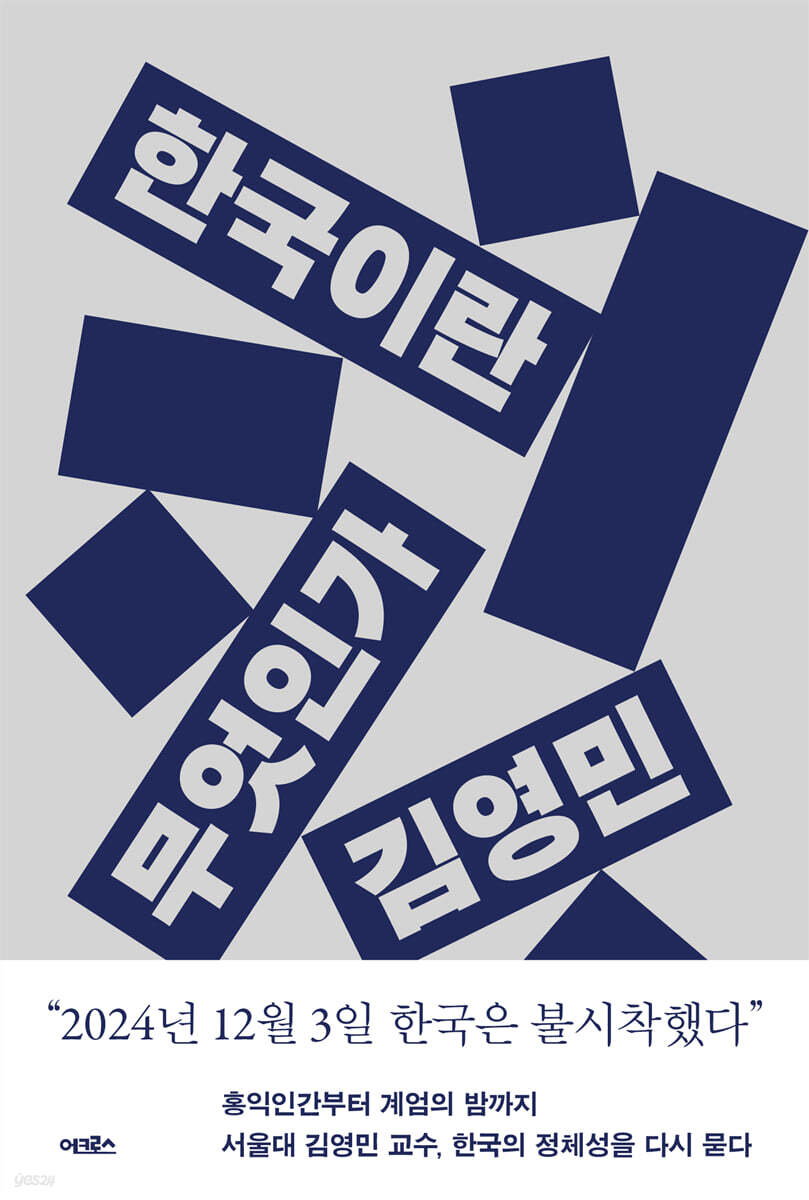
What is Korea?
 |
Description
Book Introduction
- A word from MD
-
Professor Kim Young-min of Seoul National University's theory on KoreansProfessor Kim Young-min of Seoul National University, who looks at the world from a fresh perspective with accurate analysis and a pleasant writing style, talks about Koreans.
In the process of asking who Koreans are, we go through the Dangun myth, Buddhism and Confucianism, and the colonial period.
We explored our present and future by looking at the major events in modern and contemporary history that shaped the Republic of Korea.
April 15, 2025. Humanities PD Son Min-gyu
“When the answer is not visible, we must ask
“Who am I, where am I, what is Korea?”
Seoul National University Professor Kim Young-min Revisits Korea's Identity
December 3, 2024: Korea crash-lands.
Where did Korea come from and where is it going now?
Questions about identity are often raised in moments of crisis.
When something so unfamiliar and unusual happens that it forces people to reexamine who they are and where they stand, they are finally faced with fundamental questions.
After the president's illegal martial law declaration in the middle of the night on December 3, 2024, we cannot help but ask:
Where is Korean society now? Where did it come from, and where is it headed? As familiar perspectives on Korean society crumble and the world we once knew begins to crack, rethinking the community known as "Korea" has become an unavoidable task.
Professor Kim Young-min of Seoul National University, who has led readers into a place of deep thought with his unbridled imagination, sophisticated logic, and rhythmic prose, revisits this age-old question and presents a fresh perspective on Korean society.
“What is Korea” is the beginning of that conversation.
In this book, Professor Kim Young-min questions the very way we have understood Korea from the beginning and discusses the possibility of a new narrative.
“Who am I, where am I, what is Korea?”
Seoul National University Professor Kim Young-min Revisits Korea's Identity
December 3, 2024: Korea crash-lands.
Where did Korea come from and where is it going now?
Questions about identity are often raised in moments of crisis.
When something so unfamiliar and unusual happens that it forces people to reexamine who they are and where they stand, they are finally faced with fundamental questions.
After the president's illegal martial law declaration in the middle of the night on December 3, 2024, we cannot help but ask:
Where is Korean society now? Where did it come from, and where is it headed? As familiar perspectives on Korean society crumble and the world we once knew begins to crack, rethinking the community known as "Korea" has become an unavoidable task.
Professor Kim Young-min of Seoul National University, who has led readers into a place of deep thought with his unbridled imagination, sophisticated logic, and rhythmic prose, revisits this age-old question and presents a fresh perspective on Korean society.
“What is Korea” is the beginning of that conversation.
In this book, Professor Kim Young-min questions the very way we have understood Korea from the beginning and discusses the possibility of a new narrative.
- You can preview some of the book's contents.
Preview
index
Prologue: Rethinking Korea
Part 1: Korea's Past
Korean Ideology: Oh my, Hongik Ingan!
Korean Mythology: Reflecting on the Dangun Myth
Ancient Korea: The Three Kingdoms Period
Korean Classics: Rereading History Books
The National Anthem of Korea: Epidemics and the Nation
The King's Two Bodies
Buddhism in Korea: Buddhism in History
Korean Political Community: There Is No Sage King
Universal and Particular in Korea: Visiting a Catholic Church and Seeing Paintings
Korean Pseudo-Religions: Confucian Land
Korean Slaves: Nobiland
Korea's Independence Movement: In Search of Microscopic Independence Struggles
Korea's Colonial Experience: Invasion, Assimilation, and Identity
Political Theology in Korea: Your Silence
Part 2: Korea's Present
Military Regime in Korea: The Spring of Seoul and the Coup
Democracy in Korea: The Boy Comes
The Korean Revolution: How to End a Revolution
Civil Society in Korea: In Search of Civil Society Autonomy
Korean Modernization: This is Korean Modernization
Korean Universities: The Trajectory of Freedom
Korean youth: Are we just going to live and die like this?
Adults in Korea: An Antithesis Against Disillusionment
Korean Immigration: Where is the Ship of Theseus?
Photos of Korea: Visiting a Korean-themed exhibition
Korean Architecture: Seeing the Statue of Liberty
Part 3: Korea's Future
Korean Wish: Seeing someone's wish
Opportunity in Korea: For any action to occur
Reform in Korea: When a Different Life Feels Rational
Korea's Choices: I hope you don't get stuck on the choices you're given.
Korea's new name: It is composed
The Korean Miracle: What is a Miracle?
Korean Conservatives: "Gran Torino" Recommended
The Fall of Korea: Reflecting on the Birth and Death of Community
Epilogue: Do you love pain?
Part 1: Korea's Past
Korean Ideology: Oh my, Hongik Ingan!
Korean Mythology: Reflecting on the Dangun Myth
Ancient Korea: The Three Kingdoms Period
Korean Classics: Rereading History Books
The National Anthem of Korea: Epidemics and the Nation
The King's Two Bodies
Buddhism in Korea: Buddhism in History
Korean Political Community: There Is No Sage King
Universal and Particular in Korea: Visiting a Catholic Church and Seeing Paintings
Korean Pseudo-Religions: Confucian Land
Korean Slaves: Nobiland
Korea's Independence Movement: In Search of Microscopic Independence Struggles
Korea's Colonial Experience: Invasion, Assimilation, and Identity
Political Theology in Korea: Your Silence
Part 2: Korea's Present
Military Regime in Korea: The Spring of Seoul and the Coup
Democracy in Korea: The Boy Comes
The Korean Revolution: How to End a Revolution
Civil Society in Korea: In Search of Civil Society Autonomy
Korean Modernization: This is Korean Modernization
Korean Universities: The Trajectory of Freedom
Korean youth: Are we just going to live and die like this?
Adults in Korea: An Antithesis Against Disillusionment
Korean Immigration: Where is the Ship of Theseus?
Photos of Korea: Visiting a Korean-themed exhibition
Korean Architecture: Seeing the Statue of Liberty
Part 3: Korea's Future
Korean Wish: Seeing someone's wish
Opportunity in Korea: For any action to occur
Reform in Korea: When a Different Life Feels Rational
Korea's Choices: I hope you don't get stuck on the choices you're given.
Korea's new name: It is composed
The Korean Miracle: What is a Miracle?
Korean Conservatives: "Gran Torino" Recommended
The Fall of Korea: Reflecting on the Birth and Death of Community
Epilogue: Do you love pain?
Detailed image

Into the book
Korea in the 21st century is not just a failure of politics, a failure of the constitution, a failure of the rule of law, a failure of political parties, a failure of elections, a failure of education, a failure of the media, and a failure of society, but also a failure of the way we have understood Korea.
It is a failure of the existing way of understanding that relies on easy language and lazy imagination.
Now is the time to rethink Korea.
It is time to reconsider where Korea came from and where it is going.
It is time to invent a new language to understand Korea.
--- From the "Prologue"
In a secular country, there are limits to justifying political power through religious beliefs.
What can be mobilized instead of religion is history.
History is ultimately a story that gives meaning to today's events, and today's events look different depending on who is telling what story.
So, those in political power want to include their desired political message in history books.
--- From "The Three Kingdoms Period"
What will we remember and what will we forget? The Korean community, which endures across time and space, is the result of this selective memory and forgetting.
--- From "The King's Two Bodies"
It was only then that a small realization came to me.
I see, Confucian Land isn't a place that shows past Korean culture, but a place that shows modern Korea.
French philosopher Jean Baudrillard once said that Disneyland exists to hide the fact that the 'real' country, the entire 'real' United States, is Disneyland.
Could it be that Confucian Land is in Andong to hide the fact that the entire real country, the real Korea, is Confucian Land?
The land of 'Confucianism', which was invented by modern Korea rather than a culture that existed in the past.
--- From "Confucian Land"
In Korean history, slaves are not simply interesting because of their class system.
Slaves are also quite interesting in that they were objects of collective oblivion and neglect.
Modern Korea is a place where so many slaves existed, but now it is difficult to find descendants of slaves (or people who claim to be slaves).
At the same time, this is modern Korea, where the president of a luxury apartment complex in Gangnam yells at the manager, “How dare you, you son of a bitch!”
--- From "Nobiland"
A coup is not simply an act of breaking the law.
Who urinates in public? It may be illegal, but it's not a coup.
Who pickpockets? He's a petty criminal, not a coup leader.
According to Michel Foucault, a coup is not breaking the law, but transcending the law.
So, Michel Foucault said that in a coup situation, state reason commands “the law itself.”
The essence of a coup is not a question of breaking or keeping the law, but of challenging the authority that makes it all possible.
--- From “Spring in Seoul and the Coup”
When a revolution takes place but the world it promised does not come, people cry out, “The revolution is not over yet!”
Anthropologist Clifford Geertz once said that people only cry out because they don't know how to end the revolution, not because the revolution isn't over yet.
--- From "How to End a Revolution"
Korean society has consistently relied on enlightenment.
You and I both have been shouting.
Wake up! Focus! The consciousness-raising project of the student movement is one of the representative enlightenment projects in modern Korean history.
Relying on enlightenment presupposes that society can be improved by changing consciousness.
It is assumed that society is in this state because people do not realize something.
It presupposes the moral superiority of the enlightened over the enlightened.
How successful has this enlightenment been in Korean society?
It is a failure of the existing way of understanding that relies on easy language and lazy imagination.
Now is the time to rethink Korea.
It is time to reconsider where Korea came from and where it is going.
It is time to invent a new language to understand Korea.
--- From the "Prologue"
In a secular country, there are limits to justifying political power through religious beliefs.
What can be mobilized instead of religion is history.
History is ultimately a story that gives meaning to today's events, and today's events look different depending on who is telling what story.
So, those in political power want to include their desired political message in history books.
--- From "The Three Kingdoms Period"
What will we remember and what will we forget? The Korean community, which endures across time and space, is the result of this selective memory and forgetting.
--- From "The King's Two Bodies"
It was only then that a small realization came to me.
I see, Confucian Land isn't a place that shows past Korean culture, but a place that shows modern Korea.
French philosopher Jean Baudrillard once said that Disneyland exists to hide the fact that the 'real' country, the entire 'real' United States, is Disneyland.
Could it be that Confucian Land is in Andong to hide the fact that the entire real country, the real Korea, is Confucian Land?
The land of 'Confucianism', which was invented by modern Korea rather than a culture that existed in the past.
--- From "Confucian Land"
In Korean history, slaves are not simply interesting because of their class system.
Slaves are also quite interesting in that they were objects of collective oblivion and neglect.
Modern Korea is a place where so many slaves existed, but now it is difficult to find descendants of slaves (or people who claim to be slaves).
At the same time, this is modern Korea, where the president of a luxury apartment complex in Gangnam yells at the manager, “How dare you, you son of a bitch!”
--- From "Nobiland"
A coup is not simply an act of breaking the law.
Who urinates in public? It may be illegal, but it's not a coup.
Who pickpockets? He's a petty criminal, not a coup leader.
According to Michel Foucault, a coup is not breaking the law, but transcending the law.
So, Michel Foucault said that in a coup situation, state reason commands “the law itself.”
The essence of a coup is not a question of breaking or keeping the law, but of challenging the authority that makes it all possible.
--- From “Spring in Seoul and the Coup”
When a revolution takes place but the world it promised does not come, people cry out, “The revolution is not over yet!”
Anthropologist Clifford Geertz once said that people only cry out because they don't know how to end the revolution, not because the revolution isn't over yet.
--- From "How to End a Revolution"
Korean society has consistently relied on enlightenment.
You and I both have been shouting.
Wake up! Focus! The consciousness-raising project of the student movement is one of the representative enlightenment projects in modern Korean history.
Relying on enlightenment presupposes that society can be improved by changing consciousness.
It is assumed that society is in this state because people do not realize something.
It presupposes the moral superiority of the enlightened over the enlightened.
How successful has this enlightenment been in Korean society?
--- From "When a Life Different from the Present Feels Reasonable"
Publisher's Review
Beyond easy language and lazy imagination
Rethinking Korea's Identity
Finding identity is essential to a community.
However, even the word 'identity' has become so familiar that it has become a concept that we pass over without giving it much thought.
Professor Kim Young-min poses this question more fundamentally.
Now, what exactly is this thing we call 'Korea'?
Can we imagine Korea in a different way?
But the fixed stories that have been familiar to us do not fully capture Korea.
Professor Kim Young-min dismantles the image of Korea created by existing language and reconstructs Korea's identity for a new era within that gap.
In his book, he looks back on Korea's transformations within the grand flow of history, from Hongik Ingan to the night of martial law, and shakes and re-establishes concepts that we take for granted and do not even question.
It renews the outdated perspective on the Dangun myth, reexamines the complexity of the colonial experience, and retells the story of the existence of microscopic independence movements.
Furthermore, we propose re-examining the meaning of civil society and universities in Korea and shifting our perspectives on youth and adults.
Dissected into past, present and future
The object of thought called 'Korea'
"What is Korea" is composed of three parts.
Although it is titled ‘Korea’s Past’, ‘Korea’s Present’, and ‘Korea’s Future’, it is not a simple description of chronological order.
It is close to an attempt to dissect the structure of Korean society by borrowing the ‘layers of time.’
Part 1, "Korea's Past," reinterprets concepts we have long believed to be familiar with—Hongik Ingan, the Dangun myth, the Three Kingdoms period, Buddhism and Confucianism, the slave system, and the colonial experience—from a completely different perspective.
According to Professor Kim Young-min, the Dangun myth could be the memory of a people conquered by an external civilization, or conversely, it could be a political narrative that invoked the authority of the gods to preserve self-esteem.
Meanwhile, the concept of the 'Three Kingdoms Period' is a perspective presented by Kim Bu-sik, an elite of the Goryeo Dynasty, and in reality, it was a period in which dozens of small states coexisted.
Through this, the author reminds us that the past is not simply something that has passed, but a 'narrative of memory' that is reconstructed, interpreted, and justified by the desires and power of the present.
Part 2, 'Korea's Present,' relentlessly explores the structural vulnerabilities of the reality we have taken for granted.
Professor Kim Young-min, who diagnoses the precarious state of the institutional foundations of Korean society—the crisis of Korean democracy, the incompetence and stagnation of party politics, the distrust of the media, the failure of the education system, and the impotence of reform discourse—does not view these phenomena as mere functional defects.
He points out that the words 'reform', 'democracy', and 'justice' are gradually losing their original meaning, and that the old system is not able to cope with it.
It calls for a sober reflection on where we stand amidst this crumbling language and system.
Part 3, "Korea's Future," is not a simple blueprint or hopeful outlook, but rather an experiment in thought that broadens the "horizons of the world that can be imagined under the name of Korea."
Rather than defining each other, isn't there a possibility that progressives and conservatives can work together to create new questions? Can the situation, which remains divided between youth and the elderly, urban and rural, and the middle class and the periphery, be transformed? Professor Kim Young-min asks.
What we need now is not grand ideological declarations, but the work of reconnecting everyday life with politics and restoring a sensitivity that can reinterpret suffering and community.
He further proposes that we consider together how to reconstruct the aspirations, opportunities, and possibilities of the Korean people, and what conditions must be established for the name Korea to remain valid in the future.
"Korea is a society where success and failure coexist." Discovering a new language to understand Korea.
The exploration of identity and new perceptions of Korea lead directly to a diagnosis of today's reality.
The prologue of "What is Korea?" begins in December 2024 with the shocking incident of the president's illegal declaration of martial law.
Through this incident, Professor Kim Young-min exposes how fragile the political foundations of Korean society are and the fragile order upon which our daily lives rest.
Economic growth, cultural globalization, and the maturation of democracy… Behind the seemingly "Korean miracle" achievements, we discover the failures of language and the backwardness of the rule of law.
Professor Kim Young-min believes that Korea today is a society where success and failure coexist, and the problem is that the existing language is too outdated to handle this complexity.
He therefore argues that we must dismantle the existing perspectives we have used to understand Korea and find a “new language” to replace them.
He says that the ultimate goal of the book, "What is Korea?" is the exploration of that new language, and that only through this new language can we encounter ourselves in a new way.
Beyond the short-sighted question of who will be the next president,
It's time for serious questions about this place.
Professor Kim Young-min suggests that rather than focusing on wasteful political predictions like, “Who will be the next president?” we should focus on the fundamental question, “Why do we live in this Korea now?”
He emphasizes that what is needed to overcome today's crisis is not institutional reform but a shift in thinking, not political achievement but the invention of language, and not the emergence of leaders but a reconfiguration of the nation's perspective.
"What is Korea?" is a book that goes beyond simply analyzing reality, but poses new questions and broadens the horizons of thought.
This book is the beginning of a conversation I hope to share with all those concerned about the present and future of the Korean community.
This is a proposal to go beyond fixed language and stuffed concepts and talk about Korea again and reconstruct it.
At this turning point in our era, where the familiar is crumbling, we must ask ourselves questions again and again.
The more the answer seems unclear, the more we must look deeper into who we are.
This book begins again at the end of that question.
Rethinking Korea's Identity
Finding identity is essential to a community.
However, even the word 'identity' has become so familiar that it has become a concept that we pass over without giving it much thought.
Professor Kim Young-min poses this question more fundamentally.
Now, what exactly is this thing we call 'Korea'?
Can we imagine Korea in a different way?
But the fixed stories that have been familiar to us do not fully capture Korea.
Professor Kim Young-min dismantles the image of Korea created by existing language and reconstructs Korea's identity for a new era within that gap.
In his book, he looks back on Korea's transformations within the grand flow of history, from Hongik Ingan to the night of martial law, and shakes and re-establishes concepts that we take for granted and do not even question.
It renews the outdated perspective on the Dangun myth, reexamines the complexity of the colonial experience, and retells the story of the existence of microscopic independence movements.
Furthermore, we propose re-examining the meaning of civil society and universities in Korea and shifting our perspectives on youth and adults.
Dissected into past, present and future
The object of thought called 'Korea'
"What is Korea" is composed of three parts.
Although it is titled ‘Korea’s Past’, ‘Korea’s Present’, and ‘Korea’s Future’, it is not a simple description of chronological order.
It is close to an attempt to dissect the structure of Korean society by borrowing the ‘layers of time.’
Part 1, "Korea's Past," reinterprets concepts we have long believed to be familiar with—Hongik Ingan, the Dangun myth, the Three Kingdoms period, Buddhism and Confucianism, the slave system, and the colonial experience—from a completely different perspective.
According to Professor Kim Young-min, the Dangun myth could be the memory of a people conquered by an external civilization, or conversely, it could be a political narrative that invoked the authority of the gods to preserve self-esteem.
Meanwhile, the concept of the 'Three Kingdoms Period' is a perspective presented by Kim Bu-sik, an elite of the Goryeo Dynasty, and in reality, it was a period in which dozens of small states coexisted.
Through this, the author reminds us that the past is not simply something that has passed, but a 'narrative of memory' that is reconstructed, interpreted, and justified by the desires and power of the present.
Part 2, 'Korea's Present,' relentlessly explores the structural vulnerabilities of the reality we have taken for granted.
Professor Kim Young-min, who diagnoses the precarious state of the institutional foundations of Korean society—the crisis of Korean democracy, the incompetence and stagnation of party politics, the distrust of the media, the failure of the education system, and the impotence of reform discourse—does not view these phenomena as mere functional defects.
He points out that the words 'reform', 'democracy', and 'justice' are gradually losing their original meaning, and that the old system is not able to cope with it.
It calls for a sober reflection on where we stand amidst this crumbling language and system.
Part 3, "Korea's Future," is not a simple blueprint or hopeful outlook, but rather an experiment in thought that broadens the "horizons of the world that can be imagined under the name of Korea."
Rather than defining each other, isn't there a possibility that progressives and conservatives can work together to create new questions? Can the situation, which remains divided between youth and the elderly, urban and rural, and the middle class and the periphery, be transformed? Professor Kim Young-min asks.
What we need now is not grand ideological declarations, but the work of reconnecting everyday life with politics and restoring a sensitivity that can reinterpret suffering and community.
He further proposes that we consider together how to reconstruct the aspirations, opportunities, and possibilities of the Korean people, and what conditions must be established for the name Korea to remain valid in the future.
"Korea is a society where success and failure coexist." Discovering a new language to understand Korea.
The exploration of identity and new perceptions of Korea lead directly to a diagnosis of today's reality.
The prologue of "What is Korea?" begins in December 2024 with the shocking incident of the president's illegal declaration of martial law.
Through this incident, Professor Kim Young-min exposes how fragile the political foundations of Korean society are and the fragile order upon which our daily lives rest.
Economic growth, cultural globalization, and the maturation of democracy… Behind the seemingly "Korean miracle" achievements, we discover the failures of language and the backwardness of the rule of law.
Professor Kim Young-min believes that Korea today is a society where success and failure coexist, and the problem is that the existing language is too outdated to handle this complexity.
He therefore argues that we must dismantle the existing perspectives we have used to understand Korea and find a “new language” to replace them.
He says that the ultimate goal of the book, "What is Korea?" is the exploration of that new language, and that only through this new language can we encounter ourselves in a new way.
Beyond the short-sighted question of who will be the next president,
It's time for serious questions about this place.
Professor Kim Young-min suggests that rather than focusing on wasteful political predictions like, “Who will be the next president?” we should focus on the fundamental question, “Why do we live in this Korea now?”
He emphasizes that what is needed to overcome today's crisis is not institutional reform but a shift in thinking, not political achievement but the invention of language, and not the emergence of leaders but a reconfiguration of the nation's perspective.
"What is Korea?" is a book that goes beyond simply analyzing reality, but poses new questions and broadens the horizons of thought.
This book is the beginning of a conversation I hope to share with all those concerned about the present and future of the Korean community.
This is a proposal to go beyond fixed language and stuffed concepts and talk about Korea again and reconstruct it.
At this turning point in our era, where the familiar is crumbling, we must ask ourselves questions again and again.
The more the answer seems unclear, the more we must look deeper into who we are.
This book begins again at the end of that question.
GOODS SPECIFICS
- Date of issue: April 10, 2025
- Page count, weight, size: 300 pages | 370g | 135*200*18mm
- ISBN13: 9791167742001
You may also like
카테고리
korean


korean

![ELLE 엘르 스페셜 에디션 A형 : 12월 [2025]](http://librairie.coreenne.fr/cdn/shop/files/b8e27a3de6c9538896439686c6b0e8fb.jpg?v=1766436872&width=3840)


