

History of RNA
 |
Description
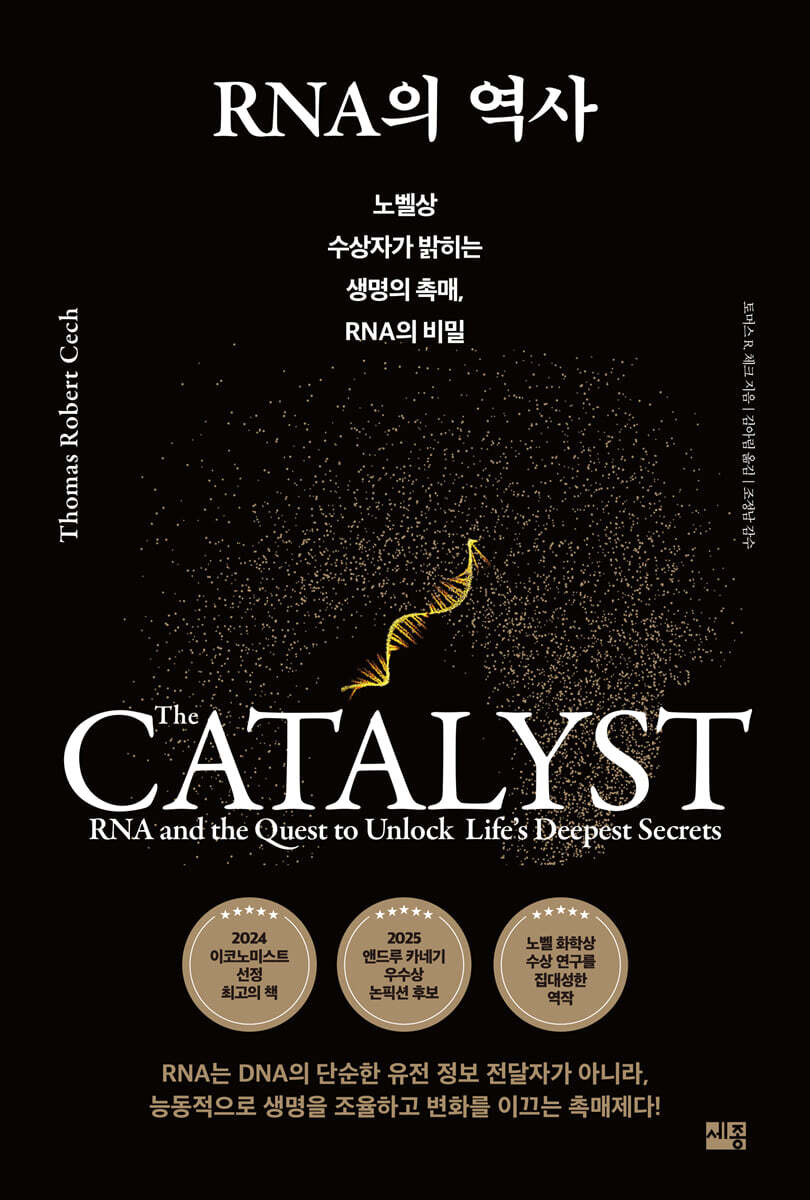
Book Introduction
RNA is not simply a carrier of genetic information.
Coordinating life and guiding evolution,
The secret of the invisible catalyst is revealed!
★The Economist's Best Books of 2024
★2025 Andrew Carnegie Excellence Award for Nonfiction Nominee
★A masterpiece that compiles Nobel Prize-winning research in chemistry
Gone are the days when DNA was believed to be the key to life.
Now, RNA takes center stage!
In the late 20th century, DNA emerged as the key to unlocking the secrets of life, but RNA was long considered merely a helper to DNA.
However, in the 21st century, RNA was discovered to be not just a simple carrier of genetic information, but an active orchestrator, catalyst, and agent of transformation of life, establishing itself as a key element driving innovation in biology, medicine, and biotechnology.
This book is a love song about RNA, written by Thomas Cech, a world-renowned molecular biologist who won the 1989 Nobel Prize in Chemistry for his discovery of RNA catalysis (ribozyme). It covers everything from the scientific discovery of RNA to groundbreaking biotechnology, including CRISPR gene editing, mRNA vaccines, and aging research utilizing telomeres, known as the fountain of life, exploring how 21st-century life sciences are being rewritten around RNA. It compares the complex workings of RNA to familiar objects like record players and spaghetti, and compares RNA splicing to the "copy and paste" function of a word processor.
This is the first book to explain the difficult principles of RNA in a way that is easy to understand by using materials easily encountered in everyday life.
Professor Cho Jeong-nam of Durham University, who reviewed the book, highly praised it, saying, “If James Watson’s ‘The Double Helix’ is the representative book on DNA, then this book is the representative book on RNA.” Nobel Prize winners such as Harold Varmus, Carol Greider, Paul Nurse, and Jennifer Doudna, as well as Professor Lee Du-gap of the Department of Science at Seoul National University, also strongly recommended the book.
This book is a must-read not only for researchers at the forefront of life sciences, but also for middle and high school students just beginning to learn biology, and anyone interested in biology and medicine.
Coordinating life and guiding evolution,
The secret of the invisible catalyst is revealed!
★The Economist's Best Books of 2024
★2025 Andrew Carnegie Excellence Award for Nonfiction Nominee
★A masterpiece that compiles Nobel Prize-winning research in chemistry
Gone are the days when DNA was believed to be the key to life.
Now, RNA takes center stage!
In the late 20th century, DNA emerged as the key to unlocking the secrets of life, but RNA was long considered merely a helper to DNA.
However, in the 21st century, RNA was discovered to be not just a simple carrier of genetic information, but an active orchestrator, catalyst, and agent of transformation of life, establishing itself as a key element driving innovation in biology, medicine, and biotechnology.
This book is a love song about RNA, written by Thomas Cech, a world-renowned molecular biologist who won the 1989 Nobel Prize in Chemistry for his discovery of RNA catalysis (ribozyme). It covers everything from the scientific discovery of RNA to groundbreaking biotechnology, including CRISPR gene editing, mRNA vaccines, and aging research utilizing telomeres, known as the fountain of life, exploring how 21st-century life sciences are being rewritten around RNA. It compares the complex workings of RNA to familiar objects like record players and spaghetti, and compares RNA splicing to the "copy and paste" function of a word processor.
This is the first book to explain the difficult principles of RNA in a way that is easy to understand by using materials easily encountered in everyday life.
Professor Cho Jeong-nam of Durham University, who reviewed the book, highly praised it, saying, “If James Watson’s ‘The Double Helix’ is the representative book on DNA, then this book is the representative book on RNA.” Nobel Prize winners such as Harold Varmus, Carol Greider, Paul Nurse, and Jennifer Doudna, as well as Professor Lee Du-gap of the Department of Science at Seoul National University, also strongly recommended the book.
This book is a must-read not only for researchers at the forefront of life sciences, but also for middle and high school students just beginning to learn biology, and anyone interested in biology and medicine.
- You can preview some of the book's contents.
Preview
index
Recommendation
Reviewer's note
Introduction: The Age of RNA
Part 1: RNA, the Immortal Catalyst
Chapter 1 Messenger
Chapter 2: Connecting the Pieces of Life
Chapter 3: Splicing by Yourself
Chapter 4: The Master of Transformation
Chapter 5: Molecular Machines: Ribosomes
Chapter 6: The Origin of Life
Part 2: Rewriting the Blueprint of Life
Chapter 7: Is the Fountain of Youth a Death Trap?
Chapter 8: What a Little Nematode Taught Us
Chapter 9: Accurate Parasites and Flimsy Copies
Chapter 10 RNA vs. RNA
Chapter 11: Running with Scissors: The CRISPR Revolution
Epilogue: The Future of RNA
Acknowledgements
Glossary of Terms
Americas
Search
Reviewer's note
Introduction: The Age of RNA
Part 1: RNA, the Immortal Catalyst
Chapter 1 Messenger
Chapter 2: Connecting the Pieces of Life
Chapter 3: Splicing by Yourself
Chapter 4: The Master of Transformation
Chapter 5: Molecular Machines: Ribosomes
Chapter 6: The Origin of Life
Part 2: Rewriting the Blueprint of Life
Chapter 7: Is the Fountain of Youth a Death Trap?
Chapter 8: What a Little Nematode Taught Us
Chapter 9: Accurate Parasites and Flimsy Copies
Chapter 10 RNA vs. RNA
Chapter 11: Running with Scissors: The CRISPR Revolution
Epilogue: The Future of RNA
Acknowledgements
Glossary of Terms
Americas
Search
Detailed image

Into the book
RNA doesn't just heal us.
It could kill us.
From polio to SARS-CoV-2, RNA is the genetic material of some of history's deadliest viruses.
When you look at these viruses alone, RNA looks like the real villain.
However, mRNA vaccines offer a glimpse into the potential of RNA to protect us from COVID-19 and, furthermore, from various diseases, including cancer.
--- p.17
The first thing that was disappointing was that most RNAs in the cytoplasm had the same ratio of A, G, C, and U, no matter what protein was being synthesized.
This was nonsense.
It's like saying that Beethoven's 9th Symphony has the exact same note ratio as Lady Gaga's song "Bad Romance."
Since these songs are from completely different genres of music, one would expect that the notes, such as pa sharps and re flats, would be distributed differently.
Likewise, if a protein has a different amino acid composition, the ratio of A, G, C, and U in the mRNA (short for messenger RNA) that determines it must be different.
--- p.33
To use another analogy, you can think of introns as meaningless words inserted into a sensible sentence.
Like the sentence, 'You smell really good today.'
If we had a word processor, we could quickly correct this sentence.
Simply select the problematic intrusive word and click the 'Delete' button.
Erase 'whatever' and paste the rest.
The sentence 'You smell really good today' appears.
Nature similarly edits introns out of mRNA, leaving behind only the genetic code used for protein synthesis.
--- p.58
In Art's RNA splicing experiments, the Tetrahymena nucleus was assumed to be a source of enzymes that catalyze the splicing reaction, so samples omitting the Tetrahymena nucleus were good controls.
We expected that this sample, devoid of nuclei, would produce nothing at all.
But surprisingly, RNA splicing still occurred.
--- p.86
Watson also struggled for nearly ten years to figure out the structure of RNA.
First, Watson purified RNA from various sources—plant viruses, calf liver, yeast—then performed X-ray diffraction experiments, and, based on the very rough data he obtained, concluded that these diverse RNAs had a common structure.3 This was like looking at an elephant and a Volkswagen from 200 meters away on a foggy day and concluding that they were identical.
If you wait until the sun comes up and take a good look with binoculars, you will come to a completely different conclusion.
--- p.109
Lee Ju had 37,000 people around the world play a computer game called 'eteRNA'.
People were playing games to find solutions to the RNA folding problem.
In 2009, eteRNA published its first challenge online.
"Design a star- or cross-shaped RNA." In other words, what sequence should A, G, C, and U form so that they complement each other and fold into the desired shape? Participants came from all walks of life. Some were graduate students studying RNA directly, while others were Sudoku enthusiasts who had barely heard of RNA but were eager to solve a new puzzle.
They developed computer programs that could fold RNA and solved problems using only paper and pencil.
--- p.128~129
After returning home from LA, I started digging through old scientific papers and it dawned on me.
For decades, scientists studying the "origin of life" have puzzled over how the first self-reproducing systems emerged on Earth nearly 4 billion years ago.
When faced with the question, "Which came first, the chicken or the egg?", they were already theorizing that RNA provided the solution.
--- p.165~166
At the time, Liz had no idea that she would usher in a new era in understanding cancer and the aging process.
Little did he know that he was breaking new ground in RNA science.
I thought it was just another fact about DNA.
At the time, none of us knew what kind of DNA existed at the ends of chromosomes, the linear DNA molecules in the nucleus of an organism's cells.
Of course, cell biologists have long been interested in the ends of chromosomes, called telomeres (which means 'ends').
Its history dates back to the days when Hermann Müller observed fruit flies and Barbara McClintock observed corn.
--- p.188
My daughters text me a lot, and they make a lot of typos because their fingers move quickly.
They sometimes misspell "food" instead of "good," and "bake" instead of "wake." They send messages like, "I'm going to bake the kids at 3 o'clock," and then add, "No, I'm going to wake them up."
Sometimes, if there are multiple typos in important parts, it can be difficult to understand what is meant.
The same goes for viral RNA replication.
Some errors may be tolerated or even advantageous, but if too many errors occur, the virus cannot survive.
--- p.247~248
After developing the first effective vaccine against polio in the 1950s, Dr. Jonas Salk was given the opportunity to build his dream research center on 27 acres of land on the coast of La Jolla, California.
Salk asked architect Louis Kahn to create a building that "Picasso would come to paint."
The resulting assembly of teak and concrete blocks is today renowned as a unique architectural masterpiece and a bastion of cutting-edge science.
But few people know that the Salk Institute, named after the man who once saved the world from a pandemic by creating a vaccine, was also where the idea for mRNA vaccines to control another pandemic was born many years later.
--- p.257~258
Having worked exclusively with DNA throughout my PhD and postdoctoral studies, I never imagined RNA would dominate my thinking so deeply. The transition from DNA scientist to RNA scientist wasn't just mine; it was a path chosen by many researchers in the early days of this field.
At the same time, RNA is no longer a tool dependent on DNA, but is emerging from its shadow and becoming a wondrous molecule with infinite possibilities.
I consider myself fortunate to have traveled with RNA as my passenger at every turning point in my life's journey.
It could kill us.
From polio to SARS-CoV-2, RNA is the genetic material of some of history's deadliest viruses.
When you look at these viruses alone, RNA looks like the real villain.
However, mRNA vaccines offer a glimpse into the potential of RNA to protect us from COVID-19 and, furthermore, from various diseases, including cancer.
--- p.17
The first thing that was disappointing was that most RNAs in the cytoplasm had the same ratio of A, G, C, and U, no matter what protein was being synthesized.
This was nonsense.
It's like saying that Beethoven's 9th Symphony has the exact same note ratio as Lady Gaga's song "Bad Romance."
Since these songs are from completely different genres of music, one would expect that the notes, such as pa sharps and re flats, would be distributed differently.
Likewise, if a protein has a different amino acid composition, the ratio of A, G, C, and U in the mRNA (short for messenger RNA) that determines it must be different.
--- p.33
To use another analogy, you can think of introns as meaningless words inserted into a sensible sentence.
Like the sentence, 'You smell really good today.'
If we had a word processor, we could quickly correct this sentence.
Simply select the problematic intrusive word and click the 'Delete' button.
Erase 'whatever' and paste the rest.
The sentence 'You smell really good today' appears.
Nature similarly edits introns out of mRNA, leaving behind only the genetic code used for protein synthesis.
--- p.58
In Art's RNA splicing experiments, the Tetrahymena nucleus was assumed to be a source of enzymes that catalyze the splicing reaction, so samples omitting the Tetrahymena nucleus were good controls.
We expected that this sample, devoid of nuclei, would produce nothing at all.
But surprisingly, RNA splicing still occurred.
--- p.86
Watson also struggled for nearly ten years to figure out the structure of RNA.
First, Watson purified RNA from various sources—plant viruses, calf liver, yeast—then performed X-ray diffraction experiments, and, based on the very rough data he obtained, concluded that these diverse RNAs had a common structure.3 This was like looking at an elephant and a Volkswagen from 200 meters away on a foggy day and concluding that they were identical.
If you wait until the sun comes up and take a good look with binoculars, you will come to a completely different conclusion.
--- p.109
Lee Ju had 37,000 people around the world play a computer game called 'eteRNA'.
People were playing games to find solutions to the RNA folding problem.
In 2009, eteRNA published its first challenge online.
"Design a star- or cross-shaped RNA." In other words, what sequence should A, G, C, and U form so that they complement each other and fold into the desired shape? Participants came from all walks of life. Some were graduate students studying RNA directly, while others were Sudoku enthusiasts who had barely heard of RNA but were eager to solve a new puzzle.
They developed computer programs that could fold RNA and solved problems using only paper and pencil.
--- p.128~129
After returning home from LA, I started digging through old scientific papers and it dawned on me.
For decades, scientists studying the "origin of life" have puzzled over how the first self-reproducing systems emerged on Earth nearly 4 billion years ago.
When faced with the question, "Which came first, the chicken or the egg?", they were already theorizing that RNA provided the solution.
--- p.165~166
At the time, Liz had no idea that she would usher in a new era in understanding cancer and the aging process.
Little did he know that he was breaking new ground in RNA science.
I thought it was just another fact about DNA.
At the time, none of us knew what kind of DNA existed at the ends of chromosomes, the linear DNA molecules in the nucleus of an organism's cells.
Of course, cell biologists have long been interested in the ends of chromosomes, called telomeres (which means 'ends').
Its history dates back to the days when Hermann Müller observed fruit flies and Barbara McClintock observed corn.
--- p.188
My daughters text me a lot, and they make a lot of typos because their fingers move quickly.
They sometimes misspell "food" instead of "good," and "bake" instead of "wake." They send messages like, "I'm going to bake the kids at 3 o'clock," and then add, "No, I'm going to wake them up."
Sometimes, if there are multiple typos in important parts, it can be difficult to understand what is meant.
The same goes for viral RNA replication.
Some errors may be tolerated or even advantageous, but if too many errors occur, the virus cannot survive.
--- p.247~248
After developing the first effective vaccine against polio in the 1950s, Dr. Jonas Salk was given the opportunity to build his dream research center on 27 acres of land on the coast of La Jolla, California.
Salk asked architect Louis Kahn to create a building that "Picasso would come to paint."
The resulting assembly of teak and concrete blocks is today renowned as a unique architectural masterpiece and a bastion of cutting-edge science.
But few people know that the Salk Institute, named after the man who once saved the world from a pandemic by creating a vaccine, was also where the idea for mRNA vaccines to control another pandemic was born many years later.
--- p.257~258
Having worked exclusively with DNA throughout my PhD and postdoctoral studies, I never imagined RNA would dominate my thinking so deeply. The transition from DNA scientist to RNA scientist wasn't just mine; it was a path chosen by many researchers in the early days of this field.
At the same time, RNA is no longer a tool dependent on DNA, but is emerging from its shadow and becoming a wondrous molecule with infinite possibilities.
I consider myself fortunate to have traveled with RNA as my passenger at every turning point in my life's journey.
--- p.335
Publisher's Review
If DNA is the blueprint for life, RNA is the innovation engine that executes it!
Everything You Need to Know About RNA, as Told by Nobel Prize Winner Thomas Cech
How did life begin? What makes us human? Why do we age and get sick?
In the late 20th century, DNA dominated science and was undeniably considered the "secret of life" in the public imagination. In this era of DNA, RNA, like a backup singer in the biochemical world, was overshadowed by the diva that was DNA.
But over the past few decades, a quiet revolution has been unfolding within academia as the potential of RNA has slowly been revealed.
Thomas Cech, a world-renowned molecular biologist who won the Nobel Prize in Chemistry in 1989 for discovering the catalytic action of RNA (ribozyme) and author of “A Brief History of RNA,” and other outstanding scientists have revealed that RNA, previously considered to be the hidden ally of DNA, is the key to solving the greatest mysteries of biology.
RNA, like DNA, can store information, but information storage is only a small part of RNA's capabilities, and unlike DNA, it plays an active role in living cells.
It can act like an enzyme, twisting other RNA molecules together or assembling proteins, keeping stem cells active, and building DNA at the ends of chromosomes to prevent aging.
Compared to RNA, which can bend and fold freely like origami, DNA, the genetic matrix, looks like a singer with only one hit song.
Moreover, RNA also holds the secret to the origin of life on Earth.
RNA, with these advantages, eventually emerged from the shadow of DNA and revealed its enormous potential.
Since 2000, scientists who have led groundbreaking advances related to RNA have won ten Nobel Prizes.
Since 2005, the number of journal articles and patents dealing with RNA research has increased rapidly.
A recent article in Nature reported that there are currently over 400 RNA-based medicines in development, and in 2022 alone, more than $1 billion in private equity funds were invested in RNA research-focused biotech startups.
If the focus of the past in life sciences was DNA, the focus of the future will undoubtedly be RNA.
The COVID-19 mRNA vaccine is not short-term,
It's the result of decades of scientific innovation!
This book follows the author and other scientists on their journey of discovery, from the early experiments that first glimpsed the amazing power of RNA to the author's own paradigm-shifting discovery that RNA could catalyze cellular reactions, to the latest biotechnology advancements.
This book explores groundbreaking advances in biotechnology, from CRISPR, which rewrites the code of life using RNA, to the revolutionary mRNA vaccine that saved millions during the pandemic, to RNA-based treatments for incurable diseases.
In the spring of 2020, as SARS-CoV-2, the RNA-based virus that causes COVID-19, swept the globe, the author's research topic—RNA, both a source of suffering and a potential cure—began to be on everyone's lips.
mRNA vaccines against coronaviruses have been developed at unprecedented speed, and the author has transformed from RNA researcher to RNA spokesperson.
How did scientists develop a vaccine so quickly? The short answer is: no.
While the COVID-19 vaccine arrived at record speed, it was actually a remarkable achievement built on decades of scientific innovation.
Many of the viruses that cause pandemics are entirely powered by RNA.
Only by understanding what viruses are made of and how they work can we effectively combat them.
As the COVID-19 pandemic has taught us, an effective way to combat RNA-based viruses is through RNA-based vaccines.
Thanks to our creativity, humanity has been able to harness the genius of RNA.
While RNA has a dark side, let's remember that understanding how it works can help us use it to our advantage in the fight.
RNA, which was considered to be a supporting actor to DNA,
Now, become the protagonist of the scientific revolution!
A Nobel Prize Winner Shares an RNA Love Song
“If we compare biological phenomena to a record player, the ribosome is the turntable, the mRNA is the LP record, and the music you hear when you lower the needle is the protein.
You can change the LP depending on your mood, but the basic settings are the same.
Just as a gramophone can play any LP record, a ribosome can operate on any mRNA.
“Just as the music that will be played is determined by the LP record, the protein that will be produced is determined by the mRNA.”
“Just as we can move the cursor across an electronic document, scratch out a specific section, and then paste it onto a new page in a word processor, the ‘Find’ and ‘Replace’ functions can easily change every T in DNA to every U in RNA.
These chemical reactions also occur in nature.
Every time we synthesize a new protein, our bodies constantly 'copy and paste,' copying mRNA from DNA.”
- From the text
The 21st century is already the era of RNA.
The greatest appeal of RNA is that it is a mysterious life substance that encompasses both the primordial and futuristic aspects that form the basis of life.
This book is a guide that explains how RNA went viral and how it evolved from a topic primarily of interest to biochemists to a key research topic shaping the future of science and medicine. It delves into how RNA, as a catalyst that orchestrates and transforms life, has reshaped our understanding of biology and revolutionized medicine and biotechnology.
The text is largely divided into two parts.
Part 1 explains how RNA revealed itself as a remarkable catalyst for life and how the author's research team discovered RNA (ribozyme) as a catalyst.
Ribozymes were entities that violated the seemingly unwavering law of nature that "enzymes are naturally proteins."
For this research achievement, the author received the Nobel Prize in 1989, and from then on, RNA began to be recognized as an important substance rather than simply a passive messenger.
While Part 1 explores how RNA supports life, Part 2 explores how RNA extends and promotes life beyond the limits of nature.
Once thought to simply carry the genetic instructions of DNA, RNA is now being discovered to have contributed to the first steps of life on Earth, to the treatment of diseases through gene editing using CRISPR, and to a deep connection not only with the aging process but also with telomeres, known as the fountain of life.
This book is a must-read for those looking into the present and future of biology and medicine. It explains the principles of RNA, which can be difficult to understand, using various analogies, making it easy for even readers who are not familiar with science to understand.
Readers of this book will experience the forefront of RNA-based gene therapy, personalized medicine, and innovative new drug development.
Everything You Need to Know About RNA, as Told by Nobel Prize Winner Thomas Cech
How did life begin? What makes us human? Why do we age and get sick?
In the late 20th century, DNA dominated science and was undeniably considered the "secret of life" in the public imagination. In this era of DNA, RNA, like a backup singer in the biochemical world, was overshadowed by the diva that was DNA.
But over the past few decades, a quiet revolution has been unfolding within academia as the potential of RNA has slowly been revealed.
Thomas Cech, a world-renowned molecular biologist who won the Nobel Prize in Chemistry in 1989 for discovering the catalytic action of RNA (ribozyme) and author of “A Brief History of RNA,” and other outstanding scientists have revealed that RNA, previously considered to be the hidden ally of DNA, is the key to solving the greatest mysteries of biology.
RNA, like DNA, can store information, but information storage is only a small part of RNA's capabilities, and unlike DNA, it plays an active role in living cells.
It can act like an enzyme, twisting other RNA molecules together or assembling proteins, keeping stem cells active, and building DNA at the ends of chromosomes to prevent aging.
Compared to RNA, which can bend and fold freely like origami, DNA, the genetic matrix, looks like a singer with only one hit song.
Moreover, RNA also holds the secret to the origin of life on Earth.
RNA, with these advantages, eventually emerged from the shadow of DNA and revealed its enormous potential.
Since 2000, scientists who have led groundbreaking advances related to RNA have won ten Nobel Prizes.
Since 2005, the number of journal articles and patents dealing with RNA research has increased rapidly.
A recent article in Nature reported that there are currently over 400 RNA-based medicines in development, and in 2022 alone, more than $1 billion in private equity funds were invested in RNA research-focused biotech startups.
If the focus of the past in life sciences was DNA, the focus of the future will undoubtedly be RNA.
The COVID-19 mRNA vaccine is not short-term,
It's the result of decades of scientific innovation!
This book follows the author and other scientists on their journey of discovery, from the early experiments that first glimpsed the amazing power of RNA to the author's own paradigm-shifting discovery that RNA could catalyze cellular reactions, to the latest biotechnology advancements.
This book explores groundbreaking advances in biotechnology, from CRISPR, which rewrites the code of life using RNA, to the revolutionary mRNA vaccine that saved millions during the pandemic, to RNA-based treatments for incurable diseases.
In the spring of 2020, as SARS-CoV-2, the RNA-based virus that causes COVID-19, swept the globe, the author's research topic—RNA, both a source of suffering and a potential cure—began to be on everyone's lips.
mRNA vaccines against coronaviruses have been developed at unprecedented speed, and the author has transformed from RNA researcher to RNA spokesperson.
How did scientists develop a vaccine so quickly? The short answer is: no.
While the COVID-19 vaccine arrived at record speed, it was actually a remarkable achievement built on decades of scientific innovation.
Many of the viruses that cause pandemics are entirely powered by RNA.
Only by understanding what viruses are made of and how they work can we effectively combat them.
As the COVID-19 pandemic has taught us, an effective way to combat RNA-based viruses is through RNA-based vaccines.
Thanks to our creativity, humanity has been able to harness the genius of RNA.
While RNA has a dark side, let's remember that understanding how it works can help us use it to our advantage in the fight.
RNA, which was considered to be a supporting actor to DNA,
Now, become the protagonist of the scientific revolution!
A Nobel Prize Winner Shares an RNA Love Song
“If we compare biological phenomena to a record player, the ribosome is the turntable, the mRNA is the LP record, and the music you hear when you lower the needle is the protein.
You can change the LP depending on your mood, but the basic settings are the same.
Just as a gramophone can play any LP record, a ribosome can operate on any mRNA.
“Just as the music that will be played is determined by the LP record, the protein that will be produced is determined by the mRNA.”
“Just as we can move the cursor across an electronic document, scratch out a specific section, and then paste it onto a new page in a word processor, the ‘Find’ and ‘Replace’ functions can easily change every T in DNA to every U in RNA.
These chemical reactions also occur in nature.
Every time we synthesize a new protein, our bodies constantly 'copy and paste,' copying mRNA from DNA.”
- From the text
The 21st century is already the era of RNA.
The greatest appeal of RNA is that it is a mysterious life substance that encompasses both the primordial and futuristic aspects that form the basis of life.
This book is a guide that explains how RNA went viral and how it evolved from a topic primarily of interest to biochemists to a key research topic shaping the future of science and medicine. It delves into how RNA, as a catalyst that orchestrates and transforms life, has reshaped our understanding of biology and revolutionized medicine and biotechnology.
The text is largely divided into two parts.
Part 1 explains how RNA revealed itself as a remarkable catalyst for life and how the author's research team discovered RNA (ribozyme) as a catalyst.
Ribozymes were entities that violated the seemingly unwavering law of nature that "enzymes are naturally proteins."
For this research achievement, the author received the Nobel Prize in 1989, and from then on, RNA began to be recognized as an important substance rather than simply a passive messenger.
While Part 1 explores how RNA supports life, Part 2 explores how RNA extends and promotes life beyond the limits of nature.
Once thought to simply carry the genetic instructions of DNA, RNA is now being discovered to have contributed to the first steps of life on Earth, to the treatment of diseases through gene editing using CRISPR, and to a deep connection not only with the aging process but also with telomeres, known as the fountain of life.
This book is a must-read for those looking into the present and future of biology and medicine. It explains the principles of RNA, which can be difficult to understand, using various analogies, making it easy for even readers who are not familiar with science to understand.
Readers of this book will experience the forefront of RNA-based gene therapy, personalized medicine, and innovative new drug development.
GOODS SPECIFICS
- Date of issue: May 15, 2025
- Page count, weight, size: 388 pages | 588g | 152*225*28mm
- ISBN13: 9788984078697
- ISBN10: 8984078697
You may also like
카테고리
korean


korean

![GQ KOREA Mark (Monthly): December [2025]](http://librairie.coreenne.fr/cdn/shop/files/8ef265dbbfbf186523ed75ba7319009d.jpg?v=1765340328&width=3840)


