

Aesthetics through architecture
 |
Description
Book Introduction
The moment architecture becomes philosophy,
Your spatial perception changes!
In line with the historical and philosophical choices of the times
Between Plato and Aristotle
The standard of 'beauty' that goes back and forth
Where is contemporary beauty headed?
Architecture is the face of the times, and philosophy is the thoughts that embody that face.
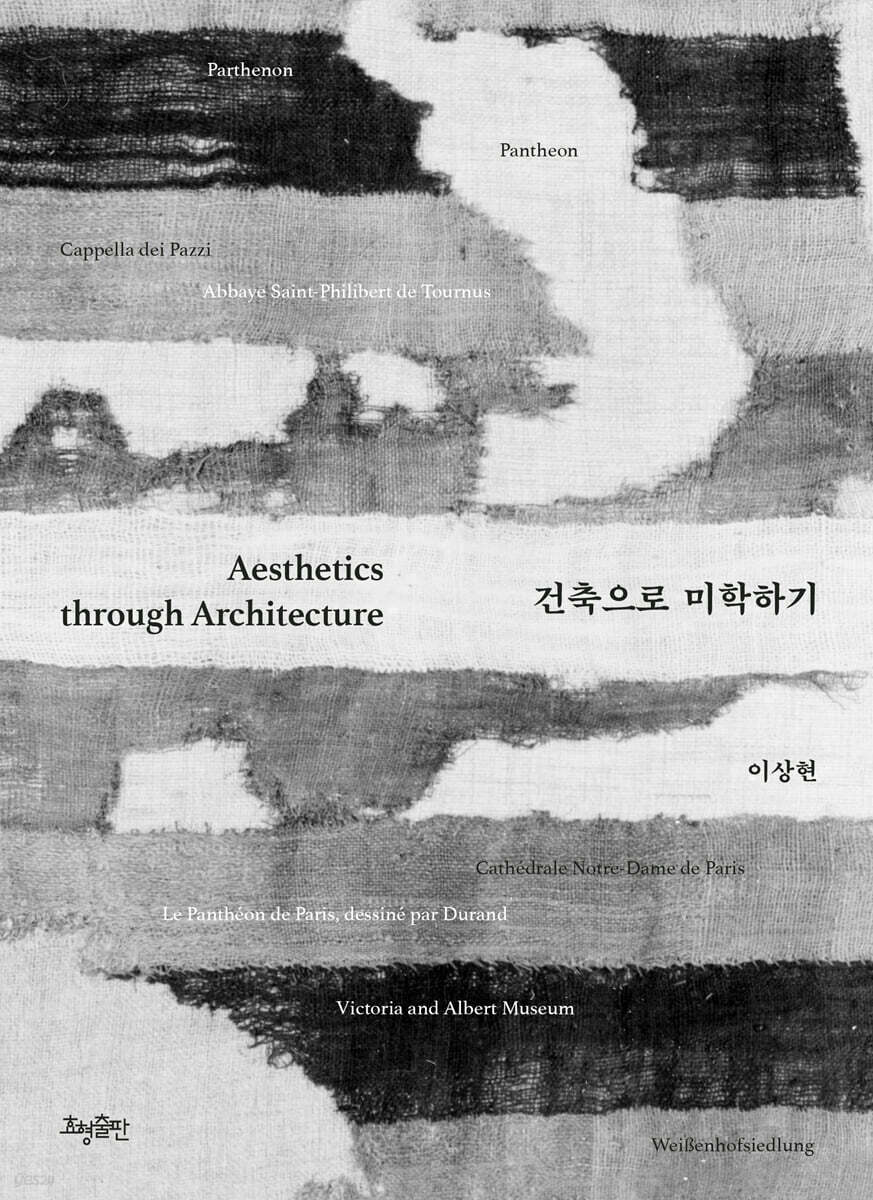
"Aesthetics through Architecture" explores the philosophies and perceptions of the times that permeate architectural forms through ten buildings spanning ancient and modern times, from the Parthenon to the Seattle Library.
We trace how aesthetic standards have changed over time, and read architectural history as a history of thought, beyond a simple record of decorative history.
It is not only physical conditions such as climate, materials, and technology that determine architecture.
At the same time, it is formed differently depending on how people perceive and evaluate the contemporary world.
This book places precisely those cultural biases at the center of its analysis.
From Plato's ideas, Aristotle's understanding of the real world, to Kant's pure reason, the philosophy of each era has left a deep mark on architectural forms.
The book's highlight lies in its insightful exploration of how deterministic and indeterministic thinking, namely the aesthetic theories of Plato and Aristotle, are repeated and transformed in the flow of architectural style.
The reason why the order of the Renaissance is replaced by the sensibility of the Baroque, and why the principles of Le Corbusier's modernism are replaced by Rem Koolhaas's deconstructionism, is not a mere fad.
It is a shift in philosophical sensibility.
Today, rather than asking, "What is beautiful?", we ask, "Why was it considered beautiful?"
"Aesthetics through Architecture" examines the thought structure behind architectural forms and offers readers a new perspective.
It reminds us that the architecture we see is not simply a product of function or style, but rather the result of historical and philosophical choices.
Aesthetics is not a way of appreciating, but a way of thinking.
This book, which understands the times through architecture and reexamines form through philosophy, will provide profound insight to those who wish to change their perspective on art.
Between aesthetic absolutism and relativism, where do we stand now? This question prompts us to reexamine the meaning of the architecture that surrounds us.
Your spatial perception changes!
In line with the historical and philosophical choices of the times
Between Plato and Aristotle
The standard of 'beauty' that goes back and forth
Where is contemporary beauty headed?
Architecture is the face of the times, and philosophy is the thoughts that embody that face.
"Aesthetics through Architecture" explores the philosophies and perceptions of the times that permeate architectural forms through ten buildings spanning ancient and modern times, from the Parthenon to the Seattle Library.
We trace how aesthetic standards have changed over time, and read architectural history as a history of thought, beyond a simple record of decorative history.
It is not only physical conditions such as climate, materials, and technology that determine architecture.
At the same time, it is formed differently depending on how people perceive and evaluate the contemporary world.
This book places precisely those cultural biases at the center of its analysis.
From Plato's ideas, Aristotle's understanding of the real world, to Kant's pure reason, the philosophy of each era has left a deep mark on architectural forms.
The book's highlight lies in its insightful exploration of how deterministic and indeterministic thinking, namely the aesthetic theories of Plato and Aristotle, are repeated and transformed in the flow of architectural style.
The reason why the order of the Renaissance is replaced by the sensibility of the Baroque, and why the principles of Le Corbusier's modernism are replaced by Rem Koolhaas's deconstructionism, is not a mere fad.
It is a shift in philosophical sensibility.
Today, rather than asking, "What is beautiful?", we ask, "Why was it considered beautiful?"
"Aesthetics through Architecture" examines the thought structure behind architectural forms and offers readers a new perspective.
It reminds us that the architecture we see is not simply a product of function or style, but rather the result of historical and philosophical choices.
Aesthetics is not a way of appreciating, but a way of thinking.
This book, which understands the times through architecture and reexamines form through philosophy, will provide profound insight to those who wish to change their perspective on art.
Between aesthetic absolutism and relativism, where do we stand now? This question prompts us to reexamine the meaning of the architecture that surrounds us.
- You can preview some of the book's contents.
Preview
index
Prologue 6
Entering 14
1 Parthenon 22
2 Roman Pantheon 46
3. Monastery of St. Philibert 66
4 Notre Dame Cathedral, Paris 86
5 Pachi Chapel 108
6th Jesu Cathedral 128
7 The Paris Pantheon by Durand 154
8 Victoria and Albert Museum 180
9 Weissenhof Housing Complex 204
10 Seattle Library 228
Epilogue 246
Reference 254
Photo copyright 263
Entering 14
1 Parthenon 22
2 Roman Pantheon 46
3. Monastery of St. Philibert 66
4 Notre Dame Cathedral, Paris 86
5 Pachi Chapel 108
6th Jesu Cathedral 128
7 The Paris Pantheon by Durand 154
8 Victoria and Albert Museum 180
9 Weissenhof Housing Complex 204
10 Seattle Library 228
Epilogue 246
Reference 254
Photo copyright 263
Detailed image
.jpg)
Into the book
So why did the Athenians distort the rectangular solid? Consistently distorting it is much more difficult than creating a perfectly square rectangular solid.
There is no reason to do something without a good reason. - Page 34 (Parthenon Temple) For the Romans of that time, it was important to perfectly express the sphere, the most ideal form.
The circle of Castel Sant'Angelo would have been of a lesser form.
The circle must be clearly recognizable both in plan and in cross section.
---From "2 Roman Pantheon"
The feeling that wonder is divine value and that God protects humans is a sense of security.
For the people of St. Philibert, wonder and a sense of security were of the utmost importance.
Because they were wearing Platonic colored glasses provided by Plotinus.
---From "The Monastery of St. Philibert"
Gothic cathedrals began to accommodate some of the human senses.
It led to a sensual expression of the image.
Light was needed for humans to perceive the representation of the saints, and this was achieved by hand.
The ceiling of the cathedral, now illuminated by light, had to be raised a little higher.
This is the moment when Aristotle's victory is confirmed.
---From "4 Notre Dame Cathedral in Paris"
The Renaissance faded so quickly that it could almost be said to have "suddenly faded."62 The fading of a dominant trend means that something else has emerged.
If we consider the use of simple, basic shapes and proportions as the characteristics of Renaissance architecture, can we not guess the characteristics of the architecture that followed?
---From "5 Pachi Chapel"
Even though it is the same building, the number of things seen by contemporaries and modern people is different.
The reason is simple.
As I have explained many times, this is because we do not see with our eyes, but rather the result of our brain's interpretation.
To say that contemporaries and modern people see things differently ultimately means that they interpret things differently.
The brain observes something, that is, interprets it based on the knowledge and experience it has gained up to the point of seeing it.
---From "6-Day Jesu Cathedral"
Architecture before Durand pursued ideal forms.
However, in the era of Durang, ideal forms are not pursued.
No, you can't do that.
Why? Because we need to create a building with an unprecedented purpose.
Can you imagine an ideal form that would fit a building with such unprecedented uses?
---From "The Paris Pantheon of 7 Durands"
In this context, we can find Aristotle's influence in the Victoria and Albert Museum.
The further development of architecture again leaned towards Aristotle.
The moment we lean towards the further Aristotle of architecture, we anticipate Plato again.
---From "8 Victoria and Albert Museum"
In modernist architecture, function can take the place of idea because it is a principle that transcends time and space.
The art of architecture reproduces function.
And such efforts are naturally given the name functionalism.
In this context, modernist architecture is once again the revival of Plato.
---From "9 Weissenhof Housing Complex"
What Koolhaas, who designed the Seattle Library, saw was the colored glasses of ‘deconstruction of deconstructionist philosophy.’
What is important, and what will be reiterated at the end of every chapter throughout the book, is that attempts like Koolhaas's are tolerated or encouraged thanks to Aristotle's theory of art.
There is no reason to do something without a good reason. - Page 34 (Parthenon Temple) For the Romans of that time, it was important to perfectly express the sphere, the most ideal form.
The circle of Castel Sant'Angelo would have been of a lesser form.
The circle must be clearly recognizable both in plan and in cross section.
---From "2 Roman Pantheon"
The feeling that wonder is divine value and that God protects humans is a sense of security.
For the people of St. Philibert, wonder and a sense of security were of the utmost importance.
Because they were wearing Platonic colored glasses provided by Plotinus.
---From "The Monastery of St. Philibert"
Gothic cathedrals began to accommodate some of the human senses.
It led to a sensual expression of the image.
Light was needed for humans to perceive the representation of the saints, and this was achieved by hand.
The ceiling of the cathedral, now illuminated by light, had to be raised a little higher.
This is the moment when Aristotle's victory is confirmed.
---From "4 Notre Dame Cathedral in Paris"
The Renaissance faded so quickly that it could almost be said to have "suddenly faded."62 The fading of a dominant trend means that something else has emerged.
If we consider the use of simple, basic shapes and proportions as the characteristics of Renaissance architecture, can we not guess the characteristics of the architecture that followed?
---From "5 Pachi Chapel"
Even though it is the same building, the number of things seen by contemporaries and modern people is different.
The reason is simple.
As I have explained many times, this is because we do not see with our eyes, but rather the result of our brain's interpretation.
To say that contemporaries and modern people see things differently ultimately means that they interpret things differently.
The brain observes something, that is, interprets it based on the knowledge and experience it has gained up to the point of seeing it.
---From "6-Day Jesu Cathedral"
Architecture before Durand pursued ideal forms.
However, in the era of Durang, ideal forms are not pursued.
No, you can't do that.
Why? Because we need to create a building with an unprecedented purpose.
Can you imagine an ideal form that would fit a building with such unprecedented uses?
---From "The Paris Pantheon of 7 Durands"
In this context, we can find Aristotle's influence in the Victoria and Albert Museum.
The further development of architecture again leaned towards Aristotle.
The moment we lean towards the further Aristotle of architecture, we anticipate Plato again.
---From "8 Victoria and Albert Museum"
In modernist architecture, function can take the place of idea because it is a principle that transcends time and space.
The art of architecture reproduces function.
And such efforts are naturally given the name functionalism.
In this context, modernist architecture is once again the revival of Plato.
---From "9 Weissenhof Housing Complex"
What Koolhaas, who designed the Seattle Library, saw was the colored glasses of ‘deconstruction of deconstructionist philosophy.’
What is important, and what will be reiterated at the end of every chapter throughout the book, is that attempts like Koolhaas's are tolerated or encouraged thanks to Aristotle's theory of art.
---From "10 Seattle Libraries"
Publisher's Review
From determinism and indeterminism, absolutism and relativism, mathematical proportions and sensory combinations, read the moment when philosophy became the standard for architecture.
Architecture is not simply a collection of techniques or styles, but a crystallization of philosophical thought.
From the Parthenon to the Seattle Library, the ten buildings this book explores each embody a different era and philosophy.
It is not just a space made of stone and brick, but a living structure of perception that shows 'how people of that time understood the world.'
The author says:
The two philosophers, Plato and Aristotle, constantly intersect and appear in the time of architecture.
According to him, the ideas of 2,500 years ago are still alive and well in the hands of modern architects.
Determinism and indeterminism, absolutism and relativism, mathematical proportion and sensory combination—all these are realized not in philosophical texts but in architectural drawings and spaces.
We often understand architecture as a ‘style’.
But this book asks:
Through whose eyes did they perceive the form? The Parthenon seen by modern people is different from the Parthenon seen by ancient Athenians.
What makes the difference lies in experience, philosophy, and the culture of the times.
This book attempts to read architecture through the lens of its time.
The attempt soon begins to affect our senses as well.
After closing the book, the architecture we encounter in our daily lives is no longer just a 'background'.
We come to realize that it contains questions of the times, conflicts arising in life, and various philosophical choices.
The moment when the Renaissance transitioned to the Baroque, the turning point from Plato to Aristotle? All of this is completely absorbed into the space called architecture.
"Aesthetics through Architecture" is open to anyone, even those who have not studied architecture, who wants to understand the aesthetics of thought, the many thoughts beyond form, and the value and philosophy that space holds.
Ultimately, isn't it a question of where what we call beauty comes from?
Architecture is not simply a collection of techniques or styles, but a crystallization of philosophical thought.
From the Parthenon to the Seattle Library, the ten buildings this book explores each embody a different era and philosophy.
It is not just a space made of stone and brick, but a living structure of perception that shows 'how people of that time understood the world.'
The author says:
The two philosophers, Plato and Aristotle, constantly intersect and appear in the time of architecture.
According to him, the ideas of 2,500 years ago are still alive and well in the hands of modern architects.
Determinism and indeterminism, absolutism and relativism, mathematical proportion and sensory combination—all these are realized not in philosophical texts but in architectural drawings and spaces.
We often understand architecture as a ‘style’.
But this book asks:
Through whose eyes did they perceive the form? The Parthenon seen by modern people is different from the Parthenon seen by ancient Athenians.
What makes the difference lies in experience, philosophy, and the culture of the times.
This book attempts to read architecture through the lens of its time.
The attempt soon begins to affect our senses as well.
After closing the book, the architecture we encounter in our daily lives is no longer just a 'background'.
We come to realize that it contains questions of the times, conflicts arising in life, and various philosophical choices.
The moment when the Renaissance transitioned to the Baroque, the turning point from Plato to Aristotle? All of this is completely absorbed into the space called architecture.
"Aesthetics through Architecture" is open to anyone, even those who have not studied architecture, who wants to understand the aesthetics of thought, the many thoughts beyond form, and the value and philosophy that space holds.
Ultimately, isn't it a question of where what we call beauty comes from?
GOODS SPECIFICS
- Date of issue: June 10, 2025
- Page count, weight, size: 264 pages | 328g | 142*195*18mm
- ISBN13: 9788958722403
- ISBN10: 8958722401
You may also like
카테고리
korean


korean

![GQ KOREA Mark (Monthly): December [2025]](http://librairie.coreenne.fr/cdn/shop/files/8ef265dbbfbf186523ed75ba7319009d.jpg?v=1765340328&width=3840)


