

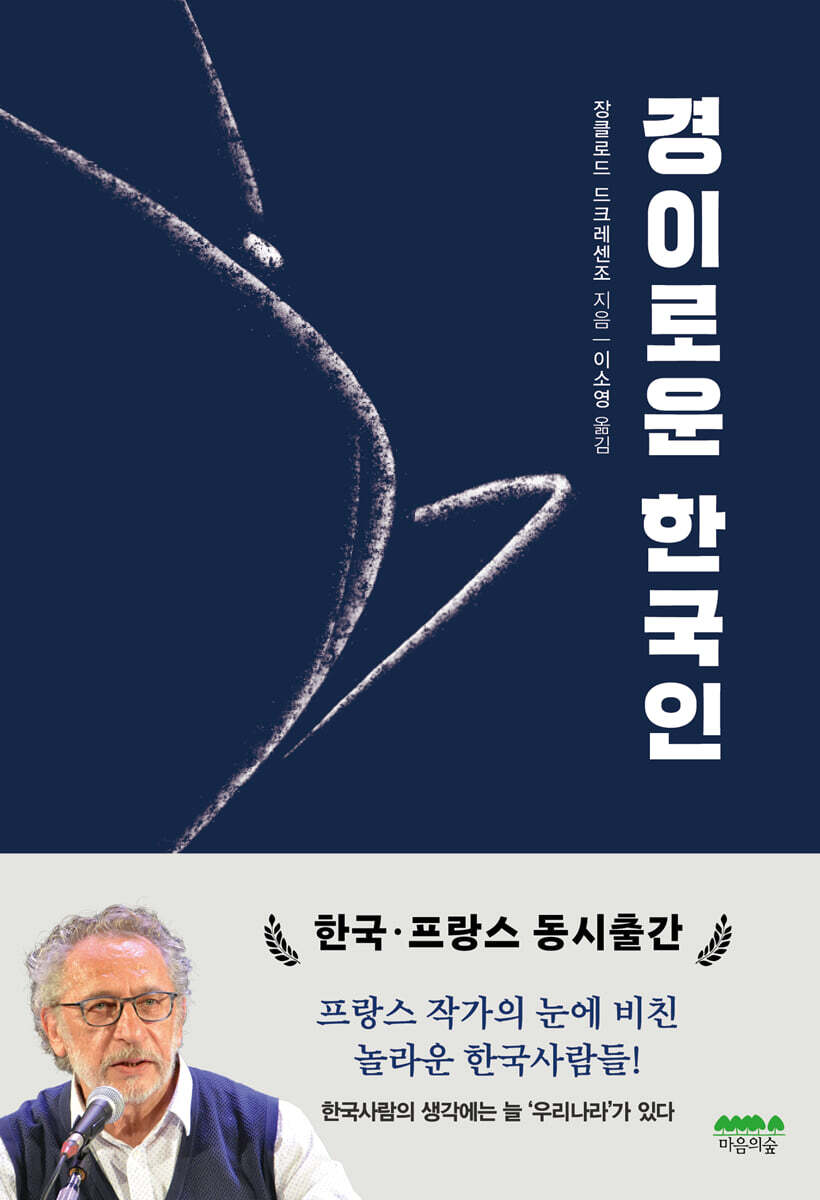
Amazing Korean
 |
Description
Book Introduction
- A word from MD
-
People who are serious about love, food, and speedIt's not 'surprise', it's 'wonder'.
'The Amazing Korean' written by a French literary critic and Korean studies authority.
Koreans are warm.
I'm serious about food.
Even Europeans, who led modernization, saw Korean society as efficient.
It's not all praise.
He also added some heartfelt advice.
April 11, 2025. Humanities PD Son Min-gyu
★ A French writer's amazing story about Koreans
★ From Korea's Nobel Prize in Literature to K-culture, K-food, and K-citizens
★ The first professor of Korean studies at the University of Aix-Marseille
★ 2023 Korean Literature Translation Award, Changwon KC International Literature Award Winner
★ The story of a Korean who brings out the brightest light when the country is in darkness.
★ Simultaneous publication in Korea and France!
Jean-Claude Decrecenzo, a French literary critic and translator who founded the Department of Korean Studies at the University of Aix-Marseille and served as its head professor, tells the story of the wondrous Korean people.
Although information on Korean culture, politics, and economy is pouring out in France, including through K-pop and K-dramas, Professor DeCrecenzo deals with the interesting aspects of what Koreans are like in their daily lives.
"Why do people write with their little fingers on the floor?" "Why do women cover their mouths with their hands when they laugh?" "Why do Koreans keep their arms close to their torsos when they run?" "Why do nurses slap their buttocks when giving shots in Korea?" "Why do poetry collections sell well in Korea?" and more. While living in Korea, I found Korean culture, habits, customs, and language to be so wondrous that I found them surprising. Reading "The Amazing Korean," an ethnographic study of Koreans from the perspective of a foreigner, allows me to understand how we live now and what strength we have to overcome.
★ From Korea's Nobel Prize in Literature to K-culture, K-food, and K-citizens
★ The first professor of Korean studies at the University of Aix-Marseille
★ 2023 Korean Literature Translation Award, Changwon KC International Literature Award Winner
★ The story of a Korean who brings out the brightest light when the country is in darkness.
★ Simultaneous publication in Korea and France!
Jean-Claude Decrecenzo, a French literary critic and translator who founded the Department of Korean Studies at the University of Aix-Marseille and served as its head professor, tells the story of the wondrous Korean people.
Although information on Korean culture, politics, and economy is pouring out in France, including through K-pop and K-dramas, Professor DeCrecenzo deals with the interesting aspects of what Koreans are like in their daily lives.
"Why do people write with their little fingers on the floor?" "Why do women cover their mouths with their hands when they laugh?" "Why do Koreans keep their arms close to their torsos when they run?" "Why do nurses slap their buttocks when giving shots in Korea?" "Why do poetry collections sell well in Korea?" and more. While living in Korea, I found Korean culture, habits, customs, and language to be so wondrous that I found them surprising. Reading "The Amazing Korean," an ethnographic study of Koreans from the perspective of a foreigner, allows me to understand how we live now and what strength we have to overcome.
- You can preview some of the book's contents.
Preview
index
Author's Note 5
Part 1: The Warm Heart Hidden in Words
26 Emotional Korean Terms of Address
Why do they keep telling me to eat a lot? 29
31 A store owner who is very attached to his customers
Korean Farewell 33
Promise to Return 35
Relationships Hidden in Titles 39
Whatever you eat, you'll feel full 41
43 Korean Expressions That Explain Everything One by One
Everything happens in the room 45
Should I say 'yes' or 'no'? 46
It's a bit weird to write it down as it sounds... 48
51 Surprisingly Shy and Cautious Expressions of Affection
Part 2: People who are more serious about eating than anyone else
Hong-eo Samhap, a Korean rite of passage 56
60 Korean National Foods
Koreans' Thrilling Noodle-Chopping Skills 62
How far does it go? 65
Once again, 69!
73 Spine-Chilling Fish Dishes
Are you okay with spicy food? 75
It takes an hour to get to the restaurant, ten minutes to eat. 78
No, why is there a roll of toilet paper here? 81
83 countries where you can eat anytime
In Korean restaurants, you ring the bell to call the waiter. 85
Already eating dinner? 89
91 Koreans who always have food in their mouths
Why do Koreans eat until their cheeks burst? 92
93 Korean Restaurants That Feel Like Banquet Halls
What's so busy that you don't even take off your coat to eat? 96
How much food does a Korean throw away each year? 98
Part 3: Koreanness Connecting Past and Present
102 A relationship that can be communicated without speaking
Why do we write with our little fingers on the floor? 103
A single slap on the cheek stings more than a needle 104
Why do Korean women cover their mouths when they laugh? 105
Why do young Koreans drag their shoes around? 106
108 Not-So-Simple Greetings
Time to drink aperitif 111
Brother first, younger brother first 114
116 Things Koreans Do First When They Wake Up in the Morning
118 countries where a stamp is more valid than a signature
Even when running, it is elegant and restrained at 120
Believe It or Not, Korean Superstitions 122
Women always bear the brunt of the hardships 124
Time to share a last drink with the deceased 126
From a beautiful land to a graveyard land 128
Is there anyone who knows my future better than I do? 130
Part 4: A nation with a history of ignorance in its genes
Korea's kind-hearted people 134
I didn't even call a substitute driver. 136
Koreans' kindness is limitless 138
140 Thoughtful consideration that is ingrained in you
The whole nation is a matchmaker 142
146 Countries Where You Can Leave Your Phone Behind Without Losing It
I will do my best to serve you 148
Responsibility is more important than privacy 152
Police and pedestrians standing under the blazing sun 153
A person who directs traffic without being a police officer 155
Korea's Unrivaled Service 157
What are you doing with that 161
Korean Kindness Covered in News 162
Patient Statement 164 for Everyone to Hear
Patient or hospital staff 166
In the minds of Koreans, there is always 'our country' 168
Part 5: Pragmatism as a Life Strategy
Korean Impatience 172
Korean taxi 174 running a red light
176 for 3 seconds for the person behind
10 minutes is okay 177
60 minutes is okay 179
90 minutes is okay 180
180 minutes is okay 181
Such an ingenious device 182
Diaper changing tables, also found in men's restrooms 184
Emergency disaster text message 185 that worries me more than my mom
Why do you ask that? 187
People who have nothing to fear in the world 188
Part 6: Fierce, sometimes leisurely
Like the antennae of a dragonfly, like the whiskers of a cat 192
193 countries that broadcast announcements from dawn
Bathroom outlet 195 that's dizzying to look at
197 Words That Shake Your Final Choice
It's cute too 200
A nation that can't live without karaoke 202
Noise Heaven 205
People Who Are Invincible at Tolerating Noise 207
Higher, Faster, More! 209
Heating is generous at 211
Koreans who hate sweating 216
Scene from a Christmas Mass at a Seoul Cathedral 218
Are Korean civil servants truly servants of the people? 223
Why do foreigners in Korea avoid eye contact? 225
Koreans who apologize without hesitation 228
The shop owner's nap scene 230
How many employees do you have? 231
How do Koreans work? 235
Closed on weekends 237
Thank you for more than just the above 239
Why doesn't anyone say hello in the elevator? 241
Champion of Waste Separation 243
A small shop selling just what you need 245
Welcome! Is this your first time at a Korean hospital? 247
254 glasses store other than ophthalmology
255 patients walking the streets like a hospital yard
Road warriors 257
258 countries where navigation is of little use
Part 7: A Country Built by Amazing People
Ah, the long-awaited Nobel Prize in Literature! 262
The Nobel Prize in Literature and the Prospects for Korean Literature 264
A nation that forgets poetry has no future. 267
269 Korean Films That Are Enchanting Even in the Shadows
People who move forward despite deep-rooted bad habits 271
Korean Folie 275
279 Citizens Who Bring Out the Brightest Light When the Nation is in Darkness
Conclusion 282
Note 287
Part 1: The Warm Heart Hidden in Words
26 Emotional Korean Terms of Address
Why do they keep telling me to eat a lot? 29
31 A store owner who is very attached to his customers
Korean Farewell 33
Promise to Return 35
Relationships Hidden in Titles 39
Whatever you eat, you'll feel full 41
43 Korean Expressions That Explain Everything One by One
Everything happens in the room 45
Should I say 'yes' or 'no'? 46
It's a bit weird to write it down as it sounds... 48
51 Surprisingly Shy and Cautious Expressions of Affection
Part 2: People who are more serious about eating than anyone else
Hong-eo Samhap, a Korean rite of passage 56
60 Korean National Foods
Koreans' Thrilling Noodle-Chopping Skills 62
How far does it go? 65
Once again, 69!
73 Spine-Chilling Fish Dishes
Are you okay with spicy food? 75
It takes an hour to get to the restaurant, ten minutes to eat. 78
No, why is there a roll of toilet paper here? 81
83 countries where you can eat anytime
In Korean restaurants, you ring the bell to call the waiter. 85
Already eating dinner? 89
91 Koreans who always have food in their mouths
Why do Koreans eat until their cheeks burst? 92
93 Korean Restaurants That Feel Like Banquet Halls
What's so busy that you don't even take off your coat to eat? 96
How much food does a Korean throw away each year? 98
Part 3: Koreanness Connecting Past and Present
102 A relationship that can be communicated without speaking
Why do we write with our little fingers on the floor? 103
A single slap on the cheek stings more than a needle 104
Why do Korean women cover their mouths when they laugh? 105
Why do young Koreans drag their shoes around? 106
108 Not-So-Simple Greetings
Time to drink aperitif 111
Brother first, younger brother first 114
116 Things Koreans Do First When They Wake Up in the Morning
118 countries where a stamp is more valid than a signature
Even when running, it is elegant and restrained at 120
Believe It or Not, Korean Superstitions 122
Women always bear the brunt of the hardships 124
Time to share a last drink with the deceased 126
From a beautiful land to a graveyard land 128
Is there anyone who knows my future better than I do? 130
Part 4: A nation with a history of ignorance in its genes
Korea's kind-hearted people 134
I didn't even call a substitute driver. 136
Koreans' kindness is limitless 138
140 Thoughtful consideration that is ingrained in you
The whole nation is a matchmaker 142
146 Countries Where You Can Leave Your Phone Behind Without Losing It
I will do my best to serve you 148
Responsibility is more important than privacy 152
Police and pedestrians standing under the blazing sun 153
A person who directs traffic without being a police officer 155
Korea's Unrivaled Service 157
What are you doing with that 161
Korean Kindness Covered in News 162
Patient Statement 164 for Everyone to Hear
Patient or hospital staff 166
In the minds of Koreans, there is always 'our country' 168
Part 5: Pragmatism as a Life Strategy
Korean Impatience 172
Korean taxi 174 running a red light
176 for 3 seconds for the person behind
10 minutes is okay 177
60 minutes is okay 179
90 minutes is okay 180
180 minutes is okay 181
Such an ingenious device 182
Diaper changing tables, also found in men's restrooms 184
Emergency disaster text message 185 that worries me more than my mom
Why do you ask that? 187
People who have nothing to fear in the world 188
Part 6: Fierce, sometimes leisurely
Like the antennae of a dragonfly, like the whiskers of a cat 192
193 countries that broadcast announcements from dawn
Bathroom outlet 195 that's dizzying to look at
197 Words That Shake Your Final Choice
It's cute too 200
A nation that can't live without karaoke 202
Noise Heaven 205
People Who Are Invincible at Tolerating Noise 207
Higher, Faster, More! 209
Heating is generous at 211
Koreans who hate sweating 216
Scene from a Christmas Mass at a Seoul Cathedral 218
Are Korean civil servants truly servants of the people? 223
Why do foreigners in Korea avoid eye contact? 225
Koreans who apologize without hesitation 228
The shop owner's nap scene 230
How many employees do you have? 231
How do Koreans work? 235
Closed on weekends 237
Thank you for more than just the above 239
Why doesn't anyone say hello in the elevator? 241
Champion of Waste Separation 243
A small shop selling just what you need 245
Welcome! Is this your first time at a Korean hospital? 247
254 glasses store other than ophthalmology
255 patients walking the streets like a hospital yard
Road warriors 257
258 countries where navigation is of little use
Part 7: A Country Built by Amazing People
Ah, the long-awaited Nobel Prize in Literature! 262
The Nobel Prize in Literature and the Prospects for Korean Literature 264
A nation that forgets poetry has no future. 267
269 Korean Films That Are Enchanting Even in the Shadows
People who move forward despite deep-rooted bad habits 271
Korean Folie 275
279 Citizens Who Bring Out the Brightest Light When the Nation is in Darkness
Conclusion 282
Note 287
Detailed image

Into the book
In Korea, they say it a little differently.
The most frequently used expression is 'eat a lot', and the polite form is 'eat a lot' or 'eat a lot'.
(……) The person who is invited responds with, “I will enjoy my meal,” or if he wants to be more formal, “I will enjoy my meal.”
The phrase "Eat a lot" is sometimes followed by "Eat slowly," which can be quite confusing to the listener.
--- From "Why do they keep telling me to eat a lot?"
The most surprising thing about the friendship between men who clink their glasses like this is the look in each other's eyes after the toast.
A sense of emptiness suddenly appears in the eyes that are deep within.
A unique Korean feeling of 'Han' that seems to be buried deep in the heart, a feeling of longing, regret, resentment, and sorrow mixed together, comes to mind for a moment.
--- From "Once Again!"
Older people do the same on the street, and even grandmothers going to the local supermarket squeak their slippers as they go.
But why do they drag their shoes like this, even in public? Is it because they lack energy? Or is it because they want to show their determination to move forward, even if it means dragging their feet? In that sense, I think it could be a reflection of a desire to break free from the Confucian tradition of prudence and now act freely.
That seems right.
--- From "Why do young Koreans drag their shoes around?"
At the basis of Korean people's thoughts and actions is always 'our country.'
A pride that goes beyond simple patriotism.
A strong sense of pride that has continued for half a millennium.
It seems that the Korean people's strength to live by doing their part in their respective positions, but to gather strength and wisely overcome difficulties or crises whenever the country faces difficulties, comes from this very source.
--- From "Koreans always have 'our country' in their minds"
Although living here may not seem so easy, it seems that there is no country that receives as much love and attention as Korea.
This can be seen as an interest in Koreans rather than in Korea itself.
When I see the people of this country, who, despite deep-rooted bad habits, advance at a dizzying pace, and the Korean people who rise stronger every time they fall, I can't help but fall in love with them, and my heart soon becomes full of emotion.
The most frequently used expression is 'eat a lot', and the polite form is 'eat a lot' or 'eat a lot'.
(……) The person who is invited responds with, “I will enjoy my meal,” or if he wants to be more formal, “I will enjoy my meal.”
The phrase "Eat a lot" is sometimes followed by "Eat slowly," which can be quite confusing to the listener.
--- From "Why do they keep telling me to eat a lot?"
The most surprising thing about the friendship between men who clink their glasses like this is the look in each other's eyes after the toast.
A sense of emptiness suddenly appears in the eyes that are deep within.
A unique Korean feeling of 'Han' that seems to be buried deep in the heart, a feeling of longing, regret, resentment, and sorrow mixed together, comes to mind for a moment.
--- From "Once Again!"
Older people do the same on the street, and even grandmothers going to the local supermarket squeak their slippers as they go.
But why do they drag their shoes like this, even in public? Is it because they lack energy? Or is it because they want to show their determination to move forward, even if it means dragging their feet? In that sense, I think it could be a reflection of a desire to break free from the Confucian tradition of prudence and now act freely.
That seems right.
--- From "Why do young Koreans drag their shoes around?"
At the basis of Korean people's thoughts and actions is always 'our country.'
A pride that goes beyond simple patriotism.
A strong sense of pride that has continued for half a millennium.
It seems that the Korean people's strength to live by doing their part in their respective positions, but to gather strength and wisely overcome difficulties or crises whenever the country faces difficulties, comes from this very source.
--- From "Koreans always have 'our country' in their minds"
Although living here may not seem so easy, it seems that there is no country that receives as much love and attention as Korea.
This can be seen as an interest in Koreans rather than in Korea itself.
When I see the people of this country, who, despite deep-rooted bad habits, advance at a dizzying pace, and the Korean people who rise stronger every time they fall, I can't help but fall in love with them, and my heart soon becomes full of emotion.
--- From "People who move forward without yielding to deep-rooted bad habits"
Publisher's Review
Wonders discovered in the daily lives of Koreans!
Questions Professor DeCrecenzo poses to Korea!
Research on Korea's rise in the world is constantly being attempted.
Korea as a group, whether represented in statistical figures or historical events, is well known and well-known to many people.
But what about Koreans? We don't know much about how ordinary people we encounter in everyday life live, how they behave at home, in restaurants, or in hospitals, how they greet each other, love each other, and face death.
The author is a so-called 'Korea nerd'.
He constantly expresses his passion for Korea and loves Korean literature, so he translates it with his Korean spouse and introduces it to France.
Observing Koreans from up close, he asks questions like a child.
“Why do Koreans write with their little fingers on the floor?” “Why do women cover their mouths with their hands when they laugh?” “Why do Koreans slap their buttocks when giving injections?” The author’s childlike, candid questions make us reflect on aspects of ourselves that we may have been unaware of because we are Koreans.
How we are living now and what strength we have to overcome.
Koreans in the eyes of French writers
Why is it 'wonderful'?
French author, translator, and literary critic Jean-Claude Decrecenzo is something unexpected.
It describes wonder, as opposed to the 'surprise' that occurs when we are suddenly confronted with something that catches us off guard and leaves us stunned for a while.
Wonder is a different emotion than mere surprise.
I want to know why this happened to me and not to anyone else.
The 'wonder' that comes after being startled demands that we ask ourselves questions about this event.
When you first encounter an object or phenomenon and shake off the shock, you ask yourself what you can do with what you have just seen, heard, and learned.
And we wonder what paths will open within us, and what truths we never knew before will be revealed to us.
The author, who discovered and observed aspects of Koreans that were similar to, yet different from, the French in his daily life, begins his writing by feeling surprised by Koreans and wondering why they behave that way.
The author's small attempt to understand each and every Korean behavior by constantly asking "Why?" leads to one theory.
“Koreans are beyond surprising; they are truly wonderful.”
Most obviously,
Revealing the value of the most unexpected things!
The author examined the appearance of Koreans he encountered in various situations, including restaurants, hospitals, homes, and society.
The image of Koreans seen by a blue-eyed foreigner is both familiar and unfamiliar.
Part 1 deals with the language habits of Koreans.
We look back on how Koreans say, "Eat well," when treating someone to a meal, and promise to return by saying, "I'll be back," or "I'll be back" wherever they go.
Part 2 also discusses Koreans' eating habits and food.
The author, who went through the Korean rite of passage by eating fermented skate and samhap, which even Koreans cannot eat properly, KO in spicy budaejjigae
It happens.
Although Koreans do not drink aperitifs like the French, they enjoy the atmosphere of drinking, and in Part 2, we can see how they share their sorrows and happiness by moving to second and third rounds of drinking.
In parts 3 and 6, we can read about the state of society, and in particular, part 3 shows how Koreans, even in the 21st century, which is on the road to success with cutting-edge technological development, still maintain old customs, believe in superstitions, and observe funeral and ancestral rites procedures.
Part 4 explains the kindness of Koreans, which is gaining attention again under the name of K-Ojibap.
Even if you leave your wallet and cell phone on the table as if they were yours, Koreans will still watch to see if anyone steals them.
Part 5 talks about how the Korean nature of wanting to get everything done quickly is reflected in the pragmatic side of Koreans today.
The fastest service you'll find anywhere, the most ingenious and efficient "tear-off" device, and even the emergency disaster text messages that ring out at all times but are absolutely necessary.
It makes us think again that the fact that Korea stands tall as a great country to live in today is all due to these Korean tendencies.
Finally, Part 7 highlights Korea's status on the global stage and the Koreans who have achieved it.
We once again lit up Gwanghwamun Square.
The sight of Koreans bringing out the brightest thing in their homes when the country is in darkness is proof enough that Korea can shine in the world.
Things we take for granted seem to have more value when viewed from a different perspective.
When the country is dark, the brightest thing comes out
A story of Koreans, by Koreans, for Koreans!
At the basis of Korean people's thoughts and actions is always 'our country.'
A pride that goes beyond simple patriotism.
A strong sense of pride that has continued for half a millennium.
It seems that the Korean people's strength to live by doing their part in their respective positions, but to gather strength and wisely overcome difficulties or crises whenever the country faces difficulties, comes from this very source.
- In the minds of Koreans, there is always ‘our country’
Koreans have an ironic side.
Even though he curses and says he will 'escape' 'Hell Joseon' at any moment, he rolls up his sleeves and takes the lead more than anyone else in raising the status of 'our country'.
During the World Cup and Olympics, everyone gathers together to cheer, and when the country faces difficulties, they rush out barefoot to help.
Everyone is happy when they see news that 'makes people feel proud of their country.'
Armistice state.
The country that achieved the "Miracle on the Han River." The land of BTS and K-pop, Son Heung-min and Kim Yuna.
The country of Kingdom, Parasite, Squid Game, and the Nobel Prize in Literature.
A country that has twice graced Gwanghwamun Square… these are all adjectives used to describe Korea, but now I think I can say it this way.
“A country built by amazing people.”
Questions Professor DeCrecenzo poses to Korea!
Research on Korea's rise in the world is constantly being attempted.
Korea as a group, whether represented in statistical figures or historical events, is well known and well-known to many people.
But what about Koreans? We don't know much about how ordinary people we encounter in everyday life live, how they behave at home, in restaurants, or in hospitals, how they greet each other, love each other, and face death.
The author is a so-called 'Korea nerd'.
He constantly expresses his passion for Korea and loves Korean literature, so he translates it with his Korean spouse and introduces it to France.
Observing Koreans from up close, he asks questions like a child.
“Why do Koreans write with their little fingers on the floor?” “Why do women cover their mouths with their hands when they laugh?” “Why do Koreans slap their buttocks when giving injections?” The author’s childlike, candid questions make us reflect on aspects of ourselves that we may have been unaware of because we are Koreans.
How we are living now and what strength we have to overcome.
Koreans in the eyes of French writers
Why is it 'wonderful'?
French author, translator, and literary critic Jean-Claude Decrecenzo is something unexpected.
It describes wonder, as opposed to the 'surprise' that occurs when we are suddenly confronted with something that catches us off guard and leaves us stunned for a while.
Wonder is a different emotion than mere surprise.
I want to know why this happened to me and not to anyone else.
The 'wonder' that comes after being startled demands that we ask ourselves questions about this event.
When you first encounter an object or phenomenon and shake off the shock, you ask yourself what you can do with what you have just seen, heard, and learned.
And we wonder what paths will open within us, and what truths we never knew before will be revealed to us.
The author, who discovered and observed aspects of Koreans that were similar to, yet different from, the French in his daily life, begins his writing by feeling surprised by Koreans and wondering why they behave that way.
The author's small attempt to understand each and every Korean behavior by constantly asking "Why?" leads to one theory.
“Koreans are beyond surprising; they are truly wonderful.”
Most obviously,
Revealing the value of the most unexpected things!
The author examined the appearance of Koreans he encountered in various situations, including restaurants, hospitals, homes, and society.
The image of Koreans seen by a blue-eyed foreigner is both familiar and unfamiliar.
Part 1 deals with the language habits of Koreans.
We look back on how Koreans say, "Eat well," when treating someone to a meal, and promise to return by saying, "I'll be back," or "I'll be back" wherever they go.
Part 2 also discusses Koreans' eating habits and food.
The author, who went through the Korean rite of passage by eating fermented skate and samhap, which even Koreans cannot eat properly, KO in spicy budaejjigae
It happens.
Although Koreans do not drink aperitifs like the French, they enjoy the atmosphere of drinking, and in Part 2, we can see how they share their sorrows and happiness by moving to second and third rounds of drinking.
In parts 3 and 6, we can read about the state of society, and in particular, part 3 shows how Koreans, even in the 21st century, which is on the road to success with cutting-edge technological development, still maintain old customs, believe in superstitions, and observe funeral and ancestral rites procedures.
Part 4 explains the kindness of Koreans, which is gaining attention again under the name of K-Ojibap.
Even if you leave your wallet and cell phone on the table as if they were yours, Koreans will still watch to see if anyone steals them.
Part 5 talks about how the Korean nature of wanting to get everything done quickly is reflected in the pragmatic side of Koreans today.
The fastest service you'll find anywhere, the most ingenious and efficient "tear-off" device, and even the emergency disaster text messages that ring out at all times but are absolutely necessary.
It makes us think again that the fact that Korea stands tall as a great country to live in today is all due to these Korean tendencies.
Finally, Part 7 highlights Korea's status on the global stage and the Koreans who have achieved it.
We once again lit up Gwanghwamun Square.
The sight of Koreans bringing out the brightest thing in their homes when the country is in darkness is proof enough that Korea can shine in the world.
Things we take for granted seem to have more value when viewed from a different perspective.
When the country is dark, the brightest thing comes out
A story of Koreans, by Koreans, for Koreans!
At the basis of Korean people's thoughts and actions is always 'our country.'
A pride that goes beyond simple patriotism.
A strong sense of pride that has continued for half a millennium.
It seems that the Korean people's strength to live by doing their part in their respective positions, but to gather strength and wisely overcome difficulties or crises whenever the country faces difficulties, comes from this very source.
- In the minds of Koreans, there is always ‘our country’
Koreans have an ironic side.
Even though he curses and says he will 'escape' 'Hell Joseon' at any moment, he rolls up his sleeves and takes the lead more than anyone else in raising the status of 'our country'.
During the World Cup and Olympics, everyone gathers together to cheer, and when the country faces difficulties, they rush out barefoot to help.
Everyone is happy when they see news that 'makes people feel proud of their country.'
Armistice state.
The country that achieved the "Miracle on the Han River." The land of BTS and K-pop, Son Heung-min and Kim Yuna.
The country of Kingdom, Parasite, Squid Game, and the Nobel Prize in Literature.
A country that has twice graced Gwanghwamun Square… these are all adjectives used to describe Korea, but now I think I can say it this way.
“A country built by amazing people.”
GOODS SPECIFICS
- Date of issue: March 31, 2025
- Page count, weight, size: 288 pages | 320g | 130*190*20mm
- ISBN13: 9791162851685
- ISBN10: 1162851686
You may also like
카테고리
korean


korean

![GQ KOREA Mark (Monthly): December [2025]](http://librairie.coreenne.fr/cdn/shop/files/8ef265dbbfbf186523ed75ba7319009d.jpg?v=1765340328&width=3840)


