

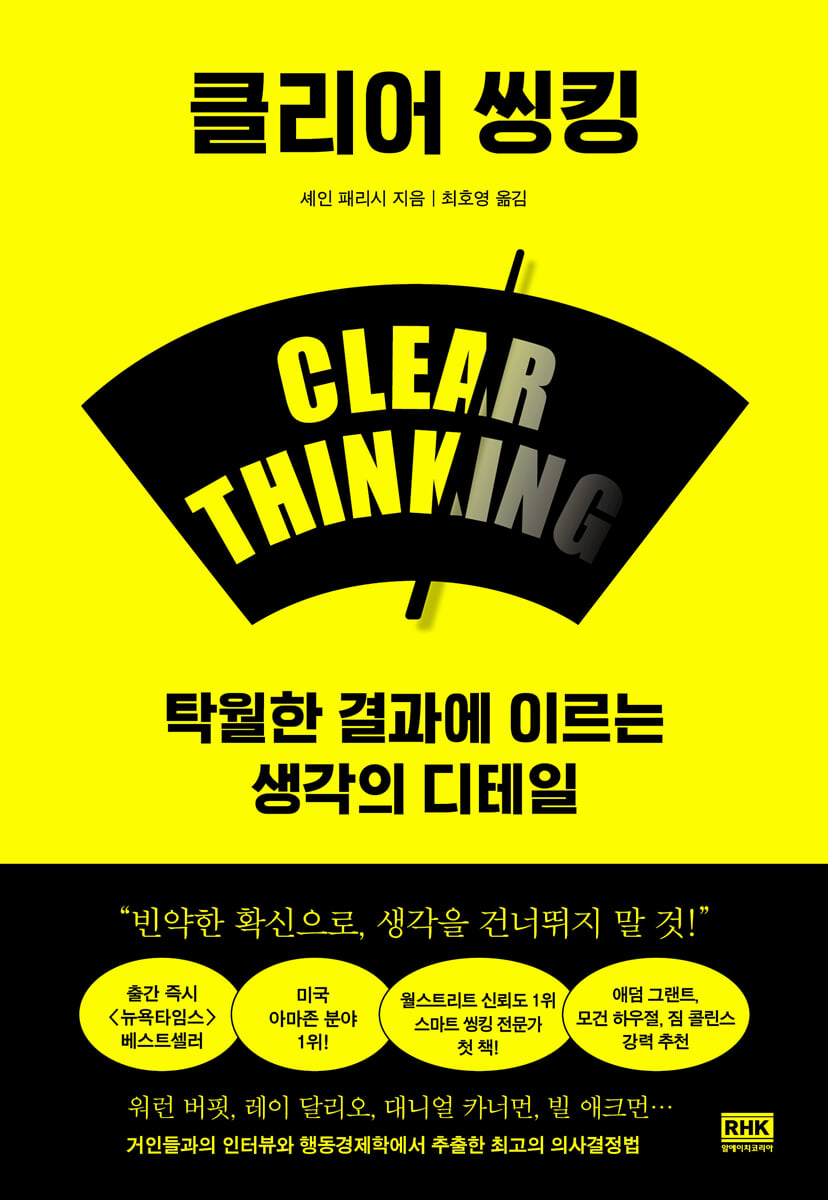
Clear Thinking
 |
Description
Book Introduction
“With weak confidence, don’t skip over thoughts!” Warren Buffett, Ray Dalio, Daniel Kahneman, Bill Ackman… The best decision-making methods extracted from interviews with giants and behavioral economics. When faced with a major issue, people often mistakenly think they are 'thinking', but usually they are simply 'reacting' according to the default human nature. We make choices that are comfortable and stagnant, we make decisions based on emotions rather than reason, and we choose the second best option over the best if it threatens our position. The problem is that when you act on these reactions, you end up making very bad decisions or making irreversible mistakes in your relationships. What actually determines the success or failure of life and happiness or unhappiness is not the momentous decisions of crucial moments, but the small, everyday decisions. This is why we need 'mental habits' that change the default human nature that blocks us from making good decisions. Clear thinking, or "clear thinking," is a crucial skill that no one ever teaches. However, it is also a skill that anyone who dreams of outstanding success must have. Shane Parrish, Wall Street's #1 trusted smart thinking expert and host of one of America's most popular podcasts, "Farnam Street," shares proven ways to overcome the forces that block your best decisions and achieve your desired results. Aurelius, Seneca, Warren Buffett, Ray Dalio… This book, which condenses interviews with some of history's most successful people and insights from neuroscience, behavioral economics, and psychology, is full of ways to overcome unconscious reactions and make significantly better decisions. If a simple choice in an ordinary moment could completely change your life, wouldn't you reconsider? Through this book, readers will learn the mindset to repeat success and avoid failure. |
- You can preview some of the book's contents.
Preview
index
introduction
Introduction: Clear Thinking in Ordinary Places
Chapter 1: Avoid Obstacles
01 Clumsy or thoughtless
02 Emotion Default
03 Self Default
04 Social Defaults
05 Inertia default value
06 Default for clarity
Chapter 2: Strengthen Your Strengths
01 Self-responsibility
02 Self-understanding
03 Self-control
04 Confidence
05 How Strengths Work
06 Setting the Standard
07 Role Models and Practice
Chapter 3: Manage Your Weaknesses
01 Know your weaknesses
02 Protect with safety devices
03 How to Deal with Mistakes
Chapter 4: Make Wise Decisions
01 Defining the Problem
02 Explore Solutions
03 Evaluating Alternatives
04 Run
05 Building a safety zone
06 Learning from previous decisions
Chapter 5: What Really Matters
01 Dickens' Hidden Lessons
02 Insights from Happiness Experts
03 Memento Mori
04 Life Lessons from Death
Conclusion: The Value of Clear Thinking
Acknowledgements
annotation
Introduction: Clear Thinking in Ordinary Places
Chapter 1: Avoid Obstacles
01 Clumsy or thoughtless
02 Emotion Default
03 Self Default
04 Social Defaults
05 Inertia default value
06 Default for clarity
Chapter 2: Strengthen Your Strengths
01 Self-responsibility
02 Self-understanding
03 Self-control
04 Confidence
05 How Strengths Work
06 Setting the Standard
07 Role Models and Practice
Chapter 3: Manage Your Weaknesses
01 Know your weaknesses
02 Protect with safety devices
03 How to Deal with Mistakes
Chapter 4: Make Wise Decisions
01 Defining the Problem
02 Explore Solutions
03 Evaluating Alternatives
04 Run
05 Building a safety zone
06 Learning from previous decisions
Chapter 5: What Really Matters
01 Dickens' Hidden Lessons
02 Insights from Happiness Experts
03 Memento Mori
04 Life Lessons from Death
Conclusion: The Value of Clear Thinking
Acknowledgements
annotation
Detailed image

Into the book
I started looking for industry heavyweights who seemed to always think clearly, even in situations that others wouldn't dare consider.
They seemed to know something that most people didn't, and I was determined to find out.
While ordinary people chase victory, the world's masters know that defeat must be avoided before victory can be achieved.
This is a surprisingly effective strategy.
--- p.8, from the "Preface"
We will discuss more in detail how to combat ego defaults in the future.
For now, let's just keep in mind how to recognize the moment when this pops up.
When you're preoccupied with how others perceive you, when you feel your ego is being bruised, when you feel like an expert after reading an article or two on a particular topic, when you constantly try to prove yourself right and have trouble admitting your mistakes, when you find it difficult to say, "I don't know," when you're often jealous of others or feel underappreciated—watch out! This is when your ego rears its ugly head.
--- p.49, from “Chapter 1: Avoid Obstacles”
Too often we fight to defend our beliefs against the feedback the world gives us.
I want the world to change rather than trying to change myself.
And when you don't have the power to change the world, the only thing you can do is complain.
Complaining is not productive.
Complaining only misleads us into believing that the world should work in an unrealistic way.
But the further we get from reality, the more difficult it becomes to solve the problems at hand.
There is always something you can do today to make the future easier.
It's only when you stop complaining that you begin to see it.
--- p.90, from “Chapter 2 Strengthen Your Strengths”
To see if my thinking is right or wrong, I need to make it visible.
By making visible what was previously invisible, we can see what we knew and what we were thinking when we made our decisions.
Memories are not very reliable because our egos distort information to make us look better than we actually are.
On the other hand, even if you realize that you need to adjust your views, changing your view of the world requires a lot of effort.
So people tend to ignore the lessons of experience, and so they keep doing what they always did and get the same results.
The inertia default works like this:
--- p.175, from “Chapter 3: Manage Your Weaknesses”
To obtain information relevant to your decision, keep the following in mind:
Before you can classify your data, you need to figure out what you're looking for.
Just as you can't hit a target if you don't know what to aim for, you can't find anything if you don't know what to look for.
If you don't know what's important, you'll miss out on the relevant stuff and waste a lot of time on the irrelevant stuff.
Most of the information is irrelevant.
Knowing what to ignore—distinguishing signal from noise—is the key to not wasting precious time.
--- p.243, from “Chapter 4: Make Wise Decisions”
The most important thing is to know what you want.
In a corner of your mind, you probably already know what you need to do.
So, you just have to follow the advice in your heart.
Sometimes the advice we give to others is the advice we need most.
They seemed to know something that most people didn't, and I was determined to find out.
While ordinary people chase victory, the world's masters know that defeat must be avoided before victory can be achieved.
This is a surprisingly effective strategy.
--- p.8, from the "Preface"
We will discuss more in detail how to combat ego defaults in the future.
For now, let's just keep in mind how to recognize the moment when this pops up.
When you're preoccupied with how others perceive you, when you feel your ego is being bruised, when you feel like an expert after reading an article or two on a particular topic, when you constantly try to prove yourself right and have trouble admitting your mistakes, when you find it difficult to say, "I don't know," when you're often jealous of others or feel underappreciated—watch out! This is when your ego rears its ugly head.
--- p.49, from “Chapter 1: Avoid Obstacles”
Too often we fight to defend our beliefs against the feedback the world gives us.
I want the world to change rather than trying to change myself.
And when you don't have the power to change the world, the only thing you can do is complain.
Complaining is not productive.
Complaining only misleads us into believing that the world should work in an unrealistic way.
But the further we get from reality, the more difficult it becomes to solve the problems at hand.
There is always something you can do today to make the future easier.
It's only when you stop complaining that you begin to see it.
--- p.90, from “Chapter 2 Strengthen Your Strengths”
To see if my thinking is right or wrong, I need to make it visible.
By making visible what was previously invisible, we can see what we knew and what we were thinking when we made our decisions.
Memories are not very reliable because our egos distort information to make us look better than we actually are.
On the other hand, even if you realize that you need to adjust your views, changing your view of the world requires a lot of effort.
So people tend to ignore the lessons of experience, and so they keep doing what they always did and get the same results.
The inertia default works like this:
--- p.175, from “Chapter 3: Manage Your Weaknesses”
To obtain information relevant to your decision, keep the following in mind:
Before you can classify your data, you need to figure out what you're looking for.
Just as you can't hit a target if you don't know what to aim for, you can't find anything if you don't know what to look for.
If you don't know what's important, you'll miss out on the relevant stuff and waste a lot of time on the irrelevant stuff.
Most of the information is irrelevant.
Knowing what to ignore—distinguishing signal from noise—is the key to not wasting precious time.
--- p.243, from “Chapter 4: Make Wise Decisions”
The most important thing is to know what you want.
In a corner of your mind, you probably already know what you need to do.
So, you just have to follow the advice in your heart.
Sometimes the advice we give to others is the advice we need most.
--- p.333, from “Chapter 5: What Really Matters”
Publisher's Review
“What if your choice today could change your life forever?”
I want to make smarter decisions every day.
'Details of Thought' for People
★★★ A New York Times bestseller upon publication, with rights exported to 19 countries.
★★★ Highly recommended by Forbes, The New York Times, and The Financial Times
★★★ Highly recommended by world-renowned authors Morgan Housel, Jim Collins, and Adam Grant.
Shane Parrish, founder of the popular website Farnam Street, which focuses on putting timeless insights into action, has finally published his hit book, CLEAR THINKING, in Korea.
This book, which became a New York Times bestseller immediately after publication due to the explosive support of domestic and international subscribers and word-of-mouth alone, contains the 'best decision-making method' learned by the author, a former secret agent for the Canadian intelligence agency, while meeting world-class figures who always think clearly even in situations that others would not dare to consider, such as Warren Buffett, Charlie Munger, Ray Dalio, and Daniel Kahneman.
He says in this book that to get the results you want, you only need to remember two things:
First, we need to secure space for reasoning in our thoughts, feelings, and actions.
It's about eliminating the deeply ingrained weaknesses in our bodies—the defaults of human nature (emotional defaults, ego defaults, social defaults, and inertial defaults) that prevent us from making good decisions.
For example, when you are conscious of other people's gaze or social hierarchy and tend to choose the second best option (social default), you should create a space to pause and think about that behavior.
Next, he tells us to consciously use this space of 'pause' to think clearly.
The thinking tools we should use at this time are 'self-responsibility, self-understanding, self-control, and self-confidence'. The reason the author chose these four is because they are very good biological tendencies that can be rooted in one's inner self through acquired effort.
He tells us that by taking these two steps, we can turn the headwinds of our default human nature into tailwinds and steadily move toward our most precious goals.
In addition, the author analyzes the habits of people who repeat failures based on papers and scientific evidence from various fields such as neuroscience, behavioral economics, and psychology, and in this book, reveals the causes and introduces various methods to break the unconscious reactions discovered in the latest research.
This book will serve as a survival strategy for those who struggle with prioritizing, those who endlessly regret the past, those who react hastily and always ruin things, and those who panic over even the smallest things, all of whom are experiencing repeated failures at work and in relationships.
Let's remember 'clear thinking' at every moment of decision, big or small.
Warren Buffett, Ray Dalio, Daniel Kahneman, Bill Atman…
The best decision-making methods extracted from interviews with giants and behavioral economics.
Wise judgments are expensive, but foolish judgments cost us dearly.
The most important message of this book is that there are invisible instincts that interfere with wise decisions.
Human defaults cause us to react without thinking.
Instead of responding carefully, it encourages us to live by reacting unconsciously.
At this time, 『Clear Thinking』 acts as a safety device that helps repeat success while avoiding failure.
Chapter 1 discusses the human biological mechanisms that lead us to make decisions based on the situation.
The author identifies the following as obstacles that must be eliminated among the default instincts of humans: the emotional default, which is when feelings become attitudes; the ego default, which follows unfounded confidence; the social default, which is preoccupied with the gaze of others; and the inertial default, which seeks comfort rather than challenge.
He warns that if you continue to follow these four instincts, you will only repeat failure.
Chapter 2 advises that to overcome the obstacles listed above, you must develop a strong nature to replace them.
He introduces Warren Buffett and Charlie Munger as utilizing the four natural forces of 'self-responsibility, self-understanding, self-control, and confidence' when making investment decisions, and adds that the most effective way to overcome obstacles is to confront them with the same biological forces.
Chapter 3 reveals Daniel Kahneman's criteria for accepting collaborations or speaking engagements, and teaches us how to manage weaknesses like cognitive biases and distractions that lead us to make foolish choices.
Chapter 4 reveals Clear Thinking, a five-step thought process that helps you think clearly based on your strengths and weaknesses.
It explains in detail through various examples, from the 'problem definition' stage where at least three solutions are prepared for an issue, to 'solution exploration' where you consider the opportunities you would have to give up if you implement two of them, to 'execution' where you set a tripwire before implementation and proceed with the decision with a small price to pay, and then when evaluating whether the choice was the right one, to the 'learning from previous decisions' stage where you review the process rather than the decision.
The final five chapters ultimately teach us about the mindset we need to have to achieve what we truly desire in business, relationships, and life.
The author shares what he learned from his conversation with Jim Collins: that while good decisions are always effective, effective decisions aren't always good decisions, and points out the mistakes we often make between good and effective decisions.
In this way, rather than focusing on how to think more rationally, this book focuses on the human subconscious and instincts that lead to errors in judgment, and serves as a guide to help us achieve what we want.
If we could develop the instincts outlined in Clear Thinking, we would undoubtedly be able to make better decisions at work, start and grow businesses, and, surprisingly, become better lovers, friends, and parents.
It all depends on whether you think clearly or not.
“Another book that will become a ‘classic’!”
“It’s full of advice that will help you make smart choices in a complex world.
“Why didn’t I read this book sooner!”
“This book is as clear as its title suggests.
So it makes you take action right away.”
“The author's guidance has helped me transform ordinary moments in my life into extraordinary outcomes!”
_Amazon Reader Reviews
I want to make smarter decisions every day.
'Details of Thought' for People
★★★ A New York Times bestseller upon publication, with rights exported to 19 countries.
★★★ Highly recommended by Forbes, The New York Times, and The Financial Times
★★★ Highly recommended by world-renowned authors Morgan Housel, Jim Collins, and Adam Grant.
Shane Parrish, founder of the popular website Farnam Street, which focuses on putting timeless insights into action, has finally published his hit book, CLEAR THINKING, in Korea.
This book, which became a New York Times bestseller immediately after publication due to the explosive support of domestic and international subscribers and word-of-mouth alone, contains the 'best decision-making method' learned by the author, a former secret agent for the Canadian intelligence agency, while meeting world-class figures who always think clearly even in situations that others would not dare to consider, such as Warren Buffett, Charlie Munger, Ray Dalio, and Daniel Kahneman.
He says in this book that to get the results you want, you only need to remember two things:
First, we need to secure space for reasoning in our thoughts, feelings, and actions.
It's about eliminating the deeply ingrained weaknesses in our bodies—the defaults of human nature (emotional defaults, ego defaults, social defaults, and inertial defaults) that prevent us from making good decisions.
For example, when you are conscious of other people's gaze or social hierarchy and tend to choose the second best option (social default), you should create a space to pause and think about that behavior.
Next, he tells us to consciously use this space of 'pause' to think clearly.
The thinking tools we should use at this time are 'self-responsibility, self-understanding, self-control, and self-confidence'. The reason the author chose these four is because they are very good biological tendencies that can be rooted in one's inner self through acquired effort.
He tells us that by taking these two steps, we can turn the headwinds of our default human nature into tailwinds and steadily move toward our most precious goals.
In addition, the author analyzes the habits of people who repeat failures based on papers and scientific evidence from various fields such as neuroscience, behavioral economics, and psychology, and in this book, reveals the causes and introduces various methods to break the unconscious reactions discovered in the latest research.
This book will serve as a survival strategy for those who struggle with prioritizing, those who endlessly regret the past, those who react hastily and always ruin things, and those who panic over even the smallest things, all of whom are experiencing repeated failures at work and in relationships.
Let's remember 'clear thinking' at every moment of decision, big or small.
Warren Buffett, Ray Dalio, Daniel Kahneman, Bill Atman…
The best decision-making methods extracted from interviews with giants and behavioral economics.
Wise judgments are expensive, but foolish judgments cost us dearly.
The most important message of this book is that there are invisible instincts that interfere with wise decisions.
Human defaults cause us to react without thinking.
Instead of responding carefully, it encourages us to live by reacting unconsciously.
At this time, 『Clear Thinking』 acts as a safety device that helps repeat success while avoiding failure.
Chapter 1 discusses the human biological mechanisms that lead us to make decisions based on the situation.
The author identifies the following as obstacles that must be eliminated among the default instincts of humans: the emotional default, which is when feelings become attitudes; the ego default, which follows unfounded confidence; the social default, which is preoccupied with the gaze of others; and the inertial default, which seeks comfort rather than challenge.
He warns that if you continue to follow these four instincts, you will only repeat failure.
Chapter 2 advises that to overcome the obstacles listed above, you must develop a strong nature to replace them.
He introduces Warren Buffett and Charlie Munger as utilizing the four natural forces of 'self-responsibility, self-understanding, self-control, and confidence' when making investment decisions, and adds that the most effective way to overcome obstacles is to confront them with the same biological forces.
Chapter 3 reveals Daniel Kahneman's criteria for accepting collaborations or speaking engagements, and teaches us how to manage weaknesses like cognitive biases and distractions that lead us to make foolish choices.
Chapter 4 reveals Clear Thinking, a five-step thought process that helps you think clearly based on your strengths and weaknesses.
It explains in detail through various examples, from the 'problem definition' stage where at least three solutions are prepared for an issue, to 'solution exploration' where you consider the opportunities you would have to give up if you implement two of them, to 'execution' where you set a tripwire before implementation and proceed with the decision with a small price to pay, and then when evaluating whether the choice was the right one, to the 'learning from previous decisions' stage where you review the process rather than the decision.
The final five chapters ultimately teach us about the mindset we need to have to achieve what we truly desire in business, relationships, and life.
The author shares what he learned from his conversation with Jim Collins: that while good decisions are always effective, effective decisions aren't always good decisions, and points out the mistakes we often make between good and effective decisions.
In this way, rather than focusing on how to think more rationally, this book focuses on the human subconscious and instincts that lead to errors in judgment, and serves as a guide to help us achieve what we want.
If we could develop the instincts outlined in Clear Thinking, we would undoubtedly be able to make better decisions at work, start and grow businesses, and, surprisingly, become better lovers, friends, and parents.
It all depends on whether you think clearly or not.
“Another book that will become a ‘classic’!”
“It’s full of advice that will help you make smart choices in a complex world.
“Why didn’t I read this book sooner!”
“This book is as clear as its title suggests.
So it makes you take action right away.”
“The author's guidance has helped me transform ordinary moments in my life into extraordinary outcomes!”
_Amazon Reader Reviews
GOODS SPECIFICS
- Date of issue: April 1, 2024
- Page count, weight, size: 368 pages | 145*210*30mm
- ISBN13: 9788925575308
- ISBN10: 8925575302
You may also like
카테고리
korean


korean

![ELLE 엘르 스페셜 에디션 A형 : 12월 [2025]](http://librairie.coreenne.fr/cdn/shop/files/b8e27a3de6c9538896439686c6b0e8fb.jpg?v=1766436872&width=3840)


