

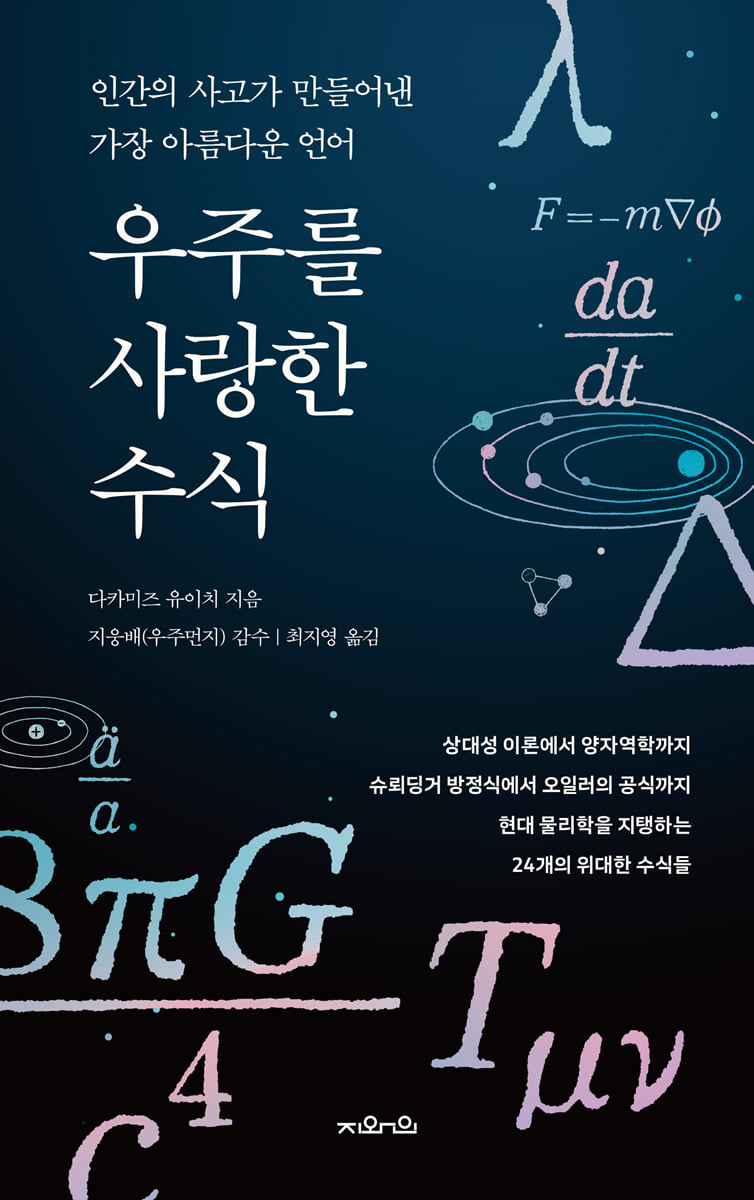
Formula for loving the universe
 |
Description
Book Introduction
Before you understand, you will first be amazed!
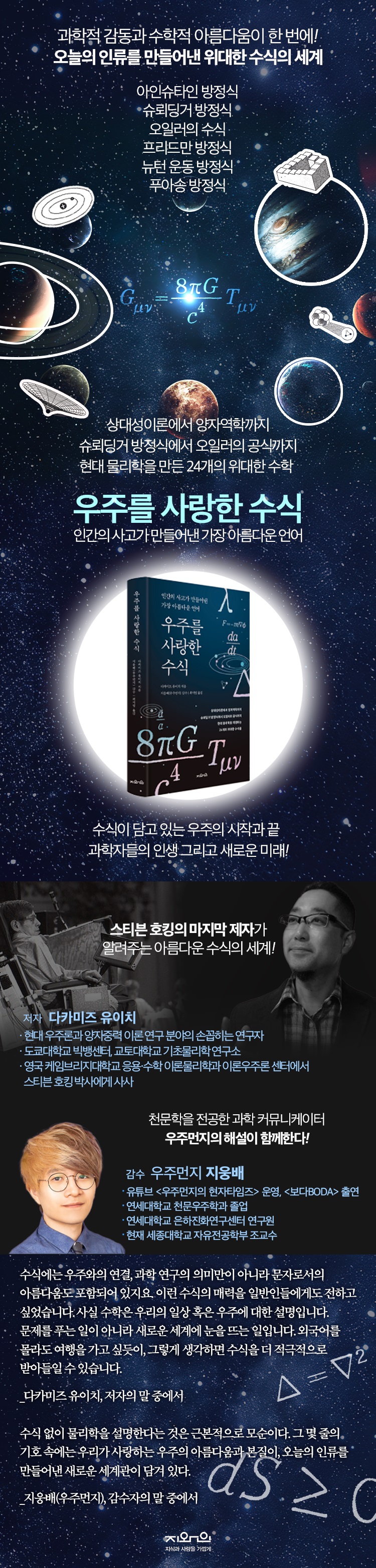
From quantum mechanics to the birth of black holes, the great equations that guide modern physics!
When you encounter a formula like E=mc2, does your heart race even if you don't understand it?
The reason is that we instinctively feel that the secrets and principles of operation of the universe and nature are hidden within just a few symbols.
Einstein's equations that govern the entire universe with a single formula, Friedmann's equations that defeated the genius scientist Einstein in one fell swoop, the geodesic equations that made possible wonderful scenes like the movie [Interstellar], the Schrödinger equations that are essential in the age of quantum theory, Euler's equations, the most beautiful equation in the world that also appears in the novel 『The Equation the Doctor Loved』, Ramanujan's infinite series that he realized equations by praying to God, etc.
Let's take a look at the great equations that created today's humanity and are driving modern physics.
"The Formula That Loved the Universe" is a book consisting of 24 interesting lectures given by the author, who was Stephen Hawking's last disciple at the Centre for Theoretical Cosmology at the University of Cambridge in the UK.
A world of formulas created by humans but called the language of God.
As science communicator Ji Woong-bae, who reviewed this book, said, “Explaining physics without equations is fundamentally contradictory.
“Imagine understanding music through words alone, without a single note.”
This book invites us head-on into the world of formulas that other science textbooks have tried to avoid.
This is a must-read for anyone who admires the world of mathematics and physics, or whose heart races with the mysteries of the universe.
From quantum mechanics to the birth of black holes, the great equations that guide modern physics!
When you encounter a formula like E=mc2, does your heart race even if you don't understand it?
The reason is that we instinctively feel that the secrets and principles of operation of the universe and nature are hidden within just a few symbols.
Einstein's equations that govern the entire universe with a single formula, Friedmann's equations that defeated the genius scientist Einstein in one fell swoop, the geodesic equations that made possible wonderful scenes like the movie [Interstellar], the Schrödinger equations that are essential in the age of quantum theory, Euler's equations, the most beautiful equation in the world that also appears in the novel 『The Equation the Doctor Loved』, Ramanujan's infinite series that he realized equations by praying to God, etc.
Let's take a look at the great equations that created today's humanity and are driving modern physics.
"The Formula That Loved the Universe" is a book consisting of 24 interesting lectures given by the author, who was Stephen Hawking's last disciple at the Centre for Theoretical Cosmology at the University of Cambridge in the UK.
A world of formulas created by humans but called the language of God.
As science communicator Ji Woong-bae, who reviewed this book, said, “Explaining physics without equations is fundamentally contradictory.
“Imagine understanding music through words alone, without a single note.”
This book invites us head-on into the world of formulas that other science textbooks have tried to avoid.
This is a must-read for anyone who admires the world of mathematics and physics, or whose heart races with the mysteries of the universe.
- You can preview some of the book's contents.
Preview
index
A Special Author Interview for Korean Readers: Formulas Open a Special World
Reviewer's Note_Ji Woong-bae (Space Dust)
Before reading this book
Part 1 | The Formula of the Universe
1.
Rules the Universe: Einstein's Equations
2.
The Expanding Universe and the World of Dark Matter: The Friedmann Equation
3.
Predicting Black Holes: The Schwarzschild Years
4.
Predictions Before the Big Bang: The Wave Equation for Gravitational Waves
5.
Classical Equations: Newton's Equations of Motion
6.
The Poisson Equation: A Formula for Future Planetary Migration
7.
You and I are attracted to each other: The law of universal gravitation
8.
The equation that created Interstellar: the geodesic equation
Part 2 | Formulas for Elementary Particles
1.
A collection of microscopic worlds: the Standard Model equations
2.
Being able to exist in two places at the same time: the uncertainty principle
3.
All matter is both particle and wave: de Broglie equations
4.
A Cat-Likely Formula: Schrödinger's Equation
5.
The Dirac equation that created semiconductors
6.
One more time: the standard model equations
7.
The Extreme World Humanity Must Aim For: Planck Length
Part 3 | The Formula of Light
1.
Generating the Power of the Atomic Bomb: The Formula of Relativistic Energy
2.
The creator and the prover are different: Lorentz transformations
3.
Welcome to the world of Tenet: Minkowski's space-time world
4.
Electricity is actually light: The Lorentz force formula
5.
Unlocking the World of Electromagnetism: Maxwell's Equations
6.
The Mystery of Prime Numbers: The Formula for the Fine Structure Constant
Part 4 | The Four Laws of Modern Physics and Mathematics
1.
Can Time Be Turned Back?: The Law of Increasing Entropy
2.
The King of Data Analysis: From Deviation to Stock Price Prediction: The Gaussian Distribution Formula
3.
The Doctor's Favorite Formula: Euler's Equation
4.
If you keep adding, you get a minus: Infinite series formula
Reviewer's Note_Ji Woong-bae (Space Dust)
Before reading this book
Part 1 | The Formula of the Universe
1.
Rules the Universe: Einstein's Equations
2.
The Expanding Universe and the World of Dark Matter: The Friedmann Equation
3.
Predicting Black Holes: The Schwarzschild Years
4.
Predictions Before the Big Bang: The Wave Equation for Gravitational Waves
5.
Classical Equations: Newton's Equations of Motion
6.
The Poisson Equation: A Formula for Future Planetary Migration
7.
You and I are attracted to each other: The law of universal gravitation
8.
The equation that created Interstellar: the geodesic equation
Part 2 | Formulas for Elementary Particles
1.
A collection of microscopic worlds: the Standard Model equations
2.
Being able to exist in two places at the same time: the uncertainty principle
3.
All matter is both particle and wave: de Broglie equations
4.
A Cat-Likely Formula: Schrödinger's Equation
5.
The Dirac equation that created semiconductors
6.
One more time: the standard model equations
7.
The Extreme World Humanity Must Aim For: Planck Length
Part 3 | The Formula of Light
1.
Generating the Power of the Atomic Bomb: The Formula of Relativistic Energy
2.
The creator and the prover are different: Lorentz transformations
3.
Welcome to the world of Tenet: Minkowski's space-time world
4.
Electricity is actually light: The Lorentz force formula
5.
Unlocking the World of Electromagnetism: Maxwell's Equations
6.
The Mystery of Prime Numbers: The Formula for the Fine Structure Constant
Part 4 | The Four Laws of Modern Physics and Mathematics
1.
Can Time Be Turned Back?: The Law of Increasing Entropy
2.
The King of Data Analysis: From Deviation to Stock Price Prediction: The Gaussian Distribution Formula
3.
The Doctor's Favorite Formula: Euler's Equation
4.
If you keep adding, you get a minus: Infinite series formula
Detailed image
Into the book
The formula contains not only the connection to the universe and the meaning of scientific research, but also the beauty of letters.
I wanted to convey the charm of this formula to the general public.
In fact, mathematics is an explanation of our daily lives and the universe.
It's not about solving problems, it's about opening your eyes to a new world.
Just as you want to travel even if you don't know a foreign language, thinking that way can help you accept formulas more actively.
--- From the Korean version of the author's interview
Explaining physics without formulas is fundamentally contradictory.
This is no different from explaining art history without a single picture.
Imagine introducing classical music without a single note, only words.
Imagine trying to explain Rembrandt's delicate chiaroscuro, Picasso's cubism, or Van Gogh's dreamy brushstrokes without using a canvas.
It may be possible to some extent to convey a conceptual framework.
But there are clear limits to reaching its essence.
Emotion doesn't come from explanation.
It comes from the expression itself.
--- From "The Supervisor's Note"
While Newtonian mechanics usually covers the dynamics on Earth, Einsteinian mechanics covers the entire universe, which is larger than the scale of dense or gravitationally strong celestial bodies or galaxies.
The two theories cover different areas, but at the same time, they coincide in some areas.
Among these, we first introduce Einstein's equations, the most famous equations that govern the universe.
It is also called 'general relativity' and is the basis of Einstein's theory of gravity.
--- From "Ruling the Entire Universe: Einstein's Equations"
When comparing the universe to a mug, the structure of the universe changes depending on the material inside the mug. The change in the structure of the universe means that the universe is moving.
Friedmann's equation is an equation that represents 'the motion of the universe = the material energy inside'.
--- From "The Expanding Universe and the World of Dark Matter: The Friedmann Equation"
We often think of formulas as a way to describe phenomena.
But in fact, formulas are the language of imagination.
It's about predicting what we don't know yet, making hypotheses, and proving them.
It's more like proving something that you haven't seen, something that you don't know exists.
Among such formulas, the Schwarzschild solution is famous as a formula that 'imagines' a black hole.
--- From "Predicting Black Holes: The Schwarzschild Years"
If humans were to colonize new planets in the future, Poisson's equation would play a crucial role in measuring gravity at each point.
It will be used to investigate gravitational environments different from Earth.
In this Poisson equation, the case where the right side becomes 0 is called the 'Laplace equation'.
Pierre Laplace was a Frenchman like Poisson who made great achievements in mathematics and physics.
--- From "The Poisson Equation: A Formula for Future Planetary Migration"
If you've seen the movie Interstellar, you'll probably remember the giant black hole in the movie, Gargantua.
The scene is not an imagination, but a calculated scene based on actual physical laws.
The man responsible for this work was Nobel Prize-winning physicist Kip Thorne.
He didn't just make a plausible picture; he actually calculated how light bends around a black hole, using geodesic equations.
--- From "The Equation That Created Interstellar: The Geodesic Equation"
Quantum theory was founded by several scientists, but if I had to name just one founder, it would be Heisenberg.
He can be said to be the father of quantum theory.
He described his excitement when he discovered the formula for the uncertainty principle:
“It was 3 o’clock in the morning.
After solving the equation that gave birth to quantum mechanics, I couldn't calm my trembling heart.
Unable to fall back asleep, I went outside and watched the morning sun rise over the mountains. What he saw that day was not the same dawn as yesterday, but the dawn of a new world that mankind had never seen before.
--- From "You Can Exist in Two Places Simultaneously: The Uncertainty Principle"
According to this equation, there is no way to be sure where the object will be at the next time.
All we can do is predict that there is a certain percentage chance that it will be here.
It is an equation that determines the future probabilistically.
If we think about it in terms of our everyday world, this probabilistic future might make sense.
Because there is a will involved that is changeable but can decide.
--- From "A Cat-Likely Charming Formula: Schrödinger's Equation"
Usually, developing a new drug or vaccine requires enormous amounts of money and time.
The most important thing here is to decide which part of the compound to change and how, with the fewest possible trials.
Usually, when creating a new drug, it is common to modify part of an existing drug.
At that time, we can solve the Schrödinger equation to calculate various structures, such as the coupling properties of new parts, in advance.
--- From "A Cat-Likely Charming Formula: Schrödinger's Equation"
It was later revealed that the world that existed only in Einstein's head was actually the essence of the universe.
The universe is a world dominated by light, so we can never understand the universe without understanding the nature of light.
Today's scientists have learned from Einstein that outlandish ideas are the quickest shortcut to understanding the world.
The essence of the world as seen through the lens of light began to become more and more clearly revealed through the theory of relativity he announced.
--- From "The Creator and the Prover are Different: Lorentz Transformation"
But why does Fleming's Law use three fingers? It's based on the fact that the space we live in is three-dimensional.
That is, the existence of 'three independent directions' is a very important foundation of Fleming's law.
--- From "Electricity is actually light: The Lorentz force formula"
Why is this law important?
Because the law of entropy is the only physical law that determines that time progresses in one direction.
Time always moves forward and never returns to the past.
This is really the only equation that fits this so obvious phenomenon so perfectly.
The appeal of the law of increasing entropy is that it is the only way to answer a fundamental question that has plagued humanity since ancient times: "Can time be turned back?"
--- From "Can Time Be Turned Back: The Law of Increasing Entropy"
I find myself wondering what it would have been like if Ramanujan had lived as long as Gauss or Euler.
It is certain that modern physics and mathematics have created a great number of formulas that are the 'most powerful weapons' that they have yet to obtain.
He was the only person on Earth who directly interpreted the 'language of God'.
If aliens could take just one genius from Earth, I think they would have chosen Ramanujan, not Einstein.
I wanted to convey the charm of this formula to the general public.
In fact, mathematics is an explanation of our daily lives and the universe.
It's not about solving problems, it's about opening your eyes to a new world.
Just as you want to travel even if you don't know a foreign language, thinking that way can help you accept formulas more actively.
--- From the Korean version of the author's interview
Explaining physics without formulas is fundamentally contradictory.
This is no different from explaining art history without a single picture.
Imagine introducing classical music without a single note, only words.
Imagine trying to explain Rembrandt's delicate chiaroscuro, Picasso's cubism, or Van Gogh's dreamy brushstrokes without using a canvas.
It may be possible to some extent to convey a conceptual framework.
But there are clear limits to reaching its essence.
Emotion doesn't come from explanation.
It comes from the expression itself.
--- From "The Supervisor's Note"
While Newtonian mechanics usually covers the dynamics on Earth, Einsteinian mechanics covers the entire universe, which is larger than the scale of dense or gravitationally strong celestial bodies or galaxies.
The two theories cover different areas, but at the same time, they coincide in some areas.
Among these, we first introduce Einstein's equations, the most famous equations that govern the universe.
It is also called 'general relativity' and is the basis of Einstein's theory of gravity.
--- From "Ruling the Entire Universe: Einstein's Equations"
When comparing the universe to a mug, the structure of the universe changes depending on the material inside the mug. The change in the structure of the universe means that the universe is moving.
Friedmann's equation is an equation that represents 'the motion of the universe = the material energy inside'.
--- From "The Expanding Universe and the World of Dark Matter: The Friedmann Equation"
We often think of formulas as a way to describe phenomena.
But in fact, formulas are the language of imagination.
It's about predicting what we don't know yet, making hypotheses, and proving them.
It's more like proving something that you haven't seen, something that you don't know exists.
Among such formulas, the Schwarzschild solution is famous as a formula that 'imagines' a black hole.
--- From "Predicting Black Holes: The Schwarzschild Years"
If humans were to colonize new planets in the future, Poisson's equation would play a crucial role in measuring gravity at each point.
It will be used to investigate gravitational environments different from Earth.
In this Poisson equation, the case where the right side becomes 0 is called the 'Laplace equation'.
Pierre Laplace was a Frenchman like Poisson who made great achievements in mathematics and physics.
--- From "The Poisson Equation: A Formula for Future Planetary Migration"
If you've seen the movie Interstellar, you'll probably remember the giant black hole in the movie, Gargantua.
The scene is not an imagination, but a calculated scene based on actual physical laws.
The man responsible for this work was Nobel Prize-winning physicist Kip Thorne.
He didn't just make a plausible picture; he actually calculated how light bends around a black hole, using geodesic equations.
--- From "The Equation That Created Interstellar: The Geodesic Equation"
Quantum theory was founded by several scientists, but if I had to name just one founder, it would be Heisenberg.
He can be said to be the father of quantum theory.
He described his excitement when he discovered the formula for the uncertainty principle:
“It was 3 o’clock in the morning.
After solving the equation that gave birth to quantum mechanics, I couldn't calm my trembling heart.
Unable to fall back asleep, I went outside and watched the morning sun rise over the mountains. What he saw that day was not the same dawn as yesterday, but the dawn of a new world that mankind had never seen before.
--- From "You Can Exist in Two Places Simultaneously: The Uncertainty Principle"
According to this equation, there is no way to be sure where the object will be at the next time.
All we can do is predict that there is a certain percentage chance that it will be here.
It is an equation that determines the future probabilistically.
If we think about it in terms of our everyday world, this probabilistic future might make sense.
Because there is a will involved that is changeable but can decide.
--- From "A Cat-Likely Charming Formula: Schrödinger's Equation"
Usually, developing a new drug or vaccine requires enormous amounts of money and time.
The most important thing here is to decide which part of the compound to change and how, with the fewest possible trials.
Usually, when creating a new drug, it is common to modify part of an existing drug.
At that time, we can solve the Schrödinger equation to calculate various structures, such as the coupling properties of new parts, in advance.
--- From "A Cat-Likely Charming Formula: Schrödinger's Equation"
It was later revealed that the world that existed only in Einstein's head was actually the essence of the universe.
The universe is a world dominated by light, so we can never understand the universe without understanding the nature of light.
Today's scientists have learned from Einstein that outlandish ideas are the quickest shortcut to understanding the world.
The essence of the world as seen through the lens of light began to become more and more clearly revealed through the theory of relativity he announced.
--- From "The Creator and the Prover are Different: Lorentz Transformation"
But why does Fleming's Law use three fingers? It's based on the fact that the space we live in is three-dimensional.
That is, the existence of 'three independent directions' is a very important foundation of Fleming's law.
--- From "Electricity is actually light: The Lorentz force formula"
Why is this law important?
Because the law of entropy is the only physical law that determines that time progresses in one direction.
Time always moves forward and never returns to the past.
This is really the only equation that fits this so obvious phenomenon so perfectly.
The appeal of the law of increasing entropy is that it is the only way to answer a fundamental question that has plagued humanity since ancient times: "Can time be turned back?"
--- From "Can Time Be Turned Back: The Law of Increasing Entropy"
I find myself wondering what it would have been like if Ramanujan had lived as long as Gauss or Euler.
It is certain that modern physics and mathematics have created a great number of formulas that are the 'most powerful weapons' that they have yet to obtain.
He was the only person on Earth who directly interpreted the 'language of God'.
If aliens could take just one genius from Earth, I think they would have chosen Ramanujan, not Einstein.
--- From "Continuing to add results in a minus: Infinite series formula"
Publisher's Review
A textbook that even includes formulas
Finally, a real introductory book for math and physics nerds!
A popular science book that addresses the needs of the general public without avoiding formulas has finally arrived! As science communicator Ji Woong-bae puts it, "Explaining physics without formulas is fundamentally contradictory.
It is close to “introducing classical music with just words, without a single note.”
While many science books have dismissed formulas as difficult, "Formulas that Love the Universe" rejects all such "pretending to be considerate."
It is finally a fascinating science book that takes readers head-on into the world of formulas.
The author is a physicist who served as Stephen Hawking's last disciple at the Centre for Theoretical Cosmology at the University of Cambridge in the UK. He has also served as a science advisor for several films and dramas in Japan, and has crossed the boundaries between the popular and scientific fields.
He is currently leading research in medical physics using artificial intelligence.
The Korean edition also includes a special interview with the author, which provides fascinating insights into why he was so impressed by the 24 formulas and what motivated him to write this book.
Formulas are the traces left behind when human thought reached its furthest reaches!
From quantum mechanics to the birth of black holes, the great equations that guide modern physics!
"The Formula That Loved the Universe" contains 24 formulas that are like the DNA of modern physics.
These 24 formulas are again divided into four categories: Part 1 deals with formulas related to the vast universe, Part 2 deals with formulas that govern the microscopic world like atoms, Part 3 deals with formulas related to the world of light, and the final Part 4 deals with four representative formulas from the field of mathematics rather than physics.
This book also features the praise and quotes about mathematics left by humanity's greatest scientists, allowing us to vividly experience their passion for advancing human thought to its fullest extent.
Humanity is completely different before and after a mathematical discovery.
Einstein created a formula that could explain the entire space-time of the universe through the theory of general relativity.
It is thanks to this formula that GPS around the world today operates accurately within a margin of error.
The world of quantum theory, which now appears as material in movies, has been formalized through Schrödinger's equation, and today, humanity has reached the point where it can challenge the world of quantum computers.
Because of this greatness, even though formulas were created by humans, they are called the language of God.
Now let us enter the world of language, the most beautiful language created by human thought.
Finally, a real introductory book for math and physics nerds!
A popular science book that addresses the needs of the general public without avoiding formulas has finally arrived! As science communicator Ji Woong-bae puts it, "Explaining physics without formulas is fundamentally contradictory.
It is close to “introducing classical music with just words, without a single note.”
While many science books have dismissed formulas as difficult, "Formulas that Love the Universe" rejects all such "pretending to be considerate."
It is finally a fascinating science book that takes readers head-on into the world of formulas.
The author is a physicist who served as Stephen Hawking's last disciple at the Centre for Theoretical Cosmology at the University of Cambridge in the UK. He has also served as a science advisor for several films and dramas in Japan, and has crossed the boundaries between the popular and scientific fields.
He is currently leading research in medical physics using artificial intelligence.
The Korean edition also includes a special interview with the author, which provides fascinating insights into why he was so impressed by the 24 formulas and what motivated him to write this book.
Formulas are the traces left behind when human thought reached its furthest reaches!
From quantum mechanics to the birth of black holes, the great equations that guide modern physics!
"The Formula That Loved the Universe" contains 24 formulas that are like the DNA of modern physics.
These 24 formulas are again divided into four categories: Part 1 deals with formulas related to the vast universe, Part 2 deals with formulas that govern the microscopic world like atoms, Part 3 deals with formulas related to the world of light, and the final Part 4 deals with four representative formulas from the field of mathematics rather than physics.
This book also features the praise and quotes about mathematics left by humanity's greatest scientists, allowing us to vividly experience their passion for advancing human thought to its fullest extent.
Humanity is completely different before and after a mathematical discovery.
Einstein created a formula that could explain the entire space-time of the universe through the theory of general relativity.
It is thanks to this formula that GPS around the world today operates accurately within a margin of error.
The world of quantum theory, which now appears as material in movies, has been formalized through Schrödinger's equation, and today, humanity has reached the point where it can challenge the world of quantum computers.
Because of this greatness, even though formulas were created by humans, they are called the language of God.
Now let us enter the world of language, the most beautiful language created by human thought.
GOODS SPECIFICS
- Date of issue: May 20, 2025
- Format: Hardcover book binding method guide
- Page count, weight, size: 260 pages | 388g | 135*212*18mm
- ISBN13: 9791191521443
- ISBN10: 1191521443
You may also like
카테고리
korean


korean

![GQ KOREA Mark (Monthly): December [2025]](http://librairie.coreenne.fr/cdn/shop/files/8ef265dbbfbf186523ed75ba7319009d.jpg?v=1765340328&width=3840)


