

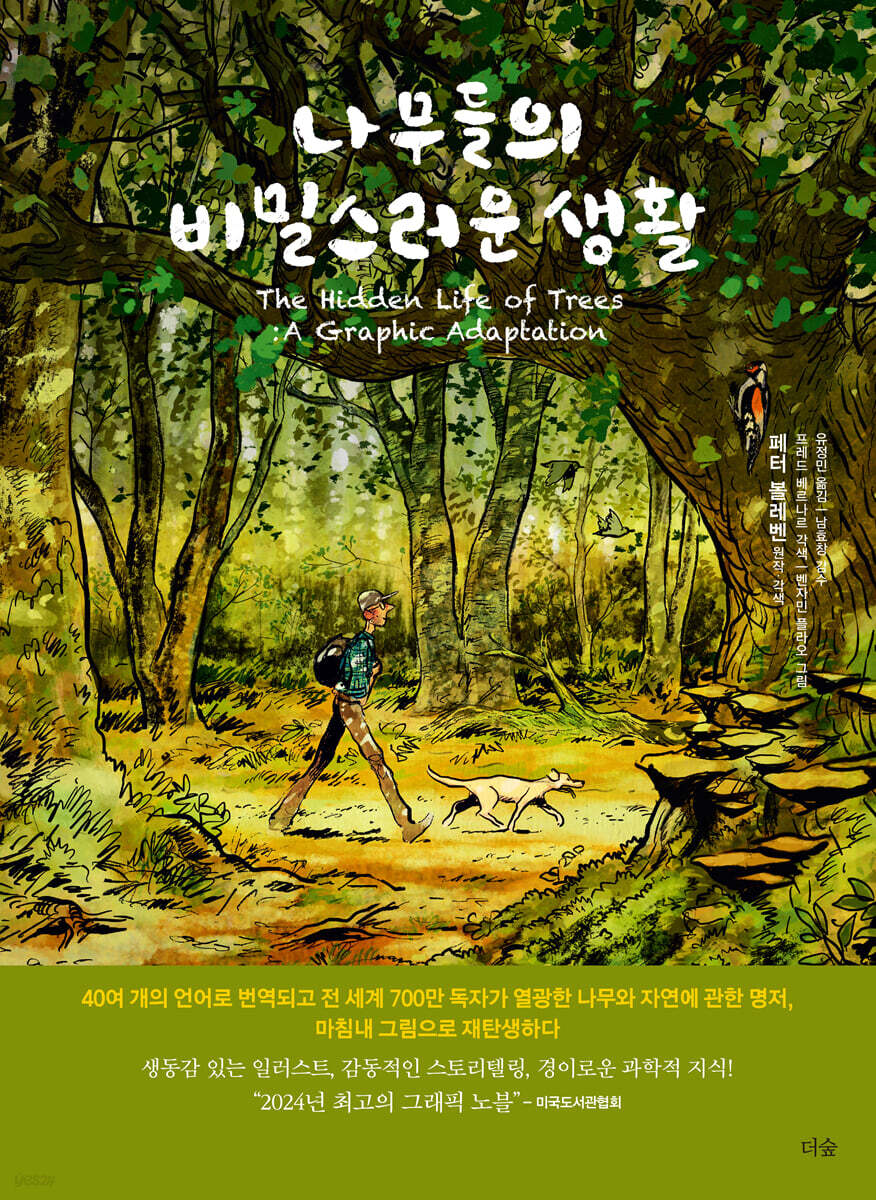
The Secret Life of Trees
 |
Description
Book Introduction
- A word from MD
-
A masterpiece graphic novel about treesTrees are everywhere and are a part of life on Earth.
To understand trees is to respect life.
『Tree Lessons』 Peter Wohlleben and French graphic artist Benjamin Plaaud have created a graphic novel about trees.
A masterpiece graphic novel combining captivating illustrations, engaging storytelling, and scientific explanations.
May 13, 2025. Natural Science PD Son Min-gyu
Translated into over 40 languages
A famous book about trees and nature that has captivated 7 million readers worldwide.
Finally reborn as a painting!
Vivid illustrations, moving storytelling, and amazing scientific knowledge!
The international bestseller "The Secret Life of Trees" (published in Korea as "Tree Lessons"), which has been translated into over 40 languages and captivated 7 million readers worldwide since its publication in Germany in 2015, has been reborn as a graphic novel.
It became a bestseller immediately after its publication in France, and the rights were sold to 13 countries including Germany, the United States, China, and Japan. In 2024, the American Library Association praised it as “the best graphic novel of 2024.”
Author and screenwriter Fred Bernard and illustrator Benjamin Flao, who have long explored the stories told by forests and trees, have brought to life the beautiful and delicate language of the original author Peter Wohlleben through colorful text and illustrations.
This book unfolds the autobiographical story of the author and protagonist, 'Peter', through his childhood and youth in Bonn, and his rise to become 'the world's most famous' forester, in a cyclical flow of spring, summer, fall, winter, and then spring again.
The moments when his life and the forest intersect are depicted in detail, and you can hear the hidden stories of the trees that Peter encountered, how they interact and communicate, and what amazing insights they used to overcome crises.
The various expressions used to describe Peter Wohlleben, such as 'a tree interpreter who deciphers the language of trees', 'a forest interpreter who conveys the mystery of the forest ecosystem', 'a nature interpreter who translates scientific knowledge into emotion', and 'Germany's most successful non-fiction writer', clearly demonstrate his role.
But there is one thing he considers most important.
Before telling people to protect nature, first make them fall in love with nature.
This book, which unfolds the wondrous scientific facts of flora, fauna, and nature through vivid illustrations and moving storytelling, precisely and clearly conveys author Peter Wohlleben's concerns, hopes, and heartfelt voice for the protection of nature and forests.
As the climate crisis and environmental destruction caused by global warming continue unabated, looking at the forest and trees ultimately means reflecting on the lives of 'me' and 'us.'
This book teaches both adults and children the principles of life that we must learn from trees in order to live in harmony with nature.
This is a meaningful must-read for anyone who loves trees and forests, seeks to find a path in life through the wisdom of nature, contemplates sustainable living, or dreams of a solid and harmonious life.
Forest expert Dr. Nam Hyo-chang supervised the book, adding footnotes where necessary for explanation of concepts and supplementary content, and including scientific names for animals, plants, and trees.
A famous book about trees and nature that has captivated 7 million readers worldwide.
Finally reborn as a painting!
Vivid illustrations, moving storytelling, and amazing scientific knowledge!
The international bestseller "The Secret Life of Trees" (published in Korea as "Tree Lessons"), which has been translated into over 40 languages and captivated 7 million readers worldwide since its publication in Germany in 2015, has been reborn as a graphic novel.
It became a bestseller immediately after its publication in France, and the rights were sold to 13 countries including Germany, the United States, China, and Japan. In 2024, the American Library Association praised it as “the best graphic novel of 2024.”
Author and screenwriter Fred Bernard and illustrator Benjamin Flao, who have long explored the stories told by forests and trees, have brought to life the beautiful and delicate language of the original author Peter Wohlleben through colorful text and illustrations.
This book unfolds the autobiographical story of the author and protagonist, 'Peter', through his childhood and youth in Bonn, and his rise to become 'the world's most famous' forester, in a cyclical flow of spring, summer, fall, winter, and then spring again.
The moments when his life and the forest intersect are depicted in detail, and you can hear the hidden stories of the trees that Peter encountered, how they interact and communicate, and what amazing insights they used to overcome crises.
The various expressions used to describe Peter Wohlleben, such as 'a tree interpreter who deciphers the language of trees', 'a forest interpreter who conveys the mystery of the forest ecosystem', 'a nature interpreter who translates scientific knowledge into emotion', and 'Germany's most successful non-fiction writer', clearly demonstrate his role.
But there is one thing he considers most important.
Before telling people to protect nature, first make them fall in love with nature.
This book, which unfolds the wondrous scientific facts of flora, fauna, and nature through vivid illustrations and moving storytelling, precisely and clearly conveys author Peter Wohlleben's concerns, hopes, and heartfelt voice for the protection of nature and forests.
As the climate crisis and environmental destruction caused by global warming continue unabated, looking at the forest and trees ultimately means reflecting on the lives of 'me' and 'us.'
This book teaches both adults and children the principles of life that we must learn from trees in order to live in harmony with nature.
This is a meaningful must-read for anyone who loves trees and forests, seeks to find a path in life through the wisdom of nature, contemplates sustainable living, or dreams of a solid and harmonious life.
Forest expert Dr. Nam Hyo-chang supervised the book, adding footnotes where necessary for explanation of concepts and supplementary content, and including scientific names for animals, plants, and trees.
- You can preview some of the book's contents.
Preview
index
spring
The Birth of the Earth │ Plants Under the Trees │ Photosynthesis and the Blue Sky │ Trees, Living Buildings
summer
Dry Alert! │ Trees and Rain │ Forest Bathing │ Breeding │ Cities and Trees
autumn
Leaf color │ Age and disease │ Slow tree growth │ Trees and fungi
winter
Trees and Carbon │ Winter and Various Events │ Intelligence and Memory │ Mutual Aid and Communication
Spring again
Moving Trees │ Supporting Primitive Forests
The Birth of the Earth │ Plants Under the Trees │ Photosynthesis and the Blue Sky │ Trees, Living Buildings
summer
Dry Alert! │ Trees and Rain │ Forest Bathing │ Breeding │ Cities and Trees
autumn
Leaf color │ Age and disease │ Slow tree growth │ Trees and fungi
winter
Trees and Carbon │ Winter and Various Events │ Intelligence and Memory │ Mutual Aid and Communication
Spring again
Moving Trees │ Supporting Primitive Forests
Detailed image

Into the book
If the tree had attracted all the white sunlight, it would have appeared black to our eyes.
Ninety-seven percent of light is absorbed or blocked by the tree canopy, the upper layer of the tree, and only about 3 percent reaches the forest floor.
For that reason, the small trees in the forest have pale green leaves.
The green that I love so much is, paradoxically, a useless color for trees.
--- From "Photosynthesis and the Blue Sky"
One day I came across a book by Amadou Mali, a writer, historian and ethnologist.
I read Ampate Ba's words, "When an old person dies, it's like a library burning down," and I thought it was very beautiful.
I immediately thought.
'A tree dying is like a building collapsing with its inhabitants!'
--- From "Trees, Living Buildings"
As a forester, it took me a long time to understand the utility of leaving dead trees in place until they decay.
A forest that humans have carefully managed is ultimately a forest that is half dead.
This is because greater biodiversity means fewer species grow at the expense of other organisms.
A tree biologist once conducted a horrific experiment that also taught us many lessons.
The tree, which was 2 meters in diameter and 52 meters tall, was sprayed with pesticides and was as old as 600 years.
As a result, a whopping 2,041 animals representing 257 species fell from the tree where they lived.
In my neighborhood, Hwymel, less than a fifth of this animal's population lives.
--- From "Trees, Living Buildings"
If all the beech and oak trees produced an abundance of nuts and acorns every year, it would be a very good food source for hungry wild boars.
But when all the piglets grow up, there will be too many pigs and they will eat all the precious seeds.
So you too, the beech and the oak, came up with a way.
It's a deliberate crossover between abundance and poverty! It produces very few seeds for four or five years in a row.
Wild boars that do not accumulate enough fat on their bodies cannot survive the winter due to starvation.
(…) When the number of wild boars decreases, the chestnut and oak trees decide that this is the time to produce as many fruits as possible to increase the chances that their seeds will germinate and grow in the ground.
Otherwise, how would he fight his predator without weapons or defense?
Isn't that really clever?
--- From "Breeding"
A tree has only one successor.
There's absolutely no risk of overpopulation! However, the beech tree, which begins reproducing between the ages of 80 and 150, produces approximately 30,000 fruits each flowering season, which occurs every five years.
If you live to be 400 years old, you'll produce 1.8 million fruits! The poplar tree even more.
The mother tree produces 26 million seeds each year, totaling one billion seeds in its lifetime! It's important to understand that seeds can't choose where they land.
You can't even choose where to sprout.
However, once the sprout takes root, the die is cast.
--- From "Breeding"
It's okay in the forest, but it's different in the city.
People may not realize it, but city trees don't grow; they survive.
For a long time, trees were considered decorations in cities.
Like 'road facilities'.
Today, people know that we need to plant many more trees for human well-being.
Because trees suck up pollutants like kitchen exhaust fans.
There's nothing more beautiful than a tree in the forest! Even tree experts, like art critics, never use adjectives like "magnificent," "wonderful," or "elegant" to describe trees.
But trees are one of the most lovely and amazing creatures we encounter in our daily lives.
--- From "Trees of the City"
When a neighboring tree is sick or in trouble, only trees of the same species provide nutrients and water to each other and help each other.
That means they know exactly which species each other belongs to.
From the very bottom to the very top, the trees identify each other.
If they are of the same species, they respect each other and do not invade the light of their neighboring trees.
So, there is a space between the branches where you can see this beautiful blue sky.
But if they are different species, there is no mercy.
Slowly, but surely, they fight to capture more sunlight.
--- From "Mutual Assistance and Communication"
Even though we know that the tree is alive, we feel nothing when we see an oak or a beech burning in the fireplace.
And to the trees sacrificed for the reading of this book.
Do you feel like I'm being too harsh? For the well-being of us all, we must stop viewing trees as mere commodities and start paying attention to their behavior as well.
(…) If we do not want to face the ‘end of humanity’, we need to be meticulous in managing living things.
Learning more about plants while enjoying the charm and beauty of large trees and forests will always be a great source of energy.
(…) It is time to think about our grandchildren who will live here after us and the lives of future generations.
Let's take it slow while we still have time.
Ninety-seven percent of light is absorbed or blocked by the tree canopy, the upper layer of the tree, and only about 3 percent reaches the forest floor.
For that reason, the small trees in the forest have pale green leaves.
The green that I love so much is, paradoxically, a useless color for trees.
--- From "Photosynthesis and the Blue Sky"
One day I came across a book by Amadou Mali, a writer, historian and ethnologist.
I read Ampate Ba's words, "When an old person dies, it's like a library burning down," and I thought it was very beautiful.
I immediately thought.
'A tree dying is like a building collapsing with its inhabitants!'
--- From "Trees, Living Buildings"
As a forester, it took me a long time to understand the utility of leaving dead trees in place until they decay.
A forest that humans have carefully managed is ultimately a forest that is half dead.
This is because greater biodiversity means fewer species grow at the expense of other organisms.
A tree biologist once conducted a horrific experiment that also taught us many lessons.
The tree, which was 2 meters in diameter and 52 meters tall, was sprayed with pesticides and was as old as 600 years.
As a result, a whopping 2,041 animals representing 257 species fell from the tree where they lived.
In my neighborhood, Hwymel, less than a fifth of this animal's population lives.
--- From "Trees, Living Buildings"
If all the beech and oak trees produced an abundance of nuts and acorns every year, it would be a very good food source for hungry wild boars.
But when all the piglets grow up, there will be too many pigs and they will eat all the precious seeds.
So you too, the beech and the oak, came up with a way.
It's a deliberate crossover between abundance and poverty! It produces very few seeds for four or five years in a row.
Wild boars that do not accumulate enough fat on their bodies cannot survive the winter due to starvation.
(…) When the number of wild boars decreases, the chestnut and oak trees decide that this is the time to produce as many fruits as possible to increase the chances that their seeds will germinate and grow in the ground.
Otherwise, how would he fight his predator without weapons or defense?
Isn't that really clever?
--- From "Breeding"
A tree has only one successor.
There's absolutely no risk of overpopulation! However, the beech tree, which begins reproducing between the ages of 80 and 150, produces approximately 30,000 fruits each flowering season, which occurs every five years.
If you live to be 400 years old, you'll produce 1.8 million fruits! The poplar tree even more.
The mother tree produces 26 million seeds each year, totaling one billion seeds in its lifetime! It's important to understand that seeds can't choose where they land.
You can't even choose where to sprout.
However, once the sprout takes root, the die is cast.
--- From "Breeding"
It's okay in the forest, but it's different in the city.
People may not realize it, but city trees don't grow; they survive.
For a long time, trees were considered decorations in cities.
Like 'road facilities'.
Today, people know that we need to plant many more trees for human well-being.
Because trees suck up pollutants like kitchen exhaust fans.
There's nothing more beautiful than a tree in the forest! Even tree experts, like art critics, never use adjectives like "magnificent," "wonderful," or "elegant" to describe trees.
But trees are one of the most lovely and amazing creatures we encounter in our daily lives.
--- From "Trees of the City"
When a neighboring tree is sick or in trouble, only trees of the same species provide nutrients and water to each other and help each other.
That means they know exactly which species each other belongs to.
From the very bottom to the very top, the trees identify each other.
If they are of the same species, they respect each other and do not invade the light of their neighboring trees.
So, there is a space between the branches where you can see this beautiful blue sky.
But if they are different species, there is no mercy.
Slowly, but surely, they fight to capture more sunlight.
--- From "Mutual Assistance and Communication"
Even though we know that the tree is alive, we feel nothing when we see an oak or a beech burning in the fireplace.
And to the trees sacrificed for the reading of this book.
Do you feel like I'm being too harsh? For the well-being of us all, we must stop viewing trees as mere commodities and start paying attention to their behavior as well.
(…) If we do not want to face the ‘end of humanity’, we need to be meticulous in managing living things.
Learning more about plants while enjoying the charm and beauty of large trees and forests will always be a great source of energy.
(…) It is time to think about our grandchildren who will live here after us and the lives of future generations.
Let's take it slow while we still have time.
--- From "Supporting the Primeval Forest"
Publisher's Review
With a warm gaze toward trees and scientific insight
A beautiful science book that connects humans and nature
This book is a graphic novel and a graphic documentary that conveys the thoughts and insights that the protagonist, Peter, who has learned from nature since childhood, acquires as he becomes a forest ranger and encounters plants, animals, and the forest.
As you follow Peter's narration while appreciating the colorful illustrations, you will encounter scenes where Peter sits on the forest floor, holding a handful of dirt, and contemplates the countless creatures living on Earth, or carefully observes the plants and trees he encounters along the forest path. These scenes convey a wealth of scientific knowledge about the creatures living underground and the internal structure, role, and characteristics of trees that have previously gone unnoticed.
Trees have many aspects that resemble humans.
As Aristotle said, the roots of a tree are the brain of an animal or a human being, so the intellectual structure of a tree is in its roots.
Trees like acacias, when attacked by large herbivores, send out chemical messages made up of tiny particles through their root systems to their neighbors over long distances to warn them of the danger.
Trees like the mimosa have amazing memories, and the beech tree recognizes its own children and protects them from danger.
However, these ecological forests are being devastated by the urban life created by humans.
Let's think about the life of a tree living in the city.
In the city, where people have to live away from their families, trees cannot grow very large.
When city people walk on the ground, the roots of the trees cannot breathe and become paralyzed.
Street trees growing on concrete asphalt must withstand the heat-trapping pavement during the day.
Not to mention the city's smoke and pollutants, and the urine of city dogs that corrode tree bark and kill roots.
“City trees don’t grow, they survive.
For a long time, trees were considered decorations in cities.
“Like a ‘road facility.’”
This book provides a panoramic view of the long history of the Earth, from the birth of trees to the use of forests by humans.
The author says that the history of these trees is rooted in the logic of reasoning accepted especially since Descartes (1596-1650) that 'mechanical animals feel neither pain nor sorrow'.
He speaks for the tree and says that, contrary to Descartes, the bark of a tree also reacts to pain at a slow pace.
It's clear why this book tells the story of trees' cognitive abilities, learning abilities, communication styles, and survival strategies.
If we listen to the voices of the trees and the forest and properly understand their cognitive and sensory abilities, we cannot treat them carelessly.
The Bible for Tree and Nature Lovers
“Peter Wohlleben
Listen to the trees and understand their language.
And he speaks to us on behalf of the tree.”
A tree biologist sprayed pesticide on a 600-year-old tree measuring 2 meters in diameter and 52 meters tall for an experiment.
As a result, a whopping 2,041 animals representing 257 species fell from the tree where they lived.
It is said that in the village of Hwummel, where the author lives, less than a fifth of the population of this animal lives.
Trees are “living buildings” that support many living organisms.
The book says that when a tree falls, its inhabitants fall with it.
While working as a forest ranger, Peter saw forests dying due to cutting down trees and spraying pesticides. He realized that “forests well-managed by humans are ultimately half-dead forests.” He has continued to practice eco-friendly forest management, using horses and hands instead of machines and not using pesticides.
The author's autobiographical story touches on the serious questions that must be asked about how humans will treat trees and forests in the future.
“We see an oak or a beech burning in the fireplace and feel nothing, even though we know that the tree is alive.
And to the trees sacrificed for the reading of this book.
Do you find my words excessive? For the well-being of us all, we must no longer view trees merely as commodities; we must also pay attention to their behavior.”
The level of awareness that nature must be protected has increased compared to the past.
However, there is still a lack of knowledge about the attitude towards trees.
As consumers increasingly reduce their meat consumption and prioritize animal-friendly farming environments that respect animals, they say that trees, like animals, should be treated with respect and prevented from unnecessary suffering.
How is this possible? The author says it depends on individual will and politics.
Although communication between forestry and logging groups isn't always successful, it's improved markedly compared to 20 years ago.
The Swiss Federal Constitution alone mandates that animals, plants, and all living organisms be treated with “respect for the dignity of life,” making it possible to hold people accountable for actions like picking flowers or cutting grass on the side of the road.
‘Welfare and respect’ for plants is an issue that brings about ‘human dignity, and further, human happiness.’
This book provides a wide-ranging insight into the world of trees, allowing anyone, regardless of age or gender, from teenagers to adults, to experience the hidden lives of trees in a vivid and entirely new way.
A beautiful science book that connects humans and nature
This book is a graphic novel and a graphic documentary that conveys the thoughts and insights that the protagonist, Peter, who has learned from nature since childhood, acquires as he becomes a forest ranger and encounters plants, animals, and the forest.
As you follow Peter's narration while appreciating the colorful illustrations, you will encounter scenes where Peter sits on the forest floor, holding a handful of dirt, and contemplates the countless creatures living on Earth, or carefully observes the plants and trees he encounters along the forest path. These scenes convey a wealth of scientific knowledge about the creatures living underground and the internal structure, role, and characteristics of trees that have previously gone unnoticed.
Trees have many aspects that resemble humans.
As Aristotle said, the roots of a tree are the brain of an animal or a human being, so the intellectual structure of a tree is in its roots.
Trees like acacias, when attacked by large herbivores, send out chemical messages made up of tiny particles through their root systems to their neighbors over long distances to warn them of the danger.
Trees like the mimosa have amazing memories, and the beech tree recognizes its own children and protects them from danger.
However, these ecological forests are being devastated by the urban life created by humans.
Let's think about the life of a tree living in the city.
In the city, where people have to live away from their families, trees cannot grow very large.
When city people walk on the ground, the roots of the trees cannot breathe and become paralyzed.
Street trees growing on concrete asphalt must withstand the heat-trapping pavement during the day.
Not to mention the city's smoke and pollutants, and the urine of city dogs that corrode tree bark and kill roots.
“City trees don’t grow, they survive.
For a long time, trees were considered decorations in cities.
“Like a ‘road facility.’”
This book provides a panoramic view of the long history of the Earth, from the birth of trees to the use of forests by humans.
The author says that the history of these trees is rooted in the logic of reasoning accepted especially since Descartes (1596-1650) that 'mechanical animals feel neither pain nor sorrow'.
He speaks for the tree and says that, contrary to Descartes, the bark of a tree also reacts to pain at a slow pace.
It's clear why this book tells the story of trees' cognitive abilities, learning abilities, communication styles, and survival strategies.
If we listen to the voices of the trees and the forest and properly understand their cognitive and sensory abilities, we cannot treat them carelessly.
The Bible for Tree and Nature Lovers
“Peter Wohlleben
Listen to the trees and understand their language.
And he speaks to us on behalf of the tree.”
A tree biologist sprayed pesticide on a 600-year-old tree measuring 2 meters in diameter and 52 meters tall for an experiment.
As a result, a whopping 2,041 animals representing 257 species fell from the tree where they lived.
It is said that in the village of Hwummel, where the author lives, less than a fifth of the population of this animal lives.
Trees are “living buildings” that support many living organisms.
The book says that when a tree falls, its inhabitants fall with it.
While working as a forest ranger, Peter saw forests dying due to cutting down trees and spraying pesticides. He realized that “forests well-managed by humans are ultimately half-dead forests.” He has continued to practice eco-friendly forest management, using horses and hands instead of machines and not using pesticides.
The author's autobiographical story touches on the serious questions that must be asked about how humans will treat trees and forests in the future.
“We see an oak or a beech burning in the fireplace and feel nothing, even though we know that the tree is alive.
And to the trees sacrificed for the reading of this book.
Do you find my words excessive? For the well-being of us all, we must no longer view trees merely as commodities; we must also pay attention to their behavior.”
The level of awareness that nature must be protected has increased compared to the past.
However, there is still a lack of knowledge about the attitude towards trees.
As consumers increasingly reduce their meat consumption and prioritize animal-friendly farming environments that respect animals, they say that trees, like animals, should be treated with respect and prevented from unnecessary suffering.
How is this possible? The author says it depends on individual will and politics.
Although communication between forestry and logging groups isn't always successful, it's improved markedly compared to 20 years ago.
The Swiss Federal Constitution alone mandates that animals, plants, and all living organisms be treated with “respect for the dignity of life,” making it possible to hold people accountable for actions like picking flowers or cutting grass on the side of the road.
‘Welfare and respect’ for plants is an issue that brings about ‘human dignity, and further, human happiness.’
This book provides a wide-ranging insight into the world of trees, allowing anyone, regardless of age or gender, from teenagers to adults, to experience the hidden lives of trees in a vivid and entirely new way.
GOODS SPECIFICS
- Date of issue: May 23, 2025
- Page count, weight, size: 242 pages | 908g | 205*280*20mm
- ISBN13: 9791194273141
- ISBN10: 1194273149
You may also like
카테고리
korean


korean

![GQ KOREA Mark (Monthly): December [2025]](http://librairie.coreenne.fr/cdn/shop/files/8ef265dbbfbf186523ed75ba7319009d.jpg?v=1765340328&width=3840)


