

The Art of Immersion
 |
Description
Book Introduction
- A word from MD
-
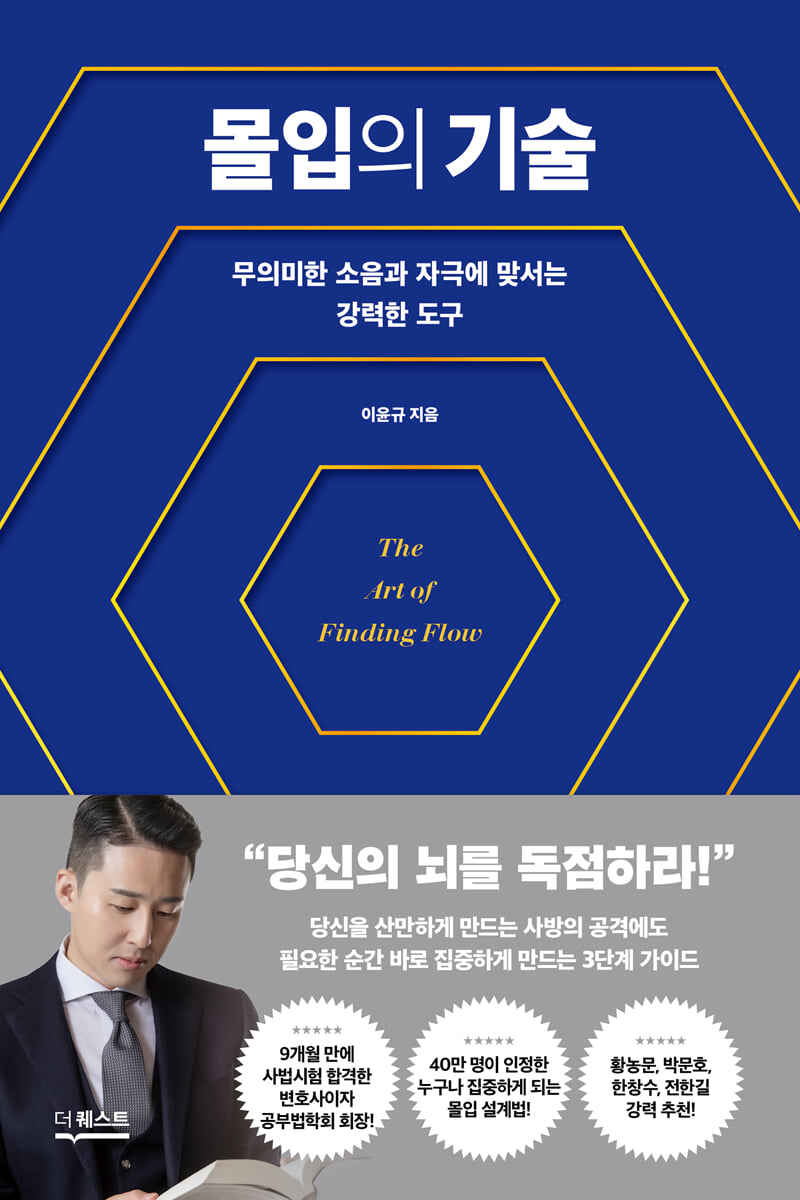
The most effective immersion strategyAttorney Lee Yoon-gyu, who runs a study method YouTube channel with 400,000 subscribers and is the president of the Study Method Society, shares the optimal immersion technique.
Based on my experience of passing the bar exam in just nine months, my study method consulting cases, and various research, I will teach you the three-step immersion technique that will allow you to focus anytime, anywhere.
March 22, 2024. Self-Development PD Kim Sang-geun
The most realistic and useful guide to an immersive life
"Anyone can immerse themselves in a study whenever and however they want!" Attorney Lee Yoon-gyu, a study YouTuber with 400,000 subscribers, reveals how to instantly focus and immerse themselves in situations and environments that distract us.
Based on his own experience of passing the bar exam in just nine months, thousands of counseling sessions for test takers, over 40,000 case studies, and extensive theories and research in psychology, brain science, and behavioral economics, this book contains an "immersion design method" that anyone can follow and achieve results with.
This book will introduce you to the principles and techniques of immersion that will allow you to focus naturally and without conscious effort, whether you have a goal you desperately want to achieve, dream of a life of daily growth, want to focus on your work or studies, or struggle with attention deficit disorder.
"Anyone can immerse themselves in a study whenever and however they want!" Attorney Lee Yoon-gyu, a study YouTuber with 400,000 subscribers, reveals how to instantly focus and immerse themselves in situations and environments that distract us.
Based on his own experience of passing the bar exam in just nine months, thousands of counseling sessions for test takers, over 40,000 case studies, and extensive theories and research in psychology, brain science, and behavioral economics, this book contains an "immersion design method" that anyone can follow and achieve results with.
This book will introduce you to the principles and techniques of immersion that will allow you to focus naturally and without conscious effort, whether you have a goal you desperately want to achieve, dream of a life of daily growth, want to focus on your work or studies, or struggle with attention deficit disorder.
- You can preview some of the book's contents.
Preview
index
Part 1: The Principle of Immersion
1. Components and Three Principles of Immersion
2 Re-understanding immersion
Part 2: The Art of Immersion
Prerequisite | Motivation to Dance
1 Why is only what is achieved through effort truly great?
2 What Makes Motivation Dance
3 If you move away from ○○, you will also move away from your heart.
4 Scientific Ways to Motivate Yourself
Step 1 | Create a Plan to Seduce Your Subconscious
1. Understanding immersion from the perspective of ‘brain consumption’
2 The brain only buys what is attractive.
3 How to Market to the Brain
4. Create a plan that engages the brain
5 There is a separate 'order' in which the brain is attracted.
6 Things the Brain Likes, Things the Brain Hates
7 Mistakes Your Brain Makes When Choosing a Means of Immersion
8 Reasons Why You Should Throw Away Your Perfect Plan
Step 2: Controlling Impulses, Anxiety, and Distractions
1. The enemy of immersion, impulse
How to Win the Race Against Your Impulses Part 1: Eliminating the Cause
How to Win the Race Against Impulses Part 2: The Consequence Elimination Method
4. Anxiety, the Disruptor of Immersion
5 Ways to Shake Off the Anxiety Saboteur
6 Ways to Use Anxiety in Reverse
Step 3: Monopolize the Brain Through Optimization
1. Two-Thirds of the Day: How to Master Your Subconscious
2. Set performance goals, not outcome goals.
3. Insert an external hard drive into your brain.
4. Use the 'Deadline Effect'
5 Reasons to Start Your Day with Music
6. Just reducing the number of tasks will make execution easier.
7. Weed out the things that just seem difficult.
8. Switch to another task at the right time.
Exploiting the human tendency to act in units of 9
10 Avoid multitasking
11 How to Use Only Moments of Pure Immersion
12 If you want to immerse yourself, use others too.
13 Designing a Choice Structure that Leads to Immersion
Part 3 For better immersion
Maintenance | Managing Engagement with Feedback
1. To make an accurate judgment, we must separate 'this'.
2 The brain remembers only two scenes
3. The brain that likes praise, the brain that hates scolding
4. If you want to improve the quality of your immersion, focus on your strengths.
5. I can't get into it without 'this'
6. Even control your sense of accomplishment.
7 Brain Errors to Watch Out for During the Feedback Process
1. Components and Three Principles of Immersion
2 Re-understanding immersion
Part 2: The Art of Immersion
Prerequisite | Motivation to Dance
1 Why is only what is achieved through effort truly great?
2 What Makes Motivation Dance
3 If you move away from ○○, you will also move away from your heart.
4 Scientific Ways to Motivate Yourself
Step 1 | Create a Plan to Seduce Your Subconscious
1. Understanding immersion from the perspective of ‘brain consumption’
2 The brain only buys what is attractive.
3 How to Market to the Brain
4. Create a plan that engages the brain
5 There is a separate 'order' in which the brain is attracted.
6 Things the Brain Likes, Things the Brain Hates
7 Mistakes Your Brain Makes When Choosing a Means of Immersion
8 Reasons Why You Should Throw Away Your Perfect Plan
Step 2: Controlling Impulses, Anxiety, and Distractions
1. The enemy of immersion, impulse
How to Win the Race Against Your Impulses Part 1: Eliminating the Cause
How to Win the Race Against Impulses Part 2: The Consequence Elimination Method
4. Anxiety, the Disruptor of Immersion
5 Ways to Shake Off the Anxiety Saboteur
6 Ways to Use Anxiety in Reverse
Step 3: Monopolize the Brain Through Optimization
1. Two-Thirds of the Day: How to Master Your Subconscious
2. Set performance goals, not outcome goals.
3. Insert an external hard drive into your brain.
4. Use the 'Deadline Effect'
5 Reasons to Start Your Day with Music
6. Just reducing the number of tasks will make execution easier.
7. Weed out the things that just seem difficult.
8. Switch to another task at the right time.
Exploiting the human tendency to act in units of 9
10 Avoid multitasking
11 How to Use Only Moments of Pure Immersion
12 If you want to immerse yourself, use others too.
13 Designing a Choice Structure that Leads to Immersion
Part 3 For better immersion
Maintenance | Managing Engagement with Feedback
1. To make an accurate judgment, we must separate 'this'.
2 The brain remembers only two scenes
3. The brain that likes praise, the brain that hates scolding
4. If you want to improve the quality of your immersion, focus on your strengths.
5. I can't get into it without 'this'
6. Even control your sense of accomplishment.
7 Brain Errors to Watch Out for During the Feedback Process
Detailed image

Into the book
According to psychologist John Atkinson's 'Achievement Motivation Theory', the level of motivation or desire is correlated with the difficulty of the task.
This means that the difficulty of a task has a very large impact on motivation.
Especially when the difficulty is too low or too high, motivation is not good.
To warm up your motivation, it's best to start with something easy.
Because it is most important to not feel resistance to that work.
--- p.54
It is recommended to sleep in '1 hour and 30 minutes' units.
Don't you sometimes feel dazed and out of it all day, even after a long night's sleep? When we sleep, we begin in a light sleep, gradually enter a deep sleep, and then return to a light sleep state, repeatedly. This phenomenon occurs when we wake up from a deep sleep state.
Therefore, it is good to wake up from a state of light sleep, and REM sleep and non-REM sleep are usually repeated in cycles of 90 to 120 minutes.
In other words, if the REM sleep cycle repeats every 1.5 hours, it is recommended to sleep for 3 hours (1.5 x 2), 4 hours and 30 minutes (1.5 x 3), 6 hours (1.5 x 4), 7 hours and 30 minutes (1.5 x 5), and 9 hours (1.5 x 6).
And you need to sleep for at least 3 hours to get deep sleep and your body will recover.
Of course, this is a general research result, so it is better to find a sleep cycle that suits you.
In my case, I feel refreshed when I sleep for 1.8 hours (1 hour and 48 minutes).
--- p.146
If you want to use impulse-driven behavior as a kind of reward, you have to be careful about the intensity of the reward.
Let's say a person studying for a certificate sets the reward for completing a week's worth of study as 'taking a break by reading a comic book.'
What level of reward should be appropriate at this point? Most people who commit to something within a certain period of time believe that the rewards mentioned above should be minimal.
They feel that the reward might break their immersion, and they feel a kind of guilt about enjoying the reward.
However, it is advisable to give a stronger reward than you think is worth it.
Many test takers feel guilty if they stop studying and "rest by reading comics" for more than an hour. In this case, it is better to give them sufficient compensation by increasing the study time to around three hours.
--- p.142
It's about getting negative thoughts out of your head and replacing them with rational, reasonable thoughts.
This is the 'rational counter-argument'.
In sports psychology, there is a method called 'ASDR training', which involves recognizing the current problematic situation (Aware), stopping instinctive judgment (Stop), refuting negative thoughts (Dispute), and replacing them with positive thoughts (Replace).
Prepare a blank notebook or piece of paper.
Draw two vertical lines down the middle of a notebook or piece of paper to divide it into three columns.
Write down the negative thoughts you are currently having in the leftmost section (Why am I stupid and can't study?).
In the middle column, write a reasonable counterargument to that idea, that is, why the idea is wrong when you think about it rationally (they say that grades are much more influenced by method and effort than by brains).
And if you blame your head or talent, which cannot be changed, your achievements will actually decrease.
If you have any negative thoughts about this objection, write them down again in the left column below.
It's about contrasting negative and positive thoughts.
--- p.167
The mental energy used to achieve immersion is similar to the battery life of a smartphone.
Each person has different energy capacity and performance.
Accordingly, the duration of immersion also varies.
If you have an immersive battery like an old smartphone, the capacity is small or the performance is not good, so the immersion time is short and the immersive battery itself drains quickly.
For those with immersive batteries like the latest smartphones, the capacity is large, the performance is good, the immersive time is relatively long, and the immersive battery itself does not drain quickly.
Without knowing this, some people suspect that they have ADHD because they cannot concentrate for long and lose focus easily, compare themselves to others and blame themselves, or lament that things will never work out no matter how hard they try, things that would make them angry if others did it to them without hesitation.
--- p.241
When you work with someone on something, your performance and way of thinking are influenced by that person's work performance, which increases your ability to perform and improves the quality of your immersion. This is called the 'Peer Effect.'
The first condition for enjoying the peer effect is that there must be at least one person among the people you work with who is more skilled than you.
When studying, you must create an environment where you can observe each other's study progress.
I need to be able to see how other people, especially those who are better than me, are studying.
This means that the difficulty of a task has a very large impact on motivation.
Especially when the difficulty is too low or too high, motivation is not good.
To warm up your motivation, it's best to start with something easy.
Because it is most important to not feel resistance to that work.
--- p.54
It is recommended to sleep in '1 hour and 30 minutes' units.
Don't you sometimes feel dazed and out of it all day, even after a long night's sleep? When we sleep, we begin in a light sleep, gradually enter a deep sleep, and then return to a light sleep state, repeatedly. This phenomenon occurs when we wake up from a deep sleep state.
Therefore, it is good to wake up from a state of light sleep, and REM sleep and non-REM sleep are usually repeated in cycles of 90 to 120 minutes.
In other words, if the REM sleep cycle repeats every 1.5 hours, it is recommended to sleep for 3 hours (1.5 x 2), 4 hours and 30 minutes (1.5 x 3), 6 hours (1.5 x 4), 7 hours and 30 minutes (1.5 x 5), and 9 hours (1.5 x 6).
And you need to sleep for at least 3 hours to get deep sleep and your body will recover.
Of course, this is a general research result, so it is better to find a sleep cycle that suits you.
In my case, I feel refreshed when I sleep for 1.8 hours (1 hour and 48 minutes).
--- p.146
If you want to use impulse-driven behavior as a kind of reward, you have to be careful about the intensity of the reward.
Let's say a person studying for a certificate sets the reward for completing a week's worth of study as 'taking a break by reading a comic book.'
What level of reward should be appropriate at this point? Most people who commit to something within a certain period of time believe that the rewards mentioned above should be minimal.
They feel that the reward might break their immersion, and they feel a kind of guilt about enjoying the reward.
However, it is advisable to give a stronger reward than you think is worth it.
Many test takers feel guilty if they stop studying and "rest by reading comics" for more than an hour. In this case, it is better to give them sufficient compensation by increasing the study time to around three hours.
--- p.142
It's about getting negative thoughts out of your head and replacing them with rational, reasonable thoughts.
This is the 'rational counter-argument'.
In sports psychology, there is a method called 'ASDR training', which involves recognizing the current problematic situation (Aware), stopping instinctive judgment (Stop), refuting negative thoughts (Dispute), and replacing them with positive thoughts (Replace).
Prepare a blank notebook or piece of paper.
Draw two vertical lines down the middle of a notebook or piece of paper to divide it into three columns.
Write down the negative thoughts you are currently having in the leftmost section (Why am I stupid and can't study?).
In the middle column, write a reasonable counterargument to that idea, that is, why the idea is wrong when you think about it rationally (they say that grades are much more influenced by method and effort than by brains).
And if you blame your head or talent, which cannot be changed, your achievements will actually decrease.
If you have any negative thoughts about this objection, write them down again in the left column below.
It's about contrasting negative and positive thoughts.
--- p.167
The mental energy used to achieve immersion is similar to the battery life of a smartphone.
Each person has different energy capacity and performance.
Accordingly, the duration of immersion also varies.
If you have an immersive battery like an old smartphone, the capacity is small or the performance is not good, so the immersion time is short and the immersive battery itself drains quickly.
For those with immersive batteries like the latest smartphones, the capacity is large, the performance is good, the immersive time is relatively long, and the immersive battery itself does not drain quickly.
Without knowing this, some people suspect that they have ADHD because they cannot concentrate for long and lose focus easily, compare themselves to others and blame themselves, or lament that things will never work out no matter how hard they try, things that would make them angry if others did it to them without hesitation.
--- p.241
When you work with someone on something, your performance and way of thinking are influenced by that person's work performance, which increases your ability to perform and improves the quality of your immersion. This is called the 'Peer Effect.'
The first condition for enjoying the peer effect is that there must be at least one person among the people you work with who is more skilled than you.
When studying, you must create an environment where you can observe each other's study progress.
I need to be able to see how other people, especially those who are better than me, are studying.
--- p.246
GOODS SPECIFICS
- Date of issue: March 19, 2024
- Page count, weight, size: 312 pages | 412g | 140*210*18mm
- ISBN13: 9791140708772
- ISBN10: 1140708775
You may also like
카테고리
korean


korean

![ELLE 엘르 스페셜 에디션 A형 : 12월 [2025]](http://librairie.coreenne.fr/cdn/shop/files/b8e27a3de6c9538896439686c6b0e8fb.jpg?v=1766436872&width=3840)


