

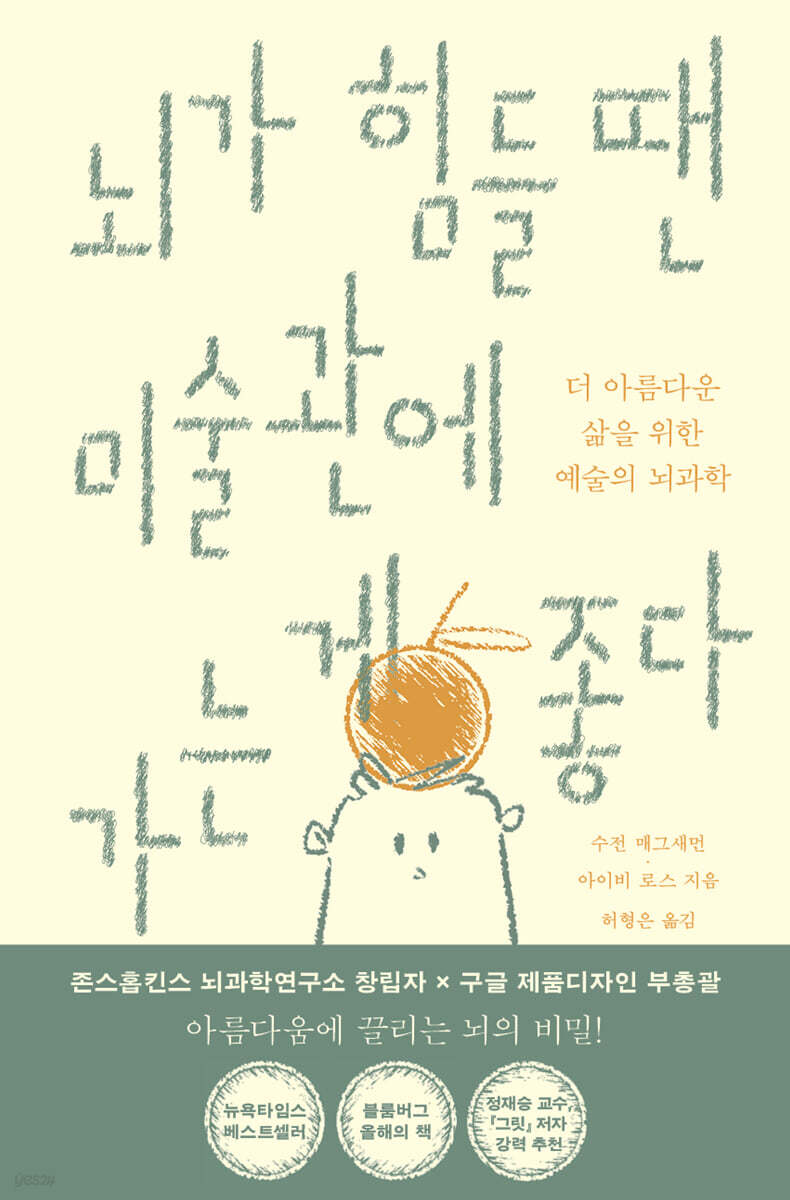
When your brain is tired, it's good to go to an art museum.
 |
Description
Book Introduction
- A word from MD
-
The power of art, comfort and healingThis book, written by a neuroscientist and a designer, advises seeking answers in art when life gets out of hand.
The perhaps obvious idea that art can comfort and heal people has been proven through various case studies and brain science research results.
Let's awaken my senses of sight, touch, and smell.
Beauty will save humanity.
April 18, 2025. Natural Science PD Son Min-gyu
★★★ New York Times Bestseller, Bloomberg Book of the Year Selection ★★★
· The secret of the brain that is attracted to beauty, revealed by a Johns Hopkins University neuroscientist and a Google design artist
· Cutting-edge brain science research reveals the incredible power of art to heal anxiety, trauma, and illness.
· Highly recommended by Professor Jaeseung Jeong, Seth Godin (author of "Marketing"), and Angela Duckworth (author of "Grit")!
"A book that will make you love both art and brain science" - Recommended by Professor Jaeseung Jeong (Department of Brain and Cognitive Sciences, KAIST)
Can art galleries and concerts save our ailing brains? A guide to the brain, art, and recovery for modern people living in a society that pursues extreme efficiency.
Co-authored by Susan Magsammon, founder of the International Institute for the Arts and Minds at Johns Hopkins University School of Medicine, and Ivy Ross, vice president of design at Google Hardware Product Development, this book explores how the brain's encounter with beauty transforms our lives.
The two authors, a neuroscientist and an artist, joined forces to write this book, believing that the convergence of art and science can offer new directions for human life. Indeed, the resulting "neuroaesthetics" goes beyond mere entertainment or taste to offer physical and mental recovery and solace.
Ivy Ross developed 'Google Glass', which combined the fun elements of cartoons with smart glasses technology and created a device that sends signals to children on the autism spectrum to help them recognize the emotions of others.
What if a familiar playlist of music could help restore memories in Alzheimer's patients? What if a virtual reality program could replace opioid painkillers to reduce pain in burn victims? What if art classes could heal firefighters' trauma from fires? Drawing on scientific research and encounters with living artists, the duo delves into the astonishing power of art in a world plagued by anxiety, addiction, and trauma.
Starbucks's ability to bounce back from the recession was largely due to art.
At a workshop where leaders gathered together, they shared and discussed their experiences with the Beatles, cultural icons, and Starbucks, and wrote a new, hopeful mission statement. This experience led to the successful reinvention of the company.
Painting, dance, writing, architecture, acting… How and to what extent do the power of various artistic activities transform our brains? This book comprehensively examines the power of art to enable both individuals and society to live healthy and fulfilling lives, presenting a wealth of case studies.
This book allows us to consider the meaning of diverse artistic activities that revitalize our weary lives through scientific evidence.
Discover how creative thinking changes the brain and how these changes enrich our lives and society, including our physical and mental health and relationships.
Art is not as far away as you think.
· The secret of the brain that is attracted to beauty, revealed by a Johns Hopkins University neuroscientist and a Google design artist
· Cutting-edge brain science research reveals the incredible power of art to heal anxiety, trauma, and illness.
· Highly recommended by Professor Jaeseung Jeong, Seth Godin (author of "Marketing"), and Angela Duckworth (author of "Grit")!
"A book that will make you love both art and brain science" - Recommended by Professor Jaeseung Jeong (Department of Brain and Cognitive Sciences, KAIST)
Can art galleries and concerts save our ailing brains? A guide to the brain, art, and recovery for modern people living in a society that pursues extreme efficiency.
Co-authored by Susan Magsammon, founder of the International Institute for the Arts and Minds at Johns Hopkins University School of Medicine, and Ivy Ross, vice president of design at Google Hardware Product Development, this book explores how the brain's encounter with beauty transforms our lives.
The two authors, a neuroscientist and an artist, joined forces to write this book, believing that the convergence of art and science can offer new directions for human life. Indeed, the resulting "neuroaesthetics" goes beyond mere entertainment or taste to offer physical and mental recovery and solace.
Ivy Ross developed 'Google Glass', which combined the fun elements of cartoons with smart glasses technology and created a device that sends signals to children on the autism spectrum to help them recognize the emotions of others.
What if a familiar playlist of music could help restore memories in Alzheimer's patients? What if a virtual reality program could replace opioid painkillers to reduce pain in burn victims? What if art classes could heal firefighters' trauma from fires? Drawing on scientific research and encounters with living artists, the duo delves into the astonishing power of art in a world plagued by anxiety, addiction, and trauma.
Starbucks's ability to bounce back from the recession was largely due to art.
At a workshop where leaders gathered together, they shared and discussed their experiences with the Beatles, cultural icons, and Starbucks, and wrote a new, hopeful mission statement. This experience led to the successful reinvention of the company.
Painting, dance, writing, architecture, acting… How and to what extent do the power of various artistic activities transform our brains? This book comprehensively examines the power of art to enable both individuals and society to live healthy and fulfilling lives, presenting a wealth of case studies.
This book allows us to consider the meaning of diverse artistic activities that revitalize our weary lives through scientific evidence.
Discover how creative thinking changes the brain and how these changes enrich our lives and society, including our physical and mental health and relationships.
Art is not as far away as you think.
- You can preview some of the book's contents.
Preview
index
Recommendation
Introduction | The Language of Humanity
Chapter 1 | Anatomy of Art
Chapter 2 | Art Experienced Through the Senses
Chapter 3 | Healing from Emotional Wounds
Chapter 4 | Healing Your Body
Chapter 5 | The Relationship Between Education and the Arts
Chapter 6 | Living Well
Chapter 7 | Becoming One Through Art
Conclusion | Art of the Future
Introduction | The Language of Humanity
Chapter 1 | Anatomy of Art
Chapter 2 | Art Experienced Through the Senses
Chapter 3 | Healing from Emotional Wounds
Chapter 4 | Healing Your Body
Chapter 5 | The Relationship Between Education and the Arts
Chapter 6 | Living Well
Chapter 7 | Becoming One Through Art
Conclusion | Art of the Future
Detailed image
.jpg)
Into the book
Art and aesthetics encompass much more than beauty; they provide an emotional connection to the diverse range of human experiences.
“Art can be more than just sugar on the tongue.
When a work of art contains challenging elements, it can be uncomfortable, but that discomfort offers the possibility of change and transformation if we are willing to look closely.
“It can be a very intense aesthetic experience.”
--- From "The Anatomy of Art"
What researchers have learned over decades is that from a neurobiological perspective, multiple systems in the body and brain work together to interact with the world, and that human life is a constant process of processing incoming data on instinctual, unconscious, and conscious levels.
As far back as ancient Greece, poetry was also prescribed as medicine.
The Greeks prescribed poetry alongside other medical interventions.
Poetry frequently appears at the most momentous moments of commemoration, from private celebrations like weddings to political and civic events like the U.S. presidential inauguration.
Poetry, as an art form, has been with humanity since the beginning.
--- From "Art Feeled with the Senses"
One study examining the effects of expressive writing on the brain found that writing about past traumatic events changed neural activity in the brain by activating the central cingulate cortex, a crucial area for processing negative emotions.
The idea is that giving language to our emotions and feelings helps us, on a neurobiological level, put context into the difficult events we experience in life and make better sense of them.
--- From "Healing from Heart Wounds"
Other artistic activities, such as drawing or music lessons, have also been shown to be effective in relieving headaches.
One small study found that having a personal music playlist helped manage chronic headaches.
People who listened to music to relieve tension and pain actually experienced pain relief and improved symptoms.
--- From "Healing the Body"
The brain isn't interested in filling out standardized test answer sheets or heated debates about course grading.
The brain is designed to create new neural pathways and constantly evolve, and the way we learn is not at all like the socially oriented educational system that is usually designed for rote memorization and recall.
Art increases synaptic circuitry, enhancing the ability of the hippocampus and other brain regions to perform the tasks they were designed to do.
This is helpful not only when playing music, but also when performing activities in life that require learning and memory.
In short, practicing music increases synapses and gray matter.
--- From "The Relationship Between Education and Art"
Curiosity is one of the elements necessary for evolution, and it is built into the human brain.
Cognitive neuroscientists believe curiosity evolved over millennia as part of a threat-detection system, along with other neural activities like worry, to help us make the best decisions in an unpredictable world.
Curiosity led our ancestors to ask questions like, "Is this red fruit safe to eat?", "What would happen if we hit two stones together and made sparks?", and "What would happen if we sharpened the end of this piece of wood?"
--- From "Living a Good Life"
Among other purposes, Matthew told The Atlantic, “the default mode network invites us to wonder about the minds of others.
It makes you wonder what that person is thinking, feeling, and what their goals are.” This is especially true because the default mode network is particularly involved in how we relate to the world.
What is our place in the world? This is what makes us wonder.
“Art can be more than just sugar on the tongue.
When a work of art contains challenging elements, it can be uncomfortable, but that discomfort offers the possibility of change and transformation if we are willing to look closely.
“It can be a very intense aesthetic experience.”
--- From "The Anatomy of Art"
What researchers have learned over decades is that from a neurobiological perspective, multiple systems in the body and brain work together to interact with the world, and that human life is a constant process of processing incoming data on instinctual, unconscious, and conscious levels.
As far back as ancient Greece, poetry was also prescribed as medicine.
The Greeks prescribed poetry alongside other medical interventions.
Poetry frequently appears at the most momentous moments of commemoration, from private celebrations like weddings to political and civic events like the U.S. presidential inauguration.
Poetry, as an art form, has been with humanity since the beginning.
--- From "Art Feeled with the Senses"
One study examining the effects of expressive writing on the brain found that writing about past traumatic events changed neural activity in the brain by activating the central cingulate cortex, a crucial area for processing negative emotions.
The idea is that giving language to our emotions and feelings helps us, on a neurobiological level, put context into the difficult events we experience in life and make better sense of them.
--- From "Healing from Heart Wounds"
Other artistic activities, such as drawing or music lessons, have also been shown to be effective in relieving headaches.
One small study found that having a personal music playlist helped manage chronic headaches.
People who listened to music to relieve tension and pain actually experienced pain relief and improved symptoms.
--- From "Healing the Body"
The brain isn't interested in filling out standardized test answer sheets or heated debates about course grading.
The brain is designed to create new neural pathways and constantly evolve, and the way we learn is not at all like the socially oriented educational system that is usually designed for rote memorization and recall.
Art increases synaptic circuitry, enhancing the ability of the hippocampus and other brain regions to perform the tasks they were designed to do.
This is helpful not only when playing music, but also when performing activities in life that require learning and memory.
In short, practicing music increases synapses and gray matter.
--- From "The Relationship Between Education and Art"
Curiosity is one of the elements necessary for evolution, and it is built into the human brain.
Cognitive neuroscientists believe curiosity evolved over millennia as part of a threat-detection system, along with other neural activities like worry, to help us make the best decisions in an unpredictable world.
Curiosity led our ancestors to ask questions like, "Is this red fruit safe to eat?", "What would happen if we hit two stones together and made sparks?", and "What would happen if we sharpened the end of this piece of wood?"
--- From "Living a Good Life"
Among other purposes, Matthew told The Atlantic, “the default mode network invites us to wonder about the minds of others.
It makes you wonder what that person is thinking, feeling, and what their goals are.” This is especially true because the default mode network is particularly involved in how we relate to the world.
What is our place in the world? This is what makes us wonder.
--- From "Becoming One Through Art"
Publisher's Review
Interpreted by brain science
The life-changing power of art
When we live a busy and difficult life, we all want to find an escape.
When even just getting through daily life feels overwhelming, the instinctive human desire to heal the wounds and deficiencies of body and mind through new sensations is triggered.
It's at this point that we find ourselves seeking out creative activities like camping, which takes us back to the open countryside, inspiring books and movies, or virtual reality games that allow us to enter new worlds.
That's because we instinctively know that these activities have a powerful power to stimulate our brains.
Susan and Ivy, who have been studying the scientific basis of this phenomenon, recently introduced the diverse power of art based on interesting research results they have discovered as well as stories they have directly met with artists in their book, "When Your Brain is Tired, It's Good to Go to an Art Museum," which has become a hot topic in the English-speaking world.
This book, which was a New York Times bestseller and Bloomberg Book of the Year, focuses on the concept of 'neuroaesthetics,' a field that scientifically approaches and interprets aesthetic experiences, and research is still ongoing.
A recent study found that viewing an actual original work of art in a museum elicits a ten times stronger emotional response than viewing a reproduction.
Based on the core theory of neuroplasticity, which states that each person's brain changes differently depending on what they see, hear, and experience, the two people's extensive story scientifically proves what we often only know intuitively, bringing us one step closer to art.
It is embedded in every aspect of our lives
The World of Neuroaesthetics
How is neuroaesthetics integrated into our lives? "When Your Brain is Tired, It's Good to Go to an Art Museum" meticulously examines the impact artistic sensibility has on individuals' daily lives and society at large.
In fact, research continues to show that aesthetic experiences, such as games or listening to music, that activate brain neural networks can be effective in treating conditions like attention deficit hyperactivity disorder, Alzheimer's disease, and cognitive impairment.
This is true not only in the medical field but also in architecture.
As COVID-19 paralyzed hospitals worldwide, one New York hospital designed a space incorporating nature-friendly elements to allow medical staff to recharge during short breaks. Around the world, inspiring buildings are being designed that heighten the senses, even to the point of feeling connected to the spiritual realm.
The power of art is also demonstrated in learning.
A professor at McGill University in Canada was shocked to discover that students remembered only 10 percent of the lecture material a year after the end of the course, so he began using music in his classes.
By exploiting the fact that music activates the memory, reasoning, and speaking areas of the brain, the lesson content is stored in long-term memory.
In 2008, Starbucks also used the power of art to overcome the difficulties of declining brand loyalty and average sales per store.
The conversation among leaders, which began at a workshop featuring creativity experts and centered around the Beatles, a representative icon of culture, provided the impetus for Starbucks to be reborn with a sophisticated sensibility, and completely changed the course of Starbucks's business for the next three years.
As Seth Godin said in this book, “Art is a magic that makes us better,” the sense of beauty in art has a powerful enough influence to become a turning point in life.
The more I admire its beauty,
The ever-growing 'strength to live'
The creative energy of art also has great power to heal deep emotional wounds.
Let's think about the trauma that we live through and repeat every day.
Things like the painful wartime memories of veterans or the horrific accidents firefighters face on fire scenes are difficult to heal on their own, and if left untreated, they tend to become internally isolating.
At this time, if you create a mask that reflects yourself or consistently draw detailed drawings, your condition will often gradually improve.
It is a healing process of expressing the wounds that were difficult to express in words through art, and regaining the voice that was lost within me.
The world-renowned painter Van Gogh said this.
“Admire beautiful things as much as possible.
“People don’t get enough admiration for beauty.” The shock of admiration we feel when we see a moving work of art has an immediate impact on our brains, without us even realizing it.
In other words, bringing art into life means cultivating a healthy, abundant, and 'well' life.
Relieve stress by doodling or journaling, calm anxiety by listening to your own music playlist, and gain new inspiration by attending a play or exhibition after a long day.
Art that nurtures the mind, heals the body, fosters bonds with others, and brings happiness to everyday life is so simple that you can begin incorporating it into your life today.
With this book, which has captivated countless art-loving readers, you will be able to experience a new sense of life and discover yourself changing day by day.
The life-changing power of art
When we live a busy and difficult life, we all want to find an escape.
When even just getting through daily life feels overwhelming, the instinctive human desire to heal the wounds and deficiencies of body and mind through new sensations is triggered.
It's at this point that we find ourselves seeking out creative activities like camping, which takes us back to the open countryside, inspiring books and movies, or virtual reality games that allow us to enter new worlds.
That's because we instinctively know that these activities have a powerful power to stimulate our brains.
Susan and Ivy, who have been studying the scientific basis of this phenomenon, recently introduced the diverse power of art based on interesting research results they have discovered as well as stories they have directly met with artists in their book, "When Your Brain is Tired, It's Good to Go to an Art Museum," which has become a hot topic in the English-speaking world.
This book, which was a New York Times bestseller and Bloomberg Book of the Year, focuses on the concept of 'neuroaesthetics,' a field that scientifically approaches and interprets aesthetic experiences, and research is still ongoing.
A recent study found that viewing an actual original work of art in a museum elicits a ten times stronger emotional response than viewing a reproduction.
Based on the core theory of neuroplasticity, which states that each person's brain changes differently depending on what they see, hear, and experience, the two people's extensive story scientifically proves what we often only know intuitively, bringing us one step closer to art.
It is embedded in every aspect of our lives
The World of Neuroaesthetics
How is neuroaesthetics integrated into our lives? "When Your Brain is Tired, It's Good to Go to an Art Museum" meticulously examines the impact artistic sensibility has on individuals' daily lives and society at large.
In fact, research continues to show that aesthetic experiences, such as games or listening to music, that activate brain neural networks can be effective in treating conditions like attention deficit hyperactivity disorder, Alzheimer's disease, and cognitive impairment.
This is true not only in the medical field but also in architecture.
As COVID-19 paralyzed hospitals worldwide, one New York hospital designed a space incorporating nature-friendly elements to allow medical staff to recharge during short breaks. Around the world, inspiring buildings are being designed that heighten the senses, even to the point of feeling connected to the spiritual realm.
The power of art is also demonstrated in learning.
A professor at McGill University in Canada was shocked to discover that students remembered only 10 percent of the lecture material a year after the end of the course, so he began using music in his classes.
By exploiting the fact that music activates the memory, reasoning, and speaking areas of the brain, the lesson content is stored in long-term memory.
In 2008, Starbucks also used the power of art to overcome the difficulties of declining brand loyalty and average sales per store.
The conversation among leaders, which began at a workshop featuring creativity experts and centered around the Beatles, a representative icon of culture, provided the impetus for Starbucks to be reborn with a sophisticated sensibility, and completely changed the course of Starbucks's business for the next three years.
As Seth Godin said in this book, “Art is a magic that makes us better,” the sense of beauty in art has a powerful enough influence to become a turning point in life.
The more I admire its beauty,
The ever-growing 'strength to live'
The creative energy of art also has great power to heal deep emotional wounds.
Let's think about the trauma that we live through and repeat every day.
Things like the painful wartime memories of veterans or the horrific accidents firefighters face on fire scenes are difficult to heal on their own, and if left untreated, they tend to become internally isolating.
At this time, if you create a mask that reflects yourself or consistently draw detailed drawings, your condition will often gradually improve.
It is a healing process of expressing the wounds that were difficult to express in words through art, and regaining the voice that was lost within me.
The world-renowned painter Van Gogh said this.
“Admire beautiful things as much as possible.
“People don’t get enough admiration for beauty.” The shock of admiration we feel when we see a moving work of art has an immediate impact on our brains, without us even realizing it.
In other words, bringing art into life means cultivating a healthy, abundant, and 'well' life.
Relieve stress by doodling or journaling, calm anxiety by listening to your own music playlist, and gain new inspiration by attending a play or exhibition after a long day.
Art that nurtures the mind, heals the body, fosters bonds with others, and brings happiness to everyday life is so simple that you can begin incorporating it into your life today.
With this book, which has captivated countless art-loving readers, you will be able to experience a new sense of life and discover yourself changing day by day.
GOODS SPECIFICS
- Date of issue: April 18, 2025
- Page count, weight, size: 368 pages | 564g | 145*220*25mm
- ISBN13: 9791155817940
- ISBN10: 115581794X
You may also like
카테고리
korean


korean

![GQ KOREA Mark (Monthly): December [2025]](http://librairie.coreenne.fr/cdn/shop/files/8ef265dbbfbf186523ed75ba7319009d.jpg?v=1765340328&width=3840)


