

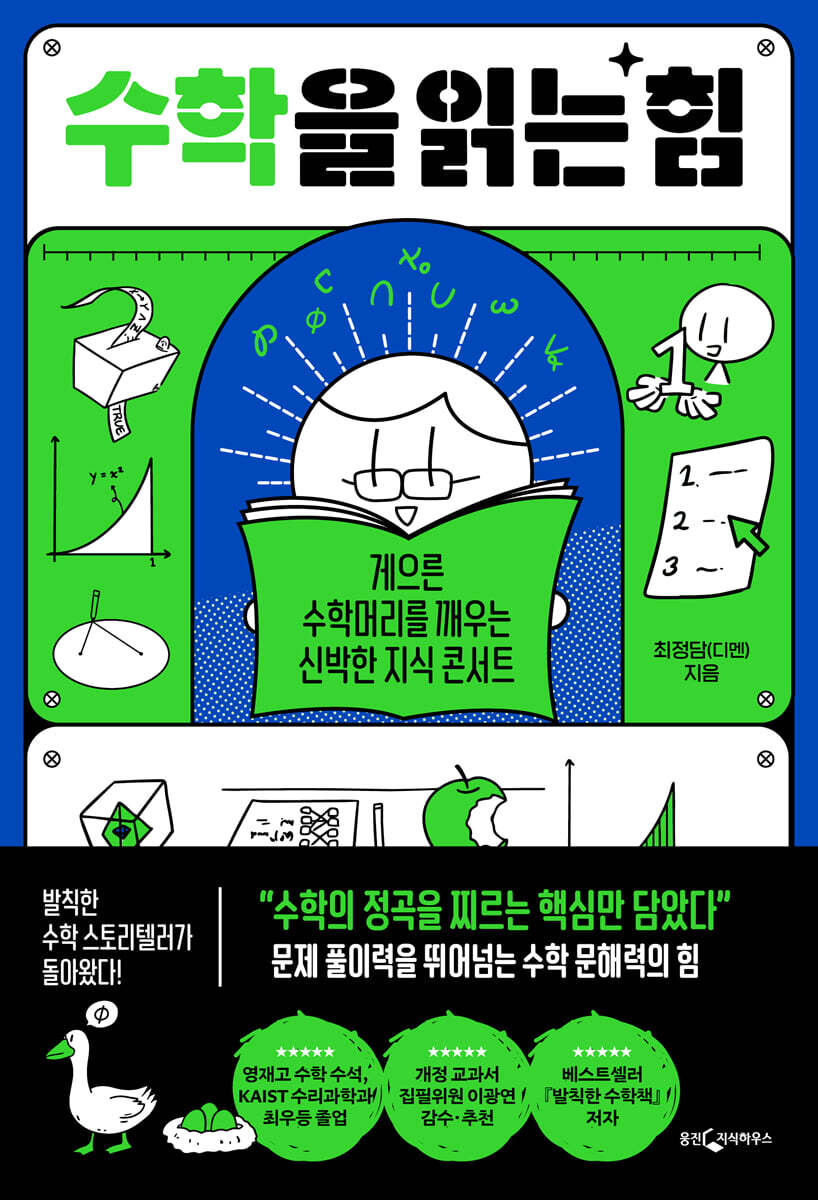
The power of reading mathematics
 |
Description
Book Introduction
"The beginning of an intellectual adventure that will take you through the vast world of mathematics."
Understand the context and concepts of mathematics through stories and illustrations!
The power of mathematical literacy that goes beyond problem-solving skills
* Graduated with highest honors from KAIST Department of Mathematical Sciences
* Graduated from Sejong Science and Arts High School with the highest grade in mathematics and second overall
* Top 2-5% of AMC (American Mathematics Competition)
* Korean Linguistics Olympiad Encouragement Award
* Sejong Hackathon Grand Prize Winner
* PUPC (Princeton University Physics Competition) Silver Medal
“It contains only the core concepts that capture the essence of mathematics.”
Lee Gwang-yeon (Revised Textbook Writing Committee Member, Professor of Mathematics, Hanseo University)
The daring storyteller is back to save those who still misunderstand math as memorizing complex formulas and solving equations.
This time, it is the history of mathematics that permeates the flow of knowledge.
This book traces the lives and discoveries of countless mathematicians who have contributed to the development of mathematics as we know it today, starting with Thales, the first mathematician in ancient times, through Newton and Euler in the Middle Ages, Gauss in the modern era, and Russell and Turing in the present day.
As you read this book, which contains interesting stories hidden behind boring mathematical formulas known only as numbers and symbols, and illustrations that kindly explain difficult formulas, you will naturally come to understand the concepts and context of mathematics.
With this book, readers will naturally enjoy the pleasure of 'reading mathematics' rather than 'solving mathematics'.
Pythagoras was worshipped as a god for measuring the height of the pyramid using geometry, and the number '0' was discovered only after Al-Khwarizmi introduced Arabic numerals.
Archimedes, famous for his “Eureka!”, derived the volume formula using only the principle of the lever, and Galileo earned the title of “father of modern science” by expressing natural phenomena “mathematically.”
The problem of planetary orbits, which was known to be difficult, was solved using Newton's calculus, and Turing reversed the war's advantage by deciphering Nazi Germany's code using mathematical models.
As you follow the footsteps of the amazing mathematics that appear in this book, you will finally realize why you 'must' read mathematics.
Because you can never understand mathematics by simply solving problems.
The mathematical formulas and laws of nature that we take for granted today were developed through the endless questions and inquiries of mathematicians, and a series of events that overturned the answers.
This book, which is full of fascinating mathematical stories that follow one another without a break, will help you understand the principles and concepts of mathematics without having to memorize formulas or do numerical calculations.
Understand the context and concepts of mathematics through stories and illustrations!
The power of mathematical literacy that goes beyond problem-solving skills
* Graduated with highest honors from KAIST Department of Mathematical Sciences
* Graduated from Sejong Science and Arts High School with the highest grade in mathematics and second overall
* Top 2-5% of AMC (American Mathematics Competition)
* Korean Linguistics Olympiad Encouragement Award
* Sejong Hackathon Grand Prize Winner
* PUPC (Princeton University Physics Competition) Silver Medal
“It contains only the core concepts that capture the essence of mathematics.”
Lee Gwang-yeon (Revised Textbook Writing Committee Member, Professor of Mathematics, Hanseo University)
The daring storyteller is back to save those who still misunderstand math as memorizing complex formulas and solving equations.
This time, it is the history of mathematics that permeates the flow of knowledge.
This book traces the lives and discoveries of countless mathematicians who have contributed to the development of mathematics as we know it today, starting with Thales, the first mathematician in ancient times, through Newton and Euler in the Middle Ages, Gauss in the modern era, and Russell and Turing in the present day.
As you read this book, which contains interesting stories hidden behind boring mathematical formulas known only as numbers and symbols, and illustrations that kindly explain difficult formulas, you will naturally come to understand the concepts and context of mathematics.
With this book, readers will naturally enjoy the pleasure of 'reading mathematics' rather than 'solving mathematics'.
Pythagoras was worshipped as a god for measuring the height of the pyramid using geometry, and the number '0' was discovered only after Al-Khwarizmi introduced Arabic numerals.
Archimedes, famous for his “Eureka!”, derived the volume formula using only the principle of the lever, and Galileo earned the title of “father of modern science” by expressing natural phenomena “mathematically.”
The problem of planetary orbits, which was known to be difficult, was solved using Newton's calculus, and Turing reversed the war's advantage by deciphering Nazi Germany's code using mathematical models.
As you follow the footsteps of the amazing mathematics that appear in this book, you will finally realize why you 'must' read mathematics.
Because you can never understand mathematics by simply solving problems.
The mathematical formulas and laws of nature that we take for granted today were developed through the endless questions and inquiries of mathematicians, and a series of events that overturned the answers.
This book, which is full of fascinating mathematical stories that follow one another without a break, will help you understand the principles and concepts of mathematics without having to memorize formulas or do numerical calculations.
- You can preview some of the book's contents.
Preview
index
Recommended Reading: The Beginning of an Intellectual Journey that Awakens Mathematical Thinking
Prologue_For those who still find math difficult
Chapter 1: Ancient and Middle Ages
- The first step toward truth
Geometry: The Bridge Between God and Man
- The first philosopher and mathematician
- A mathematician revered as a god
- Bestseller of the Century
- Can math make money?
Philosophy of Mathematics: Everything is Number
- Understanding the incomprehensible
- The incomprehensible usefulness of mathematics
- Line drawing problem
- Plato's mathematical world
- “Draw a straight line” vs.
“There is a straight line”
Number Theory: A Feast of Paradoxes
- Rational numbers and irrational numbers
- A really serious problem
- Achilles, unable to move
- Infinity greater than infinity
- An axiom that doesn't seem to be an axiom
- What happened since then?
Algebra: Euclid's Ball
- Were the Middle Ages a dark age?
- Arabic numerals with strange names
- The Riddle of 0
- Complete the vertical line
- Rescue Euclid
∞Integration with Geometry and Lever∞
Chapter 2: Early Modern Times
- Nature is written in the language of mathematics.
Calculus: From Astrology to Mathematical Physics
- Usefulness of astronomy
- Copernicus' heliocentric theory
- Scholars have to walk the line too!
- Kepler's laws
- The father of modern science?
- A fateful encounter in 1684
- Differentiation in just five pages
- Mathematical principles of natural philosophy
- Principia almost collapsed because of the fish dictionary
Complex Number Theory: Non-Fictitious Imaginary Numbers
- Duel with math
- A ghost that appears and disappears along the way
- Descartes and the Cogito
- The emergence of the coordinate plane
- From the coordinate plane to the complex plane
- Are imaginary numbers really 'imaginary numbers'?
- The most beautiful formula in the world
- A bridge connecting two worlds
- Euler, the teacher of us all
Logic: The Language of Machines, The Mathematics of Machines
- Leibniz, the all-round genius
- Shortest descent curve problem
- A legendary mud fight
- A machine that will solve all your disputes
Chapter 3: Late Modern Times
- The discovery of strict and precise language
Differential Geometry: Discovering New Spaces
- The problem that swallows up the light of life
- What is a 'real' straight line?
Proof or counterexample, that is the question.
- Putting an end to a two-thousand-year-old challenge
- Gauss, the king of mathematics
Hermeneutics: More rigorously, more accurately
- π=4?, 0.999… =1?
- The meaning of 'getting infinitely closer'
- The emergence of hermeneutics
Modern Algebra: The Legacy of Ill-Fated Geniuses
- What is the formula for the roots of the error equation?
- The Death of a Young Genius
- A flash of light, Galois
- Group theory of Abel and Galois
Chapter 4 Modern Times
- A ray of light thrown into a dark age
Set Theory: Infinity and Ignorabism
- A new definition of infinity
- Countable and uncountable sets
- Diagonal argument and continuum hypothesis
- unnameable number
- Russell's paradox
- Cantor's Paradise
- What is water?
- Relationship between predicates and sets
- Chess and set theory
- Hilbert's Dream
Mathematical Logic: From Incompleteness Theorems to Computers
- Gödel's incompleteness theorem
- Proof of the incompleteness theorem
- A logician thrown into the age of absurdity
Topology: Geometry Beyond the Universe
- The Königsberg Bridge problem
- Finding out the shape of the planet
- Reason beyond dimensions
- Poincaré's conjecture
- The emergence of phase space
- The death of Hausdorff
Computational Theory: Decoding Enigma
- Turing machine
- Can you calculate everything?
- Decrypt the unbreakable password
- Father of the Computer
Epilogue: Time to Rethink Math
Prologue_For those who still find math difficult
Chapter 1: Ancient and Middle Ages
- The first step toward truth
Geometry: The Bridge Between God and Man
- The first philosopher and mathematician
- A mathematician revered as a god
- Bestseller of the Century
- Can math make money?
Philosophy of Mathematics: Everything is Number
- Understanding the incomprehensible
- The incomprehensible usefulness of mathematics
- Line drawing problem
- Plato's mathematical world
- “Draw a straight line” vs.
“There is a straight line”
Number Theory: A Feast of Paradoxes
- Rational numbers and irrational numbers
- A really serious problem
- Achilles, unable to move
- Infinity greater than infinity
- An axiom that doesn't seem to be an axiom
- What happened since then?
Algebra: Euclid's Ball
- Were the Middle Ages a dark age?
- Arabic numerals with strange names
- The Riddle of 0
- Complete the vertical line
- Rescue Euclid
∞Integration with Geometry and Lever∞
Chapter 2: Early Modern Times
- Nature is written in the language of mathematics.
Calculus: From Astrology to Mathematical Physics
- Usefulness of astronomy
- Copernicus' heliocentric theory
- Scholars have to walk the line too!
- Kepler's laws
- The father of modern science?
- A fateful encounter in 1684
- Differentiation in just five pages
- Mathematical principles of natural philosophy
- Principia almost collapsed because of the fish dictionary
Complex Number Theory: Non-Fictitious Imaginary Numbers
- Duel with math
- A ghost that appears and disappears along the way
- Descartes and the Cogito
- The emergence of the coordinate plane
- From the coordinate plane to the complex plane
- Are imaginary numbers really 'imaginary numbers'?
- The most beautiful formula in the world
- A bridge connecting two worlds
- Euler, the teacher of us all
Logic: The Language of Machines, The Mathematics of Machines
- Leibniz, the all-round genius
- Shortest descent curve problem
- A legendary mud fight
- A machine that will solve all your disputes
Chapter 3: Late Modern Times
- The discovery of strict and precise language
Differential Geometry: Discovering New Spaces
- The problem that swallows up the light of life
- What is a 'real' straight line?
Proof or counterexample, that is the question.
- Putting an end to a two-thousand-year-old challenge
- Gauss, the king of mathematics
Hermeneutics: More rigorously, more accurately
- π=4?, 0.999… =1?
- The meaning of 'getting infinitely closer'
- The emergence of hermeneutics
Modern Algebra: The Legacy of Ill-Fated Geniuses
- What is the formula for the roots of the error equation?
- The Death of a Young Genius
- A flash of light, Galois
- Group theory of Abel and Galois
Chapter 4 Modern Times
- A ray of light thrown into a dark age
Set Theory: Infinity and Ignorabism
- A new definition of infinity
- Countable and uncountable sets
- Diagonal argument and continuum hypothesis
- unnameable number
- Russell's paradox
- Cantor's Paradise
- What is water?
- Relationship between predicates and sets
- Chess and set theory
- Hilbert's Dream
Mathematical Logic: From Incompleteness Theorems to Computers
- Gödel's incompleteness theorem
- Proof of the incompleteness theorem
- A logician thrown into the age of absurdity
Topology: Geometry Beyond the Universe
- The Königsberg Bridge problem
- Finding out the shape of the planet
- Reason beyond dimensions
- Poincaré's conjecture
- The emergence of phase space
- The death of Hausdorff
Computational Theory: Decoding Enigma
- Turing machine
- Can you calculate everything?
- Decrypt the unbreakable password
- Father of the Computer
Epilogue: Time to Rethink Math
Detailed image

Into the book
Thales is known to have been the first person to seriously ponder the question of what constitutes all things.
That's why he is remembered as the first philosopher.
Thales claimed that all things are made of water.
This is probably because water can change into solid, liquid, and gas, and a large part of the Earth is covered with water.
Although it may seem like a simple claim to us, Thales' reasoning is quite 'scientific' compared to other ancient beliefs.
Thales was also the first to elevate mathematics from a calculation game to a discipline that draws conclusions through deductive reasoning.
For this reason, he is also called the first mathematician, and his representative discovery is that “all triangles with two equal sides and the included angle are congruent.”
--- p.22~23
The waves that participate in the behavior of particles, including electrons, are called wave functions.
Specifically, the wave function is a function that maps each point in spacetime to a complex number (you might feel uncomfortable with the sudden appearance of such a difficult term, but I will skip the detailed explanation).
The key is that to describe the behavior of electrons, we need a mathematical entity called a wave function.
Here we run into a conundrum.
We concluded that since apples are made of atoms, and atoms are made of electrons and quarks, if we accept the existence of apples, we must also accept the existence of electrons and quarks.
But in a sense, electrons and quarks are made up of wave functions, and in a sense, wave functions are connected by complex numbers.
So, in order to acknowledge the existence of apples, wouldn't we have to acknowledge that complex numbers exist just as much as apples, and that mathematical objects like complex numbers are the most fundamental entities that make up the world?
--- p.45
Following Pythagoras, another ancient Greek scholar who pondered the enigmatic relationship between the world and mathematics was Plato.
Plato proposed a philosophical theory called the Theory of Forms to explain the relationship between the world and mathematics, and the Theory of Forms had a great influence on later intellectual history.
Alfred Whitehead, a mathematician and philosopher, once said, “The whole history of Western philosophy is a footnote to Plato.”
According to the theory of ideas, the world we experience is a shadow of a transcendent world called ideas.
Imagine a cube floating in the air.
There is only one cube, but the shadows it casts are varied.
If we apply this to Plato's theory of ideas, a single cube symbolizes ideas, and various shadows symbolize reality.
This book you are reading now, the space you are in, even our bodies are nothing more than shadows of the world called Idea.
This may sound like some far-fetched idea, but let's follow Plato's lead and see how he arrived at this conclusion.
--- p.47
First, let's try to decipher the 5th postulate one by one.
First, we will draw a straight line (l), and then we will draw two different lines (m, n) passing through that line.
This creates four interior angles (a, b, c, d). The sum of the two angles on the left (a, b) is greater than 180°, which is the sum of two right angles, but the sum of the two angles on the right (c, d) is less than 180°.
The parallel postulate states that two lines (m, n) intersect at the point where the sum of their interior angles is less than 180°.
I somehow understood it, but as soon as 『Elements』 was published, the parallel postulate became a thorn in my side.
Many mathematicians refused to accept the parallel postulate as an axiom, and tried to remove Euclid's weak pillar by proving the parallel postulate using only the other four axioms.
However, despite the efforts of mathematicians over a thousand years, attempts to prove the parallel postulate have ended in failure.
--- p.67
The person who made a decisive contribution to the introduction of Indian numerals was Al-Khwarizmi.
As briefly introduced earlier, Al-Khwarizmi was one of the greatest mathematicians of the Middle Ages, establishing algebra and trigonometry.
Al-Khwarizmi, who studied Indian mathematics, was impressed by the elegance of Indian numerals and actively promoted their introduction.
Al-Khwarizmi's writings, which contained such content, played a decisive role in the spread of Indian numerals in the West.
However, al-Khwarizmi was also a Persian, not an Arab, and Persians and Arabs are two distinct peoples.
But why did these Indian numerals come to be called Arabic numerals? Al-Khwarizmi compiled his works in Arabic to make them widely read, and centuries later, Europeans who encountered his Arabic works gave these Indian numerals the name Arabic.
So, Arabic numerals are a number system that was invented outside of Arab countries and spread by non-Arabs.
--- p.74~75
Galileo is often called the 'father of modern science'.
But there is something puzzling about this title.
This is because among the people who lived in the same era as Galileo or even before him, there were many who conducted research that we could call science and made significant achievements.
There are Copernicus and Kepler, William Gilbert who systematically studied magnets, and William Harvey who proposed a theory of blood circulation.
So why is Galileo elevated to the prestigious position of father of modern science? There are many reasons, but the most important is that he was the first to mathematize nature.
In other words, Galileo went beyond mathematically describing natural phenomena and attempted to mathematically express the principles of nature itself.
The difference between the two may seem trivial at first glance, but it is important.
For example, Kepler's representation of planetary orbits as ellipses is a mathematical technique.
But Kepler offered a mystical explanation for why planetary orbits are elliptical.
Copernicus also found the basis for his heliocentric theory in metaphysics.
--- p.105~106
One of the most popular problems during the Renaissance was the solution of cubic equations.
Although the formula for the roots of quadratic equations has been known for thousands of years (as briefly mentioned earlier, Brahmagupta in the 7th century also knew how to solve quadratic equations), no one had discovered the formula for the roots of cubic equations.
Then, in the early 16th century, a great discovery was made.
An Italian mathematician named Scipione del Ferro discovered a method for solving cubic equations.
Of course, Pero didn't tell anyone about this solution.
It was only shortly before his death that he revealed the secret to his disciple Antonio Fior.
Fior was excited to have received such a wealth of knowledge.
It was a secret weapon that could guarantee victory in any duel! Desperate to wield it, he challenged a mathematician, Niccolò Fontana, nicknamed Tartaglia (the stammerer), who had just moved to his village.
In this duel, Fior fatally submitted all thirty problems as cubic equations.
But then something shocking happened.
Tartaglia also sent Fior a worksheet full of cubic equations, and a more complex one at that!
--- p.125~126
The coordinate plane is such a familiar concept to us that it's easy to overlook its importance, but its invention was nothing short of a revolution in geometry.
Because it serves as a bridge between geometry and algebra.
On the coordinate plane, shapes such as straight lines, circles, and parabolas are expressed by mathematical formulas such as linear and quadratic equations.
By combining these formulas, we can find the point of intersection and also the angle formed by the two shapes.
Geometry before Descartes required only a straightedge and compass to solve problems, so even seemingly simple problems required a very high level of creativity.
But the coordinate plane makes all that work a simple equation problem.
--- p.136
Euler's influence on modern mathematics is incalculable.
Of course, there were outstanding mathematicians before Euler, such as Newton and Archimedes.
But it was Euler who transformed mathematics into what we know today.
Most of the mathematical symbols we use today, such as the trigonometric functions sin, cos, tan, the imaginary unit i, the natural constant e, the function f(x), and the symbol Σ for sum, were first used by Euler.
His influence was so great that all later mathematicians followed Euler's notation.
If we were to list Euler's achievements, there would be no end to them. In addition to the beautiful Euler theorem introduced earlier, there are dozens of theorems with Euler's name on them, such as Euler's genus, Euler's angles, Euler's product, Euler-Mascheroni constant, and Euler-Lagrange equations.
Even to prevent the number of concepts named after Euler from becoming too numerous, some discoveries had to be named after discoverers after Euler.
--- p.156
The reason Leibniz was keeping Newton in check at the time was because of the controversy between Newton and Leibniz.
Newton and Leibniz discovered calculus almost simultaneously, and some scholars have raised suspicions that Leibniz plagiarized Newton's calculus.
The calculus controversy that began like this soon escalated into a fierce competition of pride between Britain and Germany.
At the time, Newton was at the top of the scholarly ranks thanks to his Principia.
Because of this power structure within academia and the publication of Leibniz's list, Leibniz was increasingly branded a plagiarist among scholars.
Eventually, Leibniz, who had exploded, joined forces with Bernoulli and others to attack Newton, and thus began a legendary mud fight.
--- p.166
Ferro and Tartaglia discovered the formula for the roots of a cubic equation, and Ferrari discovered the formula for the roots of a quartic equation.
The natural next step, then, would have been to discover a formula for the roots of the quadratic equation, but strangely, no progress has been made in the two hundred years since the quartic equation was solved.
Have mathematicians given up? Not at all.
Many mathematicians have tried to find a formula for the roots of the equation of errors, but no one has succeeded.
The situation was exactly like the parallel postulate, and as expected, by the time the 19th century began, the problem of the formula for the roots of the equation of errors was also considered a 'shortcut to ruining a mathematician's life.'
--- p.208
The original idea of topology goes back to the Königsberg bridge problem.
When Germany was Prussian, there were seven bridges in the city of Königsberg, and the puzzle of crossing all of these bridges without repeating them became popular.
But this puzzle is impossible.
The first person to rigorously prove this fact was none other than Euler.
Euler noted that the specific shape or location of each region and bridge in the problem was not important.
Euler, who abstracted the Königsberg Bridge problem into a graph, rigorously argued that for a given graph to be traversable, all points except the starting and ending points must have the same number of entrances and exits.
That is, all points except for at most two must have an even number of edges.
However, it is impossible to draw the Königsberg graph in one stroke because every point has an odd number of edges.
--- p.279~280
Find a single solution to a problem within 24 hours, out of a possible 100,000 possible solutions! It may seem impossible, but the British government secretly hired a team of mathematicians, linguists, and puzzle experts to tackle this seemingly impossible task, a task that would take months to defeat Nazi Germany.
And Turing was among those hired for this fateful mission.
Turing realized early on that it was impossible for humans to decipher Enigma.
But wouldn't it be possible for machines, not humans, to decipher Enigma codes? That is, devise a mechanical procedure—an algorithm—and then build a machine that executes that algorithm at lightning speed.
Turing already knew that such a machine was possible.
None other than the Turing machine he himself designed? A machine capable of performing all computable tasks, including deciphering the Enigma code? This proved the truth.
--- p.310
In the prologue, I argued that one of the reasons we should study the history of mathematics is that it provides clues to what it means to be human, what we can achieve, and what we strive for.
Animals also hunt, forage, gather, make tools, breed, and explore, but many of these tasks are done solely for survival, comfort, and physical pleasure.
But humanity also dedicates its lives to the sublime, to self-realization, and to the service of others, not just for such primary goals.
I believe that beauty, goodness, and truth, as well as pleasure and comfort, are worth pursuing; they are the deepest values that most passionately drive our lives.
If you look at it one way, there is no such thing as a strange paper.
But the plain fact is that it is precisely this strangely passionate sensitivity that makes us human.
If it is right to call it foolish to devote one's life to an unjustifiable cause, then the history of Homo sapiens, from its beginnings to the present, is nothing but the history of fools whose folly has been so heartbreaking that it breaks our hearts.
But if foolishness is the very principle that has not only sustained but also prospered humanity, then perhaps we can still sing, embark on adventures, and explore mathematics with a foolish naivety today.
That's why he is remembered as the first philosopher.
Thales claimed that all things are made of water.
This is probably because water can change into solid, liquid, and gas, and a large part of the Earth is covered with water.
Although it may seem like a simple claim to us, Thales' reasoning is quite 'scientific' compared to other ancient beliefs.
Thales was also the first to elevate mathematics from a calculation game to a discipline that draws conclusions through deductive reasoning.
For this reason, he is also called the first mathematician, and his representative discovery is that “all triangles with two equal sides and the included angle are congruent.”
--- p.22~23
The waves that participate in the behavior of particles, including electrons, are called wave functions.
Specifically, the wave function is a function that maps each point in spacetime to a complex number (you might feel uncomfortable with the sudden appearance of such a difficult term, but I will skip the detailed explanation).
The key is that to describe the behavior of electrons, we need a mathematical entity called a wave function.
Here we run into a conundrum.
We concluded that since apples are made of atoms, and atoms are made of electrons and quarks, if we accept the existence of apples, we must also accept the existence of electrons and quarks.
But in a sense, electrons and quarks are made up of wave functions, and in a sense, wave functions are connected by complex numbers.
So, in order to acknowledge the existence of apples, wouldn't we have to acknowledge that complex numbers exist just as much as apples, and that mathematical objects like complex numbers are the most fundamental entities that make up the world?
--- p.45
Following Pythagoras, another ancient Greek scholar who pondered the enigmatic relationship between the world and mathematics was Plato.
Plato proposed a philosophical theory called the Theory of Forms to explain the relationship between the world and mathematics, and the Theory of Forms had a great influence on later intellectual history.
Alfred Whitehead, a mathematician and philosopher, once said, “The whole history of Western philosophy is a footnote to Plato.”
According to the theory of ideas, the world we experience is a shadow of a transcendent world called ideas.
Imagine a cube floating in the air.
There is only one cube, but the shadows it casts are varied.
If we apply this to Plato's theory of ideas, a single cube symbolizes ideas, and various shadows symbolize reality.
This book you are reading now, the space you are in, even our bodies are nothing more than shadows of the world called Idea.
This may sound like some far-fetched idea, but let's follow Plato's lead and see how he arrived at this conclusion.
--- p.47
First, let's try to decipher the 5th postulate one by one.
First, we will draw a straight line (l), and then we will draw two different lines (m, n) passing through that line.
This creates four interior angles (a, b, c, d). The sum of the two angles on the left (a, b) is greater than 180°, which is the sum of two right angles, but the sum of the two angles on the right (c, d) is less than 180°.
The parallel postulate states that two lines (m, n) intersect at the point where the sum of their interior angles is less than 180°.
I somehow understood it, but as soon as 『Elements』 was published, the parallel postulate became a thorn in my side.
Many mathematicians refused to accept the parallel postulate as an axiom, and tried to remove Euclid's weak pillar by proving the parallel postulate using only the other four axioms.
However, despite the efforts of mathematicians over a thousand years, attempts to prove the parallel postulate have ended in failure.
--- p.67
The person who made a decisive contribution to the introduction of Indian numerals was Al-Khwarizmi.
As briefly introduced earlier, Al-Khwarizmi was one of the greatest mathematicians of the Middle Ages, establishing algebra and trigonometry.
Al-Khwarizmi, who studied Indian mathematics, was impressed by the elegance of Indian numerals and actively promoted their introduction.
Al-Khwarizmi's writings, which contained such content, played a decisive role in the spread of Indian numerals in the West.
However, al-Khwarizmi was also a Persian, not an Arab, and Persians and Arabs are two distinct peoples.
But why did these Indian numerals come to be called Arabic numerals? Al-Khwarizmi compiled his works in Arabic to make them widely read, and centuries later, Europeans who encountered his Arabic works gave these Indian numerals the name Arabic.
So, Arabic numerals are a number system that was invented outside of Arab countries and spread by non-Arabs.
--- p.74~75
Galileo is often called the 'father of modern science'.
But there is something puzzling about this title.
This is because among the people who lived in the same era as Galileo or even before him, there were many who conducted research that we could call science and made significant achievements.
There are Copernicus and Kepler, William Gilbert who systematically studied magnets, and William Harvey who proposed a theory of blood circulation.
So why is Galileo elevated to the prestigious position of father of modern science? There are many reasons, but the most important is that he was the first to mathematize nature.
In other words, Galileo went beyond mathematically describing natural phenomena and attempted to mathematically express the principles of nature itself.
The difference between the two may seem trivial at first glance, but it is important.
For example, Kepler's representation of planetary orbits as ellipses is a mathematical technique.
But Kepler offered a mystical explanation for why planetary orbits are elliptical.
Copernicus also found the basis for his heliocentric theory in metaphysics.
--- p.105~106
One of the most popular problems during the Renaissance was the solution of cubic equations.
Although the formula for the roots of quadratic equations has been known for thousands of years (as briefly mentioned earlier, Brahmagupta in the 7th century also knew how to solve quadratic equations), no one had discovered the formula for the roots of cubic equations.
Then, in the early 16th century, a great discovery was made.
An Italian mathematician named Scipione del Ferro discovered a method for solving cubic equations.
Of course, Pero didn't tell anyone about this solution.
It was only shortly before his death that he revealed the secret to his disciple Antonio Fior.
Fior was excited to have received such a wealth of knowledge.
It was a secret weapon that could guarantee victory in any duel! Desperate to wield it, he challenged a mathematician, Niccolò Fontana, nicknamed Tartaglia (the stammerer), who had just moved to his village.
In this duel, Fior fatally submitted all thirty problems as cubic equations.
But then something shocking happened.
Tartaglia also sent Fior a worksheet full of cubic equations, and a more complex one at that!
--- p.125~126
The coordinate plane is such a familiar concept to us that it's easy to overlook its importance, but its invention was nothing short of a revolution in geometry.
Because it serves as a bridge between geometry and algebra.
On the coordinate plane, shapes such as straight lines, circles, and parabolas are expressed by mathematical formulas such as linear and quadratic equations.
By combining these formulas, we can find the point of intersection and also the angle formed by the two shapes.
Geometry before Descartes required only a straightedge and compass to solve problems, so even seemingly simple problems required a very high level of creativity.
But the coordinate plane makes all that work a simple equation problem.
--- p.136
Euler's influence on modern mathematics is incalculable.
Of course, there were outstanding mathematicians before Euler, such as Newton and Archimedes.
But it was Euler who transformed mathematics into what we know today.
Most of the mathematical symbols we use today, such as the trigonometric functions sin, cos, tan, the imaginary unit i, the natural constant e, the function f(x), and the symbol Σ for sum, were first used by Euler.
His influence was so great that all later mathematicians followed Euler's notation.
If we were to list Euler's achievements, there would be no end to them. In addition to the beautiful Euler theorem introduced earlier, there are dozens of theorems with Euler's name on them, such as Euler's genus, Euler's angles, Euler's product, Euler-Mascheroni constant, and Euler-Lagrange equations.
Even to prevent the number of concepts named after Euler from becoming too numerous, some discoveries had to be named after discoverers after Euler.
--- p.156
The reason Leibniz was keeping Newton in check at the time was because of the controversy between Newton and Leibniz.
Newton and Leibniz discovered calculus almost simultaneously, and some scholars have raised suspicions that Leibniz plagiarized Newton's calculus.
The calculus controversy that began like this soon escalated into a fierce competition of pride between Britain and Germany.
At the time, Newton was at the top of the scholarly ranks thanks to his Principia.
Because of this power structure within academia and the publication of Leibniz's list, Leibniz was increasingly branded a plagiarist among scholars.
Eventually, Leibniz, who had exploded, joined forces with Bernoulli and others to attack Newton, and thus began a legendary mud fight.
--- p.166
Ferro and Tartaglia discovered the formula for the roots of a cubic equation, and Ferrari discovered the formula for the roots of a quartic equation.
The natural next step, then, would have been to discover a formula for the roots of the quadratic equation, but strangely, no progress has been made in the two hundred years since the quartic equation was solved.
Have mathematicians given up? Not at all.
Many mathematicians have tried to find a formula for the roots of the equation of errors, but no one has succeeded.
The situation was exactly like the parallel postulate, and as expected, by the time the 19th century began, the problem of the formula for the roots of the equation of errors was also considered a 'shortcut to ruining a mathematician's life.'
--- p.208
The original idea of topology goes back to the Königsberg bridge problem.
When Germany was Prussian, there were seven bridges in the city of Königsberg, and the puzzle of crossing all of these bridges without repeating them became popular.
But this puzzle is impossible.
The first person to rigorously prove this fact was none other than Euler.
Euler noted that the specific shape or location of each region and bridge in the problem was not important.
Euler, who abstracted the Königsberg Bridge problem into a graph, rigorously argued that for a given graph to be traversable, all points except the starting and ending points must have the same number of entrances and exits.
That is, all points except for at most two must have an even number of edges.
However, it is impossible to draw the Königsberg graph in one stroke because every point has an odd number of edges.
--- p.279~280
Find a single solution to a problem within 24 hours, out of a possible 100,000 possible solutions! It may seem impossible, but the British government secretly hired a team of mathematicians, linguists, and puzzle experts to tackle this seemingly impossible task, a task that would take months to defeat Nazi Germany.
And Turing was among those hired for this fateful mission.
Turing realized early on that it was impossible for humans to decipher Enigma.
But wouldn't it be possible for machines, not humans, to decipher Enigma codes? That is, devise a mechanical procedure—an algorithm—and then build a machine that executes that algorithm at lightning speed.
Turing already knew that such a machine was possible.
None other than the Turing machine he himself designed? A machine capable of performing all computable tasks, including deciphering the Enigma code? This proved the truth.
--- p.310
In the prologue, I argued that one of the reasons we should study the history of mathematics is that it provides clues to what it means to be human, what we can achieve, and what we strive for.
Animals also hunt, forage, gather, make tools, breed, and explore, but many of these tasks are done solely for survival, comfort, and physical pleasure.
But humanity also dedicates its lives to the sublime, to self-realization, and to the service of others, not just for such primary goals.
I believe that beauty, goodness, and truth, as well as pleasure and comfort, are worth pursuing; they are the deepest values that most passionately drive our lives.
If you look at it one way, there is no such thing as a strange paper.
But the plain fact is that it is precisely this strangely passionate sensitivity that makes us human.
If it is right to call it foolish to devote one's life to an unjustifiable cause, then the history of Homo sapiens, from its beginnings to the present, is nothing but the history of fools whose folly has been so heartbreaking that it breaks our hearts.
But if foolishness is the very principle that has not only sustained but also prospered humanity, then perhaps we can still sing, embark on adventures, and explore mathematics with a foolish naivety today.
--- p.318
Publisher's Review
“How did such wonderful mathematics come into being?”
Pythagoras, Archimedes, Galileo, Newton, Turing…
From ancient times to the present, you can travel across the world and grasp the principles and concepts of mathematics in one go.
∞ Why were mathematicians worshipped as gods?
∞ '0' is not a number that existed from the beginning?
∞ Among countless scientists, why is Galileo called the 'father of modern science'?
∞ If you know the lever principle, you can find the volume without calculus?
∞ How was the planetary orbit problem proven?
∞ Why is the error equation not solved?
Pythagoras was worshipped as a god for measuring the height of the pyramid using geometry, and the number '0' was discovered only after Al-Khwarizmi introduced Arabic numerals.
Archimedes, famous for his “Eureka!”, derived the volume formula using only the principle of the lever, and Galileo earned the title of “father of modern science” by expressing natural phenomena “mathematically.”
The problem of planetary orbits, which was known to be difficult, was solved using Newton's calculus, and Turing reversed the war's advantage by deciphering Nazi Germany's code using mathematical models.
This book, which is a nonstop stream of fascinating mathematical stories, explains various mathematical formulas and principles, such as geometry, Euclid's postulates, the method of equilibrium, calculus, and cubic equations, which are the foundation of modern mathematics and science.
As you follow the fascinating stories of the challenges and successes of mathematicians who have opened new horizons of knowledge with cool curiosity and passionate passion, your ability to read mathematics will naturally develop.
“Mathematics leads us to the ultimate question.”
The joy of 'reading math' rather than 'solving math'
Developing a mathematician's perspective on the world
All the formulas and theorems we take for granted were born from the doubts and research of countless mathematicians.
They laid the foundation for science by formulating hypotheses about the movement of celestial bodies and gravity, and developed philosophy and humanities based on logical reasoning.
Reading mathematics is about understanding the world around us and finding clues to further progress.
Thales and Euclid paid no attention to the ridicule of those who disparaged the uselessness of mathematics, Galileo and Boyle chose the path of mathematics despite the dissuasion of those around them, and Galois and Hausdorff did not give up their mathematical research even when facing death.
If we look at the broader context of the history of mathematics, we can see how humans have reached the present through various challenges and advancements.
What we need to know from the history of mathematics is not that simple.
This book goes beyond the birth and concepts of numerous formulas that are easily encountered and memorized in textbooks.
If you break free from the trap of thinking that "mathematics is about solving difficult problems in an instant" and read with the mindset of exploring an unfamiliar world, you will be able to view the world with a deeper perspective.
Pythagoras, Archimedes, Galileo, Newton, Turing…
From ancient times to the present, you can travel across the world and grasp the principles and concepts of mathematics in one go.
∞ Why were mathematicians worshipped as gods?
∞ '0' is not a number that existed from the beginning?
∞ Among countless scientists, why is Galileo called the 'father of modern science'?
∞ If you know the lever principle, you can find the volume without calculus?
∞ How was the planetary orbit problem proven?
∞ Why is the error equation not solved?
Pythagoras was worshipped as a god for measuring the height of the pyramid using geometry, and the number '0' was discovered only after Al-Khwarizmi introduced Arabic numerals.
Archimedes, famous for his “Eureka!”, derived the volume formula using only the principle of the lever, and Galileo earned the title of “father of modern science” by expressing natural phenomena “mathematically.”
The problem of planetary orbits, which was known to be difficult, was solved using Newton's calculus, and Turing reversed the war's advantage by deciphering Nazi Germany's code using mathematical models.
This book, which is a nonstop stream of fascinating mathematical stories, explains various mathematical formulas and principles, such as geometry, Euclid's postulates, the method of equilibrium, calculus, and cubic equations, which are the foundation of modern mathematics and science.
As you follow the fascinating stories of the challenges and successes of mathematicians who have opened new horizons of knowledge with cool curiosity and passionate passion, your ability to read mathematics will naturally develop.
“Mathematics leads us to the ultimate question.”
The joy of 'reading math' rather than 'solving math'
Developing a mathematician's perspective on the world
All the formulas and theorems we take for granted were born from the doubts and research of countless mathematicians.
They laid the foundation for science by formulating hypotheses about the movement of celestial bodies and gravity, and developed philosophy and humanities based on logical reasoning.
Reading mathematics is about understanding the world around us and finding clues to further progress.
Thales and Euclid paid no attention to the ridicule of those who disparaged the uselessness of mathematics, Galileo and Boyle chose the path of mathematics despite the dissuasion of those around them, and Galois and Hausdorff did not give up their mathematical research even when facing death.
If we look at the broader context of the history of mathematics, we can see how humans have reached the present through various challenges and advancements.
What we need to know from the history of mathematics is not that simple.
This book goes beyond the birth and concepts of numerous formulas that are easily encountered and memorized in textbooks.
If you break free from the trap of thinking that "mathematics is about solving difficult problems in an instant" and read with the mindset of exploring an unfamiliar world, you will be able to view the world with a deeper perspective.
GOODS SPECIFICS
- Date of issue: February 28, 2025
- Page count, weight, size: 320 pages | 562g | 150*220*20mm
- ISBN13: 9788901293134
- ISBN10: 8901293137
You may also like
카테고리
korean


korean

![GQ KOREA Mark (Monthly): December [2025]](http://librairie.coreenne.fr/cdn/shop/files/8ef265dbbfbf186523ed75ba7319009d.jpg?v=1765340328&width=3840)


