

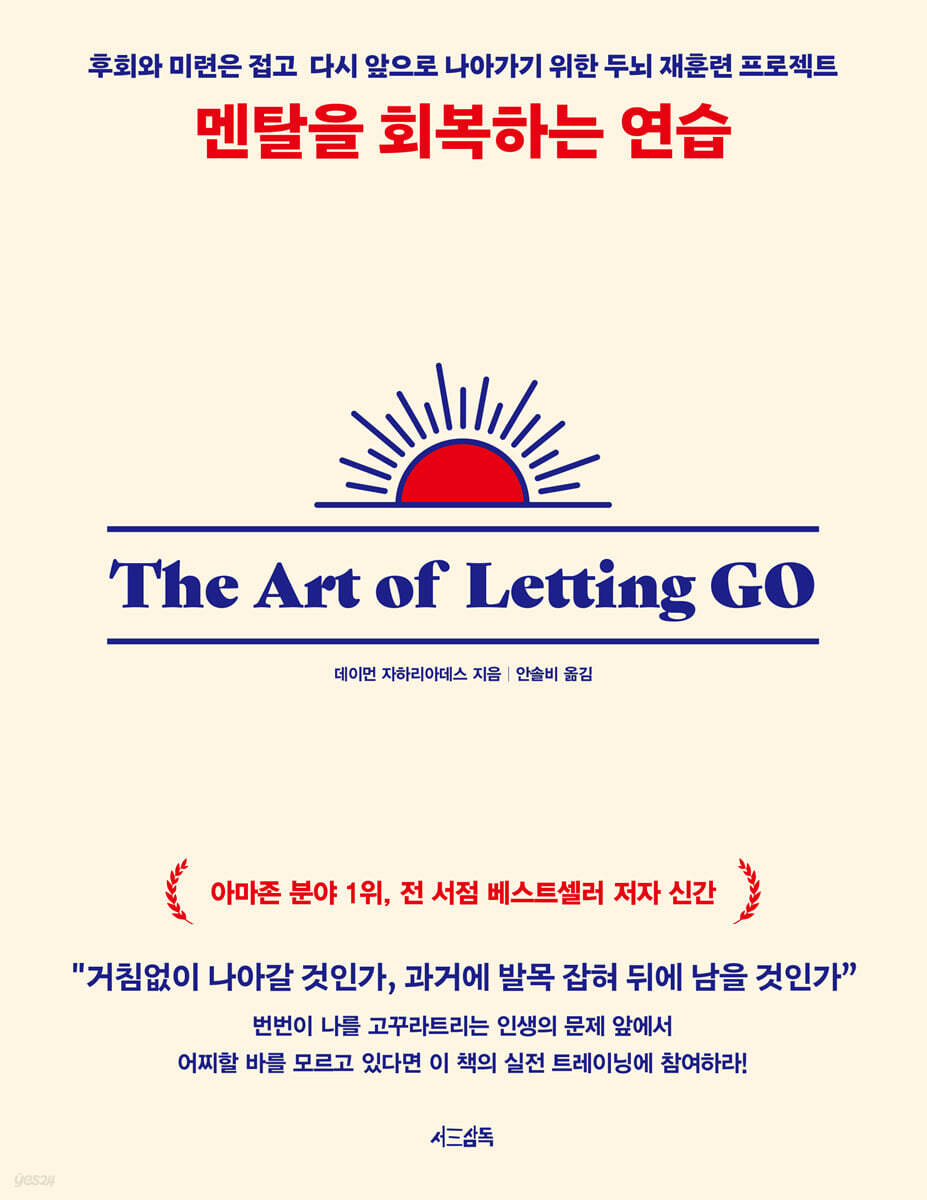
Practice to restore mental health
 |
Description
Book Introduction
- A word from MD
-
Change in life begins with mental recovery!This book was written by Damon Zachariades, the author of his previous work, "Mental Strength Training," for people who have been shattered and broken and have no mental strength left.
As the first step to mental recovery, it presents twenty-one strategies to break free from the past through 'letting go', solve problems, and move forward into a changed life.
September 8, 2023. Self-Development PD Kim Sang-geun
Damon Zachariades, author of the #1 Amazon and bestselling Mental Strength: The Art of Mental Strength, reveals how to rebuild a shattered and fragmented mentality.
Failure in job search or job change, interpersonal relationship problems, crisis and conflict at work.
Past failures and losses, such as investment failures or the separation from a loved one, are difficult to overcome.
It's fortunate if it ends with just a day or two or a month or two of heartache, but it can also completely destroy your mentality and leave you unable to do anything.
Some people are stuck in the past for decades, or even their entire lives, unable to move forward even a single step.
This book proposes an active form of 'letting go' as a way to break free from a painful past.
Letting go helps me face my attachments and negative emotions toward the past, forgive myself, and boldly let go.
In particular, it concisely explains systematic strategies for letting go and provides practical training so that readers can practice and solve their own problems.
It is a hot topic on Amazon in the US, receiving rave reviews such as “This book saved my drifting life” and “I realized that just one book can change your life.”
Failure in job search or job change, interpersonal relationship problems, crisis and conflict at work.
Past failures and losses, such as investment failures or the separation from a loved one, are difficult to overcome.
It's fortunate if it ends with just a day or two or a month or two of heartache, but it can also completely destroy your mentality and leave you unable to do anything.
Some people are stuck in the past for decades, or even their entire lives, unable to move forward even a single step.
This book proposes an active form of 'letting go' as a way to break free from a painful past.
Letting go helps me face my attachments and negative emotions toward the past, forgive myself, and boldly let go.
In particular, it concisely explains systematic strategies for letting go and provides practical training so that readers can practice and solve their own problems.
It is a hot topic on Amazon in the US, receiving rave reviews such as “This book saved my drifting life” and “I realized that just one book can change your life.”
- You can preview some of the book's contents.
Preview
index
Entering
PART 1.
What it means to restore a broken mentality
Why Mental Recovery Begins with Letting Go
-Signs that it's time to come to your senses and take care of your mental health
-Regret and Folly, Letting Go of the Past and What We Gain
Twenty Problems You Must Let Go of
PART 2.
Bad thoughts that keep you from letting go of your painful past
-I'm so afraid of change
-There may be a chance to correct it.
-I've already invested too much, so I can't give it up.
-All the problems happened 'because of me'
-I don't want to admit that I'm wrong.
-After it's over, only the good things come to mind.
-I can't let go of my past self.
-Already addicted to negative emotions and thoughts
-This experience may be useful in the future.
PART 3.
Twenty-one strategies to break free from the past that holds you back and move forward without hesitation.
Strategy 1: Declare that starting today, you will let go of the past.
Strategy 2: Understand the extent to which emotions influence you.
Strategy 3: Find an outlet for negative emotions and change your mood.
Strategy 4: Make sure your needs are being met.
Strategy 5: Find Your Life Purpose
Strategy 6: Acknowledge that you are in so much pain right now.
Strategy 7: Finding Future Insights in Regret
Strategy 8: Acknowledge that your ideal self is just an illusion.
Strategy 9: Swallow Your Pride and Embrace Human Imperfection
Strategy 10: Acknowledge that guilt and shame don't help.
Strategy 11: Don't care what others think.
Strategy 12: Don't try to make everyone happy.
Strategy 13: Let go of the compulsion to be happy.
Strategy 14: Check for Problems in the Decision-Making Process
Strategy 15: Make sure you're not stuck in a swamp of laziness.
Strategy 16: Keep a gratitude journal, even if it's just one line.
Strategy 17: Stop blaming others and focus on solving problems.
Strategy 18: Accept that you can't control everything.
Strategy 19: Don't score your relationships.
Strategy 20: Avoid unnecessary commitments.
Strategy 21: Learn to forgive others and yourself.
-Bonus Strategy 1: I think it's a process of becoming mentally stronger.
Bonus Strategy 2: Accepting Reality Even When Expectations Are Unmet
Bonus Strategy 3: Ask your inner critic, “Is that true?”
Coming out
PART 1.
What it means to restore a broken mentality
Why Mental Recovery Begins with Letting Go
-Signs that it's time to come to your senses and take care of your mental health
-Regret and Folly, Letting Go of the Past and What We Gain
Twenty Problems You Must Let Go of
PART 2.
Bad thoughts that keep you from letting go of your painful past
-I'm so afraid of change
-There may be a chance to correct it.
-I've already invested too much, so I can't give it up.
-All the problems happened 'because of me'
-I don't want to admit that I'm wrong.
-After it's over, only the good things come to mind.
-I can't let go of my past self.
-Already addicted to negative emotions and thoughts
-This experience may be useful in the future.
PART 3.
Twenty-one strategies to break free from the past that holds you back and move forward without hesitation.
Strategy 1: Declare that starting today, you will let go of the past.
Strategy 2: Understand the extent to which emotions influence you.
Strategy 3: Find an outlet for negative emotions and change your mood.
Strategy 4: Make sure your needs are being met.
Strategy 5: Find Your Life Purpose
Strategy 6: Acknowledge that you are in so much pain right now.
Strategy 7: Finding Future Insights in Regret
Strategy 8: Acknowledge that your ideal self is just an illusion.
Strategy 9: Swallow Your Pride and Embrace Human Imperfection
Strategy 10: Acknowledge that guilt and shame don't help.
Strategy 11: Don't care what others think.
Strategy 12: Don't try to make everyone happy.
Strategy 13: Let go of the compulsion to be happy.
Strategy 14: Check for Problems in the Decision-Making Process
Strategy 15: Make sure you're not stuck in a swamp of laziness.
Strategy 16: Keep a gratitude journal, even if it's just one line.
Strategy 17: Stop blaming others and focus on solving problems.
Strategy 18: Accept that you can't control everything.
Strategy 19: Don't score your relationships.
Strategy 20: Avoid unnecessary commitments.
Strategy 21: Learn to forgive others and yourself.
-Bonus Strategy 1: I think it's a process of becoming mentally stronger.
Bonus Strategy 2: Accepting Reality Even When Expectations Are Unmet
Bonus Strategy 3: Ask your inner critic, “Is that true?”
Coming out
Detailed image

Into the book
Negative thoughts and emotions have a negative impact on your mindset, health, and relationships.
It prevents us from doing our best in everything, distorts our thinking, and causes us to hesitate when we should be running towards what we want.
A hopeless and defeatist attitude becomes a stumbling block on the path to happiness and success, lowering the quality of life.
That's why the first step toward mental recovery is to let go of the frustrations, regrets, and painful memories that weigh on your mind.
By breaking free from the chains that hold us back, we can experience emotional freedom.
---From "Entering, p.6"
'Letting go' or 'letting go' is sometimes misunderstood as avoiding uncomfortable feelings.
This is because it can be confused with not accepting negative thoughts and feelings and just giving up on them.
But this is not letting go.
Rather, it is a dangerous and unhealthy attitude that leads to a state of endless apathy.
This is because by ignoring uncomfortable feelings, we end up going beyond a state of emotionlessness and embracing a cold attitude.
On the surface, you may appear strong and well-off, but in reality, you are just barely holding on by piecing together a shattered mentality.
---From "Why Mental Recovery Begins with Letting Go, p.23"
If you can't recall the last time you were happy, you might be dwelling on a painful memory, a heartbreaking loss, or a choice you regret because of misplaced expectations.
With all your attention focused on the past, the little joys you can enjoy during the day may have faded.
If these feelings are left unaddressed, they can lead to depression or emotional and social isolation.
---From "Signs that it's time to come to your senses and take care of your mental health, p.30"
The more you dwell on choices or actions that you regret, the more afraid you become of repeating the same actions.
The problem is that as fear grows, it can become so severe that you can't make even the smallest decisions or take even a single step.
When we stop dwelling on past mistakes that are tormenting us, we can begin to rationally judge the consequences of our actions.
In most cases, the results are not as significant as we imagine.
Once you realize this, you can act more boldly in the future.
---From "Letting Go of Regret and Folly, What We Gain by Leaving the Past, p.35"
Failed relationships are hard to accept and forget.
We instinctively brood over failed relationships and try to pinpoint the reasons why they broke up.
Sometimes I blame myself.
Even though we tried everything possible to repair the relationship before making the decision to break up.
It's natural to have feelings for an ex, at least for a little while.
But in order to move on with life, you have to be able to let go of that relationship at some point.
---From "Twenty Problems You Must Let Go of, p.41"
People with low self-esteem are more likely to blame themselves for their business failures.
Focusing only on one's own bad choices without considering the influence of external factors.
If this happens, even though there are certainly lessons to be learned from the failure of a business, it cannot serve as a stepping stone for future success.
It is just proof of one's own lack of ability.
---From "All problems happened 'because of me', p.73"
Let's take an example of a situation where you feel angry because of a failed investment.
This anger is not an emotion isolated from the outside world.
It has a ripple effect, extending its influence to other areas of life.
Become an irritable person at work or take out your temper on your family.
He doesn't hide his irritable attitude even to strangers.
There is no room to smile at anyone.
You need to understand how distressing emotions affect your broader emotional state and how they influence your judgment of situations.
---「Strategy 2.
Understanding the extent of the influence of emotions, p.101
When we feel completely mentally broken and miserable because we can't let go of our obsession with something, we often isolate ourselves and wallow in pain.
The human brain becomes fixated on the cause of the painful emotion and ignores other activities.
In this state of mind, it is impossible to think of any other activities that bring joy.
That's when you need to immediately put enjoyable activities into practice.
If going to the park and people-watching is relaxing for you, you should get out, even if you're feeling depressed and don't feel like going to the park right now.
---「Strategy 3.
Find an outlet for negative emotions and change your mood, p.107
If you don't know your purpose in life, life becomes boring, empty, and anxious.
We even feel despair and listen to the false and harmful voice of our mind that says, “I lack agency.”
In other words, if you lack a sense of purpose, you become more fixated on the past.
The future seems arbitrary and meaningless, making the past seem far more important.
---「Strategy 5.
From "Finding the Purpose of My Life, p.116"
Why do you regret this matter? What actions of yours led to this regret? This question serves two purposes.
The first is to distinguish between issues we can control and those we cannot.
If it was a problem beyond our control, there's no reason to blame ourselves.
Second, if it was a problem we had control over, we can admit our mistakes.
This is an important step toward enlightenment through regret.
---From "Strategy 7: Finding Insights for the Future in Regret, p. 128"
The constant effort to please everyone only leaves us with suffering.
I lose myself in protecting their priorities.
I spend so much energy trying to fulfill other people's needs and wants that I can't think about what I truly want or how to be happy.
---「Strategy 12.
From “I don’t try to make everyone happy”, p.152
We want our lives to be predictable, but in reality, life is often random.
Bad things happen regardless of our choices or actions.
You may suddenly become ill, a loved one may pass away, or a seemingly healthy job may go bankrupt.
If we want to be free from the burden of negative thoughts and emotions, and thus regain our mental health, we must accept that we inherently lack control.
You can control your choices and thoughts.
(Omitted) However, we have only limited control over the environment, other people's actions, and events that are unfavorable to us.
---「Strategy 18.
“I admit that I can’t control everything,” p.184
Forgiving yourself has never been easier.
The reason it's hard to overlook your own mistakes is because deep down you believe, "I have to be perfect."
We set unreasonably high standards for ourselves.
It leaves no room for mistakes.
They don't allow themselves to be forgiven for their mistakes because they think it makes them weak.
But self-reproach doesn't make us stronger.
It just keeps attacking your self-esteem to the point where you feel like there's nothing you can do right.
It prevents us from doing our best in everything, distorts our thinking, and causes us to hesitate when we should be running towards what we want.
A hopeless and defeatist attitude becomes a stumbling block on the path to happiness and success, lowering the quality of life.
That's why the first step toward mental recovery is to let go of the frustrations, regrets, and painful memories that weigh on your mind.
By breaking free from the chains that hold us back, we can experience emotional freedom.
---From "Entering, p.6"
'Letting go' or 'letting go' is sometimes misunderstood as avoiding uncomfortable feelings.
This is because it can be confused with not accepting negative thoughts and feelings and just giving up on them.
But this is not letting go.
Rather, it is a dangerous and unhealthy attitude that leads to a state of endless apathy.
This is because by ignoring uncomfortable feelings, we end up going beyond a state of emotionlessness and embracing a cold attitude.
On the surface, you may appear strong and well-off, but in reality, you are just barely holding on by piecing together a shattered mentality.
---From "Why Mental Recovery Begins with Letting Go, p.23"
If you can't recall the last time you were happy, you might be dwelling on a painful memory, a heartbreaking loss, or a choice you regret because of misplaced expectations.
With all your attention focused on the past, the little joys you can enjoy during the day may have faded.
If these feelings are left unaddressed, they can lead to depression or emotional and social isolation.
---From "Signs that it's time to come to your senses and take care of your mental health, p.30"
The more you dwell on choices or actions that you regret, the more afraid you become of repeating the same actions.
The problem is that as fear grows, it can become so severe that you can't make even the smallest decisions or take even a single step.
When we stop dwelling on past mistakes that are tormenting us, we can begin to rationally judge the consequences of our actions.
In most cases, the results are not as significant as we imagine.
Once you realize this, you can act more boldly in the future.
---From "Letting Go of Regret and Folly, What We Gain by Leaving the Past, p.35"
Failed relationships are hard to accept and forget.
We instinctively brood over failed relationships and try to pinpoint the reasons why they broke up.
Sometimes I blame myself.
Even though we tried everything possible to repair the relationship before making the decision to break up.
It's natural to have feelings for an ex, at least for a little while.
But in order to move on with life, you have to be able to let go of that relationship at some point.
---From "Twenty Problems You Must Let Go of, p.41"
People with low self-esteem are more likely to blame themselves for their business failures.
Focusing only on one's own bad choices without considering the influence of external factors.
If this happens, even though there are certainly lessons to be learned from the failure of a business, it cannot serve as a stepping stone for future success.
It is just proof of one's own lack of ability.
---From "All problems happened 'because of me', p.73"
Let's take an example of a situation where you feel angry because of a failed investment.
This anger is not an emotion isolated from the outside world.
It has a ripple effect, extending its influence to other areas of life.
Become an irritable person at work or take out your temper on your family.
He doesn't hide his irritable attitude even to strangers.
There is no room to smile at anyone.
You need to understand how distressing emotions affect your broader emotional state and how they influence your judgment of situations.
---「Strategy 2.
Understanding the extent of the influence of emotions, p.101
When we feel completely mentally broken and miserable because we can't let go of our obsession with something, we often isolate ourselves and wallow in pain.
The human brain becomes fixated on the cause of the painful emotion and ignores other activities.
In this state of mind, it is impossible to think of any other activities that bring joy.
That's when you need to immediately put enjoyable activities into practice.
If going to the park and people-watching is relaxing for you, you should get out, even if you're feeling depressed and don't feel like going to the park right now.
---「Strategy 3.
Find an outlet for negative emotions and change your mood, p.107
If you don't know your purpose in life, life becomes boring, empty, and anxious.
We even feel despair and listen to the false and harmful voice of our mind that says, “I lack agency.”
In other words, if you lack a sense of purpose, you become more fixated on the past.
The future seems arbitrary and meaningless, making the past seem far more important.
---「Strategy 5.
From "Finding the Purpose of My Life, p.116"
Why do you regret this matter? What actions of yours led to this regret? This question serves two purposes.
The first is to distinguish between issues we can control and those we cannot.
If it was a problem beyond our control, there's no reason to blame ourselves.
Second, if it was a problem we had control over, we can admit our mistakes.
This is an important step toward enlightenment through regret.
---From "Strategy 7: Finding Insights for the Future in Regret, p. 128"
The constant effort to please everyone only leaves us with suffering.
I lose myself in protecting their priorities.
I spend so much energy trying to fulfill other people's needs and wants that I can't think about what I truly want or how to be happy.
---「Strategy 12.
From “I don’t try to make everyone happy”, p.152
We want our lives to be predictable, but in reality, life is often random.
Bad things happen regardless of our choices or actions.
You may suddenly become ill, a loved one may pass away, or a seemingly healthy job may go bankrupt.
If we want to be free from the burden of negative thoughts and emotions, and thus regain our mental health, we must accept that we inherently lack control.
You can control your choices and thoughts.
(Omitted) However, we have only limited control over the environment, other people's actions, and events that are unfavorable to us.
---「Strategy 18.
“I admit that I can’t control everything,” p.184
Forgiving yourself has never been easier.
The reason it's hard to overlook your own mistakes is because deep down you believe, "I have to be perfect."
We set unreasonably high standards for ourselves.
It leaves no room for mistakes.
They don't allow themselves to be forgiven for their mistakes because they think it makes them weak.
But self-reproach doesn't make us stronger.
It just keeps attacking your self-esteem to the point where you feel like there's nothing you can do right.
---「Strategy 21.
From "Learning to forgive others as well as myself, p.202"
From "Learning to forgive others as well as myself, p.202"
Publisher's Review
★ ★ ★ #1 on Amazon, bestseller in all bookstores ★ ★ ★
★ ★ ★ New book from the author of "Mental Strengthening Practice"! ★ ★ ★
“Should we move forward without hesitation,
“Will we be left behind, caught in the past?”
Faced with life's problems that constantly make me cringe
If you don't know what to do
Join the practical training in this book!
“My mentality was completely shattered.
“What on earth do I do when I don’t even know where to start or what to do?”
In 2020, Damon Zachariades' book, "The Mental Strength Practicum," achieved tremendous success, reaching number one on Amazon.
Letters poured in from readers across the United States and around the world, sharing their thoughts on the book and sharing their own stories.
However, the question that commonly appears is, “What should I do when my mental strength is not strong enough, but rather completely shattered and I can’t do anything?”
Yes, that's right.
There were people who were so deeply hurt that they could not let go of their past regrets and attachments, and were in a situation where they could not move forward even a single step.
Damon Zachariades, who realized that he was teaching a person who had a broken leg and could not even walk how to run fast, later wrote "The Practice of Mental Healing" on the topic of "how to rebuild a shattered and fragmented mentality."
He suggests that the first step toward recovery is to actively let go of the painful past that is holding you back.
Letting go is a state of being free from attachment to sadness, suffering, and negative thoughts.
Damon Zahariades offers practical advice, tips, and hands-on training to help readers let go of long-ingrained attachments and transform their lives.
This book is garnering much attention, with praise such as, “This book saved my life when it was drifting away,” and “I am currently receiving psychotherapy, and this book was even more helpful.”
“Will you fall every time, or will you overcome this time?
You can decide.
“As life flows, so must we.”
A brain retraining project to let go of regret and lingering attachments and move forward again.
It's natural to dwell on the past.
We fondly recall good times, reliving joy and happiness; we recall difficult times, reliving sadness, anger, or loneliness.
Gain insight from the past and use that insight in the present or future.
That's why we often say, "Learn from the past."
But the problem is that it's easy to get stuck in the past.
Painful memories and the negative emotions they bring torment us and hold us back, so that rather than learning from the past and growing, we are oppressed by it and unable to move forward.
It's like thinking, "I'm a failure no matter what I do" because of a single experience of failure, or thinking, "I guess I'm not a person who can be loved by anyone" after a love affair ends.
If you find yourself constantly stumbling over the same issues, or if you find yourself hesitating because of past events when you should be striving for what you want, or if you find yourself overwhelmed by deep hurts that make it difficult to move on, it's time to let go of the past and move forward.
Only then can we focus on the present and live faithfully.
Everyone has one or two past wounds that they still haven't overcome.
Even though I feel mentally broken and in so much pain, I can't show it to anyone and just pretend that everything is fine and that nothing is wrong.
But deep down, you're not okay, and you long to break free from this agonizing past and start over. For those of you who want to shake it off and start anew, "Practice for Mental Recovery" will serve as an excellent guide.
We are going through the worst time ever with the endless recession.
A book that changed the lives of readers across America
The rave reviews from Amazon readers continue!
Most people have been trained for so long to become obsessed with something that they don't even realize it, so it's not easy to let go.
“Letting go is a very difficult battle that requires restructuring your mindset,” says Damon Zachariades, author of the book.
But only in this way can one fundamentally restore one's shattered mentality.
“If I had thought that mental recovery meant going on a trip to refresh my spirit or meeting friends to hear encouraging words, I would not have written this book,” he says firmly.
And, while 'letting go' can feel somewhat vague and abstract, we explain it in the most understandable and concise way possible, providing immediately applicable advice, practical tips, and hands-on training.
In particular, Damon Zachariades' trademark practical training helps readers apply the concepts explained in each article to their own lives and solve problems on their own.
This book dramatically changes the lives of readers in the United States, which is going through the worst time ever due to the endless economic recession following the coronavirus epidemic. “Honestly, it is not easy to change my life by reading a book.
But this book made it possible,” “I love Damon’s books so much that I bought all of them, and this is the best!” are some of the compliments.
You too have now been given the opportunity to change your life.
"Practice for Mental Restoration" will help you face past regrets, attachments, and negative emotions, and forgive yourself to become more resilient and stronger mentally.
I hope that through this book, you will enjoy all the happiness you deserve and move forward without hesitation.
★ ★ ★ New book from the author of "Mental Strengthening Practice"! ★ ★ ★
“Should we move forward without hesitation,
“Will we be left behind, caught in the past?”
Faced with life's problems that constantly make me cringe
If you don't know what to do
Join the practical training in this book!
“My mentality was completely shattered.
“What on earth do I do when I don’t even know where to start or what to do?”
In 2020, Damon Zachariades' book, "The Mental Strength Practicum," achieved tremendous success, reaching number one on Amazon.
Letters poured in from readers across the United States and around the world, sharing their thoughts on the book and sharing their own stories.
However, the question that commonly appears is, “What should I do when my mental strength is not strong enough, but rather completely shattered and I can’t do anything?”
Yes, that's right.
There were people who were so deeply hurt that they could not let go of their past regrets and attachments, and were in a situation where they could not move forward even a single step.
Damon Zachariades, who realized that he was teaching a person who had a broken leg and could not even walk how to run fast, later wrote "The Practice of Mental Healing" on the topic of "how to rebuild a shattered and fragmented mentality."
He suggests that the first step toward recovery is to actively let go of the painful past that is holding you back.
Letting go is a state of being free from attachment to sadness, suffering, and negative thoughts.
Damon Zahariades offers practical advice, tips, and hands-on training to help readers let go of long-ingrained attachments and transform their lives.
This book is garnering much attention, with praise such as, “This book saved my life when it was drifting away,” and “I am currently receiving psychotherapy, and this book was even more helpful.”
“Will you fall every time, or will you overcome this time?
You can decide.
“As life flows, so must we.”
A brain retraining project to let go of regret and lingering attachments and move forward again.
It's natural to dwell on the past.
We fondly recall good times, reliving joy and happiness; we recall difficult times, reliving sadness, anger, or loneliness.
Gain insight from the past and use that insight in the present or future.
That's why we often say, "Learn from the past."
But the problem is that it's easy to get stuck in the past.
Painful memories and the negative emotions they bring torment us and hold us back, so that rather than learning from the past and growing, we are oppressed by it and unable to move forward.
It's like thinking, "I'm a failure no matter what I do" because of a single experience of failure, or thinking, "I guess I'm not a person who can be loved by anyone" after a love affair ends.
If you find yourself constantly stumbling over the same issues, or if you find yourself hesitating because of past events when you should be striving for what you want, or if you find yourself overwhelmed by deep hurts that make it difficult to move on, it's time to let go of the past and move forward.
Only then can we focus on the present and live faithfully.
Everyone has one or two past wounds that they still haven't overcome.
Even though I feel mentally broken and in so much pain, I can't show it to anyone and just pretend that everything is fine and that nothing is wrong.
But deep down, you're not okay, and you long to break free from this agonizing past and start over. For those of you who want to shake it off and start anew, "Practice for Mental Recovery" will serve as an excellent guide.
We are going through the worst time ever with the endless recession.
A book that changed the lives of readers across America
The rave reviews from Amazon readers continue!
Most people have been trained for so long to become obsessed with something that they don't even realize it, so it's not easy to let go.
“Letting go is a very difficult battle that requires restructuring your mindset,” says Damon Zachariades, author of the book.
But only in this way can one fundamentally restore one's shattered mentality.
“If I had thought that mental recovery meant going on a trip to refresh my spirit or meeting friends to hear encouraging words, I would not have written this book,” he says firmly.
And, while 'letting go' can feel somewhat vague and abstract, we explain it in the most understandable and concise way possible, providing immediately applicable advice, practical tips, and hands-on training.
In particular, Damon Zachariades' trademark practical training helps readers apply the concepts explained in each article to their own lives and solve problems on their own.
This book dramatically changes the lives of readers in the United States, which is going through the worst time ever due to the endless economic recession following the coronavirus epidemic. “Honestly, it is not easy to change my life by reading a book.
But this book made it possible,” “I love Damon’s books so much that I bought all of them, and this is the best!” are some of the compliments.
You too have now been given the opportunity to change your life.
"Practice for Mental Restoration" will help you face past regrets, attachments, and negative emotions, and forgive yourself to become more resilient and stronger mentally.
I hope that through this book, you will enjoy all the happiness you deserve and move forward without hesitation.
GOODS SPECIFICS
- Date of issue: September 4, 2023
- Page count, weight, size: 224 pages | 436g | 170*220*13mm
- ISBN13: 9791165348120
- ISBN10: 1165348128
You may also like
카테고리
korean


korean

![ELLE 엘르 스페셜 에디션 A형 : 12월 [2025]](http://librairie.coreenne.fr/cdn/shop/files/b8e27a3de6c9538896439686c6b0e8fb.jpg?v=1766436872&width=3840)


