

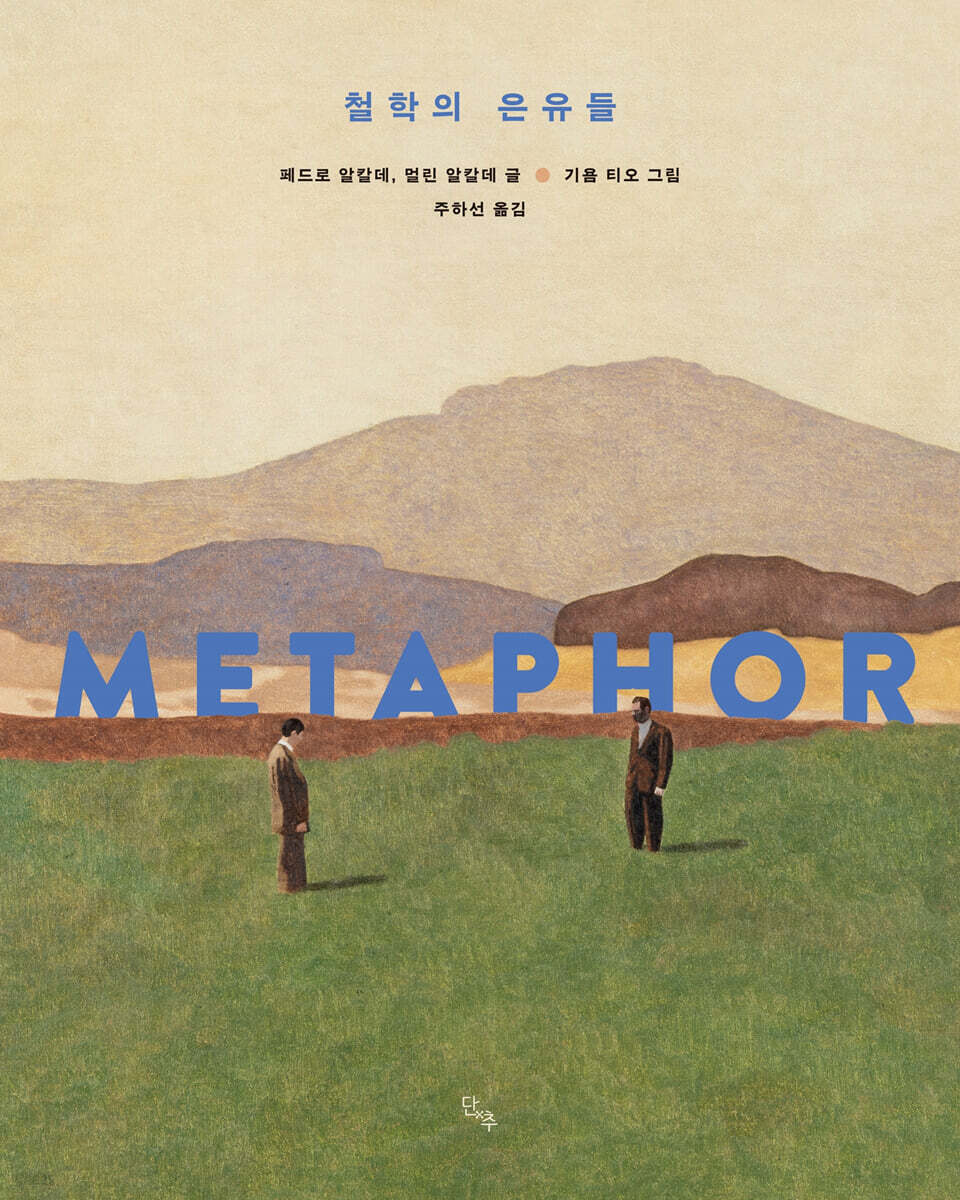
Metaphors of Philosophy
 |
Description
Book Introduction
- A word from MD
-
A beautiful and sublime philosophical picture bookFrom Heraclitus, who said you can't step into the same river twice, to Zygmunt Bauman, who proposed the concept of liquid modernity, the history of world philosophy is expressed in 24 pictures.
The clear explanation of concepts and sublime illustrations are the best.
A masterpiece that will satisfy everyone, from beginners to advanced readers familiar with philosophical thought.
January 10, 2025. Humanities PD Son Min-gyu
From Heraclitus's 'River' to Bauman's 'Liquid'
A History of Philosophy Through the Images of 24 Metaphors
A philosophy picture book that visually expresses 24 symbolic metaphors to help readers easily understand philosophical concepts.
Written by Spanish philosopher Pedro and Merlin and illustrated by world-renowned Spanish author Guillaume Tío.
Like Plato's cave, Occam's razor, and Arendt's desert, it guides you on a journey of philosophical thought by interpreting invisible philosophy through metaphorical images.
Philosophy clearly conveys philosophical thoughts and concepts to those unfamiliar with philosophy through its symbols and metaphors, and provides intellectual stimulation and an artistic experience through the paintings of Guillaume Thiao.
A History of Philosophy Through the Images of 24 Metaphors
A philosophy picture book that visually expresses 24 symbolic metaphors to help readers easily understand philosophical concepts.
Written by Spanish philosopher Pedro and Merlin and illustrated by world-renowned Spanish author Guillaume Tío.
Like Plato's cave, Occam's razor, and Arendt's desert, it guides you on a journey of philosophical thought by interpreting invisible philosophy through metaphorical images.
Philosophy clearly conveys philosophical thoughts and concepts to those unfamiliar with philosophy through its symbols and metaphors, and provides intellectual stimulation and an artistic experience through the paintings of Guillaume Thiao.
- You can preview some of the book's contents.
Preview
index
River, Heraclitus
Old, Parmenides
Yin and Yang, Lao Tzu
Cave, Plato
Garden, Epicurus
Marcus Aurelius, the puppet
Mirror, Augustine
Razor, Occam
Travel, Montaigne
Wolf, Hobbes
Light, Diderot
Pigeon, Kant
Owl, Hegel
The Secret, Kierkegaard
Opium, Marx
Sea, Nietzsche
Iceberg, Freud
Play, Wittgenstein
Aura, Benjamin
Desert, Arendt
Rhizome, Deleuze and Guattari
East, side
The Matrix, The Butler
Liquid, Bauman
Timeline
Old, Parmenides
Yin and Yang, Lao Tzu
Cave, Plato
Garden, Epicurus
Marcus Aurelius, the puppet
Mirror, Augustine
Razor, Occam
Travel, Montaigne
Wolf, Hobbes
Light, Diderot
Pigeon, Kant
Owl, Hegel
The Secret, Kierkegaard
Opium, Marx
Sea, Nietzsche
Iceberg, Freud
Play, Wittgenstein
Aura, Benjamin
Desert, Arendt
Rhizome, Deleuze and Guattari
East, side
The Matrix, The Butler
Liquid, Bauman
Timeline
Detailed image

Into the book
Heraclitus' river metaphor is one of the earliest and most important metaphors in Western philosophy that symbolically illustrates the concepts of change and fluidity.
Miletus, a city on the Ionian coast near his hometown of Ephesus, was home to early thinkers such as Thales and Anaximenes.
They focused on elements such as water and air as the fundamental nature of all things, not just metaphorically, and explored the origins of the world beyond myths and legends.
This was the beginning of philosophical thinking.
--- From "Heraclitus"
On February 2, 1839, the Danish philosopher Søren Kierkegaard wrote in his diary:
“I will have to travel the world, following the direction of the secret compass, to find the continent I lack.” We all have our own ‘continent’ that we must discover.
Kierkegaard's 'invitation to travel' guides us into a world of infinite possibilities that are constantly diverging.
There is no 'better way' there.
The journey of life is a process of moving forward step by step without a set goal or clear destination.
What is ultimately important is to realize that you are following your own direction, and that you are moving towards your own “own continent” that you have discovered, rather than following the path set by others.
--- From "Kierkegaard"
He combines theory and practice to overcome injustice, and focuses on rational and practical thinking based on this.
He said.
Philosophers have simply interpreted the world in various ways, and what is needed now is practice to change the world.
Miletus, a city on the Ionian coast near his hometown of Ephesus, was home to early thinkers such as Thales and Anaximenes.
They focused on elements such as water and air as the fundamental nature of all things, not just metaphorically, and explored the origins of the world beyond myths and legends.
This was the beginning of philosophical thinking.
--- From "Heraclitus"
On February 2, 1839, the Danish philosopher Søren Kierkegaard wrote in his diary:
“I will have to travel the world, following the direction of the secret compass, to find the continent I lack.” We all have our own ‘continent’ that we must discover.
Kierkegaard's 'invitation to travel' guides us into a world of infinite possibilities that are constantly diverging.
There is no 'better way' there.
The journey of life is a process of moving forward step by step without a set goal or clear destination.
What is ultimately important is to realize that you are following your own direction, and that you are moving towards your own “own continent” that you have discovered, rather than following the path set by others.
--- From "Kierkegaard"
He combines theory and practice to overcome injustice, and focuses on rational and practical thinking based on this.
He said.
Philosophers have simply interpreted the world in various ways, and what is needed now is practice to change the world.
--- From "Marx"
Publisher's Review
A philosophical journey following 'metaphor'
“We all have our own ‘continent’ that we must discover.”
- Kierkegaard
Heraclitus' river, Plato's cave, Hobbes' wolf, Arendt's desert, Deleuze and Guattari's rhizome...
The essence of philosophers' thoughts sometimes appears in the form of metaphors that transform abstract concepts into sensuous and concrete images.
For example, Hobbes used the metaphor "man is a wolf to man" to describe the violent and selfish nature of humans in the state of nature.
This metaphor encapsulates his philosophy of how humans achieve civilization and order through the social contract.
Likewise, Hegel emphasized that philosophy is completed in response to changes in reality, using the metaphor, "The owl of Minerva begins to fly only when dusk falls."
Philosophy is that the essence of reality can only be understood after history has matured.
Arendt used the metaphor of the "desert" to describe the social devastation that occurs when the relational space between people disappears.
This desert is not just a physical space, but also a symbol of the absence of humanity and a political vacuum.
Philosophical metaphors convey the philosophers' thoughts more vividly by conveying meaning beyond words.
This book explores how 24 leading philosophers from ancient times to the present day conveyed their philosophical insights through their own metaphors.
Metaphors are not simply tools for explaining philosophy.
It is a symbol that encapsulates the way philosophers see and understand the world.
This book provides a guide to understanding the flow of philosophy at a glance by examining the core ideas of each philosopher from the perspective of the metaphors they used.
Now is the time when we need philosophical metaphors the most.
“The garden is our soul, our inner self, which must be watered and tended.”
- Epicurus
The 21st century poses new questions to philosophy.
Contemporary and urgent topics such as climate change, environmental sustainability, gender equality, and post-humanist perspectives demonstrate that philosophy can no longer remain fixed in its thinking.
Philosophy must walk alongside the ever-changing world, engaging in dialogue with science, art, and technology.
Perhaps now is the time for a new philosophical metaphor suited to the times we live in.
Perhaps we are already on the path to finding new metaphors that will transcend the metaphors of the past and broaden the horizons of human thought.
This book goes beyond mere theoretical explanations; it offers a compass of philosophical metaphors to those who don't know where to go and who seek direction in life.
What we need now is our own garden and our own compass.
Through this book, readers will be able to discover their own philosophical symbols and explore the meaning of life within them.
Painting by Guillaume Thio,
Add philosophical depth
Another eye-catching element in this book is the work of Spanish author Guillaume Tío.
Tio is a painter with many fans in Korea for his unique colors and sensibility.
His work combines philosophical thought and sensory experience, posing new questions within us.
This book includes 24 of Tio's works, visually reinterpreting philosophical metaphors.
The dreamy sky, the endless sea, and the desolate desert depict a small, lonely human figure, embodying a sense of humility in the face of nature and a yearning to find direction in life.
Tio's work goes beyond simply providing visual beauty; it serves as a tool to promote philosophical thought.
His work demonstrates that philosophy can be understood not only through text, but also deeply engraved through images and senses.
Tio's paintings allow readers to experience philosophical metaphors sensually, offering new possibilities for expressing philosophical questions in visual language.
Rather than providing answers about where we stand and where we should go, this book poses endless questions and leads us on a journey of thought.
“We all have our own ‘continent’ that we must discover.”
- Kierkegaard
Heraclitus' river, Plato's cave, Hobbes' wolf, Arendt's desert, Deleuze and Guattari's rhizome...
The essence of philosophers' thoughts sometimes appears in the form of metaphors that transform abstract concepts into sensuous and concrete images.
For example, Hobbes used the metaphor "man is a wolf to man" to describe the violent and selfish nature of humans in the state of nature.
This metaphor encapsulates his philosophy of how humans achieve civilization and order through the social contract.
Likewise, Hegel emphasized that philosophy is completed in response to changes in reality, using the metaphor, "The owl of Minerva begins to fly only when dusk falls."
Philosophy is that the essence of reality can only be understood after history has matured.
Arendt used the metaphor of the "desert" to describe the social devastation that occurs when the relational space between people disappears.
This desert is not just a physical space, but also a symbol of the absence of humanity and a political vacuum.
Philosophical metaphors convey the philosophers' thoughts more vividly by conveying meaning beyond words.
This book explores how 24 leading philosophers from ancient times to the present day conveyed their philosophical insights through their own metaphors.
Metaphors are not simply tools for explaining philosophy.
It is a symbol that encapsulates the way philosophers see and understand the world.
This book provides a guide to understanding the flow of philosophy at a glance by examining the core ideas of each philosopher from the perspective of the metaphors they used.
Now is the time when we need philosophical metaphors the most.
“The garden is our soul, our inner self, which must be watered and tended.”
- Epicurus
The 21st century poses new questions to philosophy.
Contemporary and urgent topics such as climate change, environmental sustainability, gender equality, and post-humanist perspectives demonstrate that philosophy can no longer remain fixed in its thinking.
Philosophy must walk alongside the ever-changing world, engaging in dialogue with science, art, and technology.
Perhaps now is the time for a new philosophical metaphor suited to the times we live in.
Perhaps we are already on the path to finding new metaphors that will transcend the metaphors of the past and broaden the horizons of human thought.
This book goes beyond mere theoretical explanations; it offers a compass of philosophical metaphors to those who don't know where to go and who seek direction in life.
What we need now is our own garden and our own compass.
Through this book, readers will be able to discover their own philosophical symbols and explore the meaning of life within them.
Painting by Guillaume Thio,
Add philosophical depth
Another eye-catching element in this book is the work of Spanish author Guillaume Tío.
Tio is a painter with many fans in Korea for his unique colors and sensibility.
His work combines philosophical thought and sensory experience, posing new questions within us.
This book includes 24 of Tio's works, visually reinterpreting philosophical metaphors.
The dreamy sky, the endless sea, and the desolate desert depict a small, lonely human figure, embodying a sense of humility in the face of nature and a yearning to find direction in life.
Tio's work goes beyond simply providing visual beauty; it serves as a tool to promote philosophical thought.
His work demonstrates that philosophy can be understood not only through text, but also deeply engraved through images and senses.
Tio's paintings allow readers to experience philosophical metaphors sensually, offering new possibilities for expressing philosophical questions in visual language.
Rather than providing answers about where we stand and where we should go, this book poses endless questions and leads us on a journey of thought.
GOODS SPECIFICS
- Date of issue: December 6, 2024
- Format: Hardcover book binding method guide
- Page count, weight, size: 60 pages | 690g | 240*300*15mm
- ISBN13: 9791189723361
- ISBN10: 1189723360
You may also like
카테고리
korean


korean

![GQ KOREA Mark (Monthly): December [2025]](http://librairie.coreenne.fr/cdn/shop/files/8ef265dbbfbf186523ed75ba7319009d.jpg?v=1765340328&width=3840)


