

Brain Science of Education
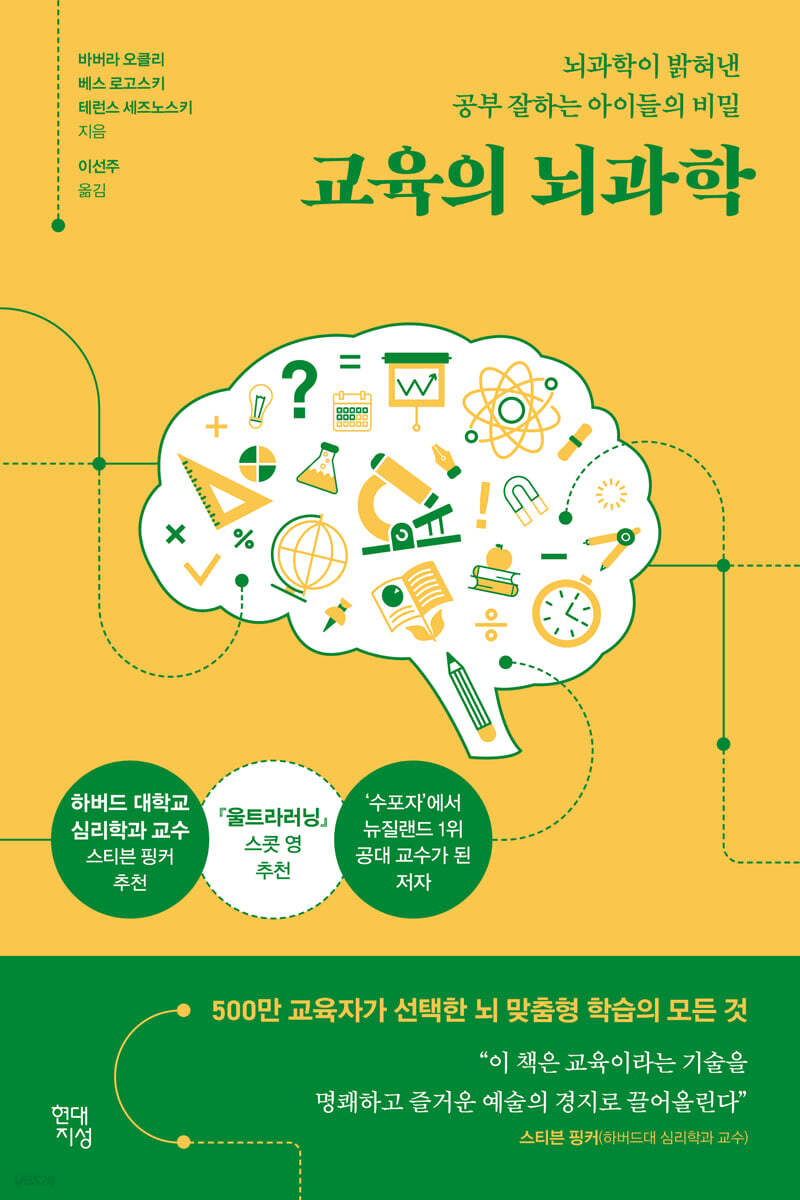 |
Description
Book Introduction
- A word from MD
-
Brain Science You Need to Know Before StudyingHumans are learning beings from birth until death.
This is why you need to have an effective study method.
This book improves study efficiency based on the latest brain science research.
How can I improve my memory? Can I study while listening to music? Is rote learning always bad? Learning about brain science can make studying more enjoyable.
March 14, 2025. Humanities PD Son Min-gyu
“Why are my grades different even though I study the same way?”
The Secret of the "Study-Friendly Brain" Revealed by Neuroscience
* Highly recommended by Harvard University psychology professor Steven Pinker!
* The best learning method chosen by 5 million educators worldwide
The difference in learning ability is not a difference in 'innate intelligence' but a difference in 'how to use the brain'.
Students who study hard but their grades don't improve, students who did well in elementary school but whose grades decline in middle and high school, and students who don't study much but always rank high.
These differences in learning ability stem from differences in how we use our brains, not from our innate intelligence.
According to brain science research, storing new knowledge in the brain's "long-term memory" is key to effective learning.
Three world-renowned scholars, including Barbara Oakley, who went from math dropout to engineering professor, present the optimal learning method based on brain science.
The Secret of the "Study-Friendly Brain" Revealed by Neuroscience
* Highly recommended by Harvard University psychology professor Steven Pinker!
* The best learning method chosen by 5 million educators worldwide
The difference in learning ability is not a difference in 'innate intelligence' but a difference in 'how to use the brain'.
Students who study hard but their grades don't improve, students who did well in elementary school but whose grades decline in middle and high school, and students who don't study much but always rank high.
These differences in learning ability stem from differences in how we use our brains, not from our innate intelligence.
According to brain science research, storing new knowledge in the brain's "long-term memory" is key to effective learning.
Three world-renowned scholars, including Barbara Oakley, who went from math dropout to engineering professor, present the optimal learning method based on brain science.
- You can preview some of the book's contents.
Preview
index
Praise poured in for this book
Introduction: A New Path to Learning Opened by Brain Science
Part 1: The Secrets of Learning Unraveled Through Brain Science
Chapter 1: Why Students Don't Learn Properly
Learning: The process of creating connections between neurons
Learn and Connect
Long-term memory vs.
working memory
Don't trust your working memory
Teaching Tips for Educators ① Mnemonic Learning Method
Teaching Tips for Educators ② Practice Memorizing While Writing
KEY IDEAS
Chapter 2: Working Memory Determines Learning Speed
Working memory has limits
Differences in working memory determine learning ability.
How to Strengthen Working Memory with Long-Term Memory
Differentiated education tailored to each individual's learning pace
Can I listen to music while studying?
Break down the lesson content
Teaching Tips for Educators ① Effective Teaching Strategies for Students with Low Working Memory Capacity
Teaching Tips for Educators ② Note-taking Lesson Tips for Students with Limited Working Memory Capacity
│Class Review│ Pair up and correct
KEY IDEAS
Chapter 3: How to Strengthen the Narrative Path
Misconceptions about active learning
Descriptive Learning Systems: The Fastest Way to Acquire New Information
How to expand long-term memory
Take short breaks during class to give your hippocampus a rest.
Why Crash Studying Doesn't Last
The paradox of good education
The importance of physical exercise
Ideal Active Learning Ratio
Teaching Tips for Educators ① Simple Activities to Help Students Recharge Mentally
Teaching Tips for Educators ② Answering Questions in Order
│Class Review│ Think and discuss in pairs
KEY IDEAS
Part 2: Effective Study Methods Tailored to Brain Development
Chapter 4: Breaking the Habit of Procrastination
Procrastination, your biggest enemy
What Happens in Your Brain When You Procrastinate
Motivational Ways to Break the Procrastination Habit
Teaching Tips for Educators ① Breaking the Habit of Procrastination with the Pomodoro Technique
Teaching Tips for Educators ② How to Break the Habit of Procrastination in the Classroom
│Class Review│ Breaking down difficult assignments into smaller pieces
KEY IDEAS
Chapter 5: Why the Brain's Evolutionary Process is Important for Learning
The lifelong process of brain development
Why You Can Speak Your Native Language Without Learning It
The more difficult the material, the more likely it is to be an educator-led class.
From educator-led classes to student-led classes
Teaching Tips for Educators How to Keep Students Focused
│Class Review│Direct Instruction Method
KEY IDEAS
Chapter 6: How to Get Answers Without Thinking
Narrative path vs.
Procedural path
Start descriptively and end procedurally.
A method of acquiring concepts by gradually increasing the level
The best way to strengthen procedural memory
I don't understand that I can explain it
Blend declarative and procedural learning.
Teaching Tips for Educators ①: Building Schemas Using Graphic Organizers
│Teaching Tips for Educators ②│ Practice insertion, repeat over time, and explain the reason for the lesson.
KEY IDEAS
Part 3: The New Power of Education Discovered by Brain Science
Chapter 7: Creating a Study Atmosphere
Habits that form the power of procedural learning
How to Create a Productive Class Atmosphere
Trigger dopamine with unexpected rewards
How to Deal with Rebellious Students
Teaching Tips for Educators How to Teach Classroom Procedures: Queuing by Number
KEY IDEAS
Chapter 8: The Power of Cooperative Learning to Build Bonds
Learning requires good stress.
Social-emotional learning reduces stress
How to manage stress while developing social skills
│Class Review│ Planning Cooperative Learning
KEY IDEAS
Chapter 9: Secrets of Effective Online Classes
Live online classes vs.
Recorded video classes
Multimedia Learning: You Learn Best When You See and Hear
How to Set Up an Online Class System
Live Online Classes: The Closest Way to In-Person Instruction
Recorded Video Lessons: Interaction is Key
How to Focus in Online Classes
Encouraging student evaluation and participation
Blending live online classes with recorded video lessons
Teaching Tips for Educators ① How to Quickly Adapt to Online Class Platforms
Teaching Tips for Educators ② Watch TV and Videos with a Critical Eye
│Teaching Tips for Educators ③│ Let Students Make Videos
│Class Review│ Creating a Video Lesson
KEY IDEAS
Chapter 10: How to Create a Solid Lesson Plan
Planning a route
Guiding Your Journey: Creating a Class Schedule
At the finish line
The power of education to rewire the brain
Conclusion: Learn and Connect
Appendix A: How Students Protect Themselves During Collaborative Work
Appendix B: Checklist for Educators
Acknowledgements
Americas
References
Introduction: A New Path to Learning Opened by Brain Science
Part 1: The Secrets of Learning Unraveled Through Brain Science
Chapter 1: Why Students Don't Learn Properly
Learning: The process of creating connections between neurons
Learn and Connect
Long-term memory vs.
working memory
Don't trust your working memory
Teaching Tips for Educators ① Mnemonic Learning Method
Teaching Tips for Educators ② Practice Memorizing While Writing
KEY IDEAS
Chapter 2: Working Memory Determines Learning Speed
Working memory has limits
Differences in working memory determine learning ability.
How to Strengthen Working Memory with Long-Term Memory
Differentiated education tailored to each individual's learning pace
Can I listen to music while studying?
Break down the lesson content
Teaching Tips for Educators ① Effective Teaching Strategies for Students with Low Working Memory Capacity
Teaching Tips for Educators ② Note-taking Lesson Tips for Students with Limited Working Memory Capacity
│Class Review│ Pair up and correct
KEY IDEAS
Chapter 3: How to Strengthen the Narrative Path
Misconceptions about active learning
Descriptive Learning Systems: The Fastest Way to Acquire New Information
How to expand long-term memory
Take short breaks during class to give your hippocampus a rest.
Why Crash Studying Doesn't Last
The paradox of good education
The importance of physical exercise
Ideal Active Learning Ratio
Teaching Tips for Educators ① Simple Activities to Help Students Recharge Mentally
Teaching Tips for Educators ② Answering Questions in Order
│Class Review│ Think and discuss in pairs
KEY IDEAS
Part 2: Effective Study Methods Tailored to Brain Development
Chapter 4: Breaking the Habit of Procrastination
Procrastination, your biggest enemy
What Happens in Your Brain When You Procrastinate
Motivational Ways to Break the Procrastination Habit
Teaching Tips for Educators ① Breaking the Habit of Procrastination with the Pomodoro Technique
Teaching Tips for Educators ② How to Break the Habit of Procrastination in the Classroom
│Class Review│ Breaking down difficult assignments into smaller pieces
KEY IDEAS
Chapter 5: Why the Brain's Evolutionary Process is Important for Learning
The lifelong process of brain development
Why You Can Speak Your Native Language Without Learning It
The more difficult the material, the more likely it is to be an educator-led class.
From educator-led classes to student-led classes
Teaching Tips for Educators How to Keep Students Focused
│Class Review│Direct Instruction Method
KEY IDEAS
Chapter 6: How to Get Answers Without Thinking
Narrative path vs.
Procedural path
Start descriptively and end procedurally.
A method of acquiring concepts by gradually increasing the level
The best way to strengthen procedural memory
I don't understand that I can explain it
Blend declarative and procedural learning.
Teaching Tips for Educators ①: Building Schemas Using Graphic Organizers
│Teaching Tips for Educators ②│ Practice insertion, repeat over time, and explain the reason for the lesson.
KEY IDEAS
Part 3: The New Power of Education Discovered by Brain Science
Chapter 7: Creating a Study Atmosphere
Habits that form the power of procedural learning
How to Create a Productive Class Atmosphere
Trigger dopamine with unexpected rewards
How to Deal with Rebellious Students
Teaching Tips for Educators How to Teach Classroom Procedures: Queuing by Number
KEY IDEAS
Chapter 8: The Power of Cooperative Learning to Build Bonds
Learning requires good stress.
Social-emotional learning reduces stress
How to manage stress while developing social skills
│Class Review│ Planning Cooperative Learning
KEY IDEAS
Chapter 9: Secrets of Effective Online Classes
Live online classes vs.
Recorded video classes
Multimedia Learning: You Learn Best When You See and Hear
How to Set Up an Online Class System
Live Online Classes: The Closest Way to In-Person Instruction
Recorded Video Lessons: Interaction is Key
How to Focus in Online Classes
Encouraging student evaluation and participation
Blending live online classes with recorded video lessons
Teaching Tips for Educators ① How to Quickly Adapt to Online Class Platforms
Teaching Tips for Educators ② Watch TV and Videos with a Critical Eye
│Teaching Tips for Educators ③│ Let Students Make Videos
│Class Review│ Creating a Video Lesson
KEY IDEAS
Chapter 10: How to Create a Solid Lesson Plan
Planning a route
Guiding Your Journey: Creating a Class Schedule
At the finish line
The power of education to rewire the brain
Conclusion: Learn and Connect
Appendix A: How Students Protect Themselves During Collaborative Work
Appendix B: Checklist for Educators
Acknowledgements
Americas
References
Detailed image
.jpg)
Into the book
People believe that long-term memory storage capacity is limited, but this is not true.
The brain's information storage capacity is about 1,000 trillion bytes (1,000 trillion is a number with 15 zeros).
(Imagine the combined wealth of one million billionaires.)
This means that the brain can store far more information than all the grains of sand on all the beaches and deserts in the world.
The question is not how much you can store, but how you remember, retrieve, and use the information.
It's similar to having a real-time music streaming app where you can listen to any song.
The key is finding the song you want.
There are a billion seconds in a life, and a hundred trillion synapses in the brain.
If you do the math, that means you have the capacity to use 100,000 synapses per second.
--- From "Chapter 1: Reasons Students Can't Learn Properly"
Students often question how to study.
We often hear advice that we shouldn't listen to music while studying, but some students do get good grades even when they study while enjoying music.
Why do some people achieve good grades while studying while listening to music, while others avoid it altogether? A recent study has solved the mystery.
The effect of music on studying varies depending on working memory capacity.
People with small working memory capacity should avoid listening to music at all while studying.
On the other hand, people with a large working memory capacity can study well even while listening to music.
Because you have a larger working memory capacity, you can concentrate more easily.
However, no student should listen to music while studying math.
This is because the brain areas used in math and music overlap.
By the way, white noise or music seems to be helpful for students with ADHD.
--- From “Chapter 2 Working Memory Determines Learning Speed”
Looking at the relationship between the neocortex and the hippocampus, it is important to take short 'brain breaks' during class to allow for mental rest.
During these quiet mental intermissions, the hippocampus whispers back to the neocortex what it has just learned.
When the hippocampus whispers to the neocortex, it can reinforce the content by repetition, and the hippocampus can also slowly remove the indexical link.
How much brain rest is appropriate? The brain rests for eight hours during sleep at night, and this is when memories are consolidated.
However, most of the preparation takes place during short breaks throughout the day.
One study found that when people closed their eyes and rested for 15 minutes after learning, they remembered what they had just learned much better than when they moved on to the next task without a break.
--- From "Chapter 3: How to Strengthen the Narrative Path"
The most fundamental reason we procrastinate is because thinking about something we don't want to do or don't want to do activates painful emotions in the insular cortex, the part of the brain that processes pain signals.
Procrastinators like Sam deal with this uncomfortable feeling by avoiding it.
It's all about thinking about something else.
Avoidance magically takes away the pain of the moment.
But the work that needs to be done doesn't disappear.
So you end up stressed out all night and pay the price by nodding off during the test.
--- From "Chapter 4: Breaking the Habit of Procrastination"
Babies learn their native language quickly and naturally.
A baby's tiny brain easily absorbs words from its native language without any effort.
Around the age of one, vocabulary learning accelerates through a mapping process that allows children to understand words after hearing them only a few times.
It is estimated that between 20 and 24 months of age, a child's vocabulary triples.
At this time, sentence structure is also learned! Recognizing faces and speaking your native language are called "biological foundational data."
Our brain learns this information naturally.
It's a skill honed by thousands of generations of evolutionary selection, and nerve cells seem to magically connect to each other.
This is because, during the evolutionary process, only babies with nerve cell tissues that could recognize and communicate with people around them survived.
On the other hand, 'biological secondary data' is an ability that was not developed during the evolutionary process.
Skills like reading the news or doing mathematical calculations are essential in modern society, but our brains aren't designed to handle them naturally.
Therefore, acquiring complex skills such as reading, writing, and mathematics, as well as geography, politics, economics, and history, requires a long period of education.
--- From Chapter 5, “Why the Brain’s Evolutionary Process is Important for Studying”
Recent research has shown that procedural systems are important when learning complex concepts and movements, from tying shoelaces to recognizing complex patterns in math to speaking a language quickly and naturally.
We observe and learn about things we encounter on a daily basis through a procedural system.
It's like learning letters in childhood.
The same goes for the mathematical pattern formulas you use when learning how to solve a Rubik's Cube quickly.
When solving a Rubik's Cube, you don't carefully consider each step, but rather move the cube according to a set order.
This information doesn't need to pass through working memory (because this thinking happens unconsciously), allowing you to solve the cube quickly.
However, it may also mean that even if you know how to solve the cube (procedural system), you cannot easily explain it (descriptive system).
--- From "Chapter 6: How to Get Answers Without Thinking"
Students' brains predict what reward they will receive at any given moment.
A reward is something that is perceived positively, whether it is a thing, an action, or an internal feeling.
Students' daily lives are mostly predictable.
So unless something magical like chocolate or a roller coaster appears, the brain just sits idle and carries on as usual.
But when an unexpected reward is given, dopamine is released in several parts of the brain involved in learning.
Not only does this dopamine make you feel good, it also makes it easier for the connections between nerve cells to be strengthened.
--- From "Chapter 7 How to Create a Study Atmosphere"
The reason students concentrate more effectively when they feel nervous while studying for a test than when they study leisurely is because of the neurochemicals released by temporary stress.
The reason why information you studied to present in front of the entire school can remain in your head for years is also due to temporary stress.
Temporary stress causes the brain to release hormones such as adrenaline and cortisol.
When these hormones are secreted in moderation, nerve cells are well connected.
It's similar to how adding oil to a frying pan when baking potatoes prevents the potatoes from sticking to the bottom of the pan.
However, if you are under too much stress, even temporarily, the effect of glucocorticoids, or 'oils', changes.
When stress is excessive, the connections between nerve cells become burned and sticky.
--- From Chapter 8, “The Power of Cooperative Learning to Cultivate a Sense of Unity”
Before getting into the main topic, let's briefly look at multimedia learning theory.
The basic concept is simple.
If you show a picture while explaining it verbally, you can grasp the concept faster than if you only show a picture or explain it verbally.
This is because working memory has both auditory and visual elements (multi-element in multimedia theory).
Using both visual and verbal explanations simultaneously allows students to better utilize their limited working memory.
--- From Chapter 9, "The Secret of Effective Online Classes"
Effective use of pull elements allows teachers to connect what students already know to the core content they are trying to teach.
To get students excited about a math-based physics lesson, focus on space travel, focusing on time, distance, and the challenge of sending astronauts to Mars.
Students are more excited when presented with a compelling challenge they actually have to solve (especially if they dream of becoming astronauts).
The brain's information storage capacity is about 1,000 trillion bytes (1,000 trillion is a number with 15 zeros).
(Imagine the combined wealth of one million billionaires.)
This means that the brain can store far more information than all the grains of sand on all the beaches and deserts in the world.
The question is not how much you can store, but how you remember, retrieve, and use the information.
It's similar to having a real-time music streaming app where you can listen to any song.
The key is finding the song you want.
There are a billion seconds in a life, and a hundred trillion synapses in the brain.
If you do the math, that means you have the capacity to use 100,000 synapses per second.
--- From "Chapter 1: Reasons Students Can't Learn Properly"
Students often question how to study.
We often hear advice that we shouldn't listen to music while studying, but some students do get good grades even when they study while enjoying music.
Why do some people achieve good grades while studying while listening to music, while others avoid it altogether? A recent study has solved the mystery.
The effect of music on studying varies depending on working memory capacity.
People with small working memory capacity should avoid listening to music at all while studying.
On the other hand, people with a large working memory capacity can study well even while listening to music.
Because you have a larger working memory capacity, you can concentrate more easily.
However, no student should listen to music while studying math.
This is because the brain areas used in math and music overlap.
By the way, white noise or music seems to be helpful for students with ADHD.
--- From “Chapter 2 Working Memory Determines Learning Speed”
Looking at the relationship between the neocortex and the hippocampus, it is important to take short 'brain breaks' during class to allow for mental rest.
During these quiet mental intermissions, the hippocampus whispers back to the neocortex what it has just learned.
When the hippocampus whispers to the neocortex, it can reinforce the content by repetition, and the hippocampus can also slowly remove the indexical link.
How much brain rest is appropriate? The brain rests for eight hours during sleep at night, and this is when memories are consolidated.
However, most of the preparation takes place during short breaks throughout the day.
One study found that when people closed their eyes and rested for 15 minutes after learning, they remembered what they had just learned much better than when they moved on to the next task without a break.
--- From "Chapter 3: How to Strengthen the Narrative Path"
The most fundamental reason we procrastinate is because thinking about something we don't want to do or don't want to do activates painful emotions in the insular cortex, the part of the brain that processes pain signals.
Procrastinators like Sam deal with this uncomfortable feeling by avoiding it.
It's all about thinking about something else.
Avoidance magically takes away the pain of the moment.
But the work that needs to be done doesn't disappear.
So you end up stressed out all night and pay the price by nodding off during the test.
--- From "Chapter 4: Breaking the Habit of Procrastination"
Babies learn their native language quickly and naturally.
A baby's tiny brain easily absorbs words from its native language without any effort.
Around the age of one, vocabulary learning accelerates through a mapping process that allows children to understand words after hearing them only a few times.
It is estimated that between 20 and 24 months of age, a child's vocabulary triples.
At this time, sentence structure is also learned! Recognizing faces and speaking your native language are called "biological foundational data."
Our brain learns this information naturally.
It's a skill honed by thousands of generations of evolutionary selection, and nerve cells seem to magically connect to each other.
This is because, during the evolutionary process, only babies with nerve cell tissues that could recognize and communicate with people around them survived.
On the other hand, 'biological secondary data' is an ability that was not developed during the evolutionary process.
Skills like reading the news or doing mathematical calculations are essential in modern society, but our brains aren't designed to handle them naturally.
Therefore, acquiring complex skills such as reading, writing, and mathematics, as well as geography, politics, economics, and history, requires a long period of education.
--- From Chapter 5, “Why the Brain’s Evolutionary Process is Important for Studying”
Recent research has shown that procedural systems are important when learning complex concepts and movements, from tying shoelaces to recognizing complex patterns in math to speaking a language quickly and naturally.
We observe and learn about things we encounter on a daily basis through a procedural system.
It's like learning letters in childhood.
The same goes for the mathematical pattern formulas you use when learning how to solve a Rubik's Cube quickly.
When solving a Rubik's Cube, you don't carefully consider each step, but rather move the cube according to a set order.
This information doesn't need to pass through working memory (because this thinking happens unconsciously), allowing you to solve the cube quickly.
However, it may also mean that even if you know how to solve the cube (procedural system), you cannot easily explain it (descriptive system).
--- From "Chapter 6: How to Get Answers Without Thinking"
Students' brains predict what reward they will receive at any given moment.
A reward is something that is perceived positively, whether it is a thing, an action, or an internal feeling.
Students' daily lives are mostly predictable.
So unless something magical like chocolate or a roller coaster appears, the brain just sits idle and carries on as usual.
But when an unexpected reward is given, dopamine is released in several parts of the brain involved in learning.
Not only does this dopamine make you feel good, it also makes it easier for the connections between nerve cells to be strengthened.
--- From "Chapter 7 How to Create a Study Atmosphere"
The reason students concentrate more effectively when they feel nervous while studying for a test than when they study leisurely is because of the neurochemicals released by temporary stress.
The reason why information you studied to present in front of the entire school can remain in your head for years is also due to temporary stress.
Temporary stress causes the brain to release hormones such as adrenaline and cortisol.
When these hormones are secreted in moderation, nerve cells are well connected.
It's similar to how adding oil to a frying pan when baking potatoes prevents the potatoes from sticking to the bottom of the pan.
However, if you are under too much stress, even temporarily, the effect of glucocorticoids, or 'oils', changes.
When stress is excessive, the connections between nerve cells become burned and sticky.
--- From Chapter 8, “The Power of Cooperative Learning to Cultivate a Sense of Unity”
Before getting into the main topic, let's briefly look at multimedia learning theory.
The basic concept is simple.
If you show a picture while explaining it verbally, you can grasp the concept faster than if you only show a picture or explain it verbally.
This is because working memory has both auditory and visual elements (multi-element in multimedia theory).
Using both visual and verbal explanations simultaneously allows students to better utilize their limited working memory.
--- From Chapter 9, "The Secret of Effective Online Classes"
Effective use of pull elements allows teachers to connect what students already know to the core content they are trying to teach.
To get students excited about a math-based physics lesson, focus on space travel, focusing on time, distance, and the challenge of sending astronauts to Mars.
Students are more excited when presented with a compelling challenge they actually have to solve (especially if they dream of becoming astronauts).
--- From "Chapter 10: How to Create a Solid Lesson Plan"
Publisher's Review
Three World-Renowned Scholars Unveil Their Innovative Learning Methods
ㆍ'Suphobe' → Professor of Engineering at New Zealand's top university
ㆍEducation expert with 14 years of field experience
AI scholar and authority on neural network research
The "Key to Brain Science-Based Learning" They Uncovered
Optimal learning cycle utilizing working memory and long-term memory
ㆍStudents who can study while listening to music vs.
Differences Between Students to Avoid
Why doesn't cramming work? The brain's preferred optimal learning timing.
Scientific learning strategies for students with ADHD
How to get the most out of online classes
I recommend this to these people
Parents who are concerned about improving their children's learning ability
Current teachers looking for more effective teaching methods
Instructors and educators who struggle to improve students' grades
Adult learners looking for effective learning methods
Educational researchers who want to learn about scientific educational methods based on brain science
There is a study method that the brain likes!
The Secret of Kids Who Study Less and Get High Grades
When you study, it seems like you already know everything, but when you actually get the test paper, your mind goes blank.
Even if you think you understand a book well when you read it, when you close it, nothing remains.
It's not because I'm stupid.
Because I studied without knowing how my brain accepts new knowledge.
"The Brain Science of Education" details the process by which the brain learns new knowledge and explains how to utilize the brain's best pathways for receiving knowledge.
Barbara Oakley, who was a 'low achiever' in her school days but is now a professor of engineering at the University of Auckland, New Zealand's top university; Beth Rogowski, who has 14 years of field teaching experience and theory; and Terence Sejnowski, a world-renowned neural network researcher, introduce a study method that anyone can use to achieve optimal learning results through this book.
We have compiled into one volume the teaching method lectures that have recorded 5 million views on Coursera, the world's leading massive open online course (MOOC) site.
We provide brain-tailored learning methods that are most effective for teachers, parents, and anyone who guides students in both the classroom and home.
Why do grades drop as you advance in grade level?
Use your brain's lifelong storage, your long-term memory!
Unlike our native language, which even newborns can easily learn, why is it so difficult to acquire math or science knowledge without expert assistance? The answer lies in the evolution of our brains.
Unlike communication skills, which were essential for survival, reading and math are skills that must be learned later in life.
The brain processes new knowledge in 'working memory' and then stores it in 'long-term memory'.
Students who get good grades even after cramming overnight tend to have a naturally large working memory capacity.
However, if these students are unable to store knowledge in long-term memory, their grades will decline as they advance in grade level.
The key to effective learning is how well you transfer information from working memory to long-term memory.
The authors suggest 'retrieval practice' as the optimal method for this.
Learning is generally thought of as the process of 'putting' knowledge into the head, but from a neuroscience perspective, practicing 'retrieving' what has been learned is actually more effective in strengthening memory.
Combining 'embedding' and 'time-lapse repetition learning' here is even more effective.
Interleaving is a method of solving problems on different topics by mixing them, and staggered repetition is a method of gradually increasing the learning interval.
It also teaches you how to overcome the habit of procrastination, which is the biggest obstacle to learning.
This includes the 'task breakdown' teaching method, which prevents procrastination by checking tasks step by step, and the 'Pomodoro Technique', which learners can practice.
It also presents practical learning strategies, ranging from efficient note-taking techniques for students with limited working memory capacity who find it difficult to learn, to specific learning methods that expand long-term memory and increase learning speed.
Capturing the rapidly changing educational landscape
The Art of Learning Revealed by Brain Science
Today's educational environment is undergoing rapid change. Distractions like social media have increased, and the pandemic has made online classes the norm.
Watching educational videos and using educational apps have also become essential.
Teachers and parents are confused by this completely different environment from their school days.
It is not easy to give students appropriate advice or set the right guidance direction.
"Brain Science of Education" thoroughly analyzes the latest changes in the educational field and provides optimal student guidance techniques based on brain science.
For example, if you organize and utilize online classes effectively, they can be just as effective as face-to-face classes.
Appropriate use of various learning apps can simultaneously increase students' interest and learning effectiveness.
You can make a study plan and maintain it for a long time so that it doesn't end after three days.
It will be the best solution not only for teachers and parents looking for effective study methods for students, but also for adult learners who want to start studying on their own.
ㆍ'Suphobe' → Professor of Engineering at New Zealand's top university
ㆍEducation expert with 14 years of field experience
AI scholar and authority on neural network research
The "Key to Brain Science-Based Learning" They Uncovered
Optimal learning cycle utilizing working memory and long-term memory
ㆍStudents who can study while listening to music vs.
Differences Between Students to Avoid
Why doesn't cramming work? The brain's preferred optimal learning timing.
Scientific learning strategies for students with ADHD
How to get the most out of online classes
I recommend this to these people
Parents who are concerned about improving their children's learning ability
Current teachers looking for more effective teaching methods
Instructors and educators who struggle to improve students' grades
Adult learners looking for effective learning methods
Educational researchers who want to learn about scientific educational methods based on brain science
There is a study method that the brain likes!
The Secret of Kids Who Study Less and Get High Grades
When you study, it seems like you already know everything, but when you actually get the test paper, your mind goes blank.
Even if you think you understand a book well when you read it, when you close it, nothing remains.
It's not because I'm stupid.
Because I studied without knowing how my brain accepts new knowledge.
"The Brain Science of Education" details the process by which the brain learns new knowledge and explains how to utilize the brain's best pathways for receiving knowledge.
Barbara Oakley, who was a 'low achiever' in her school days but is now a professor of engineering at the University of Auckland, New Zealand's top university; Beth Rogowski, who has 14 years of field teaching experience and theory; and Terence Sejnowski, a world-renowned neural network researcher, introduce a study method that anyone can use to achieve optimal learning results through this book.
We have compiled into one volume the teaching method lectures that have recorded 5 million views on Coursera, the world's leading massive open online course (MOOC) site.
We provide brain-tailored learning methods that are most effective for teachers, parents, and anyone who guides students in both the classroom and home.
Why do grades drop as you advance in grade level?
Use your brain's lifelong storage, your long-term memory!
Unlike our native language, which even newborns can easily learn, why is it so difficult to acquire math or science knowledge without expert assistance? The answer lies in the evolution of our brains.
Unlike communication skills, which were essential for survival, reading and math are skills that must be learned later in life.
The brain processes new knowledge in 'working memory' and then stores it in 'long-term memory'.
Students who get good grades even after cramming overnight tend to have a naturally large working memory capacity.
However, if these students are unable to store knowledge in long-term memory, their grades will decline as they advance in grade level.
The key to effective learning is how well you transfer information from working memory to long-term memory.
The authors suggest 'retrieval practice' as the optimal method for this.
Learning is generally thought of as the process of 'putting' knowledge into the head, but from a neuroscience perspective, practicing 'retrieving' what has been learned is actually more effective in strengthening memory.
Combining 'embedding' and 'time-lapse repetition learning' here is even more effective.
Interleaving is a method of solving problems on different topics by mixing them, and staggered repetition is a method of gradually increasing the learning interval.
It also teaches you how to overcome the habit of procrastination, which is the biggest obstacle to learning.
This includes the 'task breakdown' teaching method, which prevents procrastination by checking tasks step by step, and the 'Pomodoro Technique', which learners can practice.
It also presents practical learning strategies, ranging from efficient note-taking techniques for students with limited working memory capacity who find it difficult to learn, to specific learning methods that expand long-term memory and increase learning speed.
Capturing the rapidly changing educational landscape
The Art of Learning Revealed by Brain Science
Today's educational environment is undergoing rapid change. Distractions like social media have increased, and the pandemic has made online classes the norm.
Watching educational videos and using educational apps have also become essential.
Teachers and parents are confused by this completely different environment from their school days.
It is not easy to give students appropriate advice or set the right guidance direction.
"Brain Science of Education" thoroughly analyzes the latest changes in the educational field and provides optimal student guidance techniques based on brain science.
For example, if you organize and utilize online classes effectively, they can be just as effective as face-to-face classes.
Appropriate use of various learning apps can simultaneously increase students' interest and learning effectiveness.
You can make a study plan and maintain it for a long time so that it doesn't end after three days.
It will be the best solution not only for teachers and parents looking for effective study methods for students, but also for adult learners who want to start studying on their own.
GOODS SPECIFICS
- Date of issue: February 20, 2025
- Page count, weight, size: 384 pages | 562g | 150*225*25mm
- ISBN13: 9791139718867
- ISBN10: 113971886X
You may also like
카테고리
korean


korean

![GQ KOREA Mark (Monthly): December [2025]](http://librairie.coreenne.fr/cdn/shop/files/8ef265dbbfbf186523ed75ba7319009d.jpg?v=1765340328&width=3840)


