

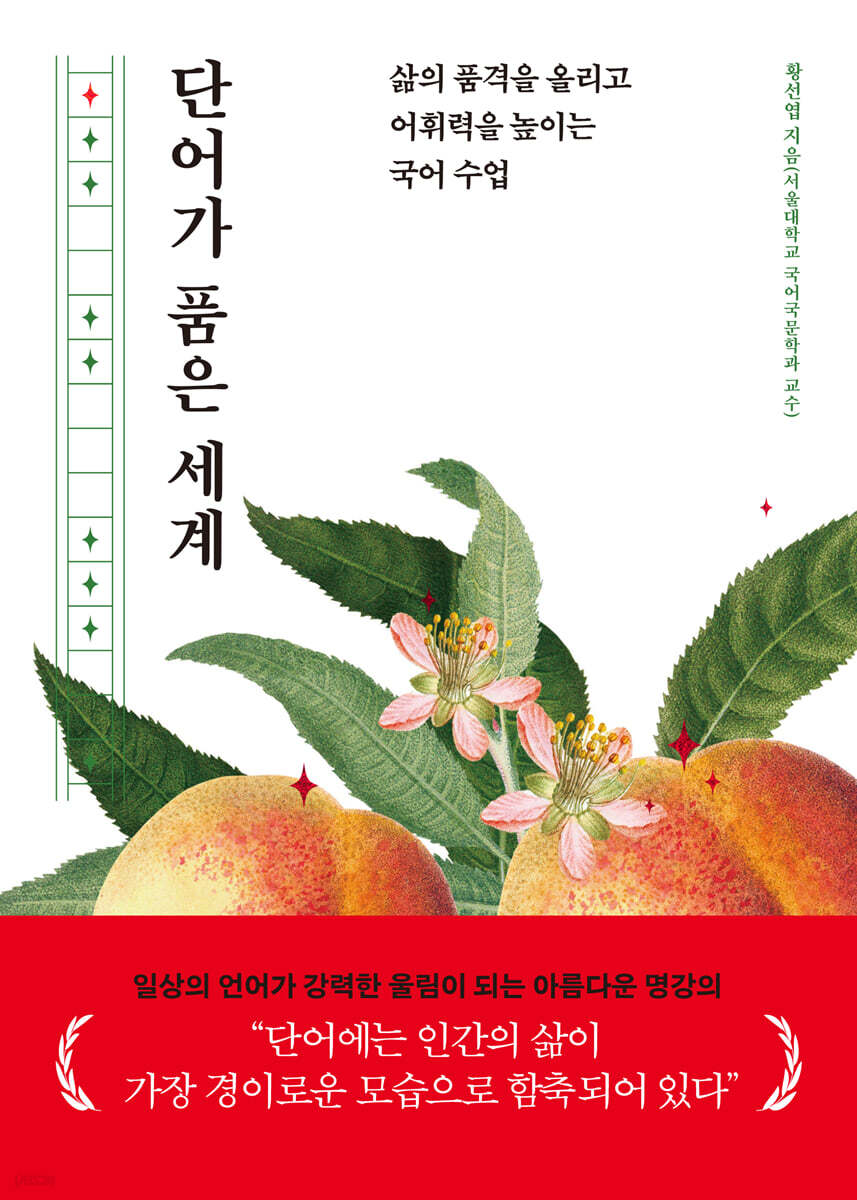
The world contained in words
 |
Description
Book Introduction
- A word from MD
-
A wondrous exploration that begins with familiar wordsThis book, written by Professor Hwang Seon-yeop of the Department of Korean Language and Literature at Seoul National University, is about our identity and subjectivity.
What do the "hwang" (황) in "ox," "yang" (양) in "sock," and "gapjak (가죽) in "가죽나무" (가죽나무) all mean? Just as the four-character idiom "Geokmulchiji" (經物而而) comes to mind, this book guides you through everyday vocabulary to a broader world.
December 10, 2024. Humanities PD Son Min-gyu
“Words contain human life.
“It is encapsulated in the most wonderful form”
Insights that explore the fundamentals of life beyond language
Professor Hwang Seon-yeop's Korean language class at Seoul National University
Seoul National University's renowned lectures, which explore life and the world through the depth and beauty of words, have been published as a book.
The book is 『The World Embraced by Words』, the first liberal arts book by Professor Hwang Seon-yeop of the Department of Korean Language and Literature at Seoul National University.
Professor Hwang Seon-yeop, who has a deep interest in the history of the Korean language, including its etymology and the evolution of words, shares in this book the secrets of words we use every day but are unaware of, as well as the insights and wisdom about human life that he encounters while exploring words.
This book explains the birth, growth, and use of words across literature, history, philosophy, and religion, offering a fascinating experience where thousands of years of language history unfold before your eyes.
Words are full of the fragrance of life.
This book vividly shows how love and pride, sweat and sorrow, success and frustration, human relationships and worries are contained in the words used most closely by people.
Not only will you gain insight into language and wisdom about life, but if you read slowly and carefully, you will also discover yourself speaking more logically and have the amazing experience of expanding your vocabulary.
“It is encapsulated in the most wonderful form”
Insights that explore the fundamentals of life beyond language
Professor Hwang Seon-yeop's Korean language class at Seoul National University
Seoul National University's renowned lectures, which explore life and the world through the depth and beauty of words, have been published as a book.
The book is 『The World Embraced by Words』, the first liberal arts book by Professor Hwang Seon-yeop of the Department of Korean Language and Literature at Seoul National University.
Professor Hwang Seon-yeop, who has a deep interest in the history of the Korean language, including its etymology and the evolution of words, shares in this book the secrets of words we use every day but are unaware of, as well as the insights and wisdom about human life that he encounters while exploring words.
This book explains the birth, growth, and use of words across literature, history, philosophy, and religion, offering a fascinating experience where thousands of years of language history unfold before your eyes.
Words are full of the fragrance of life.
This book vividly shows how love and pride, sweat and sorrow, success and frustration, human relationships and worries are contained in the words used most closely by people.
Not only will you gain insight into language and wisdom about life, but if you read slowly and carefully, you will also discover yourself speaking more logically and have the amazing experience of expanding your vocabulary.
- You can preview some of the book's contents.
Preview
index
introduction
01.
On the greatness that comes from small curiosity
02.
If you are dazzled by appearances, it is difficult to perceive the essence.
03.
Language change is perceived differently
04.
All relationships are interdependent, no one comes first.
05.
From the scholar's table to the pork belly restaurant's ssam basket
06.
The thousands of years of stories contained in the words we use every day
07.
How difficult is it to change something you've already become accustomed to?
08.
The role of a linguist in my opinion
09.
Language should reflect the human rights sensibilities of the time.
10.
Is uselessness something to be distressed about?
11.
The process of knowing words is the process of knowing life.
12.
It takes thousands of years for a flower to bloom.
13.
The story hidden behind the outward appearance
14.
If I write my name in Korean, is it a pure Korean name?
15.
Knowing the meaning of place names gives you a new perspective on geography.
16.
A name born from a dictionary editor's mistake
17.
Even after knowing the story, will it still seem like a weed?
18.
How to understand the incomprehensible
19.
Words and food change over time.
20.
A word with a surprisingly deep history
21.
Everyone wants to know the etymology.
22.
A word that has become set in stone after being called too many times
23.
Are all dictionaries correct?
01.
On the greatness that comes from small curiosity
02.
If you are dazzled by appearances, it is difficult to perceive the essence.
03.
Language change is perceived differently
04.
All relationships are interdependent, no one comes first.
05.
From the scholar's table to the pork belly restaurant's ssam basket
06.
The thousands of years of stories contained in the words we use every day
07.
How difficult is it to change something you've already become accustomed to?
08.
The role of a linguist in my opinion
09.
Language should reflect the human rights sensibilities of the time.
10.
Is uselessness something to be distressed about?
11.
The process of knowing words is the process of knowing life.
12.
It takes thousands of years for a flower to bloom.
13.
The story hidden behind the outward appearance
14.
If I write my name in Korean, is it a pure Korean name?
15.
Knowing the meaning of place names gives you a new perspective on geography.
16.
A name born from a dictionary editor's mistake
17.
Even after knowing the story, will it still seem like a weed?
18.
How to understand the incomprehensible
19.
Words and food change over time.
20.
A word with a surprisingly deep history
21.
Everyone wants to know the etymology.
22.
A word that has become set in stone after being called too many times
23.
Are all dictionaries correct?
Detailed image

Into the book
I really enjoy exploring the roots of words.
It was lettuce that first captivated me with the wonder and joy of words.
After completing my doctoral program and working as a part-time lecturer at several universities, I went on a dialect field trip to Jeongseon, Gangwon-do.
While researching dialects, I heard an elderly person say lettuce is called buru.
At that time, I learned that the word 'buru', which I had only seen in old documents, was still used in dialects.
So, I decided to write an article summarizing the evolution of the word lettuce.
And because that task was so much fun for me, I started noticing the unusual words that appeared while reading the literature and organizing them one by one.
--- p.5
But, as I read this poem, there is a phrase that catches my eye.
This is the part that says 'spotted white bull (in modern standard language, spotted white bull)'.
What kind of cow is a spotted bull? Picture a spotted bull in your mind.
If you think about it carefully, isn't there something strange about it? As the sun sets, the image of a yellow cow grazing leisurely in a vast field, basking in the golden sunlight, and mooing suddenly strikes you.
'Wait a minute, it's not just any bull, it's a 'speckled' bull, right?' You might be thinking, 'Should I add speckling to the yellow bull I've been picturing?'
Why did the poet call it a spotted bull, not a bull or a spotted cow? What exactly does a spotted bull look like?
--- p.16
The controversy that shook the academic world upside down arose because people looked only at the surface and failed to properly examine the original meaning.
When examining a single word, we must keep in mind that its meaning or target may change depending on the time period or region.
I think the same thing applies when looking at people.
There are people who you might think are cold or cynical just by looking at their appearance, but as you talk to them more and get to know them better, you realize that they are actually warm and considerate people.
The true meaning is not always apparent.
When we look at a person or use a single word, we must look into the life they have lived and the historical process they have gone through.
--- p.36
The words and phrases we use every day embody culture, customs, and ways of life that have continued for thousands of years.
When you learn where the words you use without thinking come from and why they are used that way, you will have a novel experience where you can see the surrounding scenery differently and feel the world you live in in a new way.
By looking back at and exploring things we took for granted, we discover a world we never knew existed.
There are many words that we use every day, but whose origins we don't know.
Among them is brushing teeth.
To understand the origin of the word "brushing teeth," we need to understand the cultural transmission that began in India, passed through China, and reached our country, and the cultural history behind it.
Furthermore, the word “yangchi” is very interesting in that it can even take into account the influence of Japan in the modern era.
Thousands of years of culture are embedded in the single word “brushing teeth.”
--- p.75~76
This can be further explained by looking at the Chinese and English names of the dog's paw.
In Chinese, it is called gumicho (狗尾草) using the characters for dog (狗) and tail (尾). In English, it is called foxtail because it resembles a fox's tail.
If it was named because of its appearance, it would seem appropriate to call it puppy's tail grass.
But why is it called "dog-puppy grass" and not "dog-tail grass" in Korean? There are several interesting Korean words named after its appearance.
For example, the deer antler mushroom is named after its shape, which resembles a deer antler.
We don't just take the butt out of this word and call it a deer mushroom.
It is called deer rump mushroom because it looks like a deer rump.
--- p.165
It seems that most people tend to blindly believe what the dictionary says.
Because it is written like this in the dictionary, I always think it is correct.
But dictionaries are also made by people.
There are many cases where the interpretation is incorrect.
Since the person who prescribes the dictionary is not an expert in all fields, if he or she does not have accurate knowledge, there is a possibility that he or she will come up with a similar solution.
So, we need to be critical of dictionaries, recognizing that what they describe isn't always correct.
--- p.205
Magpie, magpie, Lunar New Year was the day before yesterday.
Our Lunar New Year is today.
This children's song, which makes you sing along naturally just by reading the lyrics, is probably the most familiar Seollal song to Koreans.
When the word ‘magpie New Year’ is broken down into ‘magpie New Year’s Day’, it is perceived as meaning ‘magpie’s New Year’s Day’.
What's the connection between magpies and Seollal, and why is it called "the day before yesterday"? Examining how the term "magpie-the-day" (magpie-the-day) came to be used today will help us understand the meaning of this song, often heard but never fully understood.
It was lettuce that first captivated me with the wonder and joy of words.
After completing my doctoral program and working as a part-time lecturer at several universities, I went on a dialect field trip to Jeongseon, Gangwon-do.
While researching dialects, I heard an elderly person say lettuce is called buru.
At that time, I learned that the word 'buru', which I had only seen in old documents, was still used in dialects.
So, I decided to write an article summarizing the evolution of the word lettuce.
And because that task was so much fun for me, I started noticing the unusual words that appeared while reading the literature and organizing them one by one.
--- p.5
But, as I read this poem, there is a phrase that catches my eye.
This is the part that says 'spotted white bull (in modern standard language, spotted white bull)'.
What kind of cow is a spotted bull? Picture a spotted bull in your mind.
If you think about it carefully, isn't there something strange about it? As the sun sets, the image of a yellow cow grazing leisurely in a vast field, basking in the golden sunlight, and mooing suddenly strikes you.
'Wait a minute, it's not just any bull, it's a 'speckled' bull, right?' You might be thinking, 'Should I add speckling to the yellow bull I've been picturing?'
Why did the poet call it a spotted bull, not a bull or a spotted cow? What exactly does a spotted bull look like?
--- p.16
The controversy that shook the academic world upside down arose because people looked only at the surface and failed to properly examine the original meaning.
When examining a single word, we must keep in mind that its meaning or target may change depending on the time period or region.
I think the same thing applies when looking at people.
There are people who you might think are cold or cynical just by looking at their appearance, but as you talk to them more and get to know them better, you realize that they are actually warm and considerate people.
The true meaning is not always apparent.
When we look at a person or use a single word, we must look into the life they have lived and the historical process they have gone through.
--- p.36
The words and phrases we use every day embody culture, customs, and ways of life that have continued for thousands of years.
When you learn where the words you use without thinking come from and why they are used that way, you will have a novel experience where you can see the surrounding scenery differently and feel the world you live in in a new way.
By looking back at and exploring things we took for granted, we discover a world we never knew existed.
There are many words that we use every day, but whose origins we don't know.
Among them is brushing teeth.
To understand the origin of the word "brushing teeth," we need to understand the cultural transmission that began in India, passed through China, and reached our country, and the cultural history behind it.
Furthermore, the word “yangchi” is very interesting in that it can even take into account the influence of Japan in the modern era.
Thousands of years of culture are embedded in the single word “brushing teeth.”
--- p.75~76
This can be further explained by looking at the Chinese and English names of the dog's paw.
In Chinese, it is called gumicho (狗尾草) using the characters for dog (狗) and tail (尾). In English, it is called foxtail because it resembles a fox's tail.
If it was named because of its appearance, it would seem appropriate to call it puppy's tail grass.
But why is it called "dog-puppy grass" and not "dog-tail grass" in Korean? There are several interesting Korean words named after its appearance.
For example, the deer antler mushroom is named after its shape, which resembles a deer antler.
We don't just take the butt out of this word and call it a deer mushroom.
It is called deer rump mushroom because it looks like a deer rump.
--- p.165
It seems that most people tend to blindly believe what the dictionary says.
Because it is written like this in the dictionary, I always think it is correct.
But dictionaries are also made by people.
There are many cases where the interpretation is incorrect.
Since the person who prescribes the dictionary is not an expert in all fields, if he or she does not have accurate knowledge, there is a possibility that he or she will come up with a similar solution.
So, we need to be critical of dictionaries, recognizing that what they describe isn't always correct.
--- p.205
Magpie, magpie, Lunar New Year was the day before yesterday.
Our Lunar New Year is today.
This children's song, which makes you sing along naturally just by reading the lyrics, is probably the most familiar Seollal song to Koreans.
When the word ‘magpie New Year’ is broken down into ‘magpie New Year’s Day’, it is perceived as meaning ‘magpie’s New Year’s Day’.
What's the connection between magpies and Seollal, and why is it called "the day before yesterday"? Examining how the term "magpie-the-day" (magpie-the-day) came to be used today will help us understand the meaning of this song, often heard but never fully understood.
--- p.224
Publisher's Review
The thousands of years of stories contained in words
It unfolds before your eyes!
All those who use the Korean language
The ultimate guide to a world of deep and broad thought.
Words are the most basic units that make up language.
When babies learn to speak, they start with words like 'mom' and 'dad', and when they learn a foreign language, they start with words and begin to learn language.
In this way, words, as the most basic of language, have changed according to people's lives in the places closest and most intimate to us.
Words, like people, are born, grow, age, and eventually die.
However, the lifespan of words varies greatly, with some words being used from prehistoric times to the present day, while others disappear after only a few years of use.
If we look into the changes in words, we can see the changes in humanity, the history of a nation, and the changes in the world.
_From the text
Just as living things have a vital force that sustains life, words also have a vital force.
As time passes and the lifespan of a word wears off, it gradually fades from use, and new words gain vitality and are actively used.
Sometimes, there are attempts to obsolete existing words and replace them with new ones with specific intentions.
The power of words is so strong that they are used as tools to control people's thoughts, speech, and writing.
Professor Hwang Seon-yeop, who was exploring words with strong power and vibrant vitality, naturally encountered human life.
By looking into the culture and customs contained in language, I thought about universal human life and worries, love and frustration, experiences and relationships.
His thoughts are incorporated into his classes and lectures as topics that are relevant to our lives today.
The lecture, which had been passed down through word of mouth through students and external lectures, has finally been published as a book.
“I go beyond Korean as an academic subject in the classroom.
“I learned great understanding and love for the world.”
“Things that were taken for granted no longer seem ordinary.
“It’s amazing how my mood improves as my thoughts deepen.”
“An attitude of curiosity, asking ‘Why?’
“You learn to see things that you previously considered trivial in a different way.”
_From students' class reviews
We brush our teeth every day, but it is difficult to realize that the word “brushing teeth” contains Buddhist culture.
Kiosk is an ordering machine that can be easily seen in stores, so it is easy to think of it as a new word, but the word comes from Persian and has long been used in Europe to refer to an open vending machine.
Words with surprising histories that we often come across but never knew about, words that were popular in their time but have now disappeared, words with a twist, and vulgar words that embody the zeitgeist of the times—words with a rich story—allow us to gain insight into the past, fill our present, and help us mature for tomorrow.
Learning through language adventures
A brilliant insight into 'how to live'
"The World Embraced by Words" conveys the exciting message that "the process of knowing words is the process of knowing life" throughout the book.
In particular, it surprises readers by revealing the secrets of words that they are familiar with but accept without question.
Let's look at an example of how to surprise.
The author poses a question using the word 'spotted ox' from the poem "Perfume" by poet Jeong Ji-yong, which is very familiar to us as it is sung in songs and included in textbooks.
If you ask, “What kind of cow is the bull with the white face?” most people will tilt their heads in confusion.
People usually think of Holstein cows, but that's not the correct answer.
The correct answer is the yellow cow, and through this question and answer, the author brings up the story of Prime Minister Hwang Hui and the tale of Kongjwi and Patjwi, and tells us that cows of various colors once lived in Korea and why yellow cows make up the majority now.
This leads us to realize that an attitude of being curious about things that are taken for granted is necessary in our lives.
The author not only conveys insights into life's attitudes through words, but also offers solutions to interpersonal problems and practical concerns.
While talking about the character 'yang' attached to items imported from the West, he explains the Taegeuk pattern in the Taegeukgi and brings up the concepts of Gunwisingang, Buibubugang, and Buibujagang in Confucian culture, which he expands to human relationships where one side presupposes the existence of the other.
And when I find myself questioning my various roles and the relationships surrounding me, I offer warm advice to remember that all relationships are interdependent.
The fate of words, which are born, grow, age, and eventually die, reminds us of the human life in which everyone faces death after being born.
The scene where frequently used words defeat rarely used words reminds us of human power relations.
We come to realize that just as language and its basic units, words, are used within the vast flow and relationships of the world, so too do we each exist within the vast flow of the universe.
In this way, 『The World Embraced by Words』 moves in an exciting way through words from poetry, nursery rhymes, novels, newspaper articles, place names, and folk etymologies that easily approach the profound and vast subject of life, and before you know it, you will gain insight into 'how to live.'
As you discover the beauty of the Korean language
Your speech becomes logical and your vocabulary becomes more confident.
More and more adults are experiencing difficulties or recognizing deficiencies in their vocabulary.
Problems with vocabulary can lead to poor logic in speech or incoherent writing.
The inability to use words in a variety of ways and to utilize them as intended has become not simply a problem of knowledge, but a problem of life.
Through "The World Embraced by Words," the author guides students to understand the context of words and develop the power of imagination.
A single misinterpretation of a word can lead to a massive problem that requires the rewriting of world history, or a dictionary editor's mistake can suddenly create a word that didn't exist before, and even track down the fact that that word is still in use today, making us realize how important it is to properly understand the context in which we live.
Moreover, the fact that two cultures that have never met, are far apart, and speak different languages used the word "mingaju" to mean "pigweed" not only shows that commonalities in life are reflected in human language, but also provides insight into the human imagination that creates words by observing objects.
The names of the places we live in don't just appear out of nowhere. Knowing why those names came about and how they've evolved over time can give us a new perspective on geography and even familiar routes can be viewed differently.
This is probably why students who took Professor Hwang Seon-yeop's Korean language class say, "I was able to develop my thinking and reasoning skills."
Because it captures and conveys the power of words in various aspects, you can discover a vast world you never knew existed with just one small word, the basic unit of language.
Everyone has a curiosity about words.
The constant creation of new words, the constant change in popular words, the replacement of once-frequently used words with new ones over time, the different frequently used words for each generation, and the creation of words with similar meanings across cultures with different languages, all reflect universal human curiosity and desire.
"The World Embraced by Words" takes you on a special journey across diverse fields, including literature, religion, history, philosophy, and mythology, all wrapped up in words. It is a process and journey toward understanding our lives.
There is such a beautiful world in one small word you encounter every day.
Let's enter that amazing world.
It unfolds before your eyes!
All those who use the Korean language
The ultimate guide to a world of deep and broad thought.
Words are the most basic units that make up language.
When babies learn to speak, they start with words like 'mom' and 'dad', and when they learn a foreign language, they start with words and begin to learn language.
In this way, words, as the most basic of language, have changed according to people's lives in the places closest and most intimate to us.
Words, like people, are born, grow, age, and eventually die.
However, the lifespan of words varies greatly, with some words being used from prehistoric times to the present day, while others disappear after only a few years of use.
If we look into the changes in words, we can see the changes in humanity, the history of a nation, and the changes in the world.
_From the text
Just as living things have a vital force that sustains life, words also have a vital force.
As time passes and the lifespan of a word wears off, it gradually fades from use, and new words gain vitality and are actively used.
Sometimes, there are attempts to obsolete existing words and replace them with new ones with specific intentions.
The power of words is so strong that they are used as tools to control people's thoughts, speech, and writing.
Professor Hwang Seon-yeop, who was exploring words with strong power and vibrant vitality, naturally encountered human life.
By looking into the culture and customs contained in language, I thought about universal human life and worries, love and frustration, experiences and relationships.
His thoughts are incorporated into his classes and lectures as topics that are relevant to our lives today.
The lecture, which had been passed down through word of mouth through students and external lectures, has finally been published as a book.
“I go beyond Korean as an academic subject in the classroom.
“I learned great understanding and love for the world.”
“Things that were taken for granted no longer seem ordinary.
“It’s amazing how my mood improves as my thoughts deepen.”
“An attitude of curiosity, asking ‘Why?’
“You learn to see things that you previously considered trivial in a different way.”
_From students' class reviews
We brush our teeth every day, but it is difficult to realize that the word “brushing teeth” contains Buddhist culture.
Kiosk is an ordering machine that can be easily seen in stores, so it is easy to think of it as a new word, but the word comes from Persian and has long been used in Europe to refer to an open vending machine.
Words with surprising histories that we often come across but never knew about, words that were popular in their time but have now disappeared, words with a twist, and vulgar words that embody the zeitgeist of the times—words with a rich story—allow us to gain insight into the past, fill our present, and help us mature for tomorrow.
Learning through language adventures
A brilliant insight into 'how to live'
"The World Embraced by Words" conveys the exciting message that "the process of knowing words is the process of knowing life" throughout the book.
In particular, it surprises readers by revealing the secrets of words that they are familiar with but accept without question.
Let's look at an example of how to surprise.
The author poses a question using the word 'spotted ox' from the poem "Perfume" by poet Jeong Ji-yong, which is very familiar to us as it is sung in songs and included in textbooks.
If you ask, “What kind of cow is the bull with the white face?” most people will tilt their heads in confusion.
People usually think of Holstein cows, but that's not the correct answer.
The correct answer is the yellow cow, and through this question and answer, the author brings up the story of Prime Minister Hwang Hui and the tale of Kongjwi and Patjwi, and tells us that cows of various colors once lived in Korea and why yellow cows make up the majority now.
This leads us to realize that an attitude of being curious about things that are taken for granted is necessary in our lives.
The author not only conveys insights into life's attitudes through words, but also offers solutions to interpersonal problems and practical concerns.
While talking about the character 'yang' attached to items imported from the West, he explains the Taegeuk pattern in the Taegeukgi and brings up the concepts of Gunwisingang, Buibubugang, and Buibujagang in Confucian culture, which he expands to human relationships where one side presupposes the existence of the other.
And when I find myself questioning my various roles and the relationships surrounding me, I offer warm advice to remember that all relationships are interdependent.
The fate of words, which are born, grow, age, and eventually die, reminds us of the human life in which everyone faces death after being born.
The scene where frequently used words defeat rarely used words reminds us of human power relations.
We come to realize that just as language and its basic units, words, are used within the vast flow and relationships of the world, so too do we each exist within the vast flow of the universe.
In this way, 『The World Embraced by Words』 moves in an exciting way through words from poetry, nursery rhymes, novels, newspaper articles, place names, and folk etymologies that easily approach the profound and vast subject of life, and before you know it, you will gain insight into 'how to live.'
As you discover the beauty of the Korean language
Your speech becomes logical and your vocabulary becomes more confident.
More and more adults are experiencing difficulties or recognizing deficiencies in their vocabulary.
Problems with vocabulary can lead to poor logic in speech or incoherent writing.
The inability to use words in a variety of ways and to utilize them as intended has become not simply a problem of knowledge, but a problem of life.
Through "The World Embraced by Words," the author guides students to understand the context of words and develop the power of imagination.
A single misinterpretation of a word can lead to a massive problem that requires the rewriting of world history, or a dictionary editor's mistake can suddenly create a word that didn't exist before, and even track down the fact that that word is still in use today, making us realize how important it is to properly understand the context in which we live.
Moreover, the fact that two cultures that have never met, are far apart, and speak different languages used the word "mingaju" to mean "pigweed" not only shows that commonalities in life are reflected in human language, but also provides insight into the human imagination that creates words by observing objects.
The names of the places we live in don't just appear out of nowhere. Knowing why those names came about and how they've evolved over time can give us a new perspective on geography and even familiar routes can be viewed differently.
This is probably why students who took Professor Hwang Seon-yeop's Korean language class say, "I was able to develop my thinking and reasoning skills."
Because it captures and conveys the power of words in various aspects, you can discover a vast world you never knew existed with just one small word, the basic unit of language.
Everyone has a curiosity about words.
The constant creation of new words, the constant change in popular words, the replacement of once-frequently used words with new ones over time, the different frequently used words for each generation, and the creation of words with similar meanings across cultures with different languages, all reflect universal human curiosity and desire.
"The World Embraced by Words" takes you on a special journey across diverse fields, including literature, religion, history, philosophy, and mythology, all wrapped up in words. It is a process and journey toward understanding our lives.
There is such a beautiful world in one small word you encounter every day.
Let's enter that amazing world.
GOODS SPECIFICS
- Date of issue: November 22, 2024
- Page count, weight, size: 296 pages | 426g | 150*210*20mm
- ISBN13: 9791198731906
- ISBN10: 1198731907
You may also like
카테고리
korean


korean

![ELLE 엘르 스페셜 에디션 A형 : 12월 [2025]](http://librairie.coreenne.fr/cdn/shop/files/b8e27a3de6c9538896439686c6b0e8fb.jpg?v=1766436872&width=3840)


