

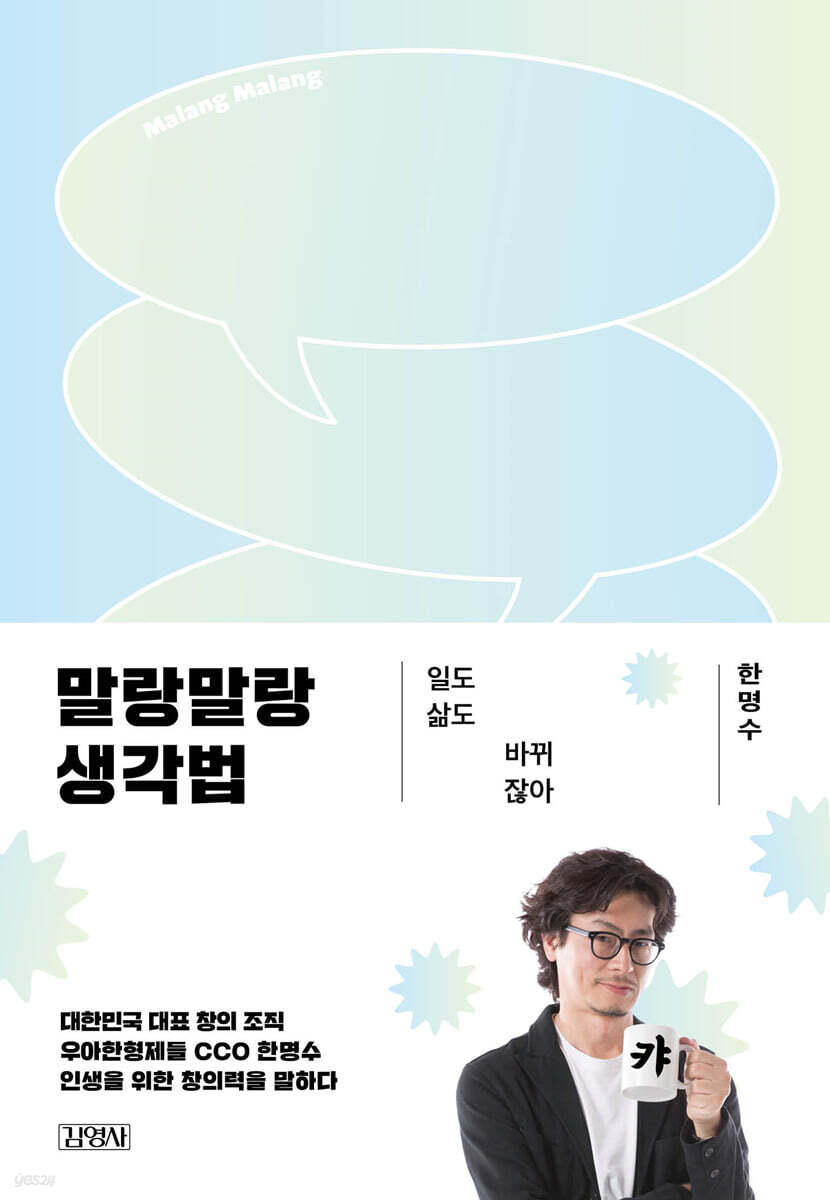
Soft thinking method
 |
Description
Book Introduction
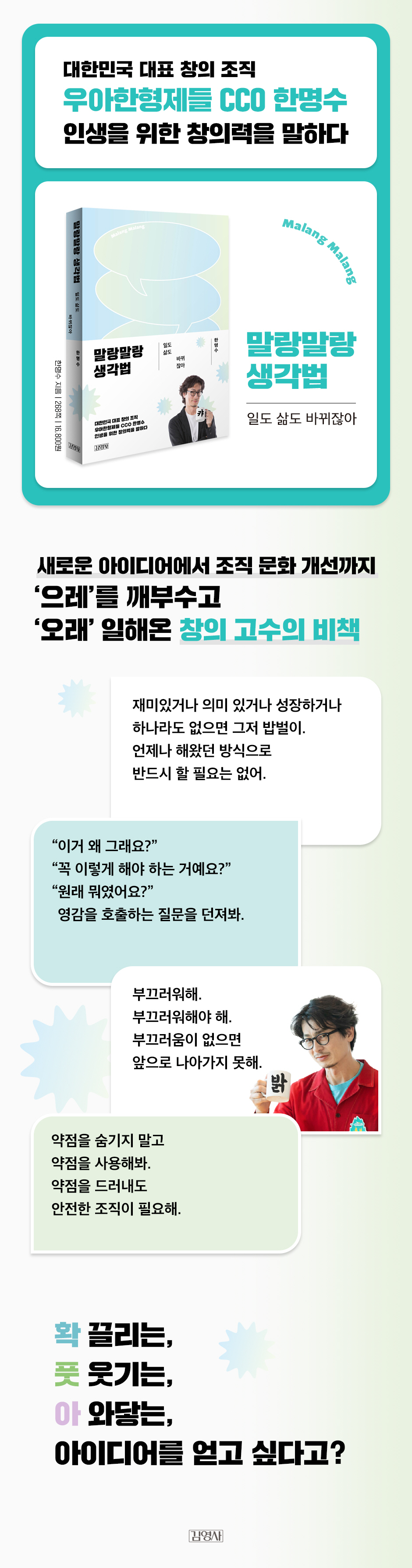
“Can you make boring things fun?” Han Myeong-su, CCO of Woowa Brothers, Korea's leading creative organization A story that changes both work and life Here's a story that will make you laugh and think deeply. Although it is titled 'How to Think', it does not say eloquently, 'Follow me'. Rather than saying that you want your goal to be breaking the guide's rules, you say you want to keep them. It makes you think about how you should act to avoid repeating the same thing in the same way, how your company should change to become more fun and enjoyable, and how you can make your daily life and workplace more exciting. As you follow this story, you might feel that even boring things can be fun, you might get an idea that is 'extremely' attractive, 'cheesy' funny, and 'aha' resonates with you, or you might have an experience where your hard-as-walnut thoughts crack open. The book, "Soft and Smooth Thinking," which contains such stories, is a book that contains the experience and dedication of Chief Creative Officer Han Myeong-su, who has been responsible for not only the Baedal Minjok service but also the development of Korean fonts and the improvement of the organizational culture of Woowa Brothers. For those of you who feel the word creativity drain away, I'll tell you what kind of creativity is helpful for making a living. He breaks the mold and introduces three-dimensional examples of how he, who has worked for a long time, comes up with new ideas and how he brings joy and fun to the workplace. “Organizational culture is not money!” “Ruin it, ruin it!” “You should be ashamed of yourself. “If you don’t have shame, you can’t move forward.” I dare say that this book will subtly change and enrich your work and life. |
- You can preview some of the book's contents.
Preview
index
At the beginning of the book.
Think of the moment that breathes life into you
Entering.
Self-introduction · What am I called?
Chapter 1.
Peel off the hard shell
Take it out · What's inside me?
If you could just peel back the covering, what would be a good question?
What is Justice? · Defining It 1
What is Communication? · Defining It 2
What is the opposite? · Defining 3
What's the opposite of culture? · Defining it 4
What are the signs of laughter, intentions, thoughts, and emotions?
Sign of Happiness · Are you happy?
I want to talk about it in a difficult way. That's what I called you.
Chapter 2.
Crossing the middle ground between the outside and the inside
Let's learn creativity through writing. · Okay, I've been studying like that all day.
The difference between what's new and what seems new · I'm being fooled, I'm being fooled
Want to know how to develop creativity and its attributes?
Two attributes of great words - two or two?
Fighting with 'Eure' · Using the eraser in my head
The structure of organizational culture and the heavy, unspoken air of assumptions
It could be a compliment or an insult saying, "That's just like you."
I want to be a creative person · Why?
What is Malrangi and Gugeuni? What is a chair?
Tch, what's the point of being creative alone? · Group Creation System
Chapter 3.
Focus on the essence
Transparent power: When the head, tongue, and actions are separate, it becomes cloudy.
It's not about pretending to be good at work, it's about doing things well.
It's not about pretending not to be able to do something, it's about being good at it.
Q&A on pretending to live · I'm really curious
Chapter 4.
Awaken the seeds of life
If you can open a small door, what is a big door?
The fear of seeing something for the first time. Isn't it fun? It's okay if you just watch it.
Leadership that creates a festival in the desert · What am I in a moment of crisis?
The best brand in the world is · Oh, Jesus
The World Behind the Fruit of "Achievement" · Who Eats the Fruit?
Going out.
The moment you tear up the guide and go against the established answer
Search
Think of the moment that breathes life into you
Entering.
Self-introduction · What am I called?
Chapter 1.
Peel off the hard shell
Take it out · What's inside me?
If you could just peel back the covering, what would be a good question?
What is Justice? · Defining It 1
What is Communication? · Defining It 2
What is the opposite? · Defining 3
What's the opposite of culture? · Defining it 4
What are the signs of laughter, intentions, thoughts, and emotions?
Sign of Happiness · Are you happy?
I want to talk about it in a difficult way. That's what I called you.
Chapter 2.
Crossing the middle ground between the outside and the inside
Let's learn creativity through writing. · Okay, I've been studying like that all day.
The difference between what's new and what seems new · I'm being fooled, I'm being fooled
Want to know how to develop creativity and its attributes?
Two attributes of great words - two or two?
Fighting with 'Eure' · Using the eraser in my head
The structure of organizational culture and the heavy, unspoken air of assumptions
It could be a compliment or an insult saying, "That's just like you."
I want to be a creative person · Why?
What is Malrangi and Gugeuni? What is a chair?
Tch, what's the point of being creative alone? · Group Creation System
Chapter 3.
Focus on the essence
Transparent power: When the head, tongue, and actions are separate, it becomes cloudy.
It's not about pretending to be good at work, it's about doing things well.
It's not about pretending not to be able to do something, it's about being good at it.
Q&A on pretending to live · I'm really curious
Chapter 4.
Awaken the seeds of life
If you can open a small door, what is a big door?
The fear of seeing something for the first time. Isn't it fun? It's okay if you just watch it.
Leadership that creates a festival in the desert · What am I in a moment of crisis?
The best brand in the world is · Oh, Jesus
The World Behind the Fruit of "Achievement" · Who Eats the Fruit?
Going out.
The moment you tear up the guide and go against the established answer
Search
Detailed image
Into the book
When we were born, we were soft beings.
My parents wondered, 'What will I become?' and 'How will I grow up?'
But as we grow up, we become rigid and eventually become like robots.
When you feel tired of repeating the same pattern in life and work, it is good to think of the breath (Pneuma, Ruach) that is being breathed into you and that wonderful state of being about to stir.
---From "Introduction"
When you do something with someone, there is something you must do first.
It's about identifying and defining what each other's words mean.
There are moments when you realize that you are saying the same thing but with completely different meanings.
For example, one person suggested, “Let’s improve the customer experience.”
Another person answered, “Yes, we will do our best to improve the customer experience.”
But sometimes the person who made the suggestion and the person who answered have completely different ideas in their heads.
The more abstract or conceptual language we use, the greater the differences in thinking become.
When speaking, it is important to define and confirm the meaning of the words.
---From "What is Justice?"
There is a joy in awakening our awareness when we go through the process of organizing the words and concepts we use every day into another language.
In particular, forcing the opposite is like digging with a shovel or a pickaxe to dig into the essence.
If you ask what the opposite of 'happiness' is, most people will answer 'unhappiness', but some people will say 'loneliness' in their own words.
At times like that, happiness feels like something buried in a grave suddenly rising up and stirring.
---From "What is the opposite?"
Step 1 is to be curious and ask questions.
Step 2 is to do what you love.
You can't do something you don't like for long.
It takes a long time to become an expert.
Deep training and thinking lead to innovation.
Step 3 is to experience fields that are unrelated to you.
It means 'don't be a frog in a well'.
Step 4 is to try hitting the blank.
Creativity doesn't grow just by forcing something.
It means, 'Have fun or rest well.'
Step 5 is a very philosophical story and a difficult task that goes against human nature.
It's about taking risks without fear of failure.
---From "How to Develop Creativity"
Who originally created and designed an organization that must constantly hide its vulnerabilities and defend itself against its opponents? And why is the software that constantly produces the atmosphere of such an organization so difficult to change in an instant? (…) For an organization's mental software to continue to be healthy and updated, there are essential codes that must be included in the initial blueprint.
'There must be someone living by your side who can freely tell you things your leader doesn't want to hear.' 'There must be a channel through which you can talk to your leader.' 'You must not harm anyone who expresses an opposing opinion to your leader.' In particular, you must include a promise to guarantee safety.
If the leader is capable of such a bold design, the future of the organization is already bright.
---From "Structure of Organizational Culture"
So-called creative people who stand out receive attention from the outside, but are criticized, rejected, and treated as uncomfortable people from the inside.
There are those who enjoy daydreaming, who delight in observing useless things, who tire of the familiar, who fail, who ruin things, and who do whatever they want.
Have you ever liked them and hated them, admired them and felt uncomfortable, applauded them and clicked your tongue behind their back? I have.
Because humans have a nature to choose familiarity and avoid risk.
(I'm human too) So, the story of wanting to become a creative person seems like a contradictory hope.
It looks vaguely good, but in reality it's uncomfortable.
There is a sword(?) hidden in the character for creativity.
Because creativity is born from overcoming the pain of cutting out the bright and dull.
---From "I want to be a creative person"
There is an easy way to make something different or new.
It's about developing the habit of not calling it what it is.
If you're someone who has to write emails every day, you might find that calling emails "emails" gives you a different perspective.
If you're someone who has meetings as a daily occurrence, you'll be able to have less stuffy meetings if you don't call them meetings.
If you are someone who has to say hello repeatedly, when you stop calling a greeting a greeting and call it something of your own, the greeting will be reborn as something new.
---From "Malangi and Gutgeoni"
It's really important to make your thoughts visible.
We live our lives unconsciously, influenced by what we see.
If you can't see it, you forget it all.
Out of sight, out of mind.
Place large boards, chalkboards, or glass windows around you and decorate your surroundings so that people can draw, stick, and remove anything they want, and anyone can touch it.
It's good to create an environment where you can see and feel something constantly changing.
Someone has to keep erasing, pasting, and pouring water on it, even if it's on purpose.
A collective creative system does not move easily on its own.
It requires sincerity and sacrifice.
Let's stick the candy bag we opened today somewhere.
If you don't touch it for a long time, no one will touch it, and eventually, even thinking about it will stop.
---From "Tch, what's the use of being the only creative person!"
When something strange and unfamiliar appears before your eyes, look at it kindly, unless it is a monster drooling sticky saliva.
Unless you're some stinky monster, you won't eat us.
There is no need to push away something just because you don't like it.
The symbols of good culture that we see now were all strange and unfamiliar at first.
Let's take a deep breath and repeat it.
'Even if this looks ugly, if you look at it for a long time, it will become pretty.' I must have thought it was really weird at first, but then someone told me I was pretty.
My parents wondered, 'What will I become?' and 'How will I grow up?'
But as we grow up, we become rigid and eventually become like robots.
When you feel tired of repeating the same pattern in life and work, it is good to think of the breath (Pneuma, Ruach) that is being breathed into you and that wonderful state of being about to stir.
---From "Introduction"
When you do something with someone, there is something you must do first.
It's about identifying and defining what each other's words mean.
There are moments when you realize that you are saying the same thing but with completely different meanings.
For example, one person suggested, “Let’s improve the customer experience.”
Another person answered, “Yes, we will do our best to improve the customer experience.”
But sometimes the person who made the suggestion and the person who answered have completely different ideas in their heads.
The more abstract or conceptual language we use, the greater the differences in thinking become.
When speaking, it is important to define and confirm the meaning of the words.
---From "What is Justice?"
There is a joy in awakening our awareness when we go through the process of organizing the words and concepts we use every day into another language.
In particular, forcing the opposite is like digging with a shovel or a pickaxe to dig into the essence.
If you ask what the opposite of 'happiness' is, most people will answer 'unhappiness', but some people will say 'loneliness' in their own words.
At times like that, happiness feels like something buried in a grave suddenly rising up and stirring.
---From "What is the opposite?"
Step 1 is to be curious and ask questions.
Step 2 is to do what you love.
You can't do something you don't like for long.
It takes a long time to become an expert.
Deep training and thinking lead to innovation.
Step 3 is to experience fields that are unrelated to you.
It means 'don't be a frog in a well'.
Step 4 is to try hitting the blank.
Creativity doesn't grow just by forcing something.
It means, 'Have fun or rest well.'
Step 5 is a very philosophical story and a difficult task that goes against human nature.
It's about taking risks without fear of failure.
---From "How to Develop Creativity"
Who originally created and designed an organization that must constantly hide its vulnerabilities and defend itself against its opponents? And why is the software that constantly produces the atmosphere of such an organization so difficult to change in an instant? (…) For an organization's mental software to continue to be healthy and updated, there are essential codes that must be included in the initial blueprint.
'There must be someone living by your side who can freely tell you things your leader doesn't want to hear.' 'There must be a channel through which you can talk to your leader.' 'You must not harm anyone who expresses an opposing opinion to your leader.' In particular, you must include a promise to guarantee safety.
If the leader is capable of such a bold design, the future of the organization is already bright.
---From "Structure of Organizational Culture"
So-called creative people who stand out receive attention from the outside, but are criticized, rejected, and treated as uncomfortable people from the inside.
There are those who enjoy daydreaming, who delight in observing useless things, who tire of the familiar, who fail, who ruin things, and who do whatever they want.
Have you ever liked them and hated them, admired them and felt uncomfortable, applauded them and clicked your tongue behind their back? I have.
Because humans have a nature to choose familiarity and avoid risk.
(I'm human too) So, the story of wanting to become a creative person seems like a contradictory hope.
It looks vaguely good, but in reality it's uncomfortable.
There is a sword(?) hidden in the character for creativity.
Because creativity is born from overcoming the pain of cutting out the bright and dull.
---From "I want to be a creative person"
There is an easy way to make something different or new.
It's about developing the habit of not calling it what it is.
If you're someone who has to write emails every day, you might find that calling emails "emails" gives you a different perspective.
If you're someone who has meetings as a daily occurrence, you'll be able to have less stuffy meetings if you don't call them meetings.
If you are someone who has to say hello repeatedly, when you stop calling a greeting a greeting and call it something of your own, the greeting will be reborn as something new.
---From "Malangi and Gutgeoni"
It's really important to make your thoughts visible.
We live our lives unconsciously, influenced by what we see.
If you can't see it, you forget it all.
Out of sight, out of mind.
Place large boards, chalkboards, or glass windows around you and decorate your surroundings so that people can draw, stick, and remove anything they want, and anyone can touch it.
It's good to create an environment where you can see and feel something constantly changing.
Someone has to keep erasing, pasting, and pouring water on it, even if it's on purpose.
A collective creative system does not move easily on its own.
It requires sincerity and sacrifice.
Let's stick the candy bag we opened today somewhere.
If you don't touch it for a long time, no one will touch it, and eventually, even thinking about it will stop.
---From "Tch, what's the use of being the only creative person!"
When something strange and unfamiliar appears before your eyes, look at it kindly, unless it is a monster drooling sticky saliva.
Unless you're some stinky monster, you won't eat us.
There is no need to push away something just because you don't like it.
The symbols of good culture that we see now were all strange and unfamiliar at first.
Let's take a deep breath and repeat it.
'Even if this looks ugly, if you look at it for a long time, it will become pretty.' I must have thought it was really weird at first, but then someone told me I was pretty.
---From "The Fear of Seeing Things for the First Time"
Publisher's Review
The secret recipe of a creative master who has been working for a long time and breaking the 'usual'
Rhythmic Thinking for Life
“When you go against the established answer, you get a better answer.”
A person who has created a buzz not only with the Baedal Minjok service but also with the development of Korean fonts (Hanna, Jua, Yeonseong, Giranghaerang, Euljiro, Glim, etc.); a person who has led the corporate culture of Woowa Brothers from a good guide to a good work space; a person who has created the brand philosophy with his own style by going from the first designer with a salary in the hundreds of millions in Korea to the Chief Creative Officer; a person who has appeared on the 'God of Interview' episode of 'Infinite Challenge' and has appeared in various media outlets and is known as a first-class lecturer liked by the government, companies, and educational institutions; that person's name is Han Myeong-su (hereinafter referred to as Myeong-su).
He is a creative worker who can express difficult and complex things in an easy and fun way.
Some of you may know his name, but if you don't, I envy you.
The influence that he and his book, "Soft Thinking," will have on you will be limitless.
『Soft Thinking』 is a book that contains stories about creativity that we need to think about for our lives.
He explains that creativity is necessary not only to live flexibly but also to change the “stale air” of an organization, and gives food for thought on how to become a creative person.
If you think about it, it really is true.
Rather than wanting to create some incredible invention, don't you want to live a full life, making even the simplest tasks as bright as a flower? To achieve that, you need creativity that brightens your daily life and your workplace.
The book's structure follows a similar path: stripping away the hard shell (Part 1), exploring the surface and the inside (Part 2), delving into the essence and focusing on it (Part 3), and awakening the seeds of creativity that have been within us since birth (Part 4). This journey is like finding joy in everyday life and work.
The first chapter begins by defining creativity not as “the ability to come up with something new,” but as “the ability to bring out what’s inside me and make something new actually exist.”
How to get ideas that are 'wow' attractive, 'pfft' funny, and 'ah' touching
How to create a corporate culture that makes even boring work fun
“You don’t have to do it the way you’ve always done it.”
“How can you think like that and create a good work environment?” Myungsoo’s answer to this question is clear.
“Do something fun and make it feel fun.” Fun is not something that you “force yourself to do when you don’t want to,” but something that “flows out naturally because you’re happy.”
『Soft Thinking』 believes that efficiency, speed, and stability are important, and reminds us of the value and importance of fun that we have temporarily neglected.
How can we work with unique ideas and enjoyment? Myeongsu says, "Defining and confirming is important."
You should be able to say, "This is what I think," rather than, "Who said that?"
They say that when you define something “with your own understanding, rather than the dead definitions that are in the dictionary,” something fresh and different emerges.
In the book, he explains “how to pretend to be good at work” and “how to pretend to be bad at work,” and says that if you imitate and practice these two methods, you will learn how to be truly good at work.
“Without shame, we cannot move forward,” he says, and instills in us the “courage to reveal our weaknesses,” encouraging us to “reveal our own weaknesses and embrace the weaknesses of others” and to encourage one another.
However, we need an “organization that is safe even when revealing weaknesses.”
So individual creativity must be explained together with organizational creativity.
How can we create a fun work environment? Just because creative people gather doesn't mean they'll become a creative group.
Working in a creative building doesn't necessarily lead to creative results.
Because control dries up creativity, Myeongsu says he strives to create a corporate culture where "autonomy is above discipline."
In particular, we repeatedly emphasize that the attitude of a strong leader plays a decisive role in creating a good workplace (perhaps the beginning and end of change).
A leader who does not pass judgment like a judge, but speaks in a fun and lively manner and puts members at ease is like an “air purifier” that clears the “heavy and murky” air of an organization.
The book offers a whopping nine tips for creating a "collective creative system," and I'll share just one of them.
It's useful to know (I hope you use it after knowing it).
I encourage you to find and read the remaining eight directly in the book.
“Let’s ‘share’ instead of ‘report’.
When you report to someone, you basically go through a process of polishing and polishing, trying to write a plausible report without any flaws.
Of course, there are times when such reports are necessary.
But creative ideas tend to be hidden in rough and imperfect contexts, not in finished conclusions and tables of contents.” (Tch, What’s the use of being the only one creative!, p. 173)
While changing the collective creative system, it is also necessary to discover small meanings in each person's daily life.
Myeongsu says we “find grandeur in the trivial things of everyday life.”
Because little questions and small talk make today more enjoyable and brighten up a boring day.
For example, when sending a text message, instead of writing "Hello, Mr./Ms. ○○," if you use "that person's modifiers," your tone of voice will change and you will feel more friendly, which will make the other person read it carefully.
It's like when you're asked, "Are you happy?" it makes you think about happiness again.
It's not a book as thick as a brick, so you can pick it up right away.
A book that constantly catches your eye, creating a clash between reason and emotion.
“Ask a question that sparks inspiration.”
Chatbots, led by ChatGPT, are taking the world by storm.
However, even as artificial intelligence technology advances, there is one thing that machines cannot create.
It is something that contains human breath and is made by human flesh.
Because intentions can be easily created, but emotions cannot be easily created.
The creative output is what captures those emotions, and that creative output moves people's hearts.
“Intention, thought, emotion, the most important of these is emotion.” “The character ‘Chang’ in ‘Creativity’ has a hidden sword(?).
We need to revisit Myeongsu's thoughts that "creativity is born from overcoming the pain of cutting out the bright and dull things."
I can name three reasons why 『Soft Thinking』 is persuasive.
First, it is the story of a person who worked for 25 years in nine different companies without losing his philosophy, individuality, and soul. In other words, it is the story of a person who, like any other office worker, cannot stand the dull atmosphere of the organization. It is a story that resonates with me.
Second, sentences that dig deep, not in a light-hearted manner but in a step-by-step manner, like blood flowing through veins, lead thoughts into action and create rhythm.
Thirdly, I tell you what you want to hear, not what I want to say, but in an interesting way, and I tell you with clear examples.
This book is classified as a 'self-help book'.
This is a classification that fits a solid 'frame'.
How about breaking away from the norm and categorizing this book as follows? "A book employees should read first, then executives, and vice versa," "An unprecedented book that provides insightful insights to those who want to excel at their jobs," "A book for those of you who find life boring these days."
So, you can tear it out and read it, you don't have to read it in order, you can read it while doodling, you can tear a page out and give it to someone around you, and you can say, 'I read it and liked it.
This is a book that I can recommend to you, saying, 'You should read it too.'
The book, "Soft Thinking," is one of the essentials for your daily life and your company.
As mentioned in the preface, “Now, it is time to breathe life into the lives of those of you who keep repeating that you are bored to death.
I hope that the seed of creativity, given as a gift to all humans, will grow without worrying about what anyone else thinks.
Rhythmic Thinking for Life
“When you go against the established answer, you get a better answer.”
A person who has created a buzz not only with the Baedal Minjok service but also with the development of Korean fonts (Hanna, Jua, Yeonseong, Giranghaerang, Euljiro, Glim, etc.); a person who has led the corporate culture of Woowa Brothers from a good guide to a good work space; a person who has created the brand philosophy with his own style by going from the first designer with a salary in the hundreds of millions in Korea to the Chief Creative Officer; a person who has appeared on the 'God of Interview' episode of 'Infinite Challenge' and has appeared in various media outlets and is known as a first-class lecturer liked by the government, companies, and educational institutions; that person's name is Han Myeong-su (hereinafter referred to as Myeong-su).
He is a creative worker who can express difficult and complex things in an easy and fun way.
Some of you may know his name, but if you don't, I envy you.
The influence that he and his book, "Soft Thinking," will have on you will be limitless.
『Soft Thinking』 is a book that contains stories about creativity that we need to think about for our lives.
He explains that creativity is necessary not only to live flexibly but also to change the “stale air” of an organization, and gives food for thought on how to become a creative person.
If you think about it, it really is true.
Rather than wanting to create some incredible invention, don't you want to live a full life, making even the simplest tasks as bright as a flower? To achieve that, you need creativity that brightens your daily life and your workplace.
The book's structure follows a similar path: stripping away the hard shell (Part 1), exploring the surface and the inside (Part 2), delving into the essence and focusing on it (Part 3), and awakening the seeds of creativity that have been within us since birth (Part 4). This journey is like finding joy in everyday life and work.
The first chapter begins by defining creativity not as “the ability to come up with something new,” but as “the ability to bring out what’s inside me and make something new actually exist.”
How to get ideas that are 'wow' attractive, 'pfft' funny, and 'ah' touching
How to create a corporate culture that makes even boring work fun
“You don’t have to do it the way you’ve always done it.”
“How can you think like that and create a good work environment?” Myungsoo’s answer to this question is clear.
“Do something fun and make it feel fun.” Fun is not something that you “force yourself to do when you don’t want to,” but something that “flows out naturally because you’re happy.”
『Soft Thinking』 believes that efficiency, speed, and stability are important, and reminds us of the value and importance of fun that we have temporarily neglected.
How can we work with unique ideas and enjoyment? Myeongsu says, "Defining and confirming is important."
You should be able to say, "This is what I think," rather than, "Who said that?"
They say that when you define something “with your own understanding, rather than the dead definitions that are in the dictionary,” something fresh and different emerges.
In the book, he explains “how to pretend to be good at work” and “how to pretend to be bad at work,” and says that if you imitate and practice these two methods, you will learn how to be truly good at work.
“Without shame, we cannot move forward,” he says, and instills in us the “courage to reveal our weaknesses,” encouraging us to “reveal our own weaknesses and embrace the weaknesses of others” and to encourage one another.
However, we need an “organization that is safe even when revealing weaknesses.”
So individual creativity must be explained together with organizational creativity.
How can we create a fun work environment? Just because creative people gather doesn't mean they'll become a creative group.
Working in a creative building doesn't necessarily lead to creative results.
Because control dries up creativity, Myeongsu says he strives to create a corporate culture where "autonomy is above discipline."
In particular, we repeatedly emphasize that the attitude of a strong leader plays a decisive role in creating a good workplace (perhaps the beginning and end of change).
A leader who does not pass judgment like a judge, but speaks in a fun and lively manner and puts members at ease is like an “air purifier” that clears the “heavy and murky” air of an organization.
The book offers a whopping nine tips for creating a "collective creative system," and I'll share just one of them.
It's useful to know (I hope you use it after knowing it).
I encourage you to find and read the remaining eight directly in the book.
“Let’s ‘share’ instead of ‘report’.
When you report to someone, you basically go through a process of polishing and polishing, trying to write a plausible report without any flaws.
Of course, there are times when such reports are necessary.
But creative ideas tend to be hidden in rough and imperfect contexts, not in finished conclusions and tables of contents.” (Tch, What’s the use of being the only one creative!, p. 173)
While changing the collective creative system, it is also necessary to discover small meanings in each person's daily life.
Myeongsu says we “find grandeur in the trivial things of everyday life.”
Because little questions and small talk make today more enjoyable and brighten up a boring day.
For example, when sending a text message, instead of writing "Hello, Mr./Ms. ○○," if you use "that person's modifiers," your tone of voice will change and you will feel more friendly, which will make the other person read it carefully.
It's like when you're asked, "Are you happy?" it makes you think about happiness again.
It's not a book as thick as a brick, so you can pick it up right away.
A book that constantly catches your eye, creating a clash between reason and emotion.
“Ask a question that sparks inspiration.”
Chatbots, led by ChatGPT, are taking the world by storm.
However, even as artificial intelligence technology advances, there is one thing that machines cannot create.
It is something that contains human breath and is made by human flesh.
Because intentions can be easily created, but emotions cannot be easily created.
The creative output is what captures those emotions, and that creative output moves people's hearts.
“Intention, thought, emotion, the most important of these is emotion.” “The character ‘Chang’ in ‘Creativity’ has a hidden sword(?).
We need to revisit Myeongsu's thoughts that "creativity is born from overcoming the pain of cutting out the bright and dull things."
I can name three reasons why 『Soft Thinking』 is persuasive.
First, it is the story of a person who worked for 25 years in nine different companies without losing his philosophy, individuality, and soul. In other words, it is the story of a person who, like any other office worker, cannot stand the dull atmosphere of the organization. It is a story that resonates with me.
Second, sentences that dig deep, not in a light-hearted manner but in a step-by-step manner, like blood flowing through veins, lead thoughts into action and create rhythm.
Thirdly, I tell you what you want to hear, not what I want to say, but in an interesting way, and I tell you with clear examples.
This book is classified as a 'self-help book'.
This is a classification that fits a solid 'frame'.
How about breaking away from the norm and categorizing this book as follows? "A book employees should read first, then executives, and vice versa," "An unprecedented book that provides insightful insights to those who want to excel at their jobs," "A book for those of you who find life boring these days."
So, you can tear it out and read it, you don't have to read it in order, you can read it while doodling, you can tear a page out and give it to someone around you, and you can say, 'I read it and liked it.
This is a book that I can recommend to you, saying, 'You should read it too.'
The book, "Soft Thinking," is one of the essentials for your daily life and your company.
As mentioned in the preface, “Now, it is time to breathe life into the lives of those of you who keep repeating that you are bored to death.
I hope that the seed of creativity, given as a gift to all humans, will grow without worrying about what anyone else thinks.
GOODS SPECIFICS
- Date of issue: March 24, 2023
- Page count, weight, size: 268 pages | 340g | 128*185*16mm
- ISBN13: 9788934966036
- ISBN10: 8934966033
You may also like
카테고리
korean


korean

![ELLE 엘르 스페셜 에디션 A형 : 12월 [2025]](http://librairie.coreenne.fr/cdn/shop/files/b8e27a3de6c9538896439686c6b0e8fb.jpg?v=1766436872&width=3840)


