

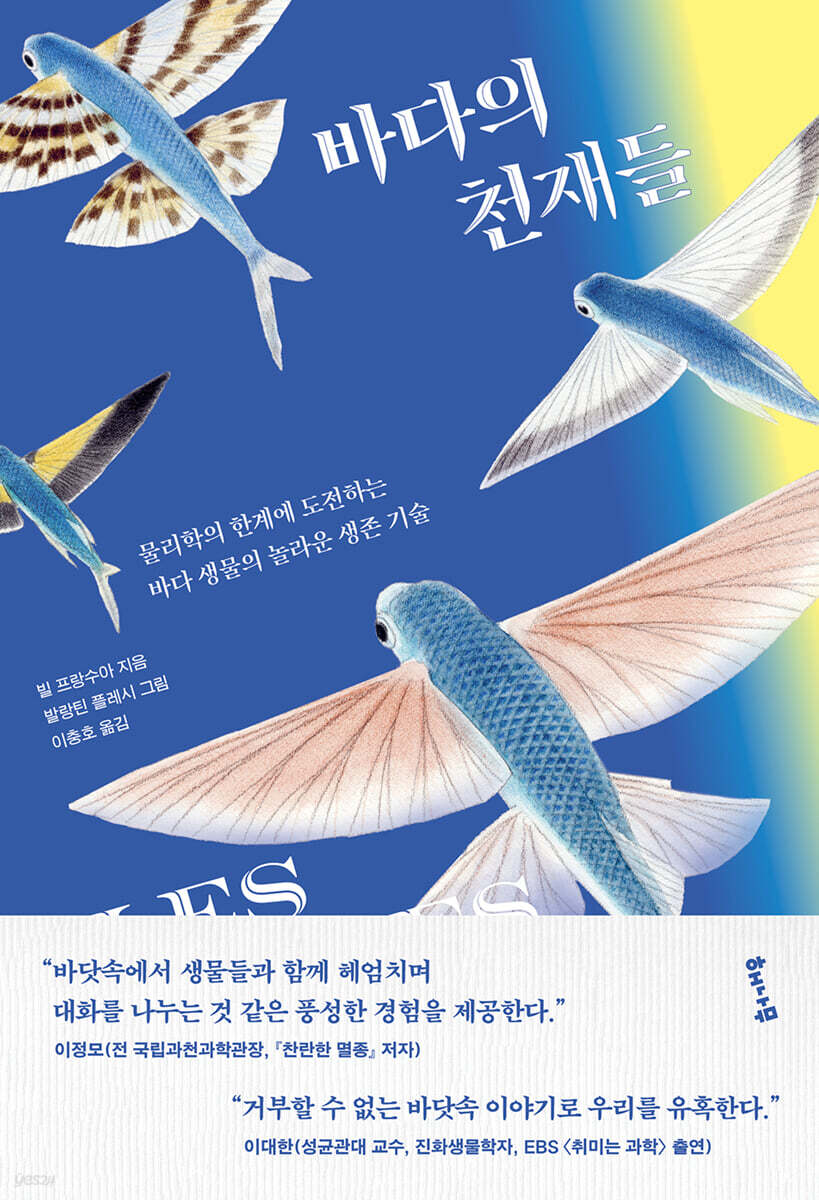
Geniuses of the Sea
 |
Description
Book Introduction
- A word from MD
-
Such amazing and beautiful sea creaturesFrench oratory champion and biophysicist Bill François reveals the fascinating and beautiful creatures of the sea.
Whales dive to depths of 2992m, flying fish glide across the water, salmon swim between rivers and the ocean, and even mantis shrimp can punch at speeds of up to 80km/h.
It's full of fascinating content.
December 27, 2024. Natural Science PD Son Min-gyu
Giant sperm whales and giant squids leisurely diving into the deep sea, schools of anchovies changing formations to confuse predators, flying fish leaping from the seawater and gliding above the surface… … .
The way marine life survives is very different from that of terrestrial life, as their environments are different.
The underwater world still fascinates us, as much of the ocean is hidden from view compared to the land.
"Geniuses of the Sea" is a book that explores the wondrous abilities of sea creatures from a physicist's perspective.
Bill François, a physicist who is fascinated by marine life, uses his signature humor and metaphors to convey the characteristics of the underwater environment and the survival skills of marine life adapted to it from a physical perspective, including matter, force, and energy.
Through vivid paintings created with meticulous observation and sophisticated techniques, we explore the genius of sea creatures who live in ways that are different from our own.
The way marine life survives is very different from that of terrestrial life, as their environments are different.
The underwater world still fascinates us, as much of the ocean is hidden from view compared to the land.
"Geniuses of the Sea" is a book that explores the wondrous abilities of sea creatures from a physicist's perspective.
Bill François, a physicist who is fascinated by marine life, uses his signature humor and metaphors to convey the characteristics of the underwater environment and the survival skills of marine life adapted to it from a physical perspective, including matter, force, and energy.
Through vivid paintings created with meticulous observation and sophisticated techniques, we explore the genius of sea creatures who live in ways that are different from our own.
- You can preview some of the book's contents.
Preview
index
Recommendation
Entering
Part 1: Swimming: From Small Movements to Long Journeys
Cheer_Young fish embarking on a long journey | Deep-sea fish_Champions of deep-sea racing | School_When thousands of fish become one
Part 2: Underwater Environment: Beings that roam the deep and vast waters
Sperm Whale: Athletes Enduring Extreme Pressure | Krill: Marine Cleaners | Salmon: Transformation to Navigate Two Waters
Part 3 Boundary_The boundary between water and air
Checkered Animals_Blue Fleet Boat Race | Flying Fish_A fish that successfully breaks through the surface | Sandpiper_A master at taming water droplets | Albatross_A bird that circumnavigates the world without ever touching land
Part 4 Energy_Everything Changes!
Whales: Polar Thermodynamics | Hydrothermal Vents: Feathered Creatures | Electric Rays: Brilliant Genius
Part 5: The Presence of Light_The Secret of Sunlight
Mantis Shrimp: A Light-Shatterer | Bioluminescence: A Deep-Sea Fireworks | Anchovies: The Perfect Mirror of the Sea
Part 6 All Kinds of Colors_Various Patterns and Shades
Watercolor Paints_The Octopus Painter's Palette | Colorful Fish_The Adventures of Stripes | Screw Clams and Shells_When a Computer Scientist Creates Shell Patterns
Part 7: Perception: The Diverse Senses of Marine Animals
Thousands of Eyes: The Retinas and Pupils of the Marine World | Miger: Jazz Musicians of the Silent World | Shark: The Ability to Perceive the World Around Us in Detail, Anytime, Anywhere
Part 8: Architects: Futurist Architecture and Building Materials
Silk-patterned snails_Extreme collectors | Glass sponges_Architects of Atlantis | Tunicated animals_Cousins in wooden tunics
Part 9: Indomitable Life: Life Defying the Laws of Physics
Flatworms: The Undivided Memory of the Planaria | Immortal Jellyfish: And Other Methuselahs of the Sea | Timeless Species: The Coelacanth and Species from the Distant Past
Going out
Acknowledgements
Image source
Search
Entering
Part 1: Swimming: From Small Movements to Long Journeys
Cheer_Young fish embarking on a long journey | Deep-sea fish_Champions of deep-sea racing | School_When thousands of fish become one
Part 2: Underwater Environment: Beings that roam the deep and vast waters
Sperm Whale: Athletes Enduring Extreme Pressure | Krill: Marine Cleaners | Salmon: Transformation to Navigate Two Waters
Part 3 Boundary_The boundary between water and air
Checkered Animals_Blue Fleet Boat Race | Flying Fish_A fish that successfully breaks through the surface | Sandpiper_A master at taming water droplets | Albatross_A bird that circumnavigates the world without ever touching land
Part 4 Energy_Everything Changes!
Whales: Polar Thermodynamics | Hydrothermal Vents: Feathered Creatures | Electric Rays: Brilliant Genius
Part 5: The Presence of Light_The Secret of Sunlight
Mantis Shrimp: A Light-Shatterer | Bioluminescence: A Deep-Sea Fireworks | Anchovies: The Perfect Mirror of the Sea
Part 6 All Kinds of Colors_Various Patterns and Shades
Watercolor Paints_The Octopus Painter's Palette | Colorful Fish_The Adventures of Stripes | Screw Clams and Shells_When a Computer Scientist Creates Shell Patterns
Part 7: Perception: The Diverse Senses of Marine Animals
Thousands of Eyes: The Retinas and Pupils of the Marine World | Miger: Jazz Musicians of the Silent World | Shark: The Ability to Perceive the World Around Us in Detail, Anytime, Anywhere
Part 8: Architects: Futurist Architecture and Building Materials
Silk-patterned snails_Extreme collectors | Glass sponges_Architects of Atlantis | Tunicated animals_Cousins in wooden tunics
Part 9: Indomitable Life: Life Defying the Laws of Physics
Flatworms: The Undivided Memory of the Planaria | Immortal Jellyfish: And Other Methuselahs of the Sea | Timeless Species: The Coelacanth and Species from the Distant Past
Going out
Acknowledgements
Image source
Search
Detailed image

Into the book
The pages sway in the water like giant, colorful seaweed.
--- From "First Sentence"
From the perspective of a small fish, water is not a fluid that moves as a single mass, but a group of water molecules that move in a disorderly manner, and it must move forward by breaking through them.
And the smaller the fish, the more difficult it is to push the 'balls' away, so the slower it moves.
Moreover, water feels like a very viscous substance to a fish that has just emerged from its egg and is only a few millimeters long.
If we were fish, it would feel like we were swimming in sticky honey.
--- p.25
The first secret to sperm whales conserving energy is their slow pulse.
As soon as you dive, your heart rate slows down.
This is a reflex behavior common to many mammals, even you and me.
Even just splashing a little water on our face slows our heart rate.
This phenomenon may have helped our ancestors gather seafood or aquatic plant stems in the distant past.
In the case of sperm whales, this phenomenon is not simply a reflex, as they appear to have the ability to consciously control their heart rate while diving, slowing it down at will.
This is a skill that any yoga instructor would envy.
--- p.58
When impacting the water, the northern garnet experiences an impact force 23 times the force of gravity.
The moment your head goes into the water, the friction from the water is so great that it can break your neck.
This reckless bird must perfect its landing maneuver every time it dives into the water.
Even a slight deviation from the angle can have fatal consequences.
Fortunately, the northern gannet's body has developed to suit this.
Their pointed beaks are convenient for cutting through the water, and their neck muscles are very strong, allowing them to survive the shock of violent collisions.
--- p.110
Italian physician Luigi Galvani was so intrigued by the fact that electric rays could generate electricity that he began investigating whether other animals could do the same.
In the 1790s, Galvani discovered that the muscles of all animals operate on electricity transmitted through nerves.
Thus, a new scientific discipline called electrophysiology was born, which studied the relationship between animals and electricity.
Much of what we know about the nervous system today began here.
--- p.162
The anchovy's transparent cloak is a perfect mirror.
If you look at the silver layer of anchovies as if you were looking into a bathroom mirror, you would see your own face perfectly reflected.
It will appear to be a mirror far superior to even the best mirror made by a mirror craftsman.
In this way, anchovies reflect the world around them like a mirror and put it on their skin, thereby blending into their surroundings and disappearing into their own image.
But there is something to be careful about.
This magic has to be done perfectly.
Not a single ray of light should be allowed to pass by or pass through!
--- p.192~193
Turing believed that colors could create all these patterns by interacting like prey and predator.
In fact, the information science pioneered by this great mathematician proved this hypothesis decades later.
We used a computer to simulate the phenomenon Turing envisioned.
All you had to do was figure out the parameters at play in this system: the diet of the 'predators', the reproductive capacity of the 'prey', and the size of the animal's skin.
Then the computer showed the results of the calculations to see what pattern came out.
The results were surprising: depending on the values of the parameters, spots, stripes, eyeballs, and mesh patterns appeared on the screen.
In short, all the patterns seen in the animal kingdom appeared, shocking the international scientific community.
--- p.216
Although it is not readily visible to the naked eye, a small gray spot pokes out from the center of one of the scales on the top of the marine iguana's head.
If you look closely, you can see that this tiny dot actually has eye-like structures, including a lens and retina.
Like the eyes on either side of the marine iguana's head, these eyes detect light.
This third eye, called the parietal eye, evolved a very long time ago.
A primitive fish that lived about 450 million years ago, the common ancestor of all vertebrates, already had parietal eyes, which it probably used to detect approaching predators from above.
--- p.235~236
The silky snail is truly an animal that collects other shells.
This mollusk, which appeared in the Cretaceous period, now lives in dozens of species on the ocean floors around the world, from the deepest oceans to the edges of beaches.
They belong to the class Gastropoda, and like their cousins, the snails, horned snails, and screw clams, their shells grow by twisting in a spiral shape.
As the silk snail grows, it places its collection on top of its shell.
--- p.273
Telomere attrition is a major physical limitation that limits the lifespan of organisms.
But lobsters know how to overcome this limitation.
Lobsters produce an enzyme called telomerase, which has the ability to repair damaged telomeres.
In mammals, this enzyme is produced only in stem cells and germ cells, but in lobsters, it is produced in all cells throughout life.
Therefore, cells can divide as many times as they want, and thus never age.
--- From "First Sentence"
From the perspective of a small fish, water is not a fluid that moves as a single mass, but a group of water molecules that move in a disorderly manner, and it must move forward by breaking through them.
And the smaller the fish, the more difficult it is to push the 'balls' away, so the slower it moves.
Moreover, water feels like a very viscous substance to a fish that has just emerged from its egg and is only a few millimeters long.
If we were fish, it would feel like we were swimming in sticky honey.
--- p.25
The first secret to sperm whales conserving energy is their slow pulse.
As soon as you dive, your heart rate slows down.
This is a reflex behavior common to many mammals, even you and me.
Even just splashing a little water on our face slows our heart rate.
This phenomenon may have helped our ancestors gather seafood or aquatic plant stems in the distant past.
In the case of sperm whales, this phenomenon is not simply a reflex, as they appear to have the ability to consciously control their heart rate while diving, slowing it down at will.
This is a skill that any yoga instructor would envy.
--- p.58
When impacting the water, the northern garnet experiences an impact force 23 times the force of gravity.
The moment your head goes into the water, the friction from the water is so great that it can break your neck.
This reckless bird must perfect its landing maneuver every time it dives into the water.
Even a slight deviation from the angle can have fatal consequences.
Fortunately, the northern gannet's body has developed to suit this.
Their pointed beaks are convenient for cutting through the water, and their neck muscles are very strong, allowing them to survive the shock of violent collisions.
--- p.110
Italian physician Luigi Galvani was so intrigued by the fact that electric rays could generate electricity that he began investigating whether other animals could do the same.
In the 1790s, Galvani discovered that the muscles of all animals operate on electricity transmitted through nerves.
Thus, a new scientific discipline called electrophysiology was born, which studied the relationship between animals and electricity.
Much of what we know about the nervous system today began here.
--- p.162
The anchovy's transparent cloak is a perfect mirror.
If you look at the silver layer of anchovies as if you were looking into a bathroom mirror, you would see your own face perfectly reflected.
It will appear to be a mirror far superior to even the best mirror made by a mirror craftsman.
In this way, anchovies reflect the world around them like a mirror and put it on their skin, thereby blending into their surroundings and disappearing into their own image.
But there is something to be careful about.
This magic has to be done perfectly.
Not a single ray of light should be allowed to pass by or pass through!
--- p.192~193
Turing believed that colors could create all these patterns by interacting like prey and predator.
In fact, the information science pioneered by this great mathematician proved this hypothesis decades later.
We used a computer to simulate the phenomenon Turing envisioned.
All you had to do was figure out the parameters at play in this system: the diet of the 'predators', the reproductive capacity of the 'prey', and the size of the animal's skin.
Then the computer showed the results of the calculations to see what pattern came out.
The results were surprising: depending on the values of the parameters, spots, stripes, eyeballs, and mesh patterns appeared on the screen.
In short, all the patterns seen in the animal kingdom appeared, shocking the international scientific community.
--- p.216
Although it is not readily visible to the naked eye, a small gray spot pokes out from the center of one of the scales on the top of the marine iguana's head.
If you look closely, you can see that this tiny dot actually has eye-like structures, including a lens and retina.
Like the eyes on either side of the marine iguana's head, these eyes detect light.
This third eye, called the parietal eye, evolved a very long time ago.
A primitive fish that lived about 450 million years ago, the common ancestor of all vertebrates, already had parietal eyes, which it probably used to detect approaching predators from above.
--- p.235~236
The silky snail is truly an animal that collects other shells.
This mollusk, which appeared in the Cretaceous period, now lives in dozens of species on the ocean floors around the world, from the deepest oceans to the edges of beaches.
They belong to the class Gastropoda, and like their cousins, the snails, horned snails, and screw clams, their shells grow by twisting in a spiral shape.
As the silk snail grows, it places its collection on top of its shell.
--- p.273
Telomere attrition is a major physical limitation that limits the lifespan of organisms.
But lobsters know how to overcome this limitation.
Lobsters produce an enzyme called telomerase, which has the ability to repair damaged telomeres.
In mammals, this enzyme is produced only in stem cells and germ cells, but in lobsters, it is produced in all cells throughout life.
Therefore, cells can divide as many times as they want, and thus never age.
--- p.325
Publisher's Review
★★★ Ranked #1 in the "Plant and Animal Physiology" category on Amazon France immediately after publication.
★★★ Highly recommended by Lee Jeong-mo (author of “Splendid Extinction”) and Lee Dae-han (Professor of Life Sciences, Sungkyunkwan University)!
“Looking into the sea means
“It’s like visiting another planet.”
ㆍThe silver layer of anchovies reflects its surroundings like a perfect mirror.
ㆍLobsters that stay young forever and jellyfish that reverse aging
ㆍA shark's sense of water movement throughout its body
A screw-shaped oyster with logical rules engraved on its shell
The albatross that travels around the world without ever touching the ground
The wonders of sea life through the eyes of a physicist
Encounter a life form completely different from ours
“Humans have deciphered some of our most secret technologies,” said the mermaid.
“How on earth did you find out all this information?” asked the octopus.
“They seem to have a very efficient extension cord.
“One is biology and the other is physics.”
Giant sperm whales and giant squids leisurely diving into the deep sea, schools of anchovies changing formations to confuse predators, flying fish leaping from the seawater and gliding above the surface… … .
The way marine life survives is very different from that of terrestrial life, as their environments are different.
What does the marine world look like? While much is unknown about the ocean compared to land, the underwater world still fascinates us.
"Geniuses of the Sea" is a book that explores the wondrous abilities of sea creatures from a physicist's perspective.
If biology acts as a kind of magnifying glass by classifying living things and describing the functions of every part in detail, physics, by its nature of trying to explain everything through laws, tries to find simple principles that permeate all entities.
Physicist Bill François, fascinated by marine life, uses his signature humor and metaphors to convey the physical characteristics of the underwater environment and the survival skills of marine life adapted to it in a delightful way.
Through vivid illustrations created with meticulous observation and sophisticated techniques, we explore the amazing abilities of sea creatures that live in ways that are different from our own.
Why is the world's largest animal in the ocean?
There's a physical reason for the appearance and survival skills of sea creatures.
The largest animal in the world is known as the blue whale.
The largest land animal of all time, the dinosaur Argentinosaurus, is estimated to have weighed around 80 tons, while the blue whale weighed twice that much.
Why don't creatures the size of a blue whale exist on land? There's a physical reason for this.
Because terrestrial organisms are affected by gravity.
Animals need muscles to move, but if the weight of the muscles increases, the bones will have a hard time supporting it, and if the skeleton increases along with the muscles, the body will become heavy and impossible to move.
Ultimately, giant animals are bound to be found in the ocean, where they are relatively free from the influence of gravity.
This book introduces various species of creatures that have evolved in the underwater environment of the ocean, and explains their appearance and survival techniques from a physicist's perspective.
From a physical perspective, such as matter, force, and energy, the underwater environment has very different constraints than the terrestrial environment where we live, and marine life has evolved to develop a lifestyle suited to the underwater environment.
Through this book, you can vividly experience the lives of marine life, including tiny fry that experience swimming in honey as soon as they are born, tuna that can never stop swimming, flying fish that break through the water's surface, and bioluminescent animals that emit light in the dark deep sea.
You will come to realize that marine life is precious in itself as a part of nature.
From the invention of the battery to the invisibility cloak and the secret to staying young.
The extraordinary abilities of sea creatures to expand human knowledge
Considering that we struggle to survive underwater for even a few minutes, the sheer number of creatures that roam the ocean is truly awe-inspiring.
Marine life has always aroused curiosity and wonder, and as we explore the secrets of their extraordinary abilities, we naturally acquire knowledge about their principles.
The discovery of the electric ray's mysterious abilities gave birth to a new scientific field called electrophysiology and led to the invention of the first battery.
Today, it is known that the silvery layer of anchovy skin reflects light like a mirror, allowing the fish to blend into the background and disappear, offering very promising possibilities for engineers designing equipment.
Additionally, biologists have discovered that lobsters, which live up to 200 years, maintain their youth by producing an enzyme called telomerase throughout their body's cells throughout their lives, which prevents chromosome damage, unlike mammals.
This book shows how simple principles discovered in the diverse abilities of marine creatures can open up new possibilities for us.
From the logical rules of pattern patterns on fish bodies and shells, to the collective intelligence discovered in the movements of schools of fish, to the senses of sharks that detect the movement of water throughout their bodies, this book will expand your thinking by observing marine life at the intersection of biology, evolution, and physics.
Where can you apply your knowledge of marine life?
Why We Need Wisdom to Live Together
Krill, a tiny vegetarian shrimp, and whales, a massive animal, play a vital role in processing carbon, a major contributor to the climate crisis.
Carbon dioxide in the atmosphere dissolves into the ocean surface, and phytoplankton convert the carbon dioxide dissolved in the water into organic matter through photosynthesis.
Krill consume these phytoplankton and capture some of the carbon dioxide within their bodies.
The role of krill in contributing to the Earth's climate is demonstrated in the following process: the shells shed during molting and the excrement they excrete accumulate and remain at the bottom of the deep sea.
You might wonder how much impact these tiny creatures have on the Earth's environment, but their numbers are staggering, processing an estimated 23 million tonnes of carbon in the Southern Ocean alone.
Meanwhile, whales eat more than 6 tons of krill every day, fixing carbon dioxide into their bodies.
Later, when the whale dies, the carbon sinks to the bottom of the ocean along with the whale's body.
Throughout the book, author Bill François raises awareness of the extinction of marine life and the ecological crisis caused by overfishing and habitat destruction.
Horseshoe crabs are hunted by the thousands in the United States alone today for their blood, which is believed to be useful in vaccine testing, but only recently has a synthetic substitute been developed.
Less than 50 years after the discovery of hydrothermal vents on the seafloor, investors and industrialists seeking to exploit the minerals are preparing to apply for mining permits, while scientists and international nongovernmental organizations are working to slow the process.
In this book, the author points out that knowledge about marine life can be a force that destroys nature or a force that saves nature, depending on how we use it.
Krill and whales may not be able to solve global warming, but if more people recognize that many marine species play a role in the carbon cycle, we can work together to find ways to use the oceans to protect them.
Let's meet the colorful creatures living in the sea through this book.
This book, imbued with a love for marine life, will make the wonder itself a compelling reason to protect the marine ecosystem.
★★★ Highly recommended by Lee Jeong-mo (author of “Splendid Extinction”) and Lee Dae-han (Professor of Life Sciences, Sungkyunkwan University)!
“Looking into the sea means
“It’s like visiting another planet.”
ㆍThe silver layer of anchovies reflects its surroundings like a perfect mirror.
ㆍLobsters that stay young forever and jellyfish that reverse aging
ㆍA shark's sense of water movement throughout its body
A screw-shaped oyster with logical rules engraved on its shell
The albatross that travels around the world without ever touching the ground
The wonders of sea life through the eyes of a physicist
Encounter a life form completely different from ours
“Humans have deciphered some of our most secret technologies,” said the mermaid.
“How on earth did you find out all this information?” asked the octopus.
“They seem to have a very efficient extension cord.
“One is biology and the other is physics.”
Giant sperm whales and giant squids leisurely diving into the deep sea, schools of anchovies changing formations to confuse predators, flying fish leaping from the seawater and gliding above the surface… … .
The way marine life survives is very different from that of terrestrial life, as their environments are different.
What does the marine world look like? While much is unknown about the ocean compared to land, the underwater world still fascinates us.
"Geniuses of the Sea" is a book that explores the wondrous abilities of sea creatures from a physicist's perspective.
If biology acts as a kind of magnifying glass by classifying living things and describing the functions of every part in detail, physics, by its nature of trying to explain everything through laws, tries to find simple principles that permeate all entities.
Physicist Bill François, fascinated by marine life, uses his signature humor and metaphors to convey the physical characteristics of the underwater environment and the survival skills of marine life adapted to it in a delightful way.
Through vivid illustrations created with meticulous observation and sophisticated techniques, we explore the amazing abilities of sea creatures that live in ways that are different from our own.
Why is the world's largest animal in the ocean?
There's a physical reason for the appearance and survival skills of sea creatures.
The largest animal in the world is known as the blue whale.
The largest land animal of all time, the dinosaur Argentinosaurus, is estimated to have weighed around 80 tons, while the blue whale weighed twice that much.
Why don't creatures the size of a blue whale exist on land? There's a physical reason for this.
Because terrestrial organisms are affected by gravity.
Animals need muscles to move, but if the weight of the muscles increases, the bones will have a hard time supporting it, and if the skeleton increases along with the muscles, the body will become heavy and impossible to move.
Ultimately, giant animals are bound to be found in the ocean, where they are relatively free from the influence of gravity.
This book introduces various species of creatures that have evolved in the underwater environment of the ocean, and explains their appearance and survival techniques from a physicist's perspective.
From a physical perspective, such as matter, force, and energy, the underwater environment has very different constraints than the terrestrial environment where we live, and marine life has evolved to develop a lifestyle suited to the underwater environment.
Through this book, you can vividly experience the lives of marine life, including tiny fry that experience swimming in honey as soon as they are born, tuna that can never stop swimming, flying fish that break through the water's surface, and bioluminescent animals that emit light in the dark deep sea.
You will come to realize that marine life is precious in itself as a part of nature.
From the invention of the battery to the invisibility cloak and the secret to staying young.
The extraordinary abilities of sea creatures to expand human knowledge
Considering that we struggle to survive underwater for even a few minutes, the sheer number of creatures that roam the ocean is truly awe-inspiring.
Marine life has always aroused curiosity and wonder, and as we explore the secrets of their extraordinary abilities, we naturally acquire knowledge about their principles.
The discovery of the electric ray's mysterious abilities gave birth to a new scientific field called electrophysiology and led to the invention of the first battery.
Today, it is known that the silvery layer of anchovy skin reflects light like a mirror, allowing the fish to blend into the background and disappear, offering very promising possibilities for engineers designing equipment.
Additionally, biologists have discovered that lobsters, which live up to 200 years, maintain their youth by producing an enzyme called telomerase throughout their body's cells throughout their lives, which prevents chromosome damage, unlike mammals.
This book shows how simple principles discovered in the diverse abilities of marine creatures can open up new possibilities for us.
From the logical rules of pattern patterns on fish bodies and shells, to the collective intelligence discovered in the movements of schools of fish, to the senses of sharks that detect the movement of water throughout their bodies, this book will expand your thinking by observing marine life at the intersection of biology, evolution, and physics.
Where can you apply your knowledge of marine life?
Why We Need Wisdom to Live Together
Krill, a tiny vegetarian shrimp, and whales, a massive animal, play a vital role in processing carbon, a major contributor to the climate crisis.
Carbon dioxide in the atmosphere dissolves into the ocean surface, and phytoplankton convert the carbon dioxide dissolved in the water into organic matter through photosynthesis.
Krill consume these phytoplankton and capture some of the carbon dioxide within their bodies.
The role of krill in contributing to the Earth's climate is demonstrated in the following process: the shells shed during molting and the excrement they excrete accumulate and remain at the bottom of the deep sea.
You might wonder how much impact these tiny creatures have on the Earth's environment, but their numbers are staggering, processing an estimated 23 million tonnes of carbon in the Southern Ocean alone.
Meanwhile, whales eat more than 6 tons of krill every day, fixing carbon dioxide into their bodies.
Later, when the whale dies, the carbon sinks to the bottom of the ocean along with the whale's body.
Throughout the book, author Bill François raises awareness of the extinction of marine life and the ecological crisis caused by overfishing and habitat destruction.
Horseshoe crabs are hunted by the thousands in the United States alone today for their blood, which is believed to be useful in vaccine testing, but only recently has a synthetic substitute been developed.
Less than 50 years after the discovery of hydrothermal vents on the seafloor, investors and industrialists seeking to exploit the minerals are preparing to apply for mining permits, while scientists and international nongovernmental organizations are working to slow the process.
In this book, the author points out that knowledge about marine life can be a force that destroys nature or a force that saves nature, depending on how we use it.
Krill and whales may not be able to solve global warming, but if more people recognize that many marine species play a role in the carbon cycle, we can work together to find ways to use the oceans to protect them.
Let's meet the colorful creatures living in the sea through this book.
This book, imbued with a love for marine life, will make the wonder itself a compelling reason to protect the marine ecosystem.
GOODS SPECIFICS
- Date of issue: December 20, 2024
- Page count, weight, size: 352 pages | 540g | 153*224*22mm
- ISBN13: 9791164052950
You may also like
카테고리
korean


korean

![GQ KOREA Mark (Monthly): December [2025]](http://librairie.coreenne.fr/cdn/shop/files/8ef265dbbfbf186523ed75ba7319009d.jpg?v=1765340328&width=3840)


