

What Jazz Tells Me
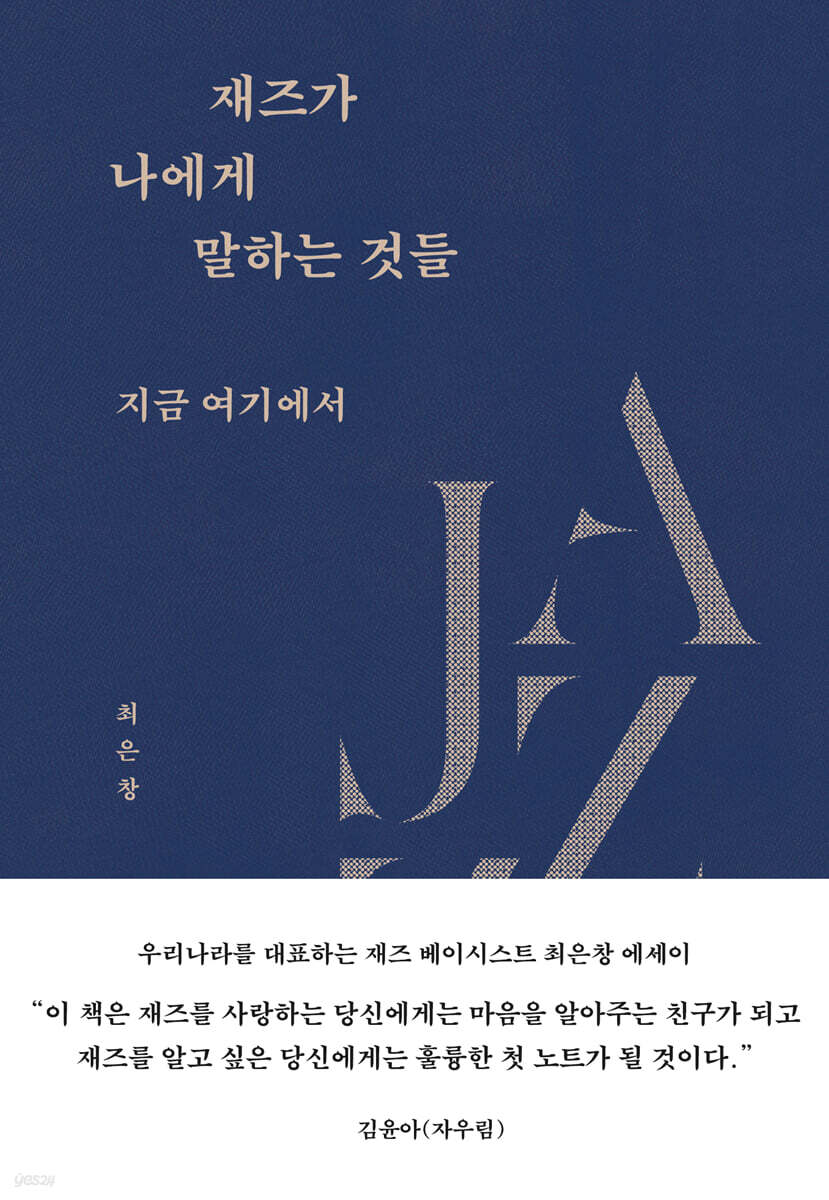 |
Description
Book Introduction
* Recommended by singer Kim Yoon-ah (Jaurim)
* In an age of chaos and conflict, a jazz bassist delivers a profound message.
* Jazz, a guide for those who don't know where to start or how to listen
Even if you don't know much about jazz, there's probably no one who hasn't heard of it at least once.
Jazz is a familiar music to our ears, as it is the main subject of movies such as Pixar's animation [Soul], the movie [Whiplash], and [Blue Giant], as background music in advertisements, and as background music in cafes.
However, if you ask what kind of music jazz is, many people will tilt their heads in confusion.
What kind of music is jazz, and where and how should I start listening to it?
This book is a record of reflections on the connection between life and jazz by Choi Eun-chang, a representative jazz bassist of our country and a jazz teacher at an art college, over the course of over 20 years of performing, and is also a jazz guide for those who want to learn about jazz and listen to it better.
Singer Kim Yuna (Jaurim) recommended the book, saying, “What Jazz Tells Me” is a friendly introduction to jazz studies, and “for those who love jazz, it will be a friend who understands their heart, and for those who want to know more about jazz, it will be a great first notebook.”
- You can preview some of the book's contents.
Preview
index
Recommendation
Author's Note
Prologue - A Few Things You Should Know About Jazz
01.
What is Jazz
02.
Swing Feel, kind of vague
If there is a correct answer in swing feel [Basic Straight Ahead]
03.
The blues speaks to the world
Some jazz makes believers [Crescent]
04.
Improvisation is done in a moderately quick manner
Let's do it our way [Double Rainbow: The Music of Antonio Carlos Jobim]
05.
Get lost here and now
They walked an unfamiliar road together [Footprints Live!]
06.
The Art of Negotiation
Different Thoughts [The Water Is Wide]
07.
How to approach the barrier called jazz
Overwhelming Difference [The Art Of The Trio vol.
4]
08.
Playing jazz in Korea
Jazz isn't locked in a museum [Music Evolution]
09.
Having a style
A style that is complete from the beginning [Word of Mouth]
10.
Even though we are at odds with the times
Focus, Focus, Focus [Waltz For Debby]
11.
Walking in quarter notes
One-third or more [We Three]
12.
Again, what is jazz?
Jazz artists featured in this book
Detailed image

Into the book
Rather, these are writings that show the process of struggling to get to the essence of jazz music, and leave behind personal realizations that can be considered tentative conclusions.
As you read it, I hope that as you develop some positive and some negative opinions, your own answers to the question, "What is jazz?" will begin to take shape in your minds.
And whenever a question arises that seems to be a bit vague, I think it would be incredibly satisfying if we could open our hearts and listen carefully to the question, 'Is that really true?'
We who listen to jazz are people who observe with our ears and accept with our hearts.
---From the "Prologue"
If you ever find yourself thinking, 'Should I listen to this album again after a long time?', then it's definitely a day when you want to ride the waves of pleasantly swaying rhythm.
It may have been a day when your heart feels calm, or on the contrary, it may have been a day when your heart feels very excited by the spring breeze.
As soon as you press play, this album lives up to your expectations from the very first song.
As I listen to a few truly impressive songs and the moderately impressive ones that fill the gaps between them, I find myself wondering, 'Is there anyone who can listen to music like this without nodding or bobbing their head?'
It's quite special to rediscover music I already know, yet still feel the same level of satisfaction.
---「If there is a correct answer to swing feel, from [Basie Straight Ahead]」
It is not an easy agreement, but a compromise after persistent negotiation, a struggle to acknowledge and accept beings different from me while not losing my own identity, and the unexpected results that come from that power struggle are the art of negotiation, the skill of negotiation, and in other words, jazz.
Belatedly, I must hone my negotiation skills, if I may admit that this is the essence of jazz.
---From "The Art of Negotiation"
Storytelling, maybe that's the essence of the blues.
Storytelling is throwing my moderately polished story out into the world.
I complete the lyrics with meaning, word by word, and then put a melody on top of them to share with the people.
That was natural back when blues was still folk music, literally the music of the people.
---From "Blues Speaks to the World"
In this age of visuals, jazz, which features complex harmonies, melodies, and rhythms played over long periods of time using acoustic instruments, is not easily resonant with many people.
Still, the reason I go to jazz clubs every day and play with all my might is because I never gave up on the hope that I might meet one or two audience members who wholeheartedly embrace this music.
Even though jazz is experiencing a conflict with the times, I still believe that there is great value in this music.
---From "Even if we are at odds with the times"
It has already been several decades since jazz was gradually pushed out of the center of popular music.
There was a time when a bass player with great quarter notes was welcomed by everyone, but now the world has become one where not many people appreciate their value.
So, am I truly living in the present, or am I vaguely reliving the glorious past? I mutter, "There's a profound meaning here, though you might not be able to relate to it now."
---From "Walking in Quarter Notes"
Publisher's Review
- Recommended by singer Kim Yoon-ah (Jaurim)
- In an age of chaos and conflict, a jazz bassist delivers a profound message.
- Jazz is an extremely social music.
Choi Eun-chang, a representative jazz bassist of South Korea, has published a book.
There have been occasional jazz books written by jazz enthusiasts or jazz critics, such as 『Season of Jazz』, 『Jazz It Up』, and 『Jazz Over Rice』, but there are few books written by domestic jazz players that reflect on the music of jazz by linking it to their own lives, so jazz enthusiasts are very interested in them.
The life of Choi Eun-chang, known as the best bassist in the Korean jazz scene, resembles jazz.
After graduating from the Department of Social Education at Seoul National University, he majored in jazz at the University of North Texas Graduate School and began his career as a performer somewhat late in life.
After graduation, he toured with bands across the country, including the Blue Note in New York.
Since returning to Korea in 2005, he has played in several jazz bands and has also been a sideman for singer Kim Yuna for over ten years.
He has also participated as a session musician in performances and albums by various artists, including Kim Deok-su, Sung Si-kyung, and Yiruma.
In 2009, he formed the jazz funk band JSFA, produced two full-length albums and a single, and performed at many jazz festivals both domestically and internationally, including the Tokyo Jazz Festival, Seoul Jazz Festival, Jaraseom Jazz Festival, and Hong Kong Jazz Festival.
As a bassist, the author focuses on the world of quarter notes.
When a jazz bassist plays a swing rhythm, it means he or she is constantly playing quarter notes.
In jazz performances, which are mainly led by soloists and drummers, the bassist simply listens to their conversation and rarely steps forward to make his own point.
But when a talented bass player supports the quarter note, their playing becomes smooth and the audience opens their hearts.
While few people pay attention to the low, monotonous playing of a bassist, the author's story of believing that there is meaning in consistently repeating this act while focusing on creating a wave of good performances from other band members comes to us with a profound feeling in an age of chaos and conflict.
Having played jazz for over 20 years and taught at an art college, the author believes that jazz is an extremely social music.
The author says that jazz is the struggle to acknowledge and accept other beings in order to be together with others, while not losing my own identity, and the unexpected results that come from that struggle are what make jazz.
Jazz: A Guide for Those Who Don't Know Where to Start
The author hopes that this book will serve as a starting point for anyone who wants to listen to jazz, and as a guide for those who want to go one step further and enjoy jazz. He has laid out various devices to help those who feel lost.
The prologue provides basic knowledge about the genre of jazz, and provides in-depth annotations that provide explanations that go beyond common sense.
As a jazz guide, the book's crowning glory are the author's carefully curated selection of ten jazz albums.
It gives you the opportunity to appreciate the diverse spectrum and styles of jazz at once.
The kind and detailed explanation of the album, which you will not find anywhere else, is as good as any docent.
In addition, the list of jazz artists included in the appendix is so comprehensive that you can acquire a wealth of jazz knowledge just by browsing through this list.
As recommended by Kim Yuna, the vocalist and singer of the rock band Jaurim, “This book will be a friend who understands your heart and a great first notebook for those who want to learn about jazz.”
GOODS SPECIFICS
- Date of issue: December 20, 2024
- Format: Hardcover book binding method guide
- Page count, weight, size: 276 pages | 498g | 135*195*23mm
- ISBN13: 9791193865101
- ISBN10: 1193865107
You may also like
카테고리
korean


korean


