

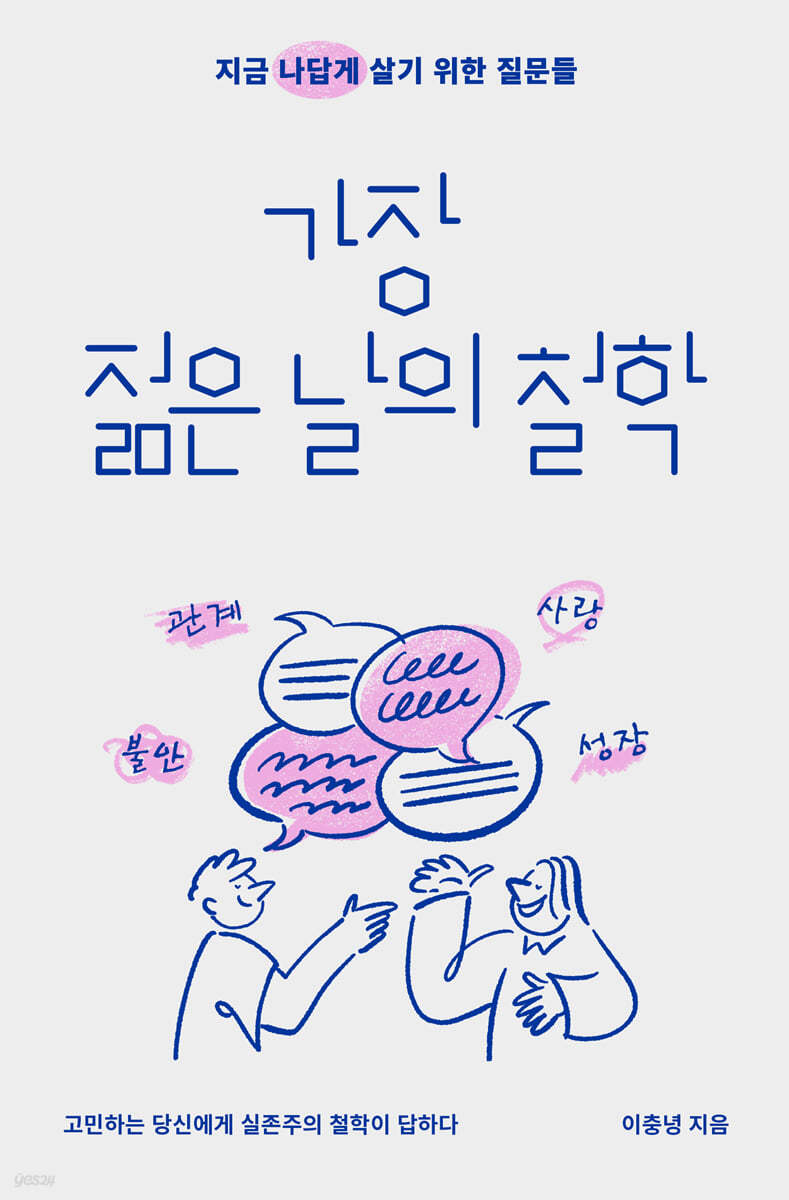
Philosophy of the Youngest Days
 |
Description
Book Introduction
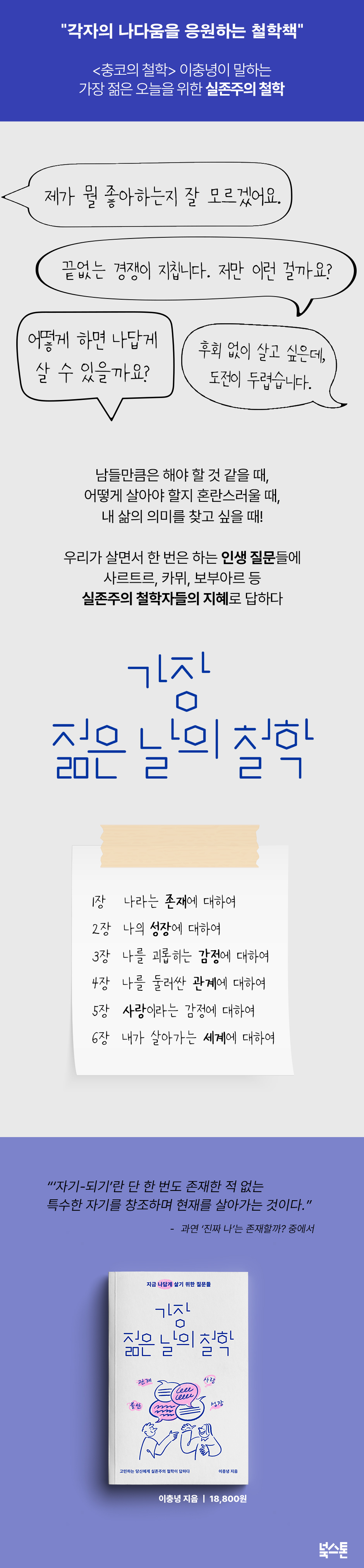
When you think, 'I should do as much as others' When you're tired of wondering 'How far should I go?' An existentialist philosophy that supports each person's differences Although we are moving towards a society that respects diversity, Korean society still feels the implicit expectation and burden of having to "be like everyone else." And at every moment of life, we compete fiercely with each other. If you pursue things that many people say are good, such as a good university, a big company, and a high salary, you will naturally start to wonder, "What is the meaning of my life?" But since we've never had these conversations, I'm plagued by anxiety, wondering, 'Am I the only one struggling with this?' As time goes by, I tend to get confused as to whether the things I have been pursuing up until now are really the goals I want. Lee Chung-nyeong, author of "Chungko's Philosophy," which has 180,000 subscribers, a rare number for a philosophy channel, talks about these anxieties, worries, and questions through existentialism. Why do we consider these questions, so intimately connected to our lives, through existentialism? Because, above all, existentialism focuses on the uniqueness and essence of human beings, making it the ideal philosophical ideology for deeply contemplating the meaning of our lives. The author focuses on real-world issues rather than philosophical theories, answering 24 questions we must consider in life through existentialism. When we are asked to walk a set path, I hope this book, which encourages each person's differences and explores them together, will help us find our own answers. I hope that the time you spend with this book will become a small dot in the course of your life. |
- You can preview some of the book's contents.
Preview
index
Opening Remarks | Discovering Differences
1.
About the existence of the country
What is individuality?
How can I live freely?
Does the 'real me' really exist?
2.
About my growth
Should I do what I'm good at rather than what I like?
How much experience do I need to gain?
How do I know if I am growing?
3.
About the feelings that bother me
How can we overcome failure?
How to deal with fear?
Can we escape the pain of the past?
How to overcome loneliness?
4.
About the relationships surrounding me
How can we be free from the gaze of others?
Why do we drift apart from old friends?
What are the benefits of living a good life?
How should I live so as not to become an old fart?
5.
About the feeling called love
Can love change someone?
How do you know if you really love someone?
Which brings more happiness, giving love or receiving it?
Can you learn about love from dating shows?
Should I forgive my lover's betrayal?
6.
About the world I live in
Money or dreams, which is more important?
In an age where creativity is crucial, how can we demonstrate it?
Is self-branding a win or a loser?
Can you have life experiences while traveling?
What is meaningful success?
Closing Remarks | Looking into Myself
annotation
1.
About the existence of the country
What is individuality?
How can I live freely?
Does the 'real me' really exist?
2.
About my growth
Should I do what I'm good at rather than what I like?
How much experience do I need to gain?
How do I know if I am growing?
3.
About the feelings that bother me
How can we overcome failure?
How to deal with fear?
Can we escape the pain of the past?
How to overcome loneliness?
4.
About the relationships surrounding me
How can we be free from the gaze of others?
Why do we drift apart from old friends?
What are the benefits of living a good life?
How should I live so as not to become an old fart?
5.
About the feeling called love
Can love change someone?
How do you know if you really love someone?
Which brings more happiness, giving love or receiving it?
Can you learn about love from dating shows?
Should I forgive my lover's betrayal?
6.
About the world I live in
Money or dreams, which is more important?
In an age where creativity is crucial, how can we demonstrate it?
Is self-branding a win or a loser?
Can you have life experiences while traveling?
What is meaningful success?
Closing Remarks | Looking into Myself
annotation
Detailed image
Into the book
Philosophy is often considered a 'cloud-clutching' exercise.
That's actually true.
Because many kinds of philosophy have nothing to do with the problems that face us right now.
Philosophy was long the preserve of the aristocracy, and it was centered on the macroscopic views of society and the origins and nature of the universe, developed from an elite perspective by those who had no worries about making a living.
But existentialism is different.
It deals with themes such as loneliness, anxiety, worries about the future, and moments of choice that everyone experiences at every moment.
So there are a lot of points that I can relate to.
--- From "Discovering Differences"
You don't have to pursue something special to live your life as yourself.
There are people who think that in order to be themselves, they must take a different path from others.
That means you have to choose a unique career path or have special tastes.
What's the basis for this thinking? Sometimes, conforming to the system established by others can be the truest choice for me.
In this regard, Pascal's 'spirit of humility' also provides important teachings.
Pascal distinguished between the 'half-wise' and the 'truly wise'.
According to his view, a half-wise person only evaluates negatively the existing system followed by the masses.
You think you have to think differently from others to be better.
On the other hand, truly wise people know how to evaluate the existing system positively.
We also acknowledge our own helplessness and the complexity of the world.
I know it's not easy to improve the situation with new solutions.
I understand that even though the current system is not perfect, it has maintained itself until now because it has some rationality.
I acknowledge that there are many times when it is better to preserve the existing order rather than to destroy it.
--- From "What is individuality?"
In fact, we know very well when we become better versions of ourselves.
It's a perfectly reasonable belief that making small improvements in your physical and mental health, relationships, academics, and work will lead to a happier life.
It is also a standard derived from the long wisdom of mankind.
However, it is important to be aware that even these self-evident standards can change.
Even if the self-evident standard itself does not change, the way it is interpreted can vary.
For example, the meaning of 'mental health' is variable.
Being aware of that diversity is directly linked to a critical awareness of oneself.
Recognizing that the standards I currently hold can be interpreted in many ways, and may be incorrect from some perspectives, is the deepest level of self-awareness.
When we forget this mutability, life degenerates into violent totalitarianism.
--- From "How do I know if I'm growing?"
Anyone who tries to look deep into themselves knows that they are by no means simple.
You know that life is just being thrown into an ignorance of yourself that you can never overcome.
So you become open to the different facets of your self.
In other words, you know that you can become a little different person than you are now at any time.
Kierkegaard was able to write from the perspective of a completely different person because he wanted to sink deep into the infinite darkness of his inner self.
--- From "How should I live to avoid becoming an old fart?"
I believe that love has a special power to transform people.
Because love fosters self-awareness.
Love is the process of accepting a mirror in my life.
The person we love is placed opposite us as a mirror that reflects us.
Through that person, we see ourselves from a new angle.
Also, in a loving relationship, a new self called 'we' is created, and I look at my life from the perspective of 'we'.
If, up until now, the survival and happiness of 'me' were the purpose and main concern of life, when we love, 'our' past, present, and future emerge as important.
That's actually true.
Because many kinds of philosophy have nothing to do with the problems that face us right now.
Philosophy was long the preserve of the aristocracy, and it was centered on the macroscopic views of society and the origins and nature of the universe, developed from an elite perspective by those who had no worries about making a living.
But existentialism is different.
It deals with themes such as loneliness, anxiety, worries about the future, and moments of choice that everyone experiences at every moment.
So there are a lot of points that I can relate to.
--- From "Discovering Differences"
You don't have to pursue something special to live your life as yourself.
There are people who think that in order to be themselves, they must take a different path from others.
That means you have to choose a unique career path or have special tastes.
What's the basis for this thinking? Sometimes, conforming to the system established by others can be the truest choice for me.
In this regard, Pascal's 'spirit of humility' also provides important teachings.
Pascal distinguished between the 'half-wise' and the 'truly wise'.
According to his view, a half-wise person only evaluates negatively the existing system followed by the masses.
You think you have to think differently from others to be better.
On the other hand, truly wise people know how to evaluate the existing system positively.
We also acknowledge our own helplessness and the complexity of the world.
I know it's not easy to improve the situation with new solutions.
I understand that even though the current system is not perfect, it has maintained itself until now because it has some rationality.
I acknowledge that there are many times when it is better to preserve the existing order rather than to destroy it.
--- From "What is individuality?"
In fact, we know very well when we become better versions of ourselves.
It's a perfectly reasonable belief that making small improvements in your physical and mental health, relationships, academics, and work will lead to a happier life.
It is also a standard derived from the long wisdom of mankind.
However, it is important to be aware that even these self-evident standards can change.
Even if the self-evident standard itself does not change, the way it is interpreted can vary.
For example, the meaning of 'mental health' is variable.
Being aware of that diversity is directly linked to a critical awareness of oneself.
Recognizing that the standards I currently hold can be interpreted in many ways, and may be incorrect from some perspectives, is the deepest level of self-awareness.
When we forget this mutability, life degenerates into violent totalitarianism.
--- From "How do I know if I'm growing?"
Anyone who tries to look deep into themselves knows that they are by no means simple.
You know that life is just being thrown into an ignorance of yourself that you can never overcome.
So you become open to the different facets of your self.
In other words, you know that you can become a little different person than you are now at any time.
Kierkegaard was able to write from the perspective of a completely different person because he wanted to sink deep into the infinite darkness of his inner self.
--- From "How should I live to avoid becoming an old fart?"
I believe that love has a special power to transform people.
Because love fosters self-awareness.
Love is the process of accepting a mirror in my life.
The person we love is placed opposite us as a mirror that reflects us.
Through that person, we see ourselves from a new angle.
Also, in a loving relationship, a new self called 'we' is created, and I look at my life from the perspective of 'we'.
If, up until now, the survival and happiness of 'me' were the purpose and main concern of life, when we love, 'our' past, present, and future emerge as important.
--- From "Can Love Change Someone?"
Publisher's Review
I want to live for myself!
But what if I don't know what I like?
Gone are the days when the main goal was to have a stable life by getting a job at the right time, starting a family, and having children.
Now is the time when living a life 'my way' is receiving attention.
The objects of admiration for young people have now shifted to those who have forged their own path.
Even in the public sphere, individuality began to be demanded.
In addition to the qualifications you have painstakingly built up, your self-introduction should include something that sets you apart from others, and in interviews, you may be asked what you are "digging for."
The problem is that many people are confused because they don't know what they should pursue in order to live their lives as themselves.
The younger generation, who have little experience making independent choices to live a life for themselves and their own, have deeper concerns.
"I don't know what I like." This is the one sentence that summarizes the questions that come up on the philosophy channel "Chungko's Philosophy," which has 190,000 subscribers.
I don't know what I should pursue in life to be happy.
What choices should I make to avoid regret? How can I find what I love? This book answers these questions, which we all face at least once in our lives, through existentialist philosophy.
To make today, the youngest day, the most me-like day
A message of encouragement from philosophy to you
“How can I properly look at myself?”
“Should I choose between doing what I like and doing what I’m good at?”
“How can we create our own identity in everyday life?”
“How can I overcome failure and grow further?”
The author suggests that we look into the answer to these concerns through existentialist philosophy.
The reason I talk about existentialism among many other thoughts is because existentialist philosophers such as Sartre, Camus, and Beauvoir thought more fiercely about 'human differences' and 'a life that is true to oneself' than any other thinker, and lived such lives.
Their keen insight still shines in our modern lives.
Don't worry too much about whether the philosophical answer will be difficult or ambiguous.
As befitting the author's track record of easily conveying philosophy to the public that can be of practical help in our lives, he presents a clear baseline.
For example, among things you like to do and things you are good at, the author recommends that it is also advisable to focus on things you are good at.
This is advice that is not commonly found in self-help books that preach 'being yourself'.
Heidegger's philosophy is explained in an easy-to-understand way to explain why he recommends it so much.
Finally, it emphasizes the communal nature of philosophical thinking while solving problems.
This book, which began with the concerns of those in their 20s and 30s and answered them with the author's philosophical knowledge, is the result of the entire 2030 generation sharing their concerns with others.
There is no such thing as 'pure solitude' in life, and we have already reached this moment by influencing and being influenced by countless people.
Our worries are also given in coexistence with others, and my worries are not just mine but also those of others.
When we think about 'being unique', this is why we all need to think about it together.
I hope this book will help you share your concerns with each other and help you move forward toward becoming the center of your own life.
Why should you read philosophy when you're young? Philosophy is the power to think for yourself.
With that power, it protects us from being 'eaten by anxiety', as the movie title suggests.
Isn't today, when neither the company, nor the country, nor any group ultimately protects me, the era of the "alone beings" that existentialist philosophers speak of?
In this ever-changing world where yesterday's rules no longer apply, one-time self-improvement prescriptions are not enough to protect and live.
This is why we should read philosophy as a living guide to life, not confined to textbooks, and why we should read philosophy especially when we are young.
But what if I don't know what I like?
Gone are the days when the main goal was to have a stable life by getting a job at the right time, starting a family, and having children.
Now is the time when living a life 'my way' is receiving attention.
The objects of admiration for young people have now shifted to those who have forged their own path.
Even in the public sphere, individuality began to be demanded.
In addition to the qualifications you have painstakingly built up, your self-introduction should include something that sets you apart from others, and in interviews, you may be asked what you are "digging for."
The problem is that many people are confused because they don't know what they should pursue in order to live their lives as themselves.
The younger generation, who have little experience making independent choices to live a life for themselves and their own, have deeper concerns.
"I don't know what I like." This is the one sentence that summarizes the questions that come up on the philosophy channel "Chungko's Philosophy," which has 190,000 subscribers.
I don't know what I should pursue in life to be happy.
What choices should I make to avoid regret? How can I find what I love? This book answers these questions, which we all face at least once in our lives, through existentialist philosophy.
To make today, the youngest day, the most me-like day
A message of encouragement from philosophy to you
“How can I properly look at myself?”
“Should I choose between doing what I like and doing what I’m good at?”
“How can we create our own identity in everyday life?”
“How can I overcome failure and grow further?”
The author suggests that we look into the answer to these concerns through existentialist philosophy.
The reason I talk about existentialism among many other thoughts is because existentialist philosophers such as Sartre, Camus, and Beauvoir thought more fiercely about 'human differences' and 'a life that is true to oneself' than any other thinker, and lived such lives.
Their keen insight still shines in our modern lives.
Don't worry too much about whether the philosophical answer will be difficult or ambiguous.
As befitting the author's track record of easily conveying philosophy to the public that can be of practical help in our lives, he presents a clear baseline.
For example, among things you like to do and things you are good at, the author recommends that it is also advisable to focus on things you are good at.
This is advice that is not commonly found in self-help books that preach 'being yourself'.
Heidegger's philosophy is explained in an easy-to-understand way to explain why he recommends it so much.
Finally, it emphasizes the communal nature of philosophical thinking while solving problems.
This book, which began with the concerns of those in their 20s and 30s and answered them with the author's philosophical knowledge, is the result of the entire 2030 generation sharing their concerns with others.
There is no such thing as 'pure solitude' in life, and we have already reached this moment by influencing and being influenced by countless people.
Our worries are also given in coexistence with others, and my worries are not just mine but also those of others.
When we think about 'being unique', this is why we all need to think about it together.
I hope this book will help you share your concerns with each other and help you move forward toward becoming the center of your own life.
Why should you read philosophy when you're young? Philosophy is the power to think for yourself.
With that power, it protects us from being 'eaten by anxiety', as the movie title suggests.
Isn't today, when neither the company, nor the country, nor any group ultimately protects me, the era of the "alone beings" that existentialist philosophers speak of?
In this ever-changing world where yesterday's rules no longer apply, one-time self-improvement prescriptions are not enough to protect and live.
This is why we should read philosophy as a living guide to life, not confined to textbooks, and why we should read philosophy especially when we are young.
GOODS SPECIFICS
- Date of issue: November 11, 2024
- Page count, weight, size: 292 pages | 472g | 125*190*20mm
- ISBN13: 9791193063705
- ISBN10: 1193063701
You may also like
카테고리
korean


korean

![GQ KOREA Mark (Monthly): December [2025]](http://librairie.coreenne.fr/cdn/shop/files/8ef265dbbfbf186523ed75ba7319009d.jpg?v=1765340328&width=3840)


