

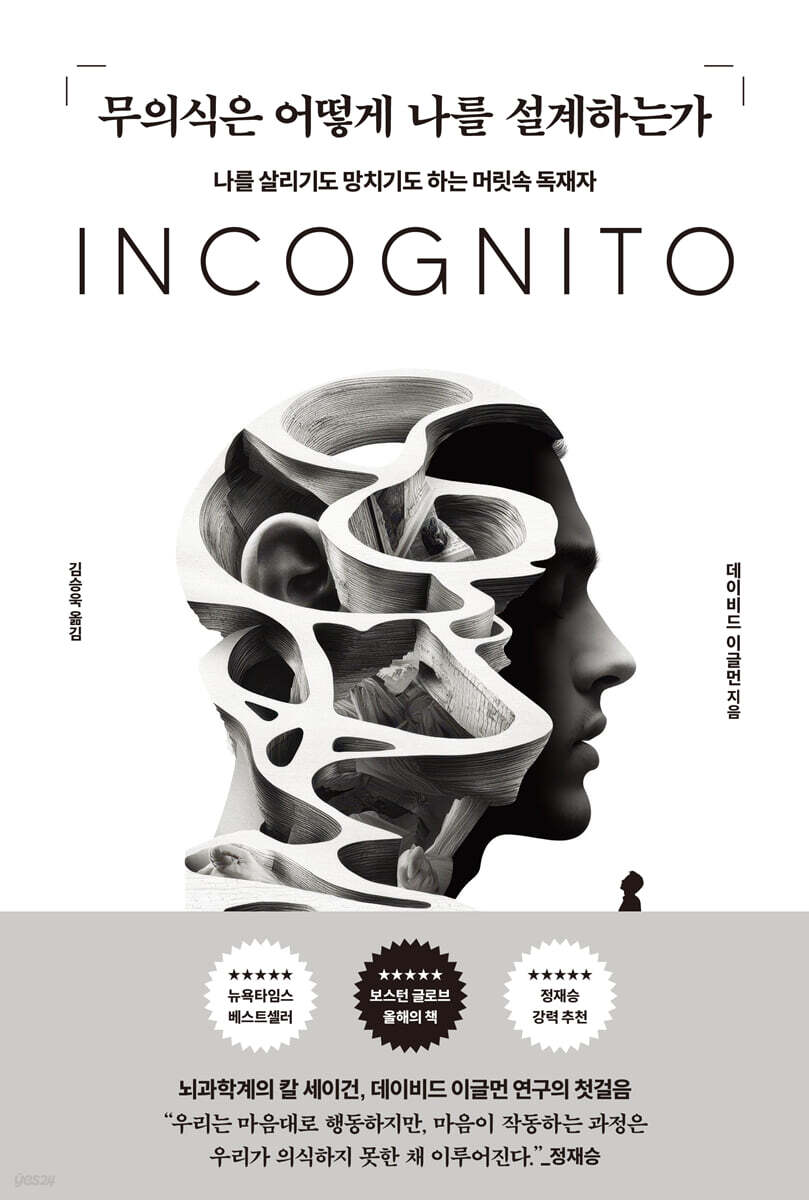
How the unconscious designs me
 |
Description
Book Introduction
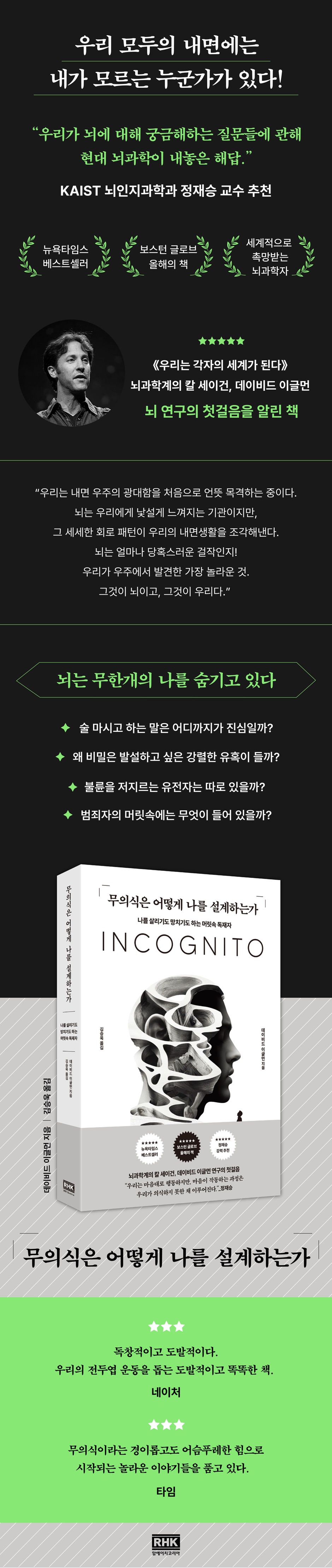
★ New York Times Bestseller, Boston Globe Book of the Year ★ The Carl Sagan of Neuroscience: David Eagleman's First Steps in Research “Modern brain science provides answers to questions we wonder about the brain.” Recommended by neuroscientist Jaeseung Jeong! Was what I did today truly my own? Some things happen without me even realizing it. From everyday actions like opening a door by pressing the door lock code or driving to work, to the occasional brilliant piece of writing that makes you think, "Is this me?" Whether it's Goethe saying "the pen in my hand seemed to move on its own" when he was writing "The Sorrows of Young Werther" or G-Dragon expressing surprise that it took him less than 20 minutes to write the lyrics to "This Love," at the heart of it all is the "unconscious." "How the Unconscious Designs Me" is an early research book by neuroscientist David Eagleman, who once again became famous in Korea with "We Become Our Own World." Although more than ten years have passed since its publication in 2011, the book's message remains valid. Because the brain is a world of 'unanswered' possibilities that are still being researched. Eagleman delves deeply into the unconscious. The brain does a lot more than we think. If we follow the footsteps of the brain, which is the control center that controls the unconscious and the culprit that built the automatic system, an 'invisible' and 'anonymous' entity as the title of the original book (Incognito) suggests, we will eventually reach the question, 'Who am I?' To borrow the words of neuroscientist Professor Jaeseung Jeong, it's amusing that "we act as we please, but the process of our minds working occurs without our awareness." Perhaps, through this book, we will gain some understanding of the incomprehensible events that occur in the world. What goes through the minds of those who commit violent crimes? How much of what they say under the influence of alcohol is genuine? Why do we feel such a strong temptation to reveal secrets? Is there a specific gene for infidelity? Is it truly a coincidence that people with similar names fall in love? This book will answer these questions. |
- You can preview some of the book's contents.
Preview
index
Chapter 1: Who's in My Head? It's Not Me
Chapter 2: The Testimony of the Senses: What Is Experience Really Like?
Chapter 3: What the Unconscious Does
Chapter 4: Thoughts Possible to Us
Chapter 5: The Brain is a Team of Rivals
Chapter 6: Why Asking for Responsibility for Mistakes Is the Wrong Question
Chapter 7: Life After the Throne
Acknowledgements | Note | Search
Chapter 2: The Testimony of the Senses: What Is Experience Really Like?
Chapter 3: What the Unconscious Does
Chapter 4: Thoughts Possible to Us
Chapter 5: The Brain is a Team of Rivals
Chapter 6: Why Asking for Responsibility for Mistakes Is the Wrong Question
Chapter 7: Life After the Throne
Acknowledgements | Note | Search
Detailed image
Into the book
What we have discovered so far inside the skull ranks among the most significant advances in human intelligence.
The fact that countless aspects of our actions, thoughts, and experiences are inextricably linked to a vast, fluid, chemically and electrically driven network: the nervous system.
This machine is utterly foreign to us, but it is nonetheless ourselves.
--- p.11
Synesthesia, which has dozens of different types, highlights the striking differences in how individuals perceive their subjective world.
It also serves to remind us that each brain decides for itself what it will perceive, or can perceive.
This fact brings us back to the most important point we want to make here.
That is, reality is much more subjective than people often think.
Rather than passively recording reality, the brain actively constructs it.
--- p.118
Philosophers call making a decision that binds oneself to the future through free will the Ulysses' Contract.
To give you a concrete example, one of the first steps in quitting alcoholism is to make sure you get rid of all the alcohol in your home when you're sober.
Because the temptation of alcohol is too great on a stressful weekday, a festive Saturday, or a lonely Sunday.
People always make Ulysses' contract.
People put their money in the bank in April because they are not confident in themselves in October.
They know that their October self will be tempted to spend money on selfish purposes rather than give it to their generous December self.
--- p.172~173
The concept of secrecy is easy to understand within the hypothesis of a team of rivals.
The secret is that the political parties in the brain compete and fight against each other.
One part of the brain wants to reveal certain facts, while another part wants to keep them hidden.
The reason for these conflicting voting results is a secret.
A fact that no political party is willing to reveal is just a boring fact.
It's a good story that both parties want to tell.
Without the framework of rivalry, we would not be able to understand the concept of secrecy.
--- p.205
Just as we could never have imagined that the universe would be so vast, we could not have intuitionally and introspectively discovered that we ourselves would be so great.
Now we are getting our first glimpse of the vastness of the inner universe.
The universe hidden within us has its own goals, responsibilities, and logic.
The brain may seem like an alien organ to us, but its detailed circuit patterns sculpt our inner lives.
What a baffling masterpiece the brain is.
And how lucky we are to live in an age where we have the will and the technology to turn our attention to this brain.
The most amazing thing we've discovered in the universe.
That's the brain, that's us.
The fact that countless aspects of our actions, thoughts, and experiences are inextricably linked to a vast, fluid, chemically and electrically driven network: the nervous system.
This machine is utterly foreign to us, but it is nonetheless ourselves.
--- p.11
Synesthesia, which has dozens of different types, highlights the striking differences in how individuals perceive their subjective world.
It also serves to remind us that each brain decides for itself what it will perceive, or can perceive.
This fact brings us back to the most important point we want to make here.
That is, reality is much more subjective than people often think.
Rather than passively recording reality, the brain actively constructs it.
--- p.118
Philosophers call making a decision that binds oneself to the future through free will the Ulysses' Contract.
To give you a concrete example, one of the first steps in quitting alcoholism is to make sure you get rid of all the alcohol in your home when you're sober.
Because the temptation of alcohol is too great on a stressful weekday, a festive Saturday, or a lonely Sunday.
People always make Ulysses' contract.
People put their money in the bank in April because they are not confident in themselves in October.
They know that their October self will be tempted to spend money on selfish purposes rather than give it to their generous December self.
--- p.172~173
The concept of secrecy is easy to understand within the hypothesis of a team of rivals.
The secret is that the political parties in the brain compete and fight against each other.
One part of the brain wants to reveal certain facts, while another part wants to keep them hidden.
The reason for these conflicting voting results is a secret.
A fact that no political party is willing to reveal is just a boring fact.
It's a good story that both parties want to tell.
Without the framework of rivalry, we would not be able to understand the concept of secrecy.
--- p.205
Just as we could never have imagined that the universe would be so vast, we could not have intuitionally and introspectively discovered that we ourselves would be so great.
Now we are getting our first glimpse of the vastness of the inner universe.
The universe hidden within us has its own goals, responsibilities, and logic.
The brain may seem like an alien organ to us, but its detailed circuit patterns sculpt our inner lives.
What a baffling masterpiece the brain is.
And how lucky we are to live in an age where we have the will and the technology to turn our attention to this brain.
The most amazing thing we've discovered in the universe.
That's the brain, that's us.
--- p.308
Publisher's Review
“There is someone inside all of us that we don’t know about!”
A secret exploration of the brain's deep unconsciousness
Surprisingly, our actions, thoughts, and feelings are not things we consciously control.
The 'conscious me' who opens my eyes in the morning is only a very small piece of what is happening in my brain.
The brain puts on its own show and runs its own programs.
'I' do not have access.
Based on these facts, Eagleman uses various examples to explain how our behavior and thoughts are governed by unconscious brain activity, that is, how the unconscious designs us.
Beginning with Freud and exploring the future direction of today's judicial system, this book crosses disciplines including brain science, neuroscience, psychology, sociology, and biology, posing questions for all those concerned with human existence and self-understanding.
When my brain changes, my essence changes too.
A notable section of this book is Chapter 6, which deals with free will and the judicial system.
Many criminals commit heinous acts and still make excuses like, "I don't remember," "I have mental problems," or "I was drunk."
People are even more outraged by this fact, but can anyone truly be completely free from it? Why did Charles Whitman, an ordinary office worker, become the perpetrator of one of the worst mass shootings in history? An autopsy of Whitman's brain after his death revealed a tumor, compressing the amygdala, the part of the brain responsible for regulating emotions like fear and aggression.
Eagleman demonstrates through this case that behavior can be influenced by the physical state of the brain, meaning that viewing crime simply as a matter of "free will" cannot lead to a proper judicial judgment.
This does not mean that everything is the brain's fault and that individuals should not be punished.
Eagleman argues that we need a forward-looking, fundamental system that focuses more on rehabilitation and treatment than punishment, based on assessing the likelihood of correction.
Eagleman's argument, emphasizing the progressive and positive role of brain science in the judicial system, serves as a stark reminder of our society, which still has a high recidivism rate despite having various rehabilitation systems, including treatment centers.
The Brain, a Baffling Masterpiece That Carves Our Inner selves
Throughout the book, Eagleman demonstrates that there is a true master who controls our minds, and that consciousness merely assists in making those decisions.
Consciousness has slow access to the systems within the skull, or cannot access them at all.
Our view of the world does not necessarily match reality.
In other words, vision is nothing more than an illusion constructed by the brain.
Thoughts are created in brain tissue we cannot directly access, and once useful routines are imprinted on brain circuits, they are no longer accessible to consciousness.
He also says that our minds are not singular but composed of many, and that the result of cooperation and competition between rival teams is what we call our 'self'.
That's why reason and impulse constantly clash within us, and we engage in absurd negotiations with ourselves ("It's the weekend, so I should eat something delicious!").
If all human thoughts, minds, and actions are the work of the unconscious, the question remains: what should we do when we have been 'pushed from the throne'?
Eagleman sees new possibilities here.
Just as Galileo's discovery that we are not the center of the universe opened our eyes to a greater world, so too will the loss of egocentrism, the belief that we can do everything, be replaced by the wonders and awe that our brains unleash.
“A bewildering masterpiece carving out our inner lives,” is Eagleman’s view of the unconscious brain.
A secret exploration of the brain's deep unconsciousness
Surprisingly, our actions, thoughts, and feelings are not things we consciously control.
The 'conscious me' who opens my eyes in the morning is only a very small piece of what is happening in my brain.
The brain puts on its own show and runs its own programs.
'I' do not have access.
Based on these facts, Eagleman uses various examples to explain how our behavior and thoughts are governed by unconscious brain activity, that is, how the unconscious designs us.
Beginning with Freud and exploring the future direction of today's judicial system, this book crosses disciplines including brain science, neuroscience, psychology, sociology, and biology, posing questions for all those concerned with human existence and self-understanding.
When my brain changes, my essence changes too.
A notable section of this book is Chapter 6, which deals with free will and the judicial system.
Many criminals commit heinous acts and still make excuses like, "I don't remember," "I have mental problems," or "I was drunk."
People are even more outraged by this fact, but can anyone truly be completely free from it? Why did Charles Whitman, an ordinary office worker, become the perpetrator of one of the worst mass shootings in history? An autopsy of Whitman's brain after his death revealed a tumor, compressing the amygdala, the part of the brain responsible for regulating emotions like fear and aggression.
Eagleman demonstrates through this case that behavior can be influenced by the physical state of the brain, meaning that viewing crime simply as a matter of "free will" cannot lead to a proper judicial judgment.
This does not mean that everything is the brain's fault and that individuals should not be punished.
Eagleman argues that we need a forward-looking, fundamental system that focuses more on rehabilitation and treatment than punishment, based on assessing the likelihood of correction.
Eagleman's argument, emphasizing the progressive and positive role of brain science in the judicial system, serves as a stark reminder of our society, which still has a high recidivism rate despite having various rehabilitation systems, including treatment centers.
The Brain, a Baffling Masterpiece That Carves Our Inner selves
Throughout the book, Eagleman demonstrates that there is a true master who controls our minds, and that consciousness merely assists in making those decisions.
Consciousness has slow access to the systems within the skull, or cannot access them at all.
Our view of the world does not necessarily match reality.
In other words, vision is nothing more than an illusion constructed by the brain.
Thoughts are created in brain tissue we cannot directly access, and once useful routines are imprinted on brain circuits, they are no longer accessible to consciousness.
He also says that our minds are not singular but composed of many, and that the result of cooperation and competition between rival teams is what we call our 'self'.
That's why reason and impulse constantly clash within us, and we engage in absurd negotiations with ourselves ("It's the weekend, so I should eat something delicious!").
If all human thoughts, minds, and actions are the work of the unconscious, the question remains: what should we do when we have been 'pushed from the throne'?
Eagleman sees new possibilities here.
Just as Galileo's discovery that we are not the center of the universe opened our eyes to a greater world, so too will the loss of egocentrism, the belief that we can do everything, be replaced by the wonders and awe that our brains unleash.
“A bewildering masterpiece carving out our inner lives,” is Eagleman’s view of the unconscious brain.
GOODS SPECIFICS
- Date of issue: November 22, 2024
- Page count, weight, size: 344 pages | 476g | 145*215*23mm
- ISBN13: 9788925574394
- ISBN10: 892557439X
You may also like
카테고리
korean


korean

![GQ KOREA Mark (Monthly): December [2025]](http://librairie.coreenne.fr/cdn/shop/files/8ef265dbbfbf186523ed75ba7319009d.jpg?v=1765340328&width=3840)


