

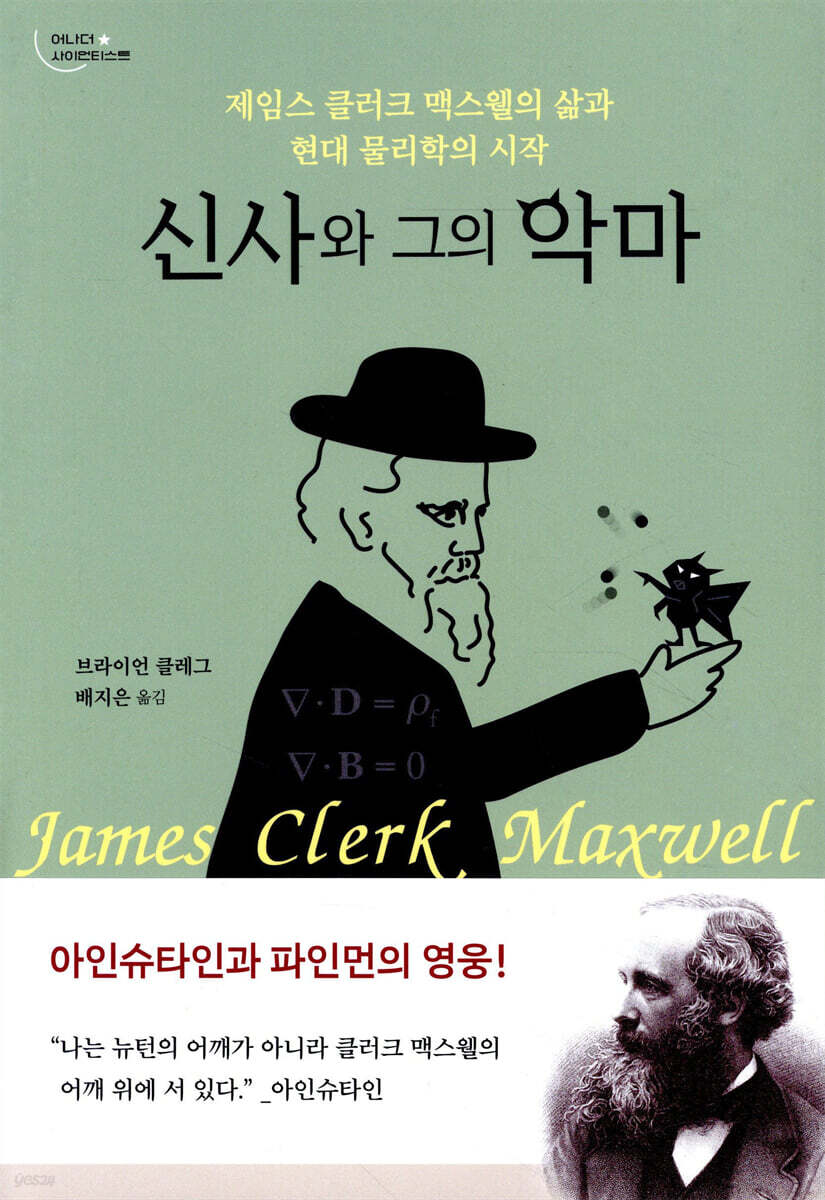
The Gentleman and His Devil
 |
Description
Book Introduction
Heroes of Einstein and Feynman!
He opened new horizons in physics with a free spirit unbound by convention.
The story of Maxwell, a cheerful gentleman from the Victorian era, and his devil.
★The only biography in Korea of James Clerk Maxwell, known as the Prometheus of the 19th century and the father of modern physics.
★Written by bestselling science author Brian Clegg, who studied physics at Cambridge.
★Translated by Bae Ji-eun, a science translator who translated Newton's Principia
Many people know about Maxwell the coffee, but not many know about Maxwell the scientist.
But at the beginning of the 21st century, when 100 prominent physicists were asked to name the most important physicist in history, a clear third place behind Einstein and Newton was James Clerk Maxwell.
Maxwell created equations that describe the behavior of electricity and magnetism, and through these, he revealed that light is a wave (electromagnetic wave) made of nothing other than electricity and magnetism.
From Einstein's special theory of relativity to wireless communications and electronics, it laid the foundation for modern physics and modern civilization.
In addition, Maxwell discovered how we perceive color and contributed to the establishment of thermodynamics and statistical physics by explaining the motion of gas molecules.
Research on speed controllers that implemented the principle of automatic control led to Norbert Wiener, the founder of cybernetics.
In the process, Maxwell changed the very way physics was done.
He progressed from mechanical models to mathematical models, and from these models he made predictions that could be tested experimentally.
This is what theoretical physicists do today.
Maxwell was the first theoretical physicist in the modern sense! This book introduces the life and science of James Clerk Maxwell, a scientist whose achievements rival those of Newton and Einstein, yet remain largely unknown to the general public, in an accessible and engaging way.
The actively quoted words and writings of Maxwell, including his poems, letters, lectures, and testimonies from those who accompanied him, take us across 140 years to the side of this cheerful and humorous gentleman of the Victorian era.
The 'devil', the protagonist of Maxwell's thermodynamic thought experiment, plays the supporting role of a second narrator, explaining the scientific background and telling various 'gossip', including his own fate.
He opened new horizons in physics with a free spirit unbound by convention.
The story of Maxwell, a cheerful gentleman from the Victorian era, and his devil.
★The only biography in Korea of James Clerk Maxwell, known as the Prometheus of the 19th century and the father of modern physics.
★Written by bestselling science author Brian Clegg, who studied physics at Cambridge.
★Translated by Bae Ji-eun, a science translator who translated Newton's Principia
Many people know about Maxwell the coffee, but not many know about Maxwell the scientist.
But at the beginning of the 21st century, when 100 prominent physicists were asked to name the most important physicist in history, a clear third place behind Einstein and Newton was James Clerk Maxwell.
Maxwell created equations that describe the behavior of electricity and magnetism, and through these, he revealed that light is a wave (electromagnetic wave) made of nothing other than electricity and magnetism.
From Einstein's special theory of relativity to wireless communications and electronics, it laid the foundation for modern physics and modern civilization.
In addition, Maxwell discovered how we perceive color and contributed to the establishment of thermodynamics and statistical physics by explaining the motion of gas molecules.
Research on speed controllers that implemented the principle of automatic control led to Norbert Wiener, the founder of cybernetics.
In the process, Maxwell changed the very way physics was done.
He progressed from mechanical models to mathematical models, and from these models he made predictions that could be tested experimentally.
This is what theoretical physicists do today.
Maxwell was the first theoretical physicist in the modern sense! This book introduces the life and science of James Clerk Maxwell, a scientist whose achievements rival those of Newton and Einstein, yet remain largely unknown to the general public, in an accessible and engaging way.
The actively quoted words and writings of Maxwell, including his poems, letters, lectures, and testimonies from those who accompanied him, take us across 140 years to the side of this cheerful and humorous gentleman of the Victorian era.
The 'devil', the protagonist of Maxwell's thermodynamic thought experiment, plays the supporting role of a second narrator, explaining the scientific background and telling various 'gossip', including his own fate.
- You can preview some of the book's contents.
Preview
index
Recommendation 6
[Devil's Interlude I] The Demon, Summoned 15
Chapter 1.
The attitude may be a little rough, but 19
Edinburgh and Glenlair, the Academy, young mathematicians, clergy and country squires?
University Life, Special Light, and the Road to Cambridge
[Devil's Interlude II] When Electricity Meets Magnetism 51
Chapter 2.
75 Most Creative Young People
Approaching TrinityㆍBecoming an ApostleㆍCats and RhymesㆍWrangler?
Color vision, true primary colors, peculiar incompetence, quantifying Faraday's field?
A new destination for workers' rights
[Devil's Interlude III] Atoms Are Real and Heat Moves 115
Chapter 3.
Young Professor 125
A City Divided, His Lectures Were Terrible, The Lord of the Rings, Life in Aberdeen?
In Pursi Muove, Statistics Will Save Us, A New Family?
Bringing in the 'British Donkey' - Leaving Aberdeen
[Devil's Interlude IV] The Devil Throws Down the Gauntlet 167
Chapter 4.
London Adventure 179
Coloring the King's Science Laboratory: Electromagnetism into Mechanics: Maxwell's
Electromagnetic fields, vortices, and fluid wheels, the power of metaphor
[Devil's Interlude V] The Devil Becomes a Star 205
Chapter 5.
Looking at the light 213
The power of flexible cells, waves in the ether, looking at the light, too much for one person to carry
Too HeavyㆍGreat London Exhibition
Chapter 6.
Science by Numbers 231
Astronomical engine, stereoscopic view, resistance standard, electrical resistance speed, visual support
Standing Alone in the Absent Electromagnetism, Inside the Mathematical Bell Tower, New Physics?
Beautiful equation, away from everything
[Devil's Interlude VI] The Devil, Frustrated 267
Chapter 7.
273 in the territory
Life in Glenlair, Return to Astrology, The Wine Merchant's Battery, The Regulator
Meeting, Thinking about the Fourth Dimension, The Life of a Scholar
Chapter 8.
Cambridge Calls 293
The Cavendish Connection, A Different Professor, The Last Home, The New Laboratory and Modern Physics?
Slow Start/Women in the Lab
[Devil's Interlude VII] The Devil's Memory is Challenged 319
Chapter 9.
Last Study 325
Books and the Power of Light, Cavendish's Papers, A Passing Fantasy, The Sudden End
[Devil's Interlude VIII] The Devil Lives to Fight Another Day 337
Chapter 10.
Maxwell's Legacy 343
Translator's Note 351
Americas 355
Chronology 372
Search 374
[Devil's Interlude I] The Demon, Summoned 15
Chapter 1.
The attitude may be a little rough, but 19
Edinburgh and Glenlair, the Academy, young mathematicians, clergy and country squires?
University Life, Special Light, and the Road to Cambridge
[Devil's Interlude II] When Electricity Meets Magnetism 51
Chapter 2.
75 Most Creative Young People
Approaching TrinityㆍBecoming an ApostleㆍCats and RhymesㆍWrangler?
Color vision, true primary colors, peculiar incompetence, quantifying Faraday's field?
A new destination for workers' rights
[Devil's Interlude III] Atoms Are Real and Heat Moves 115
Chapter 3.
Young Professor 125
A City Divided, His Lectures Were Terrible, The Lord of the Rings, Life in Aberdeen?
In Pursi Muove, Statistics Will Save Us, A New Family?
Bringing in the 'British Donkey' - Leaving Aberdeen
[Devil's Interlude IV] The Devil Throws Down the Gauntlet 167
Chapter 4.
London Adventure 179
Coloring the King's Science Laboratory: Electromagnetism into Mechanics: Maxwell's
Electromagnetic fields, vortices, and fluid wheels, the power of metaphor
[Devil's Interlude V] The Devil Becomes a Star 205
Chapter 5.
Looking at the light 213
The power of flexible cells, waves in the ether, looking at the light, too much for one person to carry
Too HeavyㆍGreat London Exhibition
Chapter 6.
Science by Numbers 231
Astronomical engine, stereoscopic view, resistance standard, electrical resistance speed, visual support
Standing Alone in the Absent Electromagnetism, Inside the Mathematical Bell Tower, New Physics?
Beautiful equation, away from everything
[Devil's Interlude VI] The Devil, Frustrated 267
Chapter 7.
273 in the territory
Life in Glenlair, Return to Astrology, The Wine Merchant's Battery, The Regulator
Meeting, Thinking about the Fourth Dimension, The Life of a Scholar
Chapter 8.
Cambridge Calls 293
The Cavendish Connection, A Different Professor, The Last Home, The New Laboratory and Modern Physics?
Slow Start/Women in the Lab
[Devil's Interlude VII] The Devil's Memory is Challenged 319
Chapter 9.
Last Study 325
Books and the Power of Light, Cavendish's Papers, A Passing Fantasy, The Sudden End
[Devil's Interlude VIII] The Devil Lives to Fight Another Day 337
Chapter 10.
Maxwell's Legacy 343
Translator's Note 351
Americas 355
Chronology 372
Search 374
Into the book
My sole purpose in life is to demonstrate that the second law of thermodynamics can actually be broken.
I can make the heat move from the cold side to the hot side.
It may be a bit uncomfortable for a demon to say this, but it can also 'lower' the level of chaos in this world.
And if I could really do this, it would not be me who would be crushed by the deepest shame, but every physicist who has walked the earth since the Victorian era.
--- p.17
Faraday conducted a necromancy experiment and proved that the table moved because the participants placed their hands on the table and unconsciously applied force in the desired direction.
After publishing these findings, Faraday was buried in letters asking him to explain other phenomena as well.
Maxwell commented on the incident in a letter:
“There was an uproar as if Faraday had declared himself omnipotent.
Such is the fate of those who actually experiment with popular occult science.
“Those who rebelled against science defeated Faraday.”
--- p.81
Although Maxwell had no idea how practical his work would become, the color triangle he devised is the core principle behind virtually every color screen we use today, from TVs and computers to cell phones.
--- p.98
Maxwell was convinced that Faraday's ideas were sound, and he sought a way to describe mathematically the magical lines of force at the heart of the idea.
Maxwell's attempt may have been possible thanks to his academic background, which, as we have seen, was unusual for the time.
Cambridge has traditionally been very strong in mathematics, but has tended to apply mathematics to sciences that are closely related to mathematics, such as astronomy.
Edinburgh, on the other hand, provided Maxwell with the foundations of electromagnetism, but may not have encouraged a mathematical approach.
Having been educated in both places, Maxwell was able to combine the two approaches.
--- p.100
Although Maxwell grew up in a wealthy family, his exposure to the poor in Glenlair made him acutely aware of the lack of education available to working-class people.
He was also well aware that Faraday had benefited from the Philosophical Society.
Maxwell, being Maxwell, didn't wait for others to solve the problem, but took it upon himself.
--- p.105
“I do not believe that humans can weave physical systems together by intellect alone, without experimentation.
Every time humanity has attempted such a thing, it has produced an unnatural and self-contradictory pile of garbage.
“If there is no basis on which to build a theory, you will quickly become lost in the fog I just warned you about.”
--- p.133
The dynamics of Saturn's rings seems like a rather one-off application.
But like many of the ideas he came up with throughout his life, this one had ramifications that extended far beyond its initial application.
The formation of planetary systems like our solar system is a complex issue with no complete consensus, but the best accepted theory to date is that they formed from the accumulation of disks of gas and dust.
This theory owes much to Maxwell's study of Saturn's rings.
In response, modern scientists have named the gap in Saturn's C ring the 'Maxwell Gap' to commemorate Maxwell's contribution, albeit in a small way.
--- p.142~143
The velocity distribution of molecules in a gas today is called the 'Maxwell distribution'.
His mathematical solutions to finding the velocity distribution of molecules at a given temperature are still used today.… Maxwell's gas theory was his first great contribution to physics.
Even at the time, people considered this gas theory more important than his masterpiece, the theory of electromagnetism.
--- p.154~155
Babbage was also living in London when Maxwell was there.
Maxwell's idea of a model with hexagonal cells and spheres likely stemmed from the many miraculous experiences of Victorian engineering.
--- p.199
This concept of displacement current changed the role of the theoretical physicist, so much so that in some ways the modern theoretical physicist itself could be said to be Maxwell's invention.
At that time, the main job of theorists was to create theories that fit the observations.
But Maxwell saw a theoretical physicist as someone who looked for holes in the experimental evidence and made predictions that could be tested.
The displacement current was not an observational result, but a pure prediction of his model.
--- p.219
The Maxwells' continental tour was not a typical trip where they simply stopped by a few countries and saw as many sights as possible in a short period of time.
The Maxwells made an effort to learn Italian and, unlike other travelers of the time, seem to have enjoyed the local culture.
--- p.281
Decades later, American mathematician Norbert Wiener took notice of Maxwell's paper.
He created the concept of cybernetics in the 1940s.
Cybernetics is the study of systems with communication and feedback capabilities, and has since become important in control systems, engineering, and computer science.
Wiener regarded Maxwell as the founder of automatic control and the initiator of control systems theory.
Control theory, which originated from Maxwell's research, is used in almost every field, from the cruise control function of automobiles to the safety maintenance system of nuclear power plants.
I can make the heat move from the cold side to the hot side.
It may be a bit uncomfortable for a demon to say this, but it can also 'lower' the level of chaos in this world.
And if I could really do this, it would not be me who would be crushed by the deepest shame, but every physicist who has walked the earth since the Victorian era.
--- p.17
Faraday conducted a necromancy experiment and proved that the table moved because the participants placed their hands on the table and unconsciously applied force in the desired direction.
After publishing these findings, Faraday was buried in letters asking him to explain other phenomena as well.
Maxwell commented on the incident in a letter:
“There was an uproar as if Faraday had declared himself omnipotent.
Such is the fate of those who actually experiment with popular occult science.
“Those who rebelled against science defeated Faraday.”
--- p.81
Although Maxwell had no idea how practical his work would become, the color triangle he devised is the core principle behind virtually every color screen we use today, from TVs and computers to cell phones.
--- p.98
Maxwell was convinced that Faraday's ideas were sound, and he sought a way to describe mathematically the magical lines of force at the heart of the idea.
Maxwell's attempt may have been possible thanks to his academic background, which, as we have seen, was unusual for the time.
Cambridge has traditionally been very strong in mathematics, but has tended to apply mathematics to sciences that are closely related to mathematics, such as astronomy.
Edinburgh, on the other hand, provided Maxwell with the foundations of electromagnetism, but may not have encouraged a mathematical approach.
Having been educated in both places, Maxwell was able to combine the two approaches.
--- p.100
Although Maxwell grew up in a wealthy family, his exposure to the poor in Glenlair made him acutely aware of the lack of education available to working-class people.
He was also well aware that Faraday had benefited from the Philosophical Society.
Maxwell, being Maxwell, didn't wait for others to solve the problem, but took it upon himself.
--- p.105
“I do not believe that humans can weave physical systems together by intellect alone, without experimentation.
Every time humanity has attempted such a thing, it has produced an unnatural and self-contradictory pile of garbage.
“If there is no basis on which to build a theory, you will quickly become lost in the fog I just warned you about.”
--- p.133
The dynamics of Saturn's rings seems like a rather one-off application.
But like many of the ideas he came up with throughout his life, this one had ramifications that extended far beyond its initial application.
The formation of planetary systems like our solar system is a complex issue with no complete consensus, but the best accepted theory to date is that they formed from the accumulation of disks of gas and dust.
This theory owes much to Maxwell's study of Saturn's rings.
In response, modern scientists have named the gap in Saturn's C ring the 'Maxwell Gap' to commemorate Maxwell's contribution, albeit in a small way.
--- p.142~143
The velocity distribution of molecules in a gas today is called the 'Maxwell distribution'.
His mathematical solutions to finding the velocity distribution of molecules at a given temperature are still used today.… Maxwell's gas theory was his first great contribution to physics.
Even at the time, people considered this gas theory more important than his masterpiece, the theory of electromagnetism.
--- p.154~155
Babbage was also living in London when Maxwell was there.
Maxwell's idea of a model with hexagonal cells and spheres likely stemmed from the many miraculous experiences of Victorian engineering.
--- p.199
This concept of displacement current changed the role of the theoretical physicist, so much so that in some ways the modern theoretical physicist itself could be said to be Maxwell's invention.
At that time, the main job of theorists was to create theories that fit the observations.
But Maxwell saw a theoretical physicist as someone who looked for holes in the experimental evidence and made predictions that could be tested.
The displacement current was not an observational result, but a pure prediction of his model.
--- p.219
The Maxwells' continental tour was not a typical trip where they simply stopped by a few countries and saw as many sights as possible in a short period of time.
The Maxwells made an effort to learn Italian and, unlike other travelers of the time, seem to have enjoyed the local culture.
--- p.281
Decades later, American mathematician Norbert Wiener took notice of Maxwell's paper.
He created the concept of cybernetics in the 1940s.
Cybernetics is the study of systems with communication and feedback capabilities, and has since become important in control systems, engineering, and computer science.
Wiener regarded Maxwell as the founder of automatic control and the initiator of control systems theory.
Control theory, which originated from Maxwell's research, is used in almost every field, from the cruise control function of automobiles to the safety maintenance system of nuclear power plants.
--- p.286
Publisher's Review
“I stand not on the shoulders of Newton, but on the shoulders of Clerk Maxwell.”
It's the same for us in modern times
When Einstein visited Cambridge University in England in 1922, his host said, "Einstein's great achievements were made by standing on the shoulders of giants like Newton." Einstein corrected himself.
"no.
“I stand on the shoulders of giants, Maxwell.” One of the three portraits of scientists that Einstein had hanging in his laboratory was of Maxwell (the other two were Newton and Faraday).
Richard Feynman cited Maxwell's discovery of the laws of electrodynamics as the most important event of the 19th century.
Maxwell, who is called the Prometheus of the 19th century and the father of modern physics, was a hero to physicists including Einstein and Feynman.
However, not many people who are not scientists know about Maxwell.
It is also surprising that there is no Korean-language biography of Maxwell currently available in bookstores.
This is even more difficult to understand when we consider that most of our modern civilization owes its existence to Maxwell's work.
Moreover, the seeds that Maxwell planted are still growing vigorously under the names of artificial intelligence and robotics.
If you want to know about the science and technology of the present and future, you must start with Maxwell.
From the color triangle to the Mona Lisa of equations to Maxwell's equations,
Into Maxwell's scientific intuition and insight, which led to great achievements across all fields.
If Newton's equations of motion F=ma represent classical mechanics, Maxwell's equations, which are organized into four equations, represent electromagnetic mechanics.
Maxwell's equations, which describe all the actions of electricity and magnetism while also containing the essence of light, are considered so beautiful that they are called the 'Mona Lisa of equations.'
How did this equation come to be? The book details the process that led to the creation of this beautiful equation.
Maxwell, with his remarkable intuition, was the first to recognize the importance of Faraday's concept of lines of force, and devised a mechanical model to represent the interaction between electricity and magnetism.
Maxwell's extraordinary and playful personality is well-exhibited as he studies vectors, makes puns, and ponders the names of operators while trying to figure out how to mathematically describe his mechanical models.
The author seems to be saying that while the Edinburgh education and curriculum, which provided the foundation for electromagnetism, remained traditional, the Cambridge education, which emphasized mathematics, a spoonful of Victorian engineering, Kant's philosophy, and Maxwell's scientific intuition and insight, which encompassed all of this, gave birth to Maxwell's equations.
Maxwell also discovered the principles of color perception and the three primary colors of light, explained Saturn's rings and radiation pressure, and made significant contributions to the development of optics, thermodynamics, and statistical mechanics.
He was also the first Cavendish Professor and the first director of the Cavendish Laboratory, where he supervised and established the laboratory's foundation. The Cavendish Laboratory has produced 28 Nobel Prize winners to date for groundbreaking research, including the discovery of the electron, the discovery of the proton, and the elucidation of the structure of DNA.
It is hard to believe that one person achieved this in his short life of 48 years.
Maxwell was born the son of a lord in 19th-century Scotland, but grew up in the pastoral surroundings of Glenlair Estate, where he freely interacted with farm children and maintained a simple lifestyle throughout his life.
The Maxwell family, unlike the strict social atmosphere of the Victorian era, had a flexible way of thinking that was not bound by formality and formality, and the house was always filled with humor.
Maxwell's greatest assets were his curiosity about nature and his free thinking, unbound by convention.
"I am the devil! Now, let me meet my creator."
The fun of reading a solid biography that weaves life and science together, with an interesting structure and humorous sentences.
The book consists of the main text and an appendix called 'The Devil's Interlude'.
The text follows Maxwell's journey from birth to death.
In particular, the candid letters exchanged with three friends: Lewis Campbell, a classical literature professor who was Maxwell's lifelong friend and first biographer; Peter Tate, a physicist who was also Maxwell's lifelong friend and sometimes competed with him for a professorship; and William Thomson (Lord Kelvin), a celebrity physicist of the time who was seven years older than Maxwell but maintained a friendship like a friend. These three friends vividly portray the cheerful and nerdy side of Maxwell.
On the one hand, I envy the friendship of friends who share everything from the small details of daily life to deep academic concerns, and just seeing the healthy youth makes me feel good.
As the author says, “I would be very happy to become friends with such a person.”
In the Devil's Interlude, Maxwell's Demon acts as the narrator, providing basic knowledge and interesting 'backstory' to understand Maxwell's science.
The 'devil' is the protagonist of a thought experiment devised by Maxwell to show that the second law of thermodynamics is a statistical law.
In The Devil's Interlude, the Devil also depicts the Devil's frustrations and challenges, from his own birth to his experiments with light pulses in 2016.
In the process, we can see how the thermodynamic demon created by Maxwell was reborn as an information demon and a quantum demon by combining with information theory and quantum mechanics.
Author's Note
I wanted the devil to have a say and a voice.
Because Maxwell's demon so beautifully reflects Maxwell's ability to challenge the entrenched thinking of his colleagues, build models with fun and novel approaches, and inject humor into formulaic science.
Maxwell was more than just a great scientist; he was a great human being.
I would be very happy to become friends with such a person._From the text
Translator's Note
It is always interesting to meet scientists, who are now only adjectives before the names of equations and constants, as fellow human beings who have lived on this earth.
The Maxwell depicted in this book is not the stern, dignified, and serious-looking, stuffy gentleman you see in photos or portraits, but rather a cheerful, young gentleman who is curious, humorous, and whose eyes sparkle at new phenomena.
…it wasn't just Maxwell who was happy.
Maxwell's demon, who has been silent for over a hundred years, finally finds a voice in this book and fulfills his role as narrator.
Moreover, the devil, which was thought to have vanished without a trace, was still alive thanks to the efforts and insights of those who tried to realize Maxwell's ideas.
The demon's tenacity and presence were astonishing, but it was also fascinating to see how a seemingly simple idea could expand and delve into the very foundations of physics.
In that sense, Maxwell's demon may be as valuable a legacy to humanity as his equations.
(Besides, how can that prickly personality be so charming!)
It's the same for us in modern times
When Einstein visited Cambridge University in England in 1922, his host said, "Einstein's great achievements were made by standing on the shoulders of giants like Newton." Einstein corrected himself.
"no.
“I stand on the shoulders of giants, Maxwell.” One of the three portraits of scientists that Einstein had hanging in his laboratory was of Maxwell (the other two were Newton and Faraday).
Richard Feynman cited Maxwell's discovery of the laws of electrodynamics as the most important event of the 19th century.
Maxwell, who is called the Prometheus of the 19th century and the father of modern physics, was a hero to physicists including Einstein and Feynman.
However, not many people who are not scientists know about Maxwell.
It is also surprising that there is no Korean-language biography of Maxwell currently available in bookstores.
This is even more difficult to understand when we consider that most of our modern civilization owes its existence to Maxwell's work.
Moreover, the seeds that Maxwell planted are still growing vigorously under the names of artificial intelligence and robotics.
If you want to know about the science and technology of the present and future, you must start with Maxwell.
From the color triangle to the Mona Lisa of equations to Maxwell's equations,
Into Maxwell's scientific intuition and insight, which led to great achievements across all fields.
If Newton's equations of motion F=ma represent classical mechanics, Maxwell's equations, which are organized into four equations, represent electromagnetic mechanics.
Maxwell's equations, which describe all the actions of electricity and magnetism while also containing the essence of light, are considered so beautiful that they are called the 'Mona Lisa of equations.'
How did this equation come to be? The book details the process that led to the creation of this beautiful equation.
Maxwell, with his remarkable intuition, was the first to recognize the importance of Faraday's concept of lines of force, and devised a mechanical model to represent the interaction between electricity and magnetism.
Maxwell's extraordinary and playful personality is well-exhibited as he studies vectors, makes puns, and ponders the names of operators while trying to figure out how to mathematically describe his mechanical models.
The author seems to be saying that while the Edinburgh education and curriculum, which provided the foundation for electromagnetism, remained traditional, the Cambridge education, which emphasized mathematics, a spoonful of Victorian engineering, Kant's philosophy, and Maxwell's scientific intuition and insight, which encompassed all of this, gave birth to Maxwell's equations.
Maxwell also discovered the principles of color perception and the three primary colors of light, explained Saturn's rings and radiation pressure, and made significant contributions to the development of optics, thermodynamics, and statistical mechanics.
He was also the first Cavendish Professor and the first director of the Cavendish Laboratory, where he supervised and established the laboratory's foundation. The Cavendish Laboratory has produced 28 Nobel Prize winners to date for groundbreaking research, including the discovery of the electron, the discovery of the proton, and the elucidation of the structure of DNA.
It is hard to believe that one person achieved this in his short life of 48 years.
Maxwell was born the son of a lord in 19th-century Scotland, but grew up in the pastoral surroundings of Glenlair Estate, where he freely interacted with farm children and maintained a simple lifestyle throughout his life.
The Maxwell family, unlike the strict social atmosphere of the Victorian era, had a flexible way of thinking that was not bound by formality and formality, and the house was always filled with humor.
Maxwell's greatest assets were his curiosity about nature and his free thinking, unbound by convention.
"I am the devil! Now, let me meet my creator."
The fun of reading a solid biography that weaves life and science together, with an interesting structure and humorous sentences.
The book consists of the main text and an appendix called 'The Devil's Interlude'.
The text follows Maxwell's journey from birth to death.
In particular, the candid letters exchanged with three friends: Lewis Campbell, a classical literature professor who was Maxwell's lifelong friend and first biographer; Peter Tate, a physicist who was also Maxwell's lifelong friend and sometimes competed with him for a professorship; and William Thomson (Lord Kelvin), a celebrity physicist of the time who was seven years older than Maxwell but maintained a friendship like a friend. These three friends vividly portray the cheerful and nerdy side of Maxwell.
On the one hand, I envy the friendship of friends who share everything from the small details of daily life to deep academic concerns, and just seeing the healthy youth makes me feel good.
As the author says, “I would be very happy to become friends with such a person.”
In the Devil's Interlude, Maxwell's Demon acts as the narrator, providing basic knowledge and interesting 'backstory' to understand Maxwell's science.
The 'devil' is the protagonist of a thought experiment devised by Maxwell to show that the second law of thermodynamics is a statistical law.
In The Devil's Interlude, the Devil also depicts the Devil's frustrations and challenges, from his own birth to his experiments with light pulses in 2016.
In the process, we can see how the thermodynamic demon created by Maxwell was reborn as an information demon and a quantum demon by combining with information theory and quantum mechanics.
Author's Note
I wanted the devil to have a say and a voice.
Because Maxwell's demon so beautifully reflects Maxwell's ability to challenge the entrenched thinking of his colleagues, build models with fun and novel approaches, and inject humor into formulaic science.
Maxwell was more than just a great scientist; he was a great human being.
I would be very happy to become friends with such a person._From the text
Translator's Note
It is always interesting to meet scientists, who are now only adjectives before the names of equations and constants, as fellow human beings who have lived on this earth.
The Maxwell depicted in this book is not the stern, dignified, and serious-looking, stuffy gentleman you see in photos or portraits, but rather a cheerful, young gentleman who is curious, humorous, and whose eyes sparkle at new phenomena.
…it wasn't just Maxwell who was happy.
Maxwell's demon, who has been silent for over a hundred years, finally finds a voice in this book and fulfills his role as narrator.
Moreover, the devil, which was thought to have vanished without a trace, was still alive thanks to the efforts and insights of those who tried to realize Maxwell's ideas.
The demon's tenacity and presence were astonishing, but it was also fascinating to see how a seemingly simple idea could expand and delve into the very foundations of physics.
In that sense, Maxwell's demon may be as valuable a legacy to humanity as his equations.
(Besides, how can that prickly personality be so charming!)
GOODS SPECIFICS
- Date of issue: November 14, 2024
- Page count, weight, size: 384 pages | 494g | 142*207*25mm
- ISBN13: 9791197909498
- ISBN10: 1197909494
You may also like
카테고리
korean


korean

![GQ KOREA Mark (Monthly): December [2025]](http://librairie.coreenne.fr/cdn/shop/files/8ef265dbbfbf186523ed75ba7319009d.jpg?v=1765340328&width=3840)


