

What makes me alive
 |
Description
Book Introduction
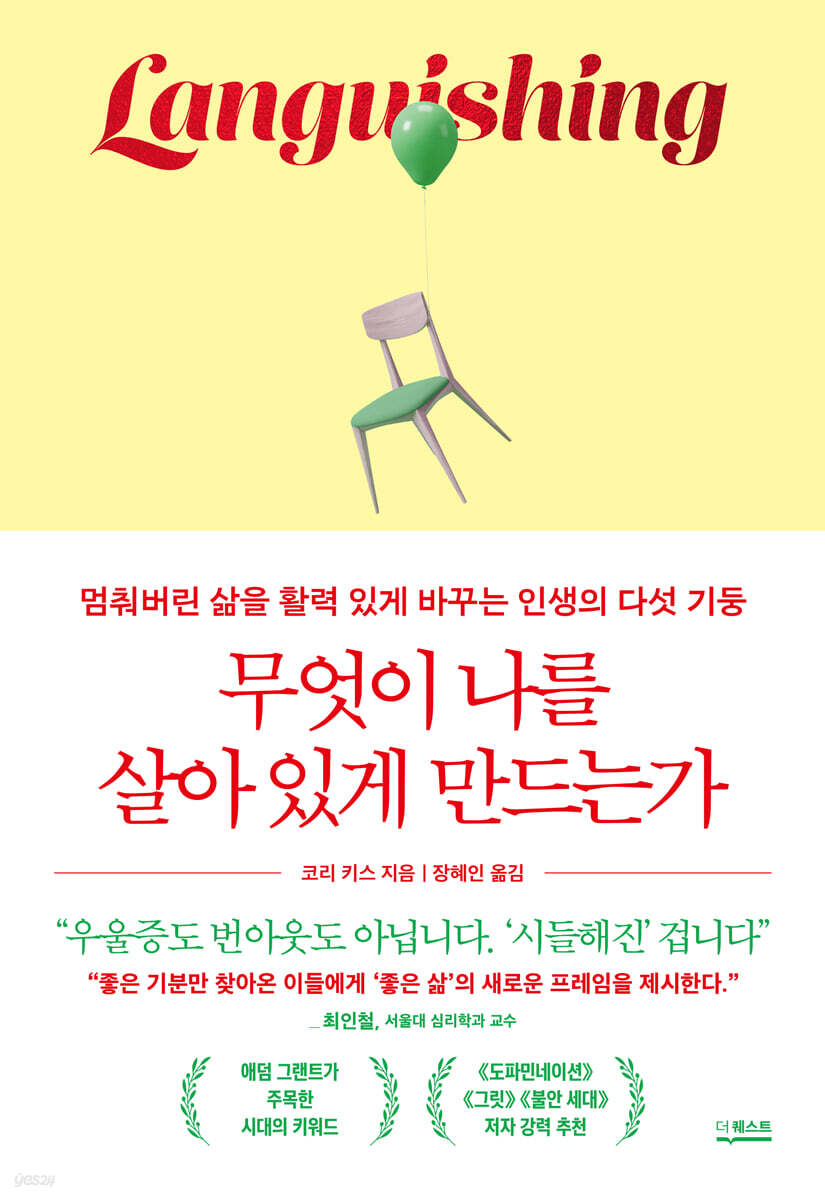
“It’s not depression or burnout. “It has become ‘withered’” A timely diagnosis to decipher the apathy and emptiness of modern people. In a world that tires us out A Guide to Living a Life Again How did we get so depressed? What the Modern Mental Health Field Has Missed 'Languish' is defined as 'a state of mental weakness that weakens self-esteem, motivation, and sense of meaning.' 'Apathy' isn't synonymous with depression or burnout, and since apathy is one of its symptoms, it's easy to dismiss it as just another passing moment of daily life. According to Corey Keyes, a pioneer in positive psychology and professor emeritus at Emory University who has long studied "flourishing" and "flourishing," this condition is not something to be taken lightly. People in "withered" moods feel they have no control over their lives, are uncertain about what they want for the future, and are likely to become paralyzed when faced with decisions. If left untreated, withering not only interferes with daily functioning, but can also be a gateway to serious mental illness and premature death. In the first half of the book, Keys lucidly explains what "withering" truly means and how it differs from other mental illnesses, drawing on solid research from over two decades. He views the two concepts he created long ago, 'withering' and 'vitality', as a single mental health continuum, and defines a vibrant life as having three elements: emotional well-being (a good mood), self-well-being (psychological well-being), and others (social well-being). You can also do a quick self-assessment to see how depressed you are right now (i.e., how mentally unhealthy you are) and what your current positive mental health status is. |
- You can preview some of the book's contents.
Preview
index
Going in / Just running empty
The Power of Names: Naming That Feeling
Are you feeling bored with life too?
This is not withering
Maybe I've been asking the wrong questions all along
13 Reasons to Find Your Vitality
A holistic measure of mental health
A new hymn of this era
Part 1.
From withering to vibrant:
Mental health is a continuum
Chapter 1.
What happens when you fall into withering?
Who else will fall into withering?
Will even children become withered?
The uncharted territory of youth
young people who went to college
If you collect the price of withering,
Out of the cage and into the world
The weariness that comes from the workplace
What protects us from work stress
Is stress a prerequisite for withering?
The withering that comes with old age
The return of withering
Chapter 2.
How did we become so withered?
Loneliness is part of being dull
The pain of being alone
Disconnection: A Disconnected Society
Relationships require skill.
Social connection and a meaningful life reinforce each other.
The Cost and Vitality of Discrimination
Coping with Adversity
Chapter 3.
Don't be fooled by happiness
Will happiness save us?
Rewriting the Cultural Script
Eudaimonia: A state of good mental health that is functioning well.
Six Areas of Human Excellence
Chapter 4.
We are not one-dimensional humans
Are we destined to fall into withering?
Humans have the potential for growth.
Medicalization of the Mind: The Path of Psychotherapy
We need a new map of mental health.
What does a day in the life of an energetic person look like?
Finding vitality becomes the base camp of life.
The truth contained in the inner path
Part 2.
Become a pillar of life
Five vital vitamins
Chapter 5.
Learning: Creating a Self-Growth Story
The system called self
We can choose to continue learning.
The appearance of courage
Learn to teach and teach to learn
The only change is changing yourself
Comparison and respect work differently.
How does self-transformation occur?
Stressors and Life's Trials
The arduous journey to success
Awareness is the most important thing
Growth after adversity
Chapter 6.
Relationships: Building warm and trusting bonds
Friendship is different from friendship
Belonging is a prerequisite for human dignity.
The desire to belong
Overcoming Isolation Through Connection
Waiting for permission to join
The message that we are all equal
'Interpersonal presence' - the feeling that I am important to someone
My Hall of Love
Postpartum Wrinkles: A New Mom's Struggles
Find someone different from me
Emotional Support: Quality Over Quantity
Restoring Friendship in a World Full of Distrust
Chapter 7.
Spirituality: The Inevitable Twists and Turns of Life
Accept
The serenity of accepting what cannot be changed
Let's start by accepting myself.
The power of quiet inner strength
Mindfulness Practice for a Flexible Mind
One step closer to the god within me
Language is soul and spirituality
What Happens When Faith Withers
I can choose what stays inside me.
Finding the Spirituality That's Right for You
Calm your confused mind
Consistent Practice: There's No Magic Pill
Connect with a greater being
Let's start right now
The road before our eyes
Chapter 8.
Purpose: To be meaningful to others and the world
A life of contribution
A very basic question
The purpose is extremely personal.
Having a purpose and living by that purpose
Kari's Story: From Uncertainty to Certainty
Is it too late to find your purpose?
It's never too early to find your purpose.
Maladaptive Perfectionism: Success at the Cost of Vitality
Journey to the destination
You may not find meaning and purpose in your work.
Why is it so hard to find purpose at work?
Purpose can be found, but it can also be lost.
Start small, around me
If you give, you get
In nature, there is no being that lives only for itself.
Chapter 9.
Play: Time away from the everyday
What is play?
Do I have to play?
Resisting a world that steals joy with play
Childhood Play and Resilience
Why do we stop playing?
We forget how to play too quickly
How to remember what you haven't learned
The rise of passive leisure
Leisure consumption
Play and work, pleasure and responsibility must coexist.
Going out / A community of vibrant people
annotation
The Power of Names: Naming That Feeling
Are you feeling bored with life too?
This is not withering
Maybe I've been asking the wrong questions all along
13 Reasons to Find Your Vitality
A holistic measure of mental health
A new hymn of this era
Part 1.
From withering to vibrant:
Mental health is a continuum
Chapter 1.
What happens when you fall into withering?
Who else will fall into withering?
Will even children become withered?
The uncharted territory of youth
young people who went to college
If you collect the price of withering,
Out of the cage and into the world
The weariness that comes from the workplace
What protects us from work stress
Is stress a prerequisite for withering?
The withering that comes with old age
The return of withering
Chapter 2.
How did we become so withered?
Loneliness is part of being dull
The pain of being alone
Disconnection: A Disconnected Society
Relationships require skill.
Social connection and a meaningful life reinforce each other.
The Cost and Vitality of Discrimination
Coping with Adversity
Chapter 3.
Don't be fooled by happiness
Will happiness save us?
Rewriting the Cultural Script
Eudaimonia: A state of good mental health that is functioning well.
Six Areas of Human Excellence
Chapter 4.
We are not one-dimensional humans
Are we destined to fall into withering?
Humans have the potential for growth.
Medicalization of the Mind: The Path of Psychotherapy
We need a new map of mental health.
What does a day in the life of an energetic person look like?
Finding vitality becomes the base camp of life.
The truth contained in the inner path
Part 2.
Become a pillar of life
Five vital vitamins
Chapter 5.
Learning: Creating a Self-Growth Story
The system called self
We can choose to continue learning.
The appearance of courage
Learn to teach and teach to learn
The only change is changing yourself
Comparison and respect work differently.
How does self-transformation occur?
Stressors and Life's Trials
The arduous journey to success
Awareness is the most important thing
Growth after adversity
Chapter 6.
Relationships: Building warm and trusting bonds
Friendship is different from friendship
Belonging is a prerequisite for human dignity.
The desire to belong
Overcoming Isolation Through Connection
Waiting for permission to join
The message that we are all equal
'Interpersonal presence' - the feeling that I am important to someone
My Hall of Love
Postpartum Wrinkles: A New Mom's Struggles
Find someone different from me
Emotional Support: Quality Over Quantity
Restoring Friendship in a World Full of Distrust
Chapter 7.
Spirituality: The Inevitable Twists and Turns of Life
Accept
The serenity of accepting what cannot be changed
Let's start by accepting myself.
The power of quiet inner strength
Mindfulness Practice for a Flexible Mind
One step closer to the god within me
Language is soul and spirituality
What Happens When Faith Withers
I can choose what stays inside me.
Finding the Spirituality That's Right for You
Calm your confused mind
Consistent Practice: There's No Magic Pill
Connect with a greater being
Let's start right now
The road before our eyes
Chapter 8.
Purpose: To be meaningful to others and the world
A life of contribution
A very basic question
The purpose is extremely personal.
Having a purpose and living by that purpose
Kari's Story: From Uncertainty to Certainty
Is it too late to find your purpose?
It's never too early to find your purpose.
Maladaptive Perfectionism: Success at the Cost of Vitality
Journey to the destination
You may not find meaning and purpose in your work.
Why is it so hard to find purpose at work?
Purpose can be found, but it can also be lost.
Start small, around me
If you give, you get
In nature, there is no being that lives only for itself.
Chapter 9.
Play: Time away from the everyday
What is play?
Do I have to play?
Resisting a world that steals joy with play
Childhood Play and Resilience
Why do we stop playing?
We forget how to play too quickly
How to remember what you haven't learned
The rise of passive leisure
Leisure consumption
Play and work, pleasure and responsibility must coexist.
Going out / A community of vibrant people
annotation
Detailed image

Into the book
About a year into the COVID-19 pandemic, organizational psychologist and bestselling author Adam Grant wrote an article in The New York Times explaining the very thing I'd been quietly researching for so long.
The article is titled "There's a Name for the Blah You Are Feeling: It's Called Languishing."
The article begins like this:
“At first, I didn’t really know what this symptom we were all feeling was.
My friends said it was hard to concentrate.
My colleagues said that even though a coronavirus vaccine is coming soon, they are not very excited about the new year.
One family member said he stayed up all night rewatching the movie National Treasure, even though everyone knew the story.
“I woke up at 6 a.m., but instead of getting up right away, I just played 'Words with Friends' and stayed up until 7 a.m.” Many people, like Grant, have experienced severe stress, sadness, or loneliness and then felt depressed.
Apathy is a low-level mental fatigue, and people often overlook it, especially because of one of its symptoms, apathy.
As I researched what leads us to good mental health, I discovered that improving psychological, relational, and social 'functioning' can fundamentally improve well-being.
I decided to call this state of good health 'flourishing'.
Learning to be more accepting of your emotions, changing the stories you tell yourself, embracing yourself and others more, and building communities that care for one another and feel a sense of belonging creates a virtuous cycle that increases your resilience to the stress, adversity, and pressures of modern life.
As you become more functional in your daily life, your life satisfaction deepens and your overall emotional well-being improves.
When I do my job, I feel better.
--- From "Entering"
As many as 50 to 60 percent of us experience withering.
Withering occurs particularly in three stages of life.
The first stage is adolescence (ages 12-19), a difficult transition period.
The second stage is the youth period, between the ages of 25 and 34, when people build their careers and start to start families.
In the final stage, after the age of 75, the withering gradually returns.
During this time, many older adults not only grieve the loss of loved ones, but also lose their former mobility and independence, and suffer from various illnesses and humiliations.
--- 「Chapter 1.
What happens when you fall into withering?
The researchers began the experiment by leaving the participants alone and allowing them to administer electric shocks to themselves, entirely at their own discretion.
Then, a surprising finding was made: a significant number of participants preferred electric shocks to being left alone with their thoughts.
Sixty-seven percent of men and 25 percent of women chose to receive electric shocks at least once during their time alone with their thoughts.
I am familiar with these research findings.
But I hope you, like me, will look at these results again through the lens of languor.
Essentially, this study removed all possibility of external connection for participants, leaving them completely alone and inducing them into a state of withering.
What was the result? Forced isolation, a situation that induces temporary withering, led to self-harm, if not suicide.
Participants chose to self-harm in order to feel something rather than feel nothing.
In recent years, researchers have begun to recognize that social and environmental factors significantly influence health-related data.
In other words, we are not simply biological beings free from our surroundings.
This awareness was the guide for my vitality research.
To get a full picture of mental health, we need to look at the quality of our relationships (are they warm and trusting) and the strength of our community connections (do we feel cared for and supported by others).
A growing body of research suggests that these social "resources" are particularly effective in preventing health problems in socioeconomically disadvantaged communities where alternative resources for seeking help are scarce.
For some, this means that increasing their energy levels can dramatically improve their quality of life.
(Omitted) This does not mean that vitality can ‘erase’ injustices such as long-standing stressors such as over-policing, disproportionate incarceration, income inequality, and discrimination.
From an immediate treatment perspective, creating revitalizing conditions increases health equity and allows for individual efforts and public health policy interventions to work together.
--- 「Chapter 2.
How did we become so withered?
Again, we focus too much on happiness.
Following the typical American trend, we often pursue a 'good' feeling and try to achieve our goals as quickly and directly as possible.
But the more that happens, the more the butterfly of happiness flies away.
A better way, and the approach advocated in this book, is to focus on achieving happiness by working on the vital elements of healthy functioning.
By focusing on finding better ways to function healthily, including increasing your vitality factors, including purpose in life, self-acceptance, and social integration, you can function well and, as a result, achieve happiness.
--- 「Chapter 3.
From “Don’t be fooled by happiness”
It is well known that depression is a very difficult illness to treat.
However, if we can raise the state of a patient who has fallen into a state of apathy to a state of vitality, mental health can improve even if they suffer from a mental illness.
Vitality helps prevent depression.
Why haven't we cured depression yet? This is the wrong question.
Instead, we should ask:
Why don't we focus on our own infirmities? The American medical system, promising miracles, encourages us to put off maintaining our health by offering hope that even if we fall ill, we can still recover later with excellent doctors or expensive procedures.
But too many families take their health for granted, leaving them with a huge financial burden, and the national economy loses millions of dollars in lost productivity and creativity.
Now that we've made some progress with the Affordable Care Act, it's time to move on to the next step.
We need a system that encourages and supports people to maintain their health and to use that health to live better lives.
Rather than focusing solely on disease, we need to invest in systems that focus on vitality and health.
--- Chapter 4.
From "We are not one-dimensional humans"
Learning something new, of your own choosing, in your own time, for your own reasons, is a surprisingly powerful antidote to boredom.
We naturally associate education with compulsory education, and we usually think that the door to education closes once we enter the workplace.
But even in old age, you can find great joy in learning new things.
We can find meaning at any stage of life, even in compulsory education, if we discover a connection between the knowledge we gain and our lives or interests.
This is especially true if we view personal growth as a true source of pride.
--- Chapter 5.
From "Learning: Creating Stories of Self-Growth"
To be vibrant, we need to feel equal in our social relationships.
In fact, many relationships are formed in situations where people have different social statuses.
Parents and children are not equal.
(Some people say that it is not a very healthy goal for children to remain friends with their parents as adults.) Employees are not equal to their bosses or managers.
We all have different levels of power and status in different areas of our lives.
This kind of inequality can send the message to the other person, "You don't belong here" or "I'm superior."
But it can also send a message that says, 'I understand you, you belong here, we are equals.'
--- Chapter 6.
From "Relationships: Building Warm and Trusting Bonds"
Why do people in wealthy countries report higher life satisfaction but less sense of meaning in their lives? More puzzlingly, why do people in poor countries consistently find more meaning in their lives? I suspect that when respondents defined "life satisfaction," they interpreted it to mean, "Do I have access to the indicators of success necessary to survive and find vitality?"
But can people who assess their lives as having less "meaning" than people in poor countries truly be more satisfied with their lives? I don't think so.
When the meaning of life diminishes or disappears, true well-being also disappears.
Here, well-being is not a measure of success in the form of achievement, but rather a sense of living well.
--- Chapter 7.
From "Spirituality: Embracing the Inevitable Twists and Turns of Life"
But the goal is not that extravagant.
If your life revolves around keeping yourself and your loved ones safe, feeding your family, and paying your mortgage, you need to remind yourself often that these things are important.
Because you are providing much-needed care and support, and you need to recognize what that means.
That's enough for now.
And in most cases, pursuing purpose doesn't require completely changing careers or having the resources to upend your life.
(syncopation)
So how can we figure out how to create meaning in our lives? Let's start by asking ourselves a few questions.
Research shows that less than a third of people say they have a purpose in life and answer "yes" to the following questions:
1.
Do you want to help others (make them happier or reduce suffering) or improve the state of the world?
2.
Do you believe you have the talent, skills, and personal qualities to do so?
A central, if not unique, challenge in finding your life's purpose is figuring out when and how to answer "yes" to these two questions.
The purpose in life that most people seek may be waiting right in front of them or hidden in their homes.
The secret to finding this purpose is to convince yourself to seek it out.
--- Chapter 8.
Purpose: A life that contributes meaningfully to others and the world
Play researchers (yes, there are such researchers) have been fighting an uphill battle for a very long time.
The definition of play often includes the fact that it should be a choice, not a necessity, in everyday life.
Some might ask, if play is a choice, is it really necessary to do it?
If play becomes a chore, won't the benefits of play disappear? Stuart Brown, a psychiatrist and director of the National Institute for Play, argues that unstructured fun is essential for adults to find vitality.
Brown presented evidence that a lack of play in the first decade of life leads to a number of negative outcomes, including depression, aggression, impulsivity, rigid thinking, emotional dysregulation, and a lack of meaningful relationships.
--- Chapter 9.
From "Play: Time Out of the Daily Routine"
Good mental health is not an empty category.
A state of good mental health is one filled with vitality, including a sense of purpose in life, a sense of belonging, social contribution, self-acceptance, acceptance of others, warm and trusting relationships, autonomy, and personal growth.
Vitality makes life worth living and fills us with things that add quality to the quantity of life we are given.
(Omitted) If life is dull, don't be complacent about your current situation.
Let's not just be satisfied with having finished this book and find out why it's so dull.
It's a good starting point, but it's not everything.
I want you to dream of what could happen and ask, 'Why not?'
Let's fight for vitality.
Let's overcome pain, loneliness, and emptiness.
Let's embrace the light.
Let us believe in the path before us and take steps to reach it each day.
Let us believe that there will be something more beautiful around every corner that appears before us.
Vitality is something you deserve.
The article is titled "There's a Name for the Blah You Are Feeling: It's Called Languishing."
The article begins like this:
“At first, I didn’t really know what this symptom we were all feeling was.
My friends said it was hard to concentrate.
My colleagues said that even though a coronavirus vaccine is coming soon, they are not very excited about the new year.
One family member said he stayed up all night rewatching the movie National Treasure, even though everyone knew the story.
“I woke up at 6 a.m., but instead of getting up right away, I just played 'Words with Friends' and stayed up until 7 a.m.” Many people, like Grant, have experienced severe stress, sadness, or loneliness and then felt depressed.
Apathy is a low-level mental fatigue, and people often overlook it, especially because of one of its symptoms, apathy.
As I researched what leads us to good mental health, I discovered that improving psychological, relational, and social 'functioning' can fundamentally improve well-being.
I decided to call this state of good health 'flourishing'.
Learning to be more accepting of your emotions, changing the stories you tell yourself, embracing yourself and others more, and building communities that care for one another and feel a sense of belonging creates a virtuous cycle that increases your resilience to the stress, adversity, and pressures of modern life.
As you become more functional in your daily life, your life satisfaction deepens and your overall emotional well-being improves.
When I do my job, I feel better.
--- From "Entering"
As many as 50 to 60 percent of us experience withering.
Withering occurs particularly in three stages of life.
The first stage is adolescence (ages 12-19), a difficult transition period.
The second stage is the youth period, between the ages of 25 and 34, when people build their careers and start to start families.
In the final stage, after the age of 75, the withering gradually returns.
During this time, many older adults not only grieve the loss of loved ones, but also lose their former mobility and independence, and suffer from various illnesses and humiliations.
--- 「Chapter 1.
What happens when you fall into withering?
The researchers began the experiment by leaving the participants alone and allowing them to administer electric shocks to themselves, entirely at their own discretion.
Then, a surprising finding was made: a significant number of participants preferred electric shocks to being left alone with their thoughts.
Sixty-seven percent of men and 25 percent of women chose to receive electric shocks at least once during their time alone with their thoughts.
I am familiar with these research findings.
But I hope you, like me, will look at these results again through the lens of languor.
Essentially, this study removed all possibility of external connection for participants, leaving them completely alone and inducing them into a state of withering.
What was the result? Forced isolation, a situation that induces temporary withering, led to self-harm, if not suicide.
Participants chose to self-harm in order to feel something rather than feel nothing.
In recent years, researchers have begun to recognize that social and environmental factors significantly influence health-related data.
In other words, we are not simply biological beings free from our surroundings.
This awareness was the guide for my vitality research.
To get a full picture of mental health, we need to look at the quality of our relationships (are they warm and trusting) and the strength of our community connections (do we feel cared for and supported by others).
A growing body of research suggests that these social "resources" are particularly effective in preventing health problems in socioeconomically disadvantaged communities where alternative resources for seeking help are scarce.
For some, this means that increasing their energy levels can dramatically improve their quality of life.
(Omitted) This does not mean that vitality can ‘erase’ injustices such as long-standing stressors such as over-policing, disproportionate incarceration, income inequality, and discrimination.
From an immediate treatment perspective, creating revitalizing conditions increases health equity and allows for individual efforts and public health policy interventions to work together.
--- 「Chapter 2.
How did we become so withered?
Again, we focus too much on happiness.
Following the typical American trend, we often pursue a 'good' feeling and try to achieve our goals as quickly and directly as possible.
But the more that happens, the more the butterfly of happiness flies away.
A better way, and the approach advocated in this book, is to focus on achieving happiness by working on the vital elements of healthy functioning.
By focusing on finding better ways to function healthily, including increasing your vitality factors, including purpose in life, self-acceptance, and social integration, you can function well and, as a result, achieve happiness.
--- 「Chapter 3.
From “Don’t be fooled by happiness”
It is well known that depression is a very difficult illness to treat.
However, if we can raise the state of a patient who has fallen into a state of apathy to a state of vitality, mental health can improve even if they suffer from a mental illness.
Vitality helps prevent depression.
Why haven't we cured depression yet? This is the wrong question.
Instead, we should ask:
Why don't we focus on our own infirmities? The American medical system, promising miracles, encourages us to put off maintaining our health by offering hope that even if we fall ill, we can still recover later with excellent doctors or expensive procedures.
But too many families take their health for granted, leaving them with a huge financial burden, and the national economy loses millions of dollars in lost productivity and creativity.
Now that we've made some progress with the Affordable Care Act, it's time to move on to the next step.
We need a system that encourages and supports people to maintain their health and to use that health to live better lives.
Rather than focusing solely on disease, we need to invest in systems that focus on vitality and health.
--- Chapter 4.
From "We are not one-dimensional humans"
Learning something new, of your own choosing, in your own time, for your own reasons, is a surprisingly powerful antidote to boredom.
We naturally associate education with compulsory education, and we usually think that the door to education closes once we enter the workplace.
But even in old age, you can find great joy in learning new things.
We can find meaning at any stage of life, even in compulsory education, if we discover a connection between the knowledge we gain and our lives or interests.
This is especially true if we view personal growth as a true source of pride.
--- Chapter 5.
From "Learning: Creating Stories of Self-Growth"
To be vibrant, we need to feel equal in our social relationships.
In fact, many relationships are formed in situations where people have different social statuses.
Parents and children are not equal.
(Some people say that it is not a very healthy goal for children to remain friends with their parents as adults.) Employees are not equal to their bosses or managers.
We all have different levels of power and status in different areas of our lives.
This kind of inequality can send the message to the other person, "You don't belong here" or "I'm superior."
But it can also send a message that says, 'I understand you, you belong here, we are equals.'
--- Chapter 6.
From "Relationships: Building Warm and Trusting Bonds"
Why do people in wealthy countries report higher life satisfaction but less sense of meaning in their lives? More puzzlingly, why do people in poor countries consistently find more meaning in their lives? I suspect that when respondents defined "life satisfaction," they interpreted it to mean, "Do I have access to the indicators of success necessary to survive and find vitality?"
But can people who assess their lives as having less "meaning" than people in poor countries truly be more satisfied with their lives? I don't think so.
When the meaning of life diminishes or disappears, true well-being also disappears.
Here, well-being is not a measure of success in the form of achievement, but rather a sense of living well.
--- Chapter 7.
From "Spirituality: Embracing the Inevitable Twists and Turns of Life"
But the goal is not that extravagant.
If your life revolves around keeping yourself and your loved ones safe, feeding your family, and paying your mortgage, you need to remind yourself often that these things are important.
Because you are providing much-needed care and support, and you need to recognize what that means.
That's enough for now.
And in most cases, pursuing purpose doesn't require completely changing careers or having the resources to upend your life.
(syncopation)
So how can we figure out how to create meaning in our lives? Let's start by asking ourselves a few questions.
Research shows that less than a third of people say they have a purpose in life and answer "yes" to the following questions:
1.
Do you want to help others (make them happier or reduce suffering) or improve the state of the world?
2.
Do you believe you have the talent, skills, and personal qualities to do so?
A central, if not unique, challenge in finding your life's purpose is figuring out when and how to answer "yes" to these two questions.
The purpose in life that most people seek may be waiting right in front of them or hidden in their homes.
The secret to finding this purpose is to convince yourself to seek it out.
--- Chapter 8.
Purpose: A life that contributes meaningfully to others and the world
Play researchers (yes, there are such researchers) have been fighting an uphill battle for a very long time.
The definition of play often includes the fact that it should be a choice, not a necessity, in everyday life.
Some might ask, if play is a choice, is it really necessary to do it?
If play becomes a chore, won't the benefits of play disappear? Stuart Brown, a psychiatrist and director of the National Institute for Play, argues that unstructured fun is essential for adults to find vitality.
Brown presented evidence that a lack of play in the first decade of life leads to a number of negative outcomes, including depression, aggression, impulsivity, rigid thinking, emotional dysregulation, and a lack of meaningful relationships.
--- Chapter 9.
From "Play: Time Out of the Daily Routine"
Good mental health is not an empty category.
A state of good mental health is one filled with vitality, including a sense of purpose in life, a sense of belonging, social contribution, self-acceptance, acceptance of others, warm and trusting relationships, autonomy, and personal growth.
Vitality makes life worth living and fills us with things that add quality to the quantity of life we are given.
(Omitted) If life is dull, don't be complacent about your current situation.
Let's not just be satisfied with having finished this book and find out why it's so dull.
It's a good starting point, but it's not everything.
I want you to dream of what could happen and ask, 'Why not?'
Let's fight for vitality.
Let's overcome pain, loneliness, and emptiness.
Let's embrace the light.
Let us believe in the path before us and take steps to reach it each day.
Let us believe that there will be something more beautiful around every corner that appears before us.
Vitality is something you deserve.
--- From "Going Out"
Publisher's Review
Withering is more prevalent than depression and is life-threatening.
It reduces motivation, breaks focus, and triples the likelihood of reducing workload.
It is more common than major depression and can increase vulnerability to mental illness and start a vicious cycle.
Don't be fooled by happiness
The important thing is to 'function healthily'
The traditional definition of mental health is 'the absence of mental illness'.
Corey Keith thinks this definition is wrong.
“That definition is a single continuum model that has been in common use for a long time.
However, not having a mental illness does not mean that everyone is mentally healthy.” Just as the definition of ‘health’ is not simply ‘the absence of illness,’ ‘mental health’ is not simply ‘the absence of mental illness.’
The 'dual continuum model of mental health' devised by Keys views mental well-being as combining two dimensions: the presence or absence of mental illness and good or bad mental health.
Soon, a person may have poor mental health without a severe mental illness, and a person may have good mental health even with a severe mental illness.
In short, we can live vibrant lives regardless of whether we have a mental illness, and even with a mental illness, we can live fulfilling lives if we are vibrant.
Until now, the mental health system has mainly focused on ‘mental illness.’
But as a sociologist, Keys asks, “If so many people are suffering from record levels of stress, anxiety, burnout, and listlessness, how can we blame it solely on individuals?” and argues that we need a system that focuses more on “mental health” itself (for reference, in 2006, Thomas Insel, director of the National Institute of Mental Health, publicly stated that all currently known treatments for mental illness are at best palliative, not “curatives.”)
“A growing body of research suggests that these social ‘resources’ are particularly effective in preventing health problems in socioeconomically disadvantaged communities where there are fewer alternative sources of help.
As seen in his statement, “For some, increasing their vitality levels can dramatically improve their quality of life,” Keys studies how the “vitality” he has been studying works without turning a blind eye to social injustices such as inequality and discrimination that become long-term stressors.
And from an immediate treatment perspective, we argue that creating revitalizing conditions can increase health equity and allow individual efforts and public health policy interventions to work together.
Corey Keith then concludes that the key to a vibrant life is prioritizing healthy functioning within society over individual happiness (feeling good).
“Being happy without being able to function properly is like eating food every day that is not nutritious or healthy, but tastes really good.”
Can we revitalize a life that has come to a standstill?
5 Vitality Vitamins That Will Be the Pillars of Your Life
How can we break the vicious cycle that perpetuates modern apathy and live truly vibrant lives? The latter part of the book introduces the "Five Vitality Vitamins," discovered through peer-reviewed research the author participated in.
“Our research shows that energetic people do more of the following five things:
They helped others in some way.
They engaged in more play or active leisure activities and more spiritual or religious activities.
I learned more new things for my personal growth.
And we did more activities that built meaningful relationships centered on warmth, trust, and belonging.”
In this book, which culminates decades of research, Corey Keith presents a characteristically counterintuitive approach.
Unlike commercial self-help systems that encourage short-term mood swings—in other words, focusing on "feeling good," the author's approach focuses on "functioning well."
In other words, I encourage you to fill your daily life with simple yet powerful activities that foster emotional relaxation, greater acceptance of yourself and others, and create cycles of meaning, connection, and growth.
We introduce 'ways to regain vitality in life' that apply to everyone regardless of demographics or mental illness, focusing on the five vital vitamins of life: learning, relationships, spirituality, purpose, and play.
Learning—learning what you choose, in your own time—is a powerful antidote to boredom.
In a world full of distrust in relationships, a friendship where people feel equal is a prerequisite for vitality.
Spirituality: Creating a base camp for my mind where I can regain peace and flexibility at any time.
Purpose: As I contribute to others and the world, my life's purpose, direction, and intention become clearer.
'Unstructured' fun that promotes playful well-being and relieves ego overload and stress.
Corey Keith has dedicated his life to studying the causes and costs of "withering," a condition that has often been overlooked in the mental health field.
This book is the first definitive work on the topic of "withering and vitality," examining the impact of withering on our lives and skillfully diagnosing the false promises of the self-help industry behind the global phenomenon of withering, the fears and losses of modern life, and the limitations of a mental health system that focuses on treatment (which is palliative, not curative) rather than prevention.
This is a must-read for anyone who struggles to get through each day, overcomes feelings of low motivation and emptiness, and seeks to better cope with personal adversity and the pressures of modern life.
By better understanding and expressing our inner experiences and deepest desires, we can all discover the potential to live more vibrant lives.
It reduces motivation, breaks focus, and triples the likelihood of reducing workload.
It is more common than major depression and can increase vulnerability to mental illness and start a vicious cycle.
Don't be fooled by happiness
The important thing is to 'function healthily'
The traditional definition of mental health is 'the absence of mental illness'.
Corey Keith thinks this definition is wrong.
“That definition is a single continuum model that has been in common use for a long time.
However, not having a mental illness does not mean that everyone is mentally healthy.” Just as the definition of ‘health’ is not simply ‘the absence of illness,’ ‘mental health’ is not simply ‘the absence of mental illness.’
The 'dual continuum model of mental health' devised by Keys views mental well-being as combining two dimensions: the presence or absence of mental illness and good or bad mental health.
Soon, a person may have poor mental health without a severe mental illness, and a person may have good mental health even with a severe mental illness.
In short, we can live vibrant lives regardless of whether we have a mental illness, and even with a mental illness, we can live fulfilling lives if we are vibrant.
Until now, the mental health system has mainly focused on ‘mental illness.’
But as a sociologist, Keys asks, “If so many people are suffering from record levels of stress, anxiety, burnout, and listlessness, how can we blame it solely on individuals?” and argues that we need a system that focuses more on “mental health” itself (for reference, in 2006, Thomas Insel, director of the National Institute of Mental Health, publicly stated that all currently known treatments for mental illness are at best palliative, not “curatives.”)
“A growing body of research suggests that these social ‘resources’ are particularly effective in preventing health problems in socioeconomically disadvantaged communities where there are fewer alternative sources of help.
As seen in his statement, “For some, increasing their vitality levels can dramatically improve their quality of life,” Keys studies how the “vitality” he has been studying works without turning a blind eye to social injustices such as inequality and discrimination that become long-term stressors.
And from an immediate treatment perspective, we argue that creating revitalizing conditions can increase health equity and allow individual efforts and public health policy interventions to work together.
Corey Keith then concludes that the key to a vibrant life is prioritizing healthy functioning within society over individual happiness (feeling good).
“Being happy without being able to function properly is like eating food every day that is not nutritious or healthy, but tastes really good.”
Can we revitalize a life that has come to a standstill?
5 Vitality Vitamins That Will Be the Pillars of Your Life
How can we break the vicious cycle that perpetuates modern apathy and live truly vibrant lives? The latter part of the book introduces the "Five Vitality Vitamins," discovered through peer-reviewed research the author participated in.
“Our research shows that energetic people do more of the following five things:
They helped others in some way.
They engaged in more play or active leisure activities and more spiritual or religious activities.
I learned more new things for my personal growth.
And we did more activities that built meaningful relationships centered on warmth, trust, and belonging.”
In this book, which culminates decades of research, Corey Keith presents a characteristically counterintuitive approach.
Unlike commercial self-help systems that encourage short-term mood swings—in other words, focusing on "feeling good," the author's approach focuses on "functioning well."
In other words, I encourage you to fill your daily life with simple yet powerful activities that foster emotional relaxation, greater acceptance of yourself and others, and create cycles of meaning, connection, and growth.
We introduce 'ways to regain vitality in life' that apply to everyone regardless of demographics or mental illness, focusing on the five vital vitamins of life: learning, relationships, spirituality, purpose, and play.
Learning—learning what you choose, in your own time—is a powerful antidote to boredom.
In a world full of distrust in relationships, a friendship where people feel equal is a prerequisite for vitality.
Spirituality: Creating a base camp for my mind where I can regain peace and flexibility at any time.
Purpose: As I contribute to others and the world, my life's purpose, direction, and intention become clearer.
'Unstructured' fun that promotes playful well-being and relieves ego overload and stress.
Corey Keith has dedicated his life to studying the causes and costs of "withering," a condition that has often been overlooked in the mental health field.
This book is the first definitive work on the topic of "withering and vitality," examining the impact of withering on our lives and skillfully diagnosing the false promises of the self-help industry behind the global phenomenon of withering, the fears and losses of modern life, and the limitations of a mental health system that focuses on treatment (which is palliative, not curative) rather than prevention.
This is a must-read for anyone who struggles to get through each day, overcomes feelings of low motivation and emptiness, and seeks to better cope with personal adversity and the pressures of modern life.
By better understanding and expressing our inner experiences and deepest desires, we can all discover the potential to live more vibrant lives.
GOODS SPECIFICS
- Date of issue: September 25, 2024
- Page count, weight, size: 380 pages | 546g | 148*215*25mm
- ISBN13: 9791140710744
- ISBN10: 1140710745
You may also like
카테고리
korean


korean

![ELLE 엘르 스페셜 에디션 A형 : 12월 [2025]](http://librairie.coreenne.fr/cdn/shop/files/b8e27a3de6c9538896439686c6b0e8fb.jpg?v=1766436872&width=3840)


