

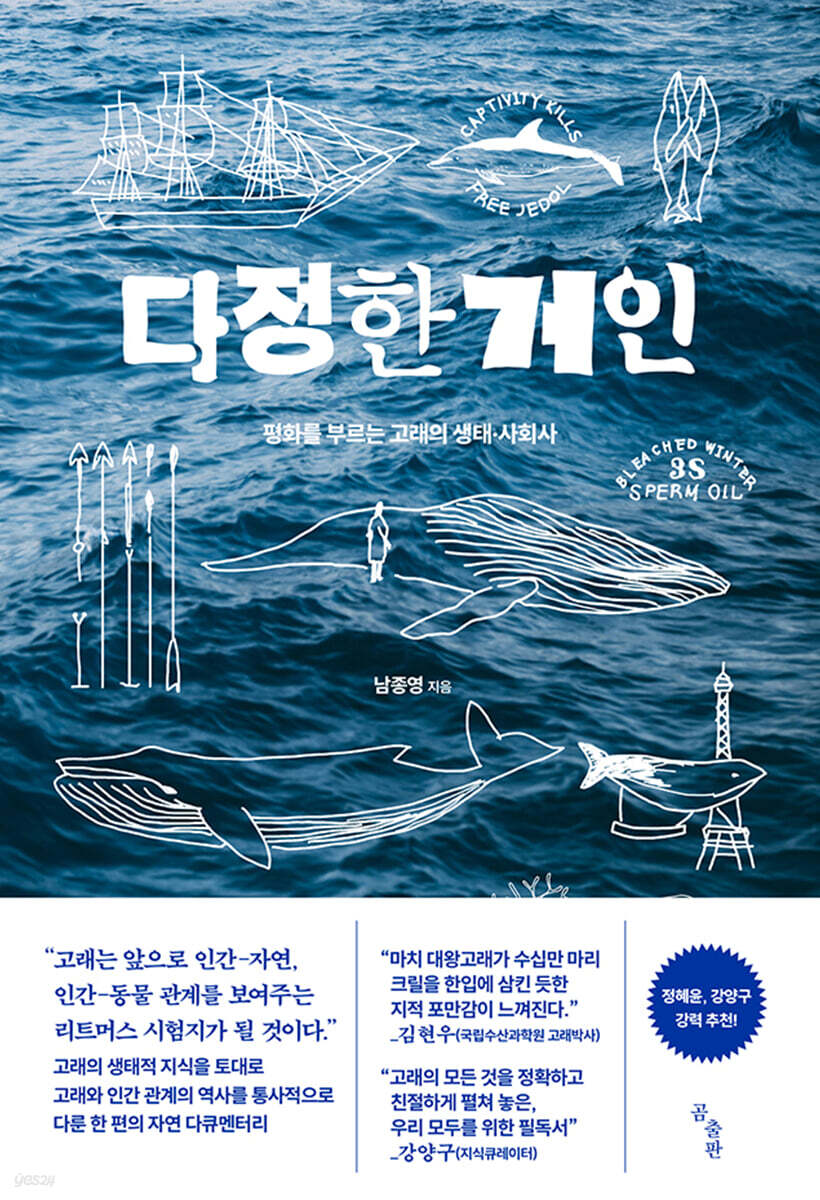
Affectionate Giant
 |
Description
Book Introduction
- A word from MD
- A new work by Nam Jong-young, Korea's top animal nonfiction writer.
This book talks about whales.
I traveled to over 20 places around the world and collected various incidents related to whales.
From lonely monsters to subjects of rights, it reconstructs the history of whales and also provides insight into the relationship between humans and whales.
- Min-gyu Son, PD of Natural Sciences
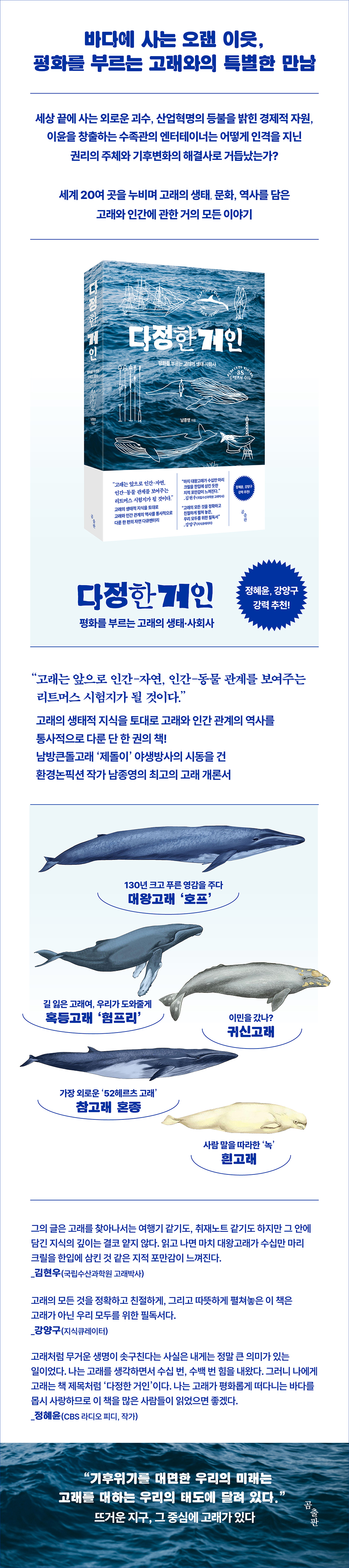
Old neighbors living by the sea,
A special encounter with the gentle giant whale that brings peace.
A lonely monster living at the end of the world,
Economic resources that lit the lamp of the Industrial Revolution,
Entertainers in profit-generating aquariums
How did we become human beings with rights and solutions to climate change?
From Nantucket (USA), home of Moby Dick; Taiji (Japan), the site of the worst dolphin massacre; to Shark Bay (Australia), home to dolphins who come to visit humans, this book delves into the ecology, culture, and history of whales and humans, covering nearly every aspect of their lives. This book, grounded in whale ecological knowledge, chronicles the history of human-whale relations. The ultimate introductory book on whales by environmental nonfiction author Nam Jong-young, who sparked the release of the Indo-Pacific bottlenose dolphin, Jedol, into the wild.
A special encounter with the gentle giant whale that brings peace.
A lonely monster living at the end of the world,
Economic resources that lit the lamp of the Industrial Revolution,
Entertainers in profit-generating aquariums
How did we become human beings with rights and solutions to climate change?
From Nantucket (USA), home of Moby Dick; Taiji (Japan), the site of the worst dolphin massacre; to Shark Bay (Australia), home to dolphins who come to visit humans, this book delves into the ecology, culture, and history of whales and humans, covering nearly every aspect of their lives. This book, grounded in whale ecological knowledge, chronicles the history of human-whale relations. The ultimate introductory book on whales by environmental nonfiction author Nam Jong-young, who sparked the release of the Indo-Pacific bottlenose dolphin, Jedol, into the wild.
- You can preview some of the book's contents.
Preview
index
Prologue 05
[Part 1] The Birth of a Whale
- Return from sea to land
Chapter 1.
They came from the land _19
Fish or Mammal? | Ancestors Who Swimmed on Land | From Pachicetus to Basilosaurus | The Unusual Body Structure of Whales | Dolphins Lying Sideways and Looking | Teeth or Whiskers | From Blue Whales to Franciscans
Whales - ① 130 Years of Big, Blue Inspiration_Blue Whale 'Hope' 50
Chapter 2.
Ecology, Society, Culture, and Mystery _55
Long-distance nomad | Seeing with sound | Whales returning to share love | Amazing underwater childbirth | Strong maternal love | Nets woven from air bubbles | Ferocious hunters | Whale leaps and tail-ups | Whales playing and napping | Tool use and cultural transmission | Cosmopolitan singer | Dolphins catching fish with humans | Coming to play with humans | Did they commit 'mass suicide'? | Sound waves of death, the trial of the century
Whales - ② Lost Whale, We'll Help You_Humphrey the Humpback Whale 103
Chapter 3.
Descendants of Sedna 107
The Inuit Girl Who Conceives a Whale | Jonah's Whale is a Sperm Whale | Nearchus and the Sea Monster | From Monster to Animal | Saint Brendan on the Whale's Back | The Stranding and the Advancement of Science
Whales - ③ Did they emigrate? _Ghost Whale 128
[Part 2] To avoid the harpoon and survive
- Human Greed and Whales (Part 1)
Chapter 4.
Whale, I gave you what you wanted 137
The Whaling Belt, the Arctic Cultural Zone | Harpoons in the Ice Labyrinth | Taboos and Purification Rituals | The Collapse of the Whaling Economy | Whaling in Northern Europe and Japan | The Basques: The Beginning of the Whaling Era | The Vanishing Whales of the Bay of Biscay
Chapter 5.
Prelude to Massacre 165
Discovering Spitsbergen | The Winds of Money Blowing in the Arctic | The Whaling Race: Britain vs. the Netherlands | The Tay Whale, Humiliated Even in Death
Chapter 6.
Whale's Revenge 181
Going Out to Sea to Hunt Sperm Whales | Whales That Shattered Ships | Sperm and Ambergris | The Fall of Nantucket | California Gray Whales | Self-Destructive Whaling | 17th-Century Population Decline
Chapter 7.
Floating Whale Factories in Antarctica 207
The Blue Whale: Conquered | Floating Factories | World War II and Whaling | The Formation of the International Whaling Commission | Sustainable Whaling is Gone | Why Sea Otters Are Vanishing
Chapter 8.
227 A Moon-Shining Bead in a Whale's Eye
The Mystery of Korean Whaling | The Vanished Bangudae Tribe | Oil Offered to the Yuan Dynasty | Whales Fallen to Japanese Imperialism | Whales Were Not Liberated
Whales - ④ Pushed to the Brink of Illegal Whaling_Korean Minke Whale 253
Chapter 9.
Whale Song 257
Whales and the Aurora | Sperm Whales Fly into Space | Winds of Change | Commercial Whaling Ends
Whales - ⑤ The Loneliest '52-Hertz Whale'_Hybrid Whale 277
[Part 3] The Age of Living Whales
- Human Greed and Whales (Part 2)
Chapter 10.
Whaling or Tourism? 285
Politically Growing Tourism | Wanting to See Up Close, Wanting to Leave | Whale Bay Sabotage | Resistance to the Moratorium | Why Japan Is Obsessed with Whaling | The Brutality of 'Korean-Style Whaling'
Whales - ⑥ Common in Korea, but Endangered Worldwide_Finless Porpoise 316
Chapter 11.
Dying to Please You 319
Daiji, the 'Black Hole' of Dolphins | Keiko, the 'Lucky' Orca | Tilikum, the 'Killer Whale' | A Pool Overflowing with Misfortune | From 'Wild Body' to 'Dolphin Show Body'
Whales - ⑦ 'Green' imitating human speech_White Whale 338
Chapter 12.
Dolphins Return to the Sea 343
The Secrets of Seoul Grand Park's Dolphin Show | The Three Principles of Wild Release | The Depressed Dolphin "Boksuni" | Performance-Based Release | The Future of Marine Sanctuaries
Whales - ⑧ People Like 'Pungi'_Bottle Dolphin 365
[Part 4] Subjects of Rights and Climate Change Solutions
- The future of whales
Chapter 13.
Whales Fighting Climate Change 375
An Ecosystem Born of Death | What Happens When You Can't Defecate | Double the Victims | East Sea Minke Whales and Nature-Based Solutions
Whales - ⑨ 50 Whales Standing in Front of Offshore Oil Fields_Rice Whales 390
Chapter 14.
The Rights of Whales, Nonhuman Persons 393
John Lilly's Strange Language Experiment | From 'Gentle Giant' to 'Rights-Holding' | Why the Southern Right Whale Ecological Corporation Matters
Epilogue 409
List of whale species 414
Americas 417
Search 439
Plate List 444
[Part 1] The Birth of a Whale
- Return from sea to land
Chapter 1.
They came from the land _19
Fish or Mammal? | Ancestors Who Swimmed on Land | From Pachicetus to Basilosaurus | The Unusual Body Structure of Whales | Dolphins Lying Sideways and Looking | Teeth or Whiskers | From Blue Whales to Franciscans
Whales - ① 130 Years of Big, Blue Inspiration_Blue Whale 'Hope' 50
Chapter 2.
Ecology, Society, Culture, and Mystery _55
Long-distance nomad | Seeing with sound | Whales returning to share love | Amazing underwater childbirth | Strong maternal love | Nets woven from air bubbles | Ferocious hunters | Whale leaps and tail-ups | Whales playing and napping | Tool use and cultural transmission | Cosmopolitan singer | Dolphins catching fish with humans | Coming to play with humans | Did they commit 'mass suicide'? | Sound waves of death, the trial of the century
Whales - ② Lost Whale, We'll Help You_Humphrey the Humpback Whale 103
Chapter 3.
Descendants of Sedna 107
The Inuit Girl Who Conceives a Whale | Jonah's Whale is a Sperm Whale | Nearchus and the Sea Monster | From Monster to Animal | Saint Brendan on the Whale's Back | The Stranding and the Advancement of Science
Whales - ③ Did they emigrate? _Ghost Whale 128
[Part 2] To avoid the harpoon and survive
- Human Greed and Whales (Part 1)
Chapter 4.
Whale, I gave you what you wanted 137
The Whaling Belt, the Arctic Cultural Zone | Harpoons in the Ice Labyrinth | Taboos and Purification Rituals | The Collapse of the Whaling Economy | Whaling in Northern Europe and Japan | The Basques: The Beginning of the Whaling Era | The Vanishing Whales of the Bay of Biscay
Chapter 5.
Prelude to Massacre 165
Discovering Spitsbergen | The Winds of Money Blowing in the Arctic | The Whaling Race: Britain vs. the Netherlands | The Tay Whale, Humiliated Even in Death
Chapter 6.
Whale's Revenge 181
Going Out to Sea to Hunt Sperm Whales | Whales That Shattered Ships | Sperm and Ambergris | The Fall of Nantucket | California Gray Whales | Self-Destructive Whaling | 17th-Century Population Decline
Chapter 7.
Floating Whale Factories in Antarctica 207
The Blue Whale: Conquered | Floating Factories | World War II and Whaling | The Formation of the International Whaling Commission | Sustainable Whaling is Gone | Why Sea Otters Are Vanishing
Chapter 8.
227 A Moon-Shining Bead in a Whale's Eye
The Mystery of Korean Whaling | The Vanished Bangudae Tribe | Oil Offered to the Yuan Dynasty | Whales Fallen to Japanese Imperialism | Whales Were Not Liberated
Whales - ④ Pushed to the Brink of Illegal Whaling_Korean Minke Whale 253
Chapter 9.
Whale Song 257
Whales and the Aurora | Sperm Whales Fly into Space | Winds of Change | Commercial Whaling Ends
Whales - ⑤ The Loneliest '52-Hertz Whale'_Hybrid Whale 277
[Part 3] The Age of Living Whales
- Human Greed and Whales (Part 2)
Chapter 10.
Whaling or Tourism? 285
Politically Growing Tourism | Wanting to See Up Close, Wanting to Leave | Whale Bay Sabotage | Resistance to the Moratorium | Why Japan Is Obsessed with Whaling | The Brutality of 'Korean-Style Whaling'
Whales - ⑥ Common in Korea, but Endangered Worldwide_Finless Porpoise 316
Chapter 11.
Dying to Please You 319
Daiji, the 'Black Hole' of Dolphins | Keiko, the 'Lucky' Orca | Tilikum, the 'Killer Whale' | A Pool Overflowing with Misfortune | From 'Wild Body' to 'Dolphin Show Body'
Whales - ⑦ 'Green' imitating human speech_White Whale 338
Chapter 12.
Dolphins Return to the Sea 343
The Secrets of Seoul Grand Park's Dolphin Show | The Three Principles of Wild Release | The Depressed Dolphin "Boksuni" | Performance-Based Release | The Future of Marine Sanctuaries
Whales - ⑧ People Like 'Pungi'_Bottle Dolphin 365
[Part 4] Subjects of Rights and Climate Change Solutions
- The future of whales
Chapter 13.
Whales Fighting Climate Change 375
An Ecosystem Born of Death | What Happens When You Can't Defecate | Double the Victims | East Sea Minke Whales and Nature-Based Solutions
Whales - ⑨ 50 Whales Standing in Front of Offshore Oil Fields_Rice Whales 390
Chapter 14.
The Rights of Whales, Nonhuman Persons 393
John Lilly's Strange Language Experiment | From 'Gentle Giant' to 'Rights-Holding' | Why the Southern Right Whale Ecological Corporation Matters
Epilogue 409
List of whale species 414
Americas 417
Search 439
Plate List 444
Detailed image
Into the book
Even in ancient times, humans gave whales a unique status.
I've never once thought of whales as fish.
Aristotle, an ancient Greek philosopher who flourished in the humanities, considered whales to be the most unique of animals.
In his "Historia Animalium," he said that whales and dolphins are similar to terrestrial animals in that they breathe with lungs rather than gills and give birth alive, making it difficult to classify them as fish.
Roman philosophers also viewed whales, dolphins, and seals as different from fish because of the way they gave birth and raised their young.
--- From "Chapter 1: They Came from the Land"
Southern right whales come to Monkey Mia Beach to meet humans.
According to a long-standing tradition, a 'feeding' ceremony is held at 8 a.m.
Dolphins arrive in shallow waters and approach people without hesitation.
Even if you touch it, it doesn't act aggressively.
They spend anywhere from a few minutes to three or four hours catching fish and socializing with people before returning to the sea.
The special relationship between dolphins and humans has a long history.
In 1964, a fisherman fed fish to dolphins, creating a 'culture' among them.
Dolphins come to feed, and people come to see them.
It became a tourist destination and a large resort was built.
The interesting thing is that dolphins don't come randomly, but rather a specific group comes.
There are about 3,000 southern right whales in Shark Bay.
Of these, only a very small number of dolphins visit Monkey Mia Beach.
--- From "Chapter 2: Ecology, Society, Culture, and Mystery"
Lee Ha-woo, an archaeological art historian who has focused on the Bangudae Petroglyphs, said that the "pipe-blower" in the Bangudae Petroglyphs was actually a "signaler" who raised his hand, and suggested that the Bangudae tribe was not a people who lived in the surrounding area, but rather a people who gathered from various regions to hunt whales during the annual whale migration season.
In the Neolithic Age, hunting was still the main focus, and in a hunting economy, it was advantageous to live scattered over a wide space.
It is said that people speaking dialects in various regions used hand signals to solve linguistic communication problems during the process of whaling.
Some researchers have suggested that the log boats are not suitable for whale hunting, and that the petroglyphs appear to be curved "umiaks", suggesting that the indigenous people of the Sea of Okhotsk and the northern Kamchatka Peninsula followed the migrating whales.
In this way, the Bangudae Petroglyphs can be seen as being in the magnetic field of the Pacific Rim whaling culture zone that stretches from the Northwest Pacific Ocean to the Arctic Ocean and then back to the Aleutian Islands.
--- From "Chapter 8: The Moon-Shining Bead in the Whale's Eye"
This marked the end of commercial whaling, which began in earnest in the 15th century by the Basques of Spain, after about 500 years.
Now whales are no longer a tool for profit accumulation.
What remained was 'subsistence hunting', where one catches and uses frugally as needed.
Only indigenous hunting, such as the hunting of bowhead whales by American Eskimos, gray whales by Siberian natives of the former Soviet Union, and beluga whales by Greenland natives, was allowed to continue at a level that complied with the International Whaling Commission's annual quota.
Cheers erupted outside the hotel.
Participants who filled the road jumped for joy, and environmental groups issued welcoming statements en masse.
The pride that the advancement of human consciousness had saved the whales was evident on his face.
On the road, people waved whale puppets, the environmentalists' mascot, throughout the conference.
Instead of the picket sign that said 'Save the whales', a new picket sign was hung.
'The whale was rescued - Brighton, 1982.'
--- From "Chapter 9: The Song of the Whale"
Jedol, who performed a dolphin show at Seoul Grand Park, met all three conditions.
Jedoli, who was captured in 2009 when he was 9 or 10 years old, was kept in captivity for three years until 2012, when the decision was made to release him into the wild.
Since there is only one pod of southern right whales in the waters of Jeju, the possibility of Jedol-i joining them was also high.
However, we should not release dolphins like throwing stones into the sea.
Because we have lived for quite some time without knowing how to survive in the wild, such as hunting for food, the wild ecology and behavioral rhythms must be restored.
To achieve this, we need to return the 'dolphin show body' to the 'wild body', which is the opposite of how wild dolphins were acclimated to the aquarium.
The most representative example is live fish feeding training.
Live fish are placed in the tank and the dolphins are allowed to chase and eat the fish themselves.
From his first training at Seoul Grand Park, Jedol succeeded in chasing and catching live fish.
At the same time, contact with people is gradually reduced so that they can stand alone in the wild.
Finally, a cage is installed in the ocean to allow the dolphins to acclimate to the outdoor sun, wind, and cold water temperatures.
Jedol was moved to the cage in Seongsan Port, Jeju in May 2013.
Among the dolphins who were confiscated, Chunsami and Sampal also join the group to return to the sea.
On June 22, about a month before release into the wild, Sampal disappeared through a torn gap in the cage net.
Five days later, Sampal is spotted with a wild group and becomes the first dolphin to be successfully released into the wild.
--- From "Chapter 12: Dolphins Returning to the Sea"
The dynamics of Earth's atmosphere, oceans, land, and diverse biota are being disrupted, disrupting the planet's intricately interconnected physicochemical systems.
One rivet can bring down a plane.
More and more bolts, nuts and rivets are rusting and falling out.
A small thing that invites disaster, a whale is at the center of the incident.
The whale is big.
The blue whale, the largest animal on Earth, is over 20 meters long and weighs over 150 tons.
The shit is big too.
Whale poop is rich in nutrients such as iron, phosphorus, and nitrogen.
So, where whales poop, phytoplankton thrive.
Phytoplankton absorb carbon dioxide from the atmosphere through photosynthesis.
Phytoplankton with stored carbon are either eaten by zooplankton or sink very slowly into the ocean along with other micronutrients.
Scientists call it 'sea snow'.
Sea snow accumulates on the seabed.
Carbon absorbed by phytoplankton is stored or sequestered here.
When exposed to the atmosphere, it contributes to the greenhouse effect, but because it is buried deep in the ocean, it has no effect on global warming.
I've never once thought of whales as fish.
Aristotle, an ancient Greek philosopher who flourished in the humanities, considered whales to be the most unique of animals.
In his "Historia Animalium," he said that whales and dolphins are similar to terrestrial animals in that they breathe with lungs rather than gills and give birth alive, making it difficult to classify them as fish.
Roman philosophers also viewed whales, dolphins, and seals as different from fish because of the way they gave birth and raised their young.
--- From "Chapter 1: They Came from the Land"
Southern right whales come to Monkey Mia Beach to meet humans.
According to a long-standing tradition, a 'feeding' ceremony is held at 8 a.m.
Dolphins arrive in shallow waters and approach people without hesitation.
Even if you touch it, it doesn't act aggressively.
They spend anywhere from a few minutes to three or four hours catching fish and socializing with people before returning to the sea.
The special relationship between dolphins and humans has a long history.
In 1964, a fisherman fed fish to dolphins, creating a 'culture' among them.
Dolphins come to feed, and people come to see them.
It became a tourist destination and a large resort was built.
The interesting thing is that dolphins don't come randomly, but rather a specific group comes.
There are about 3,000 southern right whales in Shark Bay.
Of these, only a very small number of dolphins visit Monkey Mia Beach.
--- From "Chapter 2: Ecology, Society, Culture, and Mystery"
Lee Ha-woo, an archaeological art historian who has focused on the Bangudae Petroglyphs, said that the "pipe-blower" in the Bangudae Petroglyphs was actually a "signaler" who raised his hand, and suggested that the Bangudae tribe was not a people who lived in the surrounding area, but rather a people who gathered from various regions to hunt whales during the annual whale migration season.
In the Neolithic Age, hunting was still the main focus, and in a hunting economy, it was advantageous to live scattered over a wide space.
It is said that people speaking dialects in various regions used hand signals to solve linguistic communication problems during the process of whaling.
Some researchers have suggested that the log boats are not suitable for whale hunting, and that the petroglyphs appear to be curved "umiaks", suggesting that the indigenous people of the Sea of Okhotsk and the northern Kamchatka Peninsula followed the migrating whales.
In this way, the Bangudae Petroglyphs can be seen as being in the magnetic field of the Pacific Rim whaling culture zone that stretches from the Northwest Pacific Ocean to the Arctic Ocean and then back to the Aleutian Islands.
--- From "Chapter 8: The Moon-Shining Bead in the Whale's Eye"
This marked the end of commercial whaling, which began in earnest in the 15th century by the Basques of Spain, after about 500 years.
Now whales are no longer a tool for profit accumulation.
What remained was 'subsistence hunting', where one catches and uses frugally as needed.
Only indigenous hunting, such as the hunting of bowhead whales by American Eskimos, gray whales by Siberian natives of the former Soviet Union, and beluga whales by Greenland natives, was allowed to continue at a level that complied with the International Whaling Commission's annual quota.
Cheers erupted outside the hotel.
Participants who filled the road jumped for joy, and environmental groups issued welcoming statements en masse.
The pride that the advancement of human consciousness had saved the whales was evident on his face.
On the road, people waved whale puppets, the environmentalists' mascot, throughout the conference.
Instead of the picket sign that said 'Save the whales', a new picket sign was hung.
'The whale was rescued - Brighton, 1982.'
--- From "Chapter 9: The Song of the Whale"
Jedol, who performed a dolphin show at Seoul Grand Park, met all three conditions.
Jedoli, who was captured in 2009 when he was 9 or 10 years old, was kept in captivity for three years until 2012, when the decision was made to release him into the wild.
Since there is only one pod of southern right whales in the waters of Jeju, the possibility of Jedol-i joining them was also high.
However, we should not release dolphins like throwing stones into the sea.
Because we have lived for quite some time without knowing how to survive in the wild, such as hunting for food, the wild ecology and behavioral rhythms must be restored.
To achieve this, we need to return the 'dolphin show body' to the 'wild body', which is the opposite of how wild dolphins were acclimated to the aquarium.
The most representative example is live fish feeding training.
Live fish are placed in the tank and the dolphins are allowed to chase and eat the fish themselves.
From his first training at Seoul Grand Park, Jedol succeeded in chasing and catching live fish.
At the same time, contact with people is gradually reduced so that they can stand alone in the wild.
Finally, a cage is installed in the ocean to allow the dolphins to acclimate to the outdoor sun, wind, and cold water temperatures.
Jedol was moved to the cage in Seongsan Port, Jeju in May 2013.
Among the dolphins who were confiscated, Chunsami and Sampal also join the group to return to the sea.
On June 22, about a month before release into the wild, Sampal disappeared through a torn gap in the cage net.
Five days later, Sampal is spotted with a wild group and becomes the first dolphin to be successfully released into the wild.
--- From "Chapter 12: Dolphins Returning to the Sea"
The dynamics of Earth's atmosphere, oceans, land, and diverse biota are being disrupted, disrupting the planet's intricately interconnected physicochemical systems.
One rivet can bring down a plane.
More and more bolts, nuts and rivets are rusting and falling out.
A small thing that invites disaster, a whale is at the center of the incident.
The whale is big.
The blue whale, the largest animal on Earth, is over 20 meters long and weighs over 150 tons.
The shit is big too.
Whale poop is rich in nutrients such as iron, phosphorus, and nitrogen.
So, where whales poop, phytoplankton thrive.
Phytoplankton absorb carbon dioxide from the atmosphere through photosynthesis.
Phytoplankton with stored carbon are either eaten by zooplankton or sink very slowly into the ocean along with other micronutrients.
Scientists call it 'sea snow'.
Sea snow accumulates on the seabed.
Carbon absorbed by phytoplankton is stored or sequestered here.
When exposed to the atmosphere, it contributes to the greenhouse effect, but because it is buried deep in the ocean, it has no effect on global warming.
--- From "Chapter 13: Whales Fighting Climate Change"
Publisher's Review
The stranded myth, the whale
From sea monster to moneymaker
There is no word more appropriate to describe whales than 'wonder'.
Whales are a wonder in and of themselves.
Unlike other marine animals, whales, which returned from land to the sea, are full of amazing stories, from their enormous size to their remarkable intelligence, athletic ability, ecology, and culture.
In one movie, there is a scene where a man who was a pirate explains whales to a group of bandits who have never been to the sea.
The group sits around a campfire in the middle, draws a circle outside, and tells the group that the size of a whale's eye is about this size.
Next, the size, appearance, and ecology of whales are explained.
Its nose is at the back of its head, it catches its prey with whiskers instead of teeth, and it occasionally comes up to the surface of the sea to breathe, spraying water like rain.
There is also a story about giving birth to a baby and breastfeeding it.
The bandits beat up the youngest member of the pirate clan, saying he was lying.
People who watch the movie already know the appearance and ecology of whales, so they laugh it off, but people who have never seen a whale would find it hard to believe that such an animal really exists.
Perhaps for this reason, whales appear as protagonists in myths and legends across various cultures.
Whales play important roles in the legend of the Inuit goddess Sedna, in the Old Testament Book of Jonah, and in the stories of Sinbad and Pinocchio.
Stories of mistaking whales for islands can be easily found both in the East and the West.
The whale was a huge and intelligent animal that was beyond human power.
So, the Inuit tribe, who depended on whales for much of their livelihood, may have performed such elaborate purification rituals before going out to hunt whales.
The Nuu-chah-nulth people, who lived on Canada's Vancouver Island and the Pacific Northwest, believed that sleeping with one's wife a month before a hunt would make one unclean.
If even one of the whale hunters of this tribe, also known as the 'Nootka', broke the taboo, the hunt would fail and the captain would be held responsible.
While her husband was out at sea, his wife quietly waited at home with the door open for the whale to come.
It was believed that if a stranger visited the house, the hunt would fail.
The shaman of the Nuu-chah-nul-th tribe built a shrine and placed there the excrement of the whale hunter's wife.
He believed that his wife's excrement lured whales to the shore.
Pages 147-148 (Whale, I gave you what you wanted)
What changed this thinking was the whale stranding (a dead whale washing up on land).
At the time, the whale's stranding was in itself a remarkable natural historical event.
Even in the late 16th century, whales were still considered mysterious creatures by people, and were recognized in folklore as 'monsters of the sea'.
However, with the Renaissance shift in perception and scientific advancements, people began to observe and dissect whales that had come ashore, gaining a different perspective.
Now, whales are considered to be nothing more than just animals.
Afterwards, whales, which were once objects of fear and awe, were reduced to a means of making money.
From the Bay of Biscay in Spain to the Arctic Ocean and Nantucket in North America, people around the world began harpooning the 'giants of the sea' for economic gain.
The beings who were slaughtered and imprisoned
Until he was recognized as a kind giant
When the whale, once an object of fear, a mythical being, and a monster of the sea, was reduced to a single animal, and the Basques began hunting whales for commercial purposes, imperialist powers such as Britain, the Netherlands, the United States, Russia, and Japan all jumped into the whaling industry.
The world's oceans were turned blood red for the extraction of whale byproducts such as whale oil, meat, and spermaceti.
Whaling ships grew larger and larger to catch large whales, such as the enormous blue whale, which was too large to handle.
Soon, whaling ships became factories of the sea.
And when there were no more whales to catch, they moved to another place and harpooned again.
With the advent of diesel-powered ships and the invention of explosive harpoons, whale populations began to decline exponentially.
After both world wars, fish finders, sonar (submarine sonar), and even airplanes were added.
From this time on, whales were searched for rather than discovered.
As we entered the mid-to-late 20th century, whales were not caught well.
Whaling ships began to be sold one by one, and the once bustling whaling ports gradually faded away.
In 1986, as the whaling industry was declining due to the dwindling whale population, the International Whaling Commission banned commercial whaling altogether.
With this, commercial whaling, which began in earnest by the Basques of Spain in the 15th century, came to an end after 500 years.
What saved the whale? It wasn't human wisdom or love for the Earth.
It's just that the cost of capturing has increased due to the lack of resources, so they don't throw harpoons.
Page 274 (Song of the Whale)
However, even after commercial whaling was banned, human exploitation of whales continued.
Dolphins and killer whales, which were not subject to the whaling ban, were still caught, confined in aquariums, and suffered for human entertainment.
They had to adapt to the small tanks, frozen fish, and shows, and learn show moves under the direction of trainers.
That's because then you can eat frozen fish.
Meanwhile, the 'wild body' changed into a 'dolphin show body'.
It is only recently that voices of opposition have grown louder against the reality of whales being mass-slaughtered and confined, reduced to an 'economic resource'.
It is the result of long-term efforts by environmental activists, scientists, and media producers.
When scientists published the results of their research on whale behavior and ecology, the media interpreted them as depicting advanced mental processes, diverse emotions, and individuality and culture.
Environmental activists fought the government and industry, shouting, "Whales have lives too."
It was thanks to these cultural forces that whales, once an economic resource, were re-recognized as 'affectionate giants' and further called 'subjects of rights.'
A kind giant who protects peace and the environment,
From a subject of rights to a 'non-human person'
Now, when you think of whales, you might think of 'The Strange Lawyer Woo Young-woo'.
The image of her, who suffers from autism spectrum disorder, finding peace by focusing solely on the whale song away from the loud and irritating noise of the subway, and the image of the whale swimming freely above the subway as if protecting Wooyoungwoo, comes to mind.
This shift in perception of whales has many philosophical implications.
Descartes once defined animals as beings that cannot feel self-consciousness, emotions, or pain.
It is defined as a being that only mechanically reacts to stimuli.
Whales were also perceived as mechanical beings.
However, this idea is refuted by the mirror experiment.
Dolphins, along with orangutans, gorillas, bonobos, elephants, and European magpies, have also been shown to possess self-awareness.
In other words, these animals, like humans, not only feel emotions and pain, but also have advanced mental functions that allow them to otherize themselves.
There are countless reasons why whales should be treated with respect.
Whales are now becoming a symbol of peace and environmental protection.
It has been revealed that it is a 'climate change solution' that captures carbon and sinks it in the ocean without anyone asking for it.
The so-called "whale pump" and "whale conveyor belt" phenomena, respectively, play a key role in the stable carbon cycle of the Earth through their global journey from the deep sea to the sea surface and from the poles to the equator.
We are currently spending enormous amounts of money to artificially capture carbon and store it under the sea.
However, restoring whale life cycles is much safer and more effective than these climate engineering solutions.
Shouldn't our attitude toward whales change now? It's time to consider how we view these self-conscious beings, capable of emotional exchange with humans.
Recently, a claim has emerged among scientists and environmental philosophers that these beings should be treated as 'persons'.
Some philosophers and animal rights theorists give special status to self-conscious animal species, calling them "nonhuman persons."
This concept begins with distinguishing between 'human' and 'person'.
If human is a biological category defined by comparing the physical characteristics of animal appearances, person refers to an entity that functions as an autonomous subject with self-consciousness, subjectivity, and sociality.
Environmental philosopher Thomas White argues that dolphins should be considered persons, arguing that scientific evidence has shown that they have self-awareness and make moral judgments.
In short, it is a non-human entity that is biologically different from humans (non-human), but shares characteristics (personality) that were previously thought to be unique to humans.
Pages 399-400 (Rights of Whales, Nonhuman Persons)
The missing ghost whale, Jedol, returns to the sea
The first to document the history of Korean whales and whaling.
Our country was the first to respond to these changes.
As the southern right whales, including Jedoli, Chunsami, and Sampali, who were illegally captured off the coast of Jeju Island and used in dolphin shows, returned to their homeland, South Korea became the first country to establish a system (ecological corporation) that grants legal rights to non-human creatures with significant ecological value and apply it to dolphins.
(*The Whanganui River Act of New Zealand, enacted in 2017, grants legal personality to the river basin, including its flora, fauna, water, and rocks, and appoints two people, each appointed by the central government and the Maori people, as legal guardians to protect the rights of the river.
The Hwangganui River belongs to the river, not to humans...
Likewise, if the Southern Right Whale is designated as an ecological corporation, it can file a lawsuit for damages when its habitat is damaged, such as during construction of an offshore wind farm.
Because the southern right whale is a rights-holder.
Pages 403-404 (Rights of Whales, Nonhuman Persons)
This book contains a wealth of information about Korean whales, including the history of whaling and whales in Korea, and the dolphin liberation movement that has unfolded since the mid-2010s, a wealth of information not previously available in books.
The story of the enigmatic tribe that left behind the Bangudae Petroglyphs depicting prehistoric whaling scenes, the nationalistic mentality of Korean whaling that resumed after liberation in 1945, the ongoing illegal whaling in the East Sea, and the return home of eight Jeju southern right whales, including Jedol, capture the reader's attention.
For this book, the author spent nearly 20 years researching the relics of the Holocaust, the habitats of wild whales, and the aquariums where dolphins are kept captive, in Jeju, Korea; Taiji, Japan; Husavik and Hvalfjord in Iceland; Dingle, Ireland; London, Dundee, and Kingston upon Hull in England; the Salish Sea in Canada; Stellwagen Bank and Orlando, Nantucket, and New Bedford in New England, USA; Prince William Sound in Alaska; Shark Bay and Perth in Western Australia; and Kaktovik and Svalbard in the Arctic.
By reviewing over 200 papers, reports, and original texts, we convey the latest scientific knowledge on whale ecology, while also critically analyzing the turbulent international whaling politics, including the recent resumption of commercial whaling by Japan and Isle of Man.
Whales, once 'monsters of the sea' and 'objects of slaughter and exploitation', are now moving from 'gentle giants' to 'subjects of rights'.
In the age of climate crisis, whales serve as a litmus test for how we humans view nature.
How we view whales will determine how we respond to the natural challenges that lie before us.
This is why everyone should read and think about 『The Gentle Giant』 together.
"The Gentle Giant" is a living ecological report that faithfully and vividly captures the most up-to-date information about whales.
It is also a history book that covers the long history between whales and humans, from mythology to whaling culture, aquarium dolphins, and then back to the 'subject of rights'.
It can also be read as a vivid report that raises serious concerns, reflections, and awareness about animals and humans, nature and humans.
In this book, readers will think about the history of whales and humans, the current issues surrounding them, and the desirable relationships between nature and humans, and between animals and humans.
"The Gentle Giant" is not limited to just a story about a strange whale.
It is a warm conversation and reflection on the future of humanity, which must live in harmony with nature.
From sea monster to moneymaker
There is no word more appropriate to describe whales than 'wonder'.
Whales are a wonder in and of themselves.
Unlike other marine animals, whales, which returned from land to the sea, are full of amazing stories, from their enormous size to their remarkable intelligence, athletic ability, ecology, and culture.
In one movie, there is a scene where a man who was a pirate explains whales to a group of bandits who have never been to the sea.
The group sits around a campfire in the middle, draws a circle outside, and tells the group that the size of a whale's eye is about this size.
Next, the size, appearance, and ecology of whales are explained.
Its nose is at the back of its head, it catches its prey with whiskers instead of teeth, and it occasionally comes up to the surface of the sea to breathe, spraying water like rain.
There is also a story about giving birth to a baby and breastfeeding it.
The bandits beat up the youngest member of the pirate clan, saying he was lying.
People who watch the movie already know the appearance and ecology of whales, so they laugh it off, but people who have never seen a whale would find it hard to believe that such an animal really exists.
Perhaps for this reason, whales appear as protagonists in myths and legends across various cultures.
Whales play important roles in the legend of the Inuit goddess Sedna, in the Old Testament Book of Jonah, and in the stories of Sinbad and Pinocchio.
Stories of mistaking whales for islands can be easily found both in the East and the West.
The whale was a huge and intelligent animal that was beyond human power.
So, the Inuit tribe, who depended on whales for much of their livelihood, may have performed such elaborate purification rituals before going out to hunt whales.
The Nuu-chah-nulth people, who lived on Canada's Vancouver Island and the Pacific Northwest, believed that sleeping with one's wife a month before a hunt would make one unclean.
If even one of the whale hunters of this tribe, also known as the 'Nootka', broke the taboo, the hunt would fail and the captain would be held responsible.
While her husband was out at sea, his wife quietly waited at home with the door open for the whale to come.
It was believed that if a stranger visited the house, the hunt would fail.
The shaman of the Nuu-chah-nul-th tribe built a shrine and placed there the excrement of the whale hunter's wife.
He believed that his wife's excrement lured whales to the shore.
Pages 147-148 (Whale, I gave you what you wanted)
What changed this thinking was the whale stranding (a dead whale washing up on land).
At the time, the whale's stranding was in itself a remarkable natural historical event.
Even in the late 16th century, whales were still considered mysterious creatures by people, and were recognized in folklore as 'monsters of the sea'.
However, with the Renaissance shift in perception and scientific advancements, people began to observe and dissect whales that had come ashore, gaining a different perspective.
Now, whales are considered to be nothing more than just animals.
Afterwards, whales, which were once objects of fear and awe, were reduced to a means of making money.
From the Bay of Biscay in Spain to the Arctic Ocean and Nantucket in North America, people around the world began harpooning the 'giants of the sea' for economic gain.
The beings who were slaughtered and imprisoned
Until he was recognized as a kind giant
When the whale, once an object of fear, a mythical being, and a monster of the sea, was reduced to a single animal, and the Basques began hunting whales for commercial purposes, imperialist powers such as Britain, the Netherlands, the United States, Russia, and Japan all jumped into the whaling industry.
The world's oceans were turned blood red for the extraction of whale byproducts such as whale oil, meat, and spermaceti.
Whaling ships grew larger and larger to catch large whales, such as the enormous blue whale, which was too large to handle.
Soon, whaling ships became factories of the sea.
And when there were no more whales to catch, they moved to another place and harpooned again.
With the advent of diesel-powered ships and the invention of explosive harpoons, whale populations began to decline exponentially.
After both world wars, fish finders, sonar (submarine sonar), and even airplanes were added.
From this time on, whales were searched for rather than discovered.
As we entered the mid-to-late 20th century, whales were not caught well.
Whaling ships began to be sold one by one, and the once bustling whaling ports gradually faded away.
In 1986, as the whaling industry was declining due to the dwindling whale population, the International Whaling Commission banned commercial whaling altogether.
With this, commercial whaling, which began in earnest by the Basques of Spain in the 15th century, came to an end after 500 years.
What saved the whale? It wasn't human wisdom or love for the Earth.
It's just that the cost of capturing has increased due to the lack of resources, so they don't throw harpoons.
Page 274 (Song of the Whale)
However, even after commercial whaling was banned, human exploitation of whales continued.
Dolphins and killer whales, which were not subject to the whaling ban, were still caught, confined in aquariums, and suffered for human entertainment.
They had to adapt to the small tanks, frozen fish, and shows, and learn show moves under the direction of trainers.
That's because then you can eat frozen fish.
Meanwhile, the 'wild body' changed into a 'dolphin show body'.
It is only recently that voices of opposition have grown louder against the reality of whales being mass-slaughtered and confined, reduced to an 'economic resource'.
It is the result of long-term efforts by environmental activists, scientists, and media producers.
When scientists published the results of their research on whale behavior and ecology, the media interpreted them as depicting advanced mental processes, diverse emotions, and individuality and culture.
Environmental activists fought the government and industry, shouting, "Whales have lives too."
It was thanks to these cultural forces that whales, once an economic resource, were re-recognized as 'affectionate giants' and further called 'subjects of rights.'
A kind giant who protects peace and the environment,
From a subject of rights to a 'non-human person'
Now, when you think of whales, you might think of 'The Strange Lawyer Woo Young-woo'.
The image of her, who suffers from autism spectrum disorder, finding peace by focusing solely on the whale song away from the loud and irritating noise of the subway, and the image of the whale swimming freely above the subway as if protecting Wooyoungwoo, comes to mind.
This shift in perception of whales has many philosophical implications.
Descartes once defined animals as beings that cannot feel self-consciousness, emotions, or pain.
It is defined as a being that only mechanically reacts to stimuli.
Whales were also perceived as mechanical beings.
However, this idea is refuted by the mirror experiment.
Dolphins, along with orangutans, gorillas, bonobos, elephants, and European magpies, have also been shown to possess self-awareness.
In other words, these animals, like humans, not only feel emotions and pain, but also have advanced mental functions that allow them to otherize themselves.
There are countless reasons why whales should be treated with respect.
Whales are now becoming a symbol of peace and environmental protection.
It has been revealed that it is a 'climate change solution' that captures carbon and sinks it in the ocean without anyone asking for it.
The so-called "whale pump" and "whale conveyor belt" phenomena, respectively, play a key role in the stable carbon cycle of the Earth through their global journey from the deep sea to the sea surface and from the poles to the equator.
We are currently spending enormous amounts of money to artificially capture carbon and store it under the sea.
However, restoring whale life cycles is much safer and more effective than these climate engineering solutions.
Shouldn't our attitude toward whales change now? It's time to consider how we view these self-conscious beings, capable of emotional exchange with humans.
Recently, a claim has emerged among scientists and environmental philosophers that these beings should be treated as 'persons'.
Some philosophers and animal rights theorists give special status to self-conscious animal species, calling them "nonhuman persons."
This concept begins with distinguishing between 'human' and 'person'.
If human is a biological category defined by comparing the physical characteristics of animal appearances, person refers to an entity that functions as an autonomous subject with self-consciousness, subjectivity, and sociality.
Environmental philosopher Thomas White argues that dolphins should be considered persons, arguing that scientific evidence has shown that they have self-awareness and make moral judgments.
In short, it is a non-human entity that is biologically different from humans (non-human), but shares characteristics (personality) that were previously thought to be unique to humans.
Pages 399-400 (Rights of Whales, Nonhuman Persons)
The missing ghost whale, Jedol, returns to the sea
The first to document the history of Korean whales and whaling.
Our country was the first to respond to these changes.
As the southern right whales, including Jedoli, Chunsami, and Sampali, who were illegally captured off the coast of Jeju Island and used in dolphin shows, returned to their homeland, South Korea became the first country to establish a system (ecological corporation) that grants legal rights to non-human creatures with significant ecological value and apply it to dolphins.
(*The Whanganui River Act of New Zealand, enacted in 2017, grants legal personality to the river basin, including its flora, fauna, water, and rocks, and appoints two people, each appointed by the central government and the Maori people, as legal guardians to protect the rights of the river.
The Hwangganui River belongs to the river, not to humans...
Likewise, if the Southern Right Whale is designated as an ecological corporation, it can file a lawsuit for damages when its habitat is damaged, such as during construction of an offshore wind farm.
Because the southern right whale is a rights-holder.
Pages 403-404 (Rights of Whales, Nonhuman Persons)
This book contains a wealth of information about Korean whales, including the history of whaling and whales in Korea, and the dolphin liberation movement that has unfolded since the mid-2010s, a wealth of information not previously available in books.
The story of the enigmatic tribe that left behind the Bangudae Petroglyphs depicting prehistoric whaling scenes, the nationalistic mentality of Korean whaling that resumed after liberation in 1945, the ongoing illegal whaling in the East Sea, and the return home of eight Jeju southern right whales, including Jedol, capture the reader's attention.
For this book, the author spent nearly 20 years researching the relics of the Holocaust, the habitats of wild whales, and the aquariums where dolphins are kept captive, in Jeju, Korea; Taiji, Japan; Husavik and Hvalfjord in Iceland; Dingle, Ireland; London, Dundee, and Kingston upon Hull in England; the Salish Sea in Canada; Stellwagen Bank and Orlando, Nantucket, and New Bedford in New England, USA; Prince William Sound in Alaska; Shark Bay and Perth in Western Australia; and Kaktovik and Svalbard in the Arctic.
By reviewing over 200 papers, reports, and original texts, we convey the latest scientific knowledge on whale ecology, while also critically analyzing the turbulent international whaling politics, including the recent resumption of commercial whaling by Japan and Isle of Man.
Whales, once 'monsters of the sea' and 'objects of slaughter and exploitation', are now moving from 'gentle giants' to 'subjects of rights'.
In the age of climate crisis, whales serve as a litmus test for how we humans view nature.
How we view whales will determine how we respond to the natural challenges that lie before us.
This is why everyone should read and think about 『The Gentle Giant』 together.
"The Gentle Giant" is a living ecological report that faithfully and vividly captures the most up-to-date information about whales.
It is also a history book that covers the long history between whales and humans, from mythology to whaling culture, aquarium dolphins, and then back to the 'subject of rights'.
It can also be read as a vivid report that raises serious concerns, reflections, and awareness about animals and humans, nature and humans.
In this book, readers will think about the history of whales and humans, the current issues surrounding them, and the desirable relationships between nature and humans, and between animals and humans.
"The Gentle Giant" is not limited to just a story about a strange whale.
It is a warm conversation and reflection on the future of humanity, which must live in harmony with nature.
GOODS SPECIFICS
- Date of issue: September 27, 2024
- Page count, weight, size: 452 pages | 902g | 162*237*30mm
- ISBN13: 9791189327378
- ISBN10: 1189327376
You may also like
카테고리
korean


korean

![GQ KOREA Mark (Monthly): December [2025]](http://librairie.coreenne.fr/cdn/shop/files/8ef265dbbfbf186523ed75ba7319009d.jpg?v=1765340328&width=3840)


