

How to read a tree
 |
Description
Book Introduction
·
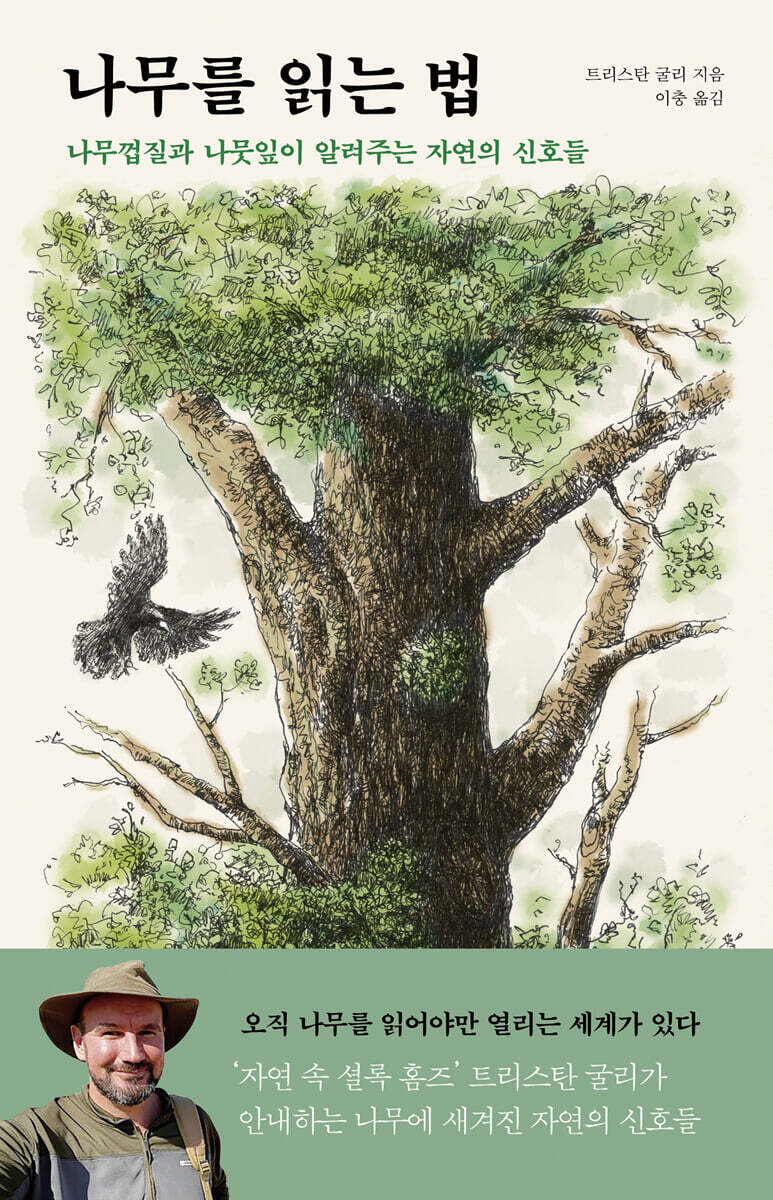
There is a world that can only be opened by reading the tree.
Signs Carved in Trees by World-renowned Explorer Tristan Gulley
We pass dozens of trees every day.
Cherry trees on the street, fig trees in the neighbor's yard, and crape myrtle trees on the walking path...
Do you know any trees? What does it mean to know a tree? Perhaps it's its name (species), its location, and its size.
Tristan Gooley, who has explored the world for decades and taught how to read trees for 20 years, says that discovering the natural signs engraved on a tree is more important than the name itself.
Even if we don't know the names of the trees, if we can read the signals they give us, we can understand not only the microscopic world of trees, but also the world around us in a way that our human senses cannot experience.
Tristan Gooley is a veteran explorer who has led expeditions on five continents and crossed the Atlantic alone.
What stands out about his resume is that he is an expert in exploring using natural navigation, using clues from nature to find his way.
This is why he was nicknamed 'Nature's Sherlock Holmes'.
Most of us who live in cities are unlikely to get lost in the forest like Tristan Gully and find our way through the signs and clues in the trees.
For us, who have become accustomed to urbanization and civilization, understanding nature, which is counterintuitive and sometimes illogical, may be an important starting point for restoring our relationship with nature.
Because there is no other living thing that is as close to our daily lives as trees, yet operates in a way that is different from that of humans.
This is why we must read the signals of trees, as taught by Tristan Gully, who has been observing nature's language closely for a long time.
This book is full of clues and signals from trees that have never been seen before.
Discovering the hidden signals of how tree roots, bark, branches, leaves, and even stumps adapt and respond to their environment will open your eyes to a way of understanding nature that goes beyond trees.
When we slow down and follow the signals the trees give us, we enter their microscopic world and the trees begin to tell their own stories.
And for the first time we can see the tree properly.
Signs Carved in Trees by World-renowned Explorer Tristan Gulley
We pass dozens of trees every day.
Cherry trees on the street, fig trees in the neighbor's yard, and crape myrtle trees on the walking path...
Do you know any trees? What does it mean to know a tree? Perhaps it's its name (species), its location, and its size.
Tristan Gooley, who has explored the world for decades and taught how to read trees for 20 years, says that discovering the natural signs engraved on a tree is more important than the name itself.
Even if we don't know the names of the trees, if we can read the signals they give us, we can understand not only the microscopic world of trees, but also the world around us in a way that our human senses cannot experience.
Tristan Gooley is a veteran explorer who has led expeditions on five continents and crossed the Atlantic alone.
What stands out about his resume is that he is an expert in exploring using natural navigation, using clues from nature to find his way.
This is why he was nicknamed 'Nature's Sherlock Holmes'.
Most of us who live in cities are unlikely to get lost in the forest like Tristan Gully and find our way through the signs and clues in the trees.
For us, who have become accustomed to urbanization and civilization, understanding nature, which is counterintuitive and sometimes illogical, may be an important starting point for restoring our relationship with nature.
Because there is no other living thing that is as close to our daily lives as trees, yet operates in a way that is different from that of humans.
This is why we must read the signals of trees, as taught by Tristan Gully, who has been observing nature's language closely for a long time.
This book is full of clues and signals from trees that have never been seen before.
Discovering the hidden signals of how tree roots, bark, branches, leaves, and even stumps adapt and respond to their environment will open your eyes to a way of understanding nature that goes beyond trees.
When we slow down and follow the signals the trees give us, we enter their microscopic world and the trees begin to tell their own stories.
And for the first time we can see the tree properly.
- You can preview some of the book's contents.
Preview
index
Part 1: The Art of Reading Trees
Chapter 1: Magic Isn't in the Nameㆍ13
Chapter 2: The Tree is a Mapㆍ16
Chapter 3 Visible Shapesㆍ40
Chapter 4: The Lost Branchesㆍ65
Chapter 5: Traces of the Windㆍ111
Chapter 6 Stemㆍ129
Chapter 7: The Stump Compass and the Piece of Cakeㆍ152
Chapter 8: Rootsㆍ171
Part 2 How to See a Tree
Chapter 9: Changes in Leaf Shapeㆍ213
Chapter 10 Shell Signalsㆍ252
Chapter 11: Hidden Seasonsㆍ283
Chapter 12: The Lost Map and the Secret of the Treeㆍ332
Going outㆍ365
Appendix 370
Acknowledgmentsㆍ390
Referencesㆍ393
Searchㆍ401
Chapter 1: Magic Isn't in the Nameㆍ13
Chapter 2: The Tree is a Mapㆍ16
Chapter 3 Visible Shapesㆍ40
Chapter 4: The Lost Branchesㆍ65
Chapter 5: Traces of the Windㆍ111
Chapter 6 Stemㆍ129
Chapter 7: The Stump Compass and the Piece of Cakeㆍ152
Chapter 8: Rootsㆍ171
Part 2 How to See a Tree
Chapter 9: Changes in Leaf Shapeㆍ213
Chapter 10 Shell Signalsㆍ252
Chapter 11: Hidden Seasonsㆍ283
Chapter 12: The Lost Map and the Secret of the Treeㆍ332
Going outㆍ365
Appendix 370
Acknowledgmentsㆍ390
Referencesㆍ393
Searchㆍ401
Detailed image
Publisher's Review
Why can't we see the same tree?
Trees that experience dramatically different things depending on the wind and light
When we think of a tree, we first think of the family tree to which it belongs.
But if you look around, you can see that no two trees are structurally the same, even if they are of the same lineage.
This is one of the characteristics that distinguishes them from animals.
For example, monkey A may have longer limbs than monkey B, or may be missing an arm due to disease or an accident, but all monkeys are born and grow up with the same genetic structure.
Depending on the individual, the limbs that are not used often may be amputated, or the limbs may be difficult to support, preventing new joints or tendons from growing.
On the other hand, trees follow the general rules of their lineage, but they prune useless branches (natural deciduousness) and when they judge that they do not have enough strength to support long and large branches, they grow new wood nearby to store up the strength to support them.
As you can see above, there are three important factors to understand the structure and growth of a tree.
‘Genes’, ‘environment’ such as wind and light, and ‘time’.
This has such an impact that it changes the structure of the tree.
These elements are carved all over the tree and can be recognized if you know what to look for.
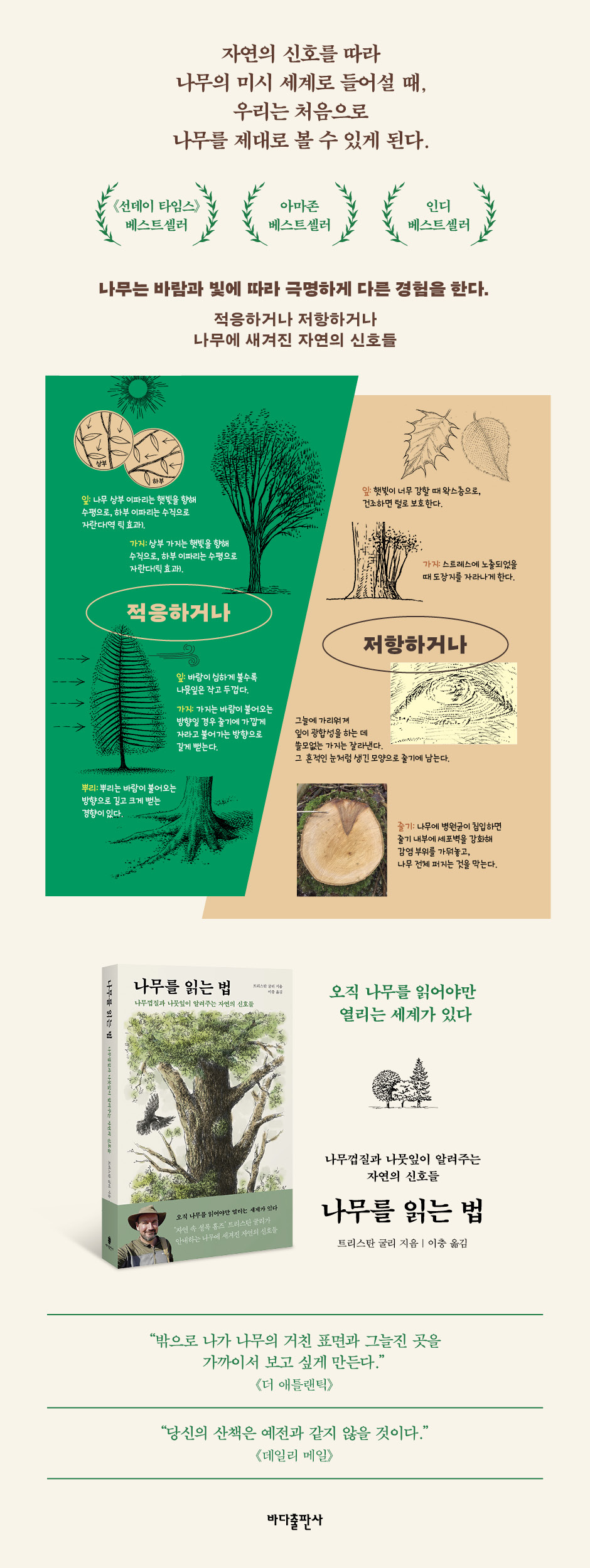
Roots in the direction the wind blows grow longer, larger, and stronger than roots in the other direction.
For this reason, the shape of the roots is one of the easiest and most useful ways to read wind direction.
Tree trunks tend to extend into open spaces such as rivers or roads.
This is because it moves with the light, and you can easily find trees planted in a row along a river or road leaning as if greeting each other.
Also, the stems tend to taper in the direction the wind blows.
For this reason, it appears thinnest when viewed in a straight line with the wind, and thickest when viewed at a right angle.
In the case of tree bark, trees that have evolved to grow well in the shade have thin bark, while trees exposed to sunlight have thick bark.
A smooth bark is a sign that the tree grew slowly, while a rough bark is a sign that the tree grew quickly and lived in a harsh environment.
The leaves become smaller when exposed to strong winds or cold.
Leaves that grow in particularly windy places are thicker than those that grow in less windy places.
For this reason, conifers, which have small, needle-like leaves, survive better in harsh environments than deciduous trees, which have large, broad leaves.
However, leaves also change in response to their surroundings.
When shade is created by nearby trees or buildings, the leaves change shape to better withstand the shade and become wider and thinner.
Trees have this plasticity that allows them to change according to their environment.
In the case of tree branches, genes cause them to grow away from the trunk, but sunlight causes them to grow at the right angle.
This is why, even among trees of the same lineage, we see trees with different branch thicknesses and growth directions depending on the direction and intensity of the light in the environment where the tree is placed.
There are many tall and short trees, but medium-sized trees are rare.
Why is this? Because trees require a lot of energy to grow tall, if that energy isn't available, they won't grow tall.
But if you choose to be a small tree, you can survive with less light.
Medium-sized trees cannot reach as high as tall trees, and are too large to receive the ground-level light that smaller trees can.
As a result, under selective pressure, medium-sized trees die, leaving only tall and small trees to survive.
‘Time’ is also an important factor to know when reading a tree.
Time in particular is associated with several misconceptions about trees.
For example, let's say you carved your name under a tree branch within reach.
When you find that tree exactly five years later, will the branch with the name on it have moved higher or lower? We often assume that since trees grow upward, the branch with the name on it will have moved higher.
However, since upward growth occurs at the top of the trunk, and the lower part of the trunk no longer grows upwards but only becomes thicker in circumference, even after five years, I can still touch the branch with my name engraved on it.
In this way, trees experience drastically different things not only depending on their genes but also on the environment and time in which they are placed. Therefore, even if they are of the same lineage, we see trees with different roots, trunks, bark conditions, leaf shapes, and even the shape, number, and direction of branches.
The repetition of separation, growth, and waiting,
How trees survive
Living organisms are constantly exposed to stimuli.
It repeats growth and decline by choosing either to resist or adapt to the stimulus.
If you look at even a tree that lives its entire life in one place without moving, you will find that it is fiercely surviving by adapting to its surroundings.
When exposed to too much or too little sunlight, in windy and barren conditions, or when diseased or exposed to pathogens, trees try different strategies to suit each situation.
The results of that attempt appear all over the body as separated and growing traces.
There are some common signs that a tree may be stressed by disease or a harsh environment.
Small branches (epicormic sprouts) grow out from the stem or branches at the same time, which are new shoots that have grown from dormant buds that were hidden due to hormonal changes.
As time passes, most of the young shoots die, leaving only one or two to grow into branches.
Eggplants grow toward the light to support photosynthetic leaves.
However, if the branches are no longer helpful in harvesting light because they are shaded by new trees or buildings nearby, they are pruned.
Because it is no longer useful.
This is called self-pruning.
Naturally occurring octopuses leave marks on the stem that resemble eyes.
The branches face south where the sunlight is, so buds are found mostly on the south side.
Trees also provide countermeasures for current and future situations.
This can also be detected as a signal.
For example, when leaves are exposed to too much sunlight, they are protected with a wax layer, and when they are dry, they are protected with hairs.
When the leaves cannot photosynthesize, the thin bark exposes the inner lining and performs photosynthesis in place of the leaves.
If the leaves feel rough, it's a sign that your plant is enduring harsh weather, either too hot or too cold.
In the case of shells, they are sometimes intentionally grown thick to prepare for natural disasters such as strong sunlight or forest fires.
When a pathogen invades, the tree strengthens its cell walls inside the trunk to confine the infected area to a specific compartment and prevent it from spreading throughout the tree.
Even when branches are separated during the natural process of cutting, the joints are sealed with pine resin or rubber juice to prevent pathogens from entering.
Trees also measure seasons by the length of the night in addition to temperature, to prevent leaf growth in harsh weather.
Because of this, even if the temperature rises to the abnormally high temperature in January, leaves do not sprout.
Temperature is not a temporary ups and downs, but it is sensitive to the duration of the temperature, and it cleverly identifies an environment suitable for its growth.
The way trees survive the uncertain future and stress is simple.
Trying out all the possibilities.
And the result of that attempt is confirmed by waiting.
It doesn't matter if the attempt fails.
Because you can try something different to suit it.
In a way, you could say that stress doesn't kill trees, but rather makes them more mature.
Once a pattern is noticed, it cannot be hidden again.
The correlation between tree reading and curiosity
Is there anything different about us before and after learning how to read trees? The author likens the relationship between reading trees and the brain to solving a crossword puzzle.
It is argued that our curiosity is more powerful when crossword puzzles are filled in one by one rather than when all the spaces are blank.
This is explained through the term 'information gap' used by American behavioral economist George Loewenstein.
When we perceive a gap between what we know and what we do not understand, we experience cognitive deprivation, which is called curiosity.
Curiosity is a kind of desire, and it is triggered when we know a few words and feel that we are missing information, rather than when we have not filled in any of the boxes in the mind-reading puzzle, so “the more we know what to look for, the more we look for it and the more we see it (p. 212).”
Knowing something can be seen as playing an important role in the chain reaction that leads to the next knowledge.
For example, we know that tree roots grow larger, stronger, and longer in the direction the wind blows.
When you enter the forest, you will notice that the roots are pointing north, not southwest where the wind blows.
The moment we realize that, we will begin to question.
This gap between what we know (the roots are facing southwest, the direction the wind blows) and the phenomenon (the roots are facing north) leads to the question, “Why does this gap occur?”
Because there is a discrepancy between what you know and what you are currently observing, you notice that something is strange.
I observed the tree and its surroundings for 30 minutes until I could resolve this discrepancy.
The moment you spend observing like that, you discover a new fact.
That the roots of the tree point to the edge of the forest.
At that moment, he was able to complete the crossword puzzle of the disparity he had seen.
The wind blows stronger around the forest than in the center, and tree roots are directed toward the forest edge.
The roots in the north were pointing to an exit from the forest.
“There are things you will never discover even if you look a thousand times, but once you discover them, you will never miss them again,” says Gulli, talking about how reading the signals trees give us can change our thoughts and actions.
As we read about trees, we wonder where our lively curiosity will lead us.
Trees that experience dramatically different things depending on the wind and light
When we think of a tree, we first think of the family tree to which it belongs.
But if you look around, you can see that no two trees are structurally the same, even if they are of the same lineage.
This is one of the characteristics that distinguishes them from animals.
For example, monkey A may have longer limbs than monkey B, or may be missing an arm due to disease or an accident, but all monkeys are born and grow up with the same genetic structure.
Depending on the individual, the limbs that are not used often may be amputated, or the limbs may be difficult to support, preventing new joints or tendons from growing.
On the other hand, trees follow the general rules of their lineage, but they prune useless branches (natural deciduousness) and when they judge that they do not have enough strength to support long and large branches, they grow new wood nearby to store up the strength to support them.
As you can see above, there are three important factors to understand the structure and growth of a tree.
‘Genes’, ‘environment’ such as wind and light, and ‘time’.
This has such an impact that it changes the structure of the tree.
These elements are carved all over the tree and can be recognized if you know what to look for.
Roots in the direction the wind blows grow longer, larger, and stronger than roots in the other direction.
For this reason, the shape of the roots is one of the easiest and most useful ways to read wind direction.
Tree trunks tend to extend into open spaces such as rivers or roads.
This is because it moves with the light, and you can easily find trees planted in a row along a river or road leaning as if greeting each other.
Also, the stems tend to taper in the direction the wind blows.
For this reason, it appears thinnest when viewed in a straight line with the wind, and thickest when viewed at a right angle.
In the case of tree bark, trees that have evolved to grow well in the shade have thin bark, while trees exposed to sunlight have thick bark.
A smooth bark is a sign that the tree grew slowly, while a rough bark is a sign that the tree grew quickly and lived in a harsh environment.
The leaves become smaller when exposed to strong winds or cold.
Leaves that grow in particularly windy places are thicker than those that grow in less windy places.
For this reason, conifers, which have small, needle-like leaves, survive better in harsh environments than deciduous trees, which have large, broad leaves.
However, leaves also change in response to their surroundings.
When shade is created by nearby trees or buildings, the leaves change shape to better withstand the shade and become wider and thinner.
Trees have this plasticity that allows them to change according to their environment.
In the case of tree branches, genes cause them to grow away from the trunk, but sunlight causes them to grow at the right angle.
This is why, even among trees of the same lineage, we see trees with different branch thicknesses and growth directions depending on the direction and intensity of the light in the environment where the tree is placed.
There are many tall and short trees, but medium-sized trees are rare.
Why is this? Because trees require a lot of energy to grow tall, if that energy isn't available, they won't grow tall.
But if you choose to be a small tree, you can survive with less light.
Medium-sized trees cannot reach as high as tall trees, and are too large to receive the ground-level light that smaller trees can.
As a result, under selective pressure, medium-sized trees die, leaving only tall and small trees to survive.
‘Time’ is also an important factor to know when reading a tree.
Time in particular is associated with several misconceptions about trees.
For example, let's say you carved your name under a tree branch within reach.
When you find that tree exactly five years later, will the branch with the name on it have moved higher or lower? We often assume that since trees grow upward, the branch with the name on it will have moved higher.
However, since upward growth occurs at the top of the trunk, and the lower part of the trunk no longer grows upwards but only becomes thicker in circumference, even after five years, I can still touch the branch with my name engraved on it.
In this way, trees experience drastically different things not only depending on their genes but also on the environment and time in which they are placed. Therefore, even if they are of the same lineage, we see trees with different roots, trunks, bark conditions, leaf shapes, and even the shape, number, and direction of branches.
The repetition of separation, growth, and waiting,
How trees survive
Living organisms are constantly exposed to stimuli.
It repeats growth and decline by choosing either to resist or adapt to the stimulus.
If you look at even a tree that lives its entire life in one place without moving, you will find that it is fiercely surviving by adapting to its surroundings.
When exposed to too much or too little sunlight, in windy and barren conditions, or when diseased or exposed to pathogens, trees try different strategies to suit each situation.
The results of that attempt appear all over the body as separated and growing traces.
There are some common signs that a tree may be stressed by disease or a harsh environment.
Small branches (epicormic sprouts) grow out from the stem or branches at the same time, which are new shoots that have grown from dormant buds that were hidden due to hormonal changes.
As time passes, most of the young shoots die, leaving only one or two to grow into branches.
Eggplants grow toward the light to support photosynthetic leaves.
However, if the branches are no longer helpful in harvesting light because they are shaded by new trees or buildings nearby, they are pruned.
Because it is no longer useful.
This is called self-pruning.
Naturally occurring octopuses leave marks on the stem that resemble eyes.
The branches face south where the sunlight is, so buds are found mostly on the south side.
Trees also provide countermeasures for current and future situations.
This can also be detected as a signal.
For example, when leaves are exposed to too much sunlight, they are protected with a wax layer, and when they are dry, they are protected with hairs.
When the leaves cannot photosynthesize, the thin bark exposes the inner lining and performs photosynthesis in place of the leaves.
If the leaves feel rough, it's a sign that your plant is enduring harsh weather, either too hot or too cold.
In the case of shells, they are sometimes intentionally grown thick to prepare for natural disasters such as strong sunlight or forest fires.
When a pathogen invades, the tree strengthens its cell walls inside the trunk to confine the infected area to a specific compartment and prevent it from spreading throughout the tree.
Even when branches are separated during the natural process of cutting, the joints are sealed with pine resin or rubber juice to prevent pathogens from entering.
Trees also measure seasons by the length of the night in addition to temperature, to prevent leaf growth in harsh weather.
Because of this, even if the temperature rises to the abnormally high temperature in January, leaves do not sprout.
Temperature is not a temporary ups and downs, but it is sensitive to the duration of the temperature, and it cleverly identifies an environment suitable for its growth.
The way trees survive the uncertain future and stress is simple.
Trying out all the possibilities.
And the result of that attempt is confirmed by waiting.
It doesn't matter if the attempt fails.
Because you can try something different to suit it.
In a way, you could say that stress doesn't kill trees, but rather makes them more mature.
Once a pattern is noticed, it cannot be hidden again.
The correlation between tree reading and curiosity
Is there anything different about us before and after learning how to read trees? The author likens the relationship between reading trees and the brain to solving a crossword puzzle.
It is argued that our curiosity is more powerful when crossword puzzles are filled in one by one rather than when all the spaces are blank.
This is explained through the term 'information gap' used by American behavioral economist George Loewenstein.
When we perceive a gap between what we know and what we do not understand, we experience cognitive deprivation, which is called curiosity.
Curiosity is a kind of desire, and it is triggered when we know a few words and feel that we are missing information, rather than when we have not filled in any of the boxes in the mind-reading puzzle, so “the more we know what to look for, the more we look for it and the more we see it (p. 212).”
Knowing something can be seen as playing an important role in the chain reaction that leads to the next knowledge.
For example, we know that tree roots grow larger, stronger, and longer in the direction the wind blows.
When you enter the forest, you will notice that the roots are pointing north, not southwest where the wind blows.
The moment we realize that, we will begin to question.
This gap between what we know (the roots are facing southwest, the direction the wind blows) and the phenomenon (the roots are facing north) leads to the question, “Why does this gap occur?”
Because there is a discrepancy between what you know and what you are currently observing, you notice that something is strange.
I observed the tree and its surroundings for 30 minutes until I could resolve this discrepancy.
The moment you spend observing like that, you discover a new fact.
That the roots of the tree point to the edge of the forest.
At that moment, he was able to complete the crossword puzzle of the disparity he had seen.
The wind blows stronger around the forest than in the center, and tree roots are directed toward the forest edge.
The roots in the north were pointing to an exit from the forest.
“There are things you will never discover even if you look a thousand times, but once you discover them, you will never miss them again,” says Gulli, talking about how reading the signals trees give us can change our thoughts and actions.
As we read about trees, we wonder where our lively curiosity will lead us.
GOODS SPECIFICS
- Date of issue: August 23, 2024
- Page count, weight, size: 412 pages | 556g | 138*214*23mm
- ISBN13: 9791166892837
You may also like
카테고리
korean


korean

![GQ KOREA Mark (Monthly): December [2025]](http://librairie.coreenne.fr/cdn/shop/files/8ef265dbbfbf186523ed75ba7319009d.jpg?v=1765340328&width=3840)


