

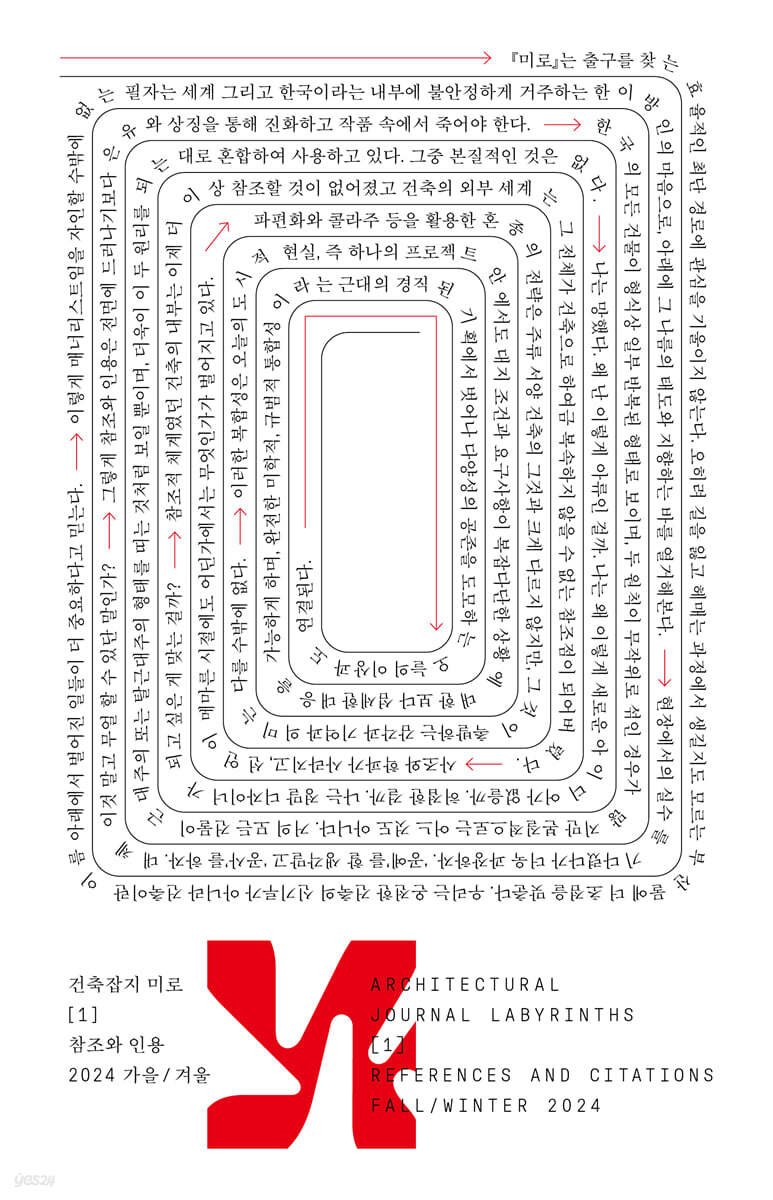
Maze 1: References and Citations [2024]
 |
Description
Book Introduction
A new architectural magazine, Miro, is launched.
『Labyrinth』 aims to uncover and document the discourse of modern Korean architecture.
It is a text-based magazine published three times a year (spring, summer, fall/winter) that focuses solely on a selected topic each issue.
The theme of the inaugural issue is “References and Citations.”
- You can preview some of the book's contents.
Preview
index
Inaugural Address
While compiling 『Labyrinth 1: References and Citations』
Kim Gwang-su · Architecture after self-reference
Seo Jae-won · Schizophrenia and Hyper-Referential Architecture
Kim Hyo-young: Building a story and architecture through references and citations
Lim Yoon-taek: The Violent and Beautiful Imagination of Crossbreeding
Lee Hee-jun · I want it because I want it
Song Ryul and Christian Schweitzer: From Space Design to Time Design: Five Theses on Modern Architecture
Jeon Jae-woo: GOAT Mental Health Tips for Copying
Lee Chi-hoon: The Outside of Architecture as a Referential World, the Inside of Architecture as a Non-Referential System
Kim Sara · Write as you think
Bae Yoon-kyung · Drift on References and Citations
Choi Won-jun · Fragmentary ideas cited
Hyun Myung-seok · Emotional Solids: On Architectural Instructions and Quotations
Kangshin · As True as Possible: A Review of Valerio Olgiati and Markus Breitschmidt's "Non-Referential Architecture"
Colin Lowe and Seungchan Kwak (translation) · Mannerism and Modern Architecture
Publisher's Review
Launch of a new architecture magazine
A new architectural magazine, Miro, is launched.
『Labyrinth』 aims to uncover and document the discourse of modern Korean architecture.
Unlike existing magazines that focus on introducing recent works and critiques of architecture and buildings, this is a text-based magazine published three times a year (spring, summer, fall/winter) that focuses only on a selected topic each issue.
The multi-layered meaning of the title, “Maze”
The title “Maze” has multi-layered meaning.
First of all, it reflects the current situation of Korean architecture.
It is a metaphor for a situation where there are many problems but no solution or exit in sight.
On the one hand, the maze is an intelligent structure with a very clear intention.
Since the buildings that 『Labyrinth』 focuses on are also buildings that contain the architect's clear intentions, the title also refers to the subject matter.
There is also a hidden reference target.
As the theme of the first issue was “reference and citation,” there are many references in Labyrinth, which came out at the end of the magazine era or modern architecture.
One of them is the book 『Sphere and Labyrinth』 (la sfera e il labirinto, 1980) by Manfredo Tafuri, an Italian architectural historian who left a distinct mark in the late 20th century.
Tapuri places the perfect sphere (circle) and the labyrinth on opposite sides.
In modern Korean architecture, a flawless and smooth sphere is a mirage that cannot exist.
That's why we prioritize the maze.
Meanwhile, Daedalus, the designer of the mythical labyrinth, is the archetypal figure of the architect and creator.
So there are some historic magazines named after this person.
Daedalus is a magazine published by the American Academy of Arts and Sciences (its roots date back to 1846).
There is also Daidalos, an architectural art magazine published in Germany.
They use the subject-Daedalus as their title, while using the object-labyrinth as their logo.
In response to the trend of the times toward new materialistic thinking and moving away from a subject-centered worldview, 『Labyrinth』 chose the name of the object rather than the subject.
The theme of the inaugural issue is “References and Citations.”
Korean literature scholar Kim Yun-sik once recalled that his life's work was to overcome the assertion of Japanese colonial critic Im Hwa that "modern literature is transplanted literature."
The results include 『History of Korean Literature』, published in 1972 with Kim Hyeon.
Because it was considered the mission of modern literature to create a common sensibility of the times through a medium shared by all and to form a kind of political community, it was difficult for this to be transplanted from outside, especially through the framework of colonial powers.
Even if it did not fully bloom, it had to be proven that there were indigenous seeds.
It was very difficult to free the history of modern Korean literature from this obsession.
What if we turned literature into architecture?
The proposition that “modern architecture is transplanted architecture” rarely causes anxiety or discomfort.
Although there are often irreconcilable debates over how to understand modern or contemporary architecture, no one claims that it was spontaneous.
Whether it was an eclectic building built before and after the colonial period or a modernist building that was introduced in earnest after liberation, it was something that came from abroad.
Naturally, how it connected to the center of modern architecture was of great importance.
The myth and legacy of Kim Chung-up and Kim Jong-seong rests absolutely on the fact that they studied directly under Le Corbusier and Mies van der Rohe, respectively.
The time difference between Europe and the United States (and Japan as an implicit reference) and Korea has been a major driving force in Korean architecture.
Between these differences, references and citations had to be either covertly concealed or, conversely, blatantly revealed.
20th century Korea as a reference
On the other hand, there is something that is rarely brought to the forefront.
It is a modern building built after the mid-20th century.
Architects rarely took explicit reference to the work of their predecessors and mentors in their work.
The writings of contemporary Korean critics and theorists rarely inspired action.
『Labyrinth 1: References and Citations』 attempts to examine this flow.
Although there are differences in their positions, the writings of Kim Gwang-su, Seo Jae-won, Kim Hyo-young, Lim Yun-taek, and Lee Hee-jun can be read in this context.
The aim is to examine how references and citations to contemporary Korea, which occur in various fields such as film, dance, novels, and music, are taking place in architecture.
It covers a group of architectural trends that draw their creative motifs from multi-generational, multi-family homes and commercial facilities that are so common that they are often overlooked.
The trend of non-referential architecture
Meanwhile, there is a name that appears like a ghost in the opposite position.
Swiss architect Valerio Olgiati.
His book, Non-Referential Architecture, published with Markus Breitschmidt, has recently gained considerable popularity in the Korean architectural world, especially among young architects and students.
This book, prone to misunderstandings and speculations (and to some extent, self-inflicted ones), speaks in diametrically opposed voices on reference and citation.
Their thesis is being simplified and amplified by anonymous Instagram accounts that use Olgiati's name to attack Korean architects' work as plagiarism.
We have included a review of 『Non-referential Architecture』, along with articles that present different positions on reference and citation.
diverse voices
"Labyrinth" contains the voices of various members of the architectural community.
It brings together the voices of critics, historians, and theorists, as well as architects of various levels (from those who work on large projects to those who rarely build buildings), curators, and planners, working across various fields within the vast field of architecture.
We also plan to hold online and offline forums that will delve deeper into the topics covered in the magazine.
Through all these activities, 『Labyrinth』 hopes to become the center of Korean architectural discourse.
GOODS SPECIFICS
- Date of issue: October 30, 2024
- Page count, weight, size: 240 pages | 424g | 143*225*19mm
- ISBN13: 9791190853583
- ISBN10: 1190853582
You may also like
카테고리
korean


korean


