

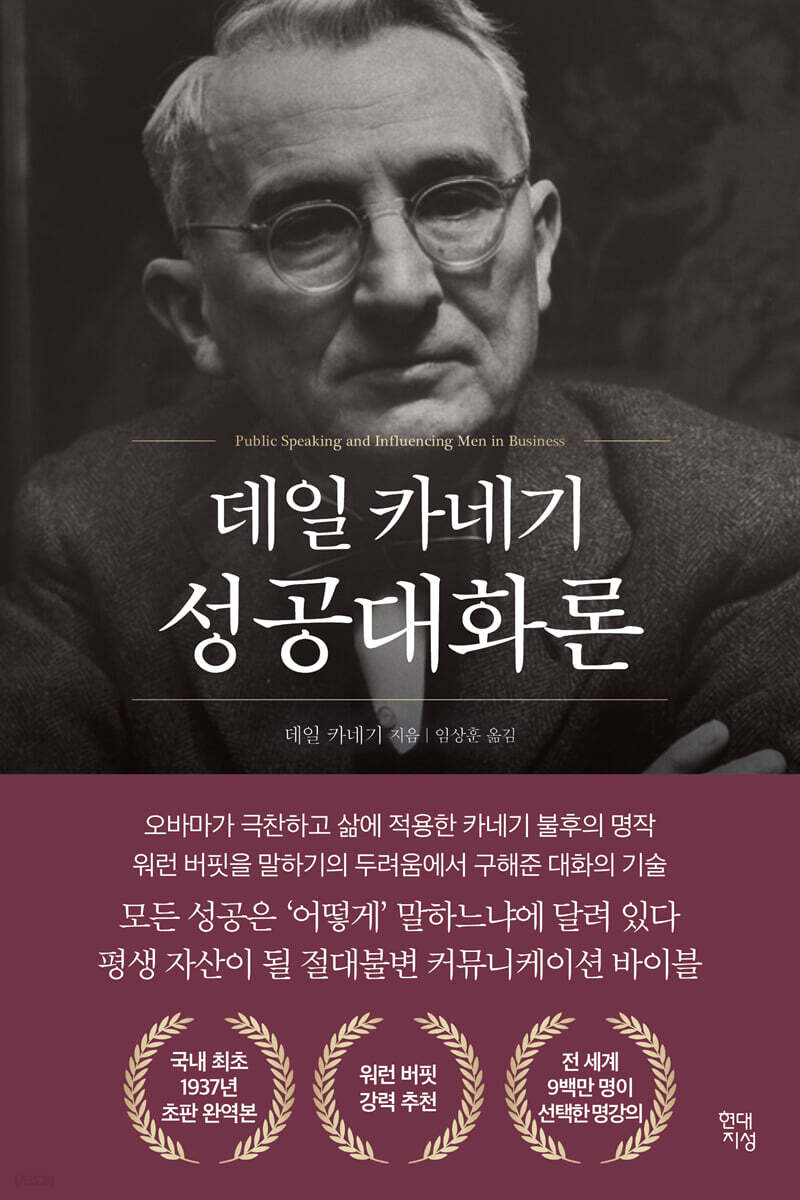
Dale Carnegie's Success Talk Theory
 |
Description
Book Introduction
- A word from MD
-
The beginning of the Carnegie legendThis book contains Dale Carnegie's speaking skills that saved world-renowned investor Warren Buffett from his fear of speaking.
This is the first complete Korean translation of 'Voice Training', first published in 1937, and contains various examples and Carnegie's principles to help anyone acquire successful communication skills.
October 18, 2022. Self-Development PD Kim Sang-geun
An immortal masterpiece that captures the essence and beginning of the Carnegie legend.
The art of conversation that saved Warren Buffett from his fear of speaking!
All success depends on how you say it.
The Absolutely Unchangeable Communication Bible That Will Be Your Lifelong Asset
Following Dale Carnegie's "How to Win Friends and Influence People" and "How to Manage Yourself" which became instant bestsellers, Hyundai Intelligence is publishing Carnegie's immortal masterpiece, "How to Talk to People: A Guide to Successful Communication," which Obama praised and applied to his own life.
This book is the first complete translation in Korea of 'Voice Training', first published in 1937, carefully selected and adapted for Korean readers, and is the starting point for the Carnegie Institute.
World-renowned investor Warren Buffett says that the speaking classes he took directly from Carnegie completely changed his life.
He was once so afraid of speaking in front of an audience that he would vomit from the nervousness, but he was far more proud of the "Diploma in Communication Studies" he received from Dale Carnegie in 1952 than of his business degree.
“If you could learn the art of conversation that Carnegie taught, you could increase your lifetime income by 50 percent,” said Warren Buffett.
Carnegie combined public speaking, salesmanship, human relations, and applied psychology to teach concrete and practical conversational skills that ordinary office workers could immediately apply in business interviews or meetings the next day.
He also thoroughly demonstrated the secrets of successful speaking through numerous examples, from the great orators of the East and the West, past and present, to the ordinary people who listened to his lectures and saw their speaking skills grow remarkably.
No matter what we do, communication skills are a critical factor in our success.
Learn the specific formula for elegant speaking through this book, which presents conversational techniques that remain unchanged even after a century.
It will become a lifelong asset by enhancing your inner values such as confidence, self-affirmation, logical thinking, and persuasiveness.
The art of conversation that saved Warren Buffett from his fear of speaking!
All success depends on how you say it.
The Absolutely Unchangeable Communication Bible That Will Be Your Lifelong Asset
Following Dale Carnegie's "How to Win Friends and Influence People" and "How to Manage Yourself" which became instant bestsellers, Hyundai Intelligence is publishing Carnegie's immortal masterpiece, "How to Talk to People: A Guide to Successful Communication," which Obama praised and applied to his own life.
This book is the first complete translation in Korea of 'Voice Training', first published in 1937, carefully selected and adapted for Korean readers, and is the starting point for the Carnegie Institute.
World-renowned investor Warren Buffett says that the speaking classes he took directly from Carnegie completely changed his life.
He was once so afraid of speaking in front of an audience that he would vomit from the nervousness, but he was far more proud of the "Diploma in Communication Studies" he received from Dale Carnegie in 1952 than of his business degree.
“If you could learn the art of conversation that Carnegie taught, you could increase your lifetime income by 50 percent,” said Warren Buffett.
Carnegie combined public speaking, salesmanship, human relations, and applied psychology to teach concrete and practical conversational skills that ordinary office workers could immediately apply in business interviews or meetings the next day.
He also thoroughly demonstrated the secrets of successful speaking through numerous examples, from the great orators of the East and the West, past and present, to the ordinary people who listened to his lectures and saw their speaking skills grow remarkably.
No matter what we do, communication skills are a critical factor in our success.
Learn the specific formula for elegant speaking through this book, which presents conversational techniques that remain unchanged even after a century.
It will become a lifelong asset by enhancing your inner values such as confidence, self-affirmation, logical thinking, and persuasiveness.
- You can preview some of the book's contents.
Preview
index
Introduction
Chapter 1: When fear leaves, courage returns.
[Voice Training] Proper Breathing 1
Chapter 2: Confidence Comes from Thorough Preparation
[Voice Training] Proper Breathing 2
Chapter 3: How Great Speeches Are Made
[Voice Training] Relaxation
Chapter 4: How to Improve Your Memory
[Voice Training] Relieving Neck Tension
Chapter 5: Keep Your Audience Awake
[Voice Training] Breathing Control
Chapter 6: Essential Elements of Successful Speaking
[Voice Training] Using the Tip of Your Tongue
Chapter 7: A Well-Delivered Speech is a Good Speech
[Voice Training] Creating a Bright and Attractive Tone
Chapter 8: Dos and Don'ts on the Podium
[Voice Training] Review
Chapter 9: How to Start
[Voice Training] Relaxing Your Jaw
Chapter 10: How to Capture Your Audience's Heart Instantly
[Voice Training] Creating Flexible Lips
Chapter 11: How to End
[Voice Training] Developing Resonance 1
Chapter 12: How to Clarify Meaning
[Voice Training] Developing Resonance 2
Chapter 13: How to Speak Impressively and Persuasively
[Voice Training] Roosevelt's Resonance Training Method
Chapter 14: How to Capture Your Audience's Interest
[Voice Training] How to Send Your Voice Far
Chapter 15: How to Motivate Your Audience to Action
[Voice Training] How to Speak More Clearly
Chapter 16: If you want to speak well, improve your expressiveness.
[Voice Training] Review
Chapter 1: When fear leaves, courage returns.
[Voice Training] Proper Breathing 1
Chapter 2: Confidence Comes from Thorough Preparation
[Voice Training] Proper Breathing 2
Chapter 3: How Great Speeches Are Made
[Voice Training] Relaxation
Chapter 4: How to Improve Your Memory
[Voice Training] Relieving Neck Tension
Chapter 5: Keep Your Audience Awake
[Voice Training] Breathing Control
Chapter 6: Essential Elements of Successful Speaking
[Voice Training] Using the Tip of Your Tongue
Chapter 7: A Well-Delivered Speech is a Good Speech
[Voice Training] Creating a Bright and Attractive Tone
Chapter 8: Dos and Don'ts on the Podium
[Voice Training] Review
Chapter 9: How to Start
[Voice Training] Relaxing Your Jaw
Chapter 10: How to Capture Your Audience's Heart Instantly
[Voice Training] Creating Flexible Lips
Chapter 11: How to End
[Voice Training] Developing Resonance 1
Chapter 12: How to Clarify Meaning
[Voice Training] Developing Resonance 2
Chapter 13: How to Speak Impressively and Persuasively
[Voice Training] Roosevelt's Resonance Training Method
Chapter 14: How to Capture Your Audience's Interest
[Voice Training] How to Send Your Voice Far
Chapter 15: How to Motivate Your Audience to Action
[Voice Training] How to Speak More Clearly
Chapter 16: If you want to speak well, improve your expressiveness.
[Voice Training] Review
Detailed image
.jpg)
Into the book
Nothing has given me more complete and lasting satisfaction than standing before an audience and leading them to do my bidding.
It's like a feeling of power, a feeling of having gained authority.
I also feel proud of having achieved my goal.
I feel like I'm standing alone, separated from my colleagues of similar skill level.
It's a magical and enchanting experience that you'll never forget.
One speaker went so far as to say:
“Until two minutes before I started speaking, I was thinking that I would rather have been whipped instead of giving a speech.
But now, with only two minutes left, I'd rather be shot than finish the story."
--- p.25
Edwin James Cattell has lectured to an estimated 30 million people.
He confided to me that he considers a speech a failure if, on the way home, he doesn't think, "I should have said that."
Why? Because he knows from long experience that a great speech is one that accumulates so much material that it cannot be fully utilized within the given time.
--- p.57
No matter how thoroughly you prepare and prepare, you can suddenly turn gray while giving a speech in front of people.
It's a situation where the story can no longer progress and is completely at a loss, just looking at the audience.
It's a scary situation.
But I don't want to sit there feeling confused and defeated.
(…) When we face such a moment of mental disaster, I will suggest the best way to save our lives.
Take the last word, phrase, or thought from the last sentence of your previous speech and use it to start a new sentence.
Then, we can make it flow freely and endlessly, like the stream in Tennyson's poem.
--- p.110
We must never forget that we determine the attitude of the listener.
When we give a speech, the audience is in the palm of our hand.
If we speak lukewarmly, the audience will also react lukewarmly.
If we are shy, the audience will be shy too.
If we pay even a little attention, the audience will pay even a little attention.
But if what we say is sincere, and we speak with emotion, spontaneity, power, and high conviction, the audience cannot help but be infected by our thoughts.
--- p.123
Weak people begin every sentence with “I think so,” “maybe,” “I think so,” and end it with “I think so.”
Almost all beginner public speaking professionals ruin their speeches by using timid expressions rather than by speaking in an overly assertive tone.
I once heard a New York businessman talk about his experience driving around Connecticut.
He said this:
“If you go to the left of the road, it looks like you’ll come across something like an onion field.” But there’s no such thing as an onion field.
If it's an onion, ... and if it's not, it's not.
--- p.135
Today's audiences prefer to speak to each person directly, as if the speaker were having a chat, whether at a business meeting of a dozen or in a tent of a thousand.
Speeches should be given in the same way.
But it shouldn't be done with the same energy as a private conversation.
If you do that, you will be completely ignored by the audience.
To appear natural, you need to use more energy talking to 40 people than to one person.
--- p.167
Wouldn't it be better to start with something you and your audience can relate to, then pose a relevant question that everyone wants to hear answered? Then, lead the audience toward the answer you propose.
When giving an answer, you must present the facts clearly so that people will naturally and unconsciously accept your conclusion as their own.
People tend to be more fixated on facts they believe they have discovered themselves.
In other words, even the highest level of speech can sound like nothing more than a simple explanation.
--- p.250
Napoleon once declared that repetition was the only important principle in rhetoric.
He knew that just because an idea was clear to him, it didn't mean it would be easily understood by others.
To understand a new idea, you need time to think about it.
In short, new ideas must be said over and over again.
But it shouldn't be the same expression.
People hate it when you repeat the same thing over and over again.
That makes sense.
But if you use different expressions to say the same idea, people tend to think you're not repeating it.
--- p.302
If possible, I'd like to hear a story about effort.
It would be better if it was a story about fighting and winning.
We are very interested in fighting.
What the world loves is conflict.
The world wants to see a story about two men fighting over a woman.
Isn't that the same thing when you watch a novel, a magazine article, a movie, or a drama? The moment the great hero overcomes all obstacles and embraces the heroine, the audience is already reaching for their hats and coats.
And then, after just five minutes, only the cleaners are left, chatting about broom handles and such.
It's like a feeling of power, a feeling of having gained authority.
I also feel proud of having achieved my goal.
I feel like I'm standing alone, separated from my colleagues of similar skill level.
It's a magical and enchanting experience that you'll never forget.
One speaker went so far as to say:
“Until two minutes before I started speaking, I was thinking that I would rather have been whipped instead of giving a speech.
But now, with only two minutes left, I'd rather be shot than finish the story."
--- p.25
Edwin James Cattell has lectured to an estimated 30 million people.
He confided to me that he considers a speech a failure if, on the way home, he doesn't think, "I should have said that."
Why? Because he knows from long experience that a great speech is one that accumulates so much material that it cannot be fully utilized within the given time.
--- p.57
No matter how thoroughly you prepare and prepare, you can suddenly turn gray while giving a speech in front of people.
It's a situation where the story can no longer progress and is completely at a loss, just looking at the audience.
It's a scary situation.
But I don't want to sit there feeling confused and defeated.
(…) When we face such a moment of mental disaster, I will suggest the best way to save our lives.
Take the last word, phrase, or thought from the last sentence of your previous speech and use it to start a new sentence.
Then, we can make it flow freely and endlessly, like the stream in Tennyson's poem.
--- p.110
We must never forget that we determine the attitude of the listener.
When we give a speech, the audience is in the palm of our hand.
If we speak lukewarmly, the audience will also react lukewarmly.
If we are shy, the audience will be shy too.
If we pay even a little attention, the audience will pay even a little attention.
But if what we say is sincere, and we speak with emotion, spontaneity, power, and high conviction, the audience cannot help but be infected by our thoughts.
--- p.123
Weak people begin every sentence with “I think so,” “maybe,” “I think so,” and end it with “I think so.”
Almost all beginner public speaking professionals ruin their speeches by using timid expressions rather than by speaking in an overly assertive tone.
I once heard a New York businessman talk about his experience driving around Connecticut.
He said this:
“If you go to the left of the road, it looks like you’ll come across something like an onion field.” But there’s no such thing as an onion field.
If it's an onion, ... and if it's not, it's not.
--- p.135
Today's audiences prefer to speak to each person directly, as if the speaker were having a chat, whether at a business meeting of a dozen or in a tent of a thousand.
Speeches should be given in the same way.
But it shouldn't be done with the same energy as a private conversation.
If you do that, you will be completely ignored by the audience.
To appear natural, you need to use more energy talking to 40 people than to one person.
--- p.167
Wouldn't it be better to start with something you and your audience can relate to, then pose a relevant question that everyone wants to hear answered? Then, lead the audience toward the answer you propose.
When giving an answer, you must present the facts clearly so that people will naturally and unconsciously accept your conclusion as their own.
People tend to be more fixated on facts they believe they have discovered themselves.
In other words, even the highest level of speech can sound like nothing more than a simple explanation.
--- p.250
Napoleon once declared that repetition was the only important principle in rhetoric.
He knew that just because an idea was clear to him, it didn't mean it would be easily understood by others.
To understand a new idea, you need time to think about it.
In short, new ideas must be said over and over again.
But it shouldn't be the same expression.
People hate it when you repeat the same thing over and over again.
That makes sense.
But if you use different expressions to say the same idea, people tend to think you're not repeating it.
--- p.302
If possible, I'd like to hear a story about effort.
It would be better if it was a story about fighting and winning.
We are very interested in fighting.
What the world loves is conflict.
The world wants to see a story about two men fighting over a woman.
Isn't that the same thing when you watch a novel, a magazine article, a movie, or a drama? The moment the great hero overcomes all obstacles and embraces the heroine, the audience is already reaching for their hats and coats.
And then, after just five minutes, only the cleaners are left, chatting about broom handles and such.
--- p.349
Publisher's Review
Captivate people's hearts in an instant
The formula for dignified speech that leads you where you want to go
This is an era where words are important.
According to a survey of 1,441 office workers conducted by job search platform Saramin in 2020, 95.6% of respondents answered that “conversational skills play an important role in work.”
Additionally, according to a 2022 survey by online lecture platform Tal-ing, users preparing to return to their pre-COVID-19 in-person daily lives flocked to "Speaking Classes," with the number of students enrolled in such courses increasing by 58% year-on-year.
Not only that.
Not only in bookstores but also on YouTube and other media, content on how to speak well is pouring out every day.
Speaking is not just an important skill for office workers.
It's a skill that's essential for anyone who wants to captivate people's hearts and drive them to action, whether they're creators, religious figures, or entrepreneurs.
Dale Carnegie, a 'speaking guru' chosen by prominent figures such as Warren Buffett, the greatest investor and entrepreneur in history, and Obama, who received worldwide attention and support for his clear speeches, wrote this book to help ordinary people improve their speaking skills.
In this book, he goes beyond fragmentary and superficial conversation principles and presents fundamental and concrete solutions for successful speaking.
Covering almost everything about speaking, from how to overcome the fear of speaking to how to find material, how to structure a speech, what to do and not to do on the podium, how to motivate the audience, and how to start and end, it presents a winning speaking formula.
Even now, a century later, it is filled with useful content that can be put to use immediately, and it can be applied and utilized in any field, so it has been recognized as an absolute and immutable communication bible by many people regardless of their occupation, work characteristics, or career history.
Be sure to read this before important meetings, presentations, and conversations!
Life hacks to eliminate fear and lead to certain success
Every day, in business meetings, business interviews, and conversations with our bosses, we are evaluated on our abilities and worth based on what we say.
However, as the number of people with 'talkophia' who have difficulty communicating face-to-face increases among the MZ generation, the number of office workers who have difficulty communicating is rapidly increasing.
While people wander around looking for momentary solutions to each situation, Carnegie goes beyond the details of speaking throughout this book to talk about the essentials—the core principles that, once ingrained, will have a lifelong impact on your speaking career.
This book analyzes the speaking styles of great orators from the East and the West, past and present, demonstrating that they can captivate people's hearts. It also inspires us by sharing the stories of ordinary people who, after attending his lectures, experienced remarkable growth in their speaking skills.
This book will reveal that among the human abilities that win people's hearts, get things done quickly, and gain recognition from many, nothing compares to conversation.
In particular, Carnegie cites overcoming fear and having courage as the key secrets to successful speaking.
He reminds us through specific examples that even great figures who shone on the podium, such as William Jennings Bryan, Ulysses S. Grant, Roosevelt, Charlie Chaplin, and Lincoln, trembled with fear when they first spoke, and emphasizes that successful experiences are more important than anything else to build confidence.
To this end, he is famous for giving all students in his lectures an opportunity to present.
Includes Korea's first 'voice training'
The Complete First Edition of "Theory of Successful Dialogue"
Dale Carnegie published the first edition of this book, Public Speaking, in 1926 for his public speaking classes.
Afterwards, he realized that adults desperately needed not only communication skills but also the ability to make friends, and published 『Human Relations』 in 1936.
The following year, in 1937, 『Public Speaking』 was significantly supplemented and a revised edition titled 『Public Speaking and Influencing Men in Business』 was published. This book 『Successful Conversation Theory』 by Hyundai Jisung is the first complete translation in Korea that even includes the 'voice training' from the first edition of the revised edition.
The 'Voice Exercise' section of the 'Speech building' section at the end of each chapter in the original text is organized into a 'voice training' corner, and it generously provides practical tips on vocalization and pronunciation for successful speaking, including proper breathing, use of the lips and tongue, jaw relaxation, and resonance development methods.
If you feel nervous and anxious before an important meeting, presentation, or conversation, try boosting your confidence with this book.
It will definitely accelerate your success.
The formula for dignified speech that leads you where you want to go
This is an era where words are important.
According to a survey of 1,441 office workers conducted by job search platform Saramin in 2020, 95.6% of respondents answered that “conversational skills play an important role in work.”
Additionally, according to a 2022 survey by online lecture platform Tal-ing, users preparing to return to their pre-COVID-19 in-person daily lives flocked to "Speaking Classes," with the number of students enrolled in such courses increasing by 58% year-on-year.
Not only that.
Not only in bookstores but also on YouTube and other media, content on how to speak well is pouring out every day.
Speaking is not just an important skill for office workers.
It's a skill that's essential for anyone who wants to captivate people's hearts and drive them to action, whether they're creators, religious figures, or entrepreneurs.
Dale Carnegie, a 'speaking guru' chosen by prominent figures such as Warren Buffett, the greatest investor and entrepreneur in history, and Obama, who received worldwide attention and support for his clear speeches, wrote this book to help ordinary people improve their speaking skills.
In this book, he goes beyond fragmentary and superficial conversation principles and presents fundamental and concrete solutions for successful speaking.
Covering almost everything about speaking, from how to overcome the fear of speaking to how to find material, how to structure a speech, what to do and not to do on the podium, how to motivate the audience, and how to start and end, it presents a winning speaking formula.
Even now, a century later, it is filled with useful content that can be put to use immediately, and it can be applied and utilized in any field, so it has been recognized as an absolute and immutable communication bible by many people regardless of their occupation, work characteristics, or career history.
Be sure to read this before important meetings, presentations, and conversations!
Life hacks to eliminate fear and lead to certain success
Every day, in business meetings, business interviews, and conversations with our bosses, we are evaluated on our abilities and worth based on what we say.
However, as the number of people with 'talkophia' who have difficulty communicating face-to-face increases among the MZ generation, the number of office workers who have difficulty communicating is rapidly increasing.
While people wander around looking for momentary solutions to each situation, Carnegie goes beyond the details of speaking throughout this book to talk about the essentials—the core principles that, once ingrained, will have a lifelong impact on your speaking career.
This book analyzes the speaking styles of great orators from the East and the West, past and present, demonstrating that they can captivate people's hearts. It also inspires us by sharing the stories of ordinary people who, after attending his lectures, experienced remarkable growth in their speaking skills.
This book will reveal that among the human abilities that win people's hearts, get things done quickly, and gain recognition from many, nothing compares to conversation.
In particular, Carnegie cites overcoming fear and having courage as the key secrets to successful speaking.
He reminds us through specific examples that even great figures who shone on the podium, such as William Jennings Bryan, Ulysses S. Grant, Roosevelt, Charlie Chaplin, and Lincoln, trembled with fear when they first spoke, and emphasizes that successful experiences are more important than anything else to build confidence.
To this end, he is famous for giving all students in his lectures an opportunity to present.
Includes Korea's first 'voice training'
The Complete First Edition of "Theory of Successful Dialogue"
Dale Carnegie published the first edition of this book, Public Speaking, in 1926 for his public speaking classes.
Afterwards, he realized that adults desperately needed not only communication skills but also the ability to make friends, and published 『Human Relations』 in 1936.
The following year, in 1937, 『Public Speaking』 was significantly supplemented and a revised edition titled 『Public Speaking and Influencing Men in Business』 was published. This book 『Successful Conversation Theory』 by Hyundai Jisung is the first complete translation in Korea that even includes the 'voice training' from the first edition of the revised edition.
The 'Voice Exercise' section of the 'Speech building' section at the end of each chapter in the original text is organized into a 'voice training' corner, and it generously provides practical tips on vocalization and pronunciation for successful speaking, including proper breathing, use of the lips and tongue, jaw relaxation, and resonance development methods.
If you feel nervous and anxious before an important meeting, presentation, or conversation, try boosting your confidence with this book.
It will definitely accelerate your success.
GOODS SPECIFICS
- Publication date: October 5, 2022
- Page count, weight, size: 416 pages | 484g | 150*225*20mm
- ISBN13: 9791139708899
You may also like
카테고리
korean


korean

![ELLE 엘르 스페셜 에디션 A형 : 12월 [2025]](http://librairie.coreenne.fr/cdn/shop/files/b8e27a3de6c9538896439686c6b0e8fb.jpg?v=1766436872&width=3840)


