

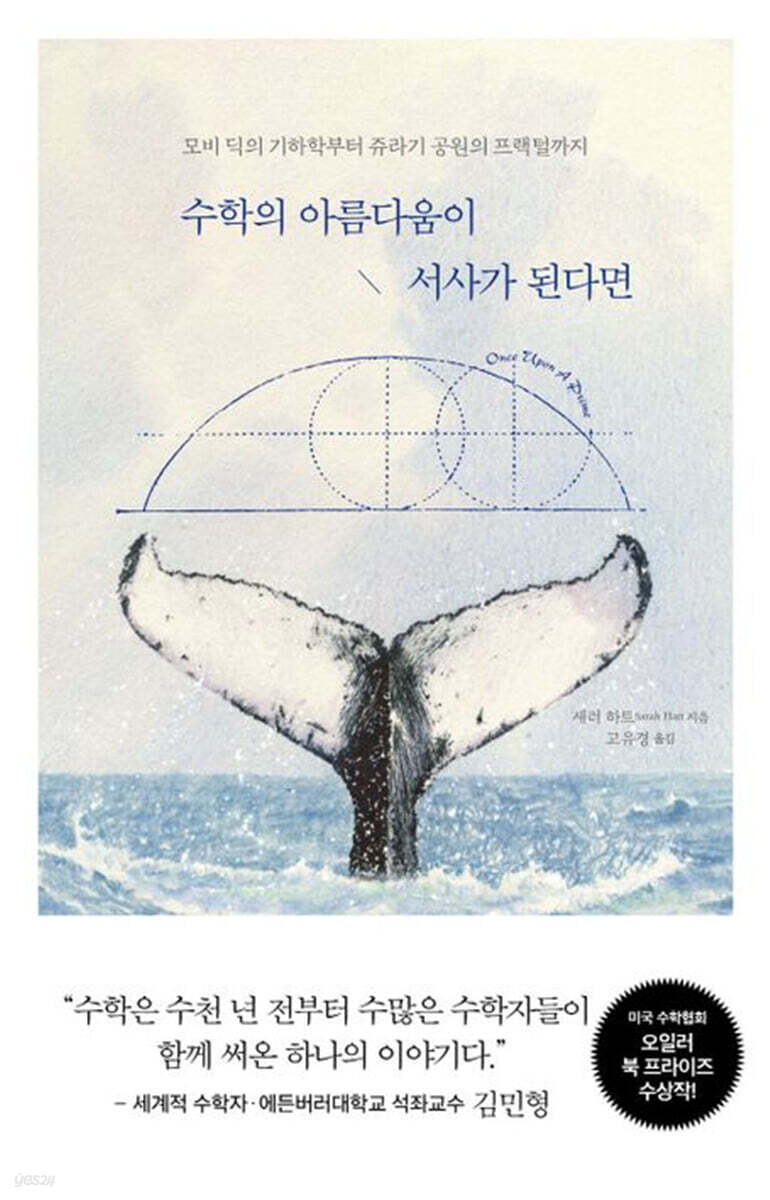
If the beauty of mathematics becomes a narrative
 |
Description
Book Introduction
- A word from MD
- In modern education, where subjects are divided into liberal arts and science, mathematics and literature seem to be separate worlds. However, according to this book, mathematics is also a beautiful story.
Mathematician Sarah Hart begins her story in the novel Moby Dick.
By examining various literary works, I unraveled beautiful mathematical stories within them.
- Min-gyu Son, PD of Natural Sciences
“The world of mathematics can be said to be the source of metaphors!”
★ The world of mathematics and literature guided by a mathematician who holds the oldest Gresham Professorship in England.
★ Winner of the American Mathematical Society's Euler Book Prize!
★ Highly recommended by world-renowned mathematician and University of Edinburgh Professor Minhyung Kim.
★ For those who want to feel the charm of mathematics and the narrative power of literature at the same time.
"If the Beauty of Mathematics Becomes a Narrative," which presents a new perspective on the connection between literature and mathematics, has been published.
Sarah Hart, a mathematician who holds the oldest Gresham Professorship in Geometry in the UK, presents a multi-layered interpretation of the mathematical concepts hidden in literature, exploring how mathematics functions as an important element of creative narrative.
What is the connection between mathematics and literature, and how can they expand our imagination and creative thinking? The breathtaking connections between mathematics and literature, presented in "If the Beauty of Mathematics Becomes Narrative," will shed light on these questions.
★ The world of mathematics and literature guided by a mathematician who holds the oldest Gresham Professorship in England.
★ Winner of the American Mathematical Society's Euler Book Prize!
★ Highly recommended by world-renowned mathematician and University of Edinburgh Professor Minhyung Kim.
★ For those who want to feel the charm of mathematics and the narrative power of literature at the same time.
"If the Beauty of Mathematics Becomes a Narrative," which presents a new perspective on the connection between literature and mathematics, has been published.
Sarah Hart, a mathematician who holds the oldest Gresham Professorship in Geometry in the UK, presents a multi-layered interpretation of the mathematical concepts hidden in literature, exploring how mathematics functions as an important element of creative narrative.
What is the connection between mathematics and literature, and how can they expand our imagination and creative thinking? The breathtaking connections between mathematics and literature, presented in "If the Beauty of Mathematics Becomes Narrative," will shed light on these questions.
index
Recommendation
Entering
Part 1: Mathematical Structure, Creativity, and Constraints
1 One, Two, Tie Your Shoelaces: Mathematical Patterns in Poetry
2 The Geometry of Narrative: How Mathematics Structures Stories
3. A Workshop for Potential Literature: Mathematicians and Oulipo
4 Let's take a closer look: The arithmetic of story selection
Part 2: Implications of Algebra: The Narrative Use of Mathematics
5 Fairy Tale Characters: The Symbolism of Numbers in Novels
6 Ahab's Arithmetic: Mathematical Metaphors in the Novel
7 Journey to a Fantastic Realm: The Mathematics of Myth
Part 3: Math Becomes a Story
8 A Walk with Mathematical Ideas: Mathematical Concepts Escaped into Novels
9 Pi in Reality: A Novel About Mathematics
10 Moriarty was a mathematician: The role of mathematical genius in literature
Acknowledgements
annotation
The Mathematician's Study
Entering
Part 1: Mathematical Structure, Creativity, and Constraints
1 One, Two, Tie Your Shoelaces: Mathematical Patterns in Poetry
2 The Geometry of Narrative: How Mathematics Structures Stories
3. A Workshop for Potential Literature: Mathematicians and Oulipo
4 Let's take a closer look: The arithmetic of story selection
Part 2: Implications of Algebra: The Narrative Use of Mathematics
5 Fairy Tale Characters: The Symbolism of Numbers in Novels
6 Ahab's Arithmetic: Mathematical Metaphors in the Novel
7 Journey to a Fantastic Realm: The Mathematics of Myth
Part 3: Math Becomes a Story
8 A Walk with Mathematical Ideas: Mathematical Concepts Escaped into Novels
9 Pi in Reality: A Novel About Mathematics
10 Moriarty was a mathematician: The role of mathematical genius in literature
Acknowledgements
annotation
The Mathematician's Study
Detailed image
Into the book
The relationship between mathematics and poetry is very profound.
But both start with very simple elements.
It is the rhythm (rhyme) of counting numbers.
The number pattern 1, 2, 3, 4, 5 is as captivating to young children as nursery rhymes featuring numbers.
In poetry, the desire for structure is met with ever more sophisticated rhythms and rhymes, from the rhythmic, strong meter of iambic pentameter to complex verse forms such as the sestina (six lines, six verses) and the villanelle (nineteen lines, two verses).
Behind these forms and other poetic constraints lies a fascinating mathematical principle.
--- p.29
The last graph I saw was from Franz Kafka's darkly comic novel, Metamorphosis.
This novel tells the story of Gregor Samsa, a man with a marginalized job as a traveling salesman.
One morning, Gregor wakes up to find that during the night he has been transformed into a giant vermin (presumably a cockroach).
And so begins the humiliating and painful descent into disease and death.
It is a typical Kafka novel.
--- p.73
The geometric sequence structure of 『Luminaries』 is expressed as a physical length, that is, a field.
But every story has another structure: a temporal structure, not a spatial structure.
EM
As the poster said, “There is always a clock in a novel.”
--- p.87
There is no shame in having your guesses proven wrong.
Euler's conjecture led to another interesting mathematical problem, which took centuries to solve.
So I don't call Euler a failure; I only dream of failing as successfully as Euler! One of the themes of "How to Use Life" is failure.
Bartlebooth fails to achieve his life goal of solving all the jigsaw puzzles.
Valen, a painter living in an apartment, fails in his plan to paint every room and its inhabitants.
The novel's double Latin square structure encapsulates Euler's failures into the story.
--- p.101
Warren F. Motte, a literary critic and prominent Perec expert, has suggested that "Disappearance" is also a meditation on loss.
Perec became an orphan during World War II.
Perec's father was killed in action and his mother was murdered in the Holocaust.
Mott argued that the absence of e has the following implications:
“In his novels, Perec could not only say the words ‘father’, ‘mother’, ‘parents’, and ‘family’, but he could not even write his own name, Georges Perec, which has four e’s.
In other words, each ‘blank’ in the novel is rich in meaning and points to the existential vacuum that Perec grappled with throughout his childhood and early adulthood.”
--- p.108
The Möbius strip is strange and interesting.
Discovered in 1858 by German mathematician August Ferdinand Mobius, this surface has properties that seem impossible.
You can make it out of plain paper, but it only has one side.
Make one right now.
Just take a long piece of paper, twist it once, and tape the ends together.
If you hold a Möbius strip anywhere, one finger will be on top and the other on the bottom.
However, if you draw a line parallel to the edge from the center of the 'upper' side, you will see that this line passes through the 'lower' side and then after a while returns to where it started.
So, the Möbius strip has only one side!
--- p.146~147
Why are there three wishes in the story? Why did the seventh of the seven sons have magical powers? Why do some numbers in the story—3, 7, 12, and 40—seem particularly significant, and why do they feature prominently in narratives ranging from religious texts to fairy tales, proverbs, and nursery rhymes? (······) I also remembered biblical references such as the three witches of Macbeth, the seven dwarfs of Snow White, the three fates and nine muses of ancient Greek mythology, the nine realms of Norse mythology, the five pillars of Islam, the seven deadly sins, the twelve apostles, the twelve tribes of Israel, the forty days and nights of Noah's flood, and the seventh seal.
Some numbers were very symbolic or had great cultural significance.
Is this just a coincidence?
--- p.165
Tolstoy applies calculus to metaphors to understand human history.
In War and Peace, he argues that the course of history cannot be changed by the actions of any individual.
According to Tolstoy, the French retreat from Moscow to Smolensk was not due to Napoleon giving the order, but rather “the influence of the whole army, which had been directing the troops along the Smolensk road,” which forced Napoleon to give the order to retreat.
--- p.213
Rubeus Hagrid, the keykeeper of Hogwarts School of Witchcraft and Wizardry in the Harry Potter series, is a half-giant.
Hagrid is described as being twice the height of an average adult, but significantly, he is described as being three times as wide.
If we assume that the vertical width is also three times as large, then Hagrid's bone has a cross-sectional area nine times ours, but his mass is only 18 times ours, not 27 times.
So the pressure on Hagrid's bones would be twice as much as ours.
Hagrid can walk and even run, but he shouldn't be jumping around because his bones would probably break easily.
--- p.239
It was Descartes who introduced the exponential notation used today, and he created a beautiful link between geometry and algebra in La Geometrie, which was included as an appendix to his 1637 book Discours de la methode.
Descartes also established the modern convention of indicating variables by letters ending in the alphabet, such as x, y, and z, and constants by letters beginning in the alphabet, such as a, b, and c.
So if you've ever wondered why mathematicians are so obsessed with x, blame Descartes.
--- p.279
This is where mathematician Alan Turing comes into play.
Turing figured out a way to counteract the plugboard effect, namely the 151 trillion additional combinations.
And in collaboration with the cryptography team, they developed a machine called the 'Bombe' that could process 17,576 ways to arrange a given scrambler.
Multiple bombs operate in parallel, each studying one of the 60 scramblers selected.
--- p.312
Life of Pi tells the story of a boy who is lost at sea and survives 227 days adrift in a lifeboat with a Bengal tiger named Richard Parker.
Pi, the famous mathematical constant that represents the ratio of a circle's circumference to its diameter, is a truly fascinating number.
And as Pi Patel said, this number goes on forever.
Pi is an irrational number that cannot be expressed as the ratio of two integers.
Because there is no end, it cannot be written as a precise fraction or decimal.
The idea of 'irrational number pi', which is likened to the protagonist's name, is the central theme of this novel.
--- p.323
Since a prime number is a number that has itself and 1 as divisors, if you eliminate all multiples of smaller numbers, the remaining numbers must all be prime numbers.
Christopher expresses the essence of minority very poetically.
“A prime number is the number that remains when all patterns are removed.
So I think minority is like life.
“It’s very logical, but no matter how much time I spend thinking about it all day, I can’t make a rule.”
--- p.368~369
I hope that readers of this book will now be convinced that the combination of mathematics and literature is not at all unnatural.
Kovalevskaya told a friend who questioned mathematics:
“Those who have not had the opportunity to learn what mathematics is confuse it with arithmetic and think of it as a dry and sterile science.
“In fact, science is what requires the greatest imagination.”
But both start with very simple elements.
It is the rhythm (rhyme) of counting numbers.
The number pattern 1, 2, 3, 4, 5 is as captivating to young children as nursery rhymes featuring numbers.
In poetry, the desire for structure is met with ever more sophisticated rhythms and rhymes, from the rhythmic, strong meter of iambic pentameter to complex verse forms such as the sestina (six lines, six verses) and the villanelle (nineteen lines, two verses).
Behind these forms and other poetic constraints lies a fascinating mathematical principle.
--- p.29
The last graph I saw was from Franz Kafka's darkly comic novel, Metamorphosis.
This novel tells the story of Gregor Samsa, a man with a marginalized job as a traveling salesman.
One morning, Gregor wakes up to find that during the night he has been transformed into a giant vermin (presumably a cockroach).
And so begins the humiliating and painful descent into disease and death.
It is a typical Kafka novel.
--- p.73
The geometric sequence structure of 『Luminaries』 is expressed as a physical length, that is, a field.
But every story has another structure: a temporal structure, not a spatial structure.
EM
As the poster said, “There is always a clock in a novel.”
--- p.87
There is no shame in having your guesses proven wrong.
Euler's conjecture led to another interesting mathematical problem, which took centuries to solve.
So I don't call Euler a failure; I only dream of failing as successfully as Euler! One of the themes of "How to Use Life" is failure.
Bartlebooth fails to achieve his life goal of solving all the jigsaw puzzles.
Valen, a painter living in an apartment, fails in his plan to paint every room and its inhabitants.
The novel's double Latin square structure encapsulates Euler's failures into the story.
--- p.101
Warren F. Motte, a literary critic and prominent Perec expert, has suggested that "Disappearance" is also a meditation on loss.
Perec became an orphan during World War II.
Perec's father was killed in action and his mother was murdered in the Holocaust.
Mott argued that the absence of e has the following implications:
“In his novels, Perec could not only say the words ‘father’, ‘mother’, ‘parents’, and ‘family’, but he could not even write his own name, Georges Perec, which has four e’s.
In other words, each ‘blank’ in the novel is rich in meaning and points to the existential vacuum that Perec grappled with throughout his childhood and early adulthood.”
--- p.108
The Möbius strip is strange and interesting.
Discovered in 1858 by German mathematician August Ferdinand Mobius, this surface has properties that seem impossible.
You can make it out of plain paper, but it only has one side.
Make one right now.
Just take a long piece of paper, twist it once, and tape the ends together.
If you hold a Möbius strip anywhere, one finger will be on top and the other on the bottom.
However, if you draw a line parallel to the edge from the center of the 'upper' side, you will see that this line passes through the 'lower' side and then after a while returns to where it started.
So, the Möbius strip has only one side!
--- p.146~147
Why are there three wishes in the story? Why did the seventh of the seven sons have magical powers? Why do some numbers in the story—3, 7, 12, and 40—seem particularly significant, and why do they feature prominently in narratives ranging from religious texts to fairy tales, proverbs, and nursery rhymes? (······) I also remembered biblical references such as the three witches of Macbeth, the seven dwarfs of Snow White, the three fates and nine muses of ancient Greek mythology, the nine realms of Norse mythology, the five pillars of Islam, the seven deadly sins, the twelve apostles, the twelve tribes of Israel, the forty days and nights of Noah's flood, and the seventh seal.
Some numbers were very symbolic or had great cultural significance.
Is this just a coincidence?
--- p.165
Tolstoy applies calculus to metaphors to understand human history.
In War and Peace, he argues that the course of history cannot be changed by the actions of any individual.
According to Tolstoy, the French retreat from Moscow to Smolensk was not due to Napoleon giving the order, but rather “the influence of the whole army, which had been directing the troops along the Smolensk road,” which forced Napoleon to give the order to retreat.
--- p.213
Rubeus Hagrid, the keykeeper of Hogwarts School of Witchcraft and Wizardry in the Harry Potter series, is a half-giant.
Hagrid is described as being twice the height of an average adult, but significantly, he is described as being three times as wide.
If we assume that the vertical width is also three times as large, then Hagrid's bone has a cross-sectional area nine times ours, but his mass is only 18 times ours, not 27 times.
So the pressure on Hagrid's bones would be twice as much as ours.
Hagrid can walk and even run, but he shouldn't be jumping around because his bones would probably break easily.
--- p.239
It was Descartes who introduced the exponential notation used today, and he created a beautiful link between geometry and algebra in La Geometrie, which was included as an appendix to his 1637 book Discours de la methode.
Descartes also established the modern convention of indicating variables by letters ending in the alphabet, such as x, y, and z, and constants by letters beginning in the alphabet, such as a, b, and c.
So if you've ever wondered why mathematicians are so obsessed with x, blame Descartes.
--- p.279
This is where mathematician Alan Turing comes into play.
Turing figured out a way to counteract the plugboard effect, namely the 151 trillion additional combinations.
And in collaboration with the cryptography team, they developed a machine called the 'Bombe' that could process 17,576 ways to arrange a given scrambler.
Multiple bombs operate in parallel, each studying one of the 60 scramblers selected.
--- p.312
Life of Pi tells the story of a boy who is lost at sea and survives 227 days adrift in a lifeboat with a Bengal tiger named Richard Parker.
Pi, the famous mathematical constant that represents the ratio of a circle's circumference to its diameter, is a truly fascinating number.
And as Pi Patel said, this number goes on forever.
Pi is an irrational number that cannot be expressed as the ratio of two integers.
Because there is no end, it cannot be written as a precise fraction or decimal.
The idea of 'irrational number pi', which is likened to the protagonist's name, is the central theme of this novel.
--- p.323
Since a prime number is a number that has itself and 1 as divisors, if you eliminate all multiples of smaller numbers, the remaining numbers must all be prime numbers.
Christopher expresses the essence of minority very poetically.
“A prime number is the number that remains when all patterns are removed.
So I think minority is like life.
“It’s very logical, but no matter how much time I spend thinking about it all day, I can’t make a rule.”
--- p.368~369
I hope that readers of this book will now be convinced that the combination of mathematics and literature is not at all unnatural.
Kovalevskaya told a friend who questioned mathematics:
“Those who have not had the opportunity to learn what mathematics is confuse it with arithmetic and think of it as a dry and sterile science.
“In fact, science is what requires the greatest imagination.”
--- p.382
Publisher's Review
Traces of Mathematics Found in Literature:
How Math Becomes a Story
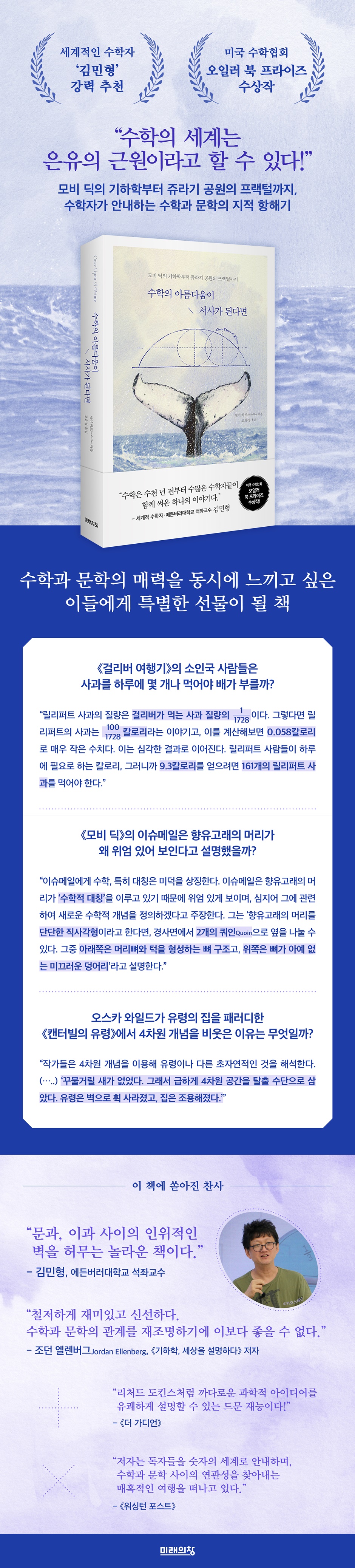
“To Stubb, mathematics is mysterious, even malevolent.
But for Ishmael, mathematics, especially symmetry, symbolizes virtue.
Ishmael claims that the head of the sperm whale is majestic because it has "mathematical symmetry," and even goes so far as to define a new mathematical concept in relation to it.
He said, 'If the head of a sperm whale is a solid rectangle, it can be divided laterally into two quoins at an inclined plane.
The lower part is a bony structure that forms the skull and jaw, while the upper part is a slippery mass with no bones at all.”
"If the Beauty of Mathematics Becomes a Narrative" fascinatingly explores how mathematical thinking is incorporated into well-known literary works.
In Herman Melville's Moby Dick, the mention of the sperm whale's head having mathematical symmetry is not a simple description, but a mathematical metaphor.
The complex structures in James Joyce's novels and the infamous Professor Moriarty from Arthur Conan Doyle's Sherlock Holmes series also have close connections to mathematics.
Through these works, Sarah Hart offers remarkable insights into how mathematics permeates literature and expands our perception.
A particularly noteworthy part of this book is the analysis of the special meaning of the number '3' in Western literature and language.
The author explains that the geometric properties of the number three play a significant role in literary structure, and analyzes in detail how the rule of thirds and the structure of a story (beginning, middle, end) add depth to a story.
"If the Beauty of Mathematics Becomes a Narrative" is also divided into three parts according to the principle of trichotomy.
The meeting of mathematical thinking and literary imagination,
For those who want to feel the charm of mathematics and the narrative power of literature at the same time.
“I hope that readers of this book will now be convinced that the combination of mathematics and literature is not at all unnatural.
Kovalevskaya told a friend who questioned mathematics:
'Those who have not had the opportunity to learn what mathematics is confuse it with arithmetic and think of it as a dry and sterile science.
“In fact, it is science that requires the greatest imagination.”
Modern people often recognize the necessity of mathematics, but often overlook its beauty and fun.
Reflecting this reality, Sarah Hart helps readers rediscover the creative side of mathematics through the fusion of mathematics and literature.
Through the book, readers can experience the beauty and wonder of mathematics and how it has taken its place alongside literature in the realm of art.
"If the Beauty of Mathematics Becomes a Narrative" not only provides profound insights to readers who love literature and mathematics, but also offers an opportunity to view the world from a new perspective.
Rather than rigid mathematical concepts, readers will experience an exciting journey where mathematics and literature cross over into each other's realms by examining how mathematical thinking embedded in literary works enriches the story.
"If the Beauty of Mathematics Becomes a Narrative" will be a great inspiration to those who want to experience both the charm of mathematics and the narrative power of literature.
It's a rare talent like Richard Dawkins's to be able to explain difficult scientific ideas in a humorous way!
- The Guardian
The author guides readers into the world of numbers and embarks on a fascinating journey to discover the connections between mathematics and literature.
- The Washington Post
"If the Beauty of Mathematics Becomes a Narrative" allows us a moment of lightheartedness, imbued with a love of good literature and mathematics.
Perhaps this book should be read as an homage to both.
- New Scientist
How Math Becomes a Story
“To Stubb, mathematics is mysterious, even malevolent.
But for Ishmael, mathematics, especially symmetry, symbolizes virtue.
Ishmael claims that the head of the sperm whale is majestic because it has "mathematical symmetry," and even goes so far as to define a new mathematical concept in relation to it.
He said, 'If the head of a sperm whale is a solid rectangle, it can be divided laterally into two quoins at an inclined plane.
The lower part is a bony structure that forms the skull and jaw, while the upper part is a slippery mass with no bones at all.”
"If the Beauty of Mathematics Becomes a Narrative" fascinatingly explores how mathematical thinking is incorporated into well-known literary works.
In Herman Melville's Moby Dick, the mention of the sperm whale's head having mathematical symmetry is not a simple description, but a mathematical metaphor.
The complex structures in James Joyce's novels and the infamous Professor Moriarty from Arthur Conan Doyle's Sherlock Holmes series also have close connections to mathematics.
Through these works, Sarah Hart offers remarkable insights into how mathematics permeates literature and expands our perception.
A particularly noteworthy part of this book is the analysis of the special meaning of the number '3' in Western literature and language.
The author explains that the geometric properties of the number three play a significant role in literary structure, and analyzes in detail how the rule of thirds and the structure of a story (beginning, middle, end) add depth to a story.
"If the Beauty of Mathematics Becomes a Narrative" is also divided into three parts according to the principle of trichotomy.
The meeting of mathematical thinking and literary imagination,
For those who want to feel the charm of mathematics and the narrative power of literature at the same time.
“I hope that readers of this book will now be convinced that the combination of mathematics and literature is not at all unnatural.
Kovalevskaya told a friend who questioned mathematics:
'Those who have not had the opportunity to learn what mathematics is confuse it with arithmetic and think of it as a dry and sterile science.
“In fact, it is science that requires the greatest imagination.”
Modern people often recognize the necessity of mathematics, but often overlook its beauty and fun.
Reflecting this reality, Sarah Hart helps readers rediscover the creative side of mathematics through the fusion of mathematics and literature.
Through the book, readers can experience the beauty and wonder of mathematics and how it has taken its place alongside literature in the realm of art.
"If the Beauty of Mathematics Becomes a Narrative" not only provides profound insights to readers who love literature and mathematics, but also offers an opportunity to view the world from a new perspective.
Rather than rigid mathematical concepts, readers will experience an exciting journey where mathematics and literature cross over into each other's realms by examining how mathematical thinking embedded in literary works enriches the story.
"If the Beauty of Mathematics Becomes a Narrative" will be a great inspiration to those who want to experience both the charm of mathematics and the narrative power of literature.
It's a rare talent like Richard Dawkins's to be able to explain difficult scientific ideas in a humorous way!
- The Guardian
The author guides readers into the world of numbers and embarks on a fascinating journey to discover the connections between mathematics and literature.
- The Washington Post
"If the Beauty of Mathematics Becomes a Narrative" allows us a moment of lightheartedness, imbued with a love of good literature and mathematics.
Perhaps this book should be read as an homage to both.
- New Scientist
GOODS SPECIFICS
- Date of issue: August 28, 2024
- Page count, weight, size: 416 pages | 500g | 135*210*22mm
- ISBN13: 9791193638408
- ISBN10: 1193638402
You may also like
카테고리
korean


korean

![GQ KOREA Mark (Monthly): December [2025]](http://librairie.coreenne.fr/cdn/shop/files/8ef265dbbfbf186523ed75ba7319009d.jpg?v=1765340328&width=3840)


