

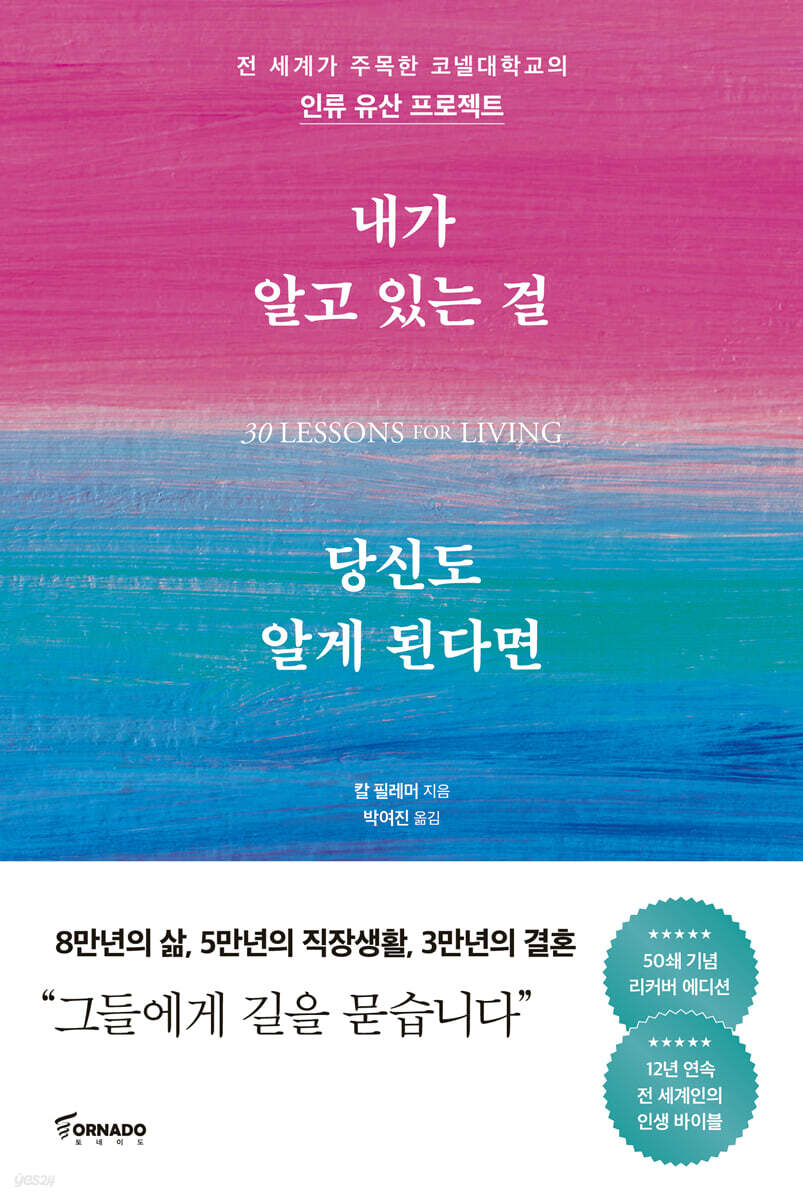
If You Knew What I Know (Recovery Edition)
 |
Description
Book Introduction
***50th Anniversary Recover Edition***
*** The world's life bible for 12 consecutive years
***Amazon's longest-running bestseller!
*** The New York Times, Publisher's Weekly, CNN, Washington Post,
Rave reviews from global media outlets including the Chicago Tribune!
*** Highly recommended by world-renowned scholars including futurist Daniel Pink!
The one who lived the longest and wisest
30 Life Lessons from 1,000 Wise Men
We live a burdensome life every day.
To alleviate even a little of that burdensome life, we read books by famous authors, attend lectures by experts, and listen to the voices of countless people through social media.
Yet, the thirst for wisdom in life is hardly quenched.
Is it because we lack the effort, information, will, and passion? Is it because we simply don't have enough to live a happy life? Or is it because true wisdom in life never existed in the first place?
The author of this book, Professor Karl Pillemer of Cornell University, who has been researching 'humans and the value of life' for the past 30 years, also delved deeply into these questions and skepticism.
And finally, I succeeded in finding the source of wisdom that is not recorded in books, fame, or authority, but wisdom rooted in vivid reality, wisdom that has withstood the ravages of time, wisdom that smells like sweat.
The source of wisdom we so desperately desire is the 'wise men' who live among us.
Grandfathers and grandmothers in their 70s or older have lived longer than us, worried more, laughed and cried more, and thus gained the true wisdom of life faster than we do.
They were truly mentors, teachers, and outstanding life leaders whom we should read, listen to, and talk to.
Since 2006, Professor Karl Pillemer has personally sought insightful advice from over 1,000 wise men who have lived to be 70 years old or older.
By asking the question, "What is the most valuable thing you have gained in life so far?", we have unearthed the wisdom and advice we need to know about life.
The combined lives of the wise men he met amounted to 80,000 years.
They have been married for 30,000 years and have raised 3,000 children.
Professor Karl Pillemer vividly captures the gems of lessons unearthed from this vast sedimentary layer of time in this book.
He named his research the 'Human Heritage Project'.
The meaning was that 'the experiences and advice of those who have walked all paths of life are the shining heritage of humanity that we must inherit and pass on.'
His 'Human Heritage Project' received worldwide attention.
In addition, the book containing the results, "If You Knew What I Know," became an Amazon bestseller immediately after its publication and received strong recommendations from global media and scholars.
The book, "If You Knew What I Know," which received extensive reviews from the New York Times, CNN, and the Washington Post, was selected as a "Best Book of 2011" by Library Journal, and was highly praised by world-renowned futurist Daniel Pink as "the most moving book I read in 2012, a book that allows you to experience the 'old future,'" has returned in a recovered edition to commemorate its 50th printing.
The reason we always worry about life is not because we don't know the 'answer'.
Because we don't know how the future of our lives will unfold.
Therefore, we must listen to the voices of the wise who know our future.
They sincerely wish that we now know what they have learned through all their lives before they disappear from this world.
Because that is our duty and blessing as we live in this world.
In this book, they say with one voice:
“If I have one regret, it’s that I wish I had known this fact in my 30s instead of in my 60s.
If that were the case, I would have had several decades more of life to enjoy in this world.
“This is the last thing I want to say to young people.”
*** The world's life bible for 12 consecutive years
***Amazon's longest-running bestseller!
*** The New York Times, Publisher's Weekly, CNN, Washington Post,
Rave reviews from global media outlets including the Chicago Tribune!
*** Highly recommended by world-renowned scholars including futurist Daniel Pink!
The one who lived the longest and wisest
30 Life Lessons from 1,000 Wise Men
We live a burdensome life every day.
To alleviate even a little of that burdensome life, we read books by famous authors, attend lectures by experts, and listen to the voices of countless people through social media.
Yet, the thirst for wisdom in life is hardly quenched.
Is it because we lack the effort, information, will, and passion? Is it because we simply don't have enough to live a happy life? Or is it because true wisdom in life never existed in the first place?
The author of this book, Professor Karl Pillemer of Cornell University, who has been researching 'humans and the value of life' for the past 30 years, also delved deeply into these questions and skepticism.
And finally, I succeeded in finding the source of wisdom that is not recorded in books, fame, or authority, but wisdom rooted in vivid reality, wisdom that has withstood the ravages of time, wisdom that smells like sweat.
The source of wisdom we so desperately desire is the 'wise men' who live among us.
Grandfathers and grandmothers in their 70s or older have lived longer than us, worried more, laughed and cried more, and thus gained the true wisdom of life faster than we do.
They were truly mentors, teachers, and outstanding life leaders whom we should read, listen to, and talk to.
Since 2006, Professor Karl Pillemer has personally sought insightful advice from over 1,000 wise men who have lived to be 70 years old or older.
By asking the question, "What is the most valuable thing you have gained in life so far?", we have unearthed the wisdom and advice we need to know about life.
The combined lives of the wise men he met amounted to 80,000 years.
They have been married for 30,000 years and have raised 3,000 children.
Professor Karl Pillemer vividly captures the gems of lessons unearthed from this vast sedimentary layer of time in this book.
He named his research the 'Human Heritage Project'.
The meaning was that 'the experiences and advice of those who have walked all paths of life are the shining heritage of humanity that we must inherit and pass on.'
His 'Human Heritage Project' received worldwide attention.
In addition, the book containing the results, "If You Knew What I Know," became an Amazon bestseller immediately after its publication and received strong recommendations from global media and scholars.
The book, "If You Knew What I Know," which received extensive reviews from the New York Times, CNN, and the Washington Post, was selected as a "Best Book of 2011" by Library Journal, and was highly praised by world-renowned futurist Daniel Pink as "the most moving book I read in 2012, a book that allows you to experience the 'old future,'" has returned in a recovered edition to commemorate its 50th printing.
The reason we always worry about life is not because we don't know the 'answer'.
Because we don't know how the future of our lives will unfold.
Therefore, we must listen to the voices of the wise who know our future.
They sincerely wish that we now know what they have learned through all their lives before they disappear from this world.
Because that is our duty and blessing as we live in this world.
In this book, they say with one voice:
“If I have one regret, it’s that I wish I had known this fact in my 30s instead of in my 60s.
If that were the case, I would have had several decades more of life to enjoy in this world.
“This is the last thing I want to say to young people.”
- You can preview some of the book's contents.
Preview
index
prolog
Chapter 1: Asking 80,000 Years of Life
“Good and bad, they are all pieces of life, and when those pieces fit together, a complete life is created.
That life cannot be exchanged for anything.
As you know, hope is something you create here and now.
"What's there to be unhappy about? Today, here, being as happy as possible—that's what I have to do."
Chapter 2: Beautiful Companions: How to Live with a Perfect Match
“We talked the night before he left two weeks ago.
My husband said something that made me laugh, and then he looked at me with a satisfied expression.
And then he said this.
“Even after all these years, I can still make you smile.” He was always the one who made me smile.”
Chapter 3: A Happy Morning: How to Find What You Want to Do for the Rest of Your Life
“Find what you love to do.
Do what you are good at.
Find something to be happy about.
You shouldn't choose a career just for the money.
I didn't make much money.
If I told you how much I've earned in 30 years, you wouldn't believe me.
The most important thing is that your job should be something you love unconditionally, something you're excited to do every day."
Chapter 4: Raising a Healthy Child
“Children make me mature, challenge me, and change me.
I have three children too.
Those kids are all different and completely unpredictable, like rock-paper-scissors.
I can't imagine my life without my children.
Have fun raising your children as much as possible.
If we do well, won’t those children become parents to children who resemble them?”
Chapter 5: The Aesthetics of Descent: How to Enjoy the Setting Sun
“Everyone ends up standing on one path.
If you can't run fast on that road, you can run slower.
But you must never stop.
Of course, we may have to acknowledge its limitations.
In that case, 'Okay.
I think, 'This is all I can do.'
Then, just extend the limit a little bit.
“That way, I can keep running.”
Chapter 6: Living Without Regrets: How to Move Away from "Should Haves"
“Honesty is the one and only precious value that guides our lives.
I think honesty rules everything.
If you are honest with yourself, you will be honest with your wife and family.
If you are honest with the people around you, you can look in the mirror in the morning and say:
“I didn’t do anything wrong.”
Chapter 7: Happiness is a Choice: How to Calculate the Rest of Your Life
“Listen carefully.
There is so much to be gained simply by being able to exist in the moment.
I just now realized that fact and I am very grateful.
If I have one regret, it's that I wish I had known this fact in my 30s instead of in my 60s.
If that were the case, I would have had several decades more to enjoy in this world.”
Chapter 8 What is the most important thing in your life?
We are truly fortunate to be standing in the middle of a path that stretches from the distant past to the distant future.
There was a person who was 102 years old at the time of the interview.
Her grandfather, born in the 1850s, told her stories about his service in the Civil War.
The old man her grandfather met as a child would have told her stories of the Revolutionary War in the 1700s.
This is how the wisdom of life is passed down.
Epilogue
Chapter 1: Asking 80,000 Years of Life
“Good and bad, they are all pieces of life, and when those pieces fit together, a complete life is created.
That life cannot be exchanged for anything.
As you know, hope is something you create here and now.
"What's there to be unhappy about? Today, here, being as happy as possible—that's what I have to do."
Chapter 2: Beautiful Companions: How to Live with a Perfect Match
“We talked the night before he left two weeks ago.
My husband said something that made me laugh, and then he looked at me with a satisfied expression.
And then he said this.
“Even after all these years, I can still make you smile.” He was always the one who made me smile.”
Chapter 3: A Happy Morning: How to Find What You Want to Do for the Rest of Your Life
“Find what you love to do.
Do what you are good at.
Find something to be happy about.
You shouldn't choose a career just for the money.
I didn't make much money.
If I told you how much I've earned in 30 years, you wouldn't believe me.
The most important thing is that your job should be something you love unconditionally, something you're excited to do every day."
Chapter 4: Raising a Healthy Child
“Children make me mature, challenge me, and change me.
I have three children too.
Those kids are all different and completely unpredictable, like rock-paper-scissors.
I can't imagine my life without my children.
Have fun raising your children as much as possible.
If we do well, won’t those children become parents to children who resemble them?”
Chapter 5: The Aesthetics of Descent: How to Enjoy the Setting Sun
“Everyone ends up standing on one path.
If you can't run fast on that road, you can run slower.
But you must never stop.
Of course, we may have to acknowledge its limitations.
In that case, 'Okay.
I think, 'This is all I can do.'
Then, just extend the limit a little bit.
“That way, I can keep running.”
Chapter 6: Living Without Regrets: How to Move Away from "Should Haves"
“Honesty is the one and only precious value that guides our lives.
I think honesty rules everything.
If you are honest with yourself, you will be honest with your wife and family.
If you are honest with the people around you, you can look in the mirror in the morning and say:
“I didn’t do anything wrong.”
Chapter 7: Happiness is a Choice: How to Calculate the Rest of Your Life
“Listen carefully.
There is so much to be gained simply by being able to exist in the moment.
I just now realized that fact and I am very grateful.
If I have one regret, it's that I wish I had known this fact in my 30s instead of in my 60s.
If that were the case, I would have had several decades more to enjoy in this world.”
Chapter 8 What is the most important thing in your life?
We are truly fortunate to be standing in the middle of a path that stretches from the distant past to the distant future.
There was a person who was 102 years old at the time of the interview.
Her grandfather, born in the 1850s, told her stories about his service in the Civil War.
The old man her grandfather met as a child would have told her stories of the Revolutionary War in the 1700s.
This is how the wisdom of life is passed down.
Epilogue
Detailed image

Into the book
“I didn’t know that when I got married.
But looking back, I realize that having similar values is really important.
Think about it.
If you are a spendthrift, you should marry someone who understands that, and if you are frugal, you should marry someone who understands that.
“Money is often a stumbling block in marriage.”
“Before I got married, I made a list of what I valued and what I wanted in a relationship.
That was already 60 years ago.
Then he asked the woman he was thinking of marrying if she would agree.
Of course, I also said that if you don't agree, I understand and that it's okay if you don't accept me."
“If you’re not sure, don’t do it! You can’t change that person.
If you don't like the way that person lives, you shouldn't even dream of getting married.
Because that person won't change.
That person has been living like that for at least 20 years.
“It’s very rare for people to change after marriage.”
“But it wasn’t until 12 years after we got married that we realized we were just living a life of basics.
I mean, waking up in the morning, going to work, coming home from work, preparing and eating dinner, and things like that.
Every single day was extremely ordinary.
“It’s like a hamster running on a wheel.”
“Above all, you must become friends with your spouse.
You have to be willing to put in the effort to do that.
I didn't know that before either.
When I got married 49 years ago, marriage was a rite of passage that everyone had to go through when they turned twenty.
But these days, that's not the case.
I have a lot of respect for young people who are still single after they are over 30.
The world has changed.
I tell young lovers this.
'Above all, you must be a good friend.
And we must respect each other.' If you become friends with each other, you will naturally love each other, and that love will grow."
“Imagine that I am wearing the other person’s shoes.
Then you can have a peaceful family.
'good.
it's okay.
It's giving.
And you have to think, ‘I’ve given it to you.’”
“Find what you love to do.
Do what you are good at.
Find something to be happy about.
You shouldn't choose a career just for the money.
I didn't make much money.
If I told you how much I've earned in 30 years, you wouldn't believe me.
The most important thing is that your job should be something you love unconditionally, something you're excited to do every day."
“If it were me, I would first work for a few years under a successful person in the field I want to work in.
I work with the attitude of learning as much as possible about that field.
And if it's not a field that suits me, then I made the wrong choice and should quit within a year or two and look for something else."
“There are people in the world who are terribly unhappy, tied down to jobs they don’t even like.
They are so tied up in money, not in life.”
“People spend their 20s and 30s buried in things they don’t like.
The material rewards are quite large.
When they reach their 40s or 50s, the smart ones start to reconsider what they are doing now.
“I think we need to get beyond the ‘ordinary person syndrome’ when it comes to work.”
“You have to stop looking at yourself.
Looking into yourself is like looking at yourself in a mirror.
If you do that, you will only see images that look exactly like you.
Go to the window.
And look out the window.
Maybe now is the time for a change.”
“Keep two things in mind.
First, if you want your child to succeed, you must love him or her.
And listen carefully when your child tells you what he or she wants.
I too have lost my mind and wavered once or twice, but I have tried to avoid physical punishment if I could.
No matter what anyone says, hitting a child is not love.”
“My husband and I have the same parenting style.
Let the children make their own decisions.
Of course, children's decisions aren't always right.
But what's important is that you can learn something from your mistakes.
If you never make mistakes, there's no way to know what's right and what's wrong.
Giving children the power to make decisions may not always lead to the best results, but it does teach them how to cope with challenges.”
“It’s okay to get older.
But what if you had to live in a wheelchair with an oxygen tank? If you can prevent it now, you should do it.
As you get older, you have the opportunity to enjoy life much more leisurely.
That is, assuming you are not suffering from a terrible disease.
If you can stay healthy, you should make any effort.
You should never smoke or do anything harmful to your body.
“If things like that pile up, the aftereffects will inevitably be revealed later.”
“If I learned anything from my mistakes, it’s that what’s done can’t be undone.
First, you have to accept yourself as you are.
That was really hard for me.
I grew up constantly hearing that if I just tried a little harder, I could do everything perfectly.
But there were times when I had to accept that not everything was like that.
And it doesn't have to be that way.”
“Honesty is the best policy” is the principle I hold most dear.
My father ran a clothing store.
If you go along the main road over there, you'll see a store with a sign that says, "Same price for everyone."
It's a very simple statement, but it contains everything.
This saying implies that everyone who enters the store is treated fairly.
There are stores that charge a higher price for the same item to non-local customers, but sell it cheaper to close friends or acquaintances.
That won't do.
Everyone is treated the same.
If you want to avoid dangerous traps and snares in life, you must make this principle your most basic principle.
“You have to treat everyone fairly.”
“What I’m trying to say is, don’t put off anything for too long.
Because there are things that you can't do at other times, but have to do at just the right time.
There is no wheelchair accessible path at the bottom of the Grand Canyon.
“If you want to go down, you should go when your legs are still strong.”
“First of all, I had to decide not to feel sorry for myself.
If you don't make that decision, you'll just sit there and worry.
Then you know what happens? The devil brings food!”
“Don’t take anything for granted.
That's an important lesson I learned.
You can't be perfectly prepared for everything that happens in life.
But still, life is worth living.
You can enjoy each day.
It's because of the very little things in life.
“You can find joy even when things are going terribly wrong.”
“I know.
That such problems will pass, and where the problems have passed, a solution will appear.
I just want to sit back and have fun with people.
We talk and go for walks.
I just let the dust of worry accumulate.
Don't worry anymore.
You're getting used to it.
“Don’t get caught up in the little things anymore.”
“I start my day by making a list of things I want to do that day.
Usually, we choose 10 things, and we can do them all or just one, but we don't know what will happen.
“This list is not a list of ‘to dos,’ it’s just a list of ‘things I want to do.’”
But looking back, I realize that having similar values is really important.
Think about it.
If you are a spendthrift, you should marry someone who understands that, and if you are frugal, you should marry someone who understands that.
“Money is often a stumbling block in marriage.”
“Before I got married, I made a list of what I valued and what I wanted in a relationship.
That was already 60 years ago.
Then he asked the woman he was thinking of marrying if she would agree.
Of course, I also said that if you don't agree, I understand and that it's okay if you don't accept me."
“If you’re not sure, don’t do it! You can’t change that person.
If you don't like the way that person lives, you shouldn't even dream of getting married.
Because that person won't change.
That person has been living like that for at least 20 years.
“It’s very rare for people to change after marriage.”
“But it wasn’t until 12 years after we got married that we realized we were just living a life of basics.
I mean, waking up in the morning, going to work, coming home from work, preparing and eating dinner, and things like that.
Every single day was extremely ordinary.
“It’s like a hamster running on a wheel.”
“Above all, you must become friends with your spouse.
You have to be willing to put in the effort to do that.
I didn't know that before either.
When I got married 49 years ago, marriage was a rite of passage that everyone had to go through when they turned twenty.
But these days, that's not the case.
I have a lot of respect for young people who are still single after they are over 30.
The world has changed.
I tell young lovers this.
'Above all, you must be a good friend.
And we must respect each other.' If you become friends with each other, you will naturally love each other, and that love will grow."
“Imagine that I am wearing the other person’s shoes.
Then you can have a peaceful family.
'good.
it's okay.
It's giving.
And you have to think, ‘I’ve given it to you.’”
“Find what you love to do.
Do what you are good at.
Find something to be happy about.
You shouldn't choose a career just for the money.
I didn't make much money.
If I told you how much I've earned in 30 years, you wouldn't believe me.
The most important thing is that your job should be something you love unconditionally, something you're excited to do every day."
“If it were me, I would first work for a few years under a successful person in the field I want to work in.
I work with the attitude of learning as much as possible about that field.
And if it's not a field that suits me, then I made the wrong choice and should quit within a year or two and look for something else."
“There are people in the world who are terribly unhappy, tied down to jobs they don’t even like.
They are so tied up in money, not in life.”
“People spend their 20s and 30s buried in things they don’t like.
The material rewards are quite large.
When they reach their 40s or 50s, the smart ones start to reconsider what they are doing now.
“I think we need to get beyond the ‘ordinary person syndrome’ when it comes to work.”
“You have to stop looking at yourself.
Looking into yourself is like looking at yourself in a mirror.
If you do that, you will only see images that look exactly like you.
Go to the window.
And look out the window.
Maybe now is the time for a change.”
“Keep two things in mind.
First, if you want your child to succeed, you must love him or her.
And listen carefully when your child tells you what he or she wants.
I too have lost my mind and wavered once or twice, but I have tried to avoid physical punishment if I could.
No matter what anyone says, hitting a child is not love.”
“My husband and I have the same parenting style.
Let the children make their own decisions.
Of course, children's decisions aren't always right.
But what's important is that you can learn something from your mistakes.
If you never make mistakes, there's no way to know what's right and what's wrong.
Giving children the power to make decisions may not always lead to the best results, but it does teach them how to cope with challenges.”
“It’s okay to get older.
But what if you had to live in a wheelchair with an oxygen tank? If you can prevent it now, you should do it.
As you get older, you have the opportunity to enjoy life much more leisurely.
That is, assuming you are not suffering from a terrible disease.
If you can stay healthy, you should make any effort.
You should never smoke or do anything harmful to your body.
“If things like that pile up, the aftereffects will inevitably be revealed later.”
“If I learned anything from my mistakes, it’s that what’s done can’t be undone.
First, you have to accept yourself as you are.
That was really hard for me.
I grew up constantly hearing that if I just tried a little harder, I could do everything perfectly.
But there were times when I had to accept that not everything was like that.
And it doesn't have to be that way.”
“Honesty is the best policy” is the principle I hold most dear.
My father ran a clothing store.
If you go along the main road over there, you'll see a store with a sign that says, "Same price for everyone."
It's a very simple statement, but it contains everything.
This saying implies that everyone who enters the store is treated fairly.
There are stores that charge a higher price for the same item to non-local customers, but sell it cheaper to close friends or acquaintances.
That won't do.
Everyone is treated the same.
If you want to avoid dangerous traps and snares in life, you must make this principle your most basic principle.
“You have to treat everyone fairly.”
“What I’m trying to say is, don’t put off anything for too long.
Because there are things that you can't do at other times, but have to do at just the right time.
There is no wheelchair accessible path at the bottom of the Grand Canyon.
“If you want to go down, you should go when your legs are still strong.”
“First of all, I had to decide not to feel sorry for myself.
If you don't make that decision, you'll just sit there and worry.
Then you know what happens? The devil brings food!”
“Don’t take anything for granted.
That's an important lesson I learned.
You can't be perfectly prepared for everything that happens in life.
But still, life is worth living.
You can enjoy each day.
It's because of the very little things in life.
“You can find joy even when things are going terribly wrong.”
“I know.
That such problems will pass, and where the problems have passed, a solution will appear.
I just want to sit back and have fun with people.
We talk and go for walks.
I just let the dust of worry accumulate.
Don't worry anymore.
You're getting used to it.
“Don’t get caught up in the little things anymore.”
“I start my day by making a list of things I want to do that day.
Usually, we choose 10 things, and we can do them all or just one, but we don't know what will happen.
“This list is not a list of ‘to dos,’ it’s just a list of ‘things I want to do.’”
--- From the text
Publisher's Review
“A Book That Allows Us to Experience the Old Future (Daniel Pink)”
The relative and absolute map of life that we were unaware of
We always long for ways to choose and decide for a better future.
But it is not easy unless you look into your own future.
So, isn't there another better way?
"If You Knew What I Know" gives you the answer.
Global broadcaster CNN praised the book, saying, “This book contains ‘future selves’ that help us anticipate what’s to come,” and that if we listen to the ‘wise men of life,’ we can discover mistakes and pitfalls we must avoid in life.
World-renowned futurist Daniel Pink also wrote that this was “the most moving book I read in 2012,” and emphasized that “all the wisdom contained in this book is based on ‘the future that has already happened,’ and thus gives us practical motivation.”
Therefore, this book contains advice on all aspects of life, from the small events that can happen in life, such as human relationships, career and money decisions, parenting, marriage, and how to deal with difficulties and live without regrets, to life philosophy and beliefs.
This is why the Washington Post introduced the book as “a book that resonates deeply with all generations, from teenagers to those in their sixties.”
To keep our lives on track and avoid the pitfalls of life, we need guidance from those who have walked the wide roads, the side roads, the dead ends, and the winding roads where we cannot see even an inch ahead.
The wise men who appear in “If You Knew What I Know” are our “old future.”
You'll meet people who have struggled with and overcome the same life challenges you face, in places you never expected.
And through this, you will discover that the answers to life lie in places you never knew existed.
“A book that breaks the frame of ‘happiness’ as we know it!”
How to live a truly good life
What should be my priority in life?
What exactly is "happiness"? We hear stories about happiness from celebrities, religious figures, and even scientists.
But ironically, the more we hear such stories, the more distant the path to happiness seems.
To modern people, happiness seems like a beautiful dream that is out of reach or a religion that must be pursued until death.
The unique perspectives of the "wise men of life" introduced in "If You Knew What I Know" make us rethink modern society's clichéd and formulaic guidelines for the "good life" or happiness.
The established guidelines are things that everyone knows, things we learn as we grow up as members of society.
It defines a certain image of a desirable life and emphasizes universal values.
The practical advice from the "sages" in this book overturns such values and presents new solutions.
Insights that go beyond simple categorization can sometimes seem liberal, sometimes conservative, and sometimes completely at odds with what is commonly accepted as universal values today.
If one day you suddenly feel smaller and more shabby than anyone else, open this book.
The sincere and loving advice of the wise men contained here will soothe your slumped shoulders and give you a slightly different answer to your question of happiness.
And the warm and realistic comfort they send also gives you the space in your heart to reset your life.
First, choose a career that provides intrinsic rewards, not financial ones.
Many 'life sages', even those who grew up poor, have said that the biggest mistake people make when choosing a career is to choose a career based solely on potential income.
A sense of purpose and passion for your job are worth far more than a salary.
Second, take care of your body as if you were going to live 100 years.
The excuse “I don’t care how long I live” is not a good one when doing something harmful to your body.
Harmful behaviors like smoking, poor diet, and lack of exercise don't just kill you quickly; they also keep you living with chronic diseases for decades before you die.
The 'wise men of life' have seen many people die after decades of desolation, their bodies ruined by this lifestyle.
If you don't want to live a desolate life, it's better to fix it now.
Third, be very careful when choosing a spouse.
The most important thing when choosing a spouse is not to rush.
You should give yourself enough time to get to know your future spouse and decide if you can be with him or her.
One respondent said:
“Never rush before you know each other well.
Rushing is a very dangerous thing, yet many people make that mistake.
Especially those in their mid-30s.”
Fourth, travel more.
Even if it means giving up other things, it's best to travel as much as you can.
When most older people look back on their lives, they consider their travel experiences, big or small, to be the highlight of their lives.
There were also many cases where I regretted not traveling more.
An old man said this.
“If you’re debating whether to fix your kitchen or go on a trip, I’d say don’t hesitate and choose the trip!”
Five, time is the essence of life.
Old people talk as if life is short.
They say that because life is really short.
The important thing is not to be discouraged by the fact that life is short, but to live according to the shortness of life.
If there's something important you need to do, do it now.
There have been many 'wise men of life' who have said that life passes by in the blink of an eye.
A wise man once said:
“If only I had known that life is short in my 30s instead of my 60s!”
Six, think small
To live a fulfilling life, think small.
Learn to see the simple joys of everyday life and savor the flavor of their smallness.
The 'wise men of life' became accustomed to the small pleasures of the moment because they believed that life was short.
Young people, on the other hand, only realize how precious those small pleasures were after they were taken away from them.
Think of a cup of coffee in the morning, a cozy bed on a winter night, pretty birds pecking at the grass, an unexpected letter from a friend, your favorite song playing on the radio.
If you pay more attention to these 'extremely small' things, your daily life will be filled with small joys and you will be happier.
They believe that young people can also enjoy this joy.
And he emphasizes that immersing oneself in these small joys is valuable regardless of age.
The relative and absolute map of life that we were unaware of
We always long for ways to choose and decide for a better future.
But it is not easy unless you look into your own future.
So, isn't there another better way?
"If You Knew What I Know" gives you the answer.
Global broadcaster CNN praised the book, saying, “This book contains ‘future selves’ that help us anticipate what’s to come,” and that if we listen to the ‘wise men of life,’ we can discover mistakes and pitfalls we must avoid in life.
World-renowned futurist Daniel Pink also wrote that this was “the most moving book I read in 2012,” and emphasized that “all the wisdom contained in this book is based on ‘the future that has already happened,’ and thus gives us practical motivation.”
Therefore, this book contains advice on all aspects of life, from the small events that can happen in life, such as human relationships, career and money decisions, parenting, marriage, and how to deal with difficulties and live without regrets, to life philosophy and beliefs.
This is why the Washington Post introduced the book as “a book that resonates deeply with all generations, from teenagers to those in their sixties.”
To keep our lives on track and avoid the pitfalls of life, we need guidance from those who have walked the wide roads, the side roads, the dead ends, and the winding roads where we cannot see even an inch ahead.
The wise men who appear in “If You Knew What I Know” are our “old future.”
You'll meet people who have struggled with and overcome the same life challenges you face, in places you never expected.
And through this, you will discover that the answers to life lie in places you never knew existed.
“A book that breaks the frame of ‘happiness’ as we know it!”
How to live a truly good life
What should be my priority in life?
What exactly is "happiness"? We hear stories about happiness from celebrities, religious figures, and even scientists.
But ironically, the more we hear such stories, the more distant the path to happiness seems.
To modern people, happiness seems like a beautiful dream that is out of reach or a religion that must be pursued until death.
The unique perspectives of the "wise men of life" introduced in "If You Knew What I Know" make us rethink modern society's clichéd and formulaic guidelines for the "good life" or happiness.
The established guidelines are things that everyone knows, things we learn as we grow up as members of society.
It defines a certain image of a desirable life and emphasizes universal values.
The practical advice from the "sages" in this book overturns such values and presents new solutions.
Insights that go beyond simple categorization can sometimes seem liberal, sometimes conservative, and sometimes completely at odds with what is commonly accepted as universal values today.
If one day you suddenly feel smaller and more shabby than anyone else, open this book.
The sincere and loving advice of the wise men contained here will soothe your slumped shoulders and give you a slightly different answer to your question of happiness.
And the warm and realistic comfort they send also gives you the space in your heart to reset your life.
First, choose a career that provides intrinsic rewards, not financial ones.
Many 'life sages', even those who grew up poor, have said that the biggest mistake people make when choosing a career is to choose a career based solely on potential income.
A sense of purpose and passion for your job are worth far more than a salary.
Second, take care of your body as if you were going to live 100 years.
The excuse “I don’t care how long I live” is not a good one when doing something harmful to your body.
Harmful behaviors like smoking, poor diet, and lack of exercise don't just kill you quickly; they also keep you living with chronic diseases for decades before you die.
The 'wise men of life' have seen many people die after decades of desolation, their bodies ruined by this lifestyle.
If you don't want to live a desolate life, it's better to fix it now.
Third, be very careful when choosing a spouse.
The most important thing when choosing a spouse is not to rush.
You should give yourself enough time to get to know your future spouse and decide if you can be with him or her.
One respondent said:
“Never rush before you know each other well.
Rushing is a very dangerous thing, yet many people make that mistake.
Especially those in their mid-30s.”
Fourth, travel more.
Even if it means giving up other things, it's best to travel as much as you can.
When most older people look back on their lives, they consider their travel experiences, big or small, to be the highlight of their lives.
There were also many cases where I regretted not traveling more.
An old man said this.
“If you’re debating whether to fix your kitchen or go on a trip, I’d say don’t hesitate and choose the trip!”
Five, time is the essence of life.
Old people talk as if life is short.
They say that because life is really short.
The important thing is not to be discouraged by the fact that life is short, but to live according to the shortness of life.
If there's something important you need to do, do it now.
There have been many 'wise men of life' who have said that life passes by in the blink of an eye.
A wise man once said:
“If only I had known that life is short in my 30s instead of my 60s!”
Six, think small
To live a fulfilling life, think small.
Learn to see the simple joys of everyday life and savor the flavor of their smallness.
The 'wise men of life' became accustomed to the small pleasures of the moment because they believed that life was short.
Young people, on the other hand, only realize how precious those small pleasures were after they were taken away from them.
Think of a cup of coffee in the morning, a cozy bed on a winter night, pretty birds pecking at the grass, an unexpected letter from a friend, your favorite song playing on the radio.
If you pay more attention to these 'extremely small' things, your daily life will be filled with small joys and you will be happier.
They believe that young people can also enjoy this joy.
And he emphasizes that immersing oneself in these small joys is valuable regardless of age.
GOODS SPECIFICS
- Publication date: August 29, 2022
- Page count, weight, size: 380 pages | 578g | 142*212*24mm
- ISBN13: 9791158511432
- ISBN10: 1158511434
You may also like
카테고리
korean


korean

![GQ KOREA Mark (Monthly): December [2025]](http://librairie.coreenne.fr/cdn/shop/files/8ef265dbbfbf186523ed75ba7319009d.jpg?v=1765340328&width=3840)


