

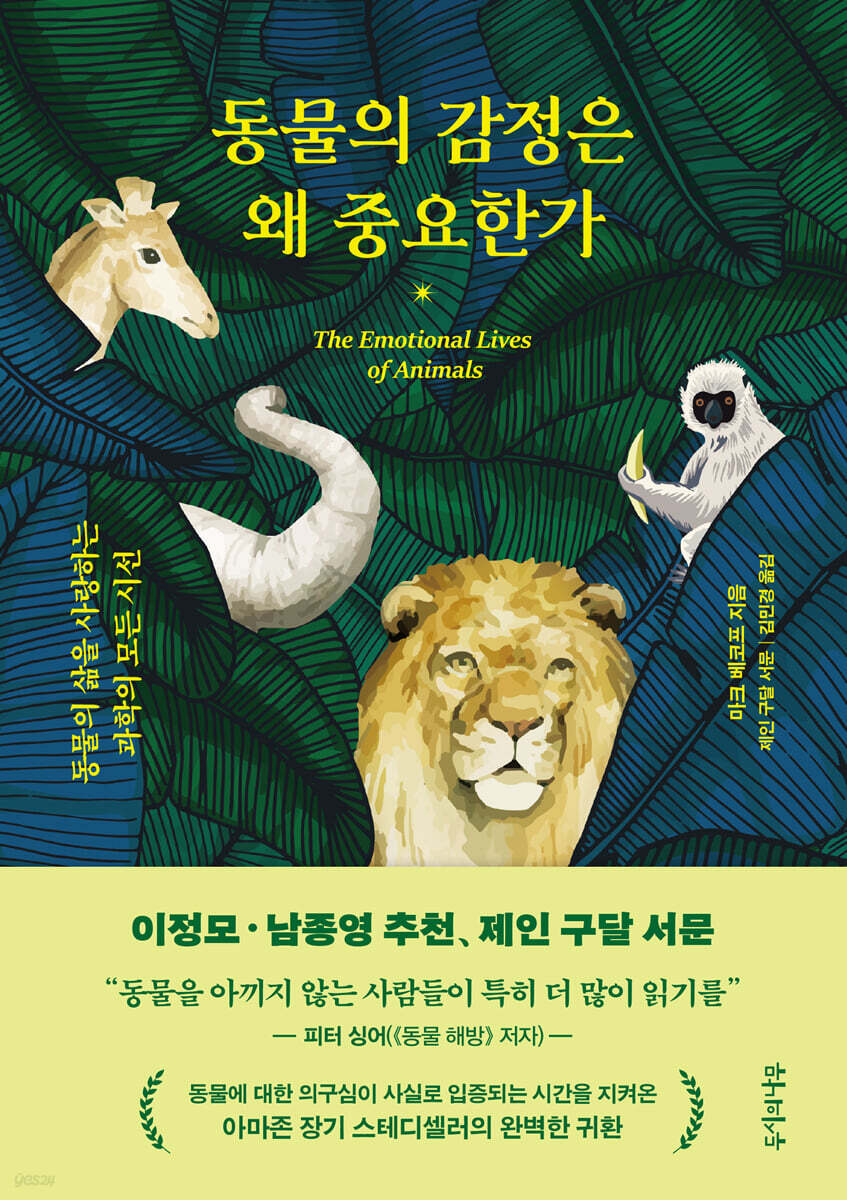
Why Animal Emotions Matter
 |
Description
Book Introduction
“Why are we humans so special?
Why do we feel such deep emotions, unlike other animals?
Putting the brakes on the idea of putting humans at the top of the 'emotional ladder'
A groundbreaking discovery from leading scientist Marc Bekoff
The perfect return of Amazon's long-time bestseller!
Recommended by Lee Jeong-mo, Nam Jong-yeong, Peter Singer, and Cy Montgomery, with a foreword by Jane Goodall.
Do humans truly experience richer emotions than other animals? Do highly intelligent animals experience greater pain than less intelligent ones? Marc Bekoff, the world-renowned animal behaviorist who wrote this book, asserts the opposite.
He criticizes 'anthropocentrism', which regards human emotions as special and superior, as arrogant, and says that animals can feel emotions that humans cannot.
Upon encountering the colorful anecdotes of animals told in this book, anyone will realize that animal lives are just as rich in emotions as human lives.
Marc Bekoff, a leading scientist who has studied animal emotions for over 50 years, has faced harsh criticism from skeptics who do not recognize animal emotions.
According to Dale Jamieson, a professor at New York University and environmental activist, publishing the first edition of the book in 2007 was a brave move because the author's views were potentially controversial.
However, the author's claims have since been largely proven true, and the field of studying the animal mind has made explosive progress.
This book is a completely revised edition, published 17 years later, by the author, preserving the emotion and thematic consciousness of the first edition.
The book delivers deeper and richer content by adding various scientific research results and testimonies accumulated over time on animal emotions and behavior, interesting animal anecdotes, and the author's new experiences.
It covers a more revised and expanded version of animal emotions and why they matter than ever before.
Everyone now believes that animals have feelings, but when we look at how we treat them and the state of animal welfare, we still have a long way to go.
And this is the real reason why we need to read this book now.
This scholar, who has walked a lonely path his entire life, has left behind a work that combines scientific achievements, insight, honesty, and emotion.
This book is a special experience that will resonate deeply with both animal lovers and non-animal lovers alike.
We also seriously consider the ethical challenges that demand our human responsibility.
Filled with the author's characteristically warm gaze, light humor, and compassion, this book is a clear call to re-evaluate how we view and treat animals.
Dr. Jane Goodall, the "Mother of Chimpanzees," who has been in close association with the author for a long time, wrote the foreword for this revised edition, following the first edition. Fellow scholars from various fields, including naturalists, bioethicists, cognitive scientists, and veterinarians, recommended and supported this book.
Why do we feel such deep emotions, unlike other animals?
Putting the brakes on the idea of putting humans at the top of the 'emotional ladder'
A groundbreaking discovery from leading scientist Marc Bekoff
The perfect return of Amazon's long-time bestseller!
Recommended by Lee Jeong-mo, Nam Jong-yeong, Peter Singer, and Cy Montgomery, with a foreword by Jane Goodall.
Do humans truly experience richer emotions than other animals? Do highly intelligent animals experience greater pain than less intelligent ones? Marc Bekoff, the world-renowned animal behaviorist who wrote this book, asserts the opposite.
He criticizes 'anthropocentrism', which regards human emotions as special and superior, as arrogant, and says that animals can feel emotions that humans cannot.
Upon encountering the colorful anecdotes of animals told in this book, anyone will realize that animal lives are just as rich in emotions as human lives.
Marc Bekoff, a leading scientist who has studied animal emotions for over 50 years, has faced harsh criticism from skeptics who do not recognize animal emotions.
According to Dale Jamieson, a professor at New York University and environmental activist, publishing the first edition of the book in 2007 was a brave move because the author's views were potentially controversial.
However, the author's claims have since been largely proven true, and the field of studying the animal mind has made explosive progress.
This book is a completely revised edition, published 17 years later, by the author, preserving the emotion and thematic consciousness of the first edition.
The book delivers deeper and richer content by adding various scientific research results and testimonies accumulated over time on animal emotions and behavior, interesting animal anecdotes, and the author's new experiences.
It covers a more revised and expanded version of animal emotions and why they matter than ever before.
Everyone now believes that animals have feelings, but when we look at how we treat them and the state of animal welfare, we still have a long way to go.
And this is the real reason why we need to read this book now.
This scholar, who has walked a lonely path his entire life, has left behind a work that combines scientific achievements, insight, honesty, and emotion.
This book is a special experience that will resonate deeply with both animal lovers and non-animal lovers alike.
We also seriously consider the ethical challenges that demand our human responsibility.
Filled with the author's characteristically warm gaze, light humor, and compassion, this book is a clear call to re-evaluate how we view and treat animals.
Dr. Jane Goodall, the "Mother of Chimpanzees," who has been in close association with the author for a long time, wrote the foreword for this revised edition, following the first edition. Fellow scholars from various fields, including naturalists, bioethicists, cognitive scientists, and veterinarians, recommended and supported this book.
- You can preview some of the book's contents.
Preview
index
Jane Goodall's Preface
Introduction | The Gift of Animal Emotions
Chapter 1: Why Animal Emotions Matter
: Clear examples of animal emotions
Chapter 2: Studying the Mind and Heart of Animals
: Cognitive ethology
Chapter 3: What Animals Feel
: The Passionate Lives of Animals
Chapter 4: Is there loyalty among animals?
: Justice, empathy, and fair action unfolding in the wild
Chapter 5 Uncertainty in Scientific Research
: Experience and Personification
Chapter 6 Ethical Choices
: The Importance of Animal Well-being
Coming out | Warmth and justice for all
Acknowledgements
main
References
Introduction | The Gift of Animal Emotions
Chapter 1: Why Animal Emotions Matter
: Clear examples of animal emotions
Chapter 2: Studying the Mind and Heart of Animals
: Cognitive ethology
Chapter 3: What Animals Feel
: The Passionate Lives of Animals
Chapter 4: Is there loyalty among animals?
: Justice, empathy, and fair action unfolding in the wild
Chapter 5 Uncertainty in Scientific Research
: Experience and Personification
Chapter 6 Ethical Choices
: The Importance of Animal Well-being
Coming out | Warmth and justice for all
Acknowledgements
main
References
Detailed image

Into the book
In a classic experiment, starving rhesus monkeys refused to eat food when they saw that eating it would shock other monkeys.
And there's a relatively recent study on the empathic abilities of mice, in which one or both adult mice in a pair were injected with acetic acid, causing them to writhe in pain.
The experiment was designed to determine whether rodents have the ability to feel the pain of others.
The experiment found that mice that saw other mice in pain reacted more sensitively to stimuli, and mice that were injected with acetic acid writhe more violently when they saw other mice writhing in pain.
Although mice are animals that typically use their sense of smell to interact socially, these mice used visual cues to generate empathic responses.
It might be an interesting intellectual pursuit to try to figure out to what extent each individual feels happy or sad.
However, we have no way to know this accurately or compare it in a valid way.
Some may disagree, but I don't think these issues are particularly interesting or meaningful research topics.
Moreover, this very same kind of vicious claim—that we can distinguish between species and that there are degrees of perceptual ability—ultimately justifies the mistreatment and abuse of certain species, such as rats, mice, birds, fish, and invertebrates, while simultaneously deference is extended to other animals, including fascinating mammals like dogs and dolphins.
--- From "Chapter 1: Why Are Animal Emotions Important?"
Darwin repeatedly emphasized through careful study that the differences between various species were differences in degree rather than in species.
For example, the diversity of intellectual abilities possessed by each species appears in a continuous form.
Therefore, according to Darwin, there is evolutionary continuity among animals, which is revealed not only in anatomical structures such as the shape of the heart, kidneys, and teeth, but also in differences in the brain and its associated emotional and cognitive abilities.
I often say that if animals have any form, then we humans will have that form too.
--- From "Chapter 2: Studying the Mind and Heart of Animals"
Chimpanzees dance in the strong winds even when heavy rain is just beginning to pour down.
Goodall has doubts.
"Could these behaviors be triggered by emotions similar to awe or wonder? After the waterfall dance, the chimpanzee perched on a rock follows the waterfall with its eyes.
“What is this? Where does this water come from?” In June 2006, Jane and I visited the Mona Foundation’s chimpanzee sanctuary near Girona, Spain.
There, one of the rescued chimpanzees named Marco was said to dance as if in a trance when there was thunder and lightning.
Perhaps countless animals perform this ritual and we are just unlucky enough to witness it.
--- From "Chapter 3 What Animals Feel"
It is clear that morality and good deeds did not suddenly emerge in the evolutionary narrative that began with mankind.
The origins of good deeds, egalitarianism, and morality are older than our own humanity.
Fair play in animals may be the most rudimentary form of social morality, but it may also be the precursor to a more complex and sophisticated moral system in humans.
But here's the most important point.
If we learn more about animals' understanding of forgiveness, fairness, trust, and cooperation, perhaps we can learn to live more compassionately and cooperatively with one another.
--- From "Chapter 4: Is There Loyalty Among Animals?"
Much scientific literature is still written in the third person rather than the first person.
Third-person statements such as "the researcher did this" or "the research subject was observed by the researcher" allow researchers to distance themselves from their research subjects and even from their own research process.
Using the third person can create an air of arrogance—"Step back! I'm the scientist!"—and can also make it seem as if the researcher's personal values and subjectivity don't influence the results.
It also reinforces the misconception that science is uninfluenced by personal opinions.
Above all, the third-person usage results in denying not only the subjectivity of the scientist but also the subjective lives of the animals being studied.
--- From "Chapter 5 Uncertainty in Scientific Research"
The key takeaway from this report is that emotions can be a source of moral understanding in conservation work.
Emotions do not get in the way of finding effective solutions.
Emotions are not 'weak' or anti-scientific.
We must embrace emotion and compassion as core values of conservation.
Emotions, both human and animal, are important, and we must weave their emotions together with our own for the sake of all animals desperately trying to survive and thrive in an increasingly human world.
At the same time, there is something we need to think deeply about.
How did we evolve to such a human-centered and selfish state that we have to control everything?
--- From "Chapter 6 Ethical Choices"
What I'm asking you to do is think carefully about how you can make the world a better place, how you can contribute to improving the lives of animals.
I recommend thinking alone when no one is around.
Then, you will be able to deeply look into and evaluate your usual habits and behaviors without the pressure or the gaze of others.
Taking the time to look at ourselves as we are always brings great enlightenment.
I hope you will take the time to ask yourself this question.
How do my current actions affect animals? And what can I do to better care for them? I believe we must seek forgiveness from animals who are being treated so cruelly, even if we are powerless to change the situation.
I believe that simply showing compassion to those who are suffering can bring about positive change.
Silence is the enemy of social change.
And there's a relatively recent study on the empathic abilities of mice, in which one or both adult mice in a pair were injected with acetic acid, causing them to writhe in pain.
The experiment was designed to determine whether rodents have the ability to feel the pain of others.
The experiment found that mice that saw other mice in pain reacted more sensitively to stimuli, and mice that were injected with acetic acid writhe more violently when they saw other mice writhing in pain.
Although mice are animals that typically use their sense of smell to interact socially, these mice used visual cues to generate empathic responses.
It might be an interesting intellectual pursuit to try to figure out to what extent each individual feels happy or sad.
However, we have no way to know this accurately or compare it in a valid way.
Some may disagree, but I don't think these issues are particularly interesting or meaningful research topics.
Moreover, this very same kind of vicious claim—that we can distinguish between species and that there are degrees of perceptual ability—ultimately justifies the mistreatment and abuse of certain species, such as rats, mice, birds, fish, and invertebrates, while simultaneously deference is extended to other animals, including fascinating mammals like dogs and dolphins.
--- From "Chapter 1: Why Are Animal Emotions Important?"
Darwin repeatedly emphasized through careful study that the differences between various species were differences in degree rather than in species.
For example, the diversity of intellectual abilities possessed by each species appears in a continuous form.
Therefore, according to Darwin, there is evolutionary continuity among animals, which is revealed not only in anatomical structures such as the shape of the heart, kidneys, and teeth, but also in differences in the brain and its associated emotional and cognitive abilities.
I often say that if animals have any form, then we humans will have that form too.
--- From "Chapter 2: Studying the Mind and Heart of Animals"
Chimpanzees dance in the strong winds even when heavy rain is just beginning to pour down.
Goodall has doubts.
"Could these behaviors be triggered by emotions similar to awe or wonder? After the waterfall dance, the chimpanzee perched on a rock follows the waterfall with its eyes.
“What is this? Where does this water come from?” In June 2006, Jane and I visited the Mona Foundation’s chimpanzee sanctuary near Girona, Spain.
There, one of the rescued chimpanzees named Marco was said to dance as if in a trance when there was thunder and lightning.
Perhaps countless animals perform this ritual and we are just unlucky enough to witness it.
--- From "Chapter 3 What Animals Feel"
It is clear that morality and good deeds did not suddenly emerge in the evolutionary narrative that began with mankind.
The origins of good deeds, egalitarianism, and morality are older than our own humanity.
Fair play in animals may be the most rudimentary form of social morality, but it may also be the precursor to a more complex and sophisticated moral system in humans.
But here's the most important point.
If we learn more about animals' understanding of forgiveness, fairness, trust, and cooperation, perhaps we can learn to live more compassionately and cooperatively with one another.
--- From "Chapter 4: Is There Loyalty Among Animals?"
Much scientific literature is still written in the third person rather than the first person.
Third-person statements such as "the researcher did this" or "the research subject was observed by the researcher" allow researchers to distance themselves from their research subjects and even from their own research process.
Using the third person can create an air of arrogance—"Step back! I'm the scientist!"—and can also make it seem as if the researcher's personal values and subjectivity don't influence the results.
It also reinforces the misconception that science is uninfluenced by personal opinions.
Above all, the third-person usage results in denying not only the subjectivity of the scientist but also the subjective lives of the animals being studied.
--- From "Chapter 5 Uncertainty in Scientific Research"
The key takeaway from this report is that emotions can be a source of moral understanding in conservation work.
Emotions do not get in the way of finding effective solutions.
Emotions are not 'weak' or anti-scientific.
We must embrace emotion and compassion as core values of conservation.
Emotions, both human and animal, are important, and we must weave their emotions together with our own for the sake of all animals desperately trying to survive and thrive in an increasingly human world.
At the same time, there is something we need to think deeply about.
How did we evolve to such a human-centered and selfish state that we have to control everything?
--- From "Chapter 6 Ethical Choices"
What I'm asking you to do is think carefully about how you can make the world a better place, how you can contribute to improving the lives of animals.
I recommend thinking alone when no one is around.
Then, you will be able to deeply look into and evaluate your usual habits and behaviors without the pressure or the gaze of others.
Taking the time to look at ourselves as we are always brings great enlightenment.
I hope you will take the time to ask yourself this question.
How do my current actions affect animals? And what can I do to better care for them? I believe we must seek forgiveness from animals who are being treated so cruelly, even if we are powerless to change the situation.
I believe that simply showing compassion to those who are suffering can bring about positive change.
Silence is the enemy of social change.
--- From "Coming Out: Warmth and Justice for All"
Publisher's Review
A quest that crosses science and philosophy, anecdotes and data.
The Evolutionary Link Between Emotionally Engaged Animals and Humans
Human emotions create many things.
Passion, empathy, morality, justice, trust, solidarity… .
This book shows that the same is true for animal emotions.
The author says that emotions are a gift from evolution.
The idea is that emotions have evolved as a means of adapting to the numerous paper environments.
So animals form social bonds and bond with each other through emotions.
Emotions also facilitate and regulate various social interactions, such as friendly, romantic, or competitive relationships.
Animals also know how to flexibly protect themselves in a wide variety of places with behavior patterns that suit them.
Research has shown that when dogs feel jealous, specific areas of their brains are activated, just as when humans feel jealous.
Oxytocin, also known as the love hormone in humans, has also been found in the brains of many animals.
It is clear evidence that the ability to love is not unique to humans.
The author reports research that has shown that in many species, neural tissue similar to humans has been found in some areas of the brain associated with emotions.
Chapter 4 explores the fascinating topic of whether animals have a moral sensitivity and whether that sensitivity is an evolutionary precursor to the moral behavior we humans exhibit.
For this reason, we can conclude that humans and animals are coexisting beings in the same boat on an evolutionary continuum.
Humans and animals share neural pathways associated with pain and share the commonality of being ostracized from the group when breaking rules in social relationships.
In this way, through this book, we encounter the problems of the human world in the lives of animals in a delicate way, and find an opportunity to understand ourselves better.
However, the author urges us not to use humans as a yardstick to measure animal abilities, even if scientific research finds similarities between species.
The key is not to compare animals to us humans, but to understand them as they are.
“The reason we are drawn to animals is because of their emotions.”
'Emotions' are the key to creating a better world.
You can find many interesting anecdotes about animals in this book.
Magpies mourning their dead friend, elephants waiting for a disabled friend and embarking on a journey together, three lions rescuing a kidnapped girl, a pod of dolphins protecting humans from shark attacks, Australian leeches acting as devoted parents…
Animals' emotions are so transparent.
Animals express their emotions through their tails, eyes, cries, gait, facial expressions, and body odor.
It's just that humans don't pay attention and don't notice it.
The author argues that the reason we are drawn to animals is because of their emotions, and the reason animals are drawn to us is also because of our emotions.
In other words, emotions are an important means of communication between humans and non-humans.
“Animals have emotions that so many people find so natural, and in the absence of a common language between humans and animals, emotions may be the most effective way we communicate with other species.” —From the text
The reason humans can communicate with animals even though they do not use the same language as animals is because they have a common language called 'emotion'.
They only communicate indirectly by expressing their feelings to each other.
The author reiterates that we must recognize that just as human emotions are important to humans, so too are animals' emotions.
He also emphasizes that the emotions animals feel are important and that we should also consider that important.
Along with this, it also tells the story of how the very existence of animals, and their emotions and empathy, are essential to human happiness.
At the same time, we do not forget to warn that if we harm any one of humans, non-humans, or the natural environment, everyone will suffer.
The natural world's order is fragile, and humans must maintain harmony with it so as not to destroy its wholeness, benefit, and generosity.
The author argues that caring for animals is ultimately caring for ourselves, and helping animals is ultimately helping ourselves.
In particular, emotions are the medium that connects all living things, and through this connection, humans can create a better life for everyone, providing important advice.
The importance of the language we use
Do not refer to animals as "things" and do not use the word "kill"
Language is directly reflected in our perspectives, attitudes, and ways of behaving.
The author points out that the language we use is important when it comes to treating animals.
Our language can reinforce speciesist thinking that devalues animals and treats them as mere objects.
For example, the author and Jane Goodall use expressions such as "he," "she," and "they" rather than "it" or "something" when referring to animals.
Instead of demonstrative pronouns that refer to 'things', use nominative pronouns that refer to 'people'.
The author also advises that when we talk about meat, we should think about 'who' we are putting on the table, not 'what' we are putting on the table.
The idea is to remind ourselves that the animals we eat were once alive and sentient beings.
Another example raises the issue of purifying the language of 'murder'.
It is an expression that justifies and purifies the act of killing animals.
In most countries today, only humans can be killed 'legally'.
But the author argues that this is discrimination.
And some words that are a purification of the expression 'kill' include 'sacrifice', 'culling', 'removal', 'harvest', 'acquisition', 'collection', and 'selection', and the author says that he actually saw the expression 'removal permit' rather than 'kill permit' during a wolf culling operation in Washington State.
It also reveals that animals that are killed are often treated as villains through language, being described as 'pests', 'strays', 'prey', 'surplus animals', 'nuisance species', and 'invasive species'.
Our minds and attitudes will certainly differ depending on the language we use.
For this reason, the author emphasizes the importance of using language about animals.
Aren't we humans too easily using language like this to shield ourselves from the discomfort we feel when sacrificing animals?
Now what should we do with what we know?
Practicing rewilding and animal well-being
If we've come to accept that animals have emotions and that this is an important issue, what's next? The author argues that now is the time to consider ethical issues.
It advocates that we examine how we use and abuse animals and ensure that these practices are consistent with our beliefs and knowledge.
As one way we can put this into practice, the author suggests rewilding.
Rewilding is the concept of restoring nature with minimal human intervention, treating all living things as beings with equal rights to survive.
Another approach is to argue that animal welfare is not good enough, and to replace it with animal well-being.
Because animal welfare allows for horrific abuse under the premise that we should do everything we can to minimize animal suffering.
On the other hand, the animal well-being advocated by the author is an approach that values the life of all individuals.
It prioritizes the happiness of individual animals by focusing on the joy and suffering of each individual animal rather than the entire species.
For example, from an animal welfare perspective, it is considered whether mink in fur farms prefer larger or smaller cages.
Animal welfare, on the other hand, questions the very idea that mink should be confined in cages.
In such an environment, no matter how many welfare improvements are made, animals cannot live happy lives.
The author asks us, above all, to do our best to ensure that what we know—our knowledge—is always aligned with our actions and compassion.
The Evolutionary Link Between Emotionally Engaged Animals and Humans
Human emotions create many things.
Passion, empathy, morality, justice, trust, solidarity… .
This book shows that the same is true for animal emotions.
The author says that emotions are a gift from evolution.
The idea is that emotions have evolved as a means of adapting to the numerous paper environments.
So animals form social bonds and bond with each other through emotions.
Emotions also facilitate and regulate various social interactions, such as friendly, romantic, or competitive relationships.
Animals also know how to flexibly protect themselves in a wide variety of places with behavior patterns that suit them.
Research has shown that when dogs feel jealous, specific areas of their brains are activated, just as when humans feel jealous.
Oxytocin, also known as the love hormone in humans, has also been found in the brains of many animals.
It is clear evidence that the ability to love is not unique to humans.
The author reports research that has shown that in many species, neural tissue similar to humans has been found in some areas of the brain associated with emotions.
Chapter 4 explores the fascinating topic of whether animals have a moral sensitivity and whether that sensitivity is an evolutionary precursor to the moral behavior we humans exhibit.
For this reason, we can conclude that humans and animals are coexisting beings in the same boat on an evolutionary continuum.
Humans and animals share neural pathways associated with pain and share the commonality of being ostracized from the group when breaking rules in social relationships.
In this way, through this book, we encounter the problems of the human world in the lives of animals in a delicate way, and find an opportunity to understand ourselves better.
However, the author urges us not to use humans as a yardstick to measure animal abilities, even if scientific research finds similarities between species.
The key is not to compare animals to us humans, but to understand them as they are.
“The reason we are drawn to animals is because of their emotions.”
'Emotions' are the key to creating a better world.
You can find many interesting anecdotes about animals in this book.
Magpies mourning their dead friend, elephants waiting for a disabled friend and embarking on a journey together, three lions rescuing a kidnapped girl, a pod of dolphins protecting humans from shark attacks, Australian leeches acting as devoted parents…
Animals' emotions are so transparent.
Animals express their emotions through their tails, eyes, cries, gait, facial expressions, and body odor.
It's just that humans don't pay attention and don't notice it.
The author argues that the reason we are drawn to animals is because of their emotions, and the reason animals are drawn to us is also because of our emotions.
In other words, emotions are an important means of communication between humans and non-humans.
“Animals have emotions that so many people find so natural, and in the absence of a common language between humans and animals, emotions may be the most effective way we communicate with other species.” —From the text
The reason humans can communicate with animals even though they do not use the same language as animals is because they have a common language called 'emotion'.
They only communicate indirectly by expressing their feelings to each other.
The author reiterates that we must recognize that just as human emotions are important to humans, so too are animals' emotions.
He also emphasizes that the emotions animals feel are important and that we should also consider that important.
Along with this, it also tells the story of how the very existence of animals, and their emotions and empathy, are essential to human happiness.
At the same time, we do not forget to warn that if we harm any one of humans, non-humans, or the natural environment, everyone will suffer.
The natural world's order is fragile, and humans must maintain harmony with it so as not to destroy its wholeness, benefit, and generosity.
The author argues that caring for animals is ultimately caring for ourselves, and helping animals is ultimately helping ourselves.
In particular, emotions are the medium that connects all living things, and through this connection, humans can create a better life for everyone, providing important advice.
The importance of the language we use
Do not refer to animals as "things" and do not use the word "kill"
Language is directly reflected in our perspectives, attitudes, and ways of behaving.
The author points out that the language we use is important when it comes to treating animals.
Our language can reinforce speciesist thinking that devalues animals and treats them as mere objects.
For example, the author and Jane Goodall use expressions such as "he," "she," and "they" rather than "it" or "something" when referring to animals.
Instead of demonstrative pronouns that refer to 'things', use nominative pronouns that refer to 'people'.
The author also advises that when we talk about meat, we should think about 'who' we are putting on the table, not 'what' we are putting on the table.
The idea is to remind ourselves that the animals we eat were once alive and sentient beings.
Another example raises the issue of purifying the language of 'murder'.
It is an expression that justifies and purifies the act of killing animals.
In most countries today, only humans can be killed 'legally'.
But the author argues that this is discrimination.
And some words that are a purification of the expression 'kill' include 'sacrifice', 'culling', 'removal', 'harvest', 'acquisition', 'collection', and 'selection', and the author says that he actually saw the expression 'removal permit' rather than 'kill permit' during a wolf culling operation in Washington State.
It also reveals that animals that are killed are often treated as villains through language, being described as 'pests', 'strays', 'prey', 'surplus animals', 'nuisance species', and 'invasive species'.
Our minds and attitudes will certainly differ depending on the language we use.
For this reason, the author emphasizes the importance of using language about animals.
Aren't we humans too easily using language like this to shield ourselves from the discomfort we feel when sacrificing animals?
Now what should we do with what we know?
Practicing rewilding and animal well-being
If we've come to accept that animals have emotions and that this is an important issue, what's next? The author argues that now is the time to consider ethical issues.
It advocates that we examine how we use and abuse animals and ensure that these practices are consistent with our beliefs and knowledge.
As one way we can put this into practice, the author suggests rewilding.
Rewilding is the concept of restoring nature with minimal human intervention, treating all living things as beings with equal rights to survive.
Another approach is to argue that animal welfare is not good enough, and to replace it with animal well-being.
Because animal welfare allows for horrific abuse under the premise that we should do everything we can to minimize animal suffering.
On the other hand, the animal well-being advocated by the author is an approach that values the life of all individuals.
It prioritizes the happiness of individual animals by focusing on the joy and suffering of each individual animal rather than the entire species.
For example, from an animal welfare perspective, it is considered whether mink in fur farms prefer larger or smaller cages.
Animal welfare, on the other hand, questions the very idea that mink should be confined in cages.
In such an environment, no matter how many welfare improvements are made, animals cannot live happy lives.
The author asks us, above all, to do our best to ensure that what we know—our knowledge—is always aligned with our actions and compassion.
GOODS SPECIFICS
- Date of issue: August 22, 2024
- Page count, weight, size: 424 pages | 594g | 148*210*27mm
- ISBN13: 9791196281298
- ISBN10: 1196281297
You may also like
카테고리
korean


korean

![GQ KOREA Mark (Monthly): December [2025]](http://librairie.coreenne.fr/cdn/shop/files/8ef265dbbfbf186523ed75ba7319009d.jpg?v=1765340328&width=3840)


