

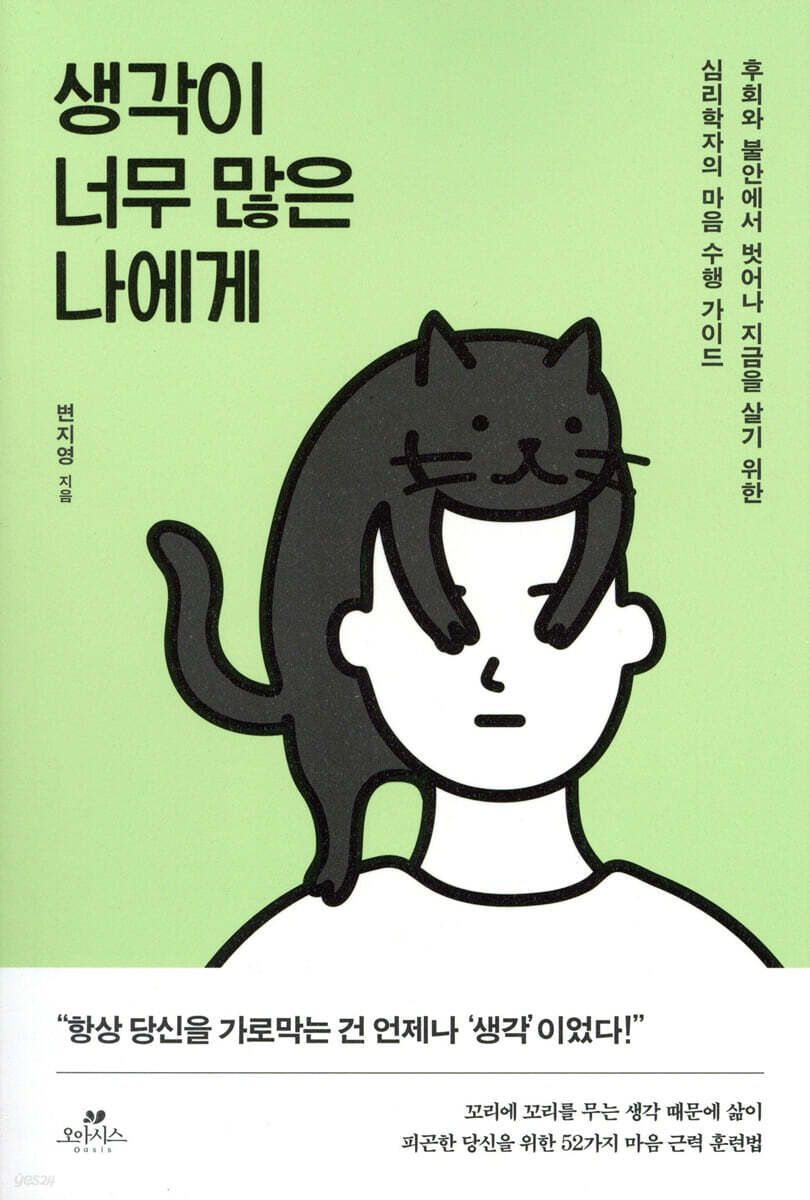
To me who thinks too much
 |
Description
Book Introduction
“It was always ‘thoughts’ that got in your way!”
52 Mind Strength Training Techniques for Those Tired of Life's Revolving Minds
* Yes24 Crema Club Humanities #1
Based on the latest discoveries in neuroscience, author Jiyoung Byun has provided us with psychological knowledge for practical application in our lives through works such as 『Going to Save My Future Self』 and 『Time to Read My Mind』. Her book 『To Me Who Thinks Too Much』 has been published, which guides modern people who are tired from thinking too much to escape from the prison of thoughts.
People who often feel tense or anxious, people who feel regret or guilt while thinking of false assumptions such as 'I shouldn't have done that', 'It's because of that', 'I could have done it', 'I should have done it then', people who think too much about things that haven't happened yet and spend too much energy planning by thinking of every possible scenario to prepare for a certain situation, people who are stuck between excessive regret and worry are all people who are trapped in a 'prison of thoughts'.
People trapped here are unable to fully focus on the present moment, suffer from anxiety, and fall into negative thought patterns, ultimately leading to severe self-denial.
Why on earth do we willingly allow ourselves to be imprisoned in this prison of thought?
The answer is simple.
Because the human mind is a master storyteller.
Humans constantly weave stories about ourselves and our lives using the threads of thought, emotion, and sensation.
While these aspects of the mind are certainly useful, they never tell the whole story at any given moment, and ultimately leave us trapped within them.
This book is a guidebook that helps us break free from the 'thoughts about thoughts' that we are trapped in, and provides specific mental practices that can help us escape from the prison of thoughts.
52 Mind Strength Training Techniques for Those Tired of Life's Revolving Minds
* Yes24 Crema Club Humanities #1
Based on the latest discoveries in neuroscience, author Jiyoung Byun has provided us with psychological knowledge for practical application in our lives through works such as 『Going to Save My Future Self』 and 『Time to Read My Mind』. Her book 『To Me Who Thinks Too Much』 has been published, which guides modern people who are tired from thinking too much to escape from the prison of thoughts.
People who often feel tense or anxious, people who feel regret or guilt while thinking of false assumptions such as 'I shouldn't have done that', 'It's because of that', 'I could have done it', 'I should have done it then', people who think too much about things that haven't happened yet and spend too much energy planning by thinking of every possible scenario to prepare for a certain situation, people who are stuck between excessive regret and worry are all people who are trapped in a 'prison of thoughts'.
People trapped here are unable to fully focus on the present moment, suffer from anxiety, and fall into negative thought patterns, ultimately leading to severe self-denial.
Why on earth do we willingly allow ourselves to be imprisoned in this prison of thought?
The answer is simple.
Because the human mind is a master storyteller.
Humans constantly weave stories about ourselves and our lives using the threads of thought, emotion, and sensation.
While these aspects of the mind are certainly useful, they never tell the whole story at any given moment, and ultimately leave us trapped within them.
This book is a guidebook that helps us break free from the 'thoughts about thoughts' that we are trapped in, and provides specific mental practices that can help us escape from the prison of thoughts.
index
Prologue_ Why do I have so many thoughts?
Part 1.
To me who is trapped in a prison of thoughts
Chapter 1 Question_ What are those thoughts for?
1.
A story created by the heart
2.
There's drama hidden in the outbursts of anger.
3.
What did I add?
4.
The mind is infinite
5.
Push Water Game Machine
6.
Me, me, me!
7.
Nothing disappears
Chapter 2 Habits_ What don't I know?
8.
Five Pairs of Neurosis and Wisdom
9.
Fatigue and impatience
10.
Chronic anxiety and emptiness
11.
How I react
12.
Misunderstandings and errors
13.
Images and Stories
14.
judgment and experience
Chapter 3: Relationships_What does it mean that I am connected to all beings?
15.
golden opportunity
16.
The more you try to avoid it, the more it comes back
17.
A self-image that is created by force
18.
The true meaning of crisis
19.
Symptoms and Roots
20.
Sit down in the middle of difficulties
21.
About obsession
22.
dependence on comfort
Part 2.
A Mindful Practice Guide for Those Trapped in a Prison of Thought
Chapter 4 Insights: What is ‘brightness’ to me?
23.
When you need a practice that permeates your life
24.
The art of dying well
25.
exhalation exercises
26.
As is
27.
Relationships and Insights
28.
Explore your own topic
Chapter 5: How to do it?
29.
preparation
30.
Step 1: Relaxation
31.
Common difficulties
32.
When you feel anxious and can't concentrate
33.
When you feel sleepy just by sitting down
34.
Coping with Discomfort and Annoyance
Chapter 6: Problems_Is there anything I am avoiding or unwilling to acknowledge?
35.
Simple self-care tips for when you're feeling down
36.
Feel emotions in your body
37.
Relating to Painful Experiences
38.
Awareness of the whole body
Chapter 7 Stillness_ At this moment, what is it that most prevents me from staying still?
39.
Using your body senses
40.
Step 2: Becoming One with Body and Mind
41.
When you feel pain somewhere in your body
42.
In that case, it's okay
Chapter 8 Adversity - What is the situation that makes me the most difficult, the thing I would most like to avoid?
43.
Step 3: Becoming One with Yourself and Your Surroundings
44.
Dealing with Obsession
45.
Dealing with anger
46.
Dealing with Depression
47.
Understanding, not overcoming
48.
Opening your heart to both joy and hardship
Chapter 9 Waves - What are the thinking habits I need to be most careful about?
49.
Step 4: Shine Silently
50.
fake meditation
51.
Correct concentration
52.
Jigwantajwa
53.
The scenery outside the car window
54.
Daily practice
Epilogue_ How to Live Well and Die Well
Part 1.
To me who is trapped in a prison of thoughts
Chapter 1 Question_ What are those thoughts for?
1.
A story created by the heart
2.
There's drama hidden in the outbursts of anger.
3.
What did I add?
4.
The mind is infinite
5.
Push Water Game Machine
6.
Me, me, me!
7.
Nothing disappears
Chapter 2 Habits_ What don't I know?
8.
Five Pairs of Neurosis and Wisdom
9.
Fatigue and impatience
10.
Chronic anxiety and emptiness
11.
How I react
12.
Misunderstandings and errors
13.
Images and Stories
14.
judgment and experience
Chapter 3: Relationships_What does it mean that I am connected to all beings?
15.
golden opportunity
16.
The more you try to avoid it, the more it comes back
17.
A self-image that is created by force
18.
The true meaning of crisis
19.
Symptoms and Roots
20.
Sit down in the middle of difficulties
21.
About obsession
22.
dependence on comfort
Part 2.
A Mindful Practice Guide for Those Trapped in a Prison of Thought
Chapter 4 Insights: What is ‘brightness’ to me?
23.
When you need a practice that permeates your life
24.
The art of dying well
25.
exhalation exercises
26.
As is
27.
Relationships and Insights
28.
Explore your own topic
Chapter 5: How to do it?
29.
preparation
30.
Step 1: Relaxation
31.
Common difficulties
32.
When you feel anxious and can't concentrate
33.
When you feel sleepy just by sitting down
34.
Coping with Discomfort and Annoyance
Chapter 6: Problems_Is there anything I am avoiding or unwilling to acknowledge?
35.
Simple self-care tips for when you're feeling down
36.
Feel emotions in your body
37.
Relating to Painful Experiences
38.
Awareness of the whole body
Chapter 7 Stillness_ At this moment, what is it that most prevents me from staying still?
39.
Using your body senses
40.
Step 2: Becoming One with Body and Mind
41.
When you feel pain somewhere in your body
42.
In that case, it's okay
Chapter 8 Adversity - What is the situation that makes me the most difficult, the thing I would most like to avoid?
43.
Step 3: Becoming One with Yourself and Your Surroundings
44.
Dealing with Obsession
45.
Dealing with anger
46.
Dealing with Depression
47.
Understanding, not overcoming
48.
Opening your heart to both joy and hardship
Chapter 9 Waves - What are the thinking habits I need to be most careful about?
49.
Step 4: Shine Silently
50.
fake meditation
51.
Correct concentration
52.
Jigwantajwa
53.
The scenery outside the car window
54.
Daily practice
Epilogue_ How to Live Well and Die Well
Into the book
In fact, the other person's actions are in the other person's domain, and my actions are in my domain, so the other person's actions are not in my hands.
No matter how close you are, such as with your spouse or children, each person's actions are their own responsibility.
It's not a question of who can change who or what can be done.
Besides, just because the other person did something doesn't mean I have to do it the same way.
For example, just because the other person swears, there is no need to swear back.
My reaction is a matter of my own making.
--- From "What I Added"
Modern people's chronic anxiety, emptiness, and loneliness are related to alienation.
Alienation is often thought of as a social phenomenon in which relationships between people become superficial, formal, and distant, but all alienation begins with one's relationship with oneself.
Alienation is the inability to fully connect with one's own experience.
It is not possible to feel and accept each moment of experience as it is, but to judge and control the experience through quick judgment.
It's hard to experience anything properly to the end because we jump to conclusions before even experiencing it.
--- From "Chronic Anxiety and Emptiness"
To understand yourself, you must first take a close look at how you react in real time to the circumstances and conditions in which you find yourself.
The starting point is always ‘my reaction’.
Self-understanding ultimately means understanding my own actions.
We need to bring our attention inward by asking ourselves questions like, "What is bothering me? What is happening inside me right now?"
Observing my reactions and actions with a warm and curious attitude is the starting point of self-understanding.
Everyone in the world has the right to speak and act as they please.
I can't force you to be kind to me.
But why do those words and actions particularly bother me and make me uncomfortable? I need to figure out the exact reason.
--- From "How I React"
Emotions and pain have a lot in common.
The most representative thing is that the more you try to force it away, the bigger the obstacle it becomes.
The more you suppress it, the stronger and more prominent it becomes.
My thoughts are similar.
It's a bad thought, so let's not do it. If you forbid or suppress it, it will come to mind more.
Why is that? There are several psychological principles that explain this, but simply put, it's because attention is more focused on that area.
The moment you say to yourself, "I shouldn't do that!" your attention shifts to the clue, "What?"
If you say, "You shouldn't be depressed!", you will focus more on depression, and if you say, "You shouldn't be anxious!", you will automatically become more sensitive to cues related to anxiety.
It's like trying to avoid something only to get caught up in it more.
--- From "The more you try to avoid it, the more it comes back"
The reason you're not satisfied with your current life isn't because you haven't accomplished more.
Because you didn't see it as it was.
Because we keep creating desires to obscure the truth.
To see the truth as it is, you must stay still in this moment, without running away or covering it up.
That's the practice.
True relaxation occurs in the exhalation.
Exhalation is letting go, emptying, and surrendering.
You need to know exactly what you're putting down.
Can you jump without knowing what's beneath your feet? You can't put something down if you don't know what you're putting down.
Meditation without proper understanding is nothing more than a sitting posture exercise or an attention training.
--- From "As It Is"
Self-understanding is ultimately about understanding one's own subject.
I'm talking about a deep understanding of what my breaking points are, my vulnerability buttons, and how they connect to my experiences and other characteristics.
It is an understanding of the life I have lived and also an understanding of the actions I repeat.
The question is whether they will get angry and lose their temper when something is touched, become stubborn and stubborn, run away in a panic, or close the shutter and block the scene.
When is that time? What is the situation? And how do you react? That's where your "self-theme" comes in.
--- From "Exploring Your Own Topic"
Breathing is the most powerful way to stay present.
So, you can use your breath as a rope to enter into an intense emotional experience.
If we forget to breathe and rush into those feelings, we can become overwhelmed.
You may feel suffocated and overwhelmed by your emotions.
But if I can keep breathing with that feeling, I can experience the feelings that arise in my body as they are, without being overwhelmed or buried.
--- From "Relationships with Painful Experiences"
When we say we think too much, it's usually because we're obsessed with the past or worrying about the future, trying to prepare for it, rather than living in the present moment.
When I focus on what's happening in my body and mind right now, it's hard to have long thoughts.
Because the current state is constantly changing.
To notice change, you have to be conscious of the here and now.
So, if you focus on this now, you'll avoid having your thoughts spiral out of control and your story will continue.
You add thoughts to thoughts and follow those thoughts, then come to your senses and come back to the here and now.
I get lost in one emotion and chase after the emotion and thoughts, wondering why that emotion is happening, but then I come to my senses and come back to the here and now.
No matter how close you are, such as with your spouse or children, each person's actions are their own responsibility.
It's not a question of who can change who or what can be done.
Besides, just because the other person did something doesn't mean I have to do it the same way.
For example, just because the other person swears, there is no need to swear back.
My reaction is a matter of my own making.
--- From "What I Added"
Modern people's chronic anxiety, emptiness, and loneliness are related to alienation.
Alienation is often thought of as a social phenomenon in which relationships between people become superficial, formal, and distant, but all alienation begins with one's relationship with oneself.
Alienation is the inability to fully connect with one's own experience.
It is not possible to feel and accept each moment of experience as it is, but to judge and control the experience through quick judgment.
It's hard to experience anything properly to the end because we jump to conclusions before even experiencing it.
--- From "Chronic Anxiety and Emptiness"
To understand yourself, you must first take a close look at how you react in real time to the circumstances and conditions in which you find yourself.
The starting point is always ‘my reaction’.
Self-understanding ultimately means understanding my own actions.
We need to bring our attention inward by asking ourselves questions like, "What is bothering me? What is happening inside me right now?"
Observing my reactions and actions with a warm and curious attitude is the starting point of self-understanding.
Everyone in the world has the right to speak and act as they please.
I can't force you to be kind to me.
But why do those words and actions particularly bother me and make me uncomfortable? I need to figure out the exact reason.
--- From "How I React"
Emotions and pain have a lot in common.
The most representative thing is that the more you try to force it away, the bigger the obstacle it becomes.
The more you suppress it, the stronger and more prominent it becomes.
My thoughts are similar.
It's a bad thought, so let's not do it. If you forbid or suppress it, it will come to mind more.
Why is that? There are several psychological principles that explain this, but simply put, it's because attention is more focused on that area.
The moment you say to yourself, "I shouldn't do that!" your attention shifts to the clue, "What?"
If you say, "You shouldn't be depressed!", you will focus more on depression, and if you say, "You shouldn't be anxious!", you will automatically become more sensitive to cues related to anxiety.
It's like trying to avoid something only to get caught up in it more.
--- From "The more you try to avoid it, the more it comes back"
The reason you're not satisfied with your current life isn't because you haven't accomplished more.
Because you didn't see it as it was.
Because we keep creating desires to obscure the truth.
To see the truth as it is, you must stay still in this moment, without running away or covering it up.
That's the practice.
True relaxation occurs in the exhalation.
Exhalation is letting go, emptying, and surrendering.
You need to know exactly what you're putting down.
Can you jump without knowing what's beneath your feet? You can't put something down if you don't know what you're putting down.
Meditation without proper understanding is nothing more than a sitting posture exercise or an attention training.
--- From "As It Is"
Self-understanding is ultimately about understanding one's own subject.
I'm talking about a deep understanding of what my breaking points are, my vulnerability buttons, and how they connect to my experiences and other characteristics.
It is an understanding of the life I have lived and also an understanding of the actions I repeat.
The question is whether they will get angry and lose their temper when something is touched, become stubborn and stubborn, run away in a panic, or close the shutter and block the scene.
When is that time? What is the situation? And how do you react? That's where your "self-theme" comes in.
--- From "Exploring Your Own Topic"
Breathing is the most powerful way to stay present.
So, you can use your breath as a rope to enter into an intense emotional experience.
If we forget to breathe and rush into those feelings, we can become overwhelmed.
You may feel suffocated and overwhelmed by your emotions.
But if I can keep breathing with that feeling, I can experience the feelings that arise in my body as they are, without being overwhelmed or buried.
--- From "Relationships with Painful Experiences"
When we say we think too much, it's usually because we're obsessed with the past or worrying about the future, trying to prepare for it, rather than living in the present moment.
When I focus on what's happening in my body and mind right now, it's hard to have long thoughts.
Because the current state is constantly changing.
To notice change, you have to be conscious of the here and now.
So, if you focus on this now, you'll avoid having your thoughts spiral out of control and your story will continue.
You add thoughts to thoughts and follow those thoughts, then come to your senses and come back to the here and now.
I get lost in one emotion and chase after the emotion and thoughts, wondering why that emotion is happening, but then I come to my senses and come back to the here and now.
--- From "In that case, it's like that"
Publisher's Review
“All the problems in life come from thinking too much!”
Regret, anxiety, worry, all of it going on and on…
A psychologist has come forward for you who is tired of life due to your overflowing thoughts!
A Psychologist's Guide to Mindfulness: A Guide to Enlightenment Through Your Whole Body, Not Just Your Head
"Why do I have to live my whole life worrying about what others think?", "I've worked hard, so why is there nothing left for me?", "Why do relationships always end badly no matter how hard I try?" Many people find themselves lingering in thought, lingering in circles around a certain topic.
Or, some people find themselves repeatedly stuck in events that trigger specific emotions, such as anger, betrayal, irritation, loneliness, sadness, anxiety, obsession, jealousy, inferiority, or guilt.
Most of the time, we fail to recognize the pattern and believe that the cause lies outside ourselves, in someone else.
Even if we vaguely discover this endlessly recurring 'self-theme' in life, we often forget it or quickly cover it up with other stimuli because we don't know how to deal with it.
But the rocks that cannot be avoided must be broken.
Just as a large rock cannot be broken in one go, it must be broken repeatedly and persistently.
Breaking a rock with your whole body, grinding it into a stone, carrying it around with you, that is self-understanding and practice.
Part 1 of this book helps you reflect on your overthinking self, and Part 2 covers specific practices to escape the prison of your thoughts.
Mind practice is not about training to control the mind to maintain equanimity or mental fitness to build a strong mind.
It is a work that penetrates the experience as it is and feels it in more detail.
It's not about brushing off the problem as if nothing happened, but about sitting right in the middle of the problem, even though it's there.
The reason you think too much is not because you can't do more, but because you don't see things as they are.
Above all, this book will help us regain our lost focus on life by changing our 'thoughts about thoughts.'
This book is a practice guide to accompany you on that journey.
“What on earth is this thought for?”
A book that helps me escape the prison of repetitive thoughts inside me.
People who think too much have poor working memory capacity because they are unable to prevent thoughts unrelated to the task at hand from intruding and interfering.
Lack of sufficient focus on tasks leads to poor performance, which in turn increases anxiety.
Even with the same amount of effort, the efficiency of cognitive function can be seen to be low because the quality of execution is low.
It's a vicious cycle of overthinking, distraction, decreased performance, anxiety, and then overthinking again.
How can we break this cycle? We must first understand the fundamental function of the thoughts we constantly revolve around.
Excessive thinking is mostly used to ‘escape reality’.
In order to step away from the experience of this moment, we continue to analyze and interpret in order to avoid or control the complexity, ambiguity, and uncertainty contained in the experience of the 'present'.
These habits reduce the efficiency of cognitive functions, creating a personality that feels anxious frequently and strongly.
If you connect with the experience that is happening now, and see and hear reality as it is, you will know clearly.
There is nothing very good or very bad in the 'present'.
The 'present' in which we live is complex in itself because it is in the midst of so many interactions.
It is so vague and uncertain that it cannot be defined by any words or concepts.
If you define it as such, it is already an interpretation of the past.
When we are focused on our work, when we truly face the face before our eyes, when we meditate or walk in the forest, we are in the 'present'.
The present, which is full of all possibilities, is surprisingly 'empty'.
If you are fully 'present', thoughts cannot arise.
The first thing that people who suffer from many thoughts and extreme emotions need to realize is that 'I am not here now.'
You must realize that for whatever reason you are running away from reality and hiding in the 'past'.
So, don't be fooled by placing too much meaning on the content of the thought, but look at the context.
We must question the hidden intentions.
'Why am I not here?' or 'What am I trying to avoid right now?'
“What are you avoiding right now?”
Wisdom of Inner Practice from a Psychologist
Psychologist Jiyoung Byun, who received her doctorate for her research on the impact of regulatory focus on mental health, emphasizes the importance of ‘inner practice.’
When people face difficult times in life or are unsure of what decisions to make, they often seek advice from experts, talk to friends or family, go on trips, or read books.
The author emphasizes that the best thing we can do at this time is to 'sit quietly and listen to our original wisdom', that is, inner practice.
Practice is seeing the whole.
Looking deeper, not being caught up in what appears on the surface.
That is 'inner practice'.
As you practice, you will find yourself becoming less hung up on and obsessed with small things.
You won't get angry easily, and even if you do have a conflict with someone, it won't last long before you find harmony.
There will also be less instances of you being consumed by the hamster wheel of thought that weighs on your mind.
You will be able to live more flexibly without being rigid or stuck, and with less unnecessary effort and wasted effort.
It is about using our inherent wisdom to better use our body and mind.
If you have lived a difficult life filled with greed, comparison, and foolishness, it is time to begin inner practice.
Let us listen to the original wisdom that we possess.
You will find yourself deeper and clearer, wiser and more intelligent.
Regret, anxiety, worry, all of it going on and on…
A psychologist has come forward for you who is tired of life due to your overflowing thoughts!
A Psychologist's Guide to Mindfulness: A Guide to Enlightenment Through Your Whole Body, Not Just Your Head
"Why do I have to live my whole life worrying about what others think?", "I've worked hard, so why is there nothing left for me?", "Why do relationships always end badly no matter how hard I try?" Many people find themselves lingering in thought, lingering in circles around a certain topic.
Or, some people find themselves repeatedly stuck in events that trigger specific emotions, such as anger, betrayal, irritation, loneliness, sadness, anxiety, obsession, jealousy, inferiority, or guilt.
Most of the time, we fail to recognize the pattern and believe that the cause lies outside ourselves, in someone else.
Even if we vaguely discover this endlessly recurring 'self-theme' in life, we often forget it or quickly cover it up with other stimuli because we don't know how to deal with it.
But the rocks that cannot be avoided must be broken.
Just as a large rock cannot be broken in one go, it must be broken repeatedly and persistently.
Breaking a rock with your whole body, grinding it into a stone, carrying it around with you, that is self-understanding and practice.
Part 1 of this book helps you reflect on your overthinking self, and Part 2 covers specific practices to escape the prison of your thoughts.
Mind practice is not about training to control the mind to maintain equanimity or mental fitness to build a strong mind.
It is a work that penetrates the experience as it is and feels it in more detail.
It's not about brushing off the problem as if nothing happened, but about sitting right in the middle of the problem, even though it's there.
The reason you think too much is not because you can't do more, but because you don't see things as they are.
Above all, this book will help us regain our lost focus on life by changing our 'thoughts about thoughts.'
This book is a practice guide to accompany you on that journey.
“What on earth is this thought for?”
A book that helps me escape the prison of repetitive thoughts inside me.
People who think too much have poor working memory capacity because they are unable to prevent thoughts unrelated to the task at hand from intruding and interfering.
Lack of sufficient focus on tasks leads to poor performance, which in turn increases anxiety.
Even with the same amount of effort, the efficiency of cognitive function can be seen to be low because the quality of execution is low.
It's a vicious cycle of overthinking, distraction, decreased performance, anxiety, and then overthinking again.
How can we break this cycle? We must first understand the fundamental function of the thoughts we constantly revolve around.
Excessive thinking is mostly used to ‘escape reality’.
In order to step away from the experience of this moment, we continue to analyze and interpret in order to avoid or control the complexity, ambiguity, and uncertainty contained in the experience of the 'present'.
These habits reduce the efficiency of cognitive functions, creating a personality that feels anxious frequently and strongly.
If you connect with the experience that is happening now, and see and hear reality as it is, you will know clearly.
There is nothing very good or very bad in the 'present'.
The 'present' in which we live is complex in itself because it is in the midst of so many interactions.
It is so vague and uncertain that it cannot be defined by any words or concepts.
If you define it as such, it is already an interpretation of the past.
When we are focused on our work, when we truly face the face before our eyes, when we meditate or walk in the forest, we are in the 'present'.
The present, which is full of all possibilities, is surprisingly 'empty'.
If you are fully 'present', thoughts cannot arise.
The first thing that people who suffer from many thoughts and extreme emotions need to realize is that 'I am not here now.'
You must realize that for whatever reason you are running away from reality and hiding in the 'past'.
So, don't be fooled by placing too much meaning on the content of the thought, but look at the context.
We must question the hidden intentions.
'Why am I not here?' or 'What am I trying to avoid right now?'
“What are you avoiding right now?”
Wisdom of Inner Practice from a Psychologist
Psychologist Jiyoung Byun, who received her doctorate for her research on the impact of regulatory focus on mental health, emphasizes the importance of ‘inner practice.’
When people face difficult times in life or are unsure of what decisions to make, they often seek advice from experts, talk to friends or family, go on trips, or read books.
The author emphasizes that the best thing we can do at this time is to 'sit quietly and listen to our original wisdom', that is, inner practice.
Practice is seeing the whole.
Looking deeper, not being caught up in what appears on the surface.
That is 'inner practice'.
As you practice, you will find yourself becoming less hung up on and obsessed with small things.
You won't get angry easily, and even if you do have a conflict with someone, it won't last long before you find harmony.
There will also be less instances of you being consumed by the hamster wheel of thought that weighs on your mind.
You will be able to live more flexibly without being rigid or stuck, and with less unnecessary effort and wasted effort.
It is about using our inherent wisdom to better use our body and mind.
If you have lived a difficult life filled with greed, comparison, and foolishness, it is time to begin inner practice.
Let us listen to the original wisdom that we possess.
You will find yourself deeper and clearer, wiser and more intelligent.
GOODS SPECIFICS
- Date of issue: July 15, 2024
- Page count, weight, size: 240 pages | 366g | 140*205*15mm
- ISBN13: 9791168271968
- ISBN10: 1168271967
You may also like
카테고리
korean


korean

![ELLE 엘르 스페셜 에디션 A형 : 12월 [2025]](http://librairie.coreenne.fr/cdn/shop/files/b8e27a3de6c9538896439686c6b0e8fb.jpg?v=1766436872&width=3840)


