

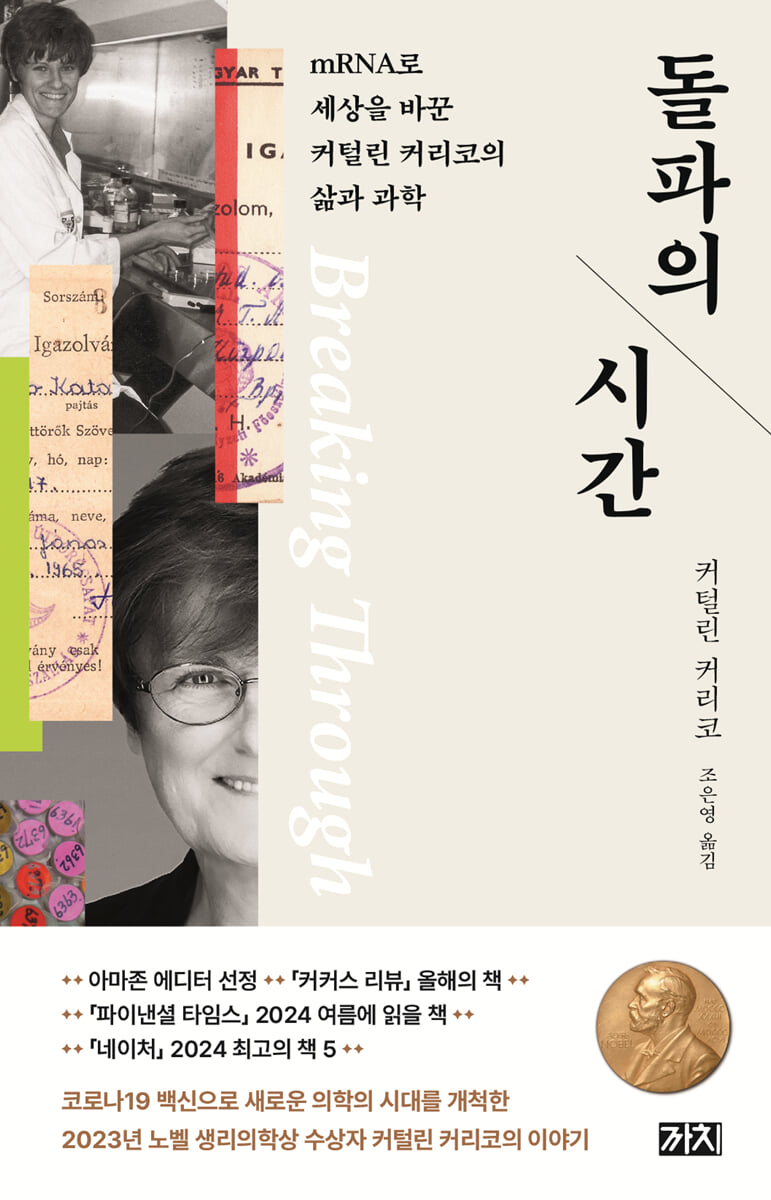
Time for a breakthrough
 |
Description
Book Introduction
- A word from MD
-
The ecstatic rise of a great researcher who changed the worldMemoirs of Katharine Kariko, winner of the 2023 Nobel Prize in Physiology or Medicine.
From being born into poverty in Hungary to rising to become an mRNA authority, the author's life has been a series of breakthroughs.
Whenever I encountered high walls such as poverty, schoolwork, marriage, childcare, and the closed academic world, I overcame them head-on.
Changed the world.
July 23, 2024. Natural Science PD Son Min-gyu
From foreigner and academic outsider to Nobel Prize winner in Physiology or Medicine
A Memoir by Kathleen Curriko, Who Ushered in a New Era of Medicine with mRNA Vaccines
The memory of COVID-19, which swept the world in 2020, paralyzing the planet and taking countless lives, is still vivid.
While countless efforts have been made to end the pandemic, perhaps the most significant has been the COVID-19 vaccine, which was developed at unprecedented speed and administered to billions of people.
Contrary to public concerns that vaccine development was too rapid, behind the vaccines that brought people back to their daily lives were the efforts of people who quietly and steadfastly continued research, one at a time, for decades.
This is Katharine Curriko, an outsider who was not recognized in the academic world, but who never gave up on her research and moved forward without hesitation.
If she lost her job at the research institute she was working at, she would leave her home country and find a new job in another country; if she couldn't get promoted at a university research institute, she would accept a low-level position as long as she could do research; and although she was a biologist, she would not hesitate to go to a lab full of doctors if her research was needed, and she was a scientist who steadily devoted herself to her research. That scientist was Katharine Curriko.
The story of this woman, who, while the academic world was obsessed with DNA, was alone drawn to the potential of RNA and, despite being ignored by her colleagues and neglected by research institutions, devoted herself to research with unwavering conviction, will serve as a great source of inspiration to countless others who believe in their own potential and walk that path.
Moreover, this book will provide an easy-to-understand introduction to mRNA vaccines and the science behind them, which have contributed to ending the pandemic.
A Memoir by Kathleen Curriko, Who Ushered in a New Era of Medicine with mRNA Vaccines
The memory of COVID-19, which swept the world in 2020, paralyzing the planet and taking countless lives, is still vivid.
While countless efforts have been made to end the pandemic, perhaps the most significant has been the COVID-19 vaccine, which was developed at unprecedented speed and administered to billions of people.
Contrary to public concerns that vaccine development was too rapid, behind the vaccines that brought people back to their daily lives were the efforts of people who quietly and steadfastly continued research, one at a time, for decades.
This is Katharine Curriko, an outsider who was not recognized in the academic world, but who never gave up on her research and moved forward without hesitation.
If she lost her job at the research institute she was working at, she would leave her home country and find a new job in another country; if she couldn't get promoted at a university research institute, she would accept a low-level position as long as she could do research; and although she was a biologist, she would not hesitate to go to a lab full of doctors if her research was needed, and she was a scientist who steadily devoted herself to her research. That scientist was Katharine Curriko.
The story of this woman, who, while the academic world was obsessed with DNA, was alone drawn to the potential of RNA and, despite being ignored by her colleagues and neglected by research institutions, devoted herself to research with unwavering conviction, will serve as a great source of inspiration to countless others who believe in their own potential and walk that path.
Moreover, this book will provide an easy-to-understand introduction to mRNA vaccines and the science behind them, which have contributed to ending the pandemic.
- You can preview some of the book's contents.
Preview
index
Entering
prolog
1 The daughter of a butcher
2 A very brief interlude about science
3. Sense of purpose
Outsider of the 4 systems
5 Susan's Mom
6 A Changing World
Epilogue
Acknowledgements
Translator's Note
prolog
1 The daughter of a butcher
2 A very brief interlude about science
3. Sense of purpose
Outsider of the 4 systems
5 Susan's Mom
6 A Changing World
Epilogue
Acknowledgements
Translator's Note
Detailed image
.jpg)
Publisher's Review
A girl born in post-war communist Hungary who dreamed of becoming a scientist
From entering the biology department to becoming a real scientist
“The Butcher’s Daughter” depicts the childhood of Katarina Kariko, born the daughter of a butcher in a small town in communist Hungary.
Growing up in a dirt house without proper electricity or running water, Curico learned science from everything around him, including the flowers his grandmother grew and the vegetables she grew in her garden.
Also, even though he was not very smart, he tried his best in school and tried to learn everything, and as a result, he participated in the Hungarian Biology Competition and won an award.
Books were also her great teachers.
In particular, Hans Selye's "The Stress of Life" had such a profound influence on her life as a scientist that she felt it was written just for her.
Curriko's desire to become a scientist was further strengthened when he received a reply to a letter he had recklessly sent to his classmates and the Hungarian scientist Albert Szent-Györgyi, addressed only as "Albert Szent-Györgyi, USA."
Moreover, Curico was a student who knew how to stand up to injustice.
Despite her Russian teacher's unreasonable demands and threats to prevent her from entering university, she did not give in and confidently took the entrance exam, successfully passing the biology department at the University of Szeged, which she had been hoping for.
"A Very Short Interlude on Science" briefly introduces RNA, a molecule that captivated Currico. While DNA is the eternal, immutable repository of our genetic information, RNA is a fleeting molecule that exists temporarily to create the things our bodies need, then disappears.
And this difference presented a tremendous fascination and endless possibilities for Currico, and she has devoted herself to RNA research for over 30 years.
Before that, you must first graduate from college.
Curico, who entered the Department of Biology at the University of Szeged, devoted himself to his studies.
It was a time when I devoted myself to studying, eating and sleeping, reading books in the cold wind with the dormitory window open even in the middle of winter to chase away the sleepiness that was pouring down, and gaining the laboratory experience I lacked, while throwing myself into becoming a scientist.
Some might think that studying is the opposite of happiness, but for Curriko, “the time I spent in Szeged was the happiest time of my life.”
An anecdote from when Currico, a year before graduating from university, briefly worked at a fisheries research institute clearly demonstrates her tenacity and passion for research.
On her first day at work, she had no direct supervisor and no materials needed for her work.
“But excuses are only found when you don’t feel like doing something,” and Currico wasn’t that kind of person.
She started her work by obtaining the materials needed for her research and making the materials she didn't have, even if it was something she was trying for the first time.
The research conducted at the National Fisheries Research and Development Institute became the subject of Currico's first paper, published a few years later in 1981.
In the winter of 1977, Curico, who was tall but had been in poor health since childhood and had no interest in dating due to her studies, made eye contact with a man taller than her at a year-end party hosted by her department, and the man actively expressed interest in Curico.
The man who came to the dormitory where Curico was staying was a high school student at the time, but he was a good person who made Curico smile, and the two eventually got married.
And then she gives birth to a daughter and becomes a mother.
Curico also faithfully continues his life as a scientist.
In the horizontal atmosphere of the Biological Research Center (BRC), Currico and his colleagues succeeded in creating liposomes made of the same material as our cell membranes, using phospholipids extracted from the brains of cattle taken from slaughterhouses.
Then, DNA was placed in liposomes and introduced into mammalian cells, causing the cells to produce proteins engraved with the DNA.
Later, while studying the interferon system, which allows cells to identify and attack RNA pathogens, she discovered the potential of "RNA as a drug." While actively researching interferon at the BRC, Currico began experiencing the same symptoms that plagued her as a child: loss of appetite, high fever, and body aches.
One day, while taking a break from work and commuting to and from the hospital, Curico has an epiphany.
She decided to turn her potential into reality when she realized that “no one will wait for what you haven’t done yet.”
After that, she “went back to work.
And from then on I kept my pace.
“Even though my body was in so much pain that it felt like it was going to break, I kept going.” RNA was notoriously difficult to work with in the laboratory, and many of his fellow scientists had a preconceived notion that RNA was a nuisance, something that couldn’t be studied, and not worth the hassle, but Currico never felt intimidated or doubted its potential.
However, as no notable research results were produced, the company that had been supporting BRC's research stopped supporting it, and Currico's research contract ended.
Despite this, in order to continue his research, Curriko submitted numerous applications and eventually left Hungary for the United States.
Leaving my home country and living in a foreign country, I have neither the attention of the academic world nor the support of research funds.
A journey of discovery for myself as a foreigner and lone RNA researcher.
After leaving Hungary and arriving in the United States with his family's entire fortune of $1,200, he put his daughter Susan's teddy bear in her pocket and began working in the laboratory of the famous American biochemist Robert Suhadolnik.
Curico, who was continuing his research in the vertical and rigid laboratory of Suhadolnik, accepted a job offer.
When Suhadolnik learned of this, he cursed Curiko and threatened to deport her from the United States, urging her to remain in his lab. However, this only served to further solidify her resolve to leave Suhadolnik's lab.
Eventually, Currico was able to secure a position at the U.S. Military Medical Training Institute and continue his research.
After moving to the University of Pennsylvania (UPenn), Currico's research career reached a turning point.
Curico's twenty years at Upenn are broadly divided into three periods, featuring two departments and three doctor colleagues.
First, there's cardiologist Elliot Barnes, who recruited Currico to Upenn.
Elliott was interested in molecules that help dissolve blood clots, and when Currico suggested a method using mRNA, the two began researching together.
The two co-authored numerous papers and experimented with urokinase, which is involved in clot dissolution, and succeeded in getting cells to make urokinase receptors using mRNA.
Even in this moment of success, Currico continued to advance his research rather than popping the champagne.
However, when Elliot is recruited by a biotech company, Currico continues his second period of collaborative research with neurosurgeons with the help of his former student, David.
Then, during the final third period, I met by chance in front of the school copy machine Drew Wiseman, my partner with whom I would build important research achievements in the future, and my Nobel Prize co-winner, who “will be mentioned alongside my name for the rest of my life.”
A chance encounter with immunologist Wiseman opened Currico's eyes to the potential of mRNA vaccines.
Using mRNA allows vaccines to be made cheaper and faster than traditional vaccines because it provides instructions for cells to produce the antigen themselves instead of putting it directly into the cells.
In other words, the body becomes an antigen manufacturing factory and an immune system that responds to those antigens.
However, the two people who started research soon encountered difficulties.
There seemed to be something in the mRNA itself that caused an inflammatory response.
As always, Currico worked one experiment at a time to find RNA that didn't trigger an inflammatory response.
Thirty years of research and countless experiments have finally been connected.
Not only did they create mRNA in the lab, deliver it to cells, protect it from destruction, and incorporate pseudouridine into the mRNA to prevent it from triggering an inflammatory response, they also translated much more protein.
Their research was published in the immunology journal Immunity, but it received no attention at the time, and in 2013, Curico left the university and moved to BioNTech, a German biotechnology company.
“A Changed World”
And the message Curico wants to convey
Curico's research has attracted worldwide attention due to the COVID-19 vaccine.
To end the pandemic that gripped the world in early 2020, a vaccine was needed as soon as possible.
Pfizer, which joined hands with BioNTech, where Curico worked, began developing a vaccine at an unprecedented speed.
Currico oversaw this process from his home in the United States, rather than in Germany, where the company is headquartered.
She too was stranded in the United States due to the pandemic.
Even on the day she got the call that the vaccine was effective, she calmly told her husband, “It works,” and celebrated the result in her own way: by opening a box of her favorite chocolates and eating them all.
After that, countless spotlights followed her.
Currico has traveled the world, giving interviews to countless media outlets, receiving numerous awards, and giving lectures.
And I received thanks from countless people.
But she says her success is just one of many possibilities.
I hope more people will continue to conduct more diverse research, and I anticipate an explosion of mRNA-based treatments and vaccines in the future.
“No one can fail to be moved by this story of one woman’s solitary crusade, persevering with remarkable resilience.
Her defiant journey ultimately had a profound impact on humanity… … Currico’s memoir is not only a significant record of the history of the coronavirus pandemic, but also an informative account of science in general.” - The Times Literary Supplement
From entering the biology department to becoming a real scientist
“The Butcher’s Daughter” depicts the childhood of Katarina Kariko, born the daughter of a butcher in a small town in communist Hungary.
Growing up in a dirt house without proper electricity or running water, Curico learned science from everything around him, including the flowers his grandmother grew and the vegetables she grew in her garden.
Also, even though he was not very smart, he tried his best in school and tried to learn everything, and as a result, he participated in the Hungarian Biology Competition and won an award.
Books were also her great teachers.
In particular, Hans Selye's "The Stress of Life" had such a profound influence on her life as a scientist that she felt it was written just for her.
Curriko's desire to become a scientist was further strengthened when he received a reply to a letter he had recklessly sent to his classmates and the Hungarian scientist Albert Szent-Györgyi, addressed only as "Albert Szent-Györgyi, USA."
Moreover, Curico was a student who knew how to stand up to injustice.
Despite her Russian teacher's unreasonable demands and threats to prevent her from entering university, she did not give in and confidently took the entrance exam, successfully passing the biology department at the University of Szeged, which she had been hoping for.
"A Very Short Interlude on Science" briefly introduces RNA, a molecule that captivated Currico. While DNA is the eternal, immutable repository of our genetic information, RNA is a fleeting molecule that exists temporarily to create the things our bodies need, then disappears.
And this difference presented a tremendous fascination and endless possibilities for Currico, and she has devoted herself to RNA research for over 30 years.
Before that, you must first graduate from college.
Curico, who entered the Department of Biology at the University of Szeged, devoted himself to his studies.
It was a time when I devoted myself to studying, eating and sleeping, reading books in the cold wind with the dormitory window open even in the middle of winter to chase away the sleepiness that was pouring down, and gaining the laboratory experience I lacked, while throwing myself into becoming a scientist.
Some might think that studying is the opposite of happiness, but for Curriko, “the time I spent in Szeged was the happiest time of my life.”
An anecdote from when Currico, a year before graduating from university, briefly worked at a fisheries research institute clearly demonstrates her tenacity and passion for research.
On her first day at work, she had no direct supervisor and no materials needed for her work.
“But excuses are only found when you don’t feel like doing something,” and Currico wasn’t that kind of person.
She started her work by obtaining the materials needed for her research and making the materials she didn't have, even if it was something she was trying for the first time.
The research conducted at the National Fisheries Research and Development Institute became the subject of Currico's first paper, published a few years later in 1981.
In the winter of 1977, Curico, who was tall but had been in poor health since childhood and had no interest in dating due to her studies, made eye contact with a man taller than her at a year-end party hosted by her department, and the man actively expressed interest in Curico.
The man who came to the dormitory where Curico was staying was a high school student at the time, but he was a good person who made Curico smile, and the two eventually got married.
And then she gives birth to a daughter and becomes a mother.
Curico also faithfully continues his life as a scientist.
In the horizontal atmosphere of the Biological Research Center (BRC), Currico and his colleagues succeeded in creating liposomes made of the same material as our cell membranes, using phospholipids extracted from the brains of cattle taken from slaughterhouses.
Then, DNA was placed in liposomes and introduced into mammalian cells, causing the cells to produce proteins engraved with the DNA.
Later, while studying the interferon system, which allows cells to identify and attack RNA pathogens, she discovered the potential of "RNA as a drug." While actively researching interferon at the BRC, Currico began experiencing the same symptoms that plagued her as a child: loss of appetite, high fever, and body aches.
One day, while taking a break from work and commuting to and from the hospital, Curico has an epiphany.
She decided to turn her potential into reality when she realized that “no one will wait for what you haven’t done yet.”
After that, she “went back to work.
And from then on I kept my pace.
“Even though my body was in so much pain that it felt like it was going to break, I kept going.” RNA was notoriously difficult to work with in the laboratory, and many of his fellow scientists had a preconceived notion that RNA was a nuisance, something that couldn’t be studied, and not worth the hassle, but Currico never felt intimidated or doubted its potential.
However, as no notable research results were produced, the company that had been supporting BRC's research stopped supporting it, and Currico's research contract ended.
Despite this, in order to continue his research, Curriko submitted numerous applications and eventually left Hungary for the United States.
Leaving my home country and living in a foreign country, I have neither the attention of the academic world nor the support of research funds.
A journey of discovery for myself as a foreigner and lone RNA researcher.
After leaving Hungary and arriving in the United States with his family's entire fortune of $1,200, he put his daughter Susan's teddy bear in her pocket and began working in the laboratory of the famous American biochemist Robert Suhadolnik.
Curico, who was continuing his research in the vertical and rigid laboratory of Suhadolnik, accepted a job offer.
When Suhadolnik learned of this, he cursed Curiko and threatened to deport her from the United States, urging her to remain in his lab. However, this only served to further solidify her resolve to leave Suhadolnik's lab.
Eventually, Currico was able to secure a position at the U.S. Military Medical Training Institute and continue his research.
After moving to the University of Pennsylvania (UPenn), Currico's research career reached a turning point.
Curico's twenty years at Upenn are broadly divided into three periods, featuring two departments and three doctor colleagues.
First, there's cardiologist Elliot Barnes, who recruited Currico to Upenn.
Elliott was interested in molecules that help dissolve blood clots, and when Currico suggested a method using mRNA, the two began researching together.
The two co-authored numerous papers and experimented with urokinase, which is involved in clot dissolution, and succeeded in getting cells to make urokinase receptors using mRNA.
Even in this moment of success, Currico continued to advance his research rather than popping the champagne.
However, when Elliot is recruited by a biotech company, Currico continues his second period of collaborative research with neurosurgeons with the help of his former student, David.
Then, during the final third period, I met by chance in front of the school copy machine Drew Wiseman, my partner with whom I would build important research achievements in the future, and my Nobel Prize co-winner, who “will be mentioned alongside my name for the rest of my life.”
A chance encounter with immunologist Wiseman opened Currico's eyes to the potential of mRNA vaccines.
Using mRNA allows vaccines to be made cheaper and faster than traditional vaccines because it provides instructions for cells to produce the antigen themselves instead of putting it directly into the cells.
In other words, the body becomes an antigen manufacturing factory and an immune system that responds to those antigens.
However, the two people who started research soon encountered difficulties.
There seemed to be something in the mRNA itself that caused an inflammatory response.
As always, Currico worked one experiment at a time to find RNA that didn't trigger an inflammatory response.
Thirty years of research and countless experiments have finally been connected.
Not only did they create mRNA in the lab, deliver it to cells, protect it from destruction, and incorporate pseudouridine into the mRNA to prevent it from triggering an inflammatory response, they also translated much more protein.
Their research was published in the immunology journal Immunity, but it received no attention at the time, and in 2013, Curico left the university and moved to BioNTech, a German biotechnology company.
“A Changed World”
And the message Curico wants to convey
Curico's research has attracted worldwide attention due to the COVID-19 vaccine.
To end the pandemic that gripped the world in early 2020, a vaccine was needed as soon as possible.
Pfizer, which joined hands with BioNTech, where Curico worked, began developing a vaccine at an unprecedented speed.
Currico oversaw this process from his home in the United States, rather than in Germany, where the company is headquartered.
She too was stranded in the United States due to the pandemic.
Even on the day she got the call that the vaccine was effective, she calmly told her husband, “It works,” and celebrated the result in her own way: by opening a box of her favorite chocolates and eating them all.
After that, countless spotlights followed her.
Currico has traveled the world, giving interviews to countless media outlets, receiving numerous awards, and giving lectures.
And I received thanks from countless people.
But she says her success is just one of many possibilities.
I hope more people will continue to conduct more diverse research, and I anticipate an explosion of mRNA-based treatments and vaccines in the future.
“No one can fail to be moved by this story of one woman’s solitary crusade, persevering with remarkable resilience.
Her defiant journey ultimately had a profound impact on humanity… … Currico’s memoir is not only a significant record of the history of the coronavirus pandemic, but also an informative account of science in general.” - The Times Literary Supplement
GOODS SPECIFICS
- Date of issue: July 10, 2024
- Page count, weight, size: 388 pages | 510g | 135*210*25mm
- ISBN13: 9788972918431
- ISBN10: 8972918431
You may also like
카테고리
korean


korean

![GQ KOREA Mark (Monthly): December [2025]](http://librairie.coreenne.fr/cdn/shop/files/8ef265dbbfbf186523ed75ba7319009d.jpg?v=1765340328&width=3840)


