

Brain Science While You Sleep
 |
Description
Book Introduction
- A word from MD
- You may have believed in a dream you had last night and bought a lottery ticket, but it was a dud, so you just dismissed it as just a dream.
Dream interpretation is a superstition, but dreams tell us more than we think.
Dreams can reveal our mental health and desires.
This book provides the latest neuroscientific insights into dreams.
- Min-gyu Son, PD of Natural Sciences
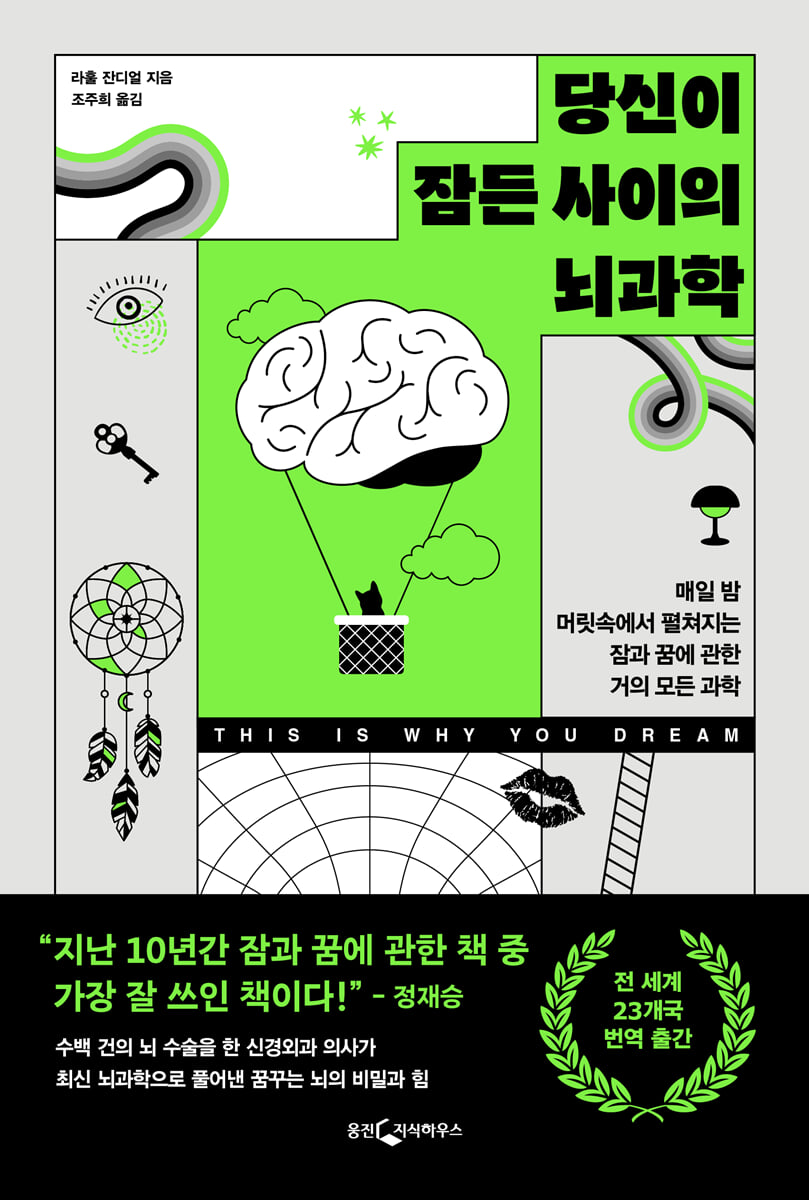
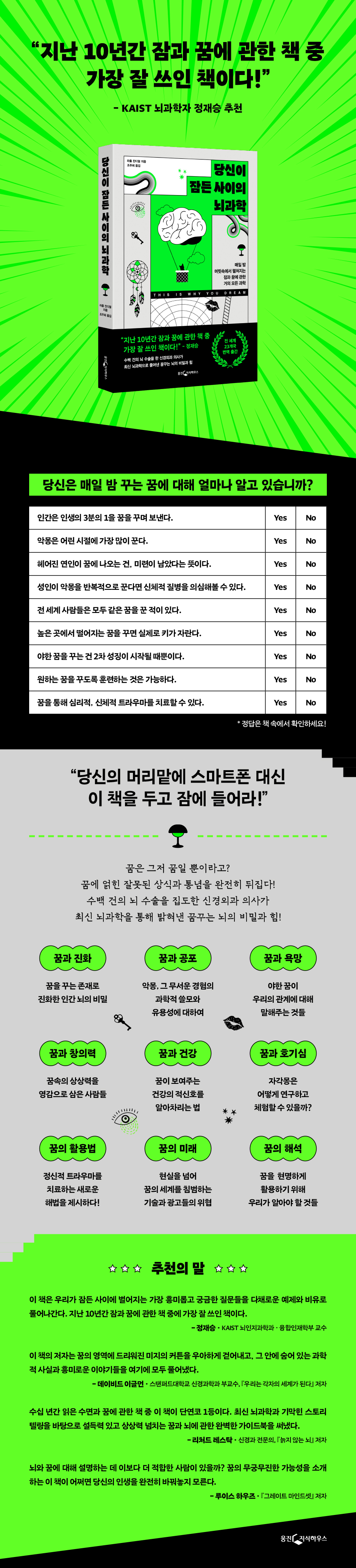
★★Highly recommended by KAIST neuroscientist Jaeseung Jeong!
★★Translated and published in 23 countries worldwide!
“Why on earth did we evolve into dreaming beings?”
A neurosurgeon who has performed hundreds of brain surgeries
The secrets and power of the dreaming brain revealed through cutting-edge brain science!
This book analyzes the unknown world of 'dreams', which has fascinated humanity for a very long time, from the perspective of brain science.
Dreams, once a highly personal realm that only the dreamer could experience, are now beginning to reveal their secrets one by one through advanced science and technology.
The author, a neurosurgeon who has performed hundreds of surgeries in an actual operating room and explored the brain, provides scientific answers to various questions such as how the human brain reacts while dreaming, where the images created in dreams come from, and what dreams are in the first place.
Furthermore, it introduces surprising facts about dreams, such as why nightmares are most common in childhood and what erotic dreams with erotic imagery mean, as well as ways to gain hints about waking life through meaningful dream interpretation.
Let's take a look at the interesting brain science story surrounding 'dreams,' one of the oldest functions in human life, yet one that has remained shrouded in mystery.
★★Translated and published in 23 countries worldwide!
“Why on earth did we evolve into dreaming beings?”
A neurosurgeon who has performed hundreds of brain surgeries
The secrets and power of the dreaming brain revealed through cutting-edge brain science!
This book analyzes the unknown world of 'dreams', which has fascinated humanity for a very long time, from the perspective of brain science.
Dreams, once a highly personal realm that only the dreamer could experience, are now beginning to reveal their secrets one by one through advanced science and technology.
The author, a neurosurgeon who has performed hundreds of surgeries in an actual operating room and explored the brain, provides scientific answers to various questions such as how the human brain reacts while dreaming, where the images created in dreams come from, and what dreams are in the first place.
Furthermore, it introduces surprising facts about dreams, such as why nightmares are most common in childhood and what erotic dreams with erotic imagery mean, as well as ways to gain hints about waking life through meaningful dream interpretation.
Let's take a look at the interesting brain science story surrounding 'dreams,' one of the oldest functions in human life, yet one that has remained shrouded in mystery.
- You can preview some of the book's contents.
Preview
index
Enter | The wondrous world that unfolds in your head every night
Chapter 1: The Evolution of Dreams | Why You Dream
What are dreams made of?
The Imagination Network That Creates Dreams: Even Dreams Have Rules
Humans explore relationships even in dreams.
Dreams reveal our waking lives. How do children's dreams develop?
Humans evolved to dream
Dreams are the counselors of the night
Dreams don't exist for just one reason.
Chapter 2: Dreams and Fear | You Need Nightmares
A nightmare is more than just a bad dream.
The time in life when you have the most nightmares
The Scientific Reasons Why You Have Nightmares
The Scientific Usefulness and Utility of Nightmares
A creepy intruder at night, the scissors trap
How to escape the fear of nightmares
How to Cure Nightmares, Lucid Dreaming
Chapter 3: Dreams and Desires | The World of Desire Unfolds in Dreams
Dirty dreams are another form of imagination.
Neurons that recognize celebrities
Why do we have dirty dreams?
The Relationship Between Brain Development and Erotic Dreams
The brain is the most powerful sexual organ
What Dirty Dreams Say About Our Relationships
Chapter 4: Dreams and Creativity | People Whose Dreams Inspired Their Imagination
How Dreams Stimulate Our Creativity
How does the brain solve problems?
The Scientific Reasons Why You Shouldn't Ignore the Clues Your Dreams Leave Behind
New ideas come to me when I take a nap.
People who got hints from dreams
Can you use what you learn in your dreams in reality?
People who turned nightmares into creativity
Designing Sleep and Dreams to Enhance Problem-Solving Abilities
How to Harness the Creativity Your Dreams Reveal
The moment you fall asleep, a new world opens up.
Chapter 5: Dreams and Health | What Dreams Say About Your Health
Dreams know what disease you will get.
Dreams know how to cope with mental pain
Practice reading relationship signals through dream conversations
Dreams that gauge depression and addiction
A dream warning of brain disease
Nightmare Disorder Symptoms That Require Treatment
The dream that makes us whole
Chapter 6: Dreams and Curiosity | Lucid Dreaming: Becoming the Protagonist of Your Dreams
What is lucid dreaming?
How do lucid dreams manifest?
Can Lucid Dreaming Be Used to Your Advantage?
New horizons in lucid dreaming
Chapter 7: How to Use Dreams | How to Lucid Dream
Can you have lucid dreams?
Various methods to induce lucid dreams
Chapter 8: The Future of Dreams | Your Dreams Are Being Manipulated
Increase the resolution of your dreams
Can dreams be manipulated?
A dream world manipulated by the five senses
The Light and Darkness of Advertising Targeting Our Dreams
How Technology Intrudes into Our Dreams
Chapter 9: Dream Interpretation | Dream Interpretation: How to Properly Understand Dreams
Why dream interpretation dictionaries are useless
Five Types of Dreams
How to interpret dreams
Various interpretations of emotional dreams
In conclusion, dreams have transcendent power.
Acknowledgements
References
Chapter 1: The Evolution of Dreams | Why You Dream
What are dreams made of?
The Imagination Network That Creates Dreams: Even Dreams Have Rules
Humans explore relationships even in dreams.
Dreams reveal our waking lives. How do children's dreams develop?
Humans evolved to dream
Dreams are the counselors of the night
Dreams don't exist for just one reason.
Chapter 2: Dreams and Fear | You Need Nightmares
A nightmare is more than just a bad dream.
The time in life when you have the most nightmares
The Scientific Reasons Why You Have Nightmares
The Scientific Usefulness and Utility of Nightmares
A creepy intruder at night, the scissors trap
How to escape the fear of nightmares
How to Cure Nightmares, Lucid Dreaming
Chapter 3: Dreams and Desires | The World of Desire Unfolds in Dreams
Dirty dreams are another form of imagination.
Neurons that recognize celebrities
Why do we have dirty dreams?
The Relationship Between Brain Development and Erotic Dreams
The brain is the most powerful sexual organ
What Dirty Dreams Say About Our Relationships
Chapter 4: Dreams and Creativity | People Whose Dreams Inspired Their Imagination
How Dreams Stimulate Our Creativity
How does the brain solve problems?
The Scientific Reasons Why You Shouldn't Ignore the Clues Your Dreams Leave Behind
New ideas come to me when I take a nap.
People who got hints from dreams
Can you use what you learn in your dreams in reality?
People who turned nightmares into creativity
Designing Sleep and Dreams to Enhance Problem-Solving Abilities
How to Harness the Creativity Your Dreams Reveal
The moment you fall asleep, a new world opens up.
Chapter 5: Dreams and Health | What Dreams Say About Your Health
Dreams know what disease you will get.
Dreams know how to cope with mental pain
Practice reading relationship signals through dream conversations
Dreams that gauge depression and addiction
A dream warning of brain disease
Nightmare Disorder Symptoms That Require Treatment
The dream that makes us whole
Chapter 6: Dreams and Curiosity | Lucid Dreaming: Becoming the Protagonist of Your Dreams
What is lucid dreaming?
How do lucid dreams manifest?
Can Lucid Dreaming Be Used to Your Advantage?
New horizons in lucid dreaming
Chapter 7: How to Use Dreams | How to Lucid Dream
Can you have lucid dreams?
Various methods to induce lucid dreams
Chapter 8: The Future of Dreams | Your Dreams Are Being Manipulated
Increase the resolution of your dreams
Can dreams be manipulated?
A dream world manipulated by the five senses
The Light and Darkness of Advertising Targeting Our Dreams
How Technology Intrudes into Our Dreams
Chapter 9: Dream Interpretation | Dream Interpretation: How to Properly Understand Dreams
Why dream interpretation dictionaries are useless
Five Types of Dreams
How to interpret dreams
Various interpretations of emotional dreams
In conclusion, dreams have transcendent power.
Acknowledgements
References
Detailed image
Into the book
When we dream, we transcend the physical body.
At some point, you don't even realize you're lying in bed anymore.
You can close your eyes but still see ahead, and your body is still but you can walk, run, drive, and even fly in your dreams.
We also talk with people we love, living and dead, and people we have never met, even though our mouths are closed.
It exists in the present, but can also travel back in time or into the future.
You can travel to places you haven't been to in a long time or places that only exist in your imagination.
We exist in a world of transcendent potential, entirely of our own making.
The wonder that unfolds every night, that is what dreams are.
--- From "The wondrous world that unfolds in your head every night"
The imagination network is central to the experience of dreaming.
This allows us to 'see' even with our eyes closed.
In fact, if you shine a bright light into the eyes of a dreamer, he or she will think it is dazzling even though his or her eyes are not open.
Dreaming like this is like watching a movie in a dark theater.
This may be why the ancient Greeks, when experiencing dreams, said they “see” dreams rather than “dream.”
When the imagination network is activated, thoughts come spontaneously.
Just as a clump of neurons in a petri dish is alive with electrical activity without any external stimulation, the dreaming brain is alive with electrical activity even when it is largely cut off from the surrounding world.
For this reason, the imagination network is sometimes compared to the brain's dark energy (a hypothetical energy thought to be distributed throughout the universe to accelerate its expansion).
In this way, the imagination network creates something from nothing and creates a story from a blank slate.
--- From "Chapter 1 Dreams and Evolution: Why You Dream"
Interestingly, nightmares unfold in predictable patterns throughout life.
First of all, children have nightmares about five times more often than adults.
Children's nightmares often involve falling, being chased, or encountering evil beings, and dreams reported by children from cultures around the world show that monsters, demons, and supernatural beings appear in their dreams.
How can children who grow up with love and care come up with scary monsters?
--- From "Chapter 2 Dreams and Fear: You Need Nightmares"
Whether it's about kissing or something more, erotic dreams are not easily forgotten.
Sensual dreams can make us feel excited, cause us to feel intense jealousy, or in some cases, make us feel anxious.
But what does it mean if your ex appears in your sexual dreams? What if your partner has erotic dreams about someone else? Should you be concerned about your or your partner's erotic dreams? Do these dreams reveal something about our true desires?
--- From "Chapter 3 Dreams and Desires: The World of Desire Unfolding in Dreams"
In the past, when half of our tribe died or was wiped out by disease, erotic dreams may have prepared our ancestors to forge new relationships within their tribe.
This also explains why the characters or images that appear in erotic dreams are not external people, but people from one's surroundings.
Most of the people who appear in these dreams are familiar, but the way we treat them in dreams is often something we would never think of in real life.
Such a dirty dream is more than just a true desire; it is the embodiment of desire itself.
Erotic dreams broaden the scope of sexual impulses, stimulating humans to become more attracted to more things and to explore a wider range of sexual experiences.
This is understandable, given that it is the instinct of all living things to survive at least long enough to reproduce.
--- From "Chapter 3 Dreams and Desires: The World of Desire Unfolding in Dreams"
Even if we don't remember our dreams, they can influence our thoughts when we're awake.
Sometimes, a brilliant idea, a solution to a problem or insight suddenly comes to us, and the source of this inspiration may be a dream, even if we don't remember it.
Every night while we sleep, our dreams do some creative work for us.
--- From "Chapter 4 Dreams and Creativity: People Who Were Inspired by the Imagination Gained from Dreams"
Interestingly, researchers found that people who coped well with their emotions after divorce were more likely to remember their dreams.
Remembering dreams can enhance the potential therapeutic value of dreams by allowing you to think about them during the day.
The study participants were struggling to cope with divorce, an emotionally challenging event they had never experienced before.
It may have been cathartic for them to recall their indifference to their ex-spouse in the dream.
--- From "Chapter 5 Dreams and Health: What Dreams Tell You About Your Health"
Since meeting that patient nearly 25 years ago, I have dedicated my life to caring for and studying the human brain and mind from a variety of scientific perspectives across multiple disciplines.
The more I learned, the more I was filled with awe and wonder at the mysteries of the brain and mind.
Among them, the ability to wake up from a dream and control the dream feels more like magic than science.
Although it has been discussed for thousands of years, only in the last decade has it been scientifically investigated and proven that the brain can actually dream while simultaneously remaining partially awake.
This is a story about 'lucid dreaming'.
--- From "Chapter 5 Dreams and Health: What Dreams Tell You About Your Health"
The scientific community has come a long way in its attempts to understand lucid dreaming in a short period of time.
Lucid dreaming, long relegated to the realm of mystics and eccentrics, is now being embraced as a new form of consciousness worthy of serious study.
As skepticism about lucid dreaming gives way to excitement, ingenious experiments are being conducted to find new ways to interact with the dreaming mind, and in the process, new aspects of dreaming and lucid dreaming are being revealed.
Moreover, lucid dreaming is no longer something that can only be achieved in sleep research labs; it has become something close enough to everyone's reach.
--- From "Chapter 6 Dreams and Curiosity, Lucid Dreams, Becoming the Protagonist of Your Dreams"
Lucid dreams are generally considered a special and positive experience, providing opportunities for practice and improvement in creativity, problem solving, and even skills needed for everyday life.
People say that when they have a lucid dream, they feel good when they wake up and feel refreshed the next morning.
However, it is important to keep in mind that most lucid dreaming techniques involve forced awakening or interruption of sleep.
Caution is advised when inducing lucid dreams through wake-up and re-sleep techniques or similar techniques, as this can fragment sleep and ultimately disrupt sleep cycles.
Additionally, if a lucid dreamer is not careful, their total sleep time may be reduced.
But at the same time, lucid dreaming can take you to a very unique state of consciousness, a surreal intersection between dreaming and waking.
--- From "Chapter 7 How to Use Dreams and How to Have Lucid Dreams"
Thirty-eight researchers from around the world have signed an open letter to the Molson Coors ad, opposing what they see as turning dreams into another playground for corporate advertisers and supporting legislation that would ban advertisers from targeting sleeping people.
They then asked the following question:
“If we all developed a collective tolerance for privacy invasions and exploitative economic practices, and we were willing to accept a dozen cans of beer in exchange for placing beer ads in our dreams, what would we lose?”
--- From "Chapter 8: The Future of Dreams: Your Dreams Are Being Manipulated"
Thinking about the meaning of dreams requires reflection and self-awareness.
Dreams lead us to look deeper into ourselves and see what they are telling us.
Taking the time to examine the meaning of our dreams can increase our awareness and acceptance of our own emotions, provide valuable insights into our lives, and lead to greater happiness.
At some point, you don't even realize you're lying in bed anymore.
You can close your eyes but still see ahead, and your body is still but you can walk, run, drive, and even fly in your dreams.
We also talk with people we love, living and dead, and people we have never met, even though our mouths are closed.
It exists in the present, but can also travel back in time or into the future.
You can travel to places you haven't been to in a long time or places that only exist in your imagination.
We exist in a world of transcendent potential, entirely of our own making.
The wonder that unfolds every night, that is what dreams are.
--- From "The wondrous world that unfolds in your head every night"
The imagination network is central to the experience of dreaming.
This allows us to 'see' even with our eyes closed.
In fact, if you shine a bright light into the eyes of a dreamer, he or she will think it is dazzling even though his or her eyes are not open.
Dreaming like this is like watching a movie in a dark theater.
This may be why the ancient Greeks, when experiencing dreams, said they “see” dreams rather than “dream.”
When the imagination network is activated, thoughts come spontaneously.
Just as a clump of neurons in a petri dish is alive with electrical activity without any external stimulation, the dreaming brain is alive with electrical activity even when it is largely cut off from the surrounding world.
For this reason, the imagination network is sometimes compared to the brain's dark energy (a hypothetical energy thought to be distributed throughout the universe to accelerate its expansion).
In this way, the imagination network creates something from nothing and creates a story from a blank slate.
--- From "Chapter 1 Dreams and Evolution: Why You Dream"
Interestingly, nightmares unfold in predictable patterns throughout life.
First of all, children have nightmares about five times more often than adults.
Children's nightmares often involve falling, being chased, or encountering evil beings, and dreams reported by children from cultures around the world show that monsters, demons, and supernatural beings appear in their dreams.
How can children who grow up with love and care come up with scary monsters?
--- From "Chapter 2 Dreams and Fear: You Need Nightmares"
Whether it's about kissing or something more, erotic dreams are not easily forgotten.
Sensual dreams can make us feel excited, cause us to feel intense jealousy, or in some cases, make us feel anxious.
But what does it mean if your ex appears in your sexual dreams? What if your partner has erotic dreams about someone else? Should you be concerned about your or your partner's erotic dreams? Do these dreams reveal something about our true desires?
--- From "Chapter 3 Dreams and Desires: The World of Desire Unfolding in Dreams"
In the past, when half of our tribe died or was wiped out by disease, erotic dreams may have prepared our ancestors to forge new relationships within their tribe.
This also explains why the characters or images that appear in erotic dreams are not external people, but people from one's surroundings.
Most of the people who appear in these dreams are familiar, but the way we treat them in dreams is often something we would never think of in real life.
Such a dirty dream is more than just a true desire; it is the embodiment of desire itself.
Erotic dreams broaden the scope of sexual impulses, stimulating humans to become more attracted to more things and to explore a wider range of sexual experiences.
This is understandable, given that it is the instinct of all living things to survive at least long enough to reproduce.
--- From "Chapter 3 Dreams and Desires: The World of Desire Unfolding in Dreams"
Even if we don't remember our dreams, they can influence our thoughts when we're awake.
Sometimes, a brilliant idea, a solution to a problem or insight suddenly comes to us, and the source of this inspiration may be a dream, even if we don't remember it.
Every night while we sleep, our dreams do some creative work for us.
--- From "Chapter 4 Dreams and Creativity: People Who Were Inspired by the Imagination Gained from Dreams"
Interestingly, researchers found that people who coped well with their emotions after divorce were more likely to remember their dreams.
Remembering dreams can enhance the potential therapeutic value of dreams by allowing you to think about them during the day.
The study participants were struggling to cope with divorce, an emotionally challenging event they had never experienced before.
It may have been cathartic for them to recall their indifference to their ex-spouse in the dream.
--- From "Chapter 5 Dreams and Health: What Dreams Tell You About Your Health"
Since meeting that patient nearly 25 years ago, I have dedicated my life to caring for and studying the human brain and mind from a variety of scientific perspectives across multiple disciplines.
The more I learned, the more I was filled with awe and wonder at the mysteries of the brain and mind.
Among them, the ability to wake up from a dream and control the dream feels more like magic than science.
Although it has been discussed for thousands of years, only in the last decade has it been scientifically investigated and proven that the brain can actually dream while simultaneously remaining partially awake.
This is a story about 'lucid dreaming'.
--- From "Chapter 5 Dreams and Health: What Dreams Tell You About Your Health"
The scientific community has come a long way in its attempts to understand lucid dreaming in a short period of time.
Lucid dreaming, long relegated to the realm of mystics and eccentrics, is now being embraced as a new form of consciousness worthy of serious study.
As skepticism about lucid dreaming gives way to excitement, ingenious experiments are being conducted to find new ways to interact with the dreaming mind, and in the process, new aspects of dreaming and lucid dreaming are being revealed.
Moreover, lucid dreaming is no longer something that can only be achieved in sleep research labs; it has become something close enough to everyone's reach.
--- From "Chapter 6 Dreams and Curiosity, Lucid Dreams, Becoming the Protagonist of Your Dreams"
Lucid dreams are generally considered a special and positive experience, providing opportunities for practice and improvement in creativity, problem solving, and even skills needed for everyday life.
People say that when they have a lucid dream, they feel good when they wake up and feel refreshed the next morning.
However, it is important to keep in mind that most lucid dreaming techniques involve forced awakening or interruption of sleep.
Caution is advised when inducing lucid dreams through wake-up and re-sleep techniques or similar techniques, as this can fragment sleep and ultimately disrupt sleep cycles.
Additionally, if a lucid dreamer is not careful, their total sleep time may be reduced.
But at the same time, lucid dreaming can take you to a very unique state of consciousness, a surreal intersection between dreaming and waking.
--- From "Chapter 7 How to Use Dreams and How to Have Lucid Dreams"
Thirty-eight researchers from around the world have signed an open letter to the Molson Coors ad, opposing what they see as turning dreams into another playground for corporate advertisers and supporting legislation that would ban advertisers from targeting sleeping people.
They then asked the following question:
“If we all developed a collective tolerance for privacy invasions and exploitative economic practices, and we were willing to accept a dozen cans of beer in exchange for placing beer ads in our dreams, what would we lose?”
--- From "Chapter 8: The Future of Dreams: Your Dreams Are Being Manipulated"
Thinking about the meaning of dreams requires reflection and self-awareness.
Dreams lead us to look deeper into ourselves and see what they are telling us.
Taking the time to examine the meaning of our dreams can increase our awareness and acceptance of our own emotions, provide valuable insights into our lives, and lead to greater happiness.
--- From "Chapter 9 Interpretation of Dreams: Interpreting Dreams Rather Than Dreams, How to Properly Understand Dreams"
Publisher's Review
“This is the best book on sleep and dreams written in the last decade.”
- Neuroscientist Jaeseung Jeong
“The dreaming brain is smarter, stronger, and more creative!”
Why humans dream and what it does
About the amazing potential hidden within it
‘Oh, I just had a really nice dream… What was it about?’ Every night, a natural yet somehow strange world unfolds in our heads.
Become a hero and fly through the sky, fall endlessly off cliffs, and escape ruined cities.
Why do humans dream, even if they don't remember it when they wake up? This book offers a fascinating analysis of "dreams," a mysterious world that has long fascinated humanity, from the perspective of neuroscience.
The author, a neurosurgeon and neuroscientist, began researching the dreaming brain after witnessing patients dream or hear auditory hallucinations when an electric current was passed through a certain part of the brain through a brain arousal surgery.
And finally, by unpacking years of research into this one book, we get one step closer to the endless possibilities surrounding the 'brain and dreams' that psychoanalysis has so far failed to explain.
This is why Professor Jaeseung Jeong recommended this book, saying, “It is the best-written book on sleep and dreams in the past 10 years.”
Humans spend one third of their lives dreaming.
Even people who say they don't dream actually do.
Because dreams are something that happens not with the human will but with the brain.
Dreams open the floodgates of creativity through transcendent imagination, help us cope with psychological stress through worst-case scenarios, and signal impending physical and mental danger.
In this way, dreams are a mental function that is essential for humans.
That is why the author says that humans evolved to dream, and even evolved to dream.
Dreams have meaning, and I believe we evolved to dream.
Evolution maintains traits that are advantageous for survival.
Therefore, traits that do not have a clear advantage, such as traits that use too much energy or are easily exposed to predators, tend to disappear during the process of evolution.
In fact, dreams are both of these.
This is because while we dream, we expend a lot of energy and become vulnerable to external attacks.
- From the text
In this book, the author also talks about another aspect of dreams that we have overlooked.
Even dreams that seem inconsistent and surreal have rules and limits.
Dreams are never random or infinite.
Dreams create rules in their own unique way.
The author argues that the unfolding of dreams follows the human "map of meaning," which is a bundle of people, things, and places that make up the world, and which is influenced by culture.
Because of this, people all over the world experience similar dreams, such as failing an exam or being embarrassed in public.
Based on the fact that the most common dreams of Japanese and American students in the 1950s were almost identical to the most common dreams of Chinese and German students 50 years later, the research reveals an interesting relationship that dreams, uncontrolled by humans, do not deviate from the map of meaning formed under modern industrial society.
The dreams of people living in indigenous cultures are mostly similar in content, which shows that although dreams may seem magical, they have the boundary of being part of everyday human experience.
It covers surprising facts about dreams, such as why nightmares are most common in childhood and what erotic dreams with erotic imagery mean, as well as how to gain hints for your waking life through meaningful dream interpretation.
The great discoveries of chemistry were made in dreams.
Stephen King's masterpieces were born from his nightmares.
Surrealist painter Dali always found inspiration in his dreams!
A world of infinite imagination created by the dreaming brain
So where does the dreaming brain's imagination originate? While awake, the brain constantly activates its "executive network," responsible for "sense of reality," such as perceiving time and space, enabling rational judgment.
But the moment you fall asleep, this performance network switches off, and the 'imagination network' switches on.
The dream scenario is written by this 'imagination network'.
The random thoughts generated by the imagination network soon come together to form a dream.
Despite the numerous benefits of dreams, people often ignore the outrageous stories this imaginative network creates.
There are many cases where people believe the misconception that dreams are something you only have when you can't get enough sleep, or that dreams are just dreams and not a big deal.
However, there are also people who have paid attention to this world of infinite imagination, 'dreams', and used that experience as inspiration.
These people have made great discoveries through dreams, and have also achieved great feats, such as creating things that did not exist in the world before.
Kekule, considered one of the greatest chemists in history, got a hint about the chemical structure of benzene from a dream, and the world-famous bestselling author Stephen King's chilling imagination also began with a dream.
It is also said that surrealist painter Salvador Dali was inspired by the images that came to his mind when he fell asleep.
This is an example that shows that dreams can serve as a material to expand the scope of human imagination and creativity beyond reality.
This book details how to use the creativity of dreams to solve real-world problems and gain hints by remembering and recording those dream moments.
A book you should keep by your bedside instead of your smartphone!
Why we need to remember the dreams that fade from our memories every night
“Dreams know things about me I didn’t know about myself.”
The author, known as a world-renowned brain nerd, suggests remembering the dreams your brain shows you every night.
Because dreams constantly give hints to our waking, real lives.
A man in his 50s with REM sleep behavior disorder, which causes the body to not become paralyzed during sleep, developed synucleinopathy, which includes Parkinson's disease and Lewy body dementia, with a 100 percent chance of developing the condition.
Even among adults with REM sleep behavior disorder without a clear cause, 97 percent developed Parkinson's disease or Lewy body dementia within 14 years of diagnosis.
What if they could quickly recognize these signals in their usual dream-like sleep patterns? They could initiate treatment quickly, delaying the onset of symptoms and reaping numerous benefits.
Other examples include healing psychological trauma through dreams and stopping recurring nightmares.
The author uses various examples to illustrate how dreams are both a mirror reflecting the problems of reality and a solution to solve them.
How is it?
This is why we must remember our dreams.
If we follow the infinite possibilities and signals of dreams introduced in this book, perhaps our lives will change little by little by getting hints from our dreams.
The secret to making that limitless potential yours is in this book.
The moment we dream, we transcend the physical body.
You can close your eyes but still see ahead, and your body is still but you can walk, run, drive, and even fly in your dreams.
We also talk with people we love, living and dead, and people we have never met, even though our mouths are closed.
It exists in the present, but can also travel back in time or into the future.
You can travel to places you haven't been to in a long time or places that only exist in your imagination.
We exist in a world of transcendent potential, entirely of our own making.
The wonder that unfolds every night, that is what dreams are.
- From the text
- Neuroscientist Jaeseung Jeong
“The dreaming brain is smarter, stronger, and more creative!”
Why humans dream and what it does
About the amazing potential hidden within it
‘Oh, I just had a really nice dream… What was it about?’ Every night, a natural yet somehow strange world unfolds in our heads.
Become a hero and fly through the sky, fall endlessly off cliffs, and escape ruined cities.
Why do humans dream, even if they don't remember it when they wake up? This book offers a fascinating analysis of "dreams," a mysterious world that has long fascinated humanity, from the perspective of neuroscience.
The author, a neurosurgeon and neuroscientist, began researching the dreaming brain after witnessing patients dream or hear auditory hallucinations when an electric current was passed through a certain part of the brain through a brain arousal surgery.
And finally, by unpacking years of research into this one book, we get one step closer to the endless possibilities surrounding the 'brain and dreams' that psychoanalysis has so far failed to explain.
This is why Professor Jaeseung Jeong recommended this book, saying, “It is the best-written book on sleep and dreams in the past 10 years.”
Humans spend one third of their lives dreaming.
Even people who say they don't dream actually do.
Because dreams are something that happens not with the human will but with the brain.
Dreams open the floodgates of creativity through transcendent imagination, help us cope with psychological stress through worst-case scenarios, and signal impending physical and mental danger.
In this way, dreams are a mental function that is essential for humans.
That is why the author says that humans evolved to dream, and even evolved to dream.
Dreams have meaning, and I believe we evolved to dream.
Evolution maintains traits that are advantageous for survival.
Therefore, traits that do not have a clear advantage, such as traits that use too much energy or are easily exposed to predators, tend to disappear during the process of evolution.
In fact, dreams are both of these.
This is because while we dream, we expend a lot of energy and become vulnerable to external attacks.
- From the text
In this book, the author also talks about another aspect of dreams that we have overlooked.
Even dreams that seem inconsistent and surreal have rules and limits.
Dreams are never random or infinite.
Dreams create rules in their own unique way.
The author argues that the unfolding of dreams follows the human "map of meaning," which is a bundle of people, things, and places that make up the world, and which is influenced by culture.
Because of this, people all over the world experience similar dreams, such as failing an exam or being embarrassed in public.
Based on the fact that the most common dreams of Japanese and American students in the 1950s were almost identical to the most common dreams of Chinese and German students 50 years later, the research reveals an interesting relationship that dreams, uncontrolled by humans, do not deviate from the map of meaning formed under modern industrial society.
The dreams of people living in indigenous cultures are mostly similar in content, which shows that although dreams may seem magical, they have the boundary of being part of everyday human experience.
It covers surprising facts about dreams, such as why nightmares are most common in childhood and what erotic dreams with erotic imagery mean, as well as how to gain hints for your waking life through meaningful dream interpretation.
The great discoveries of chemistry were made in dreams.
Stephen King's masterpieces were born from his nightmares.
Surrealist painter Dali always found inspiration in his dreams!
A world of infinite imagination created by the dreaming brain
So where does the dreaming brain's imagination originate? While awake, the brain constantly activates its "executive network," responsible for "sense of reality," such as perceiving time and space, enabling rational judgment.
But the moment you fall asleep, this performance network switches off, and the 'imagination network' switches on.
The dream scenario is written by this 'imagination network'.
The random thoughts generated by the imagination network soon come together to form a dream.
Despite the numerous benefits of dreams, people often ignore the outrageous stories this imaginative network creates.
There are many cases where people believe the misconception that dreams are something you only have when you can't get enough sleep, or that dreams are just dreams and not a big deal.
However, there are also people who have paid attention to this world of infinite imagination, 'dreams', and used that experience as inspiration.
These people have made great discoveries through dreams, and have also achieved great feats, such as creating things that did not exist in the world before.
Kekule, considered one of the greatest chemists in history, got a hint about the chemical structure of benzene from a dream, and the world-famous bestselling author Stephen King's chilling imagination also began with a dream.
It is also said that surrealist painter Salvador Dali was inspired by the images that came to his mind when he fell asleep.
This is an example that shows that dreams can serve as a material to expand the scope of human imagination and creativity beyond reality.
This book details how to use the creativity of dreams to solve real-world problems and gain hints by remembering and recording those dream moments.
A book you should keep by your bedside instead of your smartphone!
Why we need to remember the dreams that fade from our memories every night
“Dreams know things about me I didn’t know about myself.”
The author, known as a world-renowned brain nerd, suggests remembering the dreams your brain shows you every night.
Because dreams constantly give hints to our waking, real lives.
A man in his 50s with REM sleep behavior disorder, which causes the body to not become paralyzed during sleep, developed synucleinopathy, which includes Parkinson's disease and Lewy body dementia, with a 100 percent chance of developing the condition.
Even among adults with REM sleep behavior disorder without a clear cause, 97 percent developed Parkinson's disease or Lewy body dementia within 14 years of diagnosis.
What if they could quickly recognize these signals in their usual dream-like sleep patterns? They could initiate treatment quickly, delaying the onset of symptoms and reaping numerous benefits.
Other examples include healing psychological trauma through dreams and stopping recurring nightmares.
The author uses various examples to illustrate how dreams are both a mirror reflecting the problems of reality and a solution to solve them.
How is it?
This is why we must remember our dreams.
If we follow the infinite possibilities and signals of dreams introduced in this book, perhaps our lives will change little by little by getting hints from our dreams.
The secret to making that limitless potential yours is in this book.
The moment we dream, we transcend the physical body.
You can close your eyes but still see ahead, and your body is still but you can walk, run, drive, and even fly in your dreams.
We also talk with people we love, living and dead, and people we have never met, even though our mouths are closed.
It exists in the present, but can also travel back in time or into the future.
You can travel to places you haven't been to in a long time or places that only exist in your imagination.
We exist in a world of transcendent potential, entirely of our own making.
The wonder that unfolds every night, that is what dreams are.
- From the text
GOODS SPECIFICS
- Date of issue: June 26, 2024
- Page count, weight, size: 296 pages | 496g | 145*210*17mm
- ISBN13: 9788901285115
- ISBN10: 8901285118
You may also like
카테고리
korean


korean

![GQ KOREA Mark (Monthly): December [2025]](http://librairie.coreenne.fr/cdn/shop/files/8ef265dbbfbf186523ed75ba7319009d.jpg?v=1765340328&width=3840)


