

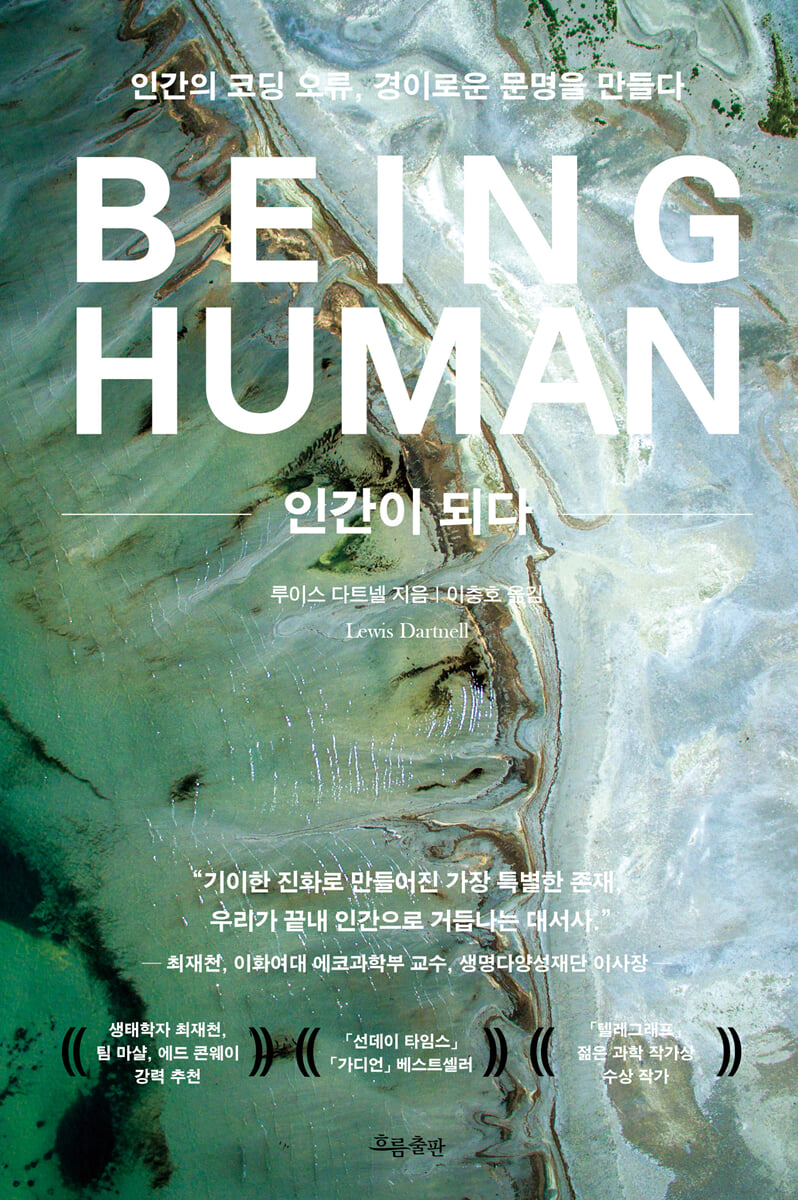
Become human
 |
Description
Book Introduction
- A word from MD
-
A history of civilization created by chance and failureWhat is the secret to humans becoming apex predators? This book focuses on chance and failure.
It reveals how inefficient reproduction, vulnerability to infectious diseases, and DNA defects have shaped the history of civilization.
If I had to pick just three books to understand humans, they would be Guns, Germs, and Steel, Sapiens, and Becoming Human.
July 16, 2024. Natural Science PD Son Min-gyu
Humans are both a wondrous evolution and a sum of colossal flaws.
created by the human body
An epic of society, history, and civilization
“Dartnell did it again.
A book full of amazing, clear, and profound teachings.
“It’s literally ‘amazing.’”
- Ed Conway, journalist and author of The Material World
“An intellectual journey exploring history through the human body.
amazing!"
- Tim Marshall, journalist and author of The Power of Geography
“A book full of facts without errors.”
- The Sunday Times
We are a wonderful product of evolution.
Powerful and resourceful, instinctive yet thoughtful, we are innovators who invent tools and technologies, and as communication experts, we collaborate with strangers to build communities and societies.
We created the civilization we have today.
But we also have a big flaw.
Whether we are kings or peasants, our bodies break, suffocate, and crumble.
Disease hinders our bold plans.
Because of psychological biases deeply ingrained in our cognitive software, we make terrible decisions in everyday life and in war.
This astonishing contradiction is the essence of human existence, a sum total of weakness and power.
And history unfolded in the balance between these two.
Louis Dartnell, a professor of science communication at the University of Westminster in the UK and bestselling author who has met Korean readers with 『Origins』 and 『The Minimum Science Knowledge Sapiens Needs』, tells the story of humans for the first time through the lens of this unique, capricious, and fragile human nature in 『Becoming Human』, the final book in his "Human Trilogy."
It explores how human biology has shaped and shaped human relationships, society, economics, and war, and how it continues to challenge and define human progress.
In this book, which has been praised as “the best interdisciplinary history” and “a book filled with accurate facts,” the author insightfully weaves together solid scientific evidence and historical facts to present a concise, yet broad and profound look at the grand scope of history and the meaning of human existence within it.
created by the human body
An epic of society, history, and civilization
“Dartnell did it again.
A book full of amazing, clear, and profound teachings.
“It’s literally ‘amazing.’”
- Ed Conway, journalist and author of The Material World
“An intellectual journey exploring history through the human body.
amazing!"
- Tim Marshall, journalist and author of The Power of Geography
“A book full of facts without errors.”
- The Sunday Times
We are a wonderful product of evolution.
Powerful and resourceful, instinctive yet thoughtful, we are innovators who invent tools and technologies, and as communication experts, we collaborate with strangers to build communities and societies.
We created the civilization we have today.
But we also have a big flaw.
Whether we are kings or peasants, our bodies break, suffocate, and crumble.
Disease hinders our bold plans.
Because of psychological biases deeply ingrained in our cognitive software, we make terrible decisions in everyday life and in war.
This astonishing contradiction is the essence of human existence, a sum total of weakness and power.
And history unfolded in the balance between these two.
Louis Dartnell, a professor of science communication at the University of Westminster in the UK and bestselling author who has met Korean readers with 『Origins』 and 『The Minimum Science Knowledge Sapiens Needs』, tells the story of humans for the first time through the lens of this unique, capricious, and fragile human nature in 『Becoming Human』, the final book in his "Human Trilogy."
It explores how human biology has shaped and shaped human relationships, society, economics, and war, and how it continues to challenge and define human progress.
In this book, which has been praised as “the best interdisciplinary history” and “a book filled with accurate facts,” the author insightfully weaves together solid scientific evidence and historical facts to present a concise, yet broad and profound look at the grand scope of history and the meaning of human existence within it.
- You can preview some of the book's contents.
Preview
index
preface
Chapter 1: Software for Civilization
Chapter 2 _ Family
Chapter 3: Infectious Diseases
Chapter 4 _ Epidemics
Chapter 5 _ Population
Chapter 6: The Substance That Changes the Mind
Chapter 7 - Coding Errors
Chapter 8: Cognitive Biases
Concluding remarks
Source of the illustration
annotation
References
Acknowledgements
Chapter 1: Software for Civilization
Chapter 2 _ Family
Chapter 3: Infectious Diseases
Chapter 4 _ Epidemics
Chapter 5 _ Population
Chapter 6: The Substance That Changes the Mind
Chapter 7 - Coding Errors
Chapter 8: Cognitive Biases
Concluding remarks
Source of the illustration
annotation
References
Acknowledgements
Detailed image
.jpg)
Into the book
“Evolution is constrained by the fact that it must somehow make do with what it already has when trying to find answers to new conditions and survival problems.
There is no opportunity to go back to the drawing board and redesign from scratch.
Throughout evolutionary history, we have continually added new adaptations by modifying or overlaying what came before, like a palimpsest.
For example, our spines are poorly designed to support our large heads while maintaining an upright posture, but we have to make do with the spines we inherited from our four-legged ancestors.
Human existence is the result of all our abilities and limitations combined.
That is, both our flaws and our abilities have contributed to making us who we are today.
And the history of mankind has progressed in balance between the two.”
--- From the "Preface"
“But it takes a certain amount of cognitive load to keep a mental ledger of who has and has not exchanged favors, and humans have found a solution in the course of evolution.
After a certain amount of repeated exchanges with the same individual, we become less vigilant about our exchanges.
In other words, we come to trust each other, and our relationship develops into a deeper bond, which is friendship.
Friends become trusted allies and collaborators in other social interactions as well, and we stop keeping a constant mental account of their actions, no longer overtly expecting or demanding that they repay us for the specific favors we have done.
“A bond is a guarantee of reciprocity and an investment in the future.”
--- From "Software for Civilization"
“The concept of indirect reciprocity argues that instead of repaying a favor directly to the person who did it, the beneficiary reciprocates it to someone else.
…for this system to function properly, it requires two important features that other animals do not have.
First, not only must there be witnesses who witness the interaction between the parties and who acted generously or selfishly, but information about the parties' behavior must be shared in a common information pool for the entire group.
In other words, community members should gossip about others.
…gossip is a key prerequisite for ensuring that indirect reciprocity is not undermined by free riders, and it is ubiquitous in human culture, from around the campfire to beside the water cooler.”
--- From "Software for Civilization"
“This epidemic, which first broke out in Ethiopia in 249 AD, spread across North Africa and throughout the Roman Empire and northern Europe, and recurred several times over the next two decades.
…the lethality of this plague and the existential crisis it wrought caused many Romans to lose faith in their traditional polytheism, whose pantheon was populated by eccentric and cunning gods.
At the time, Christianity was a rather radical and little-known new religion, but it differed significantly from traditional religions in that it preached tolerance, community-oriented practices, and caring for the sick as a righteous duty.
…even though the Roman authorities continued to persecute Christians, Christianity began to spread rapidly throughout the empire.”
Eastern Europe was the last to be hit by the Black Death in 1350–1351, and for reasons unclear, the death rate was only half that of the rest of continental Europe.
So while Eastern Europe escaped the worst direct effects of mass mortality, it followed a different path from the rest of Europe after the Black Death.
In Eastern Europe, feudalism only took hold after the Black Death, which may in fact have contributed to the 'second serfdom' and the long-term deterioration of living conditions for peasants.
The population decline in Western Europe due to the Black Death also reduced migration to the less densely populated east.
Historians have argued that this led the noble lords of Central and Eastern Europe to strengthen their control over the population and subjugate the peasants to their estates.
In many parts of the region, serfdom persisted until the early 19th century, and in Russia until the 1860s.”
--- From "Epidemic"
“Just then, John Rolfe, one of the men who had been shipwrecked in Bermuda before coming to Jamestown, got his hands on a potential cash crop.
… Rolfe obtained Nicotiana tabacum seeds from Trinidad and spent several years trying to cultivate them in Virginia's soil and climate, and … even married Pocahontas, the teenage daughter of a Powhatan chief, to secure a trade agreement with the natives.
…tobacco continued to sustain and fuel the growth of the British colonies of Virginia and Bermuda throughout the 17th and 18th centuries, until sugar, coffee, and cotton provided additional economic bases.
“It was tobacco and its addictive properties that revived and succeeded Jamestown, which teetered on the brink of complete failure and abandonment (and helped establish the English language, culture, law, and other institutions in what would later become the world’s greatest power).”
--- From "The Substance That Changes the Mind"
“Human history has unfolded as a vacillation between our functions and our flaws as a species.
But we are not helpless slaves to our innate biological conditioning.
“Humanity’s technological progress is a story of our efforts to enhance and expand our natural abilities, and to compensate for or overcome our many biological weaknesses.”
There is no opportunity to go back to the drawing board and redesign from scratch.
Throughout evolutionary history, we have continually added new adaptations by modifying or overlaying what came before, like a palimpsest.
For example, our spines are poorly designed to support our large heads while maintaining an upright posture, but we have to make do with the spines we inherited from our four-legged ancestors.
Human existence is the result of all our abilities and limitations combined.
That is, both our flaws and our abilities have contributed to making us who we are today.
And the history of mankind has progressed in balance between the two.”
--- From the "Preface"
“But it takes a certain amount of cognitive load to keep a mental ledger of who has and has not exchanged favors, and humans have found a solution in the course of evolution.
After a certain amount of repeated exchanges with the same individual, we become less vigilant about our exchanges.
In other words, we come to trust each other, and our relationship develops into a deeper bond, which is friendship.
Friends become trusted allies and collaborators in other social interactions as well, and we stop keeping a constant mental account of their actions, no longer overtly expecting or demanding that they repay us for the specific favors we have done.
“A bond is a guarantee of reciprocity and an investment in the future.”
--- From "Software for Civilization"
“The concept of indirect reciprocity argues that instead of repaying a favor directly to the person who did it, the beneficiary reciprocates it to someone else.
…for this system to function properly, it requires two important features that other animals do not have.
First, not only must there be witnesses who witness the interaction between the parties and who acted generously or selfishly, but information about the parties' behavior must be shared in a common information pool for the entire group.
In other words, community members should gossip about others.
…gossip is a key prerequisite for ensuring that indirect reciprocity is not undermined by free riders, and it is ubiquitous in human culture, from around the campfire to beside the water cooler.”
--- From "Software for Civilization"
“This epidemic, which first broke out in Ethiopia in 249 AD, spread across North Africa and throughout the Roman Empire and northern Europe, and recurred several times over the next two decades.
…the lethality of this plague and the existential crisis it wrought caused many Romans to lose faith in their traditional polytheism, whose pantheon was populated by eccentric and cunning gods.
At the time, Christianity was a rather radical and little-known new religion, but it differed significantly from traditional religions in that it preached tolerance, community-oriented practices, and caring for the sick as a righteous duty.
…even though the Roman authorities continued to persecute Christians, Christianity began to spread rapidly throughout the empire.”
Eastern Europe was the last to be hit by the Black Death in 1350–1351, and for reasons unclear, the death rate was only half that of the rest of continental Europe.
So while Eastern Europe escaped the worst direct effects of mass mortality, it followed a different path from the rest of Europe after the Black Death.
In Eastern Europe, feudalism only took hold after the Black Death, which may in fact have contributed to the 'second serfdom' and the long-term deterioration of living conditions for peasants.
The population decline in Western Europe due to the Black Death also reduced migration to the less densely populated east.
Historians have argued that this led the noble lords of Central and Eastern Europe to strengthen their control over the population and subjugate the peasants to their estates.
In many parts of the region, serfdom persisted until the early 19th century, and in Russia until the 1860s.”
--- From "Epidemic"
“Just then, John Rolfe, one of the men who had been shipwrecked in Bermuda before coming to Jamestown, got his hands on a potential cash crop.
… Rolfe obtained Nicotiana tabacum seeds from Trinidad and spent several years trying to cultivate them in Virginia's soil and climate, and … even married Pocahontas, the teenage daughter of a Powhatan chief, to secure a trade agreement with the natives.
…tobacco continued to sustain and fuel the growth of the British colonies of Virginia and Bermuda throughout the 17th and 18th centuries, until sugar, coffee, and cotton provided additional economic bases.
“It was tobacco and its addictive properties that revived and succeeded Jamestown, which teetered on the brink of complete failure and abandonment (and helped establish the English language, culture, law, and other institutions in what would later become the world’s greatest power).”
--- From "The Substance That Changes the Mind"
“Human history has unfolded as a vacillation between our functions and our flaws as a species.
But we are not helpless slaves to our innate biological conditioning.
“Humanity’s technological progress is a story of our efforts to enhance and expand our natural abilities, and to compensate for or overcome our many biological weaknesses.”
--- From "Concluding Remarks"
Publisher's Review
Guardian and Sunday Times bestselling author,
Genius scientist Lewis Dartnell tells us
The flawed evolution of humans,
And all of history and civilization created by flaws
We have become the most widely distributed terrestrial animals on Earth, migrating in all directions from Africa, the cradle of evolution.
About 10,000 years ago, we learned to domesticate wild plants and animals, invented agriculture, and as a result, developed increasingly complex social organizations: cities, civilizations, and empires.
We have gone through a tremendous period of growth and stagnation, progress and decline, cooperation and conflict, slavery and liberation, trade and plunder, invasion and revolution, plague and war.
Amid all this commotion and passion, one thing has remained constant.
It is we ourselves, fragile yet capable.
Books to read before 『Sapiens』 and 『Guns, Germs, and Steel』
A comprehensive guide to civilization, history, and ourselves.
In his first book, The Knowledge, he asked, "How did knowledge create civilization?" and in his second book, Origins, he asked, "How did the Earth create us?" Author Lewis Dartnell, who has delved into the multi-layered nature of our existence as a species, asks, "How have human biological characteristics shaped civilization and world history?" in his latest book, Being Human.
Unique aspects of human anatomy, genetics, biochemistry, and psychology have left their mark on human history in profound and surprising ways.
The author begins the narrative with the story of prehistoric Homo sapiens, and then smoothly weaves together the great historical events of the Anthropocene, which have been triggered by the flaws and vulnerabilities of the human body, the rise and fall of great civilizations, wars and the resulting resistance and revolutions, and dramatic environmental changes brought about by repeated technological developments.
Cooperation for survival, reciprocity that extends to strangers for greater trust, the family system created as a web of ties to ensure safety, the genetic disease that brought down the Habsburg dynasty, infectious diseases and epidemics that determined the direction of civilization, ‘substance addiction’ that caused war, genetic mutations that determined maritime hegemony in the sailing ship era, cognitive biases that lead to risky decisions in uncertain situations, etc… Through a multi-faceted exploration of the limitations of the human body and mind, and the resulting regression and advancement of human history, readers encounter an active history written in interaction with the human body.
Humans have made great strides, but the history of that progress has been marked by frequent mistakes and colossal failures.
In an era of climate crisis, the rise of AI technology, and war becoming a daily occurrence, how have humans created this "problematic present"? How have the diverse characteristics of human genetics, biochemistry, anatomy, physiology, and psychology left their mark on human history, influencing not only individual historical events but also major trends in world history? And what kind of human beings are behind these trends?
Our species' superpower to cooperate with strangers
The secret to human success is not just the use of tools brought about by skilled dexterity.
Even among people who had no relationship with each other or were unlikely to meet again, the tendency to help each other played a big role.
We teach and exchange skills and information that we could never have discovered on our own in a single lifetime.
New abilities acquired by one person accumulate and spread across generations.
It was the "social software" that evolved in our brains that allowed us to create complex yet largely peaceful societies and to pool our strength for the grand scheme we call civilization.
"Why would a stranger, a stranger with no blood relationship, want to help you when the odds of reciprocation are so slim? The solution to this dilemma was the evolution of friendship.
The bond between friends, mediated by oxytocin, makes each other irreplaceable.
If a friend becomes seriously ill, instead of callously neglecting them and telling them to find someone else to whom they can demonstrate reciprocal altruism, we show emotional concern for their well-being and help them recover.
In this way, friendship may have developed as a kind of insurance policy for times when human evolution desperately needed help.” (Page 42, Chapter 1, “Software for Civilization”)
The worst invention of agriculture and the spread of virulent epidemics
The invention of agriculture independently in various parts of the world about 10,000 years ago is said to have been the worst mistake in human history.
As humans have lived alongside animals, pathogens have had an optimal opportunity to evolve to jump the species barrier and infect humans as well.
As the population grew and settled societies developed, unique infectious diseases emerged in each region as population densities increased.
As trade networks expanded and major population centers, ports, and cargo depots became connected, pathogens seeking new hosts spread over vast areas.
Malignant epidemics, such as the Antonine and Cyprian Plagues, which brought the Roman Empire to the brink of collapse, the Plague of Justinian, the first form of the plague, as well as the Black Death, smallpox, measles, malaria, yellow fever, and the 1918 influenza pandemic (aka the 'Spanish flu'), have had a devastating impact on the population and brought about enormous changes in human history.
“14th century Europe was caught in a vicious cycle called the Malthusian Trap.
That is, as the population grew to a level that reached the limits of agricultural production, the majority of people lived in poverty, barely surviving.
Before the Black Death, Europe was a stagnant, overpopulated continent.
The Black Death broke this deadlock.
The population collapse meant that there was no longer a need to grow only grain on arable land to feed everyone, resulting in a greater diversity of agricultural products.
As food became more abundant, prices became much cheaper for farmers and city dwellers, and living standards rose.
Marginal lands that had been used for farming were converted into forests or pastures for livestock.
Sheep ranching required more land, but was more labor-efficient and was a good way to feed a small population.
…the growth of the wool industry revitalized the local economy, and the export of textiles significantly transformed the English economy, especially in the late Middle Ages.” (p. 168, Chapter 4, “Epidemics”)
How Conscious Beings Destroy Consciousness
Humans use plants not only for survival but also to alter brain function.
As conscious beings, we intentionally consume certain plants solely to stimulate, calm, or induce hallucinations.
Through alcohol, caffeine, nicotine, and opiates, we have changed the world by changing the way our brains function.
Europeans, addicted to tobacco, colonized the east coast of North America to grow tobacco, and Britain, in an effort to offset its trade deficit, stimulated China's demand for opium, distributing it on an unprecedented scale.
And we are still addicted to opioids.
“In the late 1990s, drug companies, including Purdue Pharma, wanted to increase their profits by increasing prescriptions for opioids, so they successfully convinced U.S. regulators and the medical community that their opioid painkiller, oxycodone (sold under several brands, but OxyContin is the most popular), was non-addictive.
Once patients developed tolerance, they were prescribed medications with even higher opioid concentrations, which eventually led many to develop dependence, relying even more on opioids to avoid the horrific withdrawal symptoms.
Millions of addicts obtain opioids on the black market, and between 1999 and 2020, more than 500,000 people died from opioid overdoses.
“Although the U.S. Department of Health and Human Services declared a national public health emergency in 2017 and took steps to address the opioid crisis, overdose deaths from synthetic opioids like tramadol and fentanyl continue to rise.” (Page 292, Chapter 6, “Mind-Altering Substances”)
The fall of the Romanov dynasty,
The coding error that wielded maritime supremacy in the sailing age
There is one genetic defect that all humans have in common.
There is a gene that was inactivated early in our evolutionary history as primates, which caused humans to suffer from scurvy, a disease caused by a lack of vitamin C, a long time ago.
Scurvy, described as “the Black Death of the sea, the Grim Reaper of sailors,” was so deadly that once aboard a ship, one had to be prepared to expect the death of one-third of the sailors.
In the 18th century, when the competition among the European powers for naval supremacy was at its peak, the first nation to figure out how to counteract the devastating effects of scurvy would gain a decisive advantage in the race to dominate the seas.
And as history tells us, that country was Britain.
“At that point, Nelson’s fleet had already been at sea for several years, but there were virtually no cases of scurvy.
…Nelson himself (who had served as a young captain in the American Revolutionary War and had survived scurvy in 1780) spent “two years, just short of ten days, on the Victory” without ever setting foot on dry land.
Meanwhile, scurvy was running rampant in the French and Spanish camps.
…with the conquest of scurvy and the victory at the Battle of Trafalgar, Britain established its naval supremacy, and the Royal Navy dominated the world's seas until World War II.
Naval historian Christopher Lloyd noted, “Of all the means by which Napoleon was defeated, the two most important were lemon juice and the carronade.” (pp. 334–335, Chapter 7, “Coding Errors”)
The probability of a mutation occurring in any letter of the DNA code is less than one in ten million.
But a genetic mutation that affected Queen Victoria of England, and which passed down through her maternal line, had a devastating effect on members of Europe's most powerful royal family.
The hemophilia that developed in the Russian Tsarevich caused the empress, worried about his abdication, to turn to the mysterious healer Rasputin, which ultimately led to the complete downfall of the Romanov dynasty.
“The desperate Empress believed that Rasputin would cure her son, the heir to the throne, and Nicholas II was reluctant to expel Rasputin from the court, so the reputation of the imperial family was irreparably damaged.
… Repeated defeats, food and fuel shortages fueled unrest among the citizens, and as a result, the popularity of the Bolsheviks, who promised peace and bread, grew, but it is clear that the Tsarevich's hemophilia played a significant role in all this.
Alexander Kerensky, who became Prime Minister of the Provisional Government after the October Revolution, said, “If there had been no Rasputin, there would have been no Lenin.” (Page 311, Chapter 7 Coding Error)
The most brilliant and most irrational human brain
The human brain is amazing.
They have excellent abilities in arithmetic, pattern recognition, deductive reasoning, calculation, information storage and retrieval.
In terms of overall capabilities, the brain is far superior to any computer system or artificial intelligence ever created.
However, human cognitive software is deeply ingrained with numerous biases.
These deviations from the perfectly logical way the brain works are called cognitive biases.
Cognitive biases cause us to think irrationally, cause wars like the Iraq invasion, lead to political polarization, and divide us.
Even though we are heading towards a bad outcome, we hesitate and cannot get out sooner because we are caught in the sunk cost fallacy.
“Since the early 1970s, the superpowers, the United States and the Soviet Union (and later Russia), have been negotiating a series of mutual agreements to reduce the number of ballistic missiles and long-range bombers they each possess, along with the strategic nuclear warheads they possess.
… [However] both sides perceived that the losses they would incur from dismantling their own nuclear missiles were greater than the gains they would gain from the other side’s equivalent reduction, and they always felt that they were at a disadvantage at the negotiating table.
… Since World War II, there have been eight countries that have developed nuclear weapons: the United States, Russia, the United Kingdom, France, China, India, Pakistan, and North Korea.
…there is only one country that developed nuclear weapons independently and then voluntarily gave them up: South Africa.” (pp. 378-379, Chapter 8, ‘Cognitive Bias’)
This book is the story of how humans evolved and progressed to become what we are.
Through the "Big History" written so far, which reflects the unique and exceptional nature of human beings with limitations, we can see with our own eyes how the next history will be created in times of crisis.
“The always interesting and likeable author Lewis Dartnell
“This time, we have once again discovered valuable knowledge in a story familiar to us.”
- "Guardian"
“A book full of facts without errors.”
- The Times
“A meaningful study.
“Biology determines more than just an individual’s destiny.”
- The New Statesman
Genius scientist Lewis Dartnell tells us
The flawed evolution of humans,
And all of history and civilization created by flaws
We have become the most widely distributed terrestrial animals on Earth, migrating in all directions from Africa, the cradle of evolution.
About 10,000 years ago, we learned to domesticate wild plants and animals, invented agriculture, and as a result, developed increasingly complex social organizations: cities, civilizations, and empires.
We have gone through a tremendous period of growth and stagnation, progress and decline, cooperation and conflict, slavery and liberation, trade and plunder, invasion and revolution, plague and war.
Amid all this commotion and passion, one thing has remained constant.
It is we ourselves, fragile yet capable.
Books to read before 『Sapiens』 and 『Guns, Germs, and Steel』
A comprehensive guide to civilization, history, and ourselves.
In his first book, The Knowledge, he asked, "How did knowledge create civilization?" and in his second book, Origins, he asked, "How did the Earth create us?" Author Lewis Dartnell, who has delved into the multi-layered nature of our existence as a species, asks, "How have human biological characteristics shaped civilization and world history?" in his latest book, Being Human.
Unique aspects of human anatomy, genetics, biochemistry, and psychology have left their mark on human history in profound and surprising ways.
The author begins the narrative with the story of prehistoric Homo sapiens, and then smoothly weaves together the great historical events of the Anthropocene, which have been triggered by the flaws and vulnerabilities of the human body, the rise and fall of great civilizations, wars and the resulting resistance and revolutions, and dramatic environmental changes brought about by repeated technological developments.
Cooperation for survival, reciprocity that extends to strangers for greater trust, the family system created as a web of ties to ensure safety, the genetic disease that brought down the Habsburg dynasty, infectious diseases and epidemics that determined the direction of civilization, ‘substance addiction’ that caused war, genetic mutations that determined maritime hegemony in the sailing ship era, cognitive biases that lead to risky decisions in uncertain situations, etc… Through a multi-faceted exploration of the limitations of the human body and mind, and the resulting regression and advancement of human history, readers encounter an active history written in interaction with the human body.
Humans have made great strides, but the history of that progress has been marked by frequent mistakes and colossal failures.
In an era of climate crisis, the rise of AI technology, and war becoming a daily occurrence, how have humans created this "problematic present"? How have the diverse characteristics of human genetics, biochemistry, anatomy, physiology, and psychology left their mark on human history, influencing not only individual historical events but also major trends in world history? And what kind of human beings are behind these trends?
Our species' superpower to cooperate with strangers
The secret to human success is not just the use of tools brought about by skilled dexterity.
Even among people who had no relationship with each other or were unlikely to meet again, the tendency to help each other played a big role.
We teach and exchange skills and information that we could never have discovered on our own in a single lifetime.
New abilities acquired by one person accumulate and spread across generations.
It was the "social software" that evolved in our brains that allowed us to create complex yet largely peaceful societies and to pool our strength for the grand scheme we call civilization.
"Why would a stranger, a stranger with no blood relationship, want to help you when the odds of reciprocation are so slim? The solution to this dilemma was the evolution of friendship.
The bond between friends, mediated by oxytocin, makes each other irreplaceable.
If a friend becomes seriously ill, instead of callously neglecting them and telling them to find someone else to whom they can demonstrate reciprocal altruism, we show emotional concern for their well-being and help them recover.
In this way, friendship may have developed as a kind of insurance policy for times when human evolution desperately needed help.” (Page 42, Chapter 1, “Software for Civilization”)
The worst invention of agriculture and the spread of virulent epidemics
The invention of agriculture independently in various parts of the world about 10,000 years ago is said to have been the worst mistake in human history.
As humans have lived alongside animals, pathogens have had an optimal opportunity to evolve to jump the species barrier and infect humans as well.
As the population grew and settled societies developed, unique infectious diseases emerged in each region as population densities increased.
As trade networks expanded and major population centers, ports, and cargo depots became connected, pathogens seeking new hosts spread over vast areas.
Malignant epidemics, such as the Antonine and Cyprian Plagues, which brought the Roman Empire to the brink of collapse, the Plague of Justinian, the first form of the plague, as well as the Black Death, smallpox, measles, malaria, yellow fever, and the 1918 influenza pandemic (aka the 'Spanish flu'), have had a devastating impact on the population and brought about enormous changes in human history.
“14th century Europe was caught in a vicious cycle called the Malthusian Trap.
That is, as the population grew to a level that reached the limits of agricultural production, the majority of people lived in poverty, barely surviving.
Before the Black Death, Europe was a stagnant, overpopulated continent.
The Black Death broke this deadlock.
The population collapse meant that there was no longer a need to grow only grain on arable land to feed everyone, resulting in a greater diversity of agricultural products.
As food became more abundant, prices became much cheaper for farmers and city dwellers, and living standards rose.
Marginal lands that had been used for farming were converted into forests or pastures for livestock.
Sheep ranching required more land, but was more labor-efficient and was a good way to feed a small population.
…the growth of the wool industry revitalized the local economy, and the export of textiles significantly transformed the English economy, especially in the late Middle Ages.” (p. 168, Chapter 4, “Epidemics”)
How Conscious Beings Destroy Consciousness
Humans use plants not only for survival but also to alter brain function.
As conscious beings, we intentionally consume certain plants solely to stimulate, calm, or induce hallucinations.
Through alcohol, caffeine, nicotine, and opiates, we have changed the world by changing the way our brains function.
Europeans, addicted to tobacco, colonized the east coast of North America to grow tobacco, and Britain, in an effort to offset its trade deficit, stimulated China's demand for opium, distributing it on an unprecedented scale.
And we are still addicted to opioids.
“In the late 1990s, drug companies, including Purdue Pharma, wanted to increase their profits by increasing prescriptions for opioids, so they successfully convinced U.S. regulators and the medical community that their opioid painkiller, oxycodone (sold under several brands, but OxyContin is the most popular), was non-addictive.
Once patients developed tolerance, they were prescribed medications with even higher opioid concentrations, which eventually led many to develop dependence, relying even more on opioids to avoid the horrific withdrawal symptoms.
Millions of addicts obtain opioids on the black market, and between 1999 and 2020, more than 500,000 people died from opioid overdoses.
“Although the U.S. Department of Health and Human Services declared a national public health emergency in 2017 and took steps to address the opioid crisis, overdose deaths from synthetic opioids like tramadol and fentanyl continue to rise.” (Page 292, Chapter 6, “Mind-Altering Substances”)
The fall of the Romanov dynasty,
The coding error that wielded maritime supremacy in the sailing age
There is one genetic defect that all humans have in common.
There is a gene that was inactivated early in our evolutionary history as primates, which caused humans to suffer from scurvy, a disease caused by a lack of vitamin C, a long time ago.
Scurvy, described as “the Black Death of the sea, the Grim Reaper of sailors,” was so deadly that once aboard a ship, one had to be prepared to expect the death of one-third of the sailors.
In the 18th century, when the competition among the European powers for naval supremacy was at its peak, the first nation to figure out how to counteract the devastating effects of scurvy would gain a decisive advantage in the race to dominate the seas.
And as history tells us, that country was Britain.
“At that point, Nelson’s fleet had already been at sea for several years, but there were virtually no cases of scurvy.
…Nelson himself (who had served as a young captain in the American Revolutionary War and had survived scurvy in 1780) spent “two years, just short of ten days, on the Victory” without ever setting foot on dry land.
Meanwhile, scurvy was running rampant in the French and Spanish camps.
…with the conquest of scurvy and the victory at the Battle of Trafalgar, Britain established its naval supremacy, and the Royal Navy dominated the world's seas until World War II.
Naval historian Christopher Lloyd noted, “Of all the means by which Napoleon was defeated, the two most important were lemon juice and the carronade.” (pp. 334–335, Chapter 7, “Coding Errors”)
The probability of a mutation occurring in any letter of the DNA code is less than one in ten million.
But a genetic mutation that affected Queen Victoria of England, and which passed down through her maternal line, had a devastating effect on members of Europe's most powerful royal family.
The hemophilia that developed in the Russian Tsarevich caused the empress, worried about his abdication, to turn to the mysterious healer Rasputin, which ultimately led to the complete downfall of the Romanov dynasty.
“The desperate Empress believed that Rasputin would cure her son, the heir to the throne, and Nicholas II was reluctant to expel Rasputin from the court, so the reputation of the imperial family was irreparably damaged.
… Repeated defeats, food and fuel shortages fueled unrest among the citizens, and as a result, the popularity of the Bolsheviks, who promised peace and bread, grew, but it is clear that the Tsarevich's hemophilia played a significant role in all this.
Alexander Kerensky, who became Prime Minister of the Provisional Government after the October Revolution, said, “If there had been no Rasputin, there would have been no Lenin.” (Page 311, Chapter 7 Coding Error)
The most brilliant and most irrational human brain
The human brain is amazing.
They have excellent abilities in arithmetic, pattern recognition, deductive reasoning, calculation, information storage and retrieval.
In terms of overall capabilities, the brain is far superior to any computer system or artificial intelligence ever created.
However, human cognitive software is deeply ingrained with numerous biases.
These deviations from the perfectly logical way the brain works are called cognitive biases.
Cognitive biases cause us to think irrationally, cause wars like the Iraq invasion, lead to political polarization, and divide us.
Even though we are heading towards a bad outcome, we hesitate and cannot get out sooner because we are caught in the sunk cost fallacy.
“Since the early 1970s, the superpowers, the United States and the Soviet Union (and later Russia), have been negotiating a series of mutual agreements to reduce the number of ballistic missiles and long-range bombers they each possess, along with the strategic nuclear warheads they possess.
… [However] both sides perceived that the losses they would incur from dismantling their own nuclear missiles were greater than the gains they would gain from the other side’s equivalent reduction, and they always felt that they were at a disadvantage at the negotiating table.
… Since World War II, there have been eight countries that have developed nuclear weapons: the United States, Russia, the United Kingdom, France, China, India, Pakistan, and North Korea.
…there is only one country that developed nuclear weapons independently and then voluntarily gave them up: South Africa.” (pp. 378-379, Chapter 8, ‘Cognitive Bias’)
This book is the story of how humans evolved and progressed to become what we are.
Through the "Big History" written so far, which reflects the unique and exceptional nature of human beings with limitations, we can see with our own eyes how the next history will be created in times of crisis.
“The always interesting and likeable author Lewis Dartnell
“This time, we have once again discovered valuable knowledge in a story familiar to us.”
- "Guardian"
“A book full of facts without errors.”
- The Times
“A meaningful study.
“Biology determines more than just an individual’s destiny.”
- The New Statesman
GOODS SPECIFICS
- Date of issue: July 8, 2024
- Page count, weight, size: 440 pages | 618g | 145*218*30mm
- ISBN13: 9788965966333
- ISBN10: 8965966337
You may also like
카테고리
korean


korean

![GQ KOREA Mark (Monthly): December [2025]](http://librairie.coreenne.fr/cdn/shop/files/8ef265dbbfbf186523ed75ba7319009d.jpg?v=1765340328&width=3840)


