

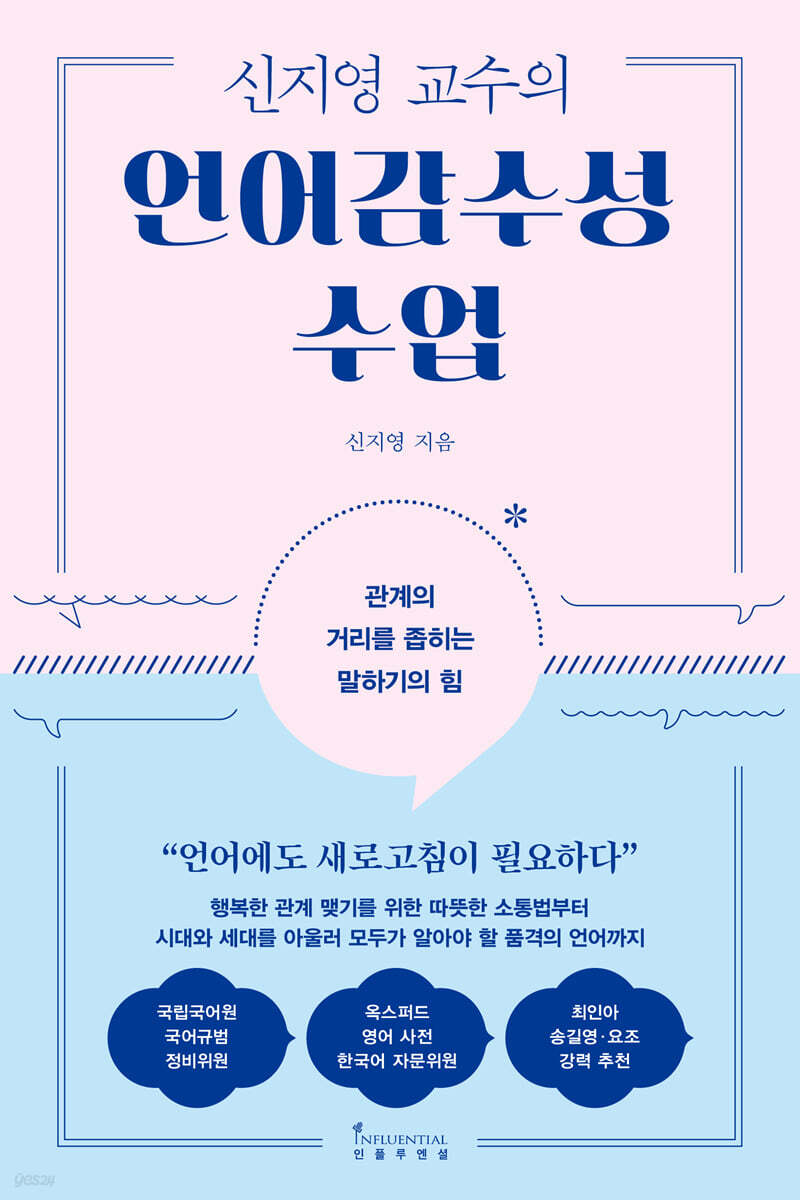
Professor Shin Ji-young's language sensitivity class
 |
Description
Book Introduction
- A word from MD
- Even in the 20th century, Korean society was quite homogeneous.
This is not 21st century Korea.
It is a diverse society where people with diverse identities, including gender, class, region, age, and ethnicity, gather together.
Words spoken thoughtlessly can be violent to others.
We need round language, not sharp words.
- Son Min-gyu, humanities PD
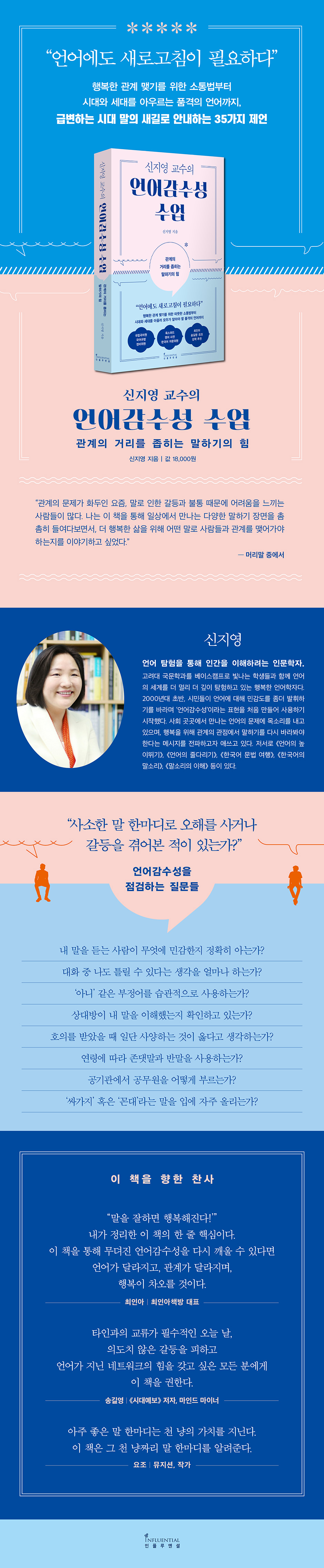
“Language also needs a refresh.”
From communication skills for building happy relationships to language of dignity that spans eras and generations,
35 Tips to Guide You on a New Path in a Rapidly Changing Era
★ Highly recommended by Choi In-ah, Song Gil-young, and Yojo!
★ Oxford English Dictionary Korean Advisory Committee!
★ National Institute of the Korean Language Korean Language Standards Committee Member!
As the age of the individual accelerates and 'relationship problems' emerge as a hot topic, the number of people experiencing difficulties due to conflicts and lack of communication stemming from 'words' is increasing.
Whether in personal relationships with family or friends, or at work, where we spend most of our time and interact with a variety of people, we've all probably experienced at least one mistake: a careless remark that caused a misunderstanding or ruined a task.
Professor Shin Ji-young (Department of Korean Language and Literature, Korea University), who first introduced the expression “language sensitivity” to the public, suggests in her new book, “Professor Shin Ji-young’s Language Sensitivity Class” (published by Influential), that those who have difficulty in daily conversation or experience conflicts due to language in modern society, where life cannot proceed without interaction with others, relearn “speaking” from a relationship perspective.
In this book, he examines the language habits of modern people that lead to conflict and communication breakdown, and clearly suggests how to use language to connect with others in order to lead happier lives.
The book's core message is that all relationships begin and are maintained through words, and that if you want a better relationship than your current one, you must first develop a sensitivity to language.
You'll learn specific ways to cultivate language sensitivity in all aspects of your life, including everyday conversations, workplace honorifics, intergenerational communication, the linguistic elements necessary for a horizontal organizational culture, and tips for overcoming communication gaps. This will lead to better relationships and ultimately, happiness.
From communication skills for building happy relationships to language of dignity that spans eras and generations,
35 Tips to Guide You on a New Path in a Rapidly Changing Era
★ Highly recommended by Choi In-ah, Song Gil-young, and Yojo!
★ Oxford English Dictionary Korean Advisory Committee!
★ National Institute of the Korean Language Korean Language Standards Committee Member!
As the age of the individual accelerates and 'relationship problems' emerge as a hot topic, the number of people experiencing difficulties due to conflicts and lack of communication stemming from 'words' is increasing.
Whether in personal relationships with family or friends, or at work, where we spend most of our time and interact with a variety of people, we've all probably experienced at least one mistake: a careless remark that caused a misunderstanding or ruined a task.
Professor Shin Ji-young (Department of Korean Language and Literature, Korea University), who first introduced the expression “language sensitivity” to the public, suggests in her new book, “Professor Shin Ji-young’s Language Sensitivity Class” (published by Influential), that those who have difficulty in daily conversation or experience conflicts due to language in modern society, where life cannot proceed without interaction with others, relearn “speaking” from a relationship perspective.
In this book, he examines the language habits of modern people that lead to conflict and communication breakdown, and clearly suggests how to use language to connect with others in order to lead happier lives.
The book's core message is that all relationships begin and are maintained through words, and that if you want a better relationship than your current one, you must first develop a sensitivity to language.
You'll learn specific ways to cultivate language sensitivity in all aspects of your life, including everyday conversations, workplace honorifics, intergenerational communication, the linguistic elements necessary for a horizontal organizational culture, and tips for overcoming communication gaps. This will lead to better relationships and ultimately, happiness.
- You can preview some of the book's contents.
Preview
index
Recommendation
Preface: Drawing a World Made Happy by Language Sensitivity
Chapter 1: Why Language Sensitivity is Necessary
Language sensitivity that bridges the gap in relationships
[Into Life] Short sleeves and short sleeves, empathy in a single syllable
Communication skills are a basic virtue that democratic citizens must possess.
Our happiness index is proportional to our communication skills.
To allow language sensitivity to naturally permeate the body
〈Looking Deeper〉 Defining Language Sensitivity│The Thought Hidden in the Word 'Fish'
Chapter 2: Relationships Come From Words
Now is the time to consider relationship issues socially.
Let's learn again from a speaking, relationship perspective
[Into Life] The Criteria for Judging "Ssagaji" and "Old Man"
Words that become magnets, words that become springs
[Into Everyday Life] Correcting the '3 Keys' for Intergenerational Communication
How to Tune Your Language Frequency - Speaking for Better Relationships
[Into Life] A good relationship requires more than just a sense of connection.
Words that start with 'no' that close the heart
〈Looking Deeper〉 A Study on 'Anissieting'
Chapter 3: Language also has a sense of touch
What kind of feeling do my words have?
Why People Only Want to Hear 'Warm Words'
To pave the way for warm words
[Into Daily Life] How to Quiet Holiday Nagging
Chapter 4: Things to Consider When Calling Others
Titles that are acceptable to the person calling them but uncomfortable to the person listening
Why the term "ajumma" is used as a derogatory term
[Into Life] If someone called me 'Auntie'
The Real Reason We're Sensitive to Titles
What Should We Call Each Other? - Using Titles in Public Relations
[Into Daily Life] How to Respond When You're Uncomfortable with Your Address
〈In-Depth Look〉 Our Society Seen Through Titles│Women's Title Struggle: Please Call Me Ms. OOO│Title Inflation
Chapter 5: The Inconvenient Truth Hidden in Workplace Titles
Can Changing Titles Create a Horizontal Organizational Culture?
Korean is difficult to speak without honorifics
[Into Life] The Difference Between Appellatives and Referentials
Refreshing your workplace culture with a language refresh
〈In-Depth Look〉 The Word 'Honey' Used Instead of 'You'│How 'OOO-nim' Became a Title
Chapter 6: The Icon of Disconnection, a Look at the Answer
“There’s no way I’m the answer.”
[Into Life] To overcome communication difficulties and grow
Smart Ways to Deal with People Who Don't Communicate
[Into Life] "Baro Baro": Effective Communication Between Superiors and Subordinates
[Into Daily Life] Using Communication Tools - Face-to-face, Phone, Text, Email
Chapter 7: For those of you who need to talk
What Makes a Pleasant Conversation? - The Finest of Conversation
[Into Life] To speak well, you must speak appropriately to the time and place.
Things to remember if you want a two-way conversation
[Into Life] A janggu is a janggu, so don't interfere!
Tips for Conversing with Strangers - Using Small Talk
Chapter 8: When Words Become Power
Things you need to prepare once you have a say
This is what happens when you get drunk on words and monopolize the conversation.
[Into Life] How to Get Your Audience's Attention
To create a community where speech is free
[Into Life] The Role of a Leader and the Purpose of Communication
Chapter 9: Our Attitude to K-Age
The national greeting, “How old are you?”
Mr. President, please do away with the Korean age calculation system!
The Real Reason Why Counting Age Doesn't Disappear
[Into Everyday Life] Ageism in Daily Life
Age Expressions Are Confusing: How to Say Them
〈In-Depth Look〉 Is Age Really the Only Sensitive Thing?
Chapter 10: Should I use formal or informal speech?
Should I raise it or not?
Relative honorifics are essential to complete a sentence.
Informal speech that sows conflict
[Into daily life] Replace unpleasant informal language with polite formal language
Why are there no such things as "adults without shame"?
〈In-Depth Look〉 The Adulthood Required by the Honorific System│The Question That Invites a Fight: “Why are you speaking informally to me?”
main
Preface: Drawing a World Made Happy by Language Sensitivity
Chapter 1: Why Language Sensitivity is Necessary
Language sensitivity that bridges the gap in relationships
[Into Life] Short sleeves and short sleeves, empathy in a single syllable
Communication skills are a basic virtue that democratic citizens must possess.
Our happiness index is proportional to our communication skills.
To allow language sensitivity to naturally permeate the body
〈Looking Deeper〉 Defining Language Sensitivity│The Thought Hidden in the Word 'Fish'
Chapter 2: Relationships Come From Words
Now is the time to consider relationship issues socially.
Let's learn again from a speaking, relationship perspective
[Into Life] The Criteria for Judging "Ssagaji" and "Old Man"
Words that become magnets, words that become springs
[Into Everyday Life] Correcting the '3 Keys' for Intergenerational Communication
How to Tune Your Language Frequency - Speaking for Better Relationships
[Into Life] A good relationship requires more than just a sense of connection.
Words that start with 'no' that close the heart
〈Looking Deeper〉 A Study on 'Anissieting'
Chapter 3: Language also has a sense of touch
What kind of feeling do my words have?
Why People Only Want to Hear 'Warm Words'
To pave the way for warm words
[Into Daily Life] How to Quiet Holiday Nagging
Chapter 4: Things to Consider When Calling Others
Titles that are acceptable to the person calling them but uncomfortable to the person listening
Why the term "ajumma" is used as a derogatory term
[Into Life] If someone called me 'Auntie'
The Real Reason We're Sensitive to Titles
What Should We Call Each Other? - Using Titles in Public Relations
[Into Daily Life] How to Respond When You're Uncomfortable with Your Address
〈In-Depth Look〉 Our Society Seen Through Titles│Women's Title Struggle: Please Call Me Ms. OOO│Title Inflation
Chapter 5: The Inconvenient Truth Hidden in Workplace Titles
Can Changing Titles Create a Horizontal Organizational Culture?
Korean is difficult to speak without honorifics
[Into Life] The Difference Between Appellatives and Referentials
Refreshing your workplace culture with a language refresh
〈In-Depth Look〉 The Word 'Honey' Used Instead of 'You'│How 'OOO-nim' Became a Title
Chapter 6: The Icon of Disconnection, a Look at the Answer
“There’s no way I’m the answer.”
[Into Life] To overcome communication difficulties and grow
Smart Ways to Deal with People Who Don't Communicate
[Into Life] "Baro Baro": Effective Communication Between Superiors and Subordinates
[Into Daily Life] Using Communication Tools - Face-to-face, Phone, Text, Email
Chapter 7: For those of you who need to talk
What Makes a Pleasant Conversation? - The Finest of Conversation
[Into Life] To speak well, you must speak appropriately to the time and place.
Things to remember if you want a two-way conversation
[Into Life] A janggu is a janggu, so don't interfere!
Tips for Conversing with Strangers - Using Small Talk
Chapter 8: When Words Become Power
Things you need to prepare once you have a say
This is what happens when you get drunk on words and monopolize the conversation.
[Into Life] How to Get Your Audience's Attention
To create a community where speech is free
[Into Life] The Role of a Leader and the Purpose of Communication
Chapter 9: Our Attitude to K-Age
The national greeting, “How old are you?”
Mr. President, please do away with the Korean age calculation system!
The Real Reason Why Counting Age Doesn't Disappear
[Into Everyday Life] Ageism in Daily Life
Age Expressions Are Confusing: How to Say Them
〈In-Depth Look〉 Is Age Really the Only Sensitive Thing?
Chapter 10: Should I use formal or informal speech?
Should I raise it or not?
Relative honorifics are essential to complete a sentence.
Informal speech that sows conflict
[Into daily life] Replace unpleasant informal language with polite formal language
Why are there no such things as "adults without shame"?
〈In-Depth Look〉 The Adulthood Required by the Honorific System│The Question That Invites a Fight: “Why are you speaking informally to me?”
main
Detailed image
Into the book
Linguistic sensitivity allows us to see language that we are so accustomed to using habitually as unfamiliar, and to raise questions about outdated linguistic expressions through sensitivity.
Linguistic sensitivity makes language a better tool to express our thoughts.
It also allows me to check whether my thoughts and goals are well expressed in my language, not just in fragmentary words or expressions, but across the language as a whole.
So I can make sure that my words reach the other person well.
This is why language sensitivity plays a very important role in communication.
---From "Defining Language Sensitivity"
When thinking about relationship issues, we need to look at the word 'no' that is used habitually at the beginning of a sentence.
The most important function of 'ani' written this way is to gain the right to speak and focus the listener's attention.
'No' is a denial of what the other person is saying, so it naturally gives you the right to speak and inevitably grabs the listener's attention.
However, abusing this strategy in conversation does not bring about very positive results.
After all, no one would be happy to have their words denied.
---From "Words that start with 'No' that close the heart"
Civilians and public officials must address each other using appropriate titles appropriate to their public relationship.
Through this, we should be able to show respect to each other.
An attitude of respect should be expressed through honorifics as well as titles.
In this respect, the terms ‘Unnie’ or ‘bachelor’ used by citizens when addressing public officials are even more inappropriate.
This is because these terms can naturally lead to informal speech.
For the same reason, civil servants should not use age- or gender-specific terms to address petitioners.
It is inappropriate for administrative professionals hired by citizens to address citizens as “ajumma,” “ajussi,” “ajussi,” “grandmother,” “grandfather,” or “elder.”
---From "The Real Reason We Are Sensitive to Titles"
It is true that the existing vertical title system used in the workplace has combined with the characteristics of the Korean language to create a vertical corporate culture.
The vertical hierarchy and the vertical use of language that reflects that hierarchy have created vertical relationships among members of the organization.
This vertical corporate culture has led people to think of higher-ranking people as "superiors" and lower-ranking people as "subordinates," meaning that the hierarchy of ranks is a hierarchy of people, which has weakened the competitiveness of the organization as a result.
Based on this diagnosis, companies sought to change their titles.
In this way, unification of titles can be said to be a declaration of separation from the vertical organizational culture.
---From "Can a Horizontal Organizational Culture Be Created by Changing Titles?"
Calling each other "Mr. OOO" regardless of rank or position can have another important meaning in addition to creating a horizontal organizational structure.
What this means is that each and every member is recognized as an individual within the organization, not as a part of the organizational hierarchy.
In other words, by referring to an individual as "Mr. Ga" rather than "Mr. Ga" or "Manager Ga," we are verbally expressing our effort to acknowledge the individual's individual characteristics and pay attention to diversity. I also believe that if this change is well-established, it can sufficiently bring about such an effect.
---From "Flexible Workplace Culture with a Refresh of Language"
The purposes of conversation vary greatly.
But the most important purpose of conversation is to build relationships and strengthen the bonds of those relationships.
That's why it's inappropriate for conversations to be one-way.
The reason why pleasant conversations strengthen the bonds of relationships is probably because of the respect for each other that is revealed through conversation.
Conversation can proceed smoothly only when both parties equally acknowledge each other's existence.
A tilted conversation is unlikely to be enjoyable because it reveals the hierarchy among the conversation participants.
A prerequisite for having a pleasant conversation is the belief that we all have our own thoughts and that those thoughts are worth sharing.
---From "What is a Pleasant Conversation - The Pleasures of Conversation"
Korean grammar naturally makes us think of older people as 'superiors, superiors, higher-ups' and younger people as 'inferiors, subordinates, lower-ups'.
The reason why we tend to unconsciously think of age hierarchy as a hierarchy of people is because of this problem in Korean grammar.
This is because the ‘hierarchy of status’ that determined grammar in a caste-based society was replaced by the ‘hierarchy of age’ based on the worldview of Jang Yu-yoo after the abolition of the caste-based society.
---From "Confusing Age Expressions: How Should I Say Them"
There is no logical reason why older people should be spoken to politely, and younger people should be spoken to informally.
Moreover, in South Korea, where equality is considered an important value, it is inappropriate to think that older people and younger people are in a superior-subordinate relationship.
Rather, it is not appropriate to set the hierarchy of people in the first place.
Therefore, the future honorific system will eliminate the past practice of judging a person's seniority by age and select honorifics based on a different standard.
It could be a friendly relationship or it could be a spur-of-the-moment situation.
Regardless of the other person's age, status, etc., informal speech is used between close friends, and formal speech is used between people who are distant, or formal speech is used in public settings, and informal speech is used in private settings.
Linguistic sensitivity makes language a better tool to express our thoughts.
It also allows me to check whether my thoughts and goals are well expressed in my language, not just in fragmentary words or expressions, but across the language as a whole.
So I can make sure that my words reach the other person well.
This is why language sensitivity plays a very important role in communication.
---From "Defining Language Sensitivity"
When thinking about relationship issues, we need to look at the word 'no' that is used habitually at the beginning of a sentence.
The most important function of 'ani' written this way is to gain the right to speak and focus the listener's attention.
'No' is a denial of what the other person is saying, so it naturally gives you the right to speak and inevitably grabs the listener's attention.
However, abusing this strategy in conversation does not bring about very positive results.
After all, no one would be happy to have their words denied.
---From "Words that start with 'No' that close the heart"
Civilians and public officials must address each other using appropriate titles appropriate to their public relationship.
Through this, we should be able to show respect to each other.
An attitude of respect should be expressed through honorifics as well as titles.
In this respect, the terms ‘Unnie’ or ‘bachelor’ used by citizens when addressing public officials are even more inappropriate.
This is because these terms can naturally lead to informal speech.
For the same reason, civil servants should not use age- or gender-specific terms to address petitioners.
It is inappropriate for administrative professionals hired by citizens to address citizens as “ajumma,” “ajussi,” “ajussi,” “grandmother,” “grandfather,” or “elder.”
---From "The Real Reason We Are Sensitive to Titles"
It is true that the existing vertical title system used in the workplace has combined with the characteristics of the Korean language to create a vertical corporate culture.
The vertical hierarchy and the vertical use of language that reflects that hierarchy have created vertical relationships among members of the organization.
This vertical corporate culture has led people to think of higher-ranking people as "superiors" and lower-ranking people as "subordinates," meaning that the hierarchy of ranks is a hierarchy of people, which has weakened the competitiveness of the organization as a result.
Based on this diagnosis, companies sought to change their titles.
In this way, unification of titles can be said to be a declaration of separation from the vertical organizational culture.
---From "Can a Horizontal Organizational Culture Be Created by Changing Titles?"
Calling each other "Mr. OOO" regardless of rank or position can have another important meaning in addition to creating a horizontal organizational structure.
What this means is that each and every member is recognized as an individual within the organization, not as a part of the organizational hierarchy.
In other words, by referring to an individual as "Mr. Ga" rather than "Mr. Ga" or "Manager Ga," we are verbally expressing our effort to acknowledge the individual's individual characteristics and pay attention to diversity. I also believe that if this change is well-established, it can sufficiently bring about such an effect.
---From "Flexible Workplace Culture with a Refresh of Language"
The purposes of conversation vary greatly.
But the most important purpose of conversation is to build relationships and strengthen the bonds of those relationships.
That's why it's inappropriate for conversations to be one-way.
The reason why pleasant conversations strengthen the bonds of relationships is probably because of the respect for each other that is revealed through conversation.
Conversation can proceed smoothly only when both parties equally acknowledge each other's existence.
A tilted conversation is unlikely to be enjoyable because it reveals the hierarchy among the conversation participants.
A prerequisite for having a pleasant conversation is the belief that we all have our own thoughts and that those thoughts are worth sharing.
---From "What is a Pleasant Conversation - The Pleasures of Conversation"
Korean grammar naturally makes us think of older people as 'superiors, superiors, higher-ups' and younger people as 'inferiors, subordinates, lower-ups'.
The reason why we tend to unconsciously think of age hierarchy as a hierarchy of people is because of this problem in Korean grammar.
This is because the ‘hierarchy of status’ that determined grammar in a caste-based society was replaced by the ‘hierarchy of age’ based on the worldview of Jang Yu-yoo after the abolition of the caste-based society.
---From "Confusing Age Expressions: How Should I Say Them"
There is no logical reason why older people should be spoken to politely, and younger people should be spoken to informally.
Moreover, in South Korea, where equality is considered an important value, it is inappropriate to think that older people and younger people are in a superior-subordinate relationship.
Rather, it is not appropriate to set the hierarchy of people in the first place.
Therefore, the future honorific system will eliminate the past practice of judging a person's seniority by age and select honorifics based on a different standard.
It could be a friendly relationship or it could be a spur-of-the-moment situation.
Regardless of the other person's age, status, etc., informal speech is used between close friends, and formal speech is used between people who are distant, or formal speech is used in public settings, and informal speech is used in private settings.
---From "Informal Language That Sows Conflict"
Publisher's Review
In this era where we live alone for a long time, language sensitivity is an essential skill!
Relearning to 'speak' from a relationship perspective!
"The one-line essence of this book, summarized by me, is 'Speaking well makes you happy!'" _Choi In-a│CEO of Choi In-a Bookstore
"Recommended for anyone who wants to harness the networking power of language." _Song Gil-young│Author of "Sidae Yebo" and Mind Miner
"A book that teaches us what a single word is worth!" _Yojo│Musician, writer
Professor Shin Ji-young (Department of Korean Language and Literature, Korea University), who first introduced the term "language sensitivity" to the public, has developed it further and published a new book, "Professor Shin Ji-young's Language Sensitivity Class," which deals with "speaking" that narrows the distance between relationships and leads to a happier life.
In this book, he says that we need to relearn 'speaking' from the perspective of relationships for happiness, rather than as a means to success such as employment or promotion.
He also explains that in this age of accelerating individualization, if you want to transcend disconnection and lack of communication and have genuine relationships, you must first reflect on your own language habits and increase your language sensitivity, which is the key to opening the hearts of others.
To this end, he has provided practical methods for building good relationships and ultimately achieving happiness, including everyday conversation techniques, intergenerational communication, language issues in the workplace for a horizontal organizational culture, and how to overcome communication difficulties, all with abundant examples.
The author's insight, gained through a meticulous examination of language issues arising throughout our society and a study of humanity through language exploration, will offer a starting point for change to those who are misunderstood by a single word or who feel disconnected and lonely due to language. It will also teach them how to utilize language as a tool for a better life.
Why Language Needs a Refresh
A language of respect creates a culture of respect.
Recently, many companies, especially leading Korean companies, are increasingly adopting so-called 'unification of titles'.
Regardless of rank, everyone from interns to executives calls each other by the title 'nim'.
However, there are slight differences in specific guidelines, such as using nicknames or English names instead of names depending on the characteristics of the industry and the existing organizational culture, or limiting the categories to two or three (pro, manager, etc.) while differentiating by job title.
What on earth is it that so many companies are so interested in?
Language is often said to be 'a tool for expressing thoughts and a social convention.'
To use a language, you must understand the conventions of the society in which the language is used and use the language accordingly.
But those promises were always made in the past, so they always contain thoughts from the past.
As a result, many of the languages we actually use contain outdated and outdated values that we no longer agree with.
It is the use of old language that contains old ideas rather than changed ideas.
As a result, we end up saying things without even thinking about them, which can lead to not only a breakdown in communication but also a trigger for conflict.
Professor Shin Ji-young asserts, “In a company, calling an individual ‘Mr. OOO’ rather than ‘Manager Ga’ or ‘Manager Ga’ is not only an attempt to establish a horizontal organizational structure, but also an effort to acknowledge the individual’s characteristics and pay attention to diversity through language” (p. 178), and “Workplace culture cannot change with just a change in words, but workplace culture cannot change without a change in words” (p. 182).
Language is a mirror that reflects culture, and a language of respect creates a culture of respect, and a culture of respect creates a language of respect.
This isn't just a story limited to silk companies.
There are countless words that have been used so naturally, including workplace titles, that fail to reflect the changing times and become the seeds of conflict.
Now, we must be sensitive to the thoughts that the words we habitually use, the words we take for granted and use without thinking, actually reflect.
If the ideas contained in our language are stuck in the past, if they contain a sense of authority and discrimination, we must boldly seek change.
Language also needs a refresh.
Language is not for me, but to reach others.
Words that should disappear vs.
New words to learn
Everyone has a bad habit or two, whether it's being late, eating poorly, or having bad posture.
We put a lot of effort into changing habits that make our daily lives uncomfortable and disrupt the order of our lives.
But people are oblivious to the bad language habits that go beyond discomfort and ruin relationships and lead to isolation.
A typical example is the expression “no” used when starting a conversation.
Often, we start a conversation with the inadvertent "no" to change the subject or to draw attention to ourselves, but using a negative word at the beginning of a conversation is more likely to close the other person's mind.
While it may be effective in gaining the right to speak, it can result in a conversation that should be a 'tiki-taga' turning into a monologue and even ruining good relationships.
The same goes for the term ‘ajumma’.
'Ajumma' is a derogatory term for 'ajumma', and it basically assumes that the person being called is being degraded, so no one is happy to be called by this term.
According to a recent survey, the term "ajumma" evokes negative feelings in one out of three women over 60.
The author explains that if you think, "What's wrong with calling an auntie 'auntie'?" you should be prepared to receive an unpleasant reaction from the other person or feel lonely.
We use too many expressions like this, which the speaker doesn't mean to use, but which make the listener uncomfortable, and which worsens communication and even relationships.
The author examines typical linguistic expressions that ruin relationships and lead to isolation, explaining why they are incorrect from a linguistic sensitivity perspective and introducing specific methods for utilizing Korean language to pave the way for warm words.
Through 35 suggestions, including how to address one another in public relationships, how to use honorifics to whom, what attitude to have for conversations rather than monologues, and what training to use to avoid arguments and make others understand you, you will be able to correct bad speaking habits and find a new path for warm words.
Relearning to 'speak' from a relationship perspective!
"The one-line essence of this book, summarized by me, is 'Speaking well makes you happy!'" _Choi In-a│CEO of Choi In-a Bookstore
"Recommended for anyone who wants to harness the networking power of language." _Song Gil-young│Author of "Sidae Yebo" and Mind Miner
"A book that teaches us what a single word is worth!" _Yojo│Musician, writer
Professor Shin Ji-young (Department of Korean Language and Literature, Korea University), who first introduced the term "language sensitivity" to the public, has developed it further and published a new book, "Professor Shin Ji-young's Language Sensitivity Class," which deals with "speaking" that narrows the distance between relationships and leads to a happier life.
In this book, he says that we need to relearn 'speaking' from the perspective of relationships for happiness, rather than as a means to success such as employment or promotion.
He also explains that in this age of accelerating individualization, if you want to transcend disconnection and lack of communication and have genuine relationships, you must first reflect on your own language habits and increase your language sensitivity, which is the key to opening the hearts of others.
To this end, he has provided practical methods for building good relationships and ultimately achieving happiness, including everyday conversation techniques, intergenerational communication, language issues in the workplace for a horizontal organizational culture, and how to overcome communication difficulties, all with abundant examples.
The author's insight, gained through a meticulous examination of language issues arising throughout our society and a study of humanity through language exploration, will offer a starting point for change to those who are misunderstood by a single word or who feel disconnected and lonely due to language. It will also teach them how to utilize language as a tool for a better life.
Why Language Needs a Refresh
A language of respect creates a culture of respect.
Recently, many companies, especially leading Korean companies, are increasingly adopting so-called 'unification of titles'.
Regardless of rank, everyone from interns to executives calls each other by the title 'nim'.
However, there are slight differences in specific guidelines, such as using nicknames or English names instead of names depending on the characteristics of the industry and the existing organizational culture, or limiting the categories to two or three (pro, manager, etc.) while differentiating by job title.
What on earth is it that so many companies are so interested in?
Language is often said to be 'a tool for expressing thoughts and a social convention.'
To use a language, you must understand the conventions of the society in which the language is used and use the language accordingly.
But those promises were always made in the past, so they always contain thoughts from the past.
As a result, many of the languages we actually use contain outdated and outdated values that we no longer agree with.
It is the use of old language that contains old ideas rather than changed ideas.
As a result, we end up saying things without even thinking about them, which can lead to not only a breakdown in communication but also a trigger for conflict.
Professor Shin Ji-young asserts, “In a company, calling an individual ‘Mr. OOO’ rather than ‘Manager Ga’ or ‘Manager Ga’ is not only an attempt to establish a horizontal organizational structure, but also an effort to acknowledge the individual’s characteristics and pay attention to diversity through language” (p. 178), and “Workplace culture cannot change with just a change in words, but workplace culture cannot change without a change in words” (p. 182).
Language is a mirror that reflects culture, and a language of respect creates a culture of respect, and a culture of respect creates a language of respect.
This isn't just a story limited to silk companies.
There are countless words that have been used so naturally, including workplace titles, that fail to reflect the changing times and become the seeds of conflict.
Now, we must be sensitive to the thoughts that the words we habitually use, the words we take for granted and use without thinking, actually reflect.
If the ideas contained in our language are stuck in the past, if they contain a sense of authority and discrimination, we must boldly seek change.
Language also needs a refresh.
Language is not for me, but to reach others.
Words that should disappear vs.
New words to learn
Everyone has a bad habit or two, whether it's being late, eating poorly, or having bad posture.
We put a lot of effort into changing habits that make our daily lives uncomfortable and disrupt the order of our lives.
But people are oblivious to the bad language habits that go beyond discomfort and ruin relationships and lead to isolation.
A typical example is the expression “no” used when starting a conversation.
Often, we start a conversation with the inadvertent "no" to change the subject or to draw attention to ourselves, but using a negative word at the beginning of a conversation is more likely to close the other person's mind.
While it may be effective in gaining the right to speak, it can result in a conversation that should be a 'tiki-taga' turning into a monologue and even ruining good relationships.
The same goes for the term ‘ajumma’.
'Ajumma' is a derogatory term for 'ajumma', and it basically assumes that the person being called is being degraded, so no one is happy to be called by this term.
According to a recent survey, the term "ajumma" evokes negative feelings in one out of three women over 60.
The author explains that if you think, "What's wrong with calling an auntie 'auntie'?" you should be prepared to receive an unpleasant reaction from the other person or feel lonely.
We use too many expressions like this, which the speaker doesn't mean to use, but which make the listener uncomfortable, and which worsens communication and even relationships.
The author examines typical linguistic expressions that ruin relationships and lead to isolation, explaining why they are incorrect from a linguistic sensitivity perspective and introducing specific methods for utilizing Korean language to pave the way for warm words.
Through 35 suggestions, including how to address one another in public relationships, how to use honorifics to whom, what attitude to have for conversations rather than monologues, and what training to use to avoid arguments and make others understand you, you will be able to correct bad speaking habits and find a new path for warm words.
GOODS SPECIFICS
- Date of issue: May 31, 2024
- Page count, weight, size: 348 pages | 524g | 145*210*20mm
- ISBN13: 9791168341982
- ISBN10: 1168341981
You may also like
카테고리
korean


korean

![GQ KOREA Mark (Monthly): December [2025]](http://librairie.coreenne.fr/cdn/shop/files/8ef265dbbfbf186523ed75ba7319009d.jpg?v=1765340328&width=3840)


