

I decided to live rough
 |
Description
Book Introduction
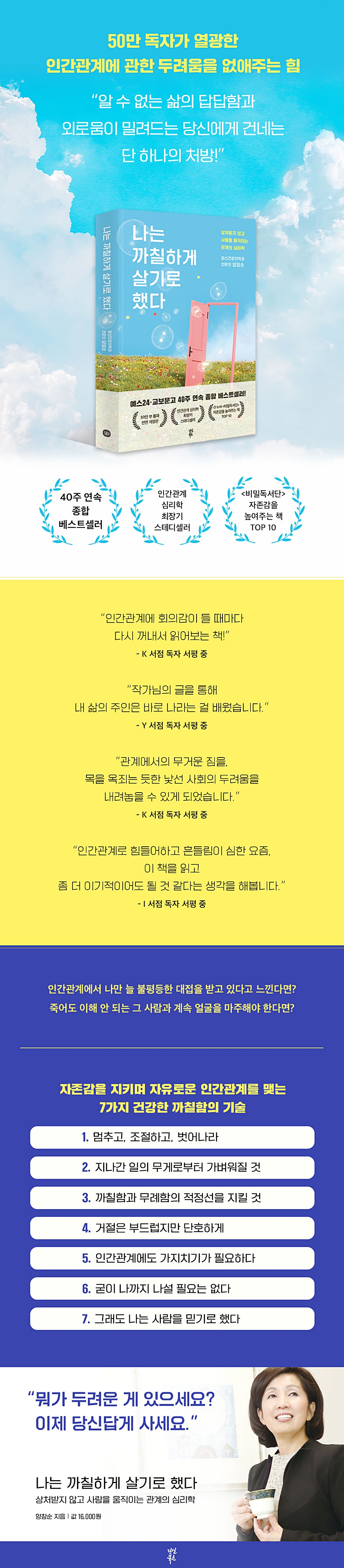
Revised and expanded edition to commemorate 500,000 copies sold Yes24 and Kyobo Bookstore's comprehensive bestseller for 40 consecutive weeks O tvN [Secret Reading Club] Top 10 Books That Boost Self-Esteem “What are you afraid of? Now live your life as yourself!” The psychological prescription of Dr. Yang Chang-soon, a psychiatrist who saved the relationships of 500,000 readers. The longest-running bestseller in the field of human relations psychology, "I Decided to Live Grumpily," which has sold over 500,000 copies since its publication in 2012, has returned to readers in a new guise. This book, which is the origin of the 'self-esteem' craze in Korea and a classic of 'living true to yourself', was a general bestseller for 40 consecutive weeks on Yes24 and Kyobo Bookstore immediately after its publication in 2012, and was ranked as the '#1 best-selling self-help book' throughout 2014. 'I recommend this to those who feel the frustration and loneliness of an unknown life.' 'It's still difficult, but I want to work hard little by little to have a healthy roughness.' It's okay to be a little rough. The more prickly you become, the more mature you will become.' "I highly recommend this book to anyone who feels they've always been treated unfairly in their relationships." "If you want to cook those people who you can't understand even after death, you must read this." This book, which presents a concrete solution called “healthy roughness” to the desire to be free and honest in interpersonal relationships, was praised as “the best book to heal depressed and wounded hearts” by popular stars such as Zico, Solbi, and Seolhyun, and was also highly praised by opinion leaders such as former Chief Justice of the Supreme Court Lee Yong-hoon and former Samsung Everland President Heo Tae-hak, and was loved by people of all ages. As countless readers have written, if you're suffering from the frustration and loneliness of an unknown life, if you feel like you're always being treated unfairly in relationships, if you're constantly confronted with someone you can't understand, then you need to read this book, "I Decided to Live a Gritty Life." Just as this book completely dispelled the fears about relationships of 500,000 readers, you too will be able to resolve the secret worries you couldn't tell anyone through this book. |
- You can preview some of the book's contents.
Preview
index
As we publish the revised edition, we see nature changing only towards the future.
Prologue┃ What are you afraid of? Now live your life as yourself.
Chapter 1
My interpersonal relationships
Why is it so hard?
Why am I always being taken advantage of?
If I feel burdened and tired in an unfamiliar place
When I can't even make small decisions on my own
A relationship where sacrifice leaves only scars
I was just being honest with my feelings.
When the thought of 'I am right' goes too far
If you don't have anyone to confide in
A trap that honest people easily fall into
Chapter 2
There are many people who have been hurt
Why no one hurt me
There is no one more difficult than myself.
There are bound to be people who are difficult to get close to.
There's no need to be serious about being hurt by the world.
As we live, there are times when we are misunderstood and times when we are misunderstood.
The Secret of the Word "I Was Sincere"
No one is better than anyone else
Just one thing to make the relationship comfortable
Bad manners make everything worse.
When you feel like you've stopped, the moment you need a change
Chapter 3
To live as a free person
Prescription for rough interpersonal relationships
I decided to live rough
Prescription #1 | Stop, Control, and Get Out
Second Prescription | Become Lighter from the Weight of the Past
Prescription #3 | Maintaining a Balance Between Rudeness and Aggression
Prescription Four | Rejection is gentle but firm
Prescription #5 | Even human relationships need pruning.
Prescription #6 | There's no need for me to step forward.
Seventh Prescription | Still, I decided to trust people.
Chapter 4
Not swayed by anyone
To become me
The courage to face my shortcomings
There's no need to go that far
Make peace with the person you've hated all this time
Things you see when you look through the eyes of the other person
Opening a window into my heart
May happiness not become an obsession
Mood management is also necessary
Nothing in this world is taken for granted.
Life goes as you say
Even if you don't achieve your goal, don't be discouraged and stay calm
Epilogue┃ Love Yourself to Love Others
Prologue┃ What are you afraid of? Now live your life as yourself.
Chapter 1
My interpersonal relationships
Why is it so hard?
Why am I always being taken advantage of?
If I feel burdened and tired in an unfamiliar place
When I can't even make small decisions on my own
A relationship where sacrifice leaves only scars
I was just being honest with my feelings.
When the thought of 'I am right' goes too far
If you don't have anyone to confide in
A trap that honest people easily fall into
Chapter 2
There are many people who have been hurt
Why no one hurt me
There is no one more difficult than myself.
There are bound to be people who are difficult to get close to.
There's no need to be serious about being hurt by the world.
As we live, there are times when we are misunderstood and times when we are misunderstood.
The Secret of the Word "I Was Sincere"
No one is better than anyone else
Just one thing to make the relationship comfortable
Bad manners make everything worse.
When you feel like you've stopped, the moment you need a change
Chapter 3
To live as a free person
Prescription for rough interpersonal relationships
I decided to live rough
Prescription #1 | Stop, Control, and Get Out
Second Prescription | Become Lighter from the Weight of the Past
Prescription #3 | Maintaining a Balance Between Rudeness and Aggression
Prescription Four | Rejection is gentle but firm
Prescription #5 | Even human relationships need pruning.
Prescription #6 | There's no need for me to step forward.
Seventh Prescription | Still, I decided to trust people.
Chapter 4
Not swayed by anyone
To become me
The courage to face my shortcomings
There's no need to go that far
Make peace with the person you've hated all this time
Things you see when you look through the eyes of the other person
Opening a window into my heart
May happiness not become an obsession
Mood management is also necessary
Nothing in this world is taken for granted.
Life goes as you say
Even if you don't achieve your goal, don't be discouraged and stay calm
Epilogue┃ Love Yourself to Love Others
Detailed image
Into the book
I try to accept that the various problems that happen to me are just things that can happen in life.
At this point, if you start looking for meaning by saying, 'Why me?', it becomes a headache.
All problems in life are both general and special.
The problem I'm having is one that anyone can experience.
Psychiatrist Jung demonstrated that when we can see common problems in general terms, it is when our complexes do not influence us.
(syncopation)
Recent brain research has revealed that emotions and thoughts are inextricably linked.
This means that thoughts influence emotions and emotions influence thoughts in the same way.
And this means that the greater and stronger the emotion I feel, the more my thoughts will be governed by that emotion with equal weight.
So, when emotions are swirling, it's wise to not make any decisions or at least postpone them for a while.
---From "There is no one more difficult than myself"
In reality, everything that happens in life depends on how I perceive the situation.
Our senses work until the day we die, whether we are conscious of it or not.
In doing so, it influences our thoughts, actions, and emotions, and these thoughts, actions, and emotions influence our senses.
This means that no matter how well-reputed someone is, if I'm in a bad mood at the time, I may not see him in a good light.
(syncopation)
If you think about it that way, the equation holds true: it's not necessarily true that I should get angry just because others are rude to me.
As we live, there are bound to be times when we misunderstand others, and vice versa.
I praised A because I liked his attitude, but others present might think I was flattering A.
In short, the principle that we must always keep in mind in human relationships is that what we remember may not necessarily be true and factual.
---From "As we live, there are times when we are misunderstood and times when we are misunderstood."
Looking at them, I realize that human relationships need pruning.
Sometimes I even think that rather than investing time, body, and money in unnecessary relationships and then regretting it later, it would be better to invest everything in myself, who is always with me 24 hours a day.
If there are a hundred people, not all of them can do it well.
There are only one or two people you spend your entire life with.
You can say that in this world, there is no one who gives me everything I want, no one I like, and almost no one who understands me.
If there is only one person, then it is considered a success, and you have to accept that even that person is not always like that.
I don't always like myself and things don't go my way, so why would I expect that from others?
(syncopation)
No matter what choice I make, there is bound to be something I give up.
Accepting the thought of letting go is a choice.
The problem is trying to have both minds.
Unless you're in a relationship where you can just say whatever you want comfortably and control your state based on the other person's feedback, it's also necessary to keep your distance.
That's healthy roughness.
---From "Human relationships also need pruning"
People who are easily excited and preoccupied with other people's hurt have one thing in common.
Despite his arrogant appearance, he is filled with fear, anxiety, hostility, and inferiority complex inside.
Gossiping about others is one of the easiest ways to vent it.
Freud called the verbal aggression we use against others “oral aggression.”
Just as babies bite hard while sucking their mother's breast, we have this aggression within us, and as adults, it mainly manifests as criticism and insults towards others.
So, when you feel like someone is saying something bad about you, you can feel a little better by thinking, 'Aha, that person's verbal aggression is kicking in.'
The reason we get hurt by gossip is because we expect people to judge us objectively.
But it's better to give up on such expectations early.
Regardless of what that person's reputation is, it is human nature to classify someone as a good person if they are kind to us, and as a bad person if they refuse our request.
At this point, if you start looking for meaning by saying, 'Why me?', it becomes a headache.
All problems in life are both general and special.
The problem I'm having is one that anyone can experience.
Psychiatrist Jung demonstrated that when we can see common problems in general terms, it is when our complexes do not influence us.
(syncopation)
Recent brain research has revealed that emotions and thoughts are inextricably linked.
This means that thoughts influence emotions and emotions influence thoughts in the same way.
And this means that the greater and stronger the emotion I feel, the more my thoughts will be governed by that emotion with equal weight.
So, when emotions are swirling, it's wise to not make any decisions or at least postpone them for a while.
---From "There is no one more difficult than myself"
In reality, everything that happens in life depends on how I perceive the situation.
Our senses work until the day we die, whether we are conscious of it or not.
In doing so, it influences our thoughts, actions, and emotions, and these thoughts, actions, and emotions influence our senses.
This means that no matter how well-reputed someone is, if I'm in a bad mood at the time, I may not see him in a good light.
(syncopation)
If you think about it that way, the equation holds true: it's not necessarily true that I should get angry just because others are rude to me.
As we live, there are bound to be times when we misunderstand others, and vice versa.
I praised A because I liked his attitude, but others present might think I was flattering A.
In short, the principle that we must always keep in mind in human relationships is that what we remember may not necessarily be true and factual.
---From "As we live, there are times when we are misunderstood and times when we are misunderstood."
Looking at them, I realize that human relationships need pruning.
Sometimes I even think that rather than investing time, body, and money in unnecessary relationships and then regretting it later, it would be better to invest everything in myself, who is always with me 24 hours a day.
If there are a hundred people, not all of them can do it well.
There are only one or two people you spend your entire life with.
You can say that in this world, there is no one who gives me everything I want, no one I like, and almost no one who understands me.
If there is only one person, then it is considered a success, and you have to accept that even that person is not always like that.
I don't always like myself and things don't go my way, so why would I expect that from others?
(syncopation)
No matter what choice I make, there is bound to be something I give up.
Accepting the thought of letting go is a choice.
The problem is trying to have both minds.
Unless you're in a relationship where you can just say whatever you want comfortably and control your state based on the other person's feedback, it's also necessary to keep your distance.
That's healthy roughness.
---From "Human relationships also need pruning"
People who are easily excited and preoccupied with other people's hurt have one thing in common.
Despite his arrogant appearance, he is filled with fear, anxiety, hostility, and inferiority complex inside.
Gossiping about others is one of the easiest ways to vent it.
Freud called the verbal aggression we use against others “oral aggression.”
Just as babies bite hard while sucking their mother's breast, we have this aggression within us, and as adults, it mainly manifests as criticism and insults towards others.
So, when you feel like someone is saying something bad about you, you can feel a little better by thinking, 'Aha, that person's verbal aggression is kicking in.'
The reason we get hurt by gossip is because we expect people to judge us objectively.
But it's better to give up on such expectations early.
Regardless of what that person's reputation is, it is human nature to classify someone as a good person if they are kind to us, and as a bad person if they refuse our request.
---From "There's no need for me to come forward"
Publisher's Review
Because of one minor conflict
Don't belittle my entire interpersonal relationship.
How to Gain Confidence in Relationships with Healthy Narcissism
“When I consult with them, I feel like I am the only one who is losing out in interpersonal relationships.
“There are so many people who live with the feeling that they are the only ones enduring it.”
What the author said was true.
Perhaps that's why 500,000 South Korean readers responded to the declaration, "I've decided to live a rough life."
So why do we so long for a "rough life"? And why can't we live it? Dr. Yang Chang-soon found the answer in "narcissism."
“All problems in life are both general and special.
What I mean is that the problem I'm having is something that anyone can experience.
But it's a special problem because it happened to me.
“The ability to generalize my particularity may be another aspect of ‘human maturity.’”
That is, no human being can maintain an objective view of their own problems as they do of others.
The author advises that it is at this very point that we must take the first step toward a healthy and rugged life.
When I accept that the problems that happen to me are universal and can happen in anyone's life, it means that I can detach myself from the relationship problems that are bothering me.
Of course, it is not easy to be calm about everything that surrounds me.
The author also confessed that his declaration, “I have decided to live a rough life,” was like a kind of “coming out.”
Life is a one-time thing for everyone.
It is natural for us, who are experiencing many conflicts for the first time, to make mistakes and fall.
If you let go of the obsession that your life has to be perfect and embrace your problems with the thought, "That's just how it goes," you can break free from the tense, icy state of everything and build light and healthy relationships.
Rough and cool
If you don't want to worry about what other people think
First, I will love myself as I am.
7 Healthy Awkward Skills for Protecting Self-Esteem and Building Free Relationships
"Can I speak my mind clearly? What if people think I'm arrogant?"
"Can I open my heart first? Will you understand my sincerity as I approach you?"
'If this continues, I'll end up getting hurt...
There's no way there's anyone like me in the world.'
In this book, Dr. Yang Chang-soon says that 'healthy roughness' is 'the power to let go of the fear of being rejected and hurt in interpersonal relationships.'
To do this, you must first have an attitude of accepting yourself as you are.
If I first clear up the misunderstanding about myself and reconcile with the self I have hated, I will be able to show my true self to the other person without any worries.
I can get along better with people who accept that side of me, and if there's someone who criticizes me, I can either examine whether the criticism is justified and fix myself, or if not, I can just dismiss it as their problem.
But living this kind of 'cool' life is not as easy as it sounds.
Dr. Yang Chang-soon introduces specific ways for us, who are always timid and anxious, to live a 'cool' and 'rough' life.
Through this, we will cultivate the courage to accept ourselves as we are, build on our strengths and complement our weaknesses, and gain the strength to always express ourselves confidently, both for ourselves and for others.
7 Healthy Grumpy Skills
1.
When your self-esteem hits rock bottom? → Stop, adjust, and get out.
2.
When childhood wounds sting your heart? → The weight of the past will be lifted.
3.
What if people seem to be avoiding me? → Maintaining a healthy balance between being abrasive and rude.
4.
When someone's request feels burdensome? → Reject gently but firmly
5.
What if group life gets tough? → Even relationships need pruning.
6.
When you hear bad things about others? → There's no need to come forward.
7.
What if there's no one who feels the same way as me? → Still, I decided to trust people.
Among the people around me
Even if only half of you say I'm 'okay'
You will realize that you have a successful life
How to make the world fit your standards with elegance and manners
Sometimes people confuse 'roughness' with 'rudeness'.
We all want to be able to speak freely about what's on our minds, but that shouldn't be rude, meaning it shouldn't be dismissive or insulting.
The difference between 'roughness and rudeness' as defined by Dr. Yang Chang-soon is clear.
Being rude is about showing respect for yourself and, by extension, respect for others.
If I am polite to myself, I don't have to compare myself to others and feel guilty, and I don't have to be dragged around by what others say.
Because I give to myself first.
This kind of person respects others as much as he respects me.
Because I know that what I have is just as precious as what others have.
“The interesting thing is that when there is no external pain for humans, they then make themselves suffer.
Because humans are strange beings who pursue happiness while also making themselves unhappy.
In that sense, to me, ‘roughness’ is one way to properly protect myself from internal and external enemies.”
This book presents a variety of clinical cases and interesting psychological theories, as if telling a story one by one, and helps you reflect on the situations and problems you face.
How to be true to your feelings without harming your relationships with others—the so-called "psychology of relationships that moves people without hurting them"—will serve as a practical guide for those who desperately want to be able to handle themselves well and avoid getting hurt, and for those who want to maintain smooth relationships while speaking clearly.
Don't belittle my entire interpersonal relationship.
How to Gain Confidence in Relationships with Healthy Narcissism
“When I consult with them, I feel like I am the only one who is losing out in interpersonal relationships.
“There are so many people who live with the feeling that they are the only ones enduring it.”
What the author said was true.
Perhaps that's why 500,000 South Korean readers responded to the declaration, "I've decided to live a rough life."
So why do we so long for a "rough life"? And why can't we live it? Dr. Yang Chang-soon found the answer in "narcissism."
“All problems in life are both general and special.
What I mean is that the problem I'm having is something that anyone can experience.
But it's a special problem because it happened to me.
“The ability to generalize my particularity may be another aspect of ‘human maturity.’”
That is, no human being can maintain an objective view of their own problems as they do of others.
The author advises that it is at this very point that we must take the first step toward a healthy and rugged life.
When I accept that the problems that happen to me are universal and can happen in anyone's life, it means that I can detach myself from the relationship problems that are bothering me.
Of course, it is not easy to be calm about everything that surrounds me.
The author also confessed that his declaration, “I have decided to live a rough life,” was like a kind of “coming out.”
Life is a one-time thing for everyone.
It is natural for us, who are experiencing many conflicts for the first time, to make mistakes and fall.
If you let go of the obsession that your life has to be perfect and embrace your problems with the thought, "That's just how it goes," you can break free from the tense, icy state of everything and build light and healthy relationships.
Rough and cool
If you don't want to worry about what other people think
First, I will love myself as I am.
7 Healthy Awkward Skills for Protecting Self-Esteem and Building Free Relationships
"Can I speak my mind clearly? What if people think I'm arrogant?"
"Can I open my heart first? Will you understand my sincerity as I approach you?"
'If this continues, I'll end up getting hurt...
There's no way there's anyone like me in the world.'
In this book, Dr. Yang Chang-soon says that 'healthy roughness' is 'the power to let go of the fear of being rejected and hurt in interpersonal relationships.'
To do this, you must first have an attitude of accepting yourself as you are.
If I first clear up the misunderstanding about myself and reconcile with the self I have hated, I will be able to show my true self to the other person without any worries.
I can get along better with people who accept that side of me, and if there's someone who criticizes me, I can either examine whether the criticism is justified and fix myself, or if not, I can just dismiss it as their problem.
But living this kind of 'cool' life is not as easy as it sounds.
Dr. Yang Chang-soon introduces specific ways for us, who are always timid and anxious, to live a 'cool' and 'rough' life.
Through this, we will cultivate the courage to accept ourselves as we are, build on our strengths and complement our weaknesses, and gain the strength to always express ourselves confidently, both for ourselves and for others.
7 Healthy Grumpy Skills
1.
When your self-esteem hits rock bottom? → Stop, adjust, and get out.
2.
When childhood wounds sting your heart? → The weight of the past will be lifted.
3.
What if people seem to be avoiding me? → Maintaining a healthy balance between being abrasive and rude.
4.
When someone's request feels burdensome? → Reject gently but firmly
5.
What if group life gets tough? → Even relationships need pruning.
6.
When you hear bad things about others? → There's no need to come forward.
7.
What if there's no one who feels the same way as me? → Still, I decided to trust people.
Among the people around me
Even if only half of you say I'm 'okay'
You will realize that you have a successful life
How to make the world fit your standards with elegance and manners
Sometimes people confuse 'roughness' with 'rudeness'.
We all want to be able to speak freely about what's on our minds, but that shouldn't be rude, meaning it shouldn't be dismissive or insulting.
The difference between 'roughness and rudeness' as defined by Dr. Yang Chang-soon is clear.
Being rude is about showing respect for yourself and, by extension, respect for others.
If I am polite to myself, I don't have to compare myself to others and feel guilty, and I don't have to be dragged around by what others say.
Because I give to myself first.
This kind of person respects others as much as he respects me.
Because I know that what I have is just as precious as what others have.
“The interesting thing is that when there is no external pain for humans, they then make themselves suffer.
Because humans are strange beings who pursue happiness while also making themselves unhappy.
In that sense, to me, ‘roughness’ is one way to properly protect myself from internal and external enemies.”
This book presents a variety of clinical cases and interesting psychological theories, as if telling a story one by one, and helps you reflect on the situations and problems you face.
How to be true to your feelings without harming your relationships with others—the so-called "psychology of relationships that moves people without hurting them"—will serve as a practical guide for those who desperately want to be able to handle themselves well and avoid getting hurt, and for those who want to maintain smooth relationships while speaking clearly.
GOODS SPECIFICS
- Date of issue: May 12, 2022
- Page count, weight, size: 258 pages | 466g | 146*216*20mm
- ISBN13: 9791130690421
- ISBN10: 1130690423
You may also like
카테고리
korean


korean

![ELLE 엘르 스페셜 에디션 A형 : 12월 [2025]](http://librairie.coreenne.fr/cdn/shop/files/b8e27a3de6c9538896439686c6b0e8fb.jpg?v=1766436872&width=3840)


