

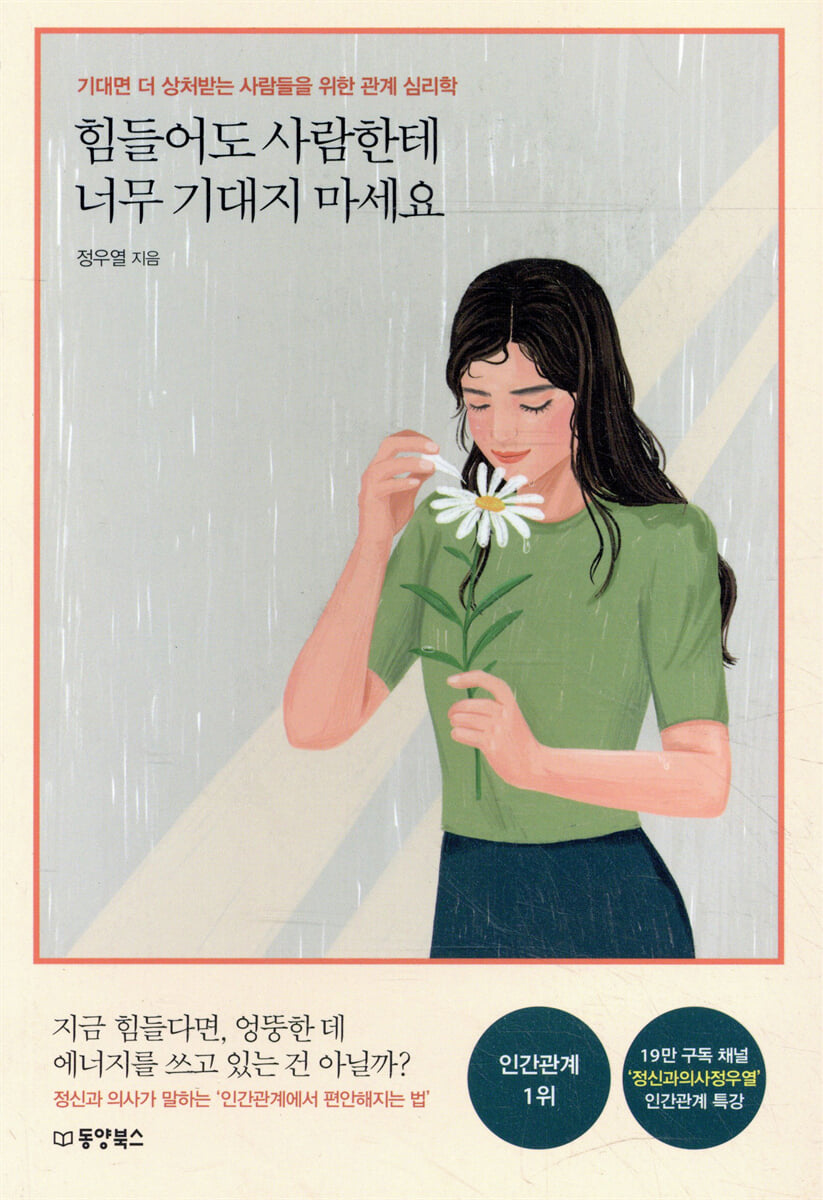
Even if things are hard, don't rely too much on people.
 |
Description
Book Introduction
“If you are having a hard time now, “Are you wasting your energy in the wrong places?” 16 million cumulative YouTube views Human Relations Special Lecture: 540,000 views 170,000-subscribed channel, "Psychiatrist Jeong Woo-yeol" specializes in human relationships. The human relations lecture that moved 170,000 subscribers is finally available as a book! How to Become Comfortable in Relationships: A Psychiatrist Explains People who are struggling to become popular again like they used to be, people who are stressed out because of coworkers who always brag about themselves and are considering quitting their jobs because of coworkers who only care about themselves and don't communicate well with them. What do these three people have in common? They're the type of people who struggle particularly with interpersonal relationships. According to psychiatrist Woo-yeol Jeong, who runs the YouTube channel 'Psychiatrist Woo-yeol Jeong' with 170,000 subscribers, people who struggle with interpersonal relationships have the following things in common. First, they secretly hope that no one around them dislikes them. Second, the focus of attention is on others, not on oneself. Third, expectations for people are extremely high. And finally, the root cause of all these commonalities is ‘difficult relationship with oneself.’ The author, based on his experience as a psychiatrist who met countless clients in the counseling room and his experience of counseling countless stories through real-time counseling while running a psychological YouTube channel, argues that a significant portion of people's troubles are due to 'interpersonal relationships.' Students worried about their grades, office workers complaining that going to work is too difficult, and people suffering from depression while staying home due to COVID-19. At first glance, their worries may seem to be caused by grades, career issues, or COVID-19, but when you delve deeper, you find that most of them are due to various types of human relationships, such as friendships, relationships at work, marital relationships, family relationships, and sibling relationships. No matter how much IT technology advances, the human instinct to share intimacy and bonds with others and the human desire to be loved and recognized by someone will not change. "Don't Rely Too Much on People, Even When Things Are Hard" is a book that summarizes the core of the counseling sessions the author had with people who were struggling with interpersonal relationships. This book is based on the content of one of the most popular lectures on his YouTube channel, "A Complete Guide to Human Relationship Concerns," and features stories from various people of various ages. The book blends theory and real-life examples, allowing you to experience both knowledge and fun. The author says that before leaning on someone or trying to make friends because you are lonely and having a hard time, it is most important to understand and accept your own inner feelings, that is, to become close to yourself. This is because when you focus on a relationship with someone without properly understanding what you like and dislike, and why you are angry and having a hard time, you are more likely to get hurt. This book includes a practical guide called "Psychology Cake for Me" for each chapter along with psychological case studies, which will be quite useful tips for understanding your own mind. |
- You can preview some of the book's contents.
Preview
index
Prologue People are not as good as you think 006
PART 1 “Why am I born like this?”
Will my efforts really change my relationships? 019
Suddenly becoming sensitive is a signal from my heart 026
Does personality change? 035
Why do I get so angry and upset over trivial things? 043
The Real Reason I Blame Him 052
I want to lean on someone 060
PART 2: “Human relationships are, in fact, relationships with oneself.”
If you're struggling right now, maybe you're wasting your energy on the wrong things? 075
People who repeatedly quit their jobs because of interpersonal relationships 081
People who can't stand being criticized 090
People who avoid relationships for fear of getting hurt 099
Is it okay to continue to stay home? 110
Is it okay to just get lost in the drama? 121
Human relationships are, in fact, relationships with oneself. 131
PART 3 "Even if things are tough, don't rely too much on people."
Even human relationships require a little flirting. 141
Even if things are difficult, don't rely too much on people. 149
I rebelled against my mother and it made me feel even more miserable. 163
Why People Who Control Their Emotions Are More Dangerous 174
Why do I end up a corpse as soon as I get off work? 184
Can shyness be changed? 195
205 Reasons Why I Stay Alone Even When I'm Lonely
PART 4: "Mental Health is Physical"
Is it really okay to admit my feelings as they are? 217
What would happen if you really listened to the other person? 226
Mentally strong people vs.
Mentally Weak People 240
Life became harder when I challenged myself instead of avoiding it. 251
When my body gets better, my relationships will naturally improve. 261
epilogue 275
PART 1 “Why am I born like this?”
Will my efforts really change my relationships? 019
Suddenly becoming sensitive is a signal from my heart 026
Does personality change? 035
Why do I get so angry and upset over trivial things? 043
The Real Reason I Blame Him 052
I want to lean on someone 060
PART 2: “Human relationships are, in fact, relationships with oneself.”
If you're struggling right now, maybe you're wasting your energy on the wrong things? 075
People who repeatedly quit their jobs because of interpersonal relationships 081
People who can't stand being criticized 090
People who avoid relationships for fear of getting hurt 099
Is it okay to continue to stay home? 110
Is it okay to just get lost in the drama? 121
Human relationships are, in fact, relationships with oneself. 131
PART 3 "Even if things are tough, don't rely too much on people."
Even human relationships require a little flirting. 141
Even if things are difficult, don't rely too much on people. 149
I rebelled against my mother and it made me feel even more miserable. 163
Why People Who Control Their Emotions Are More Dangerous 174
Why do I end up a corpse as soon as I get off work? 184
Can shyness be changed? 195
205 Reasons Why I Stay Alone Even When I'm Lonely
PART 4: "Mental Health is Physical"
Is it really okay to admit my feelings as they are? 217
What would happen if you really listened to the other person? 226
Mentally strong people vs.
Mentally Weak People 240
Life became harder when I challenged myself instead of avoiding it. 251
When my body gets better, my relationships will naturally improve. 261
epilogue 275
Detailed image
.jpg)
Into the book
The prerequisite in all human relationships is simply accepting that things don't always go my way.
--- p.80
When you truly understand your own heart, you become much more tolerant of the desires, faults, and mistakes of others.
--- p.119
If you find relationships difficult or feel lonely, it's not because you don't have close friends around you.
True loneliness strikes when we lack intimacy in our relationship with ourselves.
--- p.136
If you feel empty, think of it as a powerful signal your mind is sending you.
--- p.137
If I'm feeling stressed in a relationship, it's important to examine my feelings first, not just try to reconcile with them.
--- p.172
I believe that the most fundamental cause of these violent incidents is a culture that does not value individual feelings.
--- p.191
Whether you're having trouble concentrating at work, feeling overwhelmed by academic stress, or facing recurring problems in your relationships, you don't have to put in the effort to figure out what's wrong and fix it.
Just try to practice looking into your emotions thoroughly and expressing them as they are.
If you just keep doing that over and over again, the problem will be solved on its own.
--- p.193
People who have a strong desire to always be on top and to appear great and cool tend to lament their own shortcomings and disappointment in themselves because they don't want to appear the opposite.
--- p.212~213
I need to acknowledge that I am no different from an animal, that I have animalistic instincts, and give those feelings validity.
Only then can you truly become your own ally.
When I am on my own side, I feel better because I can suppress my emotions and not hate myself.
When my mind becomes at ease, I can give to others like a human being, not like an animal.
--- p.220
Aren't there many cases where people bring up their feelings because they think they will understand because they are close friends or family members who live together, but end up getting hurt more?
--- p.80
When you truly understand your own heart, you become much more tolerant of the desires, faults, and mistakes of others.
--- p.119
If you find relationships difficult or feel lonely, it's not because you don't have close friends around you.
True loneliness strikes when we lack intimacy in our relationship with ourselves.
--- p.136
If you feel empty, think of it as a powerful signal your mind is sending you.
--- p.137
If I'm feeling stressed in a relationship, it's important to examine my feelings first, not just try to reconcile with them.
--- p.172
I believe that the most fundamental cause of these violent incidents is a culture that does not value individual feelings.
--- p.191
Whether you're having trouble concentrating at work, feeling overwhelmed by academic stress, or facing recurring problems in your relationships, you don't have to put in the effort to figure out what's wrong and fix it.
Just try to practice looking into your emotions thoroughly and expressing them as they are.
If you just keep doing that over and over again, the problem will be solved on its own.
--- p.193
People who have a strong desire to always be on top and to appear great and cool tend to lament their own shortcomings and disappointment in themselves because they don't want to appear the opposite.
--- p.212~213
I need to acknowledge that I am no different from an animal, that I have animalistic instincts, and give those feelings validity.
Only then can you truly become your own ally.
When I am on my own side, I feel better because I can suppress my emotions and not hate myself.
When my mind becomes at ease, I can give to others like a human being, not like an animal.
--- p.220
Aren't there many cases where people bring up their feelings because they think they will understand because they are close friends or family members who live together, but end up getting hurt more?
--- p.230
Publisher's Review
◈Consultation 1
“I was popular when I was in college, but I’ve become an outcast at my current company.
I don't know how I became such a timid character.
I'm so disappointed in myself.
How can I become popular again?”
◈Consultation 2
"I have a coworker who's always bragging about himself. Should I cut him off? He's like my best friend, so I've been patient and tolerant, but I can't take it anymore."
“I’m so annoyed and angry.”
◈Consultation 3
“There is not a single person in the company I can communicate with.
Everyone was only concerned with their own interests, and no one seemed to notice even though I tried my best to help them.
That's why going to work is hard.
“Is it right to quit a company like this?”
People who are struggling to become popular again like they used to be, people who are stressed out because of coworkers who always brag about themselves and are considering quitting their jobs because of coworkers who only care about themselves and don't communicate well with them.
What do these three people have in common? They're the type of people who struggle particularly with interpersonal relationships.
According to psychiatrist Woo-yeol Jeong, who runs the YouTube channel 'Psychiatrist Woo-yeol Jeong' with 170,000 subscribers, people who struggle with interpersonal relationships have the following things in common.
First, they secretly hope that no one around them dislikes them.
Second, the focus of attention is on others, not on oneself.
Third, expectations for people are extremely high.
And finally, the root cause of all these commonalities is ‘difficult relationship with oneself.’
The author, based on his experience as a psychiatrist who met countless clients in the counseling room and his experience of counseling countless stories through real-time counseling while running a psychological YouTube channel, argues that a significant portion of people's troubles are due to 'interpersonal relationships.'
Students worried about their grades, office workers complaining that going to work is too difficult, and people suffering from depression while staying home due to COVID-19.
At first glance, their worries may seem to be caused by grades, career issues, or COVID-19, but when you delve deeper, you find that most of them are due to various types of human relationships, such as friendships, relationships at work, marital relationships, family relationships, and sibling relationships.
No matter how much IT technology advances, the human instinct to want to share intimacy and bonds with others and the human desire to be loved and recognized by someone will not change.
"Don't Rely Too Much on People, Even When Things Are Hard" is a book that summarizes the core of the counseling sessions the author had with people who were struggling with interpersonal relationships.
This book is based on the content of one of the most popular lectures on his YouTube channel, "A Complete Guide to Human Relationship Concerns," and features stories from various people of various ages. The book blends theory and real-life examples, allowing you to experience both knowledge and fun.
The author says that before leaning on someone or trying to make friends because you are lonely and having a hard time, it is most important to understand and accept your own inner feelings, that is, to become close to yourself.
This is because when you focus on a relationship with someone without properly understanding what you like and dislike, and why you are angry and having a hard time, you are more likely to get hurt.
This book includes a practical guide called "Psychology Cake for Me" for each chapter along with psychological case studies, which will be quite useful tips for understanding your own mind.
Relationship Psychology for People Who Get Hurt More When They Lean
What should I do when someone is inconsolable?
There are sayings such as, 'Only people can change people', 'I will never despair if I have just one person on my side', and 'People are more beautiful than flowers'.
Also, almost every psychology book advises that you should keep a friend who listens to you because it is so important.
But is that really true? Isn't it common to lean on someone to share your feelings, only to be hurt more? Isn't it common to have high hopes for someone who seems so good, only to be suddenly and profoundly disappointed, leaving you even more miserable? With individualism and self-preservation more prevalent than ever, how relevant is this advice to millennials, who even prioritize "cost-effectiveness" in their relationships? Jeong Woo-yeol, the operator of the YouTube channel "Psychiatrist Jeong Woo-yeol," which enjoys widespread support and love not only among those in their 20s and 30s but also those in their 40s and 50s, advises that excessive "expectations" of others can actually be dangerous.
People are animals driven by instinct before they are human, and this applies to both ourselves and others. If we simply acknowledge this and do not have excessive expectations, we can actually feel more at ease.
In the same vein, he tells us not to be too desperate to find solutions to the problems that arise.
Instead, I advise you to focus on quietly looking into your own mind and understanding why you are having such a hard time.
For example, when you are very angry, rather than trying to control your anger, ask yourself why you are angry and give an answer.
His argument is that many things can be resolved naturally by simply observing well without having to try too hard to control your emotions.
His interpersonal relationship solutions, which are evident in his solid foundation as a psychiatrist, have been loved and supported by numerous subscribers and netizens, and are still receiving positive reviews for producing very useful results in real life.
“I was popular when I was in college, but I’ve become an outcast at my current company.
I don't know how I became such a timid character.
I'm so disappointed in myself.
How can I become popular again?”
◈Consultation 2
"I have a coworker who's always bragging about himself. Should I cut him off? He's like my best friend, so I've been patient and tolerant, but I can't take it anymore."
“I’m so annoyed and angry.”
◈Consultation 3
“There is not a single person in the company I can communicate with.
Everyone was only concerned with their own interests, and no one seemed to notice even though I tried my best to help them.
That's why going to work is hard.
“Is it right to quit a company like this?”
People who are struggling to become popular again like they used to be, people who are stressed out because of coworkers who always brag about themselves and are considering quitting their jobs because of coworkers who only care about themselves and don't communicate well with them.
What do these three people have in common? They're the type of people who struggle particularly with interpersonal relationships.
According to psychiatrist Woo-yeol Jeong, who runs the YouTube channel 'Psychiatrist Woo-yeol Jeong' with 170,000 subscribers, people who struggle with interpersonal relationships have the following things in common.
First, they secretly hope that no one around them dislikes them.
Second, the focus of attention is on others, not on oneself.
Third, expectations for people are extremely high.
And finally, the root cause of all these commonalities is ‘difficult relationship with oneself.’
The author, based on his experience as a psychiatrist who met countless clients in the counseling room and his experience of counseling countless stories through real-time counseling while running a psychological YouTube channel, argues that a significant portion of people's troubles are due to 'interpersonal relationships.'
Students worried about their grades, office workers complaining that going to work is too difficult, and people suffering from depression while staying home due to COVID-19.
At first glance, their worries may seem to be caused by grades, career issues, or COVID-19, but when you delve deeper, you find that most of them are due to various types of human relationships, such as friendships, relationships at work, marital relationships, family relationships, and sibling relationships.
No matter how much IT technology advances, the human instinct to want to share intimacy and bonds with others and the human desire to be loved and recognized by someone will not change.
"Don't Rely Too Much on People, Even When Things Are Hard" is a book that summarizes the core of the counseling sessions the author had with people who were struggling with interpersonal relationships.
This book is based on the content of one of the most popular lectures on his YouTube channel, "A Complete Guide to Human Relationship Concerns," and features stories from various people of various ages. The book blends theory and real-life examples, allowing you to experience both knowledge and fun.
The author says that before leaning on someone or trying to make friends because you are lonely and having a hard time, it is most important to understand and accept your own inner feelings, that is, to become close to yourself.
This is because when you focus on a relationship with someone without properly understanding what you like and dislike, and why you are angry and having a hard time, you are more likely to get hurt.
This book includes a practical guide called "Psychology Cake for Me" for each chapter along with psychological case studies, which will be quite useful tips for understanding your own mind.
Relationship Psychology for People Who Get Hurt More When They Lean
What should I do when someone is inconsolable?
There are sayings such as, 'Only people can change people', 'I will never despair if I have just one person on my side', and 'People are more beautiful than flowers'.
Also, almost every psychology book advises that you should keep a friend who listens to you because it is so important.
But is that really true? Isn't it common to lean on someone to share your feelings, only to be hurt more? Isn't it common to have high hopes for someone who seems so good, only to be suddenly and profoundly disappointed, leaving you even more miserable? With individualism and self-preservation more prevalent than ever, how relevant is this advice to millennials, who even prioritize "cost-effectiveness" in their relationships? Jeong Woo-yeol, the operator of the YouTube channel "Psychiatrist Jeong Woo-yeol," which enjoys widespread support and love not only among those in their 20s and 30s but also those in their 40s and 50s, advises that excessive "expectations" of others can actually be dangerous.
People are animals driven by instinct before they are human, and this applies to both ourselves and others. If we simply acknowledge this and do not have excessive expectations, we can actually feel more at ease.
In the same vein, he tells us not to be too desperate to find solutions to the problems that arise.
Instead, I advise you to focus on quietly looking into your own mind and understanding why you are having such a hard time.
For example, when you are very angry, rather than trying to control your anger, ask yourself why you are angry and give an answer.
His argument is that many things can be resolved naturally by simply observing well without having to try too hard to control your emotions.
His interpersonal relationship solutions, which are evident in his solid foundation as a psychiatrist, have been loved and supported by numerous subscribers and netizens, and are still receiving positive reviews for producing very useful results in real life.
GOODS SPECIFICS
- Date of issue: May 12, 2022
- Page count, weight, size: 280 pages | 356g | 140*205*20mm
- ISBN13: 9791157688043
- ISBN10: 1157688047
You may also like
카테고리
korean


korean

![ELLE 엘르 스페셜 에디션 A형 : 12월 [2025]](http://librairie.coreenne.fr/cdn/shop/files/b8e27a3de6c9538896439686c6b0e8fb.jpg?v=1766436872&width=3840)


