

Deliberation
 |
Description
Book Introduction
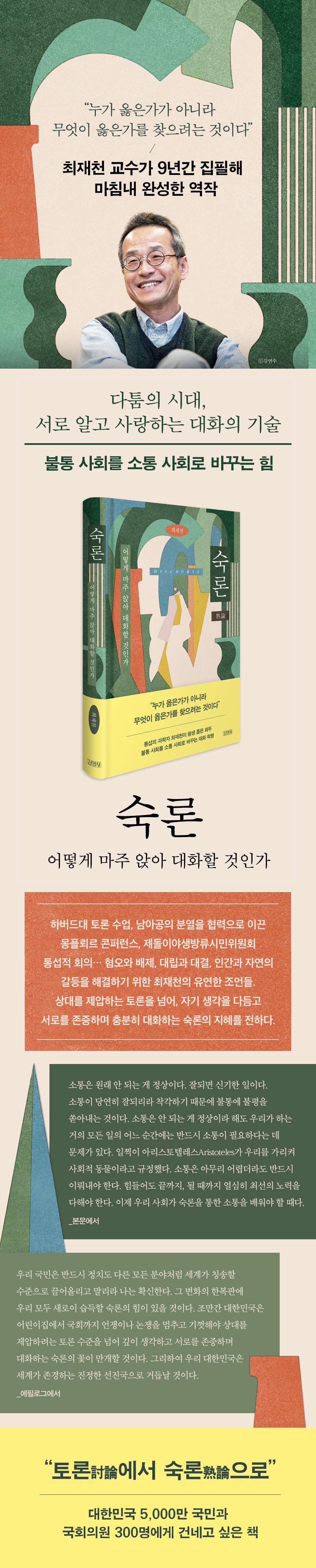
“It’s not about who is right, it’s about what is right.” The lifelong question of Professor Choi Jae-cheon, a scientist of integration A dialogue revolution that transforms a non-communication society into a communicative one. Professor Choi Jae-cheon, an intellectual of our time, is finally publishing his masterpiece, “Sukron,” which he wrote for nine years and completed. In an age of recurring conflict and division, how can we join hands? The solution Professor Choi Jae-cheon found is "Discourse." Deliberation is not a verbal battle that corners the other person, but rather a discussion about why each person's thoughts differ, deliberating together and discussing a problem thoroughly to arrive at a good conclusion. This book contains examples of the author's own experiences leading to discussions on the challenges facing our society and the methods for resolving them. He vividly recounts his experiences as a university professor, including his persistent attempts at debate classes, his process of releasing the dolphin "Jedoli" from an aquarium into the ocean as an ecologist, and his experience as a committee chairman presiding over a meeting to overcome a national crisis. And then he emphasizes that rather than beating each other up, a conversation that examines everything changes communication from a lack of communication to communication. What is the thing we most lack and need right now? It's a proper, face-to-face conversation. It's a conversation about understanding rather than winning. It's not a one-way directive, it's a two-way conversation. It is a conversation where you listen to low voices rather than just raising your own. It's a conversation that seeks rather than insults. It is a conversation that seeks to restore rather than subdue. It is a conversation that tries to reach an agreement rather than destroy it. It's a conversation that flows like tea leaves rather than thunderous squeals. The sum of such conversations is the discussion. Professor Choi Jae-cheon says: Communication is a product of effort. “If a culture of mutual respect and dialogue takes root, moving beyond discussions aimed at dominating the other side, our country will be reborn as a truly advanced nation respected by the entire world,” he hopes. We look forward to the day when a rational society will emerge, where the intensifying conflicts in various fields, including ideology, gender, generation, class, and environment, will diminish. We recommend "Sukron" to the 300 citizens and members of the National Assembly of the Republic of Korea. |
- You can preview some of the book's contents.
Preview
index
Prologue: The Eve of Revolution, the Dawn of Deliberation
Part 1 Homework
The Funny Hell: South Korea's Difficult Problems
Conflict and Communication: For a Wise Society
Ideological Conflict—Is There Nothing Beyond Black and White and Left and Right?
Regional Conflicts: Why Do Small Lands Always Fight?
Class conflict and the conflict between the rich and the poor: What are the facts and truths about poverty?
The Gender Conflict: Are Men and Women Really Different?
Generational Conflict: Is There a Solution to Low Birth Rates and an Aging Population?
Environmental Conflicts: Is Economic and Ecological Balance Possible?
Multicultural Conflict: Conquer or Reconcile?
Part 2 Education
Times when we know and love similar and different views
The collapse of the earth and the collapse of the tiles - the sad reality of our education system
Everyone has the potential to blossom
Don't be dragged along, drag along
Reading, Writing, Speaking
You learn without knowing it
When mixed, it becomes healthy and new.
We must hold hands to survive
3-part sample
Examples of people who don't parrot and talk nonsense
Harvard Students: Asking Questions Rather than Memorizing
Ted Capel - Don't rush right in
Brown Bag Lunch Meetings—Learning from Informal Conversations
Professor Roland Christensen's Workshop - Case Studies
Junior Fellows—Thinking Across Academic Boundaries
The Tongsupwon—from presentations to designated discussions and general discussions—will engage in a collaborative effort.
Committee - Recognize, identify, and resolve problems
Economic Cooperation—Joining Hands to Win the Competition
Part 4: Consolidation
Scenarios for Transforming Communication from Disruption
Comrade Chairman
Jedol Wild Life Release Citizens' Committee
Ministry of Strategy and Finance's Mid- to Long-Term Strategy Committee
Montfleur Conference
COVID-19 Daily Recovery Support Committee
Part 5: Polishing
Skills that lead to desirable deliberations
The purpose of deliberation and the role of the facilitator
Create an appropriate environment
Know thyself
Prepare thoroughly and proceed flexibly.
Agree on the rules first
Allow time to organize your remarks.
Be willing to be a 'good devil'
If it's stuck, split it
If necessary, feign passion.
Even if I speak like a dog, you understand me perfectly
Epilogue_Beyond Discussion to Deliberation
References
Search
Part 1 Homework
The Funny Hell: South Korea's Difficult Problems
Conflict and Communication: For a Wise Society
Ideological Conflict—Is There Nothing Beyond Black and White and Left and Right?
Regional Conflicts: Why Do Small Lands Always Fight?
Class conflict and the conflict between the rich and the poor: What are the facts and truths about poverty?
The Gender Conflict: Are Men and Women Really Different?
Generational Conflict: Is There a Solution to Low Birth Rates and an Aging Population?
Environmental Conflicts: Is Economic and Ecological Balance Possible?
Multicultural Conflict: Conquer or Reconcile?
Part 2 Education
Times when we know and love similar and different views
The collapse of the earth and the collapse of the tiles - the sad reality of our education system
Everyone has the potential to blossom
Don't be dragged along, drag along
Reading, Writing, Speaking
You learn without knowing it
When mixed, it becomes healthy and new.
We must hold hands to survive
3-part sample
Examples of people who don't parrot and talk nonsense
Harvard Students: Asking Questions Rather than Memorizing
Ted Capel - Don't rush right in
Brown Bag Lunch Meetings—Learning from Informal Conversations
Professor Roland Christensen's Workshop - Case Studies
Junior Fellows—Thinking Across Academic Boundaries
The Tongsupwon—from presentations to designated discussions and general discussions—will engage in a collaborative effort.
Committee - Recognize, identify, and resolve problems
Economic Cooperation—Joining Hands to Win the Competition
Part 4: Consolidation
Scenarios for Transforming Communication from Disruption
Comrade Chairman
Jedol Wild Life Release Citizens' Committee
Ministry of Strategy and Finance's Mid- to Long-Term Strategy Committee
Montfleur Conference
COVID-19 Daily Recovery Support Committee
Part 5: Polishing
Skills that lead to desirable deliberations
The purpose of deliberation and the role of the facilitator
Create an appropriate environment
Know thyself
Prepare thoroughly and proceed flexibly.
Agree on the rules first
Allow time to organize your remarks.
Be willing to be a 'good devil'
If it's stuck, split it
If necessary, feign passion.
Even if I speak like a dog, you understand me perfectly
Epilogue_Beyond Discussion to Deliberation
References
Search
Detailed image
Into the book
Why is it that South Koreans, who excel in nearly every aspect of daily life and are the envy of the world, are so incredibly bad at debating? The reason is quite simple.
That's because I didn't learn.
Unlike the West, where all learning is done through discussion from the time children start attending kindergarten, few people in Korea have received proper discussion classes until they graduate from college.
I can't do it because I've never learned it.
So, if you teach it at school from now on, you can do well.
As debate begins to be incorporated into formal education, it will soon be seen that the flowers of debate will bloom everywhere in society.
To prepare for the day when discussions will blossom, we must first train moderators who can lead discussions.
There are countless books out there that teach you how to debate well.
I decided to write a book from a slightly different angle.
--- p.22
I always carry in my heart the story of a new white teacher who was assigned to a school on an Indian reservation in the United States.
When they said they were going to start the test, the children suddenly sat in a circle.
When I told them to sit apart from each other because they had to take a test, the children looked confused and said this.
“We were taught by our elders that when we face difficulties, we should discuss them together.” Some of us have jobs that require us to work alone, but most of us always work in groups.
From the moment they step out of college and into society, almost all of us are thrown into collaborative environments, yet within the school system, our children are taught to stand on their own two feet.
--- p.85
In the run-up to the presidential election, our country's hosts in charge of interviews with candidates are evaluated as excellent hosts only when they ask sharp questions and put the candidates in a difficult position.
Every time something like this happens, I want to ask myself what kind of president we are trying to elect.
The goal seems to be to assess how well they handle unexpected questions. If so, are we perhaps trying to select the loach or eel that excels at improvising, rather than assessing their vision and fairness in governing? While it's never desirable for a conversation or interview to flow too smoothly, the goal shouldn't be to see them flustered by sudden questions.
That's something they only do on variety shows.
--- p.99~100
The Montfleur Conference taught us a valuable lesson: even the most heterogeneous and even hostile opponents can reach a democratic consensus if they share their concerns and imaginations and work together.
Rather than rushing to arrive at a concrete and definitive solution or forcing agreement, we were able to reach a common agreement by talking together beyond our own positions and perspectives.
The role of a neutral third party facilitator is crucial in this process.
The key to success was to invite an excellent facilitator like Adam Kahane, who would listen to all participants' opinions equally and not be swayed by the biased views of any particular group, and give him full authority over the process.
His neutral yet experienced leadership broadened the understanding of the participants, who were often biased, and further influenced the collective thinking of their organizations, ultimately leading to a positive outlook for the ruling political power.
--- p.158~159
It is normal for communication to not work.
If it goes well, it's a miracle.
People complain about communication failures because they mistakenly believe that communication will naturally go well.
Even though it is normal for communication to be lacking, the problem is that communication is necessary at some point in almost everything we do.
Aristotle once defined us as social animals.
Communication must be achieved, no matter how difficult it may be.
Even if it's difficult, you have to work hard and do your best until the end.
Now is the time for our society to learn communication through deliberation.
--- p.160
What underpins the discussion response is, above all, the passion of the moderator.
Yawning isn't the only thing that's contagious.
Passion is also contagious.
When the host yawns, the whole group falls asleep.
However, it is never easy to maintain a passionate attitude throughout the discussion that lasts an hour or two.
However, if you want to conduct excellent discussions, you must train yourself to have a positive mindset.
Passion can also be feigned.
If necessary, you must be willing to postpone.
In the West, we are taught to treat a group of friends “as if they were your first love.”
I have experienced first love countless times throughout my life as a professor.
Although in-depth discussions are much more difficult than one-sided lectures, they are equally exciting.
--- p.196~197
There is a proverb that says, 'Even if you speak like a dog, people will understand you perfectly.'
The ability to grasp the other person's intention and grasp the core message, no matter how difficult the speech, is an important skill in everyday human relationships, but it is by far the most important virtue that a mediator leading a discussion must possess.
Whether it's a conversation or a discussion, it's not about how well you speak, but how well you listen to what the other person says that matters.
--- p.199
When this book comes out, I want to be the first to give it to each and every one of the 300 members of the National Assembly and sign it as a gift.
It's embarrassing, but the first people who need to learn how to sit down and talk to each other are not kindergarteners or elementary school students, but the members of this country's National Assembly.
(…) I am confident that in the near future, our people will elevate politics to a level that will be praised by the world, just like all other fields.
In the midst of that change, there will be a new power of reflection that we all must acquire.
Soon, South Korea will cease its arguments and debates, from daycare centers to the National Assembly, and move beyond the level of discussion aimed at subduing opponents to a place where deep thought, mutual respect, and dialogue blossom.
In this way, our Republic of Korea will be reborn as a truly advanced country respected by the world.
That's because I didn't learn.
Unlike the West, where all learning is done through discussion from the time children start attending kindergarten, few people in Korea have received proper discussion classes until they graduate from college.
I can't do it because I've never learned it.
So, if you teach it at school from now on, you can do well.
As debate begins to be incorporated into formal education, it will soon be seen that the flowers of debate will bloom everywhere in society.
To prepare for the day when discussions will blossom, we must first train moderators who can lead discussions.
There are countless books out there that teach you how to debate well.
I decided to write a book from a slightly different angle.
--- p.22
I always carry in my heart the story of a new white teacher who was assigned to a school on an Indian reservation in the United States.
When they said they were going to start the test, the children suddenly sat in a circle.
When I told them to sit apart from each other because they had to take a test, the children looked confused and said this.
“We were taught by our elders that when we face difficulties, we should discuss them together.” Some of us have jobs that require us to work alone, but most of us always work in groups.
From the moment they step out of college and into society, almost all of us are thrown into collaborative environments, yet within the school system, our children are taught to stand on their own two feet.
--- p.85
In the run-up to the presidential election, our country's hosts in charge of interviews with candidates are evaluated as excellent hosts only when they ask sharp questions and put the candidates in a difficult position.
Every time something like this happens, I want to ask myself what kind of president we are trying to elect.
The goal seems to be to assess how well they handle unexpected questions. If so, are we perhaps trying to select the loach or eel that excels at improvising, rather than assessing their vision and fairness in governing? While it's never desirable for a conversation or interview to flow too smoothly, the goal shouldn't be to see them flustered by sudden questions.
That's something they only do on variety shows.
--- p.99~100
The Montfleur Conference taught us a valuable lesson: even the most heterogeneous and even hostile opponents can reach a democratic consensus if they share their concerns and imaginations and work together.
Rather than rushing to arrive at a concrete and definitive solution or forcing agreement, we were able to reach a common agreement by talking together beyond our own positions and perspectives.
The role of a neutral third party facilitator is crucial in this process.
The key to success was to invite an excellent facilitator like Adam Kahane, who would listen to all participants' opinions equally and not be swayed by the biased views of any particular group, and give him full authority over the process.
His neutral yet experienced leadership broadened the understanding of the participants, who were often biased, and further influenced the collective thinking of their organizations, ultimately leading to a positive outlook for the ruling political power.
--- p.158~159
It is normal for communication to not work.
If it goes well, it's a miracle.
People complain about communication failures because they mistakenly believe that communication will naturally go well.
Even though it is normal for communication to be lacking, the problem is that communication is necessary at some point in almost everything we do.
Aristotle once defined us as social animals.
Communication must be achieved, no matter how difficult it may be.
Even if it's difficult, you have to work hard and do your best until the end.
Now is the time for our society to learn communication through deliberation.
--- p.160
What underpins the discussion response is, above all, the passion of the moderator.
Yawning isn't the only thing that's contagious.
Passion is also contagious.
When the host yawns, the whole group falls asleep.
However, it is never easy to maintain a passionate attitude throughout the discussion that lasts an hour or two.
However, if you want to conduct excellent discussions, you must train yourself to have a positive mindset.
Passion can also be feigned.
If necessary, you must be willing to postpone.
In the West, we are taught to treat a group of friends “as if they were your first love.”
I have experienced first love countless times throughout my life as a professor.
Although in-depth discussions are much more difficult than one-sided lectures, they are equally exciting.
--- p.196~197
There is a proverb that says, 'Even if you speak like a dog, people will understand you perfectly.'
The ability to grasp the other person's intention and grasp the core message, no matter how difficult the speech, is an important skill in everyday human relationships, but it is by far the most important virtue that a mediator leading a discussion must possess.
Whether it's a conversation or a discussion, it's not about how well you speak, but how well you listen to what the other person says that matters.
--- p.199
When this book comes out, I want to be the first to give it to each and every one of the 300 members of the National Assembly and sign it as a gift.
It's embarrassing, but the first people who need to learn how to sit down and talk to each other are not kindergarteners or elementary school students, but the members of this country's National Assembly.
(…) I am confident that in the near future, our people will elevate politics to a level that will be praised by the world, just like all other fields.
In the midst of that change, there will be a new power of reflection that we all must acquire.
Soon, South Korea will cease its arguments and debates, from daycare centers to the National Assembly, and move beyond the level of discussion aimed at subduing opponents to a place where deep thought, mutual respect, and dialogue blossom.
In this way, our Republic of Korea will be reborn as a truly advanced country respected by the world.
--- p.208~210
Publisher's Review
Professor Choi Jae-cheon's masterpiece, "Sukron," which he finally completed after nine years of writing.
How do you sit down and have a conversation with someone who has different views?
A way to communicate and love each other in an age of strife.
It's truly an angry society.
The unprecedented diversity of opinions available on social media and the internet, coupled with the two-way communication between information providers and recipients, is certainly welcome.
However, the problem of lack of communication has come to the forefront, with social media algorithms selectively displaying only information that matches users' political leanings and preferences, and users with similar views grouping together and excluding other views.
Moreover, our society is experiencing unprecedented conflicts and confrontations of various kinds related to ideology, gender, generation, class, and environment.
The phenomenon of "conflicts being revealed to the world rather than sinking beneath the surface" is evidence that our society has become one where expression of opinions is free. However, how to wisely overcome this conflict and cooperate with one another is an urgent and crucial task for us.
Professor Choi Jae-cheon, who raised the topic of 'consilience' while emphasizing that in the 21st century, 'integrated knowledge that freely crosses and connects various fields and creates new things' is needed.
He says that what is most needed to overcome the conflicts in our society today is proper dialogue, and to lay the foundation for making this possible, he is publishing the book "Sukron," which he has been working on for nine years.
In this book, Professor Choi Jae-cheon examines current issues in our society and discusses how conflicting views can transcend confrontation and achieve true communication.
As an educator, an ecologist, and as the chair of a committee formed by a government or social organization, I will present a comprehensive collection of problem-solving, consensus-building, and communication techniques.
Professor Choi Jae-cheon, who has been learning and leading 'student-centered discussion' classes since he studied at Harvard University and served as a teaching assistant in the 1980s, has devoted himself to applying it to our society and education since taking office at Seoul National University in 1994.
In particular, from 2012 to 2013, he served as the chairman of the 'Jedol Wild Release Citizens' Committee', which released five dolphins, including 'Jedol', who had been performing at an aquarium show, back into the wild, and through discussions with experts from various fields, he led the successful release into the wild.
In this way, he has consistently led discussions in the church and society for nearly half a century and has reached one conclusion.
For our society, which has risen to rank among the world's top 10 economies, to leap forward and mature internally, we need not only science and technology, but above all, a culture of reflection.
In doing so, it raises questions about the methods and purposes of debate that the public has become accustomed to seeing in programs such as “100 Minute Debate” and “Baek Ji-yeon’s Final Debate.”
The debate has become an act of “subduing the opponent at all costs,” rather than an act of exchanging opinions and refining one’s own thoughts.
Here, I advocate for deliberation that goes beyond discussion.
Discourse is not a process of finding out ‘Who is right?’ but rather ‘What is right?’
It is an act of thinking together about a problem, discussing it thoroughly, and reaching a good conclusion.
In "Choi Jae-cheon's Study," he asked the question, "How should we learn and live?" In "Sukron," he talks about "How should we sit down and have a conversation?" and hopes that "If a culture of sukron is established where we go beyond discussions aimed at dominating the other person and have conversations with mutual respect, our country will be reborn as a truly advanced country respected by the entire world."
The reflections he presents offer valuable insights not only into our conflict-ridden society but also into our daily lives, where we must engage with those who hold different views.
From the Montfleur Conference in South Africa to the Citizens' Committee for the Release of Wild Animals
The wisdom of careful deliberation to unravel the tangled web of interests
A new public forum that will change the Republic of Korea is unfolding!
《Sukron》 is composed of five parts.
He explains why deliberation is necessary in our society today, provides examples of desirable deliberation, discusses the deliberation scene he personally led, and explains specific methods for ensuring smooth deliberation.
He generously shares the insights, experience, knowledge, and wisdom he has accumulated over 45 years of teaching at a university, drawing readers into a world of exciting debate.
Part 1, “Homework: Interesting Hell, Korea’s Difficult Problems,” takes a close look at our society, which is mired in deep conflict and lack of communication regarding ideology, gender, generation, class, and environment.
Using various sources and evidence, he keenly analyzes the causes and trends of social conflict, and as an animal behaviorist, he compares animal communication with human communication and ponders the difficulties of achieving true communication.
The author believes that conflict has festered and erupted because “our society has not yet developed democratic communication skills,” and proposes the full introduction of a culture of deliberation.
Part 2, “Education: Time to Know and Love Similar and Different Views,” identifies education as the root cause of society’s lack of democratic communication skills and discusses solutions.
The author laments the reality that schools have become “an arena for competition aimed solely at social advancement, rather than a place to learn cooperation and consideration for coexistence,” and likens our education to a situation of “tobungwahae (土崩瓦解),” meaning “the earth is collapsing and the roof tiles are splitting here and there.”
Accordingly, he brings out educational improvement measures such as securing learning diversity and providing in-depth discussions, and preaches the importance of education that encourages discussion and brainstorming together rather than 'standing alone'.
Part 3, “Examples: Parrot Conversations and Nonsense Examples,” contains the author’s insights and practices that he has learned and applied as a student and professor.
He began his study abroad in the United States in 1979 and looks back in detail at how the lecture classes were conducted at Harvard University and other universities.
Why Harvard students are bound to become masters of critical thinking and how the Society of Fellows system in the United States fosters an environment of active interdisciplinary dialogue have significant implications for our education today.
The author's struggles to apply his theories to our educational environment can be seen in the content that follows his return to Korea in 1994 and his appointment as a professor at Seoul National University.
For example, modeled after the American Honorary Society, the Tongseopwon (Unification Garden) was established at Ewha Womans University and regular symposiums are held to hone the methods of discussion.
This article discusses a university course that utilizes group and individual evaluations appropriately to encourage students to actively discuss social issues through committees and to cultivate the ability to work together and independently.
Part 4, “Consilience: Scenarios for Transforming Lack of Communication into Communication,” cites the Montfleur Conference in South Africa as an ideal example of deliberation and recounts the activities of the committee that the author personally led.
The Montfleur Conference was a national meeting held in 1990 to resolve the political turmoil in South Africa following the release of Nelson Mandela.
We invited experts who had led negotiations between opposing groups and held workshops and public communication for about a year to reach a democratic consensus on the direction the country should take.
As a result, we were able to overcome extreme social conflict and move toward trans-ideological and non-partisan cooperation.
This dramatic case demonstrates how important the role of the facilitator is in properly conducting the deliberation process through consensus.
The author also closely examines the comprehensive meetings of the 'Jedol Wild Life Release Citizens' Committee' and the 'Ministry of Strategy and Finance's Mid- to Long-Term Strategy Committee', which he personally led, and advises on the mindset and various conditions necessary for proper deliberation.
The final part 5, “Practice: Techniques for Leading Desirable Deliberation,” provides methods for successful deliberations.
It specifically explains what the role of the facilitator is, what environment and rules should be established, and what is taboo during the deliberation process.
Above all, the author emphasizes the importance of 'listening' by citing the example of anchor Larry King, known as the 'King of Talk Shows.'
The point is that participants must listen to what the other person is saying so carefully that they can understand it “even if it is nonsense.”
Communication is inherently difficult.
The essence of communication and a systematic approach to achieving it.
From a discussion to subdue the opponent, to a discussion to cooperate with the opponent
The author, an animal behaviorist, has spent his life studying animal communication and pondering the lack of communication between humans for a long time, and reveals that he has reached a conclusion that is more simple than expected.
It is said that “it is normal for communication to not work.”
In animal behavior, communication between animals has long been understood as a mutually cooperative behavior, but a new perspective has been proposed that defines it as a deliberate act by the sender to control the receiver.
That is, from that perspective, communication is a process of ‘secret dating’ rather than ‘cooperation’.
The author says that communication, then, is not a one-sided transmission or instruction, but rather something that is achieved through a process of arduous dialogue and compromise between the parties involved.
Rather than being easily discouraged by communication failures, we must take the necessary steps to achieve difficult communication.
“Even if it is normal for communication not to work, communication is necessary at some point in almost everything we do,” he emphasizes, so it must be achieved no matter how difficult it may be.
Here, the phrase “If you know, you love,” which the author has long shared with the public, raises a question about the essence of communication.
As Carnegie, the master of success, said in “How to Win Friends and Influence People,” “Knowledge leads to forgiveness,” we “hate and envy each other because we do not know each other.” Furthermore, “Humans are born with the nature to love each other the more they know each other,” and therefore, he emphasizes that the more entangled we become in our conflicts of interest, the more we need to sit down and talk to each other.
In this way, the author emphasizes the importance of a culture of deliberation and hopes that, like the "salon culture" that flourished in Vienna, Austria in the late 19th and early 20th centuries, an atmosphere of sufficient dialogue and understanding will sprout in our society and daily lives.
Communication is not about being on our side or on your side, but about knowing, understanding, and loving.
Communication is a product of effort.
There are more failed communications in the world than successful communications.
Still, we must communicate.
Rather than setting traps and cornering the opponent, it's about sitting down, thinking things through conversation, and finding good insights.
In an age of strife and conflict, the insights presented in "Sukron" will lead us to true communication.
How do you sit down and have a conversation with someone who has different views?
A way to communicate and love each other in an age of strife.
It's truly an angry society.
The unprecedented diversity of opinions available on social media and the internet, coupled with the two-way communication between information providers and recipients, is certainly welcome.
However, the problem of lack of communication has come to the forefront, with social media algorithms selectively displaying only information that matches users' political leanings and preferences, and users with similar views grouping together and excluding other views.
Moreover, our society is experiencing unprecedented conflicts and confrontations of various kinds related to ideology, gender, generation, class, and environment.
The phenomenon of "conflicts being revealed to the world rather than sinking beneath the surface" is evidence that our society has become one where expression of opinions is free. However, how to wisely overcome this conflict and cooperate with one another is an urgent and crucial task for us.
Professor Choi Jae-cheon, who raised the topic of 'consilience' while emphasizing that in the 21st century, 'integrated knowledge that freely crosses and connects various fields and creates new things' is needed.
He says that what is most needed to overcome the conflicts in our society today is proper dialogue, and to lay the foundation for making this possible, he is publishing the book "Sukron," which he has been working on for nine years.
In this book, Professor Choi Jae-cheon examines current issues in our society and discusses how conflicting views can transcend confrontation and achieve true communication.
As an educator, an ecologist, and as the chair of a committee formed by a government or social organization, I will present a comprehensive collection of problem-solving, consensus-building, and communication techniques.
Professor Choi Jae-cheon, who has been learning and leading 'student-centered discussion' classes since he studied at Harvard University and served as a teaching assistant in the 1980s, has devoted himself to applying it to our society and education since taking office at Seoul National University in 1994.
In particular, from 2012 to 2013, he served as the chairman of the 'Jedol Wild Release Citizens' Committee', which released five dolphins, including 'Jedol', who had been performing at an aquarium show, back into the wild, and through discussions with experts from various fields, he led the successful release into the wild.
In this way, he has consistently led discussions in the church and society for nearly half a century and has reached one conclusion.
For our society, which has risen to rank among the world's top 10 economies, to leap forward and mature internally, we need not only science and technology, but above all, a culture of reflection.
In doing so, it raises questions about the methods and purposes of debate that the public has become accustomed to seeing in programs such as “100 Minute Debate” and “Baek Ji-yeon’s Final Debate.”
The debate has become an act of “subduing the opponent at all costs,” rather than an act of exchanging opinions and refining one’s own thoughts.
Here, I advocate for deliberation that goes beyond discussion.
Discourse is not a process of finding out ‘Who is right?’ but rather ‘What is right?’
It is an act of thinking together about a problem, discussing it thoroughly, and reaching a good conclusion.
In "Choi Jae-cheon's Study," he asked the question, "How should we learn and live?" In "Sukron," he talks about "How should we sit down and have a conversation?" and hopes that "If a culture of sukron is established where we go beyond discussions aimed at dominating the other person and have conversations with mutual respect, our country will be reborn as a truly advanced country respected by the entire world."
The reflections he presents offer valuable insights not only into our conflict-ridden society but also into our daily lives, where we must engage with those who hold different views.
From the Montfleur Conference in South Africa to the Citizens' Committee for the Release of Wild Animals
The wisdom of careful deliberation to unravel the tangled web of interests
A new public forum that will change the Republic of Korea is unfolding!
《Sukron》 is composed of five parts.
He explains why deliberation is necessary in our society today, provides examples of desirable deliberation, discusses the deliberation scene he personally led, and explains specific methods for ensuring smooth deliberation.
He generously shares the insights, experience, knowledge, and wisdom he has accumulated over 45 years of teaching at a university, drawing readers into a world of exciting debate.
Part 1, “Homework: Interesting Hell, Korea’s Difficult Problems,” takes a close look at our society, which is mired in deep conflict and lack of communication regarding ideology, gender, generation, class, and environment.
Using various sources and evidence, he keenly analyzes the causes and trends of social conflict, and as an animal behaviorist, he compares animal communication with human communication and ponders the difficulties of achieving true communication.
The author believes that conflict has festered and erupted because “our society has not yet developed democratic communication skills,” and proposes the full introduction of a culture of deliberation.
Part 2, “Education: Time to Know and Love Similar and Different Views,” identifies education as the root cause of society’s lack of democratic communication skills and discusses solutions.
The author laments the reality that schools have become “an arena for competition aimed solely at social advancement, rather than a place to learn cooperation and consideration for coexistence,” and likens our education to a situation of “tobungwahae (土崩瓦解),” meaning “the earth is collapsing and the roof tiles are splitting here and there.”
Accordingly, he brings out educational improvement measures such as securing learning diversity and providing in-depth discussions, and preaches the importance of education that encourages discussion and brainstorming together rather than 'standing alone'.
Part 3, “Examples: Parrot Conversations and Nonsense Examples,” contains the author’s insights and practices that he has learned and applied as a student and professor.
He began his study abroad in the United States in 1979 and looks back in detail at how the lecture classes were conducted at Harvard University and other universities.
Why Harvard students are bound to become masters of critical thinking and how the Society of Fellows system in the United States fosters an environment of active interdisciplinary dialogue have significant implications for our education today.
The author's struggles to apply his theories to our educational environment can be seen in the content that follows his return to Korea in 1994 and his appointment as a professor at Seoul National University.
For example, modeled after the American Honorary Society, the Tongseopwon (Unification Garden) was established at Ewha Womans University and regular symposiums are held to hone the methods of discussion.
This article discusses a university course that utilizes group and individual evaluations appropriately to encourage students to actively discuss social issues through committees and to cultivate the ability to work together and independently.
Part 4, “Consilience: Scenarios for Transforming Lack of Communication into Communication,” cites the Montfleur Conference in South Africa as an ideal example of deliberation and recounts the activities of the committee that the author personally led.
The Montfleur Conference was a national meeting held in 1990 to resolve the political turmoil in South Africa following the release of Nelson Mandela.
We invited experts who had led negotiations between opposing groups and held workshops and public communication for about a year to reach a democratic consensus on the direction the country should take.
As a result, we were able to overcome extreme social conflict and move toward trans-ideological and non-partisan cooperation.
This dramatic case demonstrates how important the role of the facilitator is in properly conducting the deliberation process through consensus.
The author also closely examines the comprehensive meetings of the 'Jedol Wild Life Release Citizens' Committee' and the 'Ministry of Strategy and Finance's Mid- to Long-Term Strategy Committee', which he personally led, and advises on the mindset and various conditions necessary for proper deliberation.
The final part 5, “Practice: Techniques for Leading Desirable Deliberation,” provides methods for successful deliberations.
It specifically explains what the role of the facilitator is, what environment and rules should be established, and what is taboo during the deliberation process.
Above all, the author emphasizes the importance of 'listening' by citing the example of anchor Larry King, known as the 'King of Talk Shows.'
The point is that participants must listen to what the other person is saying so carefully that they can understand it “even if it is nonsense.”
Communication is inherently difficult.
The essence of communication and a systematic approach to achieving it.
From a discussion to subdue the opponent, to a discussion to cooperate with the opponent
The author, an animal behaviorist, has spent his life studying animal communication and pondering the lack of communication between humans for a long time, and reveals that he has reached a conclusion that is more simple than expected.
It is said that “it is normal for communication to not work.”
In animal behavior, communication between animals has long been understood as a mutually cooperative behavior, but a new perspective has been proposed that defines it as a deliberate act by the sender to control the receiver.
That is, from that perspective, communication is a process of ‘secret dating’ rather than ‘cooperation’.
The author says that communication, then, is not a one-sided transmission or instruction, but rather something that is achieved through a process of arduous dialogue and compromise between the parties involved.
Rather than being easily discouraged by communication failures, we must take the necessary steps to achieve difficult communication.
“Even if it is normal for communication not to work, communication is necessary at some point in almost everything we do,” he emphasizes, so it must be achieved no matter how difficult it may be.
Here, the phrase “If you know, you love,” which the author has long shared with the public, raises a question about the essence of communication.
As Carnegie, the master of success, said in “How to Win Friends and Influence People,” “Knowledge leads to forgiveness,” we “hate and envy each other because we do not know each other.” Furthermore, “Humans are born with the nature to love each other the more they know each other,” and therefore, he emphasizes that the more entangled we become in our conflicts of interest, the more we need to sit down and talk to each other.
In this way, the author emphasizes the importance of a culture of deliberation and hopes that, like the "salon culture" that flourished in Vienna, Austria in the late 19th and early 20th centuries, an atmosphere of sufficient dialogue and understanding will sprout in our society and daily lives.
Communication is not about being on our side or on your side, but about knowing, understanding, and loving.
Communication is a product of effort.
There are more failed communications in the world than successful communications.
Still, we must communicate.
Rather than setting traps and cornering the opponent, it's about sitting down, thinking things through conversation, and finding good insights.
In an age of strife and conflict, the insights presented in "Sukron" will lead us to true communication.
GOODS SPECIFICS
- Date of issue: May 10, 2024
- Format: Hardcover book binding method guide
- Page count, weight, size: 224 pages | 316g | 125*190*17mm
- ISBN13: 9788934950196
- ISBN10: 8934950196
You may also like
카테고리
korean


korean

![GQ KOREA Mark (Monthly): December [2025]](http://librairie.coreenne.fr/cdn/shop/files/8ef265dbbfbf186523ed75ba7319009d.jpg?v=1765340328&width=3840)


