

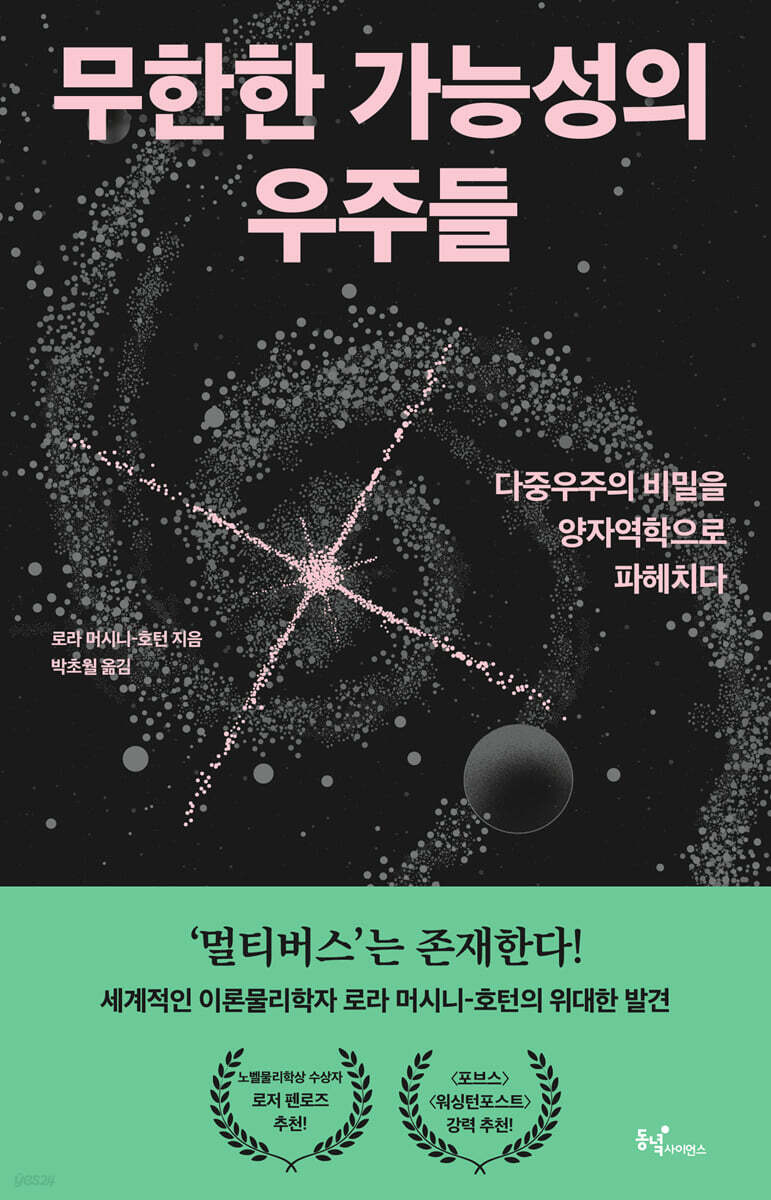
Universes of Infinite Possibilities
 |
Description
Book Introduction
★★ Recommended by Nobel Prize-winning physics professor Roger Penrose! ★★
★★ Highly recommended by Forbes and the Washington Post! ★★
An Albanian female scientist who longed for freedom of knowledge,
The first academic study to find evidence for a multiverse!
Through the ‘quantum multiverse theory’ that shook the physics world
An adventure into a universe of infinite possibilities
In the movie Spider-Man: No Way Home, Spider-Man 'Peter Parker' faces other versions of himself from the 'multiverse'.
In another film set in a multiverse, Everything Everywhere All at Once, many characters close to the main character live in completely different relationships in other universes.
Other universes that exist independently, branching off from the universe in which we exist, so-called 'multiverses' are gaining explosive popularity in various media.
The idea that this universe is not unique and that each universe may have a completely different environment has piqued the interest of many people.
But 'multiverse' is not just a simple science fiction fantasy.
According to the author of this book, Laura Macini-Houghton, a world-renowned cosmologist and theoretical physicist, the multiverse exists and can be scientifically proven.
Until now, the multiverse theory has been accepted in the physics community as a speculative theory that can never be verified.
However, while exploring the process of creation of the universe before the Big Bang, Machinney-Horton derived calculations that the existence of a quantum multiverse was inevitable for the creation of our universe.
It also presents traces of quantum entanglement observed in the sky of our universe as decisive evidence for the multiverse theory.
This book covers a wide range of concepts in astrophysics, quantum mechanics, and quantum cosmology, from inflationary cosmology to quantum mechanics and string theory, and guides readers to the conclusion of the multiverse.
Laura Macini-Horton is the founder of the quantum landscape multiverse theory, a major branch of multiverse theory, and a theoretical physicist who is currently researching the most leading theory on the origin of the multiverse and the universe.
The quantum landscape multiverse theory predicted various observational evidences, including the giant void, and these facts were confirmed by data from the Planck satellite, establishing it as strong evidence for the multiverse.
The background to this radical research by Machinney-Horton lies in the environment in which he was born and raised.
He was born in Albania under a communist dictatorship.
Although he had a great talent for physics and mathematics, there was no way to study natural sciences in Albania at the time.
So he headed alone to America and began his exploration of the vast and vast universe.
This book is a record of the momentous discovery of the "quantum landscape multiverse," and the story of a female scientist who, fueled by her thirst for knowledge, broke free from the small universe that confined her and leaped into the vast expanse of space.
★★ Highly recommended by Forbes and the Washington Post! ★★
An Albanian female scientist who longed for freedom of knowledge,
The first academic study to find evidence for a multiverse!
Through the ‘quantum multiverse theory’ that shook the physics world
An adventure into a universe of infinite possibilities
In the movie Spider-Man: No Way Home, Spider-Man 'Peter Parker' faces other versions of himself from the 'multiverse'.
In another film set in a multiverse, Everything Everywhere All at Once, many characters close to the main character live in completely different relationships in other universes.
Other universes that exist independently, branching off from the universe in which we exist, so-called 'multiverses' are gaining explosive popularity in various media.
The idea that this universe is not unique and that each universe may have a completely different environment has piqued the interest of many people.
But 'multiverse' is not just a simple science fiction fantasy.
According to the author of this book, Laura Macini-Houghton, a world-renowned cosmologist and theoretical physicist, the multiverse exists and can be scientifically proven.
Until now, the multiverse theory has been accepted in the physics community as a speculative theory that can never be verified.
However, while exploring the process of creation of the universe before the Big Bang, Machinney-Horton derived calculations that the existence of a quantum multiverse was inevitable for the creation of our universe.
It also presents traces of quantum entanglement observed in the sky of our universe as decisive evidence for the multiverse theory.
This book covers a wide range of concepts in astrophysics, quantum mechanics, and quantum cosmology, from inflationary cosmology to quantum mechanics and string theory, and guides readers to the conclusion of the multiverse.
Laura Macini-Horton is the founder of the quantum landscape multiverse theory, a major branch of multiverse theory, and a theoretical physicist who is currently researching the most leading theory on the origin of the multiverse and the universe.
The quantum landscape multiverse theory predicted various observational evidences, including the giant void, and these facts were confirmed by data from the Planck satellite, establishing it as strong evidence for the multiverse.
The background to this radical research by Machinney-Horton lies in the environment in which he was born and raised.
He was born in Albania under a communist dictatorship.
Although he had a great talent for physics and mathematics, there was no way to study natural sciences in Albania at the time.
So he headed alone to America and began his exploration of the vast and vast universe.
This book is a record of the momentous discovery of the "quantum landscape multiverse," and the story of a female scientist who, fueled by her thirst for knowledge, broke free from the small universe that confined her and leaped into the vast expanse of space.
- You can preview some of the book's contents.
Preview
index
Prologue: Rewriting the First Chapter of the Space Story
Chapter 1: Is Our Universe Special?
Chapter 2 How did our universe begin?
Chapter 3: Quantum Leap
Chapter 4: The Problem of Fine-Tuning
Chapter 5 Are We Alone?
Chapter 6, 11th dimension
Chapter 7 The First Wave
Chapter 8: Heading into the Multiverse
Chapter 9: The Origin of Our Universe
Chapter 10: Traces of Other Universes
Chapter 11: Infinity and Eternity
Epilogue: Beyond Boundaries and Limits
Acknowledgements
Translator's Note
Chapter 1: Is Our Universe Special?
Chapter 2 How did our universe begin?
Chapter 3: Quantum Leap
Chapter 4: The Problem of Fine-Tuning
Chapter 5 Are We Alone?
Chapter 6, 11th dimension
Chapter 7 The First Wave
Chapter 8: Heading into the Multiverse
Chapter 9: The Origin of Our Universe
Chapter 10: Traces of Other Universes
Chapter 11: Infinity and Eternity
Epilogue: Beyond Boundaries and Limits
Acknowledgements
Translator's Note
Detailed image

Into the book
In this book, I will describe my personal journey through the wonders of the universe, seeking answers to our origins and finding evidence for the vast cosmic family, the multiverse.
Just as the belief that the Earth was at the center of the universe and that the sun, moon, planets, and stars all revolved around our home was overturned, we are now dethroning our universe from its historical position as the center of the universe.
So we are rewriting the story of our origins.
--- p.22
As the 20th century progressed, it became clear that certain microscopic phenomena could not be explained by the laws of classical physics.
In the micro realm, another principle was at work.
The main feature of that principle was not determinism but a perplexing uncertainty.
Over the decades, an entire branch of physics has emerged to deal with uncertainty.
That's quantum theory.
--- p.80
In the quantum universe, information such as energy and momentum (a physical quantity obtained by multiplying mass and velocity) are not fixed to a single value, but can have various values.
This possibility does not exist in the visible world of classical physics.
But the quantum world is made up of wave packets that wiggle and spread out.
The best way to describe the quantum world is to calculate the likelihood (or, in technical terms, the 'probability') of the paths a quantum particle can take.
Because our universe began as a quantum object, Heisenberg's uncertainty principle was inherently rooted in its structure from the time of the primordial universe.
Even the principle remains in the large classical universe visible today.
--- p.102
This is precisely the dilemma facing physicists.
Inflationary cosmology provides a compelling framework for the origin story of the universe.
But it makes one assumption.
The universe began as a tiny, exquisitely smooth, high-energy, finely tuned space.
That's a truly incredible assumption.
Because, given everything we know about how the universe works, the likelihood that our universe began in some anomalous, ordered initial state with near-zero entropy is incredibly low!
--- p.124
No matter what kind of universe we create, we cannot avoid the problem of low probability of its creation.
All models ended in failure.
But at least it helped narrow down the possibilities and figure out what wasn't valid.
What all these thought experiments have in common is that they compare the entropy of a single universe.
I thought.
Perhaps the reason thought experiments consistently fail to explain the origin of the universe by contradicting the second law of thermodynamics is because they assume there is only one universe. The problem lies in the single universe assumption.
I was curious.
Why do physicists continue to hold onto that assumption? What would happen if they abandoned it?
--- p.137~138
Solutions to the Schrödinger equation showed that quantum particles can follow multiple paths.
It is not known in advance which path a particle will choose, and each path has its own probability of occurrence.
What if the quantum particle here were the primordial universe? The set of solutions derived from the equation would imply the possibility of multiple primordial universes.
And each of those primordial universes will have its own unique probability of existence.
Because, based on wave-particle duality, each wave solution can be thought of as its own primordial universe.
In this way, each wave solution corresponds to a primordial universe with its own probability.
From now on, let's call those solutions 'wave-universe solutions'.
--- p.148
The moment all my thought experiments about different starting points of the universe completely failed because of the entropy rule and the second law of thermodynamics, the string theory landscape emerged.
The discovery of string theory was another example of how groundbreaking advances in physics have yielded the same answer to the question of the origin of the universe.
I felt I could no longer ignore the possibility of a multiverse.
--- p.187
According to the possibility of our universe's existence that we have derived, the origin of our universe is neither special nor fine-tuned.
The possibility of its birth was simply increased by 'evolutionary selection' determined by the repulsive gravity and quantum fluctuations.
--- p.245
Our theory that our universe is part of a quantum multiverse provides a consistent and consistent theory of our existence and that of what lies beyond it.
And he made a prediction that was supported by all observations.
Our theory shows that answers about our origins can be derived.
He also proposed a way to scientifically verify the existence of the multiverse through quantum entanglement.
That's why I came to believe in the existence of a vaster, more complex, and more beautiful universe.
Our universe is only a tiny part of a vast multiverse.
--- p.286~287
Multiverse theory may bring about another paradigm shift similar to this one.
By doing so, we may forever change the way we think about the world itself and our place in it.
Just as the belief that the Earth was at the center of the universe and that the sun, moon, planets, and stars all revolved around our home was overturned, we are now dethroning our universe from its historical position as the center of the universe.
So we are rewriting the story of our origins.
--- p.22
As the 20th century progressed, it became clear that certain microscopic phenomena could not be explained by the laws of classical physics.
In the micro realm, another principle was at work.
The main feature of that principle was not determinism but a perplexing uncertainty.
Over the decades, an entire branch of physics has emerged to deal with uncertainty.
That's quantum theory.
--- p.80
In the quantum universe, information such as energy and momentum (a physical quantity obtained by multiplying mass and velocity) are not fixed to a single value, but can have various values.
This possibility does not exist in the visible world of classical physics.
But the quantum world is made up of wave packets that wiggle and spread out.
The best way to describe the quantum world is to calculate the likelihood (or, in technical terms, the 'probability') of the paths a quantum particle can take.
Because our universe began as a quantum object, Heisenberg's uncertainty principle was inherently rooted in its structure from the time of the primordial universe.
Even the principle remains in the large classical universe visible today.
--- p.102
This is precisely the dilemma facing physicists.
Inflationary cosmology provides a compelling framework for the origin story of the universe.
But it makes one assumption.
The universe began as a tiny, exquisitely smooth, high-energy, finely tuned space.
That's a truly incredible assumption.
Because, given everything we know about how the universe works, the likelihood that our universe began in some anomalous, ordered initial state with near-zero entropy is incredibly low!
--- p.124
No matter what kind of universe we create, we cannot avoid the problem of low probability of its creation.
All models ended in failure.
But at least it helped narrow down the possibilities and figure out what wasn't valid.
What all these thought experiments have in common is that they compare the entropy of a single universe.
I thought.
Perhaps the reason thought experiments consistently fail to explain the origin of the universe by contradicting the second law of thermodynamics is because they assume there is only one universe. The problem lies in the single universe assumption.
I was curious.
Why do physicists continue to hold onto that assumption? What would happen if they abandoned it?
--- p.137~138
Solutions to the Schrödinger equation showed that quantum particles can follow multiple paths.
It is not known in advance which path a particle will choose, and each path has its own probability of occurrence.
What if the quantum particle here were the primordial universe? The set of solutions derived from the equation would imply the possibility of multiple primordial universes.
And each of those primordial universes will have its own unique probability of existence.
Because, based on wave-particle duality, each wave solution can be thought of as its own primordial universe.
In this way, each wave solution corresponds to a primordial universe with its own probability.
From now on, let's call those solutions 'wave-universe solutions'.
--- p.148
The moment all my thought experiments about different starting points of the universe completely failed because of the entropy rule and the second law of thermodynamics, the string theory landscape emerged.
The discovery of string theory was another example of how groundbreaking advances in physics have yielded the same answer to the question of the origin of the universe.
I felt I could no longer ignore the possibility of a multiverse.
--- p.187
According to the possibility of our universe's existence that we have derived, the origin of our universe is neither special nor fine-tuned.
The possibility of its birth was simply increased by 'evolutionary selection' determined by the repulsive gravity and quantum fluctuations.
--- p.245
Our theory that our universe is part of a quantum multiverse provides a consistent and consistent theory of our existence and that of what lies beyond it.
And he made a prediction that was supported by all observations.
Our theory shows that answers about our origins can be derived.
He also proposed a way to scientifically verify the existence of the multiverse through quantum entanglement.
That's why I came to believe in the existence of a vaster, more complex, and more beautiful universe.
Our universe is only a tiny part of a vast multiverse.
--- p.286~287
Multiverse theory may bring about another paradigm shift similar to this one.
By doing so, we may forever change the way we think about the world itself and our place in it.
--- p.307
Publisher's Review
Proving the inevitability of the multiverse through quantum mechanics,
Discovering the countless universes intertwined with our own.
How the universe began and what exists beyond it are questions that humans have pondered since ancient times.
The most influential theory about the birth of our universe is currently the 'inflationary cosmology'.
The theory is that a small primordial universe filled with high energy underwent a tremendous explosion and expanded rapidly.
However, according to calculations by Roger Penrose, a physicist who won the 2020 Nobel Prize in Physics, the probability that our universe formed in a state of high energy and very low entropy according to inflationary cosmology is close to zero.
Machinie-Horton tackled this contradiction.
The fact that the possibility of our universe's existence seemed remote meant that there was a problem with the generally accepted theory of its origin.
Stephen Hawking and Roger Penrose have deduced that if our universe has been expanding since its birth, it must have started from a point in space with infinite energy density, a "singularity."
This theorem suggests that no one will ever be able to explore the moment when our universe was born.
Because there was nothing before the birth, and there is no way to reproduce or confirm the conditions that caused the birth of the universe.
The birth of our universe was something beyond the ability of human beings to study.
However, Machinney-Horton believed that they could elucidate the process of creation of our universe, and that the assumption that our universe is unique was the cause of the problem of the possibility of creation of the universe.
He turned to quantum mechanics, which opened new avenues in physics.
Machinie-Horton applied the 'uncertainty principle' based on the wave-particle duality of quantum particles and the 'Schrödinger equation' with 'probability waves' as its solution to the universe.
The answer was also found in the theory of the 'universal wave function' by Hugh Everett, the founder of the 'many-worlds interpretation of quantum mechanics', also known as 'parallel universes'.
Just as a quantum particle has the possibility of choosing from among multiple paths rather than just one predetermined path, the cosmic wave function does not follow a single predetermined path.
If our universe is not the only universe, but rather a branch of many cosmic wave functions, then we can compare the probabilities of the birth of various universes based on the multiverse theory and calculate the probability of our universe's existence!
Machinie-Horton extends the idea to string theory, introducing the concept of a 'string theory landscape', a vast collection of potential energies that could cause the Big Bang.
And it led to the inference that there was not just one initial energy that caused the Big Bang-inflation in the past when the universe began, and gave birth to a single universe.
There was a tremendous amount of energy that could have caused countless Big Bangs that would have created various four-dimensional universes like ours, and our universe is one of many possible quantum universes that have transitioned into a macroscopic universe.
Machinie-Horton went a step further and found evidence of an observable multiverse in our own universe.
When the universe is born, the branches of the cosmic wave function change from a quantum object to a macroscopic universe through 'decoherence'.
Machinie-Horton predicted that traces of decoherence would remain in our universe.
They presented various observational evidences, such as the existence of a giant void in the sky where matter is very sparse compared to other places, and the temperature of the cosmic background radiation being lower than expected.
And in 2013, the anomaly predicted by Massini-Houghton and his colleagues was discovered in the cosmic microwave background observed by the Planck satellite.
This is the first real evidence for a multiverse in academia.
The 21st Century's Copernican Shift: The 'Multiverse' Paradigm!
Writing a New History of the Universe with Multiverse Theory
The idea that our universe is unique is a belief that physicists, including Einstein, have long held firmly.
Many physicists also assume that our universe is special, based on the "anthropic principle," which explains the properties of the physical world through the very existence of humans.
But if we assume that our universe is the only universe, the possibility of the universe's creation becomes almost impossible.
We even come to the conclusion that the very birth of our universe required a meticulous 'fine-tuning', as if by a god-like being.
Laura Macini-Horton rejected this contradiction and proposed a new theory that contradicts existing theories.
Just as Copernicus and Galileo overturned the belief that the sun and planets revolve around the earth, and Heisenberg proposed a world of uncertainty rather than a determined world, it can be said that they opened new horizons in cosmology.
Machinie-Horton traces her tenacious research drive back to her childhood.
Albania's dictatorship used its power to suppress intellectuals, and his father, an economist with outstanding abilities, was shunned by his colleagues.
In a society where pleasing the government was more important than scientific achievement, Macinty-Horton longed for a wider world.
Albania's oppressive environment constantly forced me to question facts and imagine beyond its borders.
Leaving his homeland to study space, he questioned established theories and, without giving up, continued his explorations to resolve contradictions.
German philosopher Arthur Schopenhauer said this:
“Truth passes through three stages.
“At first it is ridiculed, then it faces fierce opposition, and then it is accepted as self-evident.” The multiverse theory was long considered experimental and fanciful, but today many scientists are embracing the possibility of a multiverse.
This book captivatingly unfolds the multiverse theory, which will serve as a paradigm for the new era, by intersecting it with the author's own life.
Readers who wish to encounter the multiverse theory, the Copernican shift of the 21st century, will be able to embark on a journey into a universe of infinite possibilities with this book.
Discovering the countless universes intertwined with our own.
How the universe began and what exists beyond it are questions that humans have pondered since ancient times.
The most influential theory about the birth of our universe is currently the 'inflationary cosmology'.
The theory is that a small primordial universe filled with high energy underwent a tremendous explosion and expanded rapidly.
However, according to calculations by Roger Penrose, a physicist who won the 2020 Nobel Prize in Physics, the probability that our universe formed in a state of high energy and very low entropy according to inflationary cosmology is close to zero.
Machinie-Horton tackled this contradiction.
The fact that the possibility of our universe's existence seemed remote meant that there was a problem with the generally accepted theory of its origin.
Stephen Hawking and Roger Penrose have deduced that if our universe has been expanding since its birth, it must have started from a point in space with infinite energy density, a "singularity."
This theorem suggests that no one will ever be able to explore the moment when our universe was born.
Because there was nothing before the birth, and there is no way to reproduce or confirm the conditions that caused the birth of the universe.
The birth of our universe was something beyond the ability of human beings to study.
However, Machinney-Horton believed that they could elucidate the process of creation of our universe, and that the assumption that our universe is unique was the cause of the problem of the possibility of creation of the universe.
He turned to quantum mechanics, which opened new avenues in physics.
Machinie-Horton applied the 'uncertainty principle' based on the wave-particle duality of quantum particles and the 'Schrödinger equation' with 'probability waves' as its solution to the universe.
The answer was also found in the theory of the 'universal wave function' by Hugh Everett, the founder of the 'many-worlds interpretation of quantum mechanics', also known as 'parallel universes'.
Just as a quantum particle has the possibility of choosing from among multiple paths rather than just one predetermined path, the cosmic wave function does not follow a single predetermined path.
If our universe is not the only universe, but rather a branch of many cosmic wave functions, then we can compare the probabilities of the birth of various universes based on the multiverse theory and calculate the probability of our universe's existence!
Machinie-Horton extends the idea to string theory, introducing the concept of a 'string theory landscape', a vast collection of potential energies that could cause the Big Bang.
And it led to the inference that there was not just one initial energy that caused the Big Bang-inflation in the past when the universe began, and gave birth to a single universe.
There was a tremendous amount of energy that could have caused countless Big Bangs that would have created various four-dimensional universes like ours, and our universe is one of many possible quantum universes that have transitioned into a macroscopic universe.
Machinie-Horton went a step further and found evidence of an observable multiverse in our own universe.
When the universe is born, the branches of the cosmic wave function change from a quantum object to a macroscopic universe through 'decoherence'.
Machinie-Horton predicted that traces of decoherence would remain in our universe.
They presented various observational evidences, such as the existence of a giant void in the sky where matter is very sparse compared to other places, and the temperature of the cosmic background radiation being lower than expected.
And in 2013, the anomaly predicted by Massini-Houghton and his colleagues was discovered in the cosmic microwave background observed by the Planck satellite.
This is the first real evidence for a multiverse in academia.
The 21st Century's Copernican Shift: The 'Multiverse' Paradigm!
Writing a New History of the Universe with Multiverse Theory
The idea that our universe is unique is a belief that physicists, including Einstein, have long held firmly.
Many physicists also assume that our universe is special, based on the "anthropic principle," which explains the properties of the physical world through the very existence of humans.
But if we assume that our universe is the only universe, the possibility of the universe's creation becomes almost impossible.
We even come to the conclusion that the very birth of our universe required a meticulous 'fine-tuning', as if by a god-like being.
Laura Macini-Horton rejected this contradiction and proposed a new theory that contradicts existing theories.
Just as Copernicus and Galileo overturned the belief that the sun and planets revolve around the earth, and Heisenberg proposed a world of uncertainty rather than a determined world, it can be said that they opened new horizons in cosmology.
Machinie-Horton traces her tenacious research drive back to her childhood.
Albania's dictatorship used its power to suppress intellectuals, and his father, an economist with outstanding abilities, was shunned by his colleagues.
In a society where pleasing the government was more important than scientific achievement, Macinty-Horton longed for a wider world.
Albania's oppressive environment constantly forced me to question facts and imagine beyond its borders.
Leaving his homeland to study space, he questioned established theories and, without giving up, continued his explorations to resolve contradictions.
German philosopher Arthur Schopenhauer said this:
“Truth passes through three stages.
“At first it is ridiculed, then it faces fierce opposition, and then it is accepted as self-evident.” The multiverse theory was long considered experimental and fanciful, but today many scientists are embracing the possibility of a multiverse.
This book captivatingly unfolds the multiverse theory, which will serve as a paradigm for the new era, by intersecting it with the author's own life.
Readers who wish to encounter the multiverse theory, the Copernican shift of the 21st century, will be able to embark on a journey into a universe of infinite possibilities with this book.
GOODS SPECIFICS
- Date of issue: May 3, 2024
- Page count, weight, size: 332 pages | 416g | 135*210*17mm
- ISBN13: 9788990247872
- ISBN10: 899024787X
You may also like
카테고리
korean


korean

![GQ KOREA Mark (Monthly): December [2025]](http://librairie.coreenne.fr/cdn/shop/files/8ef265dbbfbf186523ed75ba7319009d.jpg?v=1765340328&width=3840)


