

A tribute to the ordinary yet brilliant life
 |
Description
Book Introduction
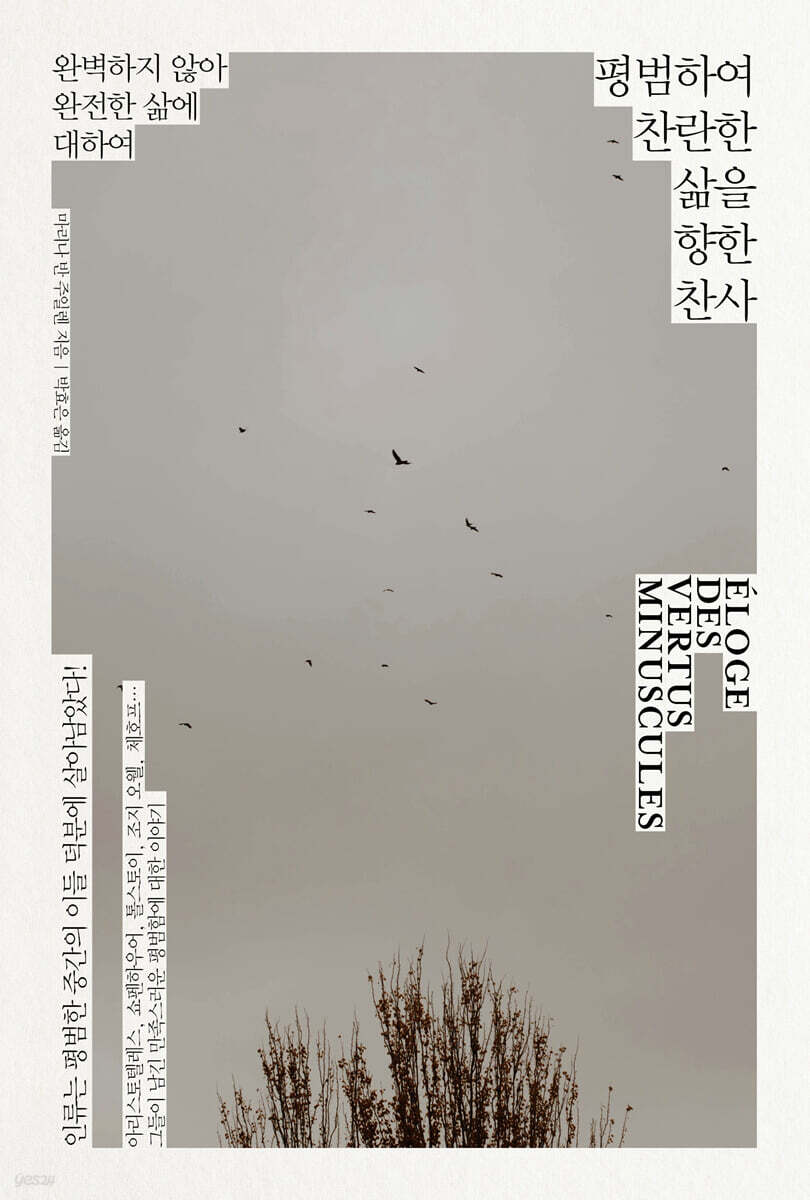
Aristotle, Spinoza, Tolstoy, George Orwell, Chekhov… The true truth of life realized by wise men around the world Who hasn't pondered, "How should I live?" and "What constitutes a successful life?" We seek answers to these questions because we want to live better, to live without regrets. But finding the answer is not easy, and there are many people who have never found the answer in their entire lives. For us, “In Praise of an Ordinary and Brilliant Life” will provide a hint. This book is the result of a long and patient collection of numerous records left by world-renowned sages praising the ordinary. Wise men such as Aristotle, Nietzsche, Spinoza, Tolstoy, and Chekhov highly valued the 'ordinary life' of moderation, neither too much nor too little. We tend to think that if we can't be something great, we're nothing. But many wise men say that life is already complete and perfect enough, even if it is trivial and ordinary. Seeing this message, which should sound an alarm in our current fiercely competitive society where performance is the priority and ability is the norm, naturally leads us to consider and decide where to set the standards for our lives. A life of ordinary brilliance is not the fulfillment of vain ambitions or cowardly compromises, but the effort to see others with different eyes, the desire to see the invisible, and the will to be interested in what lies hidden behind the flashy success. So, we learn greatly even from lowly places, find beauty in the insignificant, and see hope even in despair. I sincerely hope that this book will serve as a special guide to discovering the beauty of the ordinary yet brilliant, the small yet meaningful. |
- You can preview some of the book's contents.
Preview
index
Prologue
Chapter 1: Aren't you hesitant to think, 'That's enough'?
A normal and decent life
Writing about the never-so-easy 'ordinariness'
Is mediocrity a virtue or a vice?
Why have we come to avoid moderation?
Chapter 2 Even if you nod your head to Schopenhauer's words
A story that appeals to you when you're young
The difference between "Enough is enough" and boredom
Chapter 3: What Happens When You Fear Other People's Eyes
Why We Are Dissatisfied with Our Lives
Success doesn't mean it's over
If you wish for your rival's failure
When you are obsessed with the approval of others
Chapter 4: Exploring the Mind of "Enough is Enough"
Talk about the extraordinary ordinary
Don't be afraid to be different
There is a world that is unfamiliar to others.
Pay attention to small gestures
May you be as generous to others as you are to me.
Chapter 5: Looking at the Inconspicuous
The tyranny of meritocracy
Ordinariness that supports specialness
To find beauty in ordinary things
High and low
Chapter 6: When Labor Becomes Art
The value of labor that we don't know much about
The saying that outstanding individuals change the world
There is no such thing as trivial in the world.
Chapter 7: What is Important and What is Trivial
Why Manual Laborers Are Less Respected
Pay homage to even the most insignificant life
Chapter 8: Empathic Imagination to Avoid Prematurely Judging Others' Values
Don't judge people too quickly
Blurring the Line Between Excellence and Ordinariness
Chapter 9: On Giving Up the Aspiration for Perfection
The dignity of ordinary people
An attitude of thinking together without confrontation
Chapter 10: Fame Has a Downside, Success Has a Downside
What George Eliot Noticed
The process is more important than the result.
When small aspirations become excellence
Living life to the fullest
Can you be indifferent to success?
The ordinary and the extraordinary can be in harmony.
Chapter 11: Proust, Chekhov, and Naipaul's Refusal to Distinct
Proust's Geniuses
The power of novels that look at ordinary people
Finding the extraordinary in the ordinary, even if no one notices
Chapter 12: For the extraordinary hidden within each of us
The identity hidden behind anonymity
Failure is a part of life.
epilogue
main
Chapter 1: Aren't you hesitant to think, 'That's enough'?
A normal and decent life
Writing about the never-so-easy 'ordinariness'
Is mediocrity a virtue or a vice?
Why have we come to avoid moderation?
Chapter 2 Even if you nod your head to Schopenhauer's words
A story that appeals to you when you're young
The difference between "Enough is enough" and boredom
Chapter 3: What Happens When You Fear Other People's Eyes
Why We Are Dissatisfied with Our Lives
Success doesn't mean it's over
If you wish for your rival's failure
When you are obsessed with the approval of others
Chapter 4: Exploring the Mind of "Enough is Enough"
Talk about the extraordinary ordinary
Don't be afraid to be different
There is a world that is unfamiliar to others.
Pay attention to small gestures
May you be as generous to others as you are to me.
Chapter 5: Looking at the Inconspicuous
The tyranny of meritocracy
Ordinariness that supports specialness
To find beauty in ordinary things
High and low
Chapter 6: When Labor Becomes Art
The value of labor that we don't know much about
The saying that outstanding individuals change the world
There is no such thing as trivial in the world.
Chapter 7: What is Important and What is Trivial
Why Manual Laborers Are Less Respected
Pay homage to even the most insignificant life
Chapter 8: Empathic Imagination to Avoid Prematurely Judging Others' Values
Don't judge people too quickly
Blurring the Line Between Excellence and Ordinariness
Chapter 9: On Giving Up the Aspiration for Perfection
The dignity of ordinary people
An attitude of thinking together without confrontation
Chapter 10: Fame Has a Downside, Success Has a Downside
What George Eliot Noticed
The process is more important than the result.
When small aspirations become excellence
Living life to the fullest
Can you be indifferent to success?
The ordinary and the extraordinary can be in harmony.
Chapter 11: Proust, Chekhov, and Naipaul's Refusal to Distinct
Proust's Geniuses
The power of novels that look at ordinary people
Finding the extraordinary in the ordinary, even if no one notices
Chapter 12: For the extraordinary hidden within each of us
The identity hidden behind anonymity
Failure is a part of life.
epilogue
main
Detailed image

Into the book
An ordinary and decent life is not the fulfillment of vain ambitions or cowardly compromises, but the effort to look at others with different eyes.
The will to take an interest in what is hidden behind the sensational success.
--- p.29
If we are all warp and weft woven together in a vast tapestry, what meaning does it have to distinguish between superior and inferior?
--- p.107
Instead of assuming we can see everything clearly, let's reserve judgment.
Things that are invisible to the eye only reveal themselves when we pay attention to them.
The most trivial things can free us from the tyranny of the trivial and the important.
--- p.129
The biggest obstacle that stood in the way of my journey to becoming ordinary and okay was my stubborn belief that I could achieve anything only through myself and my own abilities.
--- p.136
To find beauty in ordinary things, we must break free from the dichotomous distinction between high and low, beautiful and ugly.
--- p.156
To take being ordinary in a negative sense is to ignore your own potential.
But when the seemingly inconspicuous ordinary takes us in a better direction, our innate nature expands our world.
The world is not an empty place that needs to be filled, but a place where something that is already filled is waiting to become bigger.
I think of it as a force that encourages us to train our ability, so to speak, to build the muscles that allow us to move forward.
--- p.252
They were not disappointed in their ordinary lives, did not think of themselves as inferior, and were able to flourish in their own place.
Isn't their talent to live their own lives, free from the harsh distinctions made by hasty judgments?
Thus, they gained the freedom to live in the present.
As Virginia Woolf said, for them, “the present moment was enough, and everything was in it.”
The will to take an interest in what is hidden behind the sensational success.
--- p.29
If we are all warp and weft woven together in a vast tapestry, what meaning does it have to distinguish between superior and inferior?
--- p.107
Instead of assuming we can see everything clearly, let's reserve judgment.
Things that are invisible to the eye only reveal themselves when we pay attention to them.
The most trivial things can free us from the tyranny of the trivial and the important.
--- p.129
The biggest obstacle that stood in the way of my journey to becoming ordinary and okay was my stubborn belief that I could achieve anything only through myself and my own abilities.
--- p.136
To find beauty in ordinary things, we must break free from the dichotomous distinction between high and low, beautiful and ugly.
--- p.156
To take being ordinary in a negative sense is to ignore your own potential.
But when the seemingly inconspicuous ordinary takes us in a better direction, our innate nature expands our world.
The world is not an empty place that needs to be filled, but a place where something that is already filled is waiting to become bigger.
I think of it as a force that encourages us to train our ability, so to speak, to build the muscles that allow us to move forward.
--- p.252
They were not disappointed in their ordinary lives, did not think of themselves as inferior, and were able to flourish in their own place.
Isn't their talent to live their own lives, free from the harsh distinctions made by hasty judgments?
Thus, they gained the freedom to live in the present.
As Virginia Woolf said, for them, “the present moment was enough, and everything was in it.”
--- p.327
Publisher's Review
“How should we live our one life?”
In search of the meaning of life, the reason for existence, and the dignity of life
"Who am I?", "How should I live?", "What constitutes a successful life?", "What must I do to live happily?" Who hasn't asked themselves these questions at some point in their lives? Regardless of age, we struggle to find answers to these questions throughout our lives.
But finding the answer is not easy, and many people never find it throughout their lives.
Here's my own answer.
From the past to the present, many spiritual teachers and wise men have sought the true truth of life, the 'brilliance of an ordinary life.'
No matter how great a life is, there are disappointments.
So, we must face reality and try to discover the beauty that comes from an imperfect, yet perfectly ordinary life.
Some might say that an ordinary life is a lowly achievement, but life is a series of unexpected events and chance encounters, each with its own meaning and specialness, and is already sufficient in itself.
If you take an interest in the ordinary and inconspicuous things in life, you will be able to find the meaning of life and the reason for existence, which is a lifelong task.
“Don’t fly too high, don’t fly too low!”
On the beauty of moderation, neither excessive nor deficient
We are caught up in an excessive obsession with success.
So, we think and act with the purpose and goal of life as social 'success'.
But the tall pine trees are often shaken by the wind, the highest towers are more likely to collapse, and the mountaintops are often struck by lightning.
The author of this book, Marina van Zylen, also set her life's goal as success rather than happiness.
But through some opportunity, we realize that the true truth of life is not apparent on the surface, comes from trivial things, and can be obtained from ordinary life.
After that, I started researching the 'specialness that comes from the ordinary' and discovered that world-renowned sages have been 'praising the ordinary' for a long time.
This book is the result of a long period of collecting countless records, and it allows us to understand what we should truly value throughout our lives.
Mediocrity doesn't mean cowardly compromise, premature surrender, or being content with the status quo.
An ordinary life is an effort to see others with different eyes, a desire to see the invisible, and a willingness to be interested in what lies behind the flashy success.
So, we learn greatly even from lowly places, find beauty in the insignificant, and see hope even in despair.
Could there be a more splendid life than this? So, as we live, we must constantly discover the value of ordinary, yet splendid, life.
“The only task left for us is to ‘find the extraordinary in the ordinary’!”
The true truth of life realized by wise men around the world
How can there be specialness without the ordinary? Only when we stop taking ordinary days for granted can we find the extraordinary in ordinary life.
Because of this, many wise men have discovered lessons in ordinary life.
Aristotle said, “Beware of extremes and value moderation,” and he considered mediocrity as gold, calling it the “golden mean.” The world-renowned author Tolstoy spent his entire life striving and yearning to become an ordinary person.
Spinoza, the philosopher of philosophers, placed greater value on the invisible, saying, “Our life is made up of constant change, and our character is formed and changed by small, ordinary events that are invisible to the eye.”
In addition, world-renowned sages from the past to the present, such as Nietzsche, Anton Chekhov, George Eliot, George Orwell, Paul Fleming, and Virginia Woolf, have continuously paid tribute to the ordinary yet brilliant life.
So how should we live now? There's only one life task left for us.
‘Finding the extraordinary in the ordinary.’
There is no more valuable goal in life.
In search of the meaning of life, the reason for existence, and the dignity of life
"Who am I?", "How should I live?", "What constitutes a successful life?", "What must I do to live happily?" Who hasn't asked themselves these questions at some point in their lives? Regardless of age, we struggle to find answers to these questions throughout our lives.
But finding the answer is not easy, and many people never find it throughout their lives.
Here's my own answer.
From the past to the present, many spiritual teachers and wise men have sought the true truth of life, the 'brilliance of an ordinary life.'
No matter how great a life is, there are disappointments.
So, we must face reality and try to discover the beauty that comes from an imperfect, yet perfectly ordinary life.
Some might say that an ordinary life is a lowly achievement, but life is a series of unexpected events and chance encounters, each with its own meaning and specialness, and is already sufficient in itself.
If you take an interest in the ordinary and inconspicuous things in life, you will be able to find the meaning of life and the reason for existence, which is a lifelong task.
“Don’t fly too high, don’t fly too low!”
On the beauty of moderation, neither excessive nor deficient
We are caught up in an excessive obsession with success.
So, we think and act with the purpose and goal of life as social 'success'.
But the tall pine trees are often shaken by the wind, the highest towers are more likely to collapse, and the mountaintops are often struck by lightning.
The author of this book, Marina van Zylen, also set her life's goal as success rather than happiness.
But through some opportunity, we realize that the true truth of life is not apparent on the surface, comes from trivial things, and can be obtained from ordinary life.
After that, I started researching the 'specialness that comes from the ordinary' and discovered that world-renowned sages have been 'praising the ordinary' for a long time.
This book is the result of a long period of collecting countless records, and it allows us to understand what we should truly value throughout our lives.
Mediocrity doesn't mean cowardly compromise, premature surrender, or being content with the status quo.
An ordinary life is an effort to see others with different eyes, a desire to see the invisible, and a willingness to be interested in what lies behind the flashy success.
So, we learn greatly even from lowly places, find beauty in the insignificant, and see hope even in despair.
Could there be a more splendid life than this? So, as we live, we must constantly discover the value of ordinary, yet splendid, life.
“The only task left for us is to ‘find the extraordinary in the ordinary’!”
The true truth of life realized by wise men around the world
How can there be specialness without the ordinary? Only when we stop taking ordinary days for granted can we find the extraordinary in ordinary life.
Because of this, many wise men have discovered lessons in ordinary life.
Aristotle said, “Beware of extremes and value moderation,” and he considered mediocrity as gold, calling it the “golden mean.” The world-renowned author Tolstoy spent his entire life striving and yearning to become an ordinary person.
Spinoza, the philosopher of philosophers, placed greater value on the invisible, saying, “Our life is made up of constant change, and our character is formed and changed by small, ordinary events that are invisible to the eye.”
In addition, world-renowned sages from the past to the present, such as Nietzsche, Anton Chekhov, George Eliot, George Orwell, Paul Fleming, and Virginia Woolf, have continuously paid tribute to the ordinary yet brilliant life.
So how should we live now? There's only one life task left for us.
‘Finding the extraordinary in the ordinary.’
There is no more valuable goal in life.
GOODS SPECIFICS
- Date of issue: May 10, 2024
- Page count, weight, size: 360 pages | 434g | 135*200*20mm
- ISBN13: 9791193866030
- ISBN10: 1193866030
You may also like
카테고리
korean


korean

![ELLE 엘르 스페셜 에디션 A형 : 12월 [2025]](http://librairie.coreenne.fr/cdn/shop/files/b8e27a3de6c9538896439686c6b0e8fb.jpg?v=1766436872&width=3840)


