

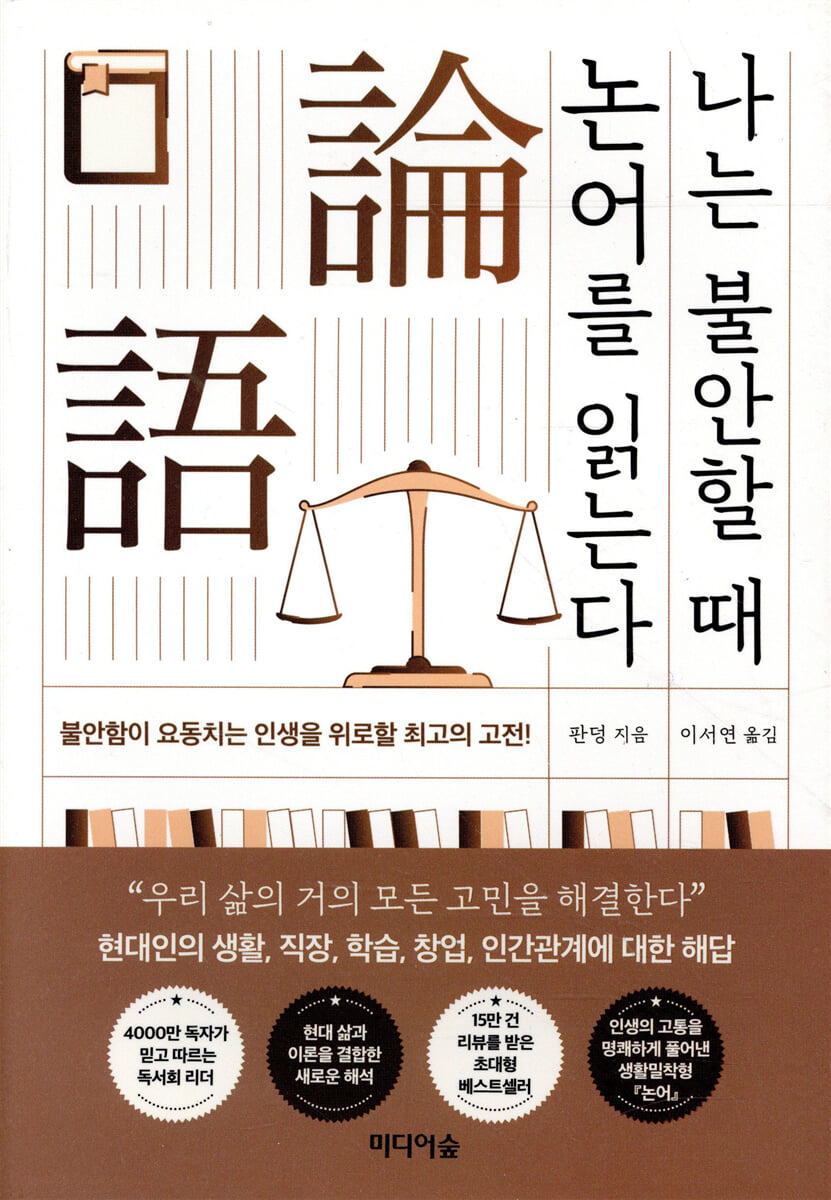
When I'm anxious, I read the Analects.
 |
Description
Book Introduction
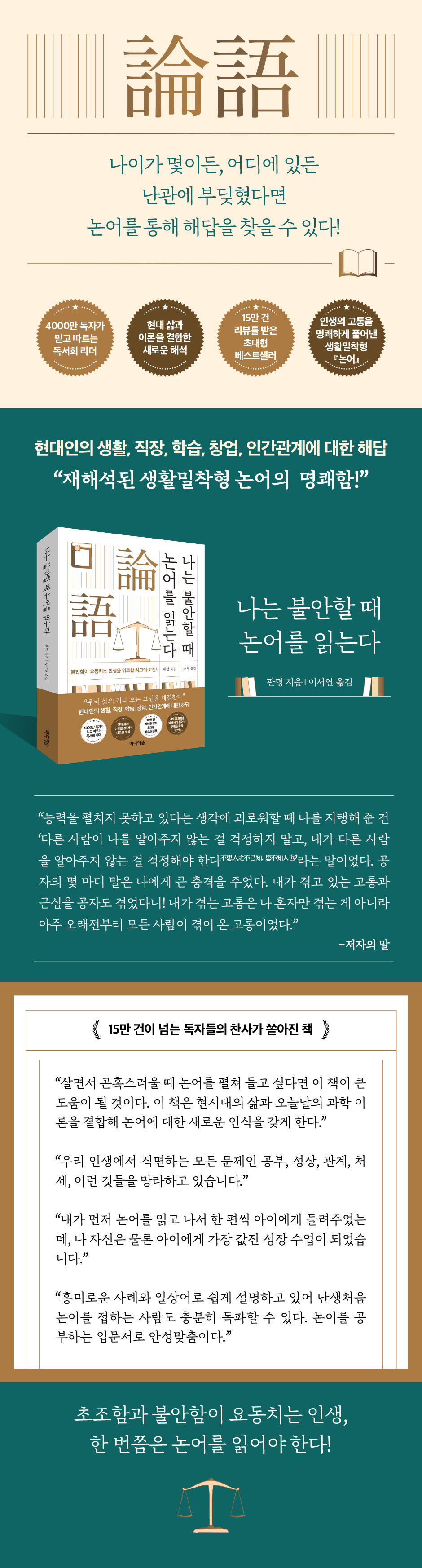
“Aren’t you glad to find the answer in the Analects?” You must read the Analects at least once in your life. The answer to all the suffering we experience in life Confucius already put it out two thousand years ago The author of this book, Pandeung, is the leader of the 'Pandeung Reading Club', which has over 40 million members. He broke down the cultural barriers between the East and the West, transcended Chinese and Western classics, and reinterpreted the Analects of Confucius so that it could be applied to real life. The 2,000-year-old wisdom and principles of Confucius contained in the Analects are explained in a user-friendly way so that anyone can easily understand them and apply them directly to real life. After graduating from graduate school, the author joined China Central Television, but suffered from extreme stress and lethargy. He always lived with the worry, "What if I lose my job? What if the program goes downhill again? What if I can't pay my rent?" Sometimes I couldn't sleep because of anxiety. In a moment of crisis, the book that saved him was the Analects of Confucius. The author, who encountered the Analects at a time when he was unable to take a single step forward due to anxiety and impatience, went on to study the Analects tirelessly, searching for and reading every copy of the Analects in the world. The Analects of Confucius is the greatest classic in the East, and numerous interpretations have been published. However, in this book, I Read the Analects of Confucius When I'm Anxious, the author explains the Analects of Confucius in a way that makes it particularly applicable to real life. The unique feature of this book is that it interprets the Analects of Confucius through the lens of modern life and gives it new life. It verifies Confucius's claims with theories based on modern science, and conveys his teachings in a way that even elementary school students can understand through a variety of interesting examples. This book, which conveys the wisdom and practical principles of Confucius in a way that is relevant to today's reality, will help us solve almost all the problems we face in life, work, learning, starting a business, and interpersonal relationships. |
- You can preview some of the book's contents.
Preview
index
Preface: The Analects of Confucius are what raised me.
Part 1: The Mindset toward Learning Rules the World
Hakishi Wetland
: A single sentence from the Analects can change your life.
A gentleman is not a man of principle
: The Amazing Power of Small Habits
Skillful words and good manners, fresh and benevolent
: Avoid subordinates who only look at their boss's expressions.
Oil Samsung Osin I examine myself three times a day
: Three questions that touch the heart
Respect and trust
: The power of cleaning to clear a cluttered mind
If you have the power to do it, you can learn it.
: Treat your children like other people, and treat other people like your children.
Hyeonhyeonyeoksaek (賢賢易色)
: Let go of your external obsession and focus on your inner self.
If it is not weighty, it is not powerful.
: The power of gravity and dignity
Shin Jong-chu-won (愼終追遠)
: When you realize the infinity of the universe and the finiteness of life, your heart becomes gentle.
On, Ryang, Gong, Geom, Yang 溫, 良, 恭, 儉, 讓
: Five Virtues of Confucius That Cannot Be Acquired Even If You Aspire to Them Your Whole Life
Three years of unchanging fatherly path
: Preserve family precepts more than the family business passed down through generations.
For the use of propriety, harmony is noble.
: Everyday Harmony Found in Yuja's Recipe
Singeun-eoui, Gongjin-eo-rye, trust in the new righteousness, respect in the past.
: A small person keeps a promise at the cost of his life, while Confucius lies to survive.
Geomugu-an, where there is no peace
: Desire is fulfilled, but desire is not.
Bini Rakdo, Buiho Rye
: Even if you are poor, do not be mean, and even if you are rich, do not be arrogant.
A person who does not know himself is not a person who does not know himself.
: Don't sow bad seeds and expect good results.
Part 2: Twenty-Four Stories for Becoming a Leader Who Shines Like the North Star
Like the North Dragon
: The Virtues of a Leader That Shine Soberly Like the North Star
Samusa 思無邪
: The pure and harmonious sound of the heart contained in the Book of Poetry
The way is through virtue
: The quality of a leader who makes people follow the rules without forcing them
Thirty-two chapters
: A state of life that is gradually raised
Sajiirye (事之以禮)
: Since ancient times, filial piety has meant not breaking etiquette.
Parental abandonment, father, mother, 其其疾之憂
: Hyoran, from the beginning, is to take full responsibility for my life.
Jayumunhyo 子游問孝
: Filial piety has always been about treating one's parents with respect.
Color difficulty
: Hyo-ran has always looked at her parents with a smiling face.
Returning is not foolish
: A Study on the Problem Within the Problem
人焉瘦哉
: Confucius's insight into the character of others in three ways
Ongojishin 溫故而knownew
: We all become someone's teacher.
Gentleman's fire flag
: The first virtue of a gentleman is antifragility, which possesses both strength and flexibility.
precedence
: The second virtue of a gentleman is to be quick in his work and careful in his speech.
A gentleman is not compared to others.
: The third virtue of a gentleman: wise unity that is independent yet harmonious.
If you think but don't learn, you're in danger.
: Learn but think diligently, think but do not be lazy in learning.
The Gongho Heresy Attacks
: Even Zhuangzi, who befriended the forest, and Laozi, who knew the laws of nature, were friends.
不知爲不Knowing
: Knowing what you know and what you don't know is what makes a true intellectual.
Jajanghakganrok (子張學干祿)
: If you want to get promoted, be careful with your words and act without regrets.
King Geojikjojeo
: Talent selection method learned from the Chinese character 'deul geo (擧)'
Geoseon paganism is impossible.
: In times of trouble, remember respect, loyalty, and encouragement.
Hyohoyuhyo 孝乎惟孝
: Politics is not about enjoying power, but about exerting influence.
If a person has no faith, he does not know what he can do.
: When you feel lonely, drive a wedge of trust.
Even if it's hundreds of years old, it can be known for hundreds of years
: Predicting the future with confidence in national culture
If you see that righteousness is not in action, you have no courage.
: Draw your sword when you must do something.
Part 3, Eighth Day: Etiquette and Music to Look Back on When Your Mind is Uneasy
Is it tolerable, who is intolerance?
: Do not hinder the will of good nature.
The three families are 『Yong』cheol
: Power cannot change etiquette.
How can a person not be benevolent and not be polite?
: Etiquette is meaningless to a dull-minded person.
Here, Yeonggeom and his charm, Ninggeom
: The foundation of courtesy is a gentle and compassionate heart.
Yi Jeok-ji You-gun 夷狄之有君
: A true nation can function without a ruler, but with music and rites.
Gyessiryeoeotaesan mountain 季氏旅於泰山
: Pay homage to your ancestors with pure respect and longing.
A gentleman has no quarrels
: Three Principles for Competing Like a Gentleman
Ohaigwanjijae 吾何以觀之哉
: Three Bad Etiquettes Leaders Should Avoid
I do not desire to observe the five virtues of ...
: Confucius's lament on the rituals of the pragmatists
The theory of the body and mind or the question?
: Humans who perform sacrifices, succeeding Homo sapiens
Taking a sin from heaven, there is no place to pray
: King Yeomra is easy to meet, but evil spirits are difficult to deal with.
Child's Buddha's injury
: Be purely joyful and truly sad.
Foot, that is, the foot of the five-neng-jing-ji, 則吾能徵之矣
: The etiquette and music that must be passed down and preserved
Oh Jong-ju
: Confucius' admiration for the developed rites and music
You have to have a musical instrument.
: Confucius, a music critic and performer, loved music.
Jinseonjinmi 盡善盡美
: Confucius's critique of the king using music as a metaphor
The heavenly general uses the husband as a wooden bell
: The popularity of Confucius armed with 'On, Ryang, Gong, Geom, Yang'
Questions and Answers
: Saying you don't know what you don't know is an example.
Shooting without master's skin
: Learning etiquette through a sport that has lost its originality.
The four nobles are to be treated with courtesy, and the people are to be treated with courtesy.
: Flattery and courtesy are fundamentally different.
The king is courteous to his subjects, and his subjects are loyal to their ruler.
: A reasonable leader does not demand loyalty from his employees.
Ah, I love the ceremony
: Even as times change, the essence of etiquette must be preserved.
Conclusion_ Aren’t you glad to have found the answer in the Analects?
Detailed image
Into the book
** Confucius was not far away.
The pain and anxiety I'm experiencing, even Confucius experienced it! My problems aren't mine alone; they've been a common struggle for a very long time.
My suffering was limited to rent and work.
However, during the Spring and Autumn Period and the Warring States Period when Confucius lived, there were many life-or-death matters.
Confucius did not worry about the suffering of hunger or the lack of fame.
I felt ecstatic about the enlightenment I had about the Analects, which contained these teachings of Confucius.
** Confucius' three sayings permeate our lives.
First, Confucius's words, "Learn and master in due time," explain how to deal with the difficulties of study.
Next, the sentence “Friends come from far away” teaches us how to cooperate and respond to people.
The last sentence, “If people don’t recognize you, don’t you get angry? Isn’t that what a gentleman is like?” explains the state of cultivation.
Confucius seems to have preached at once how to deal with every difficulty a person might encounter in life.
** Let us keep in mind Confucius's words: "Among those who 'dress up their words skillfully and put on a good face,' there are few virtuous people."
People who over-exaggerate themselves tend to act in an attempt to look cool when they lack confidence.
True joy, interest, and affection need not be exaggerated, and respect that comes from the heart does not need to be expressed in an exaggerated way.
** Confucius not only emphasized the purpose of learning, but also explained the content of learning in considerable detail.
One of the things Confucius emphasized most was etiquette.
Confucius emphasized the importance of studying etiquette, saying, “If you do not learn etiquette, you will not be able to stand upright.”
However, this does not mean that I have only repeatedly emphasized the importance of etiquette.
The six arts, or the six manners spoken of by Confucius, are a combination of basic etiquette education and music, archery, horseback riding, writing, and mathematics.
In particular, Confucius pointed out the importance of the Book of Songs by saying, “If you do not learn poetry, you will not be able to speak. 不學詩, 無以言”
** The difference between Zigong and Confucius lies in ‘seeking’ and ‘not seeking.’
The man who was trying to save her tried to force himself into bondage by exerting his strength.
On the other hand, Confucius was neither impatient nor overworked, nor did he worry about his conduct or restrain himself.
Confucius truly enjoyed a life without money.
** Confucius realized that morality and etiquette protect humanity, so he was able to achieve a comfortable and enjoyable state where he could 'act as he pleased without breaking the rules.'
The reason people feel restricted and distressed because they think that morals, etiquette, and norms do not match what they want is because their level of awareness is not yet high enough.
** Confucius first points out that filial piety is only considered as support.
For example, the idea is that filial piety is when a child provides a house for their parents, buys them a car, takes them on trips together, and gives them pocket money.
But Confucius said, “You can raise dogs and horses too.”
Even animals are not neglectful of their care, he asks, “What difference does it make if we do not respect them?”
If you don't have respect for your parents, it's no different from raising a dog or a horse.
** Confucius's perspective on judging people is more strict than Mencius'.
He says that we must understand people in three parts.
Look at the person's actions, examine the reasons, and examine their comfort.
If I were to summarize these three in one word, they would be ‘mission,’ ‘vision,’ and ‘values.’
** There are many problems that cannot be solved by just thinking about them with your own head.
If you read books written by ancient people, you will find that someone has already tried to solve these problems.
We just need to take the answers they found and use them.
However, rather than simply copying it, you should add your own thoughts and judgment.
And furthermore, you can combine what you have learned and your thoughts to come up with new methods.
** Society must have the virtue of tolerance.
There are also people like Zhuangzi who do not hold official positions and live with the forest as their friend.
There are also people like Lao Tzu who live freely, leaving nature to its own devices.
There are also people like Mozi who work for the public good.
And there are people like Yang Ju who say, “Even if I could benefit the world by plucking a single hair, I would not do it.”
We must accept that people's personalities are diverse.
The more diverse a society is, the fewer side effects and harms it has.
** Confucius preached, 'People should adhere to the three paths of wisdom, benevolence, and courage.'
A wise man is not deluded, a virtuous man is not anxious, and a courageous man knows no fear.
Confucius's words, "If you see righteousness and do not act on it, you lack courage," come from this context.
** Confucius, Mencius, and Wang Yangming all said that everyone must practice.
Why do people practice continuously? The purpose of practice is to steadily improve our ability to feel happiness.
Confucius could be happy anytime, anywhere, and could look at the changes in the world with a positive attitude.
Confucius was a man with a strong ability to feel happiness.
The pain and anxiety I'm experiencing, even Confucius experienced it! My problems aren't mine alone; they've been a common struggle for a very long time.
My suffering was limited to rent and work.
However, during the Spring and Autumn Period and the Warring States Period when Confucius lived, there were many life-or-death matters.
Confucius did not worry about the suffering of hunger or the lack of fame.
I felt ecstatic about the enlightenment I had about the Analects, which contained these teachings of Confucius.
** Confucius' three sayings permeate our lives.
First, Confucius's words, "Learn and master in due time," explain how to deal with the difficulties of study.
Next, the sentence “Friends come from far away” teaches us how to cooperate and respond to people.
The last sentence, “If people don’t recognize you, don’t you get angry? Isn’t that what a gentleman is like?” explains the state of cultivation.
Confucius seems to have preached at once how to deal with every difficulty a person might encounter in life.
** Let us keep in mind Confucius's words: "Among those who 'dress up their words skillfully and put on a good face,' there are few virtuous people."
People who over-exaggerate themselves tend to act in an attempt to look cool when they lack confidence.
True joy, interest, and affection need not be exaggerated, and respect that comes from the heart does not need to be expressed in an exaggerated way.
** Confucius not only emphasized the purpose of learning, but also explained the content of learning in considerable detail.
One of the things Confucius emphasized most was etiquette.
Confucius emphasized the importance of studying etiquette, saying, “If you do not learn etiquette, you will not be able to stand upright.”
However, this does not mean that I have only repeatedly emphasized the importance of etiquette.
The six arts, or the six manners spoken of by Confucius, are a combination of basic etiquette education and music, archery, horseback riding, writing, and mathematics.
In particular, Confucius pointed out the importance of the Book of Songs by saying, “If you do not learn poetry, you will not be able to speak. 不學詩, 無以言”
** The difference between Zigong and Confucius lies in ‘seeking’ and ‘not seeking.’
The man who was trying to save her tried to force himself into bondage by exerting his strength.
On the other hand, Confucius was neither impatient nor overworked, nor did he worry about his conduct or restrain himself.
Confucius truly enjoyed a life without money.
** Confucius realized that morality and etiquette protect humanity, so he was able to achieve a comfortable and enjoyable state where he could 'act as he pleased without breaking the rules.'
The reason people feel restricted and distressed because they think that morals, etiquette, and norms do not match what they want is because their level of awareness is not yet high enough.
** Confucius first points out that filial piety is only considered as support.
For example, the idea is that filial piety is when a child provides a house for their parents, buys them a car, takes them on trips together, and gives them pocket money.
But Confucius said, “You can raise dogs and horses too.”
Even animals are not neglectful of their care, he asks, “What difference does it make if we do not respect them?”
If you don't have respect for your parents, it's no different from raising a dog or a horse.
** Confucius's perspective on judging people is more strict than Mencius'.
He says that we must understand people in three parts.
Look at the person's actions, examine the reasons, and examine their comfort.
If I were to summarize these three in one word, they would be ‘mission,’ ‘vision,’ and ‘values.’
** There are many problems that cannot be solved by just thinking about them with your own head.
If you read books written by ancient people, you will find that someone has already tried to solve these problems.
We just need to take the answers they found and use them.
However, rather than simply copying it, you should add your own thoughts and judgment.
And furthermore, you can combine what you have learned and your thoughts to come up with new methods.
** Society must have the virtue of tolerance.
There are also people like Zhuangzi who do not hold official positions and live with the forest as their friend.
There are also people like Lao Tzu who live freely, leaving nature to its own devices.
There are also people like Mozi who work for the public good.
And there are people like Yang Ju who say, “Even if I could benefit the world by plucking a single hair, I would not do it.”
We must accept that people's personalities are diverse.
The more diverse a society is, the fewer side effects and harms it has.
** Confucius preached, 'People should adhere to the three paths of wisdom, benevolence, and courage.'
A wise man is not deluded, a virtuous man is not anxious, and a courageous man knows no fear.
Confucius's words, "If you see righteousness and do not act on it, you lack courage," come from this context.
** Confucius, Mencius, and Wang Yangming all said that everyone must practice.
Why do people practice continuously? The purpose of practice is to steadily improve our ability to feel happiness.
Confucius could be happy anytime, anywhere, and could look at the changes in the world with a positive attitude.
Confucius was a man with a strong ability to feel happiness.
--- From the text
Publisher's Review
A reading club leader trusted and followed by 40 million readers,
The Analects of Confucius, a practical and practical explanation of the Pandeong!
Starting with the Analects, I started reading in a haphazard manner.
Shake off all your anxieties and worries and live a dignified life.
The purpose of this book is not to establish another academic 'standard' for the Analects, of which numerous Orientalist interpretations already exist.
The author says that he has no intention of engaging in academic debate with this book.
The main motivation for writing this book was to share with many readers my experience of overcoming anxiety and finding a new path in life by reading the Analects when I was facing a life crisis.
Based on your understanding, how can you apply the Analects to your life?
He says he just wants to explain how it can be applied and how it relates to the present era.
So, the author tried to avoid as many of the stiff Chinese sentences and vague and abstract old terms that come to mind when we think of the Analects.
Eliminating outdated phrases that are rarely used in real life, it explains Confucius's enlightenment in an easy-to-understand way using modern terms and everyday language.
The episodes introduced here and there in connection with each sentence in the Analects are all the more relatable because they are things we commonly experience in our daily lives.
And by finding sentences from the Analects that fit it, and interpreting each Chinese character, he gives great enlightenment.
There is also the fun of reading the sentences Confucius speaks of, and hitting your knees and thinking, 'Aha, so this kind of insight was hidden in this phrase I knew.'
The author's writing, which avoids unnecessary solemnity and uses a light, colloquial style, even exudes excitement.
The author's sincere hope that the Analects will be closely connected to everyone's lives and provide enlightenment in both work and daily life warmly touches the hearts of readers.
If you are anxious, read the Analects!
A classic that transcends time,
I'm taking on the Analects for the first time in my life.
The author explains the Analects in a very accessible way using friendly language and modern examples, but never compromises in delving into the essence of the Analects.
By combining dozens of versions interpreted by historical masters of Oriental studies, including Ju Hee, Nam Hoe-geun, Jeon Mok, and Yang Baek-jun, the essence of the Analects was explored, and by citing Eastern and Western classics, the literary and aesthetic perfection was enhanced.
Each interpretation attempted in this book combines modern scientific theory with research analysis of ancient and modern scholarly perspectives.
In addition, the contents of the Analects were verified using Western psychology and modern brain science.
The Analects are interpreted in a practical and witty way, making it easy to understand the text, so even readers who are new to the Analects can read through it with ease.
In particular, the author demonstrates his special talent as a reading group leader by introducing world-famous works related to each part of the Analects, allowing readers to engage in an engaging reading experience.
The Analects of Confucius is a classic that appears in all kinds of recommended reading lists even in modern times.
It is also a book that frequently appears in many tests and interviews, from hiring at large corporations and public corporations to hiring civil servants.
That's why I count it as a book that everyone must read at least once in their life.
In fact, the Analects of Confucius solve almost all of our problems in life.
Now, under the guidance of Pan Deng, the leader of 40 million readers, let us truly understand the wisdom of the Analects, the greatest classic of the East, and find answers to the question of how to live.
The Analects of Confucius, a practical and practical explanation of the Pandeong!
Starting with the Analects, I started reading in a haphazard manner.
Shake off all your anxieties and worries and live a dignified life.
The purpose of this book is not to establish another academic 'standard' for the Analects, of which numerous Orientalist interpretations already exist.
The author says that he has no intention of engaging in academic debate with this book.
The main motivation for writing this book was to share with many readers my experience of overcoming anxiety and finding a new path in life by reading the Analects when I was facing a life crisis.
Based on your understanding, how can you apply the Analects to your life?
He says he just wants to explain how it can be applied and how it relates to the present era.
So, the author tried to avoid as many of the stiff Chinese sentences and vague and abstract old terms that come to mind when we think of the Analects.
Eliminating outdated phrases that are rarely used in real life, it explains Confucius's enlightenment in an easy-to-understand way using modern terms and everyday language.
The episodes introduced here and there in connection with each sentence in the Analects are all the more relatable because they are things we commonly experience in our daily lives.
And by finding sentences from the Analects that fit it, and interpreting each Chinese character, he gives great enlightenment.
There is also the fun of reading the sentences Confucius speaks of, and hitting your knees and thinking, 'Aha, so this kind of insight was hidden in this phrase I knew.'
The author's writing, which avoids unnecessary solemnity and uses a light, colloquial style, even exudes excitement.
The author's sincere hope that the Analects will be closely connected to everyone's lives and provide enlightenment in both work and daily life warmly touches the hearts of readers.
If you are anxious, read the Analects!
A classic that transcends time,
I'm taking on the Analects for the first time in my life.
The author explains the Analects in a very accessible way using friendly language and modern examples, but never compromises in delving into the essence of the Analects.
By combining dozens of versions interpreted by historical masters of Oriental studies, including Ju Hee, Nam Hoe-geun, Jeon Mok, and Yang Baek-jun, the essence of the Analects was explored, and by citing Eastern and Western classics, the literary and aesthetic perfection was enhanced.
Each interpretation attempted in this book combines modern scientific theory with research analysis of ancient and modern scholarly perspectives.
In addition, the contents of the Analects were verified using Western psychology and modern brain science.
The Analects are interpreted in a practical and witty way, making it easy to understand the text, so even readers who are new to the Analects can read through it with ease.
In particular, the author demonstrates his special talent as a reading group leader by introducing world-famous works related to each part of the Analects, allowing readers to engage in an engaging reading experience.
The Analects of Confucius is a classic that appears in all kinds of recommended reading lists even in modern times.
It is also a book that frequently appears in many tests and interviews, from hiring at large corporations and public corporations to hiring civil servants.
That's why I count it as a book that everyone must read at least once in their life.
In fact, the Analects of Confucius solve almost all of our problems in life.
Now, under the guidance of Pan Deng, the leader of 40 million readers, let us truly understand the wisdom of the Analects, the greatest classic of the East, and find answers to the question of how to live.
GOODS SPECIFICS
- Publication date: March 30, 2022
- Page count, weight, size: 320 pages | 522g | 148*215*30mm
- ISBN13: 9791158741426
- ISBN10: 1158741421
You may also like
카테고리
korean


korean

![ELLE 엘르 스페셜 에디션 A형 : 12월 [2025]](http://librairie.coreenne.fr/cdn/shop/files/b8e27a3de6c9538896439686c6b0e8fb.jpg?v=1766436872&width=3840)


