

The world of plants
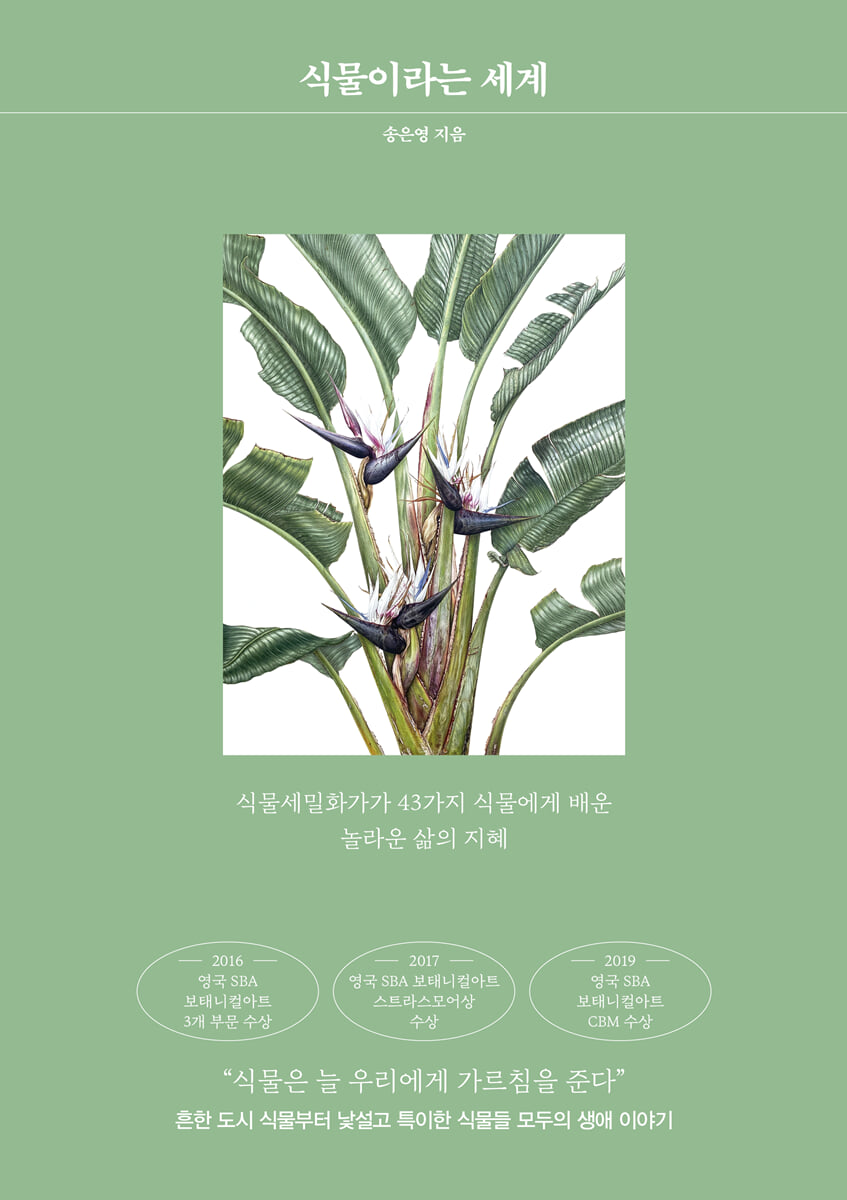 |
Description
Book Introduction
“Plants always teach us.”
The life stories of everything from common urban plants to the unfamiliar and unique.
The crocus, an early spring plant that blooms as soon as the snow on the ground melts, waits for seven years in the dark ground before blooming, and then blooms in early spring, ends its short two-week life cycle, and enters a long dormancy.
The holly tree, an evergreen shrub that remains green even in winter, also has its own hidden story.
The holly tree, with its green leaves that stand out in the pure white forest, has developed thorns as a tool for self-protection because it is easily spotted by herbivores.
Just like humans, plants are born, grow, protect themselves, grow old, get sick, and die.
This book contains 43 plant drawings and stories about the plants by botanical artist Song Eun-young, who spends her days looking at, observing, and drawing plants.
From the allergy at Hantaek Botanical Garden to the midsummer holly tree encountered at Cheonripo Forest, to the story of the tiger thorn tree encountered at Kew Gardens, the Royal Botanical Gardens located in southwest London.
We can also find comfort and empathy for our lives through the stories of 43 species of four-season plants that most closely resemble human life.
As you look at the detailed plant illustrations, which include basic information about the plants, their habitats, flowering periods, and flower language, along with their life stories, you will realize that it is only natural that we love plants.
The life stories of everything from common urban plants to the unfamiliar and unique.
The crocus, an early spring plant that blooms as soon as the snow on the ground melts, waits for seven years in the dark ground before blooming, and then blooms in early spring, ends its short two-week life cycle, and enters a long dormancy.
The holly tree, an evergreen shrub that remains green even in winter, also has its own hidden story.
The holly tree, with its green leaves that stand out in the pure white forest, has developed thorns as a tool for self-protection because it is easily spotted by herbivores.
Just like humans, plants are born, grow, protect themselves, grow old, get sick, and die.
This book contains 43 plant drawings and stories about the plants by botanical artist Song Eun-young, who spends her days looking at, observing, and drawing plants.
From the allergy at Hantaek Botanical Garden to the midsummer holly tree encountered at Cheonripo Forest, to the story of the tiger thorn tree encountered at Kew Gardens, the Royal Botanical Gardens located in southwest London.
We can also find comfort and empathy for our lives through the stories of 43 species of four-season plants that most closely resemble human life.
As you look at the detailed plant illustrations, which include basic information about the plants, their habitats, flowering periods, and flower language, along with their life stories, you will realize that it is only natural that we love plants.
- You can preview some of the book's contents.
Preview
index
Entering 20
1.
Seven Years of Waiting: Allergy
2.
Thinking Beads: Mogamju Tree
3.
Minimalist: Tillandsia
4.
Sacred Tree: Holly
5.
Silver Furry: Edelweiss
6.
Red Carpet: Seoksan
7.
Hitchhikers: Bigfoot, Goblin Needle, Burdock Fruit
8.
All-rounder: Lotus
9.
The Thinker: Pansy
10.
Good Brothers: Chilean Pine
11.
Eight Colors: Hydrangea
12.
Wise Stove: Sitting Fan
13.
Red Gold: Saffron
14.
Plan B: Goldenrod
15.
Flower that resembles a clock: Passionflower
16.
Designer: Paphiopedilum Roskildianum
17.
Naming Shop Regular Customer: Boksucho
18.
Lotus blooming on a tree: White Magnolia
19.
Hide and Seek: Fig
20.
Little Giant: Seoul Violet
21.
Queen of the Night: Moonlight Beauty
22.
Rainbow Goddess: German Iris
23.
The Number Hunter: The Venus Flytrap
24.
The Thousand-Year-Old Doctor: Jum
25.
Living with others: Yago, Saesam, and Mistletoe
26.
Dark Horse: Reed
27.
Customized Service: Licorice Bird of Paradise
28.
Goddess of Beauty: Hawaiian Rose of Sharon
29.
Flashback: Lilac
30.
Stink Strategy: Stapelia gigantea, Rafflesia arnoldii, Titan arum
31.
White Angels in the Forest: Silverbells, Silverbells, and Snowdrops
32.
Living Fossil: The Oxtail
33.
Self-replication: Lily of the valley
34.
Bamboo shoots after a rain: Wangdae
35.
Dramatic Moment: Banksia Prionotes
Dictionary of Plant Terms
1.
Seven Years of Waiting: Allergy
2.
Thinking Beads: Mogamju Tree
3.
Minimalist: Tillandsia
4.
Sacred Tree: Holly
5.
Silver Furry: Edelweiss
6.
Red Carpet: Seoksan
7.
Hitchhikers: Bigfoot, Goblin Needle, Burdock Fruit
8.
All-rounder: Lotus
9.
The Thinker: Pansy
10.
Good Brothers: Chilean Pine
11.
Eight Colors: Hydrangea
12.
Wise Stove: Sitting Fan
13.
Red Gold: Saffron
14.
Plan B: Goldenrod
15.
Flower that resembles a clock: Passionflower
16.
Designer: Paphiopedilum Roskildianum
17.
Naming Shop Regular Customer: Boksucho
18.
Lotus blooming on a tree: White Magnolia
19.
Hide and Seek: Fig
20.
Little Giant: Seoul Violet
21.
Queen of the Night: Moonlight Beauty
22.
Rainbow Goddess: German Iris
23.
The Number Hunter: The Venus Flytrap
24.
The Thousand-Year-Old Doctor: Jum
25.
Living with others: Yago, Saesam, and Mistletoe
26.
Dark Horse: Reed
27.
Customized Service: Licorice Bird of Paradise
28.
Goddess of Beauty: Hawaiian Rose of Sharon
29.
Flashback: Lilac
30.
Stink Strategy: Stapelia gigantea, Rafflesia arnoldii, Titan arum
31.
White Angels in the Forest: Silverbells, Silverbells, and Snowdrops
32.
Living Fossil: The Oxtail
33.
Self-replication: Lily of the valley
34.
Bamboo shoots after a rain: Wangdae
35.
Dramatic Moment: Banksia Prionotes
Dictionary of Plant Terms
Detailed image

Into the book
The azalea, which spends seven years waiting in the dark ground before blooming, blooms in early spring, completes its short two-week life cycle, and then enters a long dormancy.
The reason why the flower language of the perennial plant, the crocus, which hibernates and blooms new flowers every spring, is 'endure even if sad' may be because it is a word written knowing the life of the crocus, which 'finally' blooms after a long seven-year wait underground and enjoys the short early spring, but endures sorrow because it can bloom every year.
--- p.29
The large-flowered sedge, which reproduces only by seed, was originally a plant native to North America, but is now a naturalized plant widely spread throughout Asia and other regions.
It has become the most common species in our country because it adapts well to a variety of habitats, from dry to humid places.
The large-leaved yam grows up to 2 m tall and produces fruit with strong thorns.
The fruit itself is poisonous, so if it becomes food for animals, it is excreted and the species never has a chance to reproduce.
That is why the strong thorns of the fruit are the great thornbush's desperate struggle to propagate its species.
--- p.58
When I looked closely at the burdock root, I saw, 'Don't just look at the skin.
I am reminded of a passage I read in the Talmud: 'Look at what is inside.'
Although it may seem useless and annoying on the surface, the wisdom it imparts to human life is incomparable to anything else.
--- p.63
The name pansy is said to have been given because the flower buds of the pansy face sideways when they emerge from the leaf axils, and they appear to be tilted slightly like a 'thinking person', resembling a person lost in thought.
This is also why one of the flower languages of pansy is ‘contemplation.’
Because of the pansy's other flower language, 'think of me', in Europe, people confess their love by giving pansies as gifts on Saint Valentine's Day.
--- p.73
The fig tree, one of the oldest fruit trees in the world and even mentioned in the Bible, is said to have been planted in Egypt 4,000 years ago.
If you look at the engraving “Adam and Eve” by Albrecht Durer, a great 16th-century German Renaissance painter, you can see Adam and Eve from the Old Testament covering themselves with fig leaves in shame after eating the forbidden fruit. You can feel the intricate shape of the realistic fig leaves.
--- p.118
The flowers of the Licorice bird-of-paradise, native to South Africa, are more than twice as large as the commonly known bird-of-paradise flowers.
It is 45 cm long and 18 cm high and resembles the birds of paradise, the national bird of Papua New Guinea.
Known as the most beautiful bird in the world, the bird of paradise is famous for the long, elaborate plumage of the male, which is very showy and beautiful.
The shape and color of the feathers of the bird of paradise spread out vigorously during courtship are very similar to those of the bird of paradise flower, so the bird of paradise flower is called the giant white bird of paradise flower, using the same name as the bird of paradise, and comparing it to the unique color and size of the licorice bird of paradise flower.
The reason why the flower language of the perennial plant, the crocus, which hibernates and blooms new flowers every spring, is 'endure even if sad' may be because it is a word written knowing the life of the crocus, which 'finally' blooms after a long seven-year wait underground and enjoys the short early spring, but endures sorrow because it can bloom every year.
--- p.29
The large-flowered sedge, which reproduces only by seed, was originally a plant native to North America, but is now a naturalized plant widely spread throughout Asia and other regions.
It has become the most common species in our country because it adapts well to a variety of habitats, from dry to humid places.
The large-leaved yam grows up to 2 m tall and produces fruit with strong thorns.
The fruit itself is poisonous, so if it becomes food for animals, it is excreted and the species never has a chance to reproduce.
That is why the strong thorns of the fruit are the great thornbush's desperate struggle to propagate its species.
--- p.58
When I looked closely at the burdock root, I saw, 'Don't just look at the skin.
I am reminded of a passage I read in the Talmud: 'Look at what is inside.'
Although it may seem useless and annoying on the surface, the wisdom it imparts to human life is incomparable to anything else.
--- p.63
The name pansy is said to have been given because the flower buds of the pansy face sideways when they emerge from the leaf axils, and they appear to be tilted slightly like a 'thinking person', resembling a person lost in thought.
This is also why one of the flower languages of pansy is ‘contemplation.’
Because of the pansy's other flower language, 'think of me', in Europe, people confess their love by giving pansies as gifts on Saint Valentine's Day.
--- p.73
The fig tree, one of the oldest fruit trees in the world and even mentioned in the Bible, is said to have been planted in Egypt 4,000 years ago.
If you look at the engraving “Adam and Eve” by Albrecht Durer, a great 16th-century German Renaissance painter, you can see Adam and Eve from the Old Testament covering themselves with fig leaves in shame after eating the forbidden fruit. You can feel the intricate shape of the realistic fig leaves.
--- p.118
The flowers of the Licorice bird-of-paradise, native to South Africa, are more than twice as large as the commonly known bird-of-paradise flowers.
It is 45 cm long and 18 cm high and resembles the birds of paradise, the national bird of Papua New Guinea.
Known as the most beautiful bird in the world, the bird of paradise is famous for the long, elaborate plumage of the male, which is very showy and beautiful.
The shape and color of the feathers of the bird of paradise spread out vigorously during courtship are very similar to those of the bird of paradise flower, so the bird of paradise flower is called the giant white bird of paradise flower, using the same name as the bird of paradise, and comparing it to the unique color and size of the licorice bird of paradise flower.
--- p.164
Publisher's Review
The amazing world of colorful and wondrous plants
The various stories of the plants around us
Tillandsia, the minimalist of the plant world; the giant squirrel and the goblin needle that call themselves hitchhikers for survival; the versatile lotus that can easily be found in wetlands and ponds; the Chilean pine that grows together like friendly brothers to receive equal amounts of light; and from the Stapelia gigantea that uses its foul odor as a survival strategy to the titan arum.
This book contains a wide range of information about the world of plants, from the plants we commonly see around us to the hidden life histories of unfamiliar and unique plants.
The survival strategies of plants that have lived on Earth for a long time provide wisdom to humans, whose lifespan is less than 100 years compared to the age of the universe, which is approximately 13.8 billion years.
The author of this book, Song Eun-young, a botanical artist, spends time observing the process of plants sprouting from seeds, blooming flowers, and bearing fruit, and sometimes grows them herself to confirm the four seasons of plants.
I have been interested in the life cycle of plants for over ten years, and I wrote this book because I wanted to share with people the world of plants, which makes people exclaim in awe the more they learn about them and see them.
“The theme of my paintings is always life.
Observing the life cycle of plants seems like experiencing the life cycle of humans in advance.
The baby in your womb, who was so amazed by the movement of the fetus, is born, and that baby crawls, walks, runs, and goes through adolescence to become an adult.
As time passes, his hair turns gray, his steps become slower, and he reaches his final years, barely able to take a step with the help of a cane.
“The human life, which then returns to the earth, is very similar to the German iris in the painting.”_From the text
The fun of looking into the scientific and English names of plants and the stories behind their flower language.
The surprising life lessons a botanical artist learned from 43 plants.
“When I first heard the name ‘Boksucho’, the first thing that came to mind was, ‘What kind of grudge could there be that it means revenge?’
However, the revenge of the revenge herb is none other than the blessing of fortune and longevity, the blessing of fortune and longevity.
“It is said that in Japan, it is a flower given as a New Year’s gift because its name has a good meaning of wishing for wealth, happiness, and health.”_From the text
“The English name for the German iris is German Iris.
Iris means rainbow in Greek and is derived from the name of the rainbow goddess in Greek mythology, Iris.
German irises come in a variety of colors and numerous varieties, and are said to boast a rainbow-like variety of colors, so they are also called rainbow flowers in Europe and America.”_From the text
The scientific names, English names, and flower languages of the plants in this book each contain a special narrative.
The name of the flower, which means fortune and longevity, the German iris, which is derived from Iris, the name of the rainbow woman in Greek mythology, and the yew, which is said to be a thousand years old when alive and a thousand years when dead, etc.
As you carefully examine the stories of these 43 plants, you will be struck by the amazing stories these quiet creatures hold.
The various stories of the plants around us
Tillandsia, the minimalist of the plant world; the giant squirrel and the goblin needle that call themselves hitchhikers for survival; the versatile lotus that can easily be found in wetlands and ponds; the Chilean pine that grows together like friendly brothers to receive equal amounts of light; and from the Stapelia gigantea that uses its foul odor as a survival strategy to the titan arum.
This book contains a wide range of information about the world of plants, from the plants we commonly see around us to the hidden life histories of unfamiliar and unique plants.
The survival strategies of plants that have lived on Earth for a long time provide wisdom to humans, whose lifespan is less than 100 years compared to the age of the universe, which is approximately 13.8 billion years.
The author of this book, Song Eun-young, a botanical artist, spends time observing the process of plants sprouting from seeds, blooming flowers, and bearing fruit, and sometimes grows them herself to confirm the four seasons of plants.
I have been interested in the life cycle of plants for over ten years, and I wrote this book because I wanted to share with people the world of plants, which makes people exclaim in awe the more they learn about them and see them.
“The theme of my paintings is always life.
Observing the life cycle of plants seems like experiencing the life cycle of humans in advance.
The baby in your womb, who was so amazed by the movement of the fetus, is born, and that baby crawls, walks, runs, and goes through adolescence to become an adult.
As time passes, his hair turns gray, his steps become slower, and he reaches his final years, barely able to take a step with the help of a cane.
“The human life, which then returns to the earth, is very similar to the German iris in the painting.”_From the text
The fun of looking into the scientific and English names of plants and the stories behind their flower language.
The surprising life lessons a botanical artist learned from 43 plants.
“When I first heard the name ‘Boksucho’, the first thing that came to mind was, ‘What kind of grudge could there be that it means revenge?’
However, the revenge of the revenge herb is none other than the blessing of fortune and longevity, the blessing of fortune and longevity.
“It is said that in Japan, it is a flower given as a New Year’s gift because its name has a good meaning of wishing for wealth, happiness, and health.”_From the text
“The English name for the German iris is German Iris.
Iris means rainbow in Greek and is derived from the name of the rainbow goddess in Greek mythology, Iris.
German irises come in a variety of colors and numerous varieties, and are said to boast a rainbow-like variety of colors, so they are also called rainbow flowers in Europe and America.”_From the text
The scientific names, English names, and flower languages of the plants in this book each contain a special narrative.
The name of the flower, which means fortune and longevity, the German iris, which is derived from Iris, the name of the rainbow woman in Greek mythology, and the yew, which is said to be a thousand years old when alive and a thousand years when dead, etc.
As you carefully examine the stories of these 43 plants, you will be struck by the amazing stories these quiet creatures hold.
GOODS SPECIFICS
- Date of issue: April 25, 2024
- Format: Hardcover book binding method guide
- Page count, weight, size: 224 pages | 160*215*20mm
- ISBN13: 9788925575117
- ISBN10: 8925575116
You may also like
카테고리
korean


korean

![GQ KOREA Mark (Monthly): December [2025]](http://librairie.coreenne.fr/cdn/shop/files/8ef265dbbfbf186523ed75ba7319009d.jpg?v=1765340328&width=3840)


