

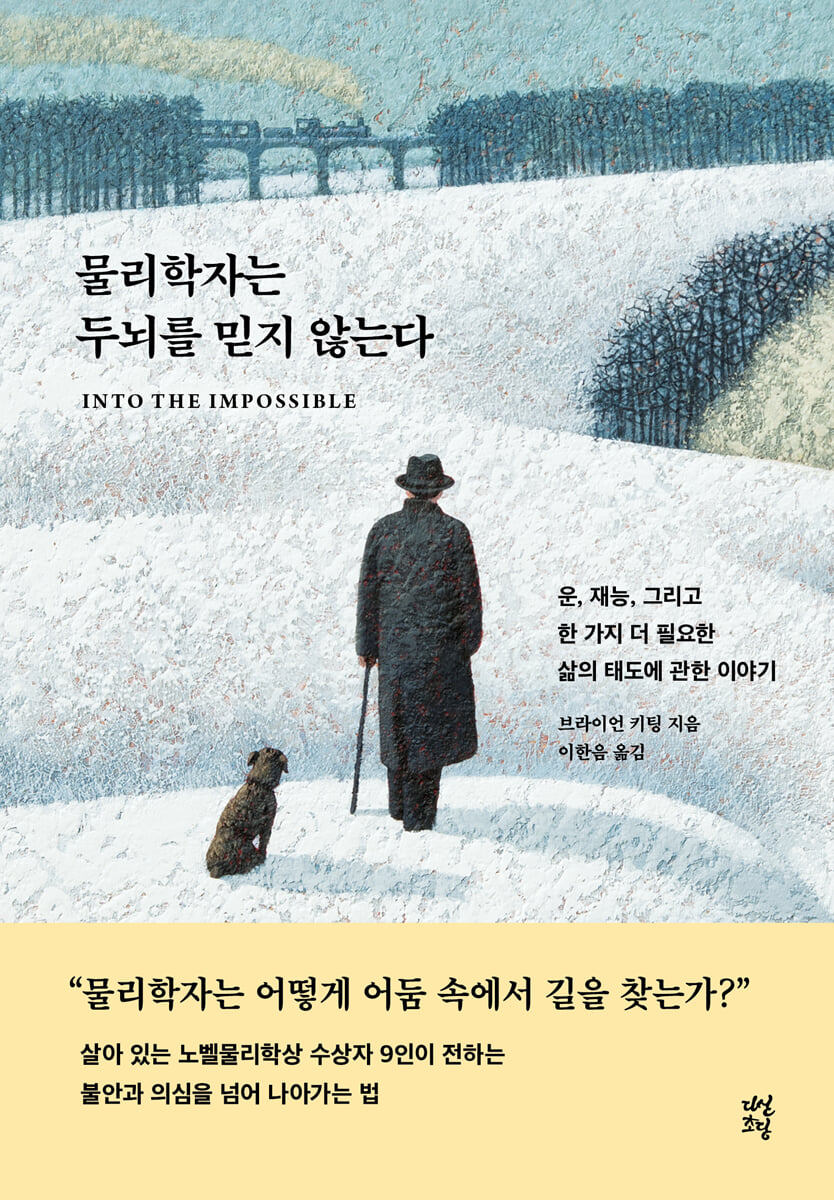
Physicists don't trust the brain
 |
Description
Book Introduction
Nine Living Nobel Laureates in Physics Share Their Wisdom for Navigating Uncertainty
“How do physicists find their way in the dark?”
Facing an impossible problem is like facing my own ignorance, so it cannot help but be painful.
The people you'll meet in this book are people who have made a living out of 'being stupid'.
Because I know the joy of pushing the limits little by little after digging deep into something, just as much as the pain of confronting questions.
They peel away prejudices, dismantle questions, collaborate with enemies, employ unthinkable means, and sometimes simply endure and endure to find a single clue.
By following the struggles of physicists, we can discover excitement and wonder instead of fear in our lives, where we cannot see even an inch ahead.
“How do physicists find their way in the dark?”
Facing an impossible problem is like facing my own ignorance, so it cannot help but be painful.
The people you'll meet in this book are people who have made a living out of 'being stupid'.
Because I know the joy of pushing the limits little by little after digging deep into something, just as much as the pain of confronting questions.
They peel away prejudices, dismantle questions, collaborate with enemies, employ unthinkable means, and sometimes simply endure and endure to find a single clue.
By following the struggles of physicists, we can discover excitement and wonder instead of fear in our lives, where we cannot see even an inch ahead.
- You can preview some of the book's contents.
Preview
index
Prologue_ Physicists Who Measure People
Chapter 1: The Skeptic Who Gazes the Stars
If you're not curious about the answer, find something else to do.
A meaningful question is one that the other person cannot easily answer.
I am fooled much more easily than I thought.
There's a clue in the critic's words.
How not to be afraid
Chapter 2: Achieving Acceptable Failure
There is no hidden royal road, only continuous attempt.
The goal of every experiment is not success, but learning.
Social skills are the essence of competence.
If you don't communicate, you're just a weirdo.
How to win until the end
Follow my fun
Chapter 3: Useless Science is the Most Elegant
There is no reason why I should take that honor.
imagination that takes time
The power of 'garbage time'
I teach because I'm happy
How to Use the Tool of Beauty
There are things in the world that are important in and of themselves.
How to Use the Tool of Beauty
Chapter 4: Teaching is Influence
Just because it's been done that way doesn't mean it's right.
The misunderstanding caused by the 10,000-hour rule
Innovation comes from sophisticated imitation.
In that moment of confusion, the brain is working.
What is true heritage?
Chapter 5: Do with what you have
Perfection is the enemy of excellence.
When you work with someone who has different opinions, you both become stronger.
We are not algorithms
There are breakthroughs that are only visible when viewed from a different angle.
Past glory is past.
Chapter 6 I Don't Know What I'm Doing
There are pictures that can only be seen when you keep your distance.
To combine, first split
Leave room for accidental discoveries.
Chapter 7: Humility Makes a Better Physicist
If you imagine the answer first, you will see the starting point.
Having different opinions doesn't mean anyone is wrong.
Neither failure nor success is life itself.
Choose a good question
Remember I don't know everything.
Don't underestimate someone just because you don't believe in them.
Every moment has its own meaning
Chapter 8: Question the Highest Authority
How to push the limits little by little
Anything can go wrong
Don't get hurt, build evidence
What I can't do, someone else will.
You don't have to see the big picture
It just bends when the wind blows
The ultimate goal is not to win once now.
Chapter 9: Science is also a human affair
Comfort is dangerous
In the face of frustration, the only thing to do is move forward.
Teach an old dog new tricks
Some things are unknown, some things are just not yet known.
What's lacking may not be the tools
Safe choices only yield predictable results.
Systems that understand people lead to innovation.
Go beyond the limits you set for yourself
Epilogue_ Luck, Talent, and One More Thing
Chapter 1: The Skeptic Who Gazes the Stars
If you're not curious about the answer, find something else to do.
A meaningful question is one that the other person cannot easily answer.
I am fooled much more easily than I thought.
There's a clue in the critic's words.
How not to be afraid
Chapter 2: Achieving Acceptable Failure
There is no hidden royal road, only continuous attempt.
The goal of every experiment is not success, but learning.
Social skills are the essence of competence.
If you don't communicate, you're just a weirdo.
How to win until the end
Follow my fun
Chapter 3: Useless Science is the Most Elegant
There is no reason why I should take that honor.
imagination that takes time
The power of 'garbage time'
I teach because I'm happy
How to Use the Tool of Beauty
There are things in the world that are important in and of themselves.
How to Use the Tool of Beauty
Chapter 4: Teaching is Influence
Just because it's been done that way doesn't mean it's right.
The misunderstanding caused by the 10,000-hour rule
Innovation comes from sophisticated imitation.
In that moment of confusion, the brain is working.
What is true heritage?
Chapter 5: Do with what you have
Perfection is the enemy of excellence.
When you work with someone who has different opinions, you both become stronger.
We are not algorithms
There are breakthroughs that are only visible when viewed from a different angle.
Past glory is past.
Chapter 6 I Don't Know What I'm Doing
There are pictures that can only be seen when you keep your distance.
To combine, first split
Leave room for accidental discoveries.
Chapter 7: Humility Makes a Better Physicist
If you imagine the answer first, you will see the starting point.
Having different opinions doesn't mean anyone is wrong.
Neither failure nor success is life itself.
Choose a good question
Remember I don't know everything.
Don't underestimate someone just because you don't believe in them.
Every moment has its own meaning
Chapter 8: Question the Highest Authority
How to push the limits little by little
Anything can go wrong
Don't get hurt, build evidence
What I can't do, someone else will.
You don't have to see the big picture
It just bends when the wind blows
The ultimate goal is not to win once now.
Chapter 9: Science is also a human affair
Comfort is dangerous
In the face of frustration, the only thing to do is move forward.
Teach an old dog new tricks
Some things are unknown, some things are just not yet known.
What's lacking may not be the tools
Safe choices only yield predictable results.
Systems that understand people lead to innovation.
Go beyond the limits you set for yourself
Epilogue_ Luck, Talent, and One More Thing
Detailed image

Into the book
This book is packed with examples of resilience, perseverance, and courage, distilling the wisdom of the world's leading physicists over many years into a concise, applicable resource for ourselves.
You'll learn how to deconstruct the most vexing issues in your life, how to identify and weave together the common threads that connect disparate aspects of your life or career, and how to understand the meaning of the conflicts you sometimes encounter when working with your collaborators.
And you will learn not only to be satisfied with your own past achievements, but also to invest in the future by teaching the next generation in your field.
You will also learn the virtue of patience, the many parallels between science and art, and the value of working for the sake of doing something, not for the sake of praise or attention.
And that's not all.
When you look at new problems with fresh eyes, you will be heartbreakingly struck by the curiosity, beauty, and coincidence that seep into unexpected cracks and bring joy to your life.
---From "The Physicist Who Measures People"
When the direction and method itself are wrong, how can we recognize this fact while still being in it and discover the root of the problem? The answer is to listen to the critics.
It's the same no matter what you do.
Working means communicating with the outside world, which means being exposed to criticism.
We must not allow praise to overwhelm reason, nor must we allow criticism to overwhelm emotion.
Because we are human, there will be flaws in what we do and obstacles will appear on the path we seek to take.
But as author Ryan Holiday points out, obstacles often show the way.
By facing obstacles, we finally realize where our goals lie.
---From "The Skeptic Who Gazes the Stars"
“I only give up on an experiment when I can clearly understand why it is not working.
Knowing that will make it easier to recognize when the technology to overcome the limitations of that experiment is developed.”
Liner continued the experiment that his superior had abandoned as a failure, driven by his own curiosity.
And that not only became the starting point for my doctorate, but also led to a lifelong pursuit.
When faced with failure, if you put aside the feeling of defeat and look at the situation calmly, you will find that there is a lot of sparkle mixed in among the debris.
And if you learned something from it, can you call it a failure?
---From "Achieve Acceptable Failure"
The pursuit of beauty is also just one direction and tool for finding answers.
It is wonderful to discover and cultivate simplicity and elegance in our work and daily lives.
But reality doesn't always live up to those values.
Sometimes we just can't find that simple answer.
At that time, you can just enjoy that vague and enigmatic aspect of the world.
---From "Useless Science is the Most Elegant"
The phrase "useless science" is a common phrase Sheldon uses to describe so-called basic research that might not immediately improve the call quality on your smartphone, but might unlock the secrets of the universe.
That is why physics, and indeed basic science as a whole, is so important not only to our technology but also to our culture.
As with quantum mechanics, it is difficult to initially predict what impact the research results of basic science will have on our lives.
But in itself it already tells us about the wonders of nature.
That alone was enough for Sheldon.
Of course, it is also true that most technological breakthroughs, from mechanical engineering to electronics and computers, have stemmed from achievements in basic science.
The basic research that led to these developments was once all 'useless'.
Who can say that Sheldon's research on electroweak theory won't one day be applied to develop some kind of technology? Even if it doesn't prove useful, understanding the majesty and power of how nature operates is a profoundly important achievement for humanity.
Ironically, the most important ideas in all human civilization often seem at first to be completely useless.
---From "Useless Science is the Most Elegant"
“Cognitive psychologists’ brain activity studies show that if you endure, endure, and endure again, a sudden leap forward doesn’t happen.
As it develops, develops, and develops again, at some point, the pattern suddenly becomes clear.
Our brain continues to process things until it finally reaches a point where the door opens.
But it doesn't reveal itself until you reach that door.
All those overwhelming worries were preparing and wiring my brain to go in the right direction.
Then we complete the final loop.”
---From "Teaching is Influence"
In every field, we all stand on the shoulders of giants, providing a platform for future generations.
We don't know who our research will lead to and how it will lead us years from now.
Therefore, at the time of presentation, the importance of one's own research cannot be properly understood.
Duncan's story reminds us of the importance of persevering and dedicating ourselves to research even in the face of such ambiguity.
Someone can pick up the thread that is woven like that and continue it into the future.
By doing so, you can believe that each and every single thread is of utmost importance.
Even if you don't know yet what will happen if you continue to weave that thread.
In the end, everyone is just part of the big picture.
If it's something I'm curious about and can find meaning in, I'll just do what I want to do, without any compulsion to see it through to the end or any hope of seeing a conclusion in my lifetime.
And as you have received it, leave the rest to future generations.
---From "I Don't Know What I'm Doing Now"
But ultimately, there is no complete victory in science.
You can win awards, but you can never surpass nature.
Life goes on, and science is infinite, whether you win a prize or not.
For some, this in itself is a powerful motivator to keep working, and it is also a symbol of curiosity and unwavering passion.
We must be conscious of what moves us, whether it will consume us or keep us going.
---From "Humility Makes a Better Physicist"
Even when believing in the megaliths called the orthodoxy, the key is to leave gaps large enough for a little light to seep in.
It takes a lot of force and time to knock down a megalith, so a small gap is not at all dangerous.
Conversely, if we are very careful not to let light into any gaps and do not leave any room for alternatives, we will also block the possibility of growth or change.
---From "Doubt the Highest Authority"
We must also not lose sight of the meaning of what we do every day and how it contributes to the symphony of life.
Only when each musician plays together in a symphony orchestra do we understand the true purpose of the work.
---From "Doubt the Highest Authority"
There are things that are incredibly fascinating, yet impossible, like entering the event horizon of a black hole and surviving to tell us what you saw.
But there are things that seem impossible but are actually just technical challenges.
---From "Science is also a human affair"
Their humble and simple attitude tells us the truth that when you cultivate your mind and give it your all, you will not be swayed by anything else.
We cannot imitate their luck or talent.
But the attitude and philosophy that allowed that talent to shine and opened up opportunities can be imitated.
You'll learn how to deconstruct the most vexing issues in your life, how to identify and weave together the common threads that connect disparate aspects of your life or career, and how to understand the meaning of the conflicts you sometimes encounter when working with your collaborators.
And you will learn not only to be satisfied with your own past achievements, but also to invest in the future by teaching the next generation in your field.
You will also learn the virtue of patience, the many parallels between science and art, and the value of working for the sake of doing something, not for the sake of praise or attention.
And that's not all.
When you look at new problems with fresh eyes, you will be heartbreakingly struck by the curiosity, beauty, and coincidence that seep into unexpected cracks and bring joy to your life.
---From "The Physicist Who Measures People"
When the direction and method itself are wrong, how can we recognize this fact while still being in it and discover the root of the problem? The answer is to listen to the critics.
It's the same no matter what you do.
Working means communicating with the outside world, which means being exposed to criticism.
We must not allow praise to overwhelm reason, nor must we allow criticism to overwhelm emotion.
Because we are human, there will be flaws in what we do and obstacles will appear on the path we seek to take.
But as author Ryan Holiday points out, obstacles often show the way.
By facing obstacles, we finally realize where our goals lie.
---From "The Skeptic Who Gazes the Stars"
“I only give up on an experiment when I can clearly understand why it is not working.
Knowing that will make it easier to recognize when the technology to overcome the limitations of that experiment is developed.”
Liner continued the experiment that his superior had abandoned as a failure, driven by his own curiosity.
And that not only became the starting point for my doctorate, but also led to a lifelong pursuit.
When faced with failure, if you put aside the feeling of defeat and look at the situation calmly, you will find that there is a lot of sparkle mixed in among the debris.
And if you learned something from it, can you call it a failure?
---From "Achieve Acceptable Failure"
The pursuit of beauty is also just one direction and tool for finding answers.
It is wonderful to discover and cultivate simplicity and elegance in our work and daily lives.
But reality doesn't always live up to those values.
Sometimes we just can't find that simple answer.
At that time, you can just enjoy that vague and enigmatic aspect of the world.
---From "Useless Science is the Most Elegant"
The phrase "useless science" is a common phrase Sheldon uses to describe so-called basic research that might not immediately improve the call quality on your smartphone, but might unlock the secrets of the universe.
That is why physics, and indeed basic science as a whole, is so important not only to our technology but also to our culture.
As with quantum mechanics, it is difficult to initially predict what impact the research results of basic science will have on our lives.
But in itself it already tells us about the wonders of nature.
That alone was enough for Sheldon.
Of course, it is also true that most technological breakthroughs, from mechanical engineering to electronics and computers, have stemmed from achievements in basic science.
The basic research that led to these developments was once all 'useless'.
Who can say that Sheldon's research on electroweak theory won't one day be applied to develop some kind of technology? Even if it doesn't prove useful, understanding the majesty and power of how nature operates is a profoundly important achievement for humanity.
Ironically, the most important ideas in all human civilization often seem at first to be completely useless.
---From "Useless Science is the Most Elegant"
“Cognitive psychologists’ brain activity studies show that if you endure, endure, and endure again, a sudden leap forward doesn’t happen.
As it develops, develops, and develops again, at some point, the pattern suddenly becomes clear.
Our brain continues to process things until it finally reaches a point where the door opens.
But it doesn't reveal itself until you reach that door.
All those overwhelming worries were preparing and wiring my brain to go in the right direction.
Then we complete the final loop.”
---From "Teaching is Influence"
In every field, we all stand on the shoulders of giants, providing a platform for future generations.
We don't know who our research will lead to and how it will lead us years from now.
Therefore, at the time of presentation, the importance of one's own research cannot be properly understood.
Duncan's story reminds us of the importance of persevering and dedicating ourselves to research even in the face of such ambiguity.
Someone can pick up the thread that is woven like that and continue it into the future.
By doing so, you can believe that each and every single thread is of utmost importance.
Even if you don't know yet what will happen if you continue to weave that thread.
In the end, everyone is just part of the big picture.
If it's something I'm curious about and can find meaning in, I'll just do what I want to do, without any compulsion to see it through to the end or any hope of seeing a conclusion in my lifetime.
And as you have received it, leave the rest to future generations.
---From "I Don't Know What I'm Doing Now"
But ultimately, there is no complete victory in science.
You can win awards, but you can never surpass nature.
Life goes on, and science is infinite, whether you win a prize or not.
For some, this in itself is a powerful motivator to keep working, and it is also a symbol of curiosity and unwavering passion.
We must be conscious of what moves us, whether it will consume us or keep us going.
---From "Humility Makes a Better Physicist"
Even when believing in the megaliths called the orthodoxy, the key is to leave gaps large enough for a little light to seep in.
It takes a lot of force and time to knock down a megalith, so a small gap is not at all dangerous.
Conversely, if we are very careful not to let light into any gaps and do not leave any room for alternatives, we will also block the possibility of growth or change.
---From "Doubt the Highest Authority"
We must also not lose sight of the meaning of what we do every day and how it contributes to the symphony of life.
Only when each musician plays together in a symphony orchestra do we understand the true purpose of the work.
---From "Doubt the Highest Authority"
There are things that are incredibly fascinating, yet impossible, like entering the event horizon of a black hole and surviving to tell us what you saw.
But there are things that seem impossible but are actually just technical challenges.
---From "Science is also a human affair"
Their humble and simple attitude tells us the truth that when you cultivate your mind and give it your all, you will not be swayed by anything else.
We cannot imitate their luck or talent.
But the attitude and philosophy that allowed that talent to shine and opened up opportunities can be imitated.
---From "Luck, Talent, and One More Thing"
Publisher's Review
* Highly recommended by physicist Kim Beom-jun
* Highly recommended by 2017 Nobel Prize in Physics winner Barry Barish
* Life wisdom from scientists, shared by the recipients of the Presidential Award for Young Scientists
Life attitudes from modern philosophers and physicists
Many people flip through countless books, wondering how to live and what is a better way to live.
But the answer you're looking for may lie in an unexpected direction.
In the past, mankind tried to solve the worries and questions of life through religious figures and philosophers.
But now it's different.
What is the origin of the universe? How does time flow? How did life begin? Modern physicists are seeking answers to these grand questions, permeated by natural evidence, that have plagued humanity throughout history. One by one, clues to answers once thought to be known only to God are being discovered.
This is why physicists are sometimes called modern philosophers.
But this book doesn't talk about that great science.
It speaks of an attitude towards life that moves towards questions that seem impossible.
To uncover the secrets of the vast universe, genius and luck were not enough.
What fueled physicists' dedication and perseverance, and what did they ultimately discover? In "Physicists Don't Trust Their Brains," author Brian Keating distills the insights of nine Nobel Prize winners in physics into conversations, aiming to impart insight and courage that can be crucial to any life.
Nine Nobel Prize winners in Physics speak
Two conditions for a meaningful life in and of itself
The lives and fields of study of those featured in this book are quite different.
There are two things they all have in common.
It's curiosity, and uselessness.
In particular, the importance of curiosity is repeatedly emphasized.
When you are driven by curiosity rather than external rewards, the research process becomes a reward in itself, and even failure becomes knowledge.
It goes without saying that people driven by curiosity are more likely to uncover sharper and more important questions and discover new breakthroughs.
Just looking at their lives, you can see that curiosity was at the root of it all.
Even after receiving the Nobel Prize in Physics, they continued their research as before.
Whether or not I won the award, there were still countless questions I was curious about.
'Uselessness' is an essential value for following curiosity more fundamentally.
Can innovation occur when we evaluate usefulness through today's lens and conduct research accordingly? Many of the discoveries that have become central to modern civilization were never imagined at the time of their creation.
So the world's greatest physicists cry out:
Follow the compass of curiosity.
Don't be limited by your current usefulness and value.
That we should be given more opportunities to fail.
But that doesn't mean you should study physics for future new technologies.
Isn't discovering new truths about the world itself a beautiful and valuable experience? Their stories reveal the unique power of a life true to its essence.
I don't know what I'm doing now.
What scares us most? The fact that we can't even see into the future.
But scientists face the unknown world with a different perspective.
Nobel laureate in physics John Mather said:
“There is probably nothing that would make scientists happier than to discover that we were all wrong.” For physicists, learning something new about the world is an absolute good, even if it means they themselves are wrong.
Living in the face of the infinity of the universe, they rarely emphasize their achievements even though they have achieved the highest honors in the scientific world.
He knows better than anyone that he has contributed only a single thread to the vast tapestry of science, and that its meaning is not yet even clear.
But the fact that there are so many unknowns in the world doesn't make the physicists in this book helpless; it's their core driving force.
Who knows how great a picture the single thread I'm weaving now might complete.
The world seen through their eyes is unknowable, wondrous, exciting, and full of possibility.
This book features paintings by Mark Edwards, a master of modern British surrealism, to help us more intuitively grasp the courage and wisdom unique to humans who take steps forward to see far ahead, even when they cannot see even an inch ahead.
Science is also something that happens between people.
This book is a conversation between physicist Brian Keating, who was once considered a candidate for the Nobel Prize in Physics but ultimately did not win, and nine living laureates.
In this conversation, he also discovered an unexpected side to these physicists.
They are people who are deeply immersed in their studies, but they are not loners who live in the corner of the room.
Even in physics, the days when someone could come up with a brilliant idea and innovation would happen on their own are over.
In modern physics, research must be funded by governments, conducted through early-stage institutions and transnational collaborations, and validated by the global scientific community.
What was crucial for the scientists who survived the process and ultimately brought about innovation was their ability to understand people.
Without the resilience to listen to rigorous peer review and instead find clues for improvement within it, and the social skills to communicate and collaborate effectively with colleagues, science would be impossible.
The physicists in this book are not people who originally had such a great temperament, but rather those who realized the need and worked hard through trial and error.
People say that modern society is an individualistic society, but now more than ever, we live in an era where nothing can be accomplished alone.
Even in a field where all those who deeply recognized that science is ultimately a matter of human interaction made a difference, they were all geniuses.
In today's Korean society, where everything is easily shaken to fit the framework of economic utility, their stories make us reconsider what it truly means to see far ahead and live faithfully to one's essence.
Their story broadened the geography of the universe and rewrote our common sense of physics.
The nine Nobel Prize winners in Physics you'll meet in this book are individuals who, through their research, changed the landscape of the universe and rewrote our common sense of physics.
Sheldon Glashow won the 1979 Nobel Prize in Physics for showing that the electromagnetic and weak nuclear forces were the same in the early universe.
Carl Wieman won the 2001 prize for discovering a fourth substance that had previously existed only as a hypothesis.
Frank Wilczek figured out why quarks cannot be split while he was a graduate student, and he finally won the prize in 2004, a full 31 years later.
NASA's John Mather led the COBE satellite project, which successfully observed the universe with great precision, and won the 2006 award.
Adam Riess won the prize in 2011 at the age of just 41 for discovering that the universe is not only expanding but also accelerating.
Duncan Haldane won the 2016 Nobel Prize in Physics for his theoretical discoveries of topological transitions and topological matter.
Barry Barish and Rainer Weiss were awarded the 2017 prize for their successful detection of gravitational waves.
Roger Penrose won the 2020 Nobel Prize in Physics, along with Stephen Hawking, for proving in 1964 that black holes are theoretically inevitable.
Instead of focusing on their research, this book contains the attitude toward life that led them to that research, as well as the enlightenment gained through countless failures and achievements.
* Highly recommended by 2017 Nobel Prize in Physics winner Barry Barish
* Life wisdom from scientists, shared by the recipients of the Presidential Award for Young Scientists
Life attitudes from modern philosophers and physicists
Many people flip through countless books, wondering how to live and what is a better way to live.
But the answer you're looking for may lie in an unexpected direction.
In the past, mankind tried to solve the worries and questions of life through religious figures and philosophers.
But now it's different.
What is the origin of the universe? How does time flow? How did life begin? Modern physicists are seeking answers to these grand questions, permeated by natural evidence, that have plagued humanity throughout history. One by one, clues to answers once thought to be known only to God are being discovered.
This is why physicists are sometimes called modern philosophers.
But this book doesn't talk about that great science.
It speaks of an attitude towards life that moves towards questions that seem impossible.
To uncover the secrets of the vast universe, genius and luck were not enough.
What fueled physicists' dedication and perseverance, and what did they ultimately discover? In "Physicists Don't Trust Their Brains," author Brian Keating distills the insights of nine Nobel Prize winners in physics into conversations, aiming to impart insight and courage that can be crucial to any life.
Nine Nobel Prize winners in Physics speak
Two conditions for a meaningful life in and of itself
The lives and fields of study of those featured in this book are quite different.
There are two things they all have in common.
It's curiosity, and uselessness.
In particular, the importance of curiosity is repeatedly emphasized.
When you are driven by curiosity rather than external rewards, the research process becomes a reward in itself, and even failure becomes knowledge.
It goes without saying that people driven by curiosity are more likely to uncover sharper and more important questions and discover new breakthroughs.
Just looking at their lives, you can see that curiosity was at the root of it all.
Even after receiving the Nobel Prize in Physics, they continued their research as before.
Whether or not I won the award, there were still countless questions I was curious about.
'Uselessness' is an essential value for following curiosity more fundamentally.
Can innovation occur when we evaluate usefulness through today's lens and conduct research accordingly? Many of the discoveries that have become central to modern civilization were never imagined at the time of their creation.
So the world's greatest physicists cry out:
Follow the compass of curiosity.
Don't be limited by your current usefulness and value.
That we should be given more opportunities to fail.
But that doesn't mean you should study physics for future new technologies.
Isn't discovering new truths about the world itself a beautiful and valuable experience? Their stories reveal the unique power of a life true to its essence.
I don't know what I'm doing now.
What scares us most? The fact that we can't even see into the future.
But scientists face the unknown world with a different perspective.
Nobel laureate in physics John Mather said:
“There is probably nothing that would make scientists happier than to discover that we were all wrong.” For physicists, learning something new about the world is an absolute good, even if it means they themselves are wrong.
Living in the face of the infinity of the universe, they rarely emphasize their achievements even though they have achieved the highest honors in the scientific world.
He knows better than anyone that he has contributed only a single thread to the vast tapestry of science, and that its meaning is not yet even clear.
But the fact that there are so many unknowns in the world doesn't make the physicists in this book helpless; it's their core driving force.
Who knows how great a picture the single thread I'm weaving now might complete.
The world seen through their eyes is unknowable, wondrous, exciting, and full of possibility.
This book features paintings by Mark Edwards, a master of modern British surrealism, to help us more intuitively grasp the courage and wisdom unique to humans who take steps forward to see far ahead, even when they cannot see even an inch ahead.
Science is also something that happens between people.
This book is a conversation between physicist Brian Keating, who was once considered a candidate for the Nobel Prize in Physics but ultimately did not win, and nine living laureates.
In this conversation, he also discovered an unexpected side to these physicists.
They are people who are deeply immersed in their studies, but they are not loners who live in the corner of the room.
Even in physics, the days when someone could come up with a brilliant idea and innovation would happen on their own are over.
In modern physics, research must be funded by governments, conducted through early-stage institutions and transnational collaborations, and validated by the global scientific community.
What was crucial for the scientists who survived the process and ultimately brought about innovation was their ability to understand people.
Without the resilience to listen to rigorous peer review and instead find clues for improvement within it, and the social skills to communicate and collaborate effectively with colleagues, science would be impossible.
The physicists in this book are not people who originally had such a great temperament, but rather those who realized the need and worked hard through trial and error.
People say that modern society is an individualistic society, but now more than ever, we live in an era where nothing can be accomplished alone.
Even in a field where all those who deeply recognized that science is ultimately a matter of human interaction made a difference, they were all geniuses.
In today's Korean society, where everything is easily shaken to fit the framework of economic utility, their stories make us reconsider what it truly means to see far ahead and live faithfully to one's essence.
Their story broadened the geography of the universe and rewrote our common sense of physics.
The nine Nobel Prize winners in Physics you'll meet in this book are individuals who, through their research, changed the landscape of the universe and rewrote our common sense of physics.
Sheldon Glashow won the 1979 Nobel Prize in Physics for showing that the electromagnetic and weak nuclear forces were the same in the early universe.
Carl Wieman won the 2001 prize for discovering a fourth substance that had previously existed only as a hypothesis.
Frank Wilczek figured out why quarks cannot be split while he was a graduate student, and he finally won the prize in 2004, a full 31 years later.
NASA's John Mather led the COBE satellite project, which successfully observed the universe with great precision, and won the 2006 award.
Adam Riess won the prize in 2011 at the age of just 41 for discovering that the universe is not only expanding but also accelerating.
Duncan Haldane won the 2016 Nobel Prize in Physics for his theoretical discoveries of topological transitions and topological matter.
Barry Barish and Rainer Weiss were awarded the 2017 prize for their successful detection of gravitational waves.
Roger Penrose won the 2020 Nobel Prize in Physics, along with Stephen Hawking, for proving in 1964 that black holes are theoretically inevitable.
Instead of focusing on their research, this book contains the attitude toward life that led them to that research, as well as the enlightenment gained through countless failures and achievements.
GOODS SPECIFICS
- Date of issue: April 22, 2024
- Format: Hardcover book binding method guide
- Page count, weight, size: 272 pages | 438g | 128*188*20mm
- ISBN13: 9791130652016
- ISBN10: 1130652017
You may also like
카테고리
korean


korean

![GQ KOREA Mark (Monthly): December [2025]](http://librairie.coreenne.fr/cdn/shop/files/8ef265dbbfbf186523ed75ba7319009d.jpg?v=1765340328&width=3840)


